10 Oscar Snubs From The 1960s


Ah, the 60s. Both the studio system and the production code collapsed as Hollywood struggled to remain relevant during a time of great social upheaval. The Academy alternated between nominating films that took chances and nominating films that cost a lot of money. It led to some odd best picture lineups and some notable snubs!

1960: Psycho Is Not Nominated For Best Picture and Anthony Perkins Is Not Nominated For Best Actor

To be honest, considering that the Academy has never really embraced horror as a genre and spent most of the 60s nominating big budget prestige pictures, it’s a bit surprising that Psycho was actually nominated for four Oscars.  Along with being nominated for its production design and its cinematography, Psycho also won nominations for Alfred Hitchcock and Janet Leigh.  However, Anthony Perkins was not nominated for Best Actor, despite giving one of the most memorable performances of all time.  The film literally would not work without Perkins’s performance and, considering that Perkins pretty much spent the rest of his career in the shadow of Norman Bates, it’s a shame that he didn’t at least get a nomination for his trouble.  Psycho was also not nominated for Best Picture, despite being better remembered and certainly more influential than most of the films that were.

1962: The Man Who Shot Liberty Valance Is Almost Totally Snubbed

The Man Who Shot Liberty Valance was not totally snubbed by the Academy.  It received a nomination for Best Costume Design.  But still, it deserved so much more!  John Ford, James Stewart, John Wayne, Lee Marvin, Vera Miles, and the picture itself were all worthy of nominations.  Admittedly, 1962 was a year full of great American films and there was a lot of competition when it came to the Oscars.  Still, The Man Who Shot Liberty Valance definitely deserved a best picture nomination over the bloated remake of Mutiny on the Bounty.  Today, if the first Mutiny on the Bounty remake is known for anything, it’s for Marlon Brando being difficult on the set.  But The Man Who Shot Liberty Valance is still remembered for telling us to always print the legend.
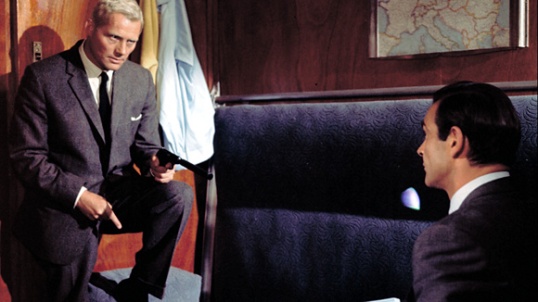
1964: From Russia With Love Is Totally Snubbed

The same year that the Academy honored George Cukor’s creaky adaptation of My Fair Lady, it totally ignored my favorite James Bond film.  From Russia With Love is a Bond film that works wonderfully as both a love story and a thriller.  Sean Connery, Lotte Lenya, Robert Shaw, and Terence Young all deserved some award consideration.  From Russia With Love was released in the UK in 1963.  In a perfect world, it would have also been released concurrently in the U.S., allowing From Russia With Love to be the film that gave the the Academy the chance to recognize the British invasion.  Instead, Tom Jones was named the Best Picture of 1963 and From Russia With Love had to wait until 1964 to premiere in the U.S.  It was snubbed in favor of one of old Hollywood’s last grasps at relevance.

1964: Slim Pickens Is Not Nominated For Best Supporting Actor

Playing three separate roles, Peter Sellers dominates Dr. Strangelove: Or How I Learned To Stop Worrying And Love The Bomb.  But, as good as Sellers is, the film’s most memorable image is definitely Slim Pickens whooping it up as he rides the bomb down to Earth.  George C. Scott and Sterling Hyaden also undoubtedly deserved some award consideration but, in the end, Pickens is the one who brings the film to life even as he helps to bring society to an end.

1967: In Cold Blood Is Not Nominated For Best Picture

In Cold Blood, though not a perfect film, certainly deserved a nomination over Dr. Doolittle.  In Cold Blood is a film that still has the power to disturb and haunt viewers today.  Dr. Doolittle was a box office debacle that was nominated in an attempt to help 20th Century Fox make back some of their money.

1967: Sidney Poitier Is Not Nominated For Best Actor For In The Heat Of The Night

In 1967, Sidney Poitier starred in two of the films that were nominated for Best Picture but somehow, he did not pick up a nomination himself.  His restrained but fiercely intelligent performance in In The Heat Of The Night provided a powerful contrast to Rod Steiger’s more blustery turn.  That Poitier was not nominated for his performance as Virgil Tibbs truly is one of the stranger snubs in Academy history.  (If I had to guess, I’d say that the Actors Branch was split on whether to honor him for In The Heat of the Night or Guess Who’s Coming To Dinner or even for To Sir With Love and, as a result, he ended up getting nominated for none of them.)

1968: 2001: A Space Odyssey and Planet of the Apes Are Not Nominated For Best Picture

Neither one of these classic science fiction films were nominated for Best Picture, despite the fact that both of them are far superior and far more influential than Oliver!, the film that won that year.

1968: The Good, The Bad, and the Ugly Is Totally Ignored

Not even Ennio Morricone’s score received a nomination!

1968: Petulia Is Totally Snubbed

Seriously, I don’t know what was going on with the Academy in 1968 but it seems they went out of their way to ignore the best films of the year.  Richard Lester’s Petulia is usually cited as one of the definitive films of the 60s but it received not a single Oscar nomination.  Not only did the film fail to receive a nomination for Best Picture but Richard Lester, George C. Scott, Julie Christie, Shirley Knight, Richard Chamberlain, and the film’s screenwriters were snubbed as well.

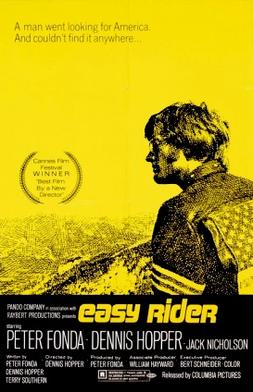
1969: Easy Rider Is Not Nominated For Best Picture

Yes, I know.  Easy Rider is a flawed film and there are certain moments that are just incredibly pretentious.  That said, Easy Rider defined an era and it also presented a portrait of everything that was and is good, bad, and timeless about America.  The film may have been produced, directed, and acted in a drug-razed haze but it’s also an important historical document and it was also a film whose success permanently changed Hollywood.  Certainly, Easy Rider’s legacy is superior to that of Hello, Dolly!

Agree? Disagree? Do you have an Oscar snub that you think is even worse than the 10 listed here? Let us know in the comments!

Up next: It’s the 70s!
Banjo Hackett: Roamin’ Free (1976, directed by Andrew V. McLaglen)


The great Don Meredith will always be remembered for a few things.

He’s remembered for being the first Dallas Cowboys quarterback, leading the team to multiple championship games but sadly never making it to the Super Bowl.  If you’ve seen North Dallas Forty, the quarterback played by Mac Davis was based on Meredith.  North Dallas Forty was based on a book by Phil Gent, a former Cowboys wide receiver.  When asked about the book and Gent’s portrayal of himself as being the best player on the team, Meredith reportedly said, “Hell, if I had known Phil was that good, I would have thrown him the ball more often.”

Don Mereidth was also one of the first players to make the jump from playing on the field to calling plays in the broadcast booth.  He was the good old boy who served as a foil to Howard Cosell and who sang “Turn out the lights, the party’s over” whenever it became obvious that one team was going to win the game.

He will also always be remembered for an incident in 1979 when, while covering a game in Denver, he supposedly said, “Welcome to Mile High Stadium — and I am!”  This is actually an urban legend.  Meredith never actually said he was high on national television but if a member of the original Monday Night Football Team was going to say that, it probably would have been Dandy Don.

Don Meredith is less remembered for his acting career but, like a lot of retired football players in the 70s, he tried his hand at performing.  As an actor, Don Meredith was a very good quarterback.  His performances were superior to Joe Namath’s but his range was undeniably limited.  Smart producers essentially had Don Meredith play himself, a laid back good old boy who liked his beer and enjoyed hanging out with his buddies.

Banjo Hackett was typical of Don Meredith’s films.  In this made-for-TV movie, Meredith plays the title character.  He’s the nicest horse trader in the old west but not even someone as laid back as Banjo Hackett is going to stand for someone stealing from him.  When he learns that his nephew, Jubal (Ike Eisenmann), has been put into an orphanage and that evil bounty hunter Sam Ivory (Chuck Conners) has stolen Jubal’s favorite horse, Banjo steps up to the huddle.  First, he engineers Jubal’s escape from the orphanage. Then he and his nephew track Sam across the frontier, determined to catch up with him before he sells Jubal’s horse.

Banjo Hackett was obviously meant to serve as a pilot for a television series.  The series never happened but Banjo Hackett itself is a likable film that will be best appreciated by western fans who are looking for something harmless to watch.  Don Meredith may not have been a versatile actor but he had a sincere screen presence and Chuck Conners was always an effective bad guy.  The cast is full of familiar western actors, including Slim Pickens, L.Q. Jones, and Jeff Corey.  As a movie, Banjo Hackett is as amiable as its lead character.

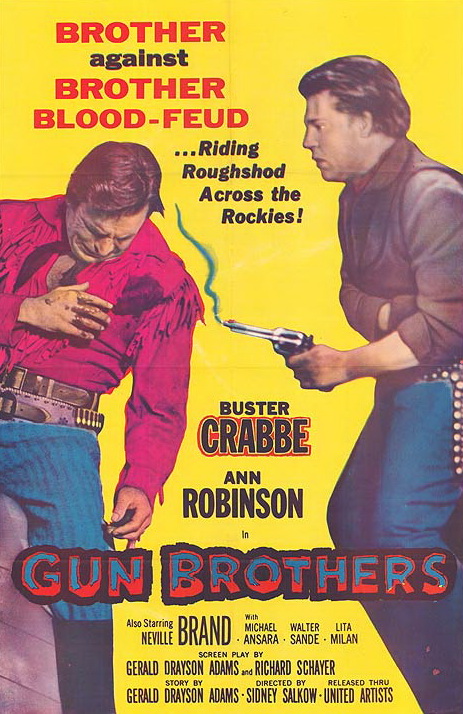
Gun Brothers (1956, directed by Sidney Salkow)


In this western, Buster Crabbe plays Chad Santee, a former Calvary officer who has traveled to Wyoming so he can visit his brother Jubal (Neville Brand) and see Jubal’s ranch.  Traveling by stagecoach, Chad meets and falls in love with a saloon singer named Rose Fargo (Ann Robinson).  When the stagecoach is held up by outlaws and one of them steals Rose’s broach, Chad decides to track the outlaws down.  What Chad doesn’t know is that Jubal is one of those outlaws.

Gun Brothers is an entertaining B-western.  There’s nothing surprising about the story but Buster Crabbe is a believable hero and Ann Robinson gets a chance to show off her saloon singing skills.  Neville Brand steals the film as Jubal.  Before going into acting, Brand was a highly decorated World War II combat officer and he brought his real-life toughness to every role that he played.  He could throw a punch and shoot a gun with an authority that few other actors could match.  Jubal, like Brand, has obviously seen and experienced things that his self-righteous brother will never be able to understand and, as a result, he’s not as tied down to the laws of society as everyone else.   Also turning in good performances are Michael Ansara as an outlaw and Lita Milan, as a Native American woman who is involved with the gang.

Not surprisingly, for a B-western, Gun Brothers is full of characters with names like Shawnee Jack, Yellowstone Kelly, Blackjack Silk, and Moose McClain.  It’s a simple movie but one that will be enjoyed by fans of old fashioned western action.

Tom Horn (1980, directed by William Wiard)


Today would have been Steve McQueen’s 90th birthday.

Sadly, McQueen died in 1980 at the absurdly young age of 50.  In life, McQueen never got as much respect as he deserved as an actor but in death, he’s been rediscovered as not just an icon of cool but also as an underrated actor who, much like Clint Eastwood, could say a lot without uttering a word.  (Be sure to read Marshall Terrill’s biography of McQueen.)  When Steve McQueen (as played by Damian Lewis) showed up in Once Upon A Time In Hollywood, it seemed appropriate.  McQueen and Tarantino both seem made for each other, even if McQueen died long before Tarantino even wrote his first screenplay.

McQueen made two films shortly before he died, The Hunter and Tom Horn. Unfortunately, neither one of them was a hit with audiences or critics.  The Hunter, which was McQueen’s last film, is a forgettable movie that features McQueen as a bounty hunter who can’t drive.  Tom Horn, however, was an underrated western that features one of McQueen’s best performances.

In Tom Horn, McQueen plays the title character, a legendary frontier scout who is known for the role he played in the capture of Geronimo.  When the film opens, Tom Horn has seen better days.  With the frontier changing and the old west being replaced by the modern age, Horn has been reduced to being almost a vagrant, wandering from town to town in search of work.  When the film begins, Horn has found employment as a “stock detective.”  He’s employed by the local cattlemen to keep rustlers from stealing their stock.  Horn uses the same violent methods that he’s always used, gunning down rustlers and often doing so in public.  What Horn doesn’t realize is that times have changed and the methods that previously made him a legend are now making him a pariah.  When the cattlemen realize that the townspeople are turning against them because of Horn’s activities, they conspire to take out Horn themselves.

Tom Horn is based on a true story.  In 1903, Tom Horn was hung for shooting a 15 year-old boy.  While it is agreed that Horn killed many men over the course of his life, he was undoubtedly framed for the murder for which he was executed.  While sitting in his jail cell, waiting to be executed, Horn wrote the autobiography upon which this movie is based.  The movie makes the argument that Horn was executed because he was a reminder of what the West used to be like.  In order to prove that they were now ready to be members of civilized society, the cattleman had to sacrifice Horn in the most public way possible.

The film does a good job of capturing the final days of the old west and Steve McQueen does an even better job of playing a man who doesn’t realize that his time has come to a close.  Horn often seems to be the only man who doesn’t understand that the time of outlaws and the gunslingers is coming to a close and that leaves him defenseless when he’s put on trial.  Even after found guilty, Horn remains confident that he will somehow escape the hangman’s noose.  Tragically, it’s not until time is up that Horn truly comes to understand that the world has changed and civilization no longer has place for men like him.  The same people who used to depend on men like Tom Horn now just want to forget that he ever existed.  McQueen took a long break between making The Towering Inferno and Tom Horn and dropped out of the public eye.  The only film he made during that period was a barely released version of Enemy of the People.  When McQueen made Tom Horn, he was also a man out of time and he brings a sense of resignation and loss to the role that he might not have been capable of doing earlier in his career.

Sadly, it was while filming Tom Horn that McQueen first started to show symptoms of the cancer that would eventually kill him.  Tom Horn was released in 1980 and never got the attention that it deserved.  It’s a minor western classic and features Steve McQueen at his best.


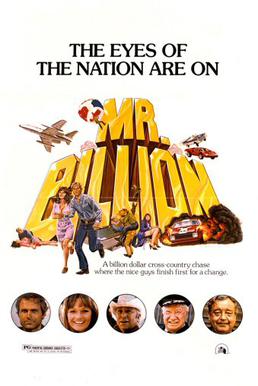
Lisa Reviews A Film That Was Not Nominated For Any Oscars: Mr. Billion (dir by Jonathan Kaplan)


The 1977 film Mr. Billion tells the story of Gudio Falcone (played by Terence Hill, whose real name is Mario Girotti).  Guido has got a pretty good life going in Italy.  Everyone in his village loves him.  He works as an auto mechanic.  When we first see him, he speeding around in a red sportscar.  When he returns to the garage, he smiles and says, in Italian, “Just like Steve McQueen.”  Guido may not be rich but he’s happy.

But that’s all about change!

Well, not the happy part.  Guido is pretty much always happy.  But he’s about to get rich.  It turns out that Guido is the last surviving relative of Antonio Falcone.  Years ago, Antonio immigrated to America and founded Falcon Motors.  The company eventually made Antonio one of the richest men in the world.  Unfortunately, the big Falcon Motors sign eventually fell off the company’s headquarters and it landed right on top of Antonio.

Everyone’s upset about Antonio’s death.  Well, everyone but the company’s vice president, John Cutler (Jackie Gleason).  John was naturally expecting that he would be named Antonio’s successor and that he would also inherit all of Antonio’s money.  Instead, Antonio’s will leaves everything to Guido!

Why?

Because, apparently, Guido never asked Antonio for anything more than a “pair of American cowboy boots.”

Cutler and his sleazy attorney (William Redfield) are soon on the next flight to Italy.  When they find Guido, they make sure to compliment him on his cowboy boots.  They explain to Guido that he has twenty days to go San Francisco and sign the proper papers.  If he’s any later than 20 days he’ll lose the money.  Of course, that shouldn’t be a problem since Guido can fly over anytime that he wants…

Except Guido refuses to fly!  No, he says that if he’s going to go to America, he’s going to arrive there the same way that Antonio did.  He is going to take a boat to New York City and then ride a train all the way to California.

Did you guess that the very next scene would be Guido standing on the dock of a cruise ship, staring at the Statue of Liberty?  And did you also also guess that, upon disembarking, he would immediately find himself besieged by reporters, one of whom declares him to now be the world’s most eligible bachelor?  If so, good work.

But here’s the big question.  Did you also predict that John Cutler would attempt to sabotage Guido’s trip to California and that the sabotage would involve hiring a private detective (Valerie Perrine)?  Even more importantly, did you predict that the detective would eventually end up falling in love with simple but honest Guido?

Because that’s totally what happens!

At the time that Mr. Billion was made, Terence Hill was a huge star in Europe but was barely known in the United States.  He was best known for appearing in a series of comedic Spaghetti Westerns with Bud Spencer, the majority of which featured Hill as a lazy but likable ne’er do well.  In Mr. Billion, Hill is cast as the exact opposite, as an earnest man-of-the-people who is so nice that it’s almost painful.  Add to that some major tone problems (the film cannot make up its mind if it wants to be a comedy, an action film, or a romance) and you have a pretty forgettable movie.

And that’s kind of a shame because Terence Hill showed some legitimate charm in the lead role.  The role may have been underwritten but all Hill had to do is flash that winning smile and it didn’t matter.  It’s unfortunate that Hill didn’t get a more appropriate vehicle for his American debut.

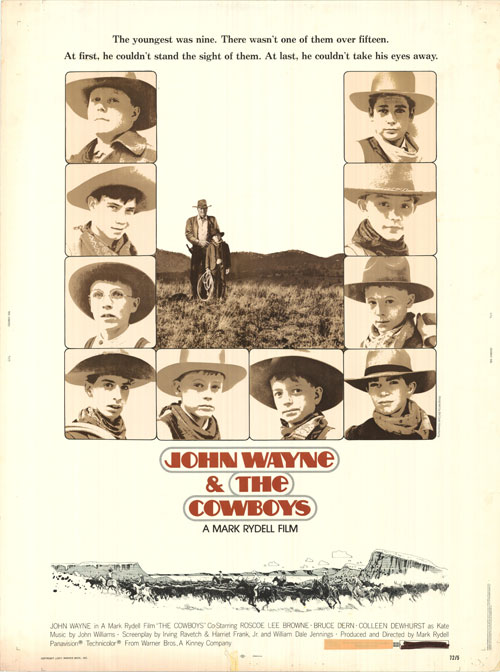
Young Frontier: John Wayne in THE COWBOYS (Warner Brothers 1972)


gary loggins's avatarcracked rear viewer

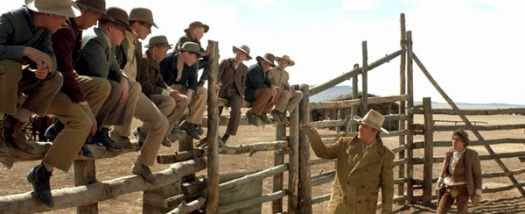
THE COWBOYS is not just another ‘John Wayne Movie’ from the latter part of his career. Not by a long shot. Duke had read the script and coveted the part of Wil Andersen, who’s forced to hire a bunch of wet behind the ears adolescents for a 400 mile cattle drive across the rugged Montana territory. Director Mark Rydell wanted George C. Scott for the role, but when John Wayne set his sights on something, he usually got what he wanted. The two men were at polar opposites of the political spectrum, and the Sanford Meisner-trained Rydell and Old Hollywood Wayne were expected to clash. They didn’t; putting their differences aside, they collaborated and cooperated  to make one of the best Westerns of the 70’s.

Andersen’s regular hands have all deserted him when gold is discovered nearby, leaving the aging rancher in the lurch. He heads for Boseman to look…

View original post 797 more words

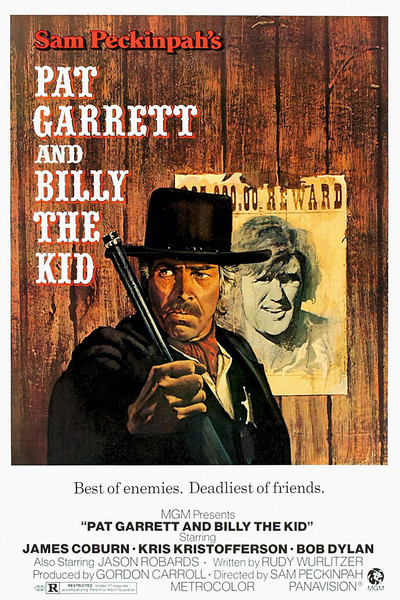
Knockin’ On Heaven’s Door: PAT GARRETT AND BILLY THE KID (MGM 1973)


gary loggins's avatarcracked rear viewer

(PAT GARRETT AND BILLY THE KID airs tonight at 11:45 EST on TCM. Do yourselves a favor… watch it!)

PAT GARRETT AND BILLY THE KID was director Sam Peckinpah’s final Western, and as usual it’s about more than just the Old West. It’s about the new breed vs the old establishment, about the maverick auteur vs the old studio guard, and about his never-ending battle to make his films his way. The fact that there are six, count ’em, SIX different editors credited tells you what MGM honcho James Aubrey thought of that idea! They butchered over 20 minutes out of the movie, which then proceeded to tank at the box office. Fortunately for us, PAT GARRETT AND BILLY THE KID has been restored to its full glory, and we can enjoy Peckinpah’s original artistic vision.

I’m not going to try to make excuses for Peckinpah; he was a legitimate pain in the ass, a…

View original post 616 more words

A Movie A Day #154: The Day They Hanged Kid Curry (1971, directed by Barry Shear)


Welcome to the Old West.  Hannibal Heyes (Pete Duel) and Kid Curry (Ben Murphy) are two of the most wanted outlaws in the country, two cousins who may have robbed trains but who also never shot anyone.  After being promised a pardon if they can stay out of trouble for a year, Heyes and Curry have been living under the names Joshua Smith and Thaddeus Jones.

During a trip to San Francisco to visit his old friend, a con artist named Silky O’Sullivan (Walter Brennan), Heyes is told that Kid Curry is currently on trial in Colorado.  When Heyes goes to the trial, he discovers that the accused (Robert Morse) is an imposter and that the real Kid Curry is watching the trial from the back of the courtroom.  It turns out that the man of trial is just an attention seeker , someone who is so desperate for fame that he is willing to be hanged to get it.  At first, Curry thinks this is a great thing.  After the imposter hangs, everyone will believe that Curry is dead and they’ll stop searching for him.  Heyes, however, disagrees, especially after the imposter starts to implicated Heyes in crimes that he didn’t commit.

Obviously inspired by Butch Cassidy and the Sundance Kid, Alias Smith and Jones was one of the last of the classic TV westerns.  Though I originally assumed that it was the show’s pilot, The Day They Hanged Kid Curry was actually the first episode of the second season.  With commercials, it ran 90 minutes.  Because of its extended running time, The Day They Hanged Kid Curry was not included in Alias Smith and Jones‘s standard rerun package.  Instead, it was edited to remove the show’s usual opening credits and it was then sold as a motion picture, despite the fact that it is very obviously a television show.

As long as no one is expecting anything more than an extended television episode, The Day They Hanged Kid Curry is okay.  I have never been a big Alias Smith and Jones fan but this episode’s plotline, with Robert Morse confessing to crimes he didn’t commit just so he can have a taste of fame before he dies, feels prescient of today’s culture.  For classic western fans, the main reason to watch will be the chance to see a parade of familiar faces: Slim Pickens, Henry Jones, Paul Fix, and Vaughn Taylor all have roles.  Most important is familiar Western character actor and four-time Oscar winner, Walter Brennan, as Silky O’Sullivan.  This was one of Brennan’s final performance and the wily old veteran never loses his dignity, even when he’s pretending to be Kid Curry’s grandmother.

As for Alias Smith and Jones, it was a modest success until Pete Duel shot himself halfway through the second season.  Rather than retire the character of Hannibal Heyes, the show’s producers replaced Pete Duel with another actor, Roger Davis.  One day after Duel’s suicide, Davis being fitted for costumes.  This move was not popular with the show’s fanbase and Alias Smith and Jones was canceled a year later, though it lived on for years in reruns.

A Movie A Day #56: The White Buffalo (1977, directed by J. Lee Thompson)


whitebuffalo1977The year is 1874 and James Otis (Charles Bronson) is traveling through the Dakota Territory.  Everywhere that James Otis goes, someone tries to shoot him.  This is because James Otis is actually the infamous Wild Bill Hickcock and everyone this side of Deadwood has a reason to want him dead.  Hickcock has returned to the territory because he is losing his eyesight and he fears that he may be dying.  Hickcock has been having nightmares about a giant albino buffalo and believes that it is his destiny to either kill it or be killed himself.
Meanwhile, a young indian chief (Will Sampson) is also seeking the White Buffalo.  The buffalo previously attacked his village and killed his son.  The chief must now get revenge or lose his power in the tribe.  He is now known as Worm.  Before the buffalo attack, his name was Crazy Horse.

Crazy Horse eventually teams up with Hickcock and a one-eyed hunter named Charlie Zane (Jack Warden).  They work out an uneasy alliance but who, of the three, will finally get the chance to kill the buffalo?

When Dino De Laurentiis produced The White Buffalo, he was hoping to combine the popularity of Jaws with the star power of Charles Bronson.  It should have been a hit but instead, The White Buffalo was one of the many flops that temporarily killed the western as a commercial genre.  (Before there was Heaven’s Gate, there was The White Buffalo.)  The reason why is obvious: while audiences loved to watch Bronson shoot muggers in New York, they were less willing to sit through a pseudo-intellectual western version of Moby Dick that featured more conversation than gunplay.  The obviously fake buffalo did not help matters.

I still like The White Buffalo, though.  Because of the movie’s cheap sets, fake snow, and some inconsistent rear projection work, The White Buffalo is sometimes so surreal that it could pass for a Spaghetti Western.  (When I saw Bronson, Sampson, and Warden huddled in a cardboard cave while it fake snowed outside, I immediately thought of Sergio Corbucci’s The Great Silence.)  Charles Bronson, always an underrated actor, gave one of his best performances as the haunted Hickcock.  The White Buffalo was, up until his small role in Sean Penn’s The Indian Runner, the last time that Bronson would allow himself to appear as anyone other than Charles Bronson on-screen.

When watching The White Buffalo, keep an eye out for several Hollywood veterans in minor roles.  Kim Novak plays a prostitute.  Stuart Whitman is a thief.  Slim Pickens drives a stagecoach.  Clint Walker’s an outlaw and Ed Lauter plays the younger brother of Gen. Custer.  The town’s undertaker is John Carradine.  The cameos don’t add up too much but it’s still good to see everyone.

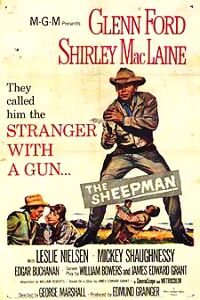
Surely, Leslie Nielsen can’t be the bad guy: The Sheepman (1958, directed by George Marshall)


Thesheepman At the start of The Sheepman, reformed gambler and gunslinger Jason Sweet (Glenn Ford) shows up in the middle of cattle country. He has won a herd of sheep in a poker game and he is planning on grazing them on the nearby public land. Knowing that he will face opposition from the local cattle ranchers, Jason asks the local towns people to direct him to the town bully. After Jason beats up Jumbo (Mickey Shaughnessy), Jason is invited to meet Jumbo’s boss, Col. Stephen Bedford (Leslie Nielsen).
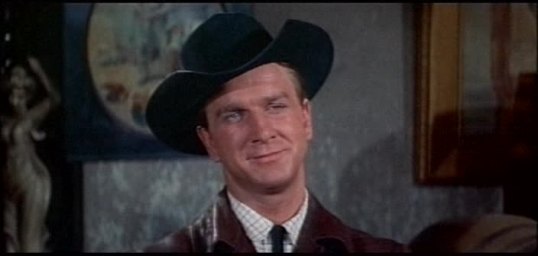
As soon as Jason meets Bedford, he realizes that he is not a colonel and his name is not Bedford. Instead, he is an old friend from Texas, a former gambler and outlaw named Johnny Bledsoe. Like Jason, Bledsoe has also gone straight and is now the most powerful man in town. He is also engaged to marry a local girl named Dell Payton (Shirley MacClaine), to whom Jason has taken a liking.  Bledsoe tells Jason to take his sheep somewhere else and when Jason refuses, Bledsoe threatens to have him, Dell, and his sheep killed.

Wait a minute, Leslie Nielsen is playing a bad guy?

Surely, you can’t be serious!

I am serious. And don’t call me Shirley.

(Sorry, had to do it.)

Leslie Nielsen is best remembered for being the deadpan comedian who could deliver the most ridiculous of lines with a totally straight face and who helped to make Airplane one of the funniest movies ever made. But before Nielsen recreated himself as a comedic actor, he was a dependably stiff supporting player and occasional leading man who appeared in nearly 100 dramatic pictures. The Sheepman is one of his “serious” roles.

Today, it is always strange to see one of Nielsen’s dramatic performances. Johnny Bledsoe is a standard western villain and Nielsen does okay with the role but, because his serious performances shared the same style as his comedic performances, it was impossible not to think of Dr. Rumack saying, “I just want to tell you both good luck. We’re all counting on you,” even while Johnny Bledsoe was offering to pay the outlaw Chocktaw (Pernell Roberts) to track down and kill Jason and his sheep.

The Sheepman is an average western and, as always, Glenn Ford is a good hero. But ultimately, the most interesting thing about it and the main reason to see it is to witness Leslie Nielsen doing his thing before he officially became the funniest man in the world.  Leslie Nielsen was not a terrible dramatic actor but watching The Sheepman made me all the happier that he eventually got to show the world his true calling.

Leslie Nielsen in The Sheepman (1958)