Before I forget, The Independent Spirit Award Nominations were announced earlier today! In a year that has yet to see a Spotlight, a Mad Max, or even a Big Short, the Oscar race remains undeniably murky. Maybe the Spirit nominations will help to clarify things.
(Sad to say but I haven’t seen most of the films that were nominated. They’ve either just opened down here in Dallas or they’ll be opening next month. So, you’ll have to forgive me if I can’t provide much commentary beyond saying that I look forward to seeing and reviewing them all for myself!)
(I will say, however, that I’m happy to see that American Honey was nominated because, even though I missed seeing the film, it’s directed Andrea Arnold. Arnold’s previous film, Fish Tank, is pretty much one of my essential movies.)
BEST ACTOR Casey Affleck, “Manchester by the Sea”
David Harewood, “Free In Deed”
Viggo Mortensen, “Captain Fantastic”
Jesse Plemons, “Other People”
Tim Roth, “Chronic”
BEST ACTRESS Annette Bening, “20th Century Women”
Isabelle Huppert, “Elle” Sasha Lane, “American Honey”
Ruth Negga, “Loving”
Natalie Portman, “Jackie”
BEST DOCUMENTARY “13th”
“Cameraperson”
“I Am Not Your Negro”
“O.J.: Made in America”
“Sonita”
“Under the Sun”
BEST INTERNATIONAL PICTURE “Aquarius” (Brazil)
“Chevalier” (Greece)
“My Golden Days” (France)
“Toni Erdmann” (Germany and Romania)
“Under the Shadow” (Iran and U.K.)
BEST FIRST FEATURE “The Childhood of a Leader”
“The Fits”
“Other People”
“Swiss Army Man” “The Witch”
BEST FIRST SCREENPLAY “Barry”
“Christine”
“Jean of the Joneses”
“Other People” “The Witch”
JOHN CASSAVETES AWARD (best feature made for under $500,000)
“Free In Deed”
“Hunter Gatherer”
“Lovesong”
“Nakom”
“Spa Night”
I will be the first to admit that it feels strange to admit that I’m actually looking forward to a movie featuring Shia LaBeouf.
(You ever notice how I always say stuff like that, despite the fact that Lawless wasn’t terrible and I enjoyed Fury about as much as I can enjoy any movie about war. Despite the fact that he’s actually appeared in a lot of decent films, I will always think of Shia as being the whiny kid from The Battle of Shaker Heights. That is the revolting power of Shia LaBeouf…)
However, I am very much looking forward to American Honey!
And you know why?
Because it’s the latest film from Andrea Arnold, who previously directed the absolutely exquisite Fish Tank. Fish Tank is one of those films that I watch and I just see myself, who I’ve been and who I could have become. It’s an amazing film.
I’ll try and keep this short, unlike the movie, which if you watch the director’s cut as I did, comes out to about five and a half hours. Once you’ve sat through something like Jacques Rivette’s Out 1 (1971), which comes out to a little over twelve hours, this isn’t much. Also, despite what I’m going to say about it, it’s problems don’t come from it’s length. A lot of movies damage themselves by going past two hours, but not this one. The length really wasn’t an issue for me.
I’m also not going to pick out all the little stupid things like you see me do with Hallmark movies. Yes, Stellan Skarsgard says the Christian church split up in 1054 into Roman Catholic and Orthodox, but it actually fractured a long time before that break. Or the onscreen text, which you would expect in a Godard film. Especially when Skarsgard brings up Fibonacci numbers. That probably only ticked me off because I went through about nine years of college level computer science and really don’t want to hear about Fibonacci numbers ever again. Also, there’s a scene where she makes one attempt to have sex with black guys. It kind of reminded me of that “documentary” from the early 1970’s called Black Love. It’s there to mention that men are homophobic, but she is implicitly homophobic since sex with a woman is never brought up in this sex addict film. Von Trier also whips out the Two Kinds Of People In The World cliche, but it only makes sense if everyone is right handed. Well, let’s talk about the movie.
First, if you’re a fan of Lars Von Trier, then it’s a no brainer. This movie is for you. Don’t hesitate to watch it. If you are like me and love Breaking The Waves (1996), then this has similar material, but it’s not even remotely as moving. If you were offended by Dogville (2003) like I was, then don’t worry, this isn’t offensive stuff. It’s just boring.
The movie is about a girl named Joe (Charlotte Gainsbourg) who recounts her life as a self proclaimed nymphomaniac to Seligman (Stellan Skarsgad). The movie cuts back and forth between the actual story and then Seligman’s thoughts on it. Kind of like sitting in on a therapy session if it were being conducted by college students in a debate class. And that’s where this film’s biggest issue is for me. A lot of the analysis feels pedestrian or the kind of thing you would expect in a college paper written by a student who hopes the teacher will be impressed. And at times its almost like argument for arguments sake. Like when you’re in a class and a topic is tossed out for discussion. The topic may actually be rather simple, but people keep trying to throw things in to pad out the conversation to fill the class time. A lot of the dialogue feels like that sort of thing.
The story begins when she is a little girl and takes us up to the events that led Seligman to find her in the alley outside of his place at the beginning of the film. Her father is played by Christian Slater who I think does a good job. His British accent may be a problem for you, but it wasn’t for me. Neither was it a problem for me with Shia LaBeouf’s character who is a male presence in Joe’s life pretty much throughout the film. The accent was a problem for me with Uma Thurman’s character though.
There’s a point where Joe just starts referring to the men in her life by letters. She casually tosses them around. During one of these scenes, Uma Thurman shows up as the wife of one of the guys who’s there with Joe along with their kids in tow. The scene is supposed to start a little funny, then get really uncomfortable as it keeps going. Like when Thurman asks if she can show her kids the “whoring bed”. The problem for me was the accent. If they had just let her speak normally, then it would have worked, but it was a voice that at this point in her career is obviously not her’s and I can’t suspend disbelief. So the scene was just hilarious to me. Especially when she actually screams. That made me think of Julianne Moore in Map To The Stars (2014), which also had me laughing.
This film has been dismissed as porn or on the flip side, played up for showing so much. People especially like to mention that the sex is unsimulated. Well, it really doesn’t count in my book if that isn’t Shia LeBeouf’s penis, which it isn’t. They use CGI to graft porn actors genitalia onto some of the actors. So it’s not anything to brag about. Is it porn? Far from it. Anybody who tells you that has no idea what they are talking about. It probably comes closest to an exploitation movie at best in that department.
I said I wouldn’t pick out little flaws, but there’s a big one I have with the title and her consistently referring to herself as either a nymphomaniac or being addicted to sex. She’s not really addicted to sex. She’s addicted to sex like someone who only smokes Marlboro is addicted to cigarettes, but won’t smoke any other brand. She’s like that. She’ll take penetration by a penis, give a blow job, and poorly dabbles in S&M. That’s really it. She’s rather discriminating about what she’ll do. Another analogy is like when someone says they’re a cinephile, but that means to them that they love watching highly acclaimed foreign films. An addiction to something broad like movies or sex means you’re indiscriminate. However, I get why Von Trier sticks with the term nymphomaniac because the movie does have a reason to make sure the apparent love of sex and guilt about it is explicitly associated with a female character. The ending depends on it.
The only thing that was kind of noteworthy to me was how the way the movie is shot changes in the final part of the film. It’s divided into chapters and in the last one Von Trier either shot it to get film grain and over exposed lights or did it in post processing. I think it was probably a reference to a movement in film he was involved in back in the 1990’s called Dogme 95. You can watch something like Thomas Vinterberg’s The Celebration (1998) and it will look similar.
Honestly, it’s not a bad movie, but it’s really for people who like Von Trier stuff. If you like his stuff, see it. If you don’t, definitely skip it. If you’re totally new, then don’t start here. Begin with Breaking The Waves and Europa (1991) before wading into films like The Idiots (1998), Dancer In The Dark (2000), Dogville, and beyond.
2014 had it’s share of very good action films and here are four that I was particularly drawn to. While the film themselves were of varying degrees of quality in terms of storytelling. These 4 films all had one thing that I enjoyed despite their films’ flaws. They all had action scenes that I thought were quite excellent.
You have gritty present-day action thriller, an operatic gangster epic, a revenge thriller and a war film. One stars an aging action star back from playing politician. Another a foreign film whose filmmaker and star have set the bar for all action films for years to come. Then there’s the stunt coordinators and 2nd unit directors finally making their mark with their first feature-length film. Lastly, a war film that brings the brutality of World War II tank warfare to the forefront.
A few years ago, I was on twitter when I came across someone who had just watched The Breakfast Club.
“Whatever happened to Emilio Estevez?” she asked.
Being the know-it-all, obsessive film fan that I am, I tweeted back, “He’s a director.”
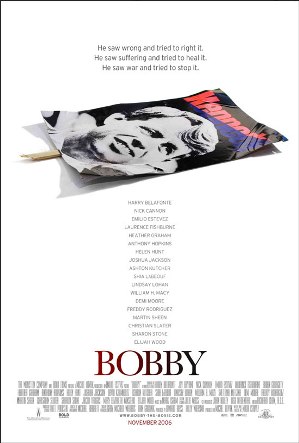
Of course, I could not leave well enough along. I had to send another tweet, “He directed a movie called Bobby that got nominated for bunch of Golden Globes.”
“Was it any good?” she wrote back.
“Never seen it,” I wrote back, suddenly feeling very embarrassed because, if there’s anything I hate, it’s admitting that there’s a film that I haven’t seen.
However, Shattered Politics gave me an excuse to finally sit down and watch Bobby. So now, I can now say that I have watched this 2006 film and … eh.
Listen, I have to admit that I really hate giving a film like Bobby a lukewarm review because it’s not like Bobby is a bad film. It really isn’t. As a director, Emilio Estevez is a bit heavy-handed but he’s not without talent. He’s good with actors. Bobby actually features good performances from both Lindsay Lohan and Shia LaBeouf! So, give Estevez that.
And Bobby is a film that Estevez spent seven years making. It’s a film that he largely made with his own money. Bobby is obviously a passion project for Estevez and that passion does come through. (That’s actually one of the reasons why the film often feels so heavy-handed.)
But, with all that in mind, Bobby never really develops a strong enough narrative to make Estevez’s passion dramatically compelling. The film takes place on the day of the 1968 Democratic California Presidential Primary. That’s the day that Robert F. Kennedy won the primary and was then shot by Sirhan Sirhan in the kitchen of the Ambassador Hotel. However, it never seems to know what it wants to say about Kennedy or his death, beyond the fact that Estevez seems to like him.
(Incidentally, it’s always interesting, to me, that Dallas is still expected to apologize every day for the death of JFK but Los Angeles has never had to apologize for the death of his brother.)
Estevez follows an ensemble of 22 characters as they go about their day at and around the Ambassador Hotel. As often happens with ensemble pieces, some of these characters are more interesting than others.
For instance, Anthony Hopkins plays a courtly and retired doorman who sits in the lobby and plays chess with his friend Nelson (Harry Belafonte). It adds little to the film’s story but both Hopkins and Belafonte appear to enjoy acting opposite each other and so, they’re fun to watch.
Lindsay Lohan plays a woman who marries a recently enlisted soldier (Elijah Wood), the hope being that his marital status will keep him out of Vietnam. The problem with this story is that it’s so compelling that it feels unfair that it has to share space with all the other stories.
Christian Slater plays Darrell, who runs the kitchen and who spends most of the movie talking down to the kitchen staff, the majority of whom are Hispanic. Darrell is disliked by the hotel’s manager (William H. Macy) who is cheating on his wife (Sharon Stone).
And then, you’ve got two campaign aides (Shia LaBeouf and Brian Geraghty) who end up dropping acid with a drug dealer played by Ashton Kutcher. Unfortunately, Estevez tries to visualize their trip and it brings the film’s action to a halt.
Estevez himself shows up, playing the husband of an alcoholic singer (Demi Moore). And Estevez’s father, Martin Sheen, gets to play a wealthy supporter of Kennedy’s. Sheen’s wife is played by Helen Hunt. She gets to ask her husband whether she reminds him more of Jackie or of Ethel.
(Actually, Martin Sheen and Helen Hunt are cute together. Much as with Lohan and Wood, you wish that more time had been devoted to them and their relationship.)
And there are other stories as well. In fact, there’s far too many stories going on in Bobby. It may seem strange for a girl who is trying to review 94 films in three weeks to say this but Emilio Estevez really tries to cram too much into Bobby.
At the same time, too much ambition is better none. Bobby may have been a misfire but at least it’s a respectable misfire.
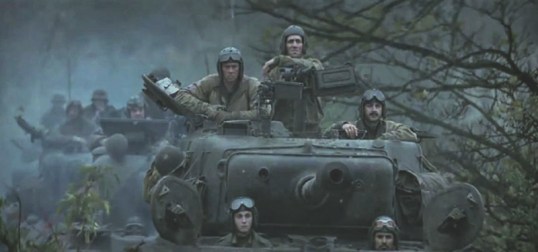
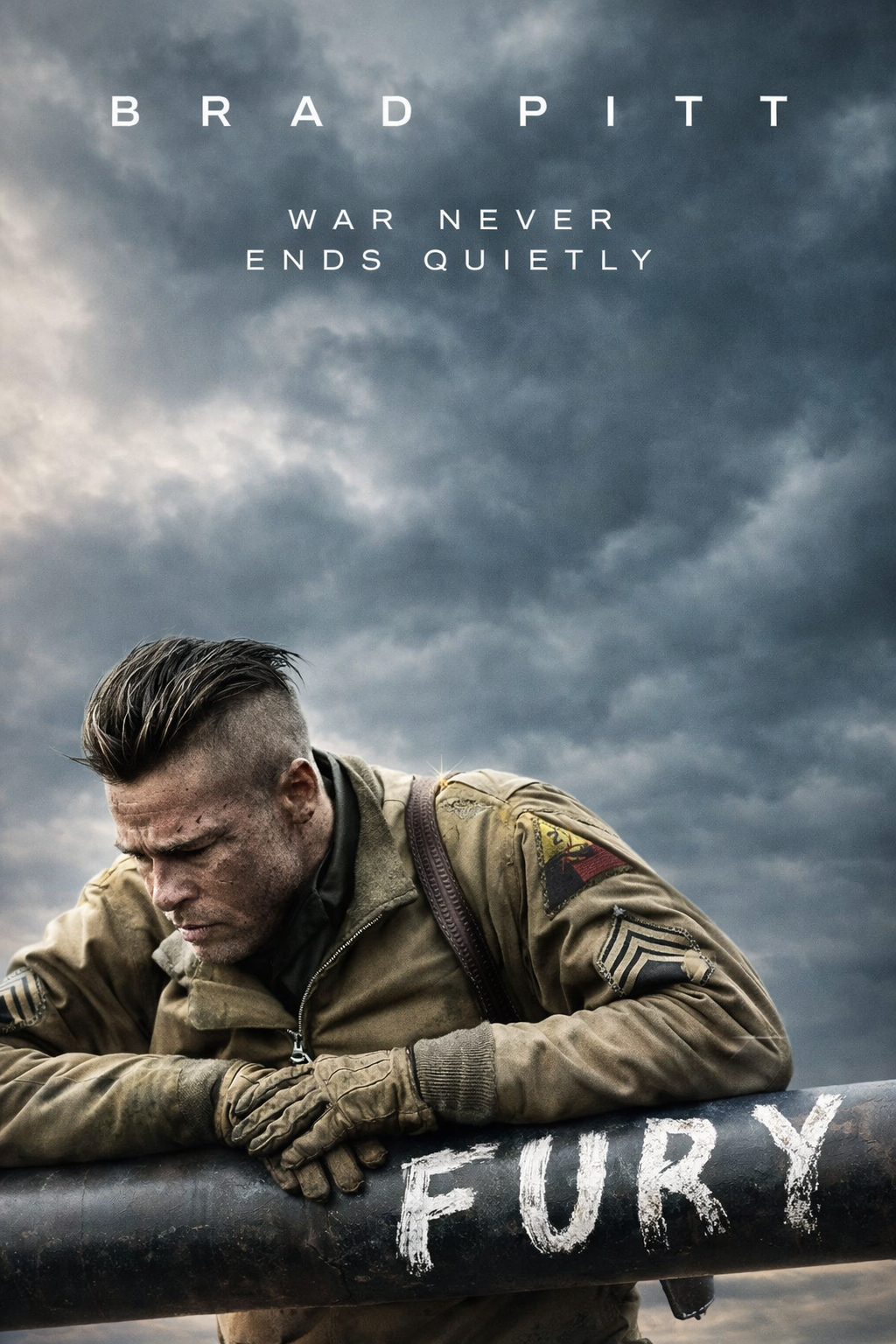
You know that feeling when a war movie tries so hard to be gritty that it forgets to be anything else? Fury, directed by David Ayer, flirts with that problem but mostly stays on the right side of the line. Released in 2014, this WWII drama follows a five-man American tank crew as they push deeper into Nazi Germany in April 1945. The war is almost over, but as the film constantly reminds us, that only makes the fighting more desperate and meaningless. Ayer, who wrote Training Day and directed End of Watch, clearly wanted to make a grimy, claustrophobic, and visceral experience—not a clean, heroic adventure. And for the most part, he succeeds. But the movie is also uneven, sometimes brilliant, and occasionally frustrating. One thing becomes clear early on: Ayer is not just making a war movie. He is trying to out-war the war movie that changed everything. Saving Private Ryan raised the bar for realistic combat violence in 1998, and ever since, directors have been chasing that opening Omaha Beach sequence. Fury spends its entire runtime trying to shove that bar even higher, especially in its final act, where the violence tips over from realistic into something almost performative—as if Ayer is daring you to look away.
The plot is simple. We meet Don “Wardaddy” Collier, played by Brad Pitt, as the seasoned commander of a Sherman tank nicknamed “Fury.” His crew includes Boyd “Bible” Swan (Shia LaBeouf), the religious gunner; Coon-Ass (Jon Bernthal), the volatile loader; and Grady (also Bernthal, though the character is actually Grady “Coon-Ass” Travis; the movie gives everyone a nickname). The crew loses their assistant driver in the opening scene, and they get a replacement: Norman Ellison (Logan Lerman), a young typist who has never fired a gun and has no intention of killing anyone. The rest of the film is basically a crash course in how war turns gentle men into monsters—or at least into effective killers.
What works best in Fury is the sense of being trapped inside a steel coffin. Ayer films almost everything from inside the tank or right next to it. You hear every shell clank, every engine strain, every bullet ping off the hull. The sound design is incredible—it’s the kind of movie where you feel the bass in your chest during combat scenes. And the tank battles are brutally realistic. There’s no slick choreography here. When a German Tiger tank shows up, the fight becomes static, clumsy, and terrifying. The Sherman isn’t some superhero; it’s outgunned and out-armored, and the crew wins only because they’re desperate and lucky. That sequence alone is worth the price of admission. You can feel Ayer’s respect for Saving Private Ryan in those moments—the same handheld cameras, the same sudden death, the same sense that no one is safe. But then the film goes further.
Brad Pitt gives one of his tougher, quieter performances. Wardaddy isn’t a philosopher or a hero. He’s a tired man who has seen too much and made too many compromises. He forces Norman to execute a German prisoner, not out of cruelty but out of a cold, broken logic: if Norman can’t kill, he’ll get the whole crew killed. Pitt sells the weight of that decision without grand speeches. Shia LaBeouf is surprisingly restrained as Bible, a character who prays before each battle but never preaches. The real surprise is Logan Lerman. He starts as a scared kid who vomits at the sight of corpses and ends the film doing things that would ruin anyone’s soul. His transformation is uncomfortable to watch, but that’s the point.
However, the movie has some clunky moments. One extended scene has Wardaddy and Norman sharing a meal with two German women in an abandoned apartment. It’s supposed to show a brief flash of normal life—eggs, music, a soft bed—but it feels oddly staged. The women are just props. They have no real personality except to be gentle and then get killed offscreen. It’s a rare moment where Ayer’s macho instincts flatten the story instead of deepening it. But the real problem is the final act. The crew holds a crossroads against an entire SS battalion of about 200 men, doing it with a broken-down tank that cannot move. Realistically, they’d be dead in minutes. But Ayer turns it into a grim last stand that feels more like a Western than a WWII movie. The Germans attack in waves like idiots, running straight into machine-gun fire. And here is where you sense Ayer’s real intention: he is not trying to be realistic anymore. He is trying to one-up Saving Private Ryan by making the violence not just brutal but excessive, almost numbing. Limbs fly. Faces get torn open. The camera lingers on wounds long past the point of necessary storytelling. It feels like Ayer is saying, “You thought Spielberg was intense? Watch this.” But instead of adding emotional weight, the violence starts to feel like a dare. The movie becomes less about these five men and more about proving it can stomach more than any other war film.
Thematically, Fury is about how institutions crush individuality. Norman was a decent person who typed letters and likely never hurt anyone. By the end, he is sitting in the commander’s seat, pulling triggers without hesitation. The movie doesn’t celebrate this—it presents it as a tragedy. But the final act undercuts that tragedy because it becomes so cartoonishly violent that you stop feeling for the characters and just wait for the bloodshed to end. Unlike Saving Private Ryan, which uses its famous opening sequence to establish horror and then pulls back for character moments, Fury seems to think that more gore equals more truth. It doesn’t. It just equals more gore.
If you’re looking for a clean story with clear good guys and bad guys, this isn’t it. The Germans are offscreen most of the time, and the real enemy is the war itself. Wardaddy even says, “The only thing that separates us from them is this uniform.” That’s a heavy line, and the film never really resolves it. It just lets it hang there. Some critics called Fury shallow because it raises moral questions without answering them. I’d argue that’s the point. War doesn’t come with footnotes. You just survive or you don’t. But the film’s desperate need to prove it is tougher than its predecessors does make it feel, at times, like a younger brother showing off.
On a technical level, the cinematography by Roman Vasyanov is beautiful in a grim way. Colors are desaturated—browns, grays, washed-out greens. Mud and blood look the same. The camera shakes when it needs to, but it’s not the hyperactive Bourne style. It’s controlled chaos. And the final shot, where the camera slowly pulls back from the dead tank, is haunting. It stays with you.
So, final verdict? Fury is a solid, often great war film that trips over its own ambitions in the last thirty minutes. It wants to be a small, character-driven horror show, then pivots to a heroic last stand that feels like it belongs in a different movie—one that cares more about shocking you than moving you. The comparison to Saving Private Ryan is unavoidable, and Fury clearly wants to be mentioned in the same breath. But where Spielberg used violence as a doorway into human cost, Ayer sometimes uses it as a blunt instrument. The performances are strong, the tank combat is second to none, and the atmosphere is suffocating in the best way. It’s not Come and See, but it’s also not Pearl Harbor. If you can handle the tonal whiplash and the occasional macho posturing, you’ll find a movie that respects its audience enough to leave them feeling dirty. Just don’t expect a clean exit—and don’t expect it to earn every drop of blood it spills.
“When you’re 17, every day is war.” — Tagline of The Battle of Shaker Heights (2003)
Anyone here remember Project Greenlight? It’s a show that used to be on HBO and Bravo, in which Matt Damon and Ben Affleck would arrange for a director and screenwriter to get a chance to make their low budget feature film debuts. The catch, of course, is that a camera crew would then follow the director as he (and all of the Greenlight “winners” were male) struggled to get the film made. Mistakes would be made. Money would be wasted. Producer Chris Moore would randomly show up on set and start yelling. In short, it was typical reality show drama with the catch being that the film itself would then be released in a theater or two.
Well, after being consigned to footnote status for the past nine years. Project Greenlight is coming back for a fourth season and a lot of people are pretty excited about it. And why not? I own the first two seasons of Project Greenlight on DVD and I’ve watched the third season on YouTube. It’s a lot of fun, mostly because all of the directors, with the exception of season 3 winner John Gulager, turned out to be so incredibly inept. (Gulager is one of the few Project Greenlight success stories — not only did his movie, Feast, come across as being made by a professional but he’s actually had a career post-Greenlight.) It all makes for good televised drama.
However, it doesn’t necessarily make for a good movie.
Case in point: 2003’s The Battle of Shaker Heights.
The Battle of Shaker Heights is about a creepy 17 year-old named Kelly (played by the reliably creepy Shia LaBeouf). His mother (Kathleen Quinlan) is an artist. His father (William Sadler) is a former drug addict who, despite having been clean for 6 years, still has to deal with his son’s constant resentment. Kelly is a high school outcast who spends all of his spare time thinking and talking about war. Every weekend, he takes part in war reenactments. At night, he works in a 24-hour grocery store where he doesn’t realize that he’s the object of Sarah’s (Shiri Appleby) affection.
(Why Sarah has so much affection for Kelly is a good question. Maybe it’s the scene where he throws cans of cat food at her…)
At a reenactment of the Battle of the Bulge, Kelly meets and befriends Bart (Elden Hansen), which leads to him meeting Bart’s older sister, Tabby (Amy Smart). Tabby is an artist, because the film isn’t imaginative enough to make her anything else. (We’re also told that she’s a talented artist and it’s a good thing that we’re told this because otherwise, we might notice that her paintings are the type of uninspired stuff that you can buy at any county art fair.) Kelly decides that he’s in love with Tabby but — uh oh! — Tabby’s getting married. Naturally, she’s marrying a guy named Minor (Anson Mount). Imagine how the film would have been different if his name had been Major.
As a film, the Battle of Shaker Heights is a bit of a mess. It never establishes a consistent tone, the dialogue and the direction are all way too heavy-handed and on the nose, and Shia LaBeouf … well, he remains Shia LaBeouf. In some ways, Shia is actually pretty well cast in this film. He’s an off-putting actor playing an off-putting characters but the end of result is an off-putting film.
Of course, if you’ve seen the second season of Project Greenlight, then you know that The Battle of Shaker Heights had an incredibly troubled production. Neither one of the film’s two directors were particularly comfortable with dealing with the more low-key human aspects of the story. Screenwriter Erica Beeney was not happy with who was selected to direct her script and basically spent the entire production whining about it to anyone who would listen. (Sorry, Erica — your script was one of the film’s biggest problems. When you actually give a character a name like Minor Webber, it means you’re not trying hard enough.) Finally, Miramax took the completed film away from the directors and re-edited it, removing all of the dramatic scenes and basically leaving a 79-minute comedic cartoon.
So, in the end, Battle of Shaker Heights is not a very good film. But season two of Project Greenlight is a lot of fun!
I must admit that World War II films are a favorite of mine. Even bad ones I tend to enjoy. Whether it’s alternate fantasy fares like Tarantino’s Inglourious Basterds or something that combines historical accuracy with dramatic license like Spielberg’s Saving Private Ryan, the World War II genre always manage to hit straight and true to my film wheelhouse.
This October there looks to be another World War II film that seems almost tailor-fit for me. I’m talking about David Ayer’s follow-up to his underappreciated film End of Watch. This follow-up is Fury and tells the story of an American tank crew in the waning days of World War II in Europe. Just from the two trailer released I already know that I’m seeing this. Ayer looks to be exploring the bond of a tank crew that has seen war from the deserts of Africa and now to the urban and forested landscapes of Germany.
The film is already getting major buzz as a major contender for the upcoming awards season and I, for one, hope that it’s a well-deserved buzz. Even with Shia LaBeouf being part of the cast is not dampening my excitement for this film. Even if it doesn’t live up to the hype I know that I’ll probably still end up enjoying it.
This trailer looks to be selling the utter brutality and carnage of World War II’s final days in Europe when German forces were literally fighting for their homeland and that makes for a desperate enemy (who still had weapons and soldiers that were still hands down better than what the Allies had one-on-one).
On a side note, I like the fact that the tracers in the film actually look like tracers which means they look like freakin’ laser blasts. That’s how tracers behave.
Fury is set to hit theaters on October 17, 2014 in the United States and October 22, 2014 internationally.



 Through the Shattered Lens