Brad reviews DOUBLE THREAT (1992), starring Sally Kirkland, Andrew Stevens and Sherrie Rose!


Sally Kirkland stars as Monica Martel, a sexy but aging Hollywood actress who’s in lust for, and obsessed with, her boy toy, Eric Cline (Andrew Stevens). When Monica is given a chance for a big comeback, she uses her pull to get Eric the leading man role. Still, the producer Crocker Scott (Anthony Franciosa) insists that the film contain a lot of sexy scenes and Monica isn’t exactly in her prime anymore. Needing this big break, director Stephen Ross (Chick Vennera) hires a model of visual perfection, the lovely Lisa Shane (Sherrie Rose), to serve as a body double for Monica on the production. Soon Eric and Lisa are having a hot affair while Monica is being left out in the cold. Not one to accept being the odd woman out, Monica hires a private investigator to track the oversexed young lovers. When Lisa’s car blows up, luckily for us viewers she isn’t in it at the time, you can’t help but wonder if Monica has decided nobody will make a fool of her again. Not so fast though when Detective Robert Fenich (Richard Lynch) shows up on the scene carrying a serious grudge against Eric… something to do with a murderous event that occurred in San Francisco a few years earlier. It’s not easy to determine who’s hateful and who’s just horny in this sizzler from Director David A. Prior. 

This was my first viewing of the 1992 erotic thriller, DOUBLE THREAT, but I’ve seen plenty of movies like it before. I was a teenager when the erotic thriller became a staple at the video store. Actor Andrew Stevens, who had starred with my hero Charles Bronson in the films DEATH HUNT (1981) and TEN TO MIDNIGHT (1983) became a star of the genre with his roles in the NIGHT EYES and SCORNED series. I remember talking my mom into letting me rent NIGHT EYES (1990) because “the guy from 10 TO MIDNIGHT is in it.” Needless to say, she wasn’t happy when the “erotic” part of the erotic thriller started, and we never finished the film. To be completely honest, outside of the budget differences and the overall talent on display, a film like DOUBLE THREAT isn’t that much different than a movie like BASIC INSTINCT (1992), which I’m sure served as an inspiration when you consider that both films came out in 1992. There is a scene where Andrew Stevens walks into a club and sees Sherrie Rose dancing provocatively that reminded me of the corresponding scene in BASIC INSTINCT with Michael Douglas and Sharon Stone. And when it’s all said and done, the plots of these types of films are all pretty ridiculous. This one’s a real doozy, and looking back there are ample clues, but I somehow didn’t figure out the big twist at the end.

I must say that Sally Kirkland and Sherrie Rose, separated in age by 25 years, are both extremely appealing in DOUBLE THREAT as the actress on the comeback trail and her beautiful young body double. This is the first time I’ve watched one of these straight-to-video erotic thrillers in a long, long, time, so I may just need to revisit a few more just for old times’ sake! Besides the sexy ladies, this specific film intrigues me due to the presence of Andrew Stevens as the ladies’ man whose motives aren’t completely clear until later in the film. A consistent presence in Charles Bronson films of the early 80’s, Stevens has had quite the career as an actor, director, and producer, almost exclusively in low budget fare like this. He’s a good-looking guy and a pretty good actor, and I’m always glad to see him involved in a production. He’s recently written and directed a documentary about his mother called STELLA STEVENS: THE LAST STARLET (2025) that I have on my watch-list. Honestly, the full cast of DOUBLE THREAT is pretty stacked, with actors like Rychard Lynch (INVASION USA), Gary Swanson (VICE SQUAD), and Anthony Franciosa (TENEBRAE) all bringing some additional class to the proceedings in their various roles. 

At the end of the day, you fall in one of three categories when it comes to a movie like DOUBLE THREAT: you’re the kind of person who wants to watch a low budget erotic thriller; you’re the kind of person who says that you don’t want to watch a low budget erotic thriller, but then you watch one anyway; or you’re the kind of person who truly doesn’t want to watch a low budget erotic thriller. In my case, there’s a certain nostalgia that I associate with these types of video store genre films that were a dime a dozen in my youth. As silly as it all is, I must admit that I enjoyed DOUBLE THREAT and proudly fall in the first category!

Rest in peace, Sally Kirkland. 

The Eric Roberts Collection: Best of the Best (dir by Bob Radler)


“No!” James Earl Jones says towards the end of 1989’s The Best of the Best, his already deep voice made even more imposing by the use of slow motion.

“No, Tommy, no!” Eric Roberts joins in as he watches martial artist Tommy Lee (Phillip Rhee) internally struggle with whether or not to strike a blow that will definitely kill his opponent and, if James Earl Jones is all gravitas and stern wisdom, Eric Roberts is all emotion and desperation.

The Best of the Best is a bit of an oddity, in that the script features just about every martial arts tournament cliche imaginable (right down to the other “bad” team having a history of killing people in the ring) but those cliches are all acted out by a surprisingly distinguished cast.  I counted four Oscar nominees (and one winner) in the cast.  James Earl Jones (nominated for The Great White Hope) plays Coach Couzo, who gets a team of Americans prepared to fight in an international tournament.  Sally Kirkland (nominated for Anna) plays their trainer, who worries not just about the team’s physical health but also their mental burdens.  Eric Roberts (nominated for Runaway Train) is Alex Grady, the former martial arts champion-turned-auto worker who makes the team despite having a bad shoulder.  Louise Fletcher (who won for One Flew Over The Cuckoo’s Nest) plays Alex’s mother, who looks after his son while Alex is off getting ready to face the Korean team.  And then there’s Chris Penn  (who seems like, if not for his early death, he would have eventually been nominated for something) as the arrogant Travis, a cowboy who can throw a punch.

(The American team is filled out by John Dye as Virgil, an intellectual Buddhist, David Agresta as Sonny “I’m Italian” Grasso, and Phillip Rhee, who not only plays Tommy but also wrote the film’s script.)

Roberts gets top-billing in this and he does get a lot of important moments, including a scene where he breaks the Coach’s rules so that he can visit his son in the hospital.  That said, the story centers around Phillip Rhee’s Tommy.  Tommy’s older brother was killed in the ring by the one-eyed Dae Han Park (Simon Rhee) and — wow, what a coincidence! — that just happens to be who Tommy needs to beat for the Americans to win the big tournament.  Both of the Rhee brothers actually are martial artists and they are very convincing in the fight scenes, which is good because neither Phillip nor Simon Rhee were particularly strong actors.  Eric Roberts is not a particularly convincing martial artist but it doesn’t matter because he acts the Heck out of every scene in which he appears.  What happens when you bring method intensity to the type of martial arts film that Jean-Claude Van Damme would later make his specialty?  You get scenes of a heavily-bruised Eric Roberts crying but, because Roberts is a good actor, the tears feel earned.  Still, whenever I saw Alex’s eyes starting to glisten, I imagined James Earl Jones saying, “Noooooooo!”  How can you win the world’s greatest tournament when you’re constantly on the verge of tears?  Well, maybe you don’t need to win.  Maybe you just need to show that you have more honor than anyone else there.

Best of the Best is a classic of its kind.  There’s nothing surprising about it but it’s entertaining in its own dumb way and, in the end, it reminds us that America doesn’t need medals to be the best.  It just needs Eric Roberts.

Previous Eric Roberts Films That We Have Reviewed:

  1. Star 80 (1983)
  2. Runaway Train (1985)
  3. Blood Red (1989)
  4. The Ambulance (1990)
  5. The Lost Capone (1990)
  6. Love, Cheat, & Steal (1993)
  7. Voyage (1993)
  8. Love Is A Gun (1994)
  9. Sensation (1994)
  10. Dark Angel (1996)
  11. Doctor Who (1996)
  12. Most Wanted (1997)
  13. Mercy Streets (2000)
  14. Raptor (2001)
  15. Rough Air: Danger on Flight 534 (2001)
  16. Wolves of Wall Street (2002)
  17. Border Blues (2004)
  18. Mr. Brightside (2004)
  19. Six: The Mark Unleased (2004)
  20. We Belong Together (2005)
  21. Hey You (2006)
  22. Depth Charge (2008)
  23. Amazing Racer (2009)
  24. In The Blink of an Eye (2009)
  25. Bed & Breakfast (2010)
  26. Enemies Among Us (2010)
  27. The Expendables (2010) 
  28. Sharktopus (2010)
  29. Beyond The Trophy (2012)
  30. The Dead Want Women (2012)
  31. Deadline (2012)
  32. The Mark (2012)
  33. Miss Atomic Bomb (2012)
  34. Assault on Wall Street (2013)
  35. Bonnie And Clyde: Justified (2013)
  36. Lovelace (2013)
  37. The Mark: Redemption (2013)
  38. The Perfect Summer (2013)
  39. Self-Storage (2013)
  40. A Talking Cat!?! (2013)
  41. This Is Our Time (2013)
  42. Inherent Vice (2014)
  43. Road to the Open (2014)
  44. Rumors of War (2014)
  45. Amityville Death House (2015)
  46. Deadly Sanctuary (2015)
  47. A Fatal Obsession (2015)
  48. Las Vegas Story (2015)
  49. Stalked By My Doctor (2015)
  50. Enemy Within (2016)
  51. Joker’s Poltergeist (2016)
  52. Prayer Never Fails (2016)
  53. Stalked By My Doctor: The Return (2016)
  54. The Wrong Roommate (2016)
  55. Dark Image (2017)
  56. Black Wake (2018)
  57. Frank and Ava (2018)
  58. Stalked By My Doctor: Patient’s Revenge (2018)
  59. Clinton Island (2019)
  60. Monster Island (2019)
  61. The Reliant (2019)
  62. The Savant (2019)
  63. Seven Deadly Sins (2019)
  64. Stalked By My Doctor: A Sleepwalker’s Nightmare (2019)
  65. The Wrong Mommy (2019)
  66. Exodus of a Prodigal Son (2020)
  67. Free Lunch Express (2020)
  68. Her Deadly Groom (2020)
  69. Top Gunner (2020)
  70. Deadly Nightshade (2021)
  71. The Elevator (2021)
  72. Just What The Doctor Ordered (2021)
  73. Killer Advice (2021)
  74. Night Night (2021)
  75. The Poltergeist Diaries (2021)
  76. The Rebels of PT-218 (2021)
  77. A Town Called Parable (2021)
  78. Bleach (2022)
  79. My Dinner With Eric (2022)
  80. 69 Parts (2022)
  81. D.C. Down (2023)
  82. Aftermath (2024)
  83. Bad Substitute (2024)
  84. Devil’s Knight (2024)
  85. The Wrong Life Coach (2024)
  86. When It Rains In L.A. (2025

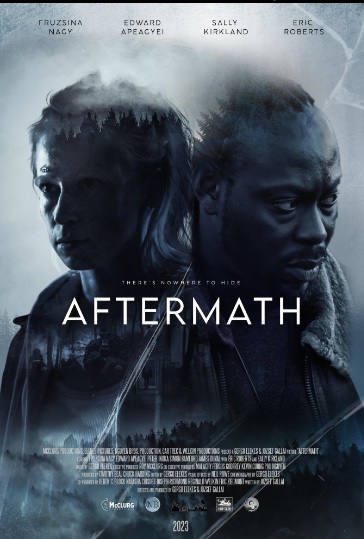
Film Review: Aftermath (dir by Jozsef Gallai and Gergö Elekes)


A woman named Kate (Fruzsina Nagy) drives down a road.  We don’t know where she is driving to but we can tell that she’s driving quickly and she’s not in the mood for any delays.  It’s the way that someone drives when they’re trying to escape but they’re not sure where they want to go.  It’s way you drive when you just want to convince yourself that you can somehow leave everything behind.

We hear what sounds like an accident and suddenly, Kate is waking up in a forest.  Her car is nowhere to be seen and Kate has no idea how she came to be in the forest.  In fact, she’s not even sure who she was before she woke up.  She has no memories of her past life, beyond fleeting visions that don’t always seem to fit together.  Eventually, she meets another apparent amnesiac, Bubba (Edward Apeagyei).  Bubba wears a locket around his neck and there’s a picture of a woman in the locket but he doesn’t seem to be quite sure who she was.

Bubba and Kate are not alone in the forest.  There are other wanderers and then there’s a group of men who appear to be soldiers, wearing crude uniforms and gas masks and carrying machine guns.  (The sight of the soldiers, with their crude uniforms, bring to mind the horrific militias that often spring up in the aftermath of a war and attempt to seize power out of the chaos.)  Receiving cryptic orders from their leader (Eric Roberts), the soldiers patrol the forest and execute anyone that they come across.  Their leader repeatedly tells them that they have to track down and execute everyone because the future of the world depends upon it.  Failure is not an option.

Aftermath deals with a very real fear.  The idea of suddenly waking up and discovering that you have not only lost your identity but also control over your own fate is at the heart of many horror stories and it’s also a reflection of the way many people feel about living in today’s world.  One wrong word, thought, or move and you can find yourself exiled into both a real and metaphorical wilderness.  When Kate wakes up with little memory of what the world was like before she ended up in that forest, she’s feeling what a lot of people have felt when they try to remember the world and their lives before the lockdowns of 2020 and all of the political and societal events that followed.  We live in a world that seems to change from day to day and, as result, everyone has had that moment when, like Kate, they’ve struggled to understand what’s happening.  From the minute that Kate wakes up with the feeling that she has no control over what’s happening to her, she becomes an instantly relatable character.  The audience not only wants to know what’s happening to her but they also want her to regain control of her fate.  If Kate can regain control, then those watching in the audience can also regain control.

The film’s cinematography emphasizes both the grandeur and the ominous atmosphere of the forest, making it a place that manages to be beautiful and threatening at the same time and the deliberate pace builds up suspense as Kate tries to discover why she is in the forest.  Fruzsina Nagy and Edward Apeagyei both give sympathetic and relatable performances as Kate and Bubba and the audience does care what happens to them.  Aftermath is both an intriguing thriller and a meditation on life and love.

Aftermath will be released on digital and blu-ray by Bayview Entertainment on January 30th.


The Film of Dario Argento: Two Evil Eyes


In 1990, long-time friends George Romero and Dario Argento collaborated on Two Evil Eyes, anthology film that was based on the writings of Edgar Allan Poe.  An Italian-American co-production, Two Evil Eyes featured two stories.  The first was directed by George Romero, while the second was directed by Argento.

The Facts In The Case of Mr. Valdemar

(Dir by George Romero)

The first story is Romero’s, a modernized version of The Facts In The Case of M. Valdemar.

Jessica Valdemar (Adrienne Barbeau) is the 40 year-old wife of 65 year-old, Ernest Valdemar (Bingo O’Malley).  Jessica only married Ernest for her money and, now that he’s on his death bed, she and her lover, Dr. Robert Hoffman (Ramy Zada), have hypnotized to him to do and say whatever they tell him to say and do.  Even though Ernest is essentially comatose, the hypnosis allows them to force Ernest to sign his name to legal documents and to tell his suspicious attorney (E.G. Marshall) that he indeed wants to leave all of his money to Jessica.

When Ernest dies while under the influence of hypnosis, Jessica and Robert attempt hide his body in the basement.  But is Ernest really dead?  Jessica is convinced that she hears groaning from the basement and she wonders if the hypnosis has somehow left Ernest in limbo, between life and death.  Robert thinks that Jessica is being foolish but it turns out that she’s not.  After much paranoia and betrayal, one conspirator is dead and the other is a part of the living dead.

Usually, I like Romero’s work but this one didn’t work for me.  From the flat cinematography to the shallow performances, this film felt more like an episode of a television show than anything else.  Perhaps if it had been a stand-alone film, Romero could have found a way to make the material a bit more cinematic.  (The story’s final shot, of blood dripping on a hundred dollar bill, is the film’s strongest moment and the part that feels the most Romeroesque.)  But as a shortened chapter of an anthology film, it fell flat.

The Black Cat

(Dir by Dario Argento)

The Dario Argento segment is based on several different Poe stories.  While the majority of the story is taken from The Black Cat, it also contains elements of Annabel Lee, Telltale Heat, The Pit and the Pendulum, and Buried Alive.  Though this segment doesn’t really work, it’s obvious that Argento is a fan of Poe’s work and, for other Poe fans, there’s a lot of fun to be found in all of the Poe references that Argento sneaks into his story.

Harvey Keitel stars as Rod Usher, a crime scene photographer who loves his work a bit too much.  He’s excited about the fact that his book of photography is about to be published.  He’s less happy about the fact that his girlfriend, Annabel (Madeleine Potter), has adopted a black cat that is constantly glaring at Rod.  Rod is eventually driven mad by both the cat’s apparent hatred of him and the fact that the cat itself keeps showing up no matter how far he goes to get rid of it.  (This film features violence against a cat, which I hated.  But it also featured a cat getting revenge and I appreciated that.)  Eventually, Rod’s paranoia leads to violence and murder.

Look, this is a film about a guy who has an obsessive hatred of a cat.  Obviously, this is not a film that I’m going to enjoy because I love cats.  That said, I can still judge the film on its merits, even if it’s not for me on a personal level.  While Argento is able to build up a good deal of tension and suspense in this film, the overall film doesn’t work because Harvey Keitel, supremely talented actor that he is, was totally the wrong choice for Rod Usher.  Keitel, who reportedly did not get along with Argento during filming, gave a self-indulgent performance that featured a lot of bellowing.  It’s as if Keitel is trying to compete with the constantly moving camera.  The problem is that a star of a film like this has to be the director and Keitel’s histrionics take the viewer right out of the story.

Considering all of the talent involved, Two Evil Eyes is a disappointment.

The (Reviewed) Films of Dario Argento:

  1. The Bird With The Crystal Plumage
  2. Cat O’Nine Tales
  3. Four Flies on Grey Velvet
  4. Deep Red
  5. Suspiria
  6. Inferno
  7. Tenebrae
  8. Phenomena
  9. Opera

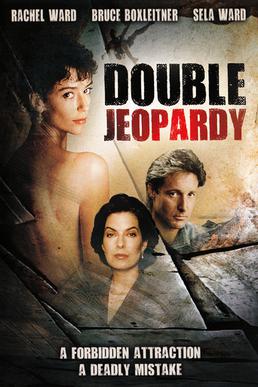
Double Jeopardy (1992, directed by Lawrence Schiller)


Salt Lake City is riveted by the sensational murder trial of mountain climber Lisa Burns Donnelly (Rachel Ward).  Lisa killed her ex-boyfriend, Eddie.  She says that she did it in self-defense after Eddie raped her.  The prosecution claims that she murdered Eddie after he caught her cheating on him with another man.  Lisa’s lawyer, Karen Hart (Sela Ward), is up for a judgeship.  Her husband, Jack (Bruce Boxleitner) is Lisa’s ex-boyfriend.  What Karen doesn’t know is that, other than Lisa, Jack is the only person who witnessed what happened the night of the murder because, just moments before, he and Lisa had been committing PG-13-rated adultery in her shower.

One of the interesting things — in fact, maybe the only interesting thing — about Double Jeopardy is that several online sellers claim that the film stars Aaron Eckhart.  It is true that Eckhart is in the movie.  It was shot in Salt Lake City while he was a student at BYU and it was his film debut.  However, Eckhart has about a minute of screen time and about five lines.  He plays a Marine named Dwayne who someone meets in an airport.  His big line is, “Semper Fi, babe!”

As for the film, since it’s set in Salt Lake City, there’s a lot of talk about how Lisa is being unfairly judged for her unconventional (read: non-Mormon) life style and there’s a heavy-handed subplot about Jack trying to put on a production of The Crucible but it doesn’t add up too much.  It would probably have been easier for the movie to make a point about religious and moral persecution if Lisa wasn’t actually guilty of murdering Eddie.  Instead, the movie leaves you thinking, “Maybe those Mormons have a point.”

Double Jeopardy tries hard to be something more than your standard legal thriller but it’s pretty forgettable.  Rachel Ward was always a great femme fatale and Sally Kirkland gives a good performance as the cop who sees through both Lisa and Jack.  The film was produced for Showtime at a time when cable was still trying to prove that it could provide original content worth paying for so there’s some cursing and sideboob tossed in, as if to say, “See?  You don’t get this on NBC!”  Otherwise, this is a by-the-numbers made-for-TV movie.

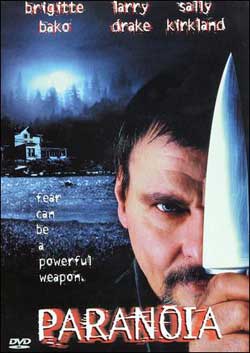
Email of the Damned: Paranoia (1998, directed by Larry Brand)


Interior designer Jana Mercer (Brigitte Bako) is haunted by the night that her entire family was murdered by serial killer, Calvin Hawks (Larry Drake).  Even though Calvin was captured and imprisoned, she still fears that someday he’ll get out.  Calvin, meanwhile, feels that he and Jana have a special bond because he decided to allow her to live.  From his prison cell, he follows her life via the internet.  He even sends her messages, which doesn’t do much for her state of mind.  Finally, a former neighbor of hers invites her to return to her old neighborhood so that she can confront her fears.  However, after serving 20 years in prison, Calvin has been released for good behavior.  As a part of his parole, he is not allowed to go anywhere near Jana or any of the scenes of his crimes.  Soon after getting released, Calvin decides to violate his probation.  A serial killer violating probation?  Who would have guessed?

Paranoia raises a few questions.  What type of prison would allow a serial killer to have a laptop in his cell and access to the internet, let alone send out messages unsupervised?  What type of legal system would sentence a serial killer to only 20 years in prison?  Why wouldn’t the authorities make any effort to let Jana, as the sole survivor of Calvin’s crimes, know that Calvin is about to be released from prison?  Why would Jana, a recluse who says she is incapable of trusting people, be so quick to accept an invitation to go to the country with someone that she barely knows?  It makes no sense but the movie still somehow maintains enough suspense to work.

The best thing about Paranoia are the performances of Brigitte Bako and Larry Drake.  Bako, who was one of the best of the 90s direct-to-video stars, brings some needed sass to the role of Jana while Larry Drake was a B-movie veteran who always made a good villain.  Larry Brand, who also did Overexposed and The Drifter, wrote and directed Paranoia and, just as he did in those two previous films, Brand includes a lot of pop cultural references.  It’s not every day that you see a direct-to-video B-movie that includes an inside joke about The Dick Van Dyke Show.  Brand and his cast bring some unexpected style to the nonsensical story.

Watching Paranoia today, it’s hard not to get nostalgic.  With a plot that hinges on email almost as much as the plot of Sleepless in Seattle, it’s a 90s film, through and through.  They don’t make them like this anymore.

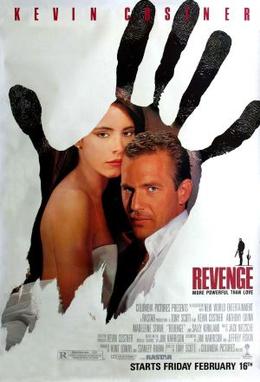
Insomnia File #42: Revenge (dir by Tony Scott)


What’s an Insomnia File? You know how some times you just can’t get any sleep and, at about three in the morning, you’ll find yourself watching whatever you can find on cable? This feature is all about those insomnia-inspired discoveries!

Earlier today, If you were having trouble getting to sleep around one in the morning, you could have turned over to TCM and watched the 1990 action film, Revenge.

Revenge is an almost absurdly masculine film about two men who are in love with the same woman and who, as a result, end up trying to kill each other and a lot of other people.

Jay Cochran (Kevin Costner) is a U.S. Navy aviator who, when we first see him, is doing the whole Top Gun thing of flying in a fast jet and making jokes while his navigator worries about dying.  Interestingly enough, Top Gun and Revenge were both directed by Tony Scott so perhaps this opening scene was meant to be a self-reference.  Well, regardless of intent, it’s a scene that goes on forever.  This is Jay’s last flight, as he’s due to retire.  We go through an extended retirement party, where everyone has a beer and Jay gives one of those bullshit sentimental speeches that men always give in films like this.

Jay has been invited to estate of Tibbey (Anthony Quinn), who is a Mexican gangster.  Tibbey and Jay are apparently old friends, though it’s never quite explained how the youngish Jay knows the not-very-youngish Tibbey.  Tibbey is one of those gangster who is incapable of doing anything without first talking about what an amazing journey it’s been, going from poverty to becoming one of the most powerful men in Mexico.

Tibbey apparently wants to play tennis with Jay and take him hunting.  Jay decides that he’d rather have an affair with Tibbey’s much younger wife, Miryea (Madeleine Stowe).  Miryea is upset that Tibbey doesn’t want to have children because he feels that pregnancy would ruin her body.  When Tibbey finds out about the affair, he sends Miryea to a brothel and Jay to the middle of the desert.  That’s Tibbey’s revenge!

Except, of course, Jay doesn’t die because he’s Kevin Costner and if he died, the movie would end too quickly.  So, Jay fights his way back from the desert, intent on not only finding Miryea but getting his own revenge on Tibbey!

(It’s hard to take a bad guy named Tibbey seriously, even if he is played by Anthony Quinn.)

Revenge goes on for way too long and neither Tibbey nor Jay are really sympathetic enough to be compelling characters.  You never really believe in Tibbey and Jay’s friendship, so the whole betrayal and revenge aspect of the film just falls flat.  On the plus side, youngish Kevin Costner is not half as annoying as cranky old man Costner.  Anthony Quinn was one of the actors who was considered for the role of Don Corleone in The Godfather and, watching him here, you can kind of see him in the role.  He would have been a bit of a crude Corleone but Quinn had an undeniably powerful and magnetic screen presence.  In Revenge, Quinn chews up and spits out all of the scenery and is not subtle at all but it’s entertaining to watch him because he’s Anthony Quinn.

Anyway, Revenge ends with a tragedy, as these things often do.  Anthony Quinn never says, “Revenge is a dish best served cold,” and that, to me, is a true missed opportunity.

Previous Insomnia Files:

  1. Story of Mankind
  2. Stag
  3. Love Is A Gun
  4. Nina Takes A Lover
  5. Black Ice
  6. Frogs For Snakes
  7. Fair Game
  8. From The Hip
  9. Born Killers
  10. Eye For An Eye
  11. Summer Catch
  12. Beyond the Law
  13. Spring Broke
  14. Promise
  15. George Wallace
  16. Kill The Messenger
  17. The Suburbans
  18. Only The Strong
  19. Great Expectations
  20. Casual Sex?
  21. Truth
  22. Insomina
  23. Death Do Us Part
  24. A Star is Born
  25. The Winning Season
  26. Rabbit Run
  27. Remember My Name
  28. The Arrangement
  29. Day of the Animals
  30. Still of The Night
  31. Arsenal
  32. Smooth Talk
  33. The Comedian
  34. The Minus Man
  35. Donnie Brasco
  36. Punchline
  37. Evita
  38. Six: The Mark Unleashed
  39. Disclosure
  40. The Spanish Prisoner
  41. Elektra

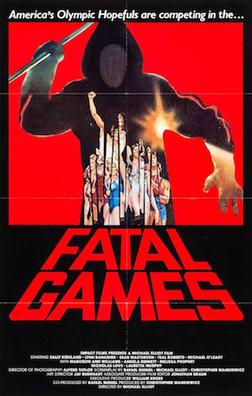
An Olympic Horror Film Review: Fatal Games (dir by Michael Elliot)


Like all good people, I am currently obsessed with the Winter Olympics!  As a result, over the past two weeks, I’ve been watching and reviewing a lot of Olympic-themed films.  Today, I watched the 1984 slasher film, Fatal Games!

If you look at the poster above, you’ll see that Fatal Games was advertised as being a film about “America’s Olympic hopefuls … competing in the Fatal Games!”  That’s kind of true.  The Olympics are frequently mentioned throughout Fatal Games but technically, no one in the movie is actually a member of the Olympic team.  At least not yet.  Instead, they’re all students at a special athletic academy.  Apparently, it’s supposed to be a high school, though we don’t ever see anyone taking a math test or attending English class or anything like that.  Instead, it appears that everyone at the school spends all day practicing gymnastics, swimming, or running.  In fact, it appears that there’s only 20 students at the school and, at most, 5 members of the faculty.  Maybe it’s meant to be like that school that all of the clones attended in Never Let Me Go.  Either that or it’s just an indication that Fatal Games was an extremely low-budget film.

Anyway, seven of the students have just won some sort of regional competition and now they’re getting ready for nationals!  And, if they win at nationals, they’ll get to go to the Olympics.  However, they might not even make it to nationals.  Someone is stalking the blandly likable athletes and using a javelin to pick them off, one-by-one.

Interestingly, it takes people a while to notice that the number of potential Olympians is steadily dwindling.  Instead, people say stuff like, “Hey, have you seen Nancy?”  “Not for a few days.”  “Hey, have you seen Sue Ellen?”  “Didn’t she got to San Francisco to see her boyfriend?”

Well, I guess it’s understandable.  It’s not like anyone in the film is going to school to develop their critical thinking skills.  They’re athletes.  Who cares about all of the people mysteriously disappearing?  They have athletic stuff to worry about!

Fatal Games is pretty much a typical mid-80s slasher.  Interestingly enough, it’s structured like a giallo.  The murderer dresses in black and we get all of the required close-ups of the killer’s gloved hands.  The film introduces several potential suspects but doesn’t reveal the killer’s identity until the final ten minutes.

Is it the overly critical track coach?

Is it the creepy doctor?

Is it the nurse who is worried that the athletes are being injected with too many hormones?  (Obviously, she’s seen Goldengirl.)

Is it the swim coach?

Or is it her girlfriend, the swimmer who didn’t qualify for nationals?

Is it the gymnast whose grades are slipping?

Could it be the other gymnast who is always telling jokes?

Or the runner who has father issues?

Or is it Joe, the token weird guy?

They’re all given a scene or two to establish that they have a potential motive for wanting the seven aspiring Olympians dead.  When the killer and the killer’s motive is finally revealed, it’s so over-the-top and stupid that you can’t help but admire the film for actually going there.  The filmmakers obviously said, “Forget trying to make sense.  WE’RE GOING FOR IT!”

Anyway, the main problem with Fatal Games is that the murderer uses a javelin and, as a result, there’s a lot of scenes of the killer running through narrow school hallways, carrying this goofy-looking javelin.  Don’t get me wrong.  Javelins are sharp and scary and I wouldn’t want one thrown at me.  But still, when someone spends more than five minutes running down a narrow hallway while carrying a javelin, it just looks silly.  Let’s not even think about the logistics of using a javelin to kill someone in broad daylight without anyone else noticing.

That said, as silly and predictable as Fatal Games may have been, there were a few moments of inspired lunacy.  I already mentioned the ending, which is so over-the-top and silly that you can’t help but admire it.  But there’s also a few shots that are genuinely effective.  A scene where the killer suddenly appears in a doorway was handled well.  There’s also an oddly dream-like sequence in which a swimmer practices in the pool, little realizing that the killer is floating underneath her.  How did the killer get in the pool, with the javelin, without anyone noticing?  Who knows?  It’s still an effective scene.

Finally, I have to mention that Fatal Games opens with a song called “Take It All The Way,” which is so generically 80s that it’s oddly brilliant.  It’s almost as good as Graduation Day‘s “The Winner.”

Fatal Games is currently available for viewing on YouTube.

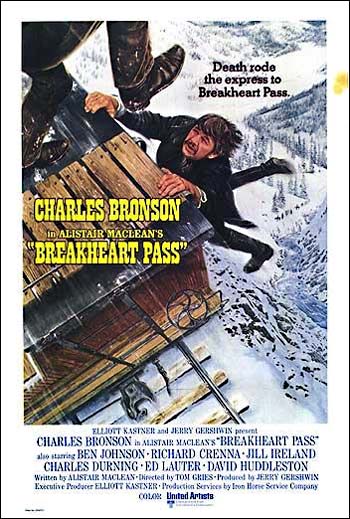
A Movie A Day #141: Breakheart Pass (1975, directed by Tom Gries)


California.  The 1870s.  Sheriff Pearce (Ben Johnson) boards a train with his prisoner, an alleged outlaw named John Deakin (Charles Bronson).  The train is mostly full of soldiers, under the command of Major Claremont (Ed Lauter), who are on their way to Fort Humboldt.  The fort has suffered a diphtheria epidemic and the soldiers are supposedly transporting medical supplies.

However, it’s not just soldiers on the train.  There’s also Gov. Fairchild (Richard Crenna) of Nevada, his fiancée (Jill Ireland), the Reverend Peabody (Bill McKinney), and a conductor named O’Brien (Charles Durning).  As the train continues on its journey, it becomes obvious that all is not as it seems.  People start to disappear.  A man is thrown from the train.  Two cars full of soldiers are separated from the train and plunge over a cliff.  There is also more to Deakin than anyone first realized and soon, he is the only person who can bring the murderers to justice.

In both real life and the movies, Charles Bronson was the epitome of a tough guy, so it’s always interesting to see him playing a more cerebral character than usual.  There are some exciting and surprisingly brutal action scenes, including a scene where Bronson fights a cook (played by former professional boxer Archie Moore) on top of the speeding train, but Breakheart Pass is more of a murder mystery than a typical action film.  If Louis L’Amour and Agatha Christie had collaborated on a story, the end result would be much like Breakheart Pass.  Bronson spends as much time investigating as he does swinging his fists or shooting a gun.  It’s not a typical Bronson role but he does a good job, showing that he could think as convincingly as he could kill.  Acting opposite some of the best character actors around in the 70s, Bronson more than holds his own.

Apparently, back in 1975, audiences were not interesting in watching Bronson think so Breakheart Pass was a disappointment at the box office and it is still not as well known as Bronson’s other films.  However, even if you’re not already a fan of the great Bronson, Breakheart Pass is worth discovering.

Insomnia File #24: A Star is Born (dir by Frank Pierson)


What’s an Insomnia File? You know how some times you just can’t get any sleep and, at about three in the morning, you’ll find yourself watching whatever you can find on cable? This feature is all about those insomnia-inspired discoveries!

If you found yourself awake and unable to sleep at 2:30 this morning, you could have always turned over to TCM and watched the 1976 film, A Star is Born. 

A Star is Born gets off to a good start by having Gary Busey give Kris Kristofferson a hit of cocaine.  As I pointed out on twitter, no movie that starts with Gary Busey offering cocaine to Kris Kristofferson can be all bad.

Anyway, Kris is playing John Norman Howard.  John Norman Howard is a big 70s rock star, which means that he has a beard and a bad case of ennui.  Despite all of the cocaine and whiskey, his career is on a downward spiral.  Part of the problem appears to be that he only sings one song and, half the time, he still can’t bring himself to remember all of the lyrics.  The song opens with John growling, “Are you a figment of my imagination or am I one of yours?” and John always ends up storming off stage before we can hear the rest of it.

Anyway, John ends up at this club in Hollywood that looks a lot like the place that Ryan Gosling opened up at the end of La La Land.  While at the club, John gets into a fight with Robert Englund (who I assume was playing a young Freddy Krueger) and totally interrupts the performance of the Oreos.

Who are the Oreos?   They’re a folk-singin’ power trio.  There’s One (Venetta Fields) and Two (Clydie King).  (According to the credits, that’s actually their names.)  And then there’s Esther Hoffman, who has a truly horrid perm and who is played by Barbra Streisand.  One and Two are black.  Esther, who stands right in the middle whenever they perform, is white.  And they’re called The Oreos!

Uhmmm, yeah…

Anyway, we really don’t learn anything about One or Two, beyond the fact that they are totally and completely devoted to Esther.  When Esther gets them fired from recording a cat food jingle, they just smile and laugh.  Sure, why not!?  After all, it’s not like struggling musicians need money or anything.  When Esther interrupts a performance to yell at John, One and Two smile and laugh.  When Esther, under John’s tutelage, becomes a big star and basically abandons the Oreos, One and Two show up at a recording session and smile and laugh.

Last night was my first time to actually see A Star is Born, though I had heard and read quite a bit about it.  Of all the versions of A Star is Born, this one made the most money at the box office but it also got the worst reviews.  Reportedly, the film’s production was a trainwreck with Barbra Streisand and then-boyfriend Jon Peters fighting with … well, everyone.

And yet, like so many cinematic trainwrecks, you simply cannot look away from it.  This version of A Star is Born gets so many things wrong that it becomes rather fascinating to watch.  Perhaps the scene that epitomizes A Star is Born comes when John refuses to perform his one song at a benefit concert and instead, brings out Esther and has her perform her songs.  First off, John’s hard rock band suddenly transforms into a Broadway orchestra and John’s audience — who presumably had paid money to hear that growling song about imagination — is overjoyed to instead have to listen to Esther’s style of lite pop/rock.  (Actually, to even call it rock is to needlessly stretch the definition of rock to its breaking point.)  Making the scene even more bizarre is that 1) John is basically exploiting a benefit concert to launch Esther’s career and 2) since the concert was being performed to support the American Indian Movement, the disembodied head of a Native American woman keeps appearing over Esther’s shoulder while she’s performing songs that have absolutely nothing to do with the cause that the concert is supposedly supporting.  It’s kind of the cinematic equivalent of that Kendall Jenner Pepsi commercial.

Anyway, things get even better when John buys an empty field and, in a ten minute montage, John and Esther literally build a house.  Seriously, I’m not kidding.  At no point do we see anyone other than John and Esther working on that house and yet, within a matter of minutes, they have an adobe mansion to live in.  I had no idea it was so easy to build a house.  It makes me wonder why people waste money buying houses when they can just buy an empty field and build their own.

(Maybe they’re scared of the poltergeists.  Imagine how different this version of A Star Is Born would have been if it ended with Esther grabbing John and screaming, “YOU MOVED THE HEADSTONES BUT YOU LEFT THE BODIES, DIDN’T YOU!?  YOU LEFT THE BODIES!”)

Kris Kristofferson is well-cast as John Norman Howard but the film is pretty much centered around Barbra.  That, in itself, wouldn’t be a problem if not for the fact that Barbra is completely miscast.  She’s a great singer but she’s not a rock singer.  You never believe that the same people who want to hear John sing his one song would also want to hear any of Esther’s songs.  The fact that the film is basically 140 minutes of everyone insisting that Esther is the future of music only reminds us of the fact that she’s not.  Her style is throwback to the past, which is one reason why everyone’s grandmother loves Barbra Streisand.

This wouldn’t be such a big deal if Barbra and Kris actually had any chemistry but they really don’t.  There’s a scene where Barbra and Kris take a bath together and Barbra puts makeup on Kris’s face.  Between two people who have chemistry, that would be sexy and sweet.  Between Kris and Barbra, it’s just kind of icky and you find yourself wondering who took the time to light the hundreds of candles surrounding them.  Whenever Barbra and Kris kissed, I worried for her just because all I could think of was the stubble burn that Esther would have to deal with later.

Yet, in the end, the film makes so many mistakes that it becomes one of the most watchable movies ever made.  It may not be good but it sure is entertaining.

Previous Insomnia Files:

  1. Story of Mankind
  2. Stag
  3. Love Is A Gun
  4. Nina Takes A Lover
  5. Black Ice
  6. Frogs For Snakes
  7. Fair Game
  8. From The Hip
  9. Born Killers
  10. Eye For An Eye
  11. Summer Catch
  12. Beyond the Law
  13. Spring Broke
  14. Promise
  15. George Wallace
  16. Kill The Messenger
  17. The Suburbans
  18. Only The Strong
  19. Great Expectations
  20. Casual Sex?
  21. Truth
  22. Insomina
  23. Death Do Us Part