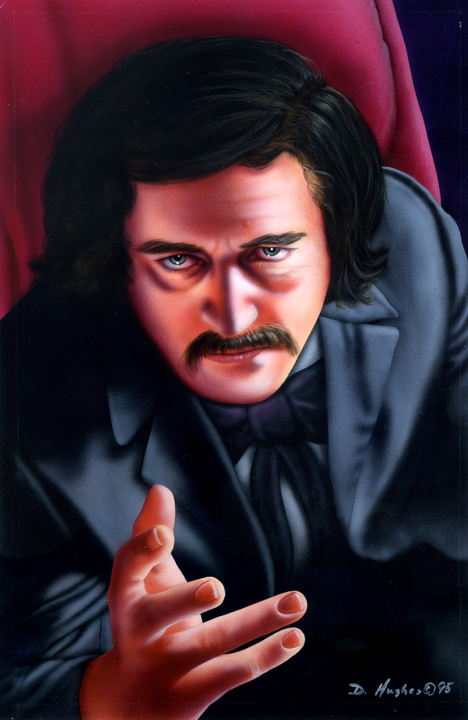
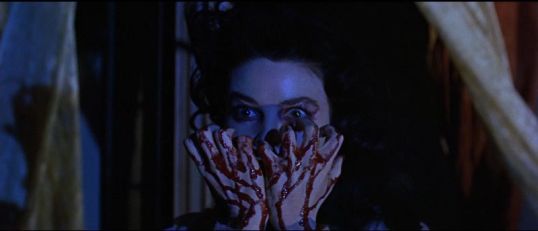
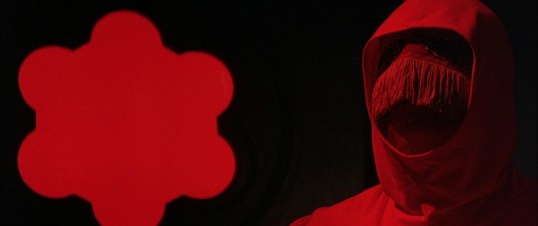
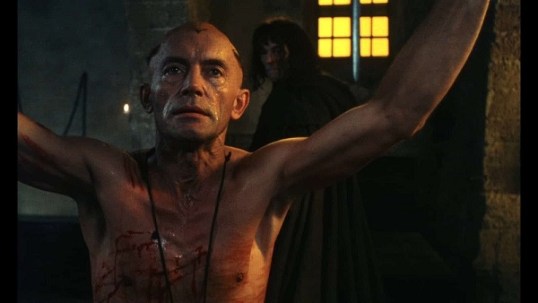
Horror Film Review: The Haunted Palace (dir by Roger Corman)


In the 18th century, the inhabitants of Arkham, Massachusetts yank Joseph Curwen (Vincent Price) out of his mansion and tie him to a tree.  They accuse Curwen of being a warlock who is in league with the devil and who has been bringing young women to his “palace,” and putting them in a trance.  They burn Curwen alive but, before the flames are lit, they also give Curwen a chance to speak and curse both them and their descendants.

You really do have to wonder about the logic behind witch (and warlock) burnings.  They seem counter-productive because they always give the accused just enough time to cast one final curse before being burned to a crisp.  Indeed, you have to wonder why witches and warlock were allowed any final words to begin with.  I mean, at some point, you would think everyone would notice that the final words were always a curse.

Anyway. 110 years later, Joseph Curwen’s descendant, Charles Dexter Ward (Vincent Price, again) rides into town with his wife, Anne (Debra Paget).  He is stunned to see that Arkham has apparently fallen on hard times, with many of the town’s people being horribly disfigured.  It’s explain to him that the disfigurements and the poverty are all a result of his ancestor’s curse.  That’s going to make things a bit awkward, considering that Charles Dexter Ward has not only inherited the Palace but he’s also inherited a copy of Necronomicon and a legacy of messing with Cthulhu.  The townspeople don’t want Ward around but he and Anne decide to spend the night in the Place regardless.

Of course, it doesn’t take long for Curwen’s spirit to possess Charles.  Soon, Charles is trying to resurrect Curwen’s mistress, Hester (Cathie Merchant) and pursuing Curwen’s goals of breeding a race of super humans by forcing the women of the town to mate with the fearsome Yog-Sothoth.  Charles also seeks vengeance on the descendants of those who burned Curwen at the stake, as if all of the poverty and the deformities aren’t punishment enough.  Again, this is why you don’t give warlocks and witches a chance to get out one last curse before being executed.

Though The Haunted Palace is usually considered to be a part of Roger Corman’s Edgar Allan Poe cycle, the story itself is actually based on H.P. Lovecraft’s The Case of Charles Dexter Ward.  (In Lovecraft’s novella, Ward seeks out his evil ancestor whereas, in the film, Ward is more or less an innocent victim.)  The film’s title comes from a Poe poem, which is recited at both the beginning and the end of the film.  But the film itself, with its references to the Cthulhu mythos and its hideous New England setting, is definitely a work of Lovecraftian horror.

Fortunately, it’s an effective work of Lovecraftian horror, one that captures the feeling of people unwisely trying to control a force of evil that they cannot begin to comprehend.  Roger Corman keeps the action moving quickly and creates a gothic atmosphere of impending doom.  Vincent Price, toning down his usual theatrics, is chillingly evil as Curwen and sympathetic as Charles.  The film’s strongest performance, however, comes from Debra Paget, who desperately tries to free her husband from Curwen’s control.  Any woman who has suddenly felt as if she can no longer recognize the man who she once loved will be able to relate to Paget’s performance.

The Haunted Palace is a strong entry in the films of Roger Corman and Vincent Price and one of the better adaptations of the work of H.P. Lovecraft.

Horror Film Review: Tales of Terror (dir by Roger Corman)


Eh, anthology films.

I have to admit that I’ve never been a huge fan of anthology films.  Anthology films are almost always a bit uneven.  Some filmmakers are better suited to making short films than others and, as anyone who has ever sat through one can tell you, sitting through a boring short film is actually worse than having to watch a boring long film.  Too often, anthology films are just a collection of boring short films.  If you get lucky, there might be a good segment hidden amongst all of the bad segments.  But even so, that often means sitting through 30 minutes of bad filmmaking for 15 minutes of something that’s moderately entertaining.

1962’s Tales of Terror is an anthology horror film.  Directed by Roger Corman, the film is a part of his Poe cycle and features adaptations of three Poe short stories, Morella, The Black Cat, and The Facts In The Case of M. Valedemar.  While it definitely suffers from the flaws that afflict many anthology films, Tales of Terror is saved a bit by the presence of Vincent Price.  Price not only appears  in all three of the films but he also provides the narration that links each film.  As I mentioned when I reviewed The Premature Burial, one cannot underestimate the importance of Vincent Price and his unique style of acting when it comes to discussing Corman’s Poe adaptations.  With his dramatic flourishes and his theatrical style of speaking, Price was the perfect star for these films.  As an actor, he perfectly complimented Corman’s flamboyant and colorful direction.  It also helps that Price himself seems to be truly enjoying himself in all of these films.  His eccentricity brings the film’s to life.

As for the separate stories that make up Tales of Terror, things get off to a rather macabre start with Morella.  Leonora (Maggie Pierce) returns home to visit her father (Vincent Price), who is now a drunken wreck who continues to blame Leonora for the death of her mother, Morella (Leona Gage).  Morella died while giving birth to Leonora.  Leonora is shocked to discover that her father is keeping her mother’s decomposing body in the mansion.  Leonora, who is suffering from a terminal illness, tries to take care of her father.  However, Morella’s spirit remains in the house, leading this story to a rather depressing and unsettling ending.  This story was effectively done, playing out like a particularly morbid companion to The Fall Of The House of Usher.

The Black Cat is presented as a comedy, starring Peter Lorre as a man who becomes convinced that his wife is cheating on him with a snobby wine taster who is, of course, played by Vincent Price.  This overlong segment did not work for me and I have to admit that a lot of that is because I love cats, black cats in particular.  Beyond that, the humor is a bit too broad.  Corman could do comedy, as he showed with Little Shop of Horrors, but he seems to be trying a bit too hard here.

Finally, the third segment is The Facts In The Case of M. Valdemar, in which Vincent Price plays the title character.  The dying Valdemar employs a hypnotist (Basi Rathbone) to put him in a trance to help relieve his suffering.  However, the hypnotist hopes to marry Valdemar’s wife (Debra Paget) and, after putting Valdemar into a trance, he leaves the dying man there.  Valdemar, whose body starts to decay, cannot die.  But, once he becomes angry enough, he can still rise from his bed to seek revenge even as his body putrefies.  This segment was the best of the three, featuring Price’s best work in the film and also a wonderfully villainous turn from Basil Rathbone.  The makeup effects that were used to capture Valdemar’s decay remain effectively frightening today.

Tales of Terror is two good stories and one mediocre one, which is better than the usual anthology film.  Still, not surprisingly, the main reason watch is for the wonderful Vincent Price.

Horror Film Review: Day The World Ended (dir by Roger Corman)


“You finally did it!  You blew it up! …. Goddamn you to Hell!”

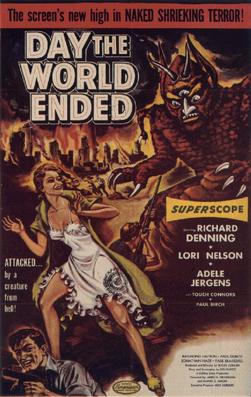
That’s right.  Just as how the original Planet of the Apes showed us what the world would look like centuries after a nuclear war, 1957’s Day The World Ended shows us what things would be like in  the weeks afterwards.  And guess what?  It wouldn’t be a lot of fun.

Day The World Ended starts with the bombs dropping and mushroom clouds forming in all of their fearsome glory.  (Oppenheimer may have hated his greatest achievement but aesthetically, the atomic bomb is still an impressive invention.)  Jim Maddison (Paul Birch) and his daughter, Louise (Lori Nelson), manage to survive by camping out in a steel bunker that Maddison built especially for the moment.  As a former Navy commander, Maddison understood that the world was on the verge of nuclear war and he also understood that only those with discipline would survive.  He’s filled with bomb shelter with supplies and he’s told Louise that only the two of them can use the shelter.  Anyone else is out of luck.

Unfortunately, people keep showing up at the shelter and asking to come in.  And while Maddison is prepared to leave them outside with the fallout and the mutants that have started to roam the desert, Louise just can’t stand the thought of leaving anyone to die.  Reluctantly, Maddison starts to allow people to join him and his daughter.  Some of them, like geologist Rick (Richard Denning), are a good addition to the group,  Rick is actually an expert in uranium mining and a potential husband for Louise.  (Louise has a fiancé but he’s missing.  She keeps his picture by her bed.  The picture, of course, is actually a photo of director Roger Corman.)  Unfortunately, not everyone is as likable and well-intentioned as Rick.  Lowlife hood Tony (Mike Connors) and his girlfriend, Ruby (Adele Jergens) show up and continue to act as if they’ve got the police after them even though the police were probably atomized with the rest of civilization.  And finally, there’s a man (Jonathan Haze) who is transforming into a mutant and who develops a strange mental connection to Louise.

No one said the end of the world would be easy!

Day The World Ended was Corman’s fourth film as a director and it was also his first film in the horror genre.  (It’s actually a mix of science fiction and horror but whatever.)  The film was enough of a box office success that it inspired Corman to do more films in the genre.  Seen today, it’s obviously an early directorial effort.  It lacks the humor that distinguished Corman’s later films.  In fact, the film is actually a little bit boring.  Watching a film like this really drives home just how important Vincent Price and his energy were to Corman’s later films.  This film doesn’t have an actor like Vincent Price or Boris Karloff or even Dick Miller, someone who could energize a film just through the power of their own eccentricities.  Instead, Mike Connors, Paul Birch, and Richard Denning all give dull performances as the survivors.  This is a historically important film because, without its box office success, Corman probably would have stuck with doing B-westerns and gangster films.  Filmgoers should be happy that audiences in the 50s were drawn in by the film’s title and their own paranoia about nuclear war.  It’s a film that one appreciates as a piece of history, even if it doesn’t quite stand up to the test of time.

Horror Film Review: Premature Burial (by Roger Corman)


Poor Guy Carrell (Ray Milland!)

The character at the center of the 1962 Edgar Allan Poe adaptation, The Premature Burial, Guy spends his days terrified of being buried alive.  Like his father before him, Guy suffers from a disease that can make him appear to be dead despite actually being alive.  Guy is convinced that his father was buried alive and swears that he could even hear his father crying for help inside of his tomb.  Though his fiancée, Emily (Hazel Court), insists that Guy is driving himself mad with his fears, Guy continue to spend his time trying to invent a coffin from which one can easily escape.  Even after Emily and Guy are married, Guy continues to obsess.

Finally, faced with the prospect of opening his father’s tomb to discover whether or not his father truly was buried alive, Guy appears to drop dead of a heart attack.  But is he really dead or is he about to be buried alive!?  And who is responsible for the series of mysterious events that apparently drove Guy to collapse of fright?  Watch the film to find out!  Or read the Edgar Allan Poe short story.

This was the third of Roger Corman’s Edgar Allan Poe adaptations and it’s the first one to not feature Vincent Price as the lead character.  For the most part, the members of the small cast all do a good job with their roles.  Ray Milland is both sympathetic and a little frightening as the obsessed Guy.  Heather Angel is properly enigmatic as Guy’s overprotective sister and Hazel Court will keep you guessing as far as her character’s motivations are concerned.  Dick Miller has a small but key role as a grave digger who seems to take just a little bit too much enjoyment from his work.  The film’s atmosphere is properly gothic and, if the film isn’t as visually audacious as the first two Poe films, Corman still finds time to include a creepy and psychedelic dream sequence.

That said, Vincent Price is still very much missed.  Corman reportedly wanted to use Price but, because Corman produced and financed the film  himself, Corman’s former business partners at American International Pictures would not allow Price to appear in the film.  (Price was under exclusive contract to AIP.)  By the time Corman and AIP worked out their disagreements and again joined forces, Ray Milland had already been cast in the lead role.

While the actors all do a good job, it’s hard to deny that Guy Correll would have been an ideal role for Vincent Price, even if it would have meant essentially re-doing his performance from The Pit and the Pendulum.  It’s not just that the film misses Price’s theatrical acting style.  The film also misses the energy that Price brought to the previous two Poe films.  The Premature Burial moves at a stately pace and, in the end, it’s a bit too slow and respectable for its own good.  Price would have jazzed things up and made a decent film into a truly memorable one.  Fortunately, Price would return for the later Poe adaptations.

Horror Film Review: The Pit and the Pendulum (dir by Roger Corman)


The second of Roger Corman’s Edgar Allan Poe adaptations, 1961’s The Pit and The Pendulum opens in much the same way as The Fall of the House of Usher.  A young Englishman (played by John Kerr) rides a horse across a colorful but desolate landscape.  A castle sits in the distance.

Of course, as opposed to  the 19th Century British setting of The Fall of the House of Usher, The Pit and the Pendulum takes place in 16th Century Spain, at a time when the country was still scarred by the horrors of the Inquisition.  And Francis Barnard is not traveling to the castle to see his fiancée but instead, he’s searching for information about the disappearance of his sister, Elizabeth (played by the one and only, Barbara Steele).  At the castle, Francis meets Elizabeth’s husband, Nicholas (Vincent Price) and Nicholas’s sister, Catherine (Luana Anders).  Nicholas explains that Elizabeth died under mysterious circumstances, while suffering from a rare blood disorder that seemed to quickly sap away her will to live.  Nicholas’s best friend, Dr. Leon (Anthony Carbone), explains that Elizabeth died of fright after she locked herself in one of the iron maidens in the castle’s torture chamber….

Oh yes, the castle has a torture chamber.  Nicholas’s father was a leader of the Inquisition and he used the castle as a place to conduct his business.  Nicholas’s father was a madman who suspected that his wife was cheating on him.  One day, while young Nicholas was exploring the torture chamber, he witnessed his father murder both his wife and his brother.  Nicholas watched as his mother was entombed alive and ever since, he’s been terrified of the idea of premature burial.  In fact, his fear that he may have buried alive Elizabeth while she was still alive is driving him mad.  The sudden arrival of the suspicious Francis doesn’t help matters….

The Pit and the Pendulum opens with splashes of color spreading across the screen, a sign that Corman was once again in a pop art state of mind when he directed this film.  The Pit and The Pendulum takes everything that worked (and didn’t work) about The Fall of the House of Usher and it turns it all up by a notch or two.  The castle is even more gothic.  Vincent Price’s Nicholas is even more mentally fragile than his Roderick Usher, though Nicholas is also a quite a bit more sympathetic.  If Roderick was a control freak who used his family’s curse as an excuse to embrace his own authoritarian tendencies, Nicholas is just a frail man suffering from PTSD.  He’s definitely more of a victim than a victimizer … or, at least, he is at first.  Much like Mark Damon is The Fall of the House of the Usher, John Kerr is a bit of a stiff in the role of Francis but it doesn’t matter.  Vincent Price is the main attraction here and Corman’s direction shows that he understood that.

And then there’s the Pendulum.  It takes a while for the Pendulum and its swinging blade to make an appearance but when it does, it lives up to the hype.  The Pendulum swings and Corman goes all out, zooming into Price’s crazed eyes while the Pendulum comes closer and closer to its latest victim.  The images are tinted red and green and the Pendulum itself seems to swing in a slow motion, the cinematic equivalent of a nightmare come to life.

The Pit and the Pendulum is a wonderful work of gothic pop art.  Featuring Vincent Price at his most wonderfully unhinged, this is a film we should all watch this Halloween.

Pit and the Pendulum (1961, dir by Roger Corman, DP: Floyd Crosby)


Horror Movie Review: The Fall of the House of Usher (dir by Roger Corman)


The 1960 film, The Fall Of The House of Usher, opens with Phillip Winthrop (Mark Damon) riding his horse across a desolate landscape.

There’s a foreboding mansion in the distance but what the viewer immediately notices is that the land around the mansion looks almost post-apocalyptic.  Even though the film is set in the 1800s, the misshapen trees and the high winds all bring to mind a film set in a nuclear-scarred world, the type where you expect to find radioactive mutants hiding behind every tree and rock.

Phillip is a young aristocrat who is traveling to the home of the Usher family.  He is engaged to marry Madeleine Usher (Myrna Fahey) but, as soon as he arrives at the mansion, her older brother, Roderick (Vincent Price, with no mustache and blonde hair), informs Phillip that he will never be allowed to marry Madeleine.  Roderick explains that the Usher family is cursed and he even takes Phillip on a tour of Usher family history, showing him a series of truly hideous paintings of past Ushers.  One Usher was a murderer.  Another Usher was blackmailer.  An Usher wearing a pirate’s cap is identified as being a slave trader.  The Ushers are cursed, with each family member destined to become insane.  Roderick’s mission is to bring the Usher bloodline to a close and that means that Madeleine cannot marry.

Phillip disagrees, especially when the sickly Madeleine herself says that she wants to escape from her seemingly mad brother.  With the house itself continually shaking as if it’s on the verge of collapsing, Phillip becomes determined to take Madeleine away.  Roderick tries to warn him not to.  Even the friendly butler, Bristol (Harry Ellerbe), encourages Phillip to give up.  But Phillip remains stubborn and determined.  However, when Madeleine suddenly collapses and dies, it appears that Phillip’s plans to marry her are at an end.  But is Madeleine truly dead?

Based on a short story by Edgar Allan Poe, this was, at the time, the most expensive film that Roger Corman and American International Pictures had ever made.  (It was also their first color film.)  Of course, the budget was still just $300,000 and the Usher mansion was largely constructed out of props that were borrowed from other films.  That said, the film had a name star and, with its vivid colors and its fiery finale, it certainly looked like a big-budget film.  This film marked the first collaboration between Vincent Price and Roger Corman and it was a box office success, making  a million dollars at a time when a million dollars really meant something..  Corman and Price would go on to do several other Poe adaptations together, all of which were distinguished by Price’s villainous performances and Corman’s pop art visuals.

Seen today, The Fall of the House of Usher can seem to be a bit slow.  With only one location and a cast of only four actors, it often feels a bit stagey.  Mark Damon is rather stiff as Phillip.  (One can see why he abandoned acting to become a producer.)  But Vincent Price’s performance as Roderick Usher continue to entertain, with Price delivering every line of dialogue with his trademark aristocratic archness.  There’s nothing subtle about Price’s performance but Price’s tendency to overact perfectly matched Corman’s vivid visuals and it’s interesting to watch a hyperactive Price performance paired with the type of dull performance that Mark Damon offers up.

The fiery finale still packs a certain punch and, watching it, one can see why Corman and Price said, “Let’s do this again!”  The Fall of the House of Usher (which is also available on some streaming sites as simply House of Usher) remains an enjoyable macabre Halloween treat.

House of Usher (1960, dir by Roger Corman, DP: Floyd Crosby)


Horror on the Lens: Dementia 13 (dir by Francis Ford Coppola)


(I originally shared this film back in 2011, 2019, 2022, and 2023 — can you believe we’ve been doing this for that long? — but the YouTube upload keeps getting taken down!  So, I’m resharing it today!)

For today’s excursion into the world of public domain horror, I offer up the film debut of Francis Ford Coppola.  Before Coppola directed the Godfather and Apocalypse Now, he directed a low-budget, black-and-white thriller that was called Dementia 13.  In a possible sign of things to come, producer Roger Corman and Coppola ended up disagreeing on the film’s final cut and Corman reportedly brought in director Jack Hill to film and, in some cases, re-film additional scenes.

Regardless of whether the credit should go to Coppola, Corman, or Hill, Dementia 13 is a brutally effective little film that is full of moody photography and which clearly served as an influence on the slasher films that would follow it in the future.  Speaking of influence, Dementia 13 itself is obviously influenced by the Italian giallo films that, in 1963, were just now starting to make their way into the drive-ins and grindhouses of America.

Speaking of giallo films, keep an eye out for Patrick Magee, who gave a memorable performance in Lucio Fulci’s The Black Cat.  Luana Anders, who plays the duplicitous wife in this film, showed up in just about every other exploitation film made in the 60s and yes, the scene where she’s swimming freaks me out to no end.  Other films featuring Luana Anders include Night Tide and Easy Rider, in which she played one of the hippies who unsuccessfully enticed Peter Fonda and Dennis Hopper to stay at the commune.

As for Francis Ford Coppola, well, he’s gone on to have quite a career, hasn’t he?  It’s been quite a journey from Dementia 13 to Megalopolis!

Horror Film Review: X: The Man With X-Ray Eyes (dir by Roger Corman)


X: The Man With The X-Ray Eyes (1963, dir by Roger Corman, DP: Floyd Crosby)

Eyes.  They’re one of the most important parts of our body but they’re also frightening easy to damage. Unlike the heart or the liver or the brain, they don’t have a protective covering of skin and bone.  They sit exposed and  are easily injured.  They can be ripped out of one’s head, which is a scary thought.  As well, they tend to grow weaker over time.  I love my multi-colored eyes and I think they’re one of my best features but I still spend a lot of time wishing that they weren’t quite as vulnerable as they are.  I often say that I’m blind without my contacts or my glasses.  That’s not quite true, of course.  I can see enough to get by if I forget to put in my contacts but I still have to do a lot of squinting, enough so that most people can take one look at me and say, “You forgot to put in your contacts, didn’t you?”  In my case, my eyesight has definitely gotten even worse over the past few years.  I’ve been told that’s normal but it still freaks me out.  I worry about waking up one day and not being able to see anything at all.

Director Lucio Fulci, a diabetic who was slowly going blind during the final years of his life, was infamous for including scenes of eyes being either pierced or gouged out in his films.  The New York Ripper even featured one scene where an eye was slit in half with a razor blade.  (This occurred in a close-up, no less!)  In Joe D’Amato’s Beyond the Darkness, there’s a scene where a mad taxidermist replaces the eyes of his dead fiancée with glass and for me, that’s one of most disturbing elements of the film.  Horror directors understand the vulnerability of the eyes and the sadness when life is extinguished from those eyes.  Eyes are said to be the windows to soul and when those eyes are lifeless, it’s a reminder that a living soul is a fleeting thing.

Perhaps that’s why 1963’s X: The Man With The X-Ray Eyes is such an effective work of art.  Directed by Roger Corman, the film tells the story of Dr. James Xavier (Ray Milland), a doctor who has developed eye drops that, when taken, allow one to have x-ray vision.  Dr. Xavier claims that the eye drops will allow doctors to more easily diagnose their patients and certainly, he has a point there.  His friend, Dr. Sam Brant (Harold J. Stone), points out that the eyes are directly connected to the brain and that using experimental eye drops on them could potentially drive a person mad.  Dr. Xavier proves Dr. Brant’s point by losing his tempter and accidentally pushing him out of a window.

Ah, x-ray vision.  It all starts out fun.  Dr. Xavier is performing miracle surgeries and seeing what everyone looks like naked.  (The swinging jazz party scene is a classic example of how 60s B-movies teased audiences while never quite showing everything.) But once he’s forced to go on the run from the police, Xavier finds himself making a living as a carnival psychic while still trying to refine his eyedrops.  Xavier’s sleazy manager (Don Rickles) tries to turn Xavier into a faith healer but, with Xavier’s x-ray vision growing more erratic and more intense, Xavier ends up running off to Vegas with a former colleague, Dr. Diane Fairfax (Diana Van der Vils).

And again, it’s all fun and games as Xavier uses his powers to cheat at cards.  But then the megalomania kicks in and, after Xavier basically announces that he’s cheating, he finds himself being chased through the desert by a police helicopter and freaking out as more and more of the universe is revealed to him.  Much like a Lovecraftian protagonist who has been driven mad by the sight of the Great Old Ones, Xavier finds himself overwhelmed by the center of the universe.  At a tent revival, a preacher shouts, “If thine eye offends thee, pluck it out!”

The film’s final image is a shocking one and it stays with you.  (There were rumors that the film originally ended with Xavier shouting, “I can still see!” but Corman himself said that never happened.)  Even without that final image, this would be one of Corman’s best films, a surprisingly intelligent and rather sad story about a man who, in trying to see what is usually hidden, was driven mad by what he discovered.  Ray Milland was well-cast as Dr. Xavier and watching him go from being a somewhat stiff but good-hearted scientist to a raving madman at a revival is quite an experience, a testament to the vulnerability that all humans share.  In the name of science, Xavier goes from being a respected researcher to being chased through the desert by a helicopter.  The man who wanted to be able to see everything finds himself wishing to be forever blinded.  Sometimes, the film suggests, it’s best not to be able to see everything around us.  Sometime, the mysteries of the universe should remain mysteries and the rest of us should respect our own vulnerabilities.

Horror on the Lens: The Terror (dir by Roger Corman, Francis Ford Coppola, Jack Hill, Monte Hellman, Dennis Jakob, and Jack Nicholson)


Have you ever woken up and thought to yourself, “I’d love to see a movie where a youngish Jack Nicholson played a French soldier who, while searching for a mysterious woman, comes across a castle that’s inhabited by both Dick Miller and Boris Karloff?”

Of course you have!  Who hasn’t?

Well, fortunately, it’s YouTube to the rescue.  In Roger Corman’s 1963 film The Terror, Jack Nicholson is the least believable 19th century French soldier ever.  However, it’s still interesting to watch him before he became a cinematic icon.  (Judging from his performance here and in Cry Baby Killer, Jack was not a natural-born actor.)  Boris Karloff is, as usual, great and familiar Corman actor Dick Miller gets a much larger role than usual.  Pay attention to the actress playing the mysterious woman.  That’s Sandra Knight who, at the time of filming, was married to Jack Nicholson.

Reportedly, The Terror was one of those films that Corman made because he still had the sets from his much more acclaimed film version of The Raven.  The script was never finished, the story was made up as filming moved alone, and no less than five directors shot different parts of this 81 minute movie.  Among the directors: Roger Corman, Jack Hill, Monte Hellman, Francis Ford Coppola, and even Jack Nicholson himself!  Perhaps not surprisingly, the final film is a total mess but it does have some historical value.

(In typical Corman fashion, scenes from The Terror were later used in the 1968 film, Targets.)

Check out The Terror below!

4 Shots From 4 Films: Special Roger Corman Edition


4 (or more) Shots From 4 (or more) Films is just what it says it is, 4 (or more) shots from 4 (or more) of our favorite films. As opposed to the reviews and recaps that we usually post, 4 (or more) Shots From 4 (or more) Films lets the visuals do the talking.

Today, on the first day of Horrorthon, we remember the great film pioneer and director, Roger Corman!  It’s time for….

4 Shots From 4 Roger Corman Films

Not of this Earth (1957, dir by Roger Corman DP: John J. Mescall)

Pit and the Pendulum (1961, dir by Roger Corman, DP: Floyd Crosby)

X: The Man With The X-Ray Eyes (1963, dir by Roger Corman, DP: Floyd Crosby)

The Masque of the Red Death (1964, dir by Roger Corman, DP: Nicolas Roeg)