Don’t worry. There’s Miles O’Keeffe in The Drifter. (™ MST3k)
While driving back to Los Angeles from a fashion show, designer Julia Robbins (Kim Delaney, long before co-starring on NYPD Blue) picks up and has a one night stand with a hitchhiker named Trey (O’Keeffe). Even though Julia does not ever plan to see him again, she still gives him her grandfather’s stopwatch. Trey is so touched by the gift that he shows up in Los Angeles and starts demanding to see her. Julia, who already has a cheating boyfriend (Timothy Bottoms), doesn’t want anything to do with Trey. When one her friends is murdered while staying at Julia’s apartment, Julia finally goes to the police and tells Detective Morrison (played by the director, Larry Brand) about Trey. But is Trey the one who she should be worried about?
The Drifter is an above average example of the films that Roger Corman executive produced in the 80s and 90s. The predictable plot won’t win any points for plausibility but Larry Brand did a good job directing and everyone in the cast (especially Delaney) contributed a decent performance. The film has a twist ending that might take viewers by surprise but probably won’t. As for where this ranks in the Miles O’Keeffe filmography, it’s better than Tarzan, The Ape Man but it’s still no Ator.
The Drifter was enough of a success that it got a quasi-sequel in 1990. Larry Brand (and Detective Morrison) returned in tomorrow’s movie a day, Overexposed.
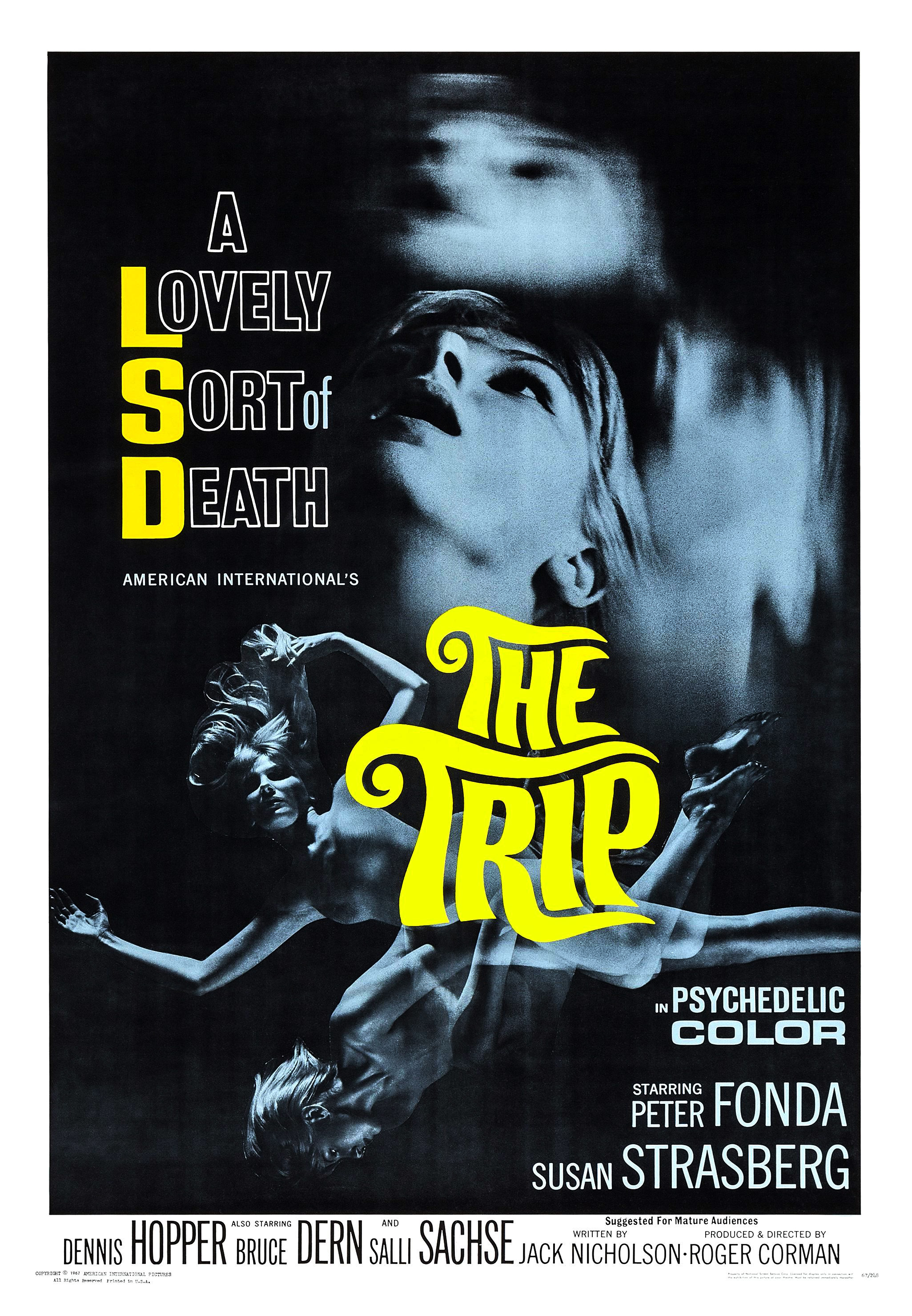
“You are about to be involved in a most unusual motion picture experience. It deals fictionally with the hallucinogenic drug LSD. Today, the extensive use in black market production of this and other so-called ‘mind bending’ chemicals are of great concern to medical and civil authorities…. This picture represents a shocking commentary on a prevalent trend of our time and one that must be of great concern to us all.” – Disclaimer at the beginning of 1967’s THE TRIP
“Tune in, turn on, drop out”, exhorted 60’s acid guru Timothy Leary. The hippie generation’s fascination with having a psychedelic experience was a craze ripe for exploitation picking, and leave it to Roger Corman to create the first drug movie, THE TRIP. Released during the peak of the Summer of Love, THE TRIP was a box office success. Most critics of the era had no clue what to make of it, but the youth…
We’ve got a great big Death Race… runnin’ through the night. [sung]
So, the OA was ok, but just not good enough to keep anyone’s interest for my reviews. The result: my editor took pity on me and gave my brain a rest with…..
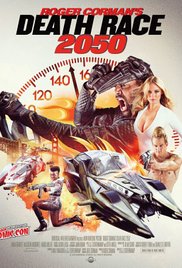
DEATH RACE 2050
I will say this for Death Race 2050 – Manu Bennet AKA Slade Wilson can act. It kind of got to me that he’s in a Roger Corman flick. The other actors belonged in Roger Corman films, including Malcolm McDowell, who I always thought was a hack, but Manu Bennet really needs a new agent.
The Death Race world is a desolate shit hole with 99% unemployment; yet, we are overpopulated…. somehow. Also, because of the over-population we need to do some culling in a very inefficient way, hence the Death Race. We all need to NOT think about why we need such an inefficient way to decrease the population because it will ruin your guilty pleasure. The political statement doesn’t really make sense because America is supposed to be a Corporation, but nobody works or makes anything and all we do is watch people’s homemovies. So, America is Youtube! HIYOOOO!!!
The Death Race is a coast to coast kill spree that awards points to drivers who kill pedestrians along the way. The Chairman who is obviously Donald Trump is the inventor of the death race. He sees it as a good distraction for the masses who use VR to experience the carnage. The drivers are Frankenstein – the anti-hero and reigning champion, Minerva-the rapper, Tammy- interfaith evangelist (really), Perfectus- a genetically engineered heir apparent- who is closeted, and an artificially intelligent car. To advance the plot, every driver is paired up with a co-pilot to provide openings for dialogue and comic relief.
The anti-hero of the story is Frankenstein (Manu “Why am I doing this?” Bennet). He doesn’t care about the craphole that the world is because he likes to race. Annie is his Co-Pilot, but she is actually with the Resistance … DUN DUN DUN! The Resistance is a group of angry democrats who are trying to figure out how 1) we elected a fascist and 2)how we can get people to vote in 4 years…. Wait, that’s my reality. The race begins with a lot people getting run over and points being awarded to drivers – this goes on for about a half hour.
Then, they reach the Heartland. These people are slightly harder to kill because they shoot back. During this time, we learn by a lot of telling that Annie is in the Resistance and needs to kill Frankenstein, but she is starting to love him. Also, the Resistance leader is in cahoots and the paramour of the evil Chairman.
Annie tries to set up Frankenstein as per her orders and he gets attacked by Ninjas. Ok fine, ninjas it is! He kills the ninjas and quasi-forgives Annie. They end up at a well-stocked, but unattended hotel. Perfectus over-acts, attacks Frankenstein, and tries to come to terms with his sexuality. It’s a very fast arc. Just as Perfectus is about to kill Frankenstein, Annie knocks him out. Annie’s gonna knock you out….I’m gonna you out. [Sung as LL Cool J]. This allows Annie and Frankenstein to begin to fall in love. AWWWW.
The Southwest and New Los Angeles
The Chairman changes the rules to keep Frankenstein on one road that is a trap. Frankenstein wins, the other racers die, and Frankenstein decides to kill the Chairman. Yep, life comes at you pretty fast in Death Race 2050.This is not at all like Death Race 2050 BC because chariots couldn’t go that fast. BAM!
Frankenstein runs down the Chairman and then asks America to do their own race, causing the entire population to kill each other. This begs the point: why not do that instead of a Death Race?
Death Race 2050 had a lot of schlock for the buck. There was loud death metal, weird cars, bewbs, Donald Trump references, and Manu Bennet. I would say Death Race 2050 is a fine way to spend 90 minutes of your day, if you are into these films. I don’t know if this was Grindhouse, but it’s gotta be close to the genre. Cheers!
(I originally shared this film back in 2011 — can you believe we’ve been doing this for that long? — but the YouTube vid was taken down. So, I’m resharing it today!)
For today’s excursion into the world of public domain horror, I offer up the film debut of Francis Ford Coppola. Before Coppola directed the Godfathers and Apocalypse Now, he directed a low-budget, black-and-white thriller that was called Dementia 13. (Though, in a sign of things to come, producer Roger Corman and Coppola ended up disagreeing on the film’s final cut and Corman reportedly brought in director Jack Hill to film and, in some cases, re-film additional scenes.)
Regardless of whether the credit should go to Coppola, Corman, or Hill, Dementia 13 is a brutally effective little film that is full of moody photography and which clearly served as an influence on the slasher films that would follow it in the future. Speaking of influence,Dementia 13 itself is obviously influenced by the Italian giallo films that, in 1963, were just now starting to make their way into the drive-ins and grindhouses of America.
In the cast, keep an eye out for Patrick Magee, who later appeared as Mr. Alexander in A Clockwork Orange as well as giving a memorable performance in Lucio Fulci’s The Black Cat. Luana Anders, who plays the duplicitous wife in this film, showed up in just about every other exploitation film made in the 60s and yes, the scene where she’s swimming freaks me out to no end.
(One final note: I just love the title Dementia 13. Seriously, is that a great one or what?)
We can’t have Halloween without a good Roger Corman movie, and A BUCKET OF BLOOD is one of my favorites. This 1959 black comedy is a precursor to Corman’s THE LITTLE SHOP OF HORRORS, and I actually prefer it over that little gem. A BUCKET OF BLOOD skewers the pretentiousness of the art world, the 50’s beatnik scene, and the horror genre itself with its story of nerdy Walter Paisley, a busboy at a hipster coffee house learns making it as a famous artist can be murder!
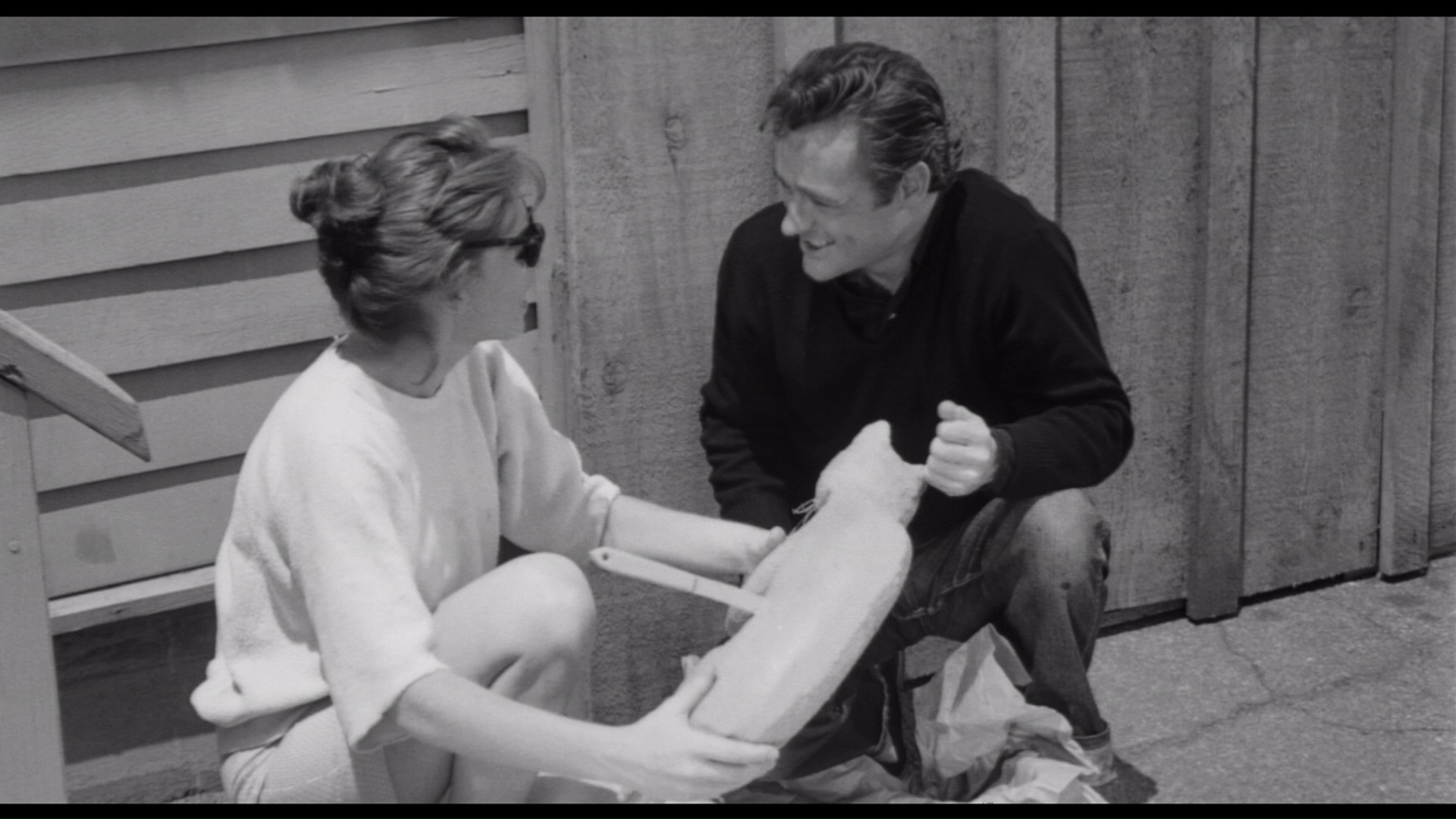
Walter’s a no-talent nebbish longing to be accepted by the pompous clientele at The Yellow Door, especially beautiful hostess Carla. When he accidentally kills the landlady’s cat, Walter covers it in clay (with the knife still protruding in poor little Frankie!), and brings it in to work. The grotesque sculpture causes a stir among the patrons, and Walter is congratulated for his brilliant work ‘Dead Cat’. Beatnik…
(It’s tradition here at the Lens that, every October, we watch the original Little Shop of Horrors. And always, I start things off by telling this story…)
Enter singing.
Little Shop…Little Shop of Horrors…Little Shop…Little Shop of Terrors…
Hi! Good morning and Happy October the 25th! For today’s plunge into the world of public domain horror films, I’d like to present you with a true classic. From 1960, it’s the originalLittle Shop of Horrors!
When I was 19 years old, I was in a community theater production of the musical Little Shop of Horrors. Though I think I would have made the perfect Audrey, everybody always snickered whenever I sang so I ended up as a part of “the ensemble.” Being in the ensemble basically meant that I spent a lot of time dancing and showing off lots of cleavage. And you know what? The girl who did play Audrey was screechy, off-key, and annoying and after every show, all the old people in the audience always came back stage and ignored her and went straight over to me. So there.
Anyway, during rehearsals, our director thought it would be so funny if we all watched the original film. Now, I’m sorry to say, much like just about everyone else in the cast, this was my first exposure to the original and I even had to be told that the masochistic dentist patient was being played by Jack Nicholson. However, I’m also very proud to say that — out of that entire cast — I’m the only one who understood that the zero-budget film I was watching was actually better than the big spectacle we were attempting to perform on stage. Certainly, I understood the film better than that screechy little thing that was playing Audrey.
The first Little Shop of Horrors certainly isn’t scary and there’s nobody singing about somewhere that’s green (I always tear up when I hear that song, by the way). However, it is a very, very funny film with the just the right amount of a dark streak to make it perfect Halloween viewing.
So, if you have 72 minutes to kill, check out the original and the best Little Shop of Horrors…
(As some of you may have noticed, I shared this movie last year as well. However, since the video that I embedded in the previous post was subsequently taken down, I figured I might as well post it again this year. Plus, it’s Boris Karloff, Jack Nicholson, and Dick Miller! Why not post it twice?)
Have you ever woken up and thought to yourself, “I’d love to see a movie where a youngish Jack Nicholson played a French soldier who, while searching for a mysterious woman, comes across a castle that’s inhabited by both Dick Miller and Boris Karloff?”
Of course you have! Who hasn’t?
Well, fortunately, it’s YouTube to the rescue. In Roger Corman’s 1963 film The Terror, Jack Nicholson is the least believable 19th century French soldier ever. However, it’s still interesting to watch him before he became a cinematic icon. (Judging from his performance here and in Cry Baby Killer, Jack was not a natural-born actor.) Boris Karloff is, as usual, great and familiar Corman actor Dick Miller gets a much larger role than usual. Pay attention to the actress playing the mysterious woman. That’s Sandra Knight who, at the time of filming, was married to Jack Nicholson.
Reportedly, The Terror was one of those films that Corman made because he still had the sets from his much more acclaimed film version of The Raven. The script was never finished, the story was made up as filming moved alone, and no less than five directors shot different parts of this 81 minute movie. Among the directors: Roger Corman, Jack Hill, Monte Hellman, Francis Ford Coppola, and even Jack Nicholson himself! Perhaps not surprisingly, the final film is a total mess but it does have some historical value.
(In typical Corman fashion, scenes from The Terror were later used in the 1968 film, Targets.)
This October, I’m going to be doing something a little bit different with my contribution to 4 Shots From 4 Films. I’m going to be taking a little chronological tour of the history of horror cinema, moving from decade to decade.
Today, we start the 1960s!
4 Shots From 4 Films
Psycho (1960, dir by Alfred Hitchcock)
The Pit and the Pendulum (1961, dir by Roger Corman)
Long before Event Horizon (but, perhaps more importantly, shortly after the original Alien), there was 1981’s Galaxy of Terror!
Produced by Roger Corman and featuring production design and second unit work from James Cameron, Galaxy of Terror tells the story of what happens when, in the future, the crew of the Quest are dispatched to a mysterious planet. They’re on a rescue mission but what they don’t realize is that they’re heading into a trap!
The crew of the Quest is virtually a who’s who of cult actors.
The youngest member of the crew is Cos. Cos is scared of everything and, from the minute you see him, you can tell that he’ll probably be the first to die. Cos is played by Jack Blessing, who subsequently became a very in-demand voice over artist. You may not recognize the name or the face but you’ve probably heard the voice.
Captain Trainor, who is still troubled by a disastrous mission in the past, is played by Grace Zabriskie, who is rumored to have inspired Bob Dylan’s “Like A Rolling Stone” and who subsequently became a regular member of David Lynch’s stock company.
The fearsome Quuhod is played by one of the patron saints of exploitation filmmaking, the one and only SID HAIG! Quuhod doesn’t say much but Sid Haig doesn’t have to say much to make an impression.
Technical officer Dameia is played by Taaffe O’Connell. She suffers through the film’s most infamous and distasteful scenes, in which she’s assaulted by a gigantic space worm. That scene was apparently insisted upon by Roger Corman and it’s not easy to watch. At the same time, since the film takes place on a planet that is ruled by pure evil, the scene somehow works. It’s that scene that tells you that Galaxy of Terror is not going to be your typical B-movie. That is the scene that says, “This movie is going to give you nightmares!”
Ranger is played by Robert Englund! That’s right — the original Freddy Krueger himself. It’s interesting to see Englund in this role because Ranger is actually one of the only likable characters in the film. It’s strange to see the future Freddy Krueger being menaced by the same type of threats that he unleashed on Elm Street. But Englund does a good job in the role. In fact, he does so well that you wonder what would have happened in his career if he hadn’t been forever typecast as the man of your nightmares.
The arrogant and cocky Baelon is played by future director, Zalman King. It says something about King’s acting career that Galaxy of Terror is not the strangest film that he ever appeared in.
Burned-out Commander Ilvar is played by Bernard Behrens, who is one of those character actors who has a very familiar face. If you watch any movie from the 80s or 90s that features a weary homicide detective or an unsympathetic bureaucrat, it’s entirely possible that he was played by Bernard Behrens.
Kore, the ship’s cook, is played by Ray Waltson, who is another one of those very familiar character actors. Over the course of his long career, Waltson appeared in everything from The Apartment to The Sting to Fast Times At Ridgemont High to a countless number of TV shows and TV movies. Waltson was usually cast in comedic roles so it’s interesting to see him here, playing a role that is very much not comedic.
Alluma, an empath, is played by Erin Moran, who was best known for playing Ron Howard’s bratty sister on the somewhat terrible (but apparently popular and deathless) sitcom, Happy Days. Moran’s explosive death scene is another reason why Galaxy of Terror has a cult following.
And finally, the “star” of the film is Edward Albert, who plays Cabren. To return to my earlier comparison to Event Horizon, Edward Albert has the Laurence Fishburne role.
Anyway, our crew is sent on a rescue mission but, when they crash land on the planet Morganthus, they find themselves outside of a desolate pyramid. They make the mistake of exploring the pyramid and end up being confronted by their greatest fears. (They also eventually discover that one of their crewmates is a traitor.) It’s pretty much a typical sci-fi slasher film but it makes an impression because, thematically, it’s just so dark. The fears that attack the crew members are so ruthless and brutal that they will take even the most jaded of horror fans by surprise. Galaxy of Terror is relentless and merciless in its effort to scare the audience.
What especially distinguishes Galaxy of Terror is that, despite the obviously low budget, the entire film feels sickeningly real. A lot of credit for that has to go to James Cameron, who creates a lived-in future that actually feels a lot more plausible than anything to be found in Avatar.
So, if you have the chance, turn off the lights, watch the film in the dark, and prepare for a perfect Halloween nightmare!
Today’s Horror on the Lens is the 1959 Roger Corman film, Wasp Woman!
In this film, Janice Starlin (Susan Cabot) is the head of a cosmetic company. When she discovers that her sales are suffering because the public has noticed that she is getting older, Janice does what any dedicated CEO would do! She agrees to undergo a radical treatment involving the royal jelly taken from a queen wasp.
Do you think this treatment will make Janice look younger?
Or will it lead to her periodically transforming into a monstrous creature?
 How much keeffe is in this movie?