Lisa Reviews An Oscar Nominee: The Big Chill (dir by Lawrence Kasdan)


Big_chill_ver1

There are certain films that truly are “You just had to be there” films.  These are the movies that were apparently loved by contemporary audiences but, when viewed today, it’s difficult to see just what exactly everyone was getting so excited about.  Sometimes, this is because the film itself was so influential and has been copied by so many other films that the original has had its power diluted.  And then, sometimes, it’s just a case that the film was never that good to begin with.

I’m guessing that The Big Chill must be one of those “you just had to be there” type of films.  First released in 1983, The Big Chill was nominated for best picture.  If you look the film up over at the imdb, you’ll find lots of comments from people who absolutely adore this film.  However, when I watched the film as a part of TCM’s 31 Days of Oscar, I have to admit that my reaction can be best summed in one word.

Meh.

Now, don’t get me wrong.  I’m not saying that The Big Chill was a bad film.  To be honest, it was neither memorably bad nor remarkably good.  Instead, it just was.  Overall, the performances were good, the direction was shallow, and the screenplay was occasionally good and occasionally shallow but mostly, it was the epitome of serviceable.

At the start of The Big Chill, Alex is dead.  With the exception of a scene where his corpse is being prepared for burial, Alex never actually appears on screen.  (Originally, Kevin Costner was cast to play the role in a flashback but director Lawrence Kasdan cut the scene.)  What little we learn about Alex, we learn from listening to the other characters in the film talk about him.  For instance, Alex was apparently brilliant but troubled.  He attended the University of Michigan in the 1960s and was close to 7 other politically radical students.  While everyone else was busy selling out their ideals, Alex stayed true to his and, as a result, he ended up spending his life depressed and poor.  Alex ultimately ended up committing suicide, an act that leads to his 7 friends reuniting for his funeral.

Opening with Alex’s funeral and taking place over one long weekend, The Big Chill follows Alex’s friends as they try to figure out why Alex committed suicide and debate whether or not they’ve sold out their college ideals.  They also spend a lot of time listening to the music of the youth, getting high, watching a football game, and washing dishes.

(Interestingly enough, they spend the weekend in the exact same house where Alex committed suicide.  Which, to be honest, I would think would be kind of creepy.)

There’s Harold (Kevin Kline) and Sarah (Glenn Close), who are the unofficial grown ups of the group.  It was at their vacation home that Alex committed suicide and, over the course of the film, we find out that Alex and Sarah had a brief affair.  Harold owns a company that makes running shoes and, to at least one friend’s horror, is now good friends with the local police.  Sarah, meanwhile, splits her time between crying in the shower and smiling beatifically at her friends.

(Incidentally, throughout the film, Kevin Kline speaks in one of the least convincing southern accents that I’ve ever heard…)

Meg (Mary Kay Place) is a former public defender who, after deciding that all of her poverty-stricken clients really were scum, has now become a real estate attorney.  Meg wants a baby and is hoping that one of the men at the funeral might be willing to impregnate her.  Meg is a chain smoker so good luck, unborn child.  Before Alex killed himself, she had an argument with him.  (“That’s probably why he killed himself,” someone suggests.)

I liked Karen (JoBeth Williams) because she’s prettier than Meg and less condescending than Sarah.  She’s unhappily married to an advertising executive named Richard (Dan Galloway).  As they drive to the cemetery, Richard tells Karen that he can’t believe her famous friends all turned out to be so boring.  Karen is unhappy in her marriage and, after Richard returns home and leaves her in South Carolina for the weekend, decides that she wants a divorce.

That’s good news for Sam (Tom Berenger), an actor who is best known for playing private detective J.T. Lancer on television.  Sam is upset that nobody takes him or his career seriously.  Meg was hoping that Sam would be the father of her baby but, instead, Sam is more interested in Karen.

And then there’s Nick (William Hurt), who is a former radio psychologist-turned-drug dealer.  Nick was wounded in Vietnam and is impotent as a result.  In case you somehow forget that fact, don’t worry.  Nick brings it up every few minutes.

Michael (Jeff Goldblum) was my favorite among the men because he’s at least willing to admit that he’s a self-centered jerk.  Michael is a former underground journalist who now works for People Magazine.  Nobody seems to like Michael and yet, he’s still invited to stay over the weekend.  Personally, I like to think that he does so just to get on everyone’s nerves.  Good for him.

And finally, there’s Chloe (Meg Tillis), who was Alex’s much younger girlfriend and who doesn’t seem to be impressed with any of Alex’s friends (with the exception, of course, of impotent old Nick).

I have to admit that I probably would have responded more to The Big Chill if it was actually about my generation, as opposed to being about my grandparents. Someday, someone my age will make a movie about a bunch of college friends reunited for a funeral and it will be filled with my music and my cultural references and I’ll think it’s brilliant.  And then, a 30 years later, some snotty little film reviewer will watch and probably say, “Meh.  Old people.”

Such is life.
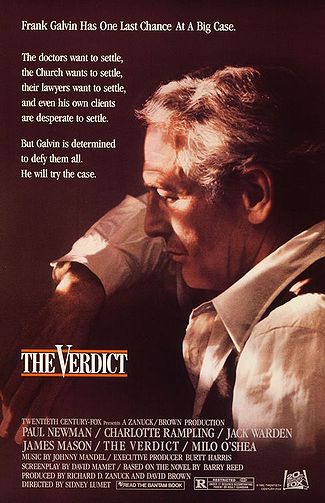
Lisa Watches An Oscar Nominee: The Verdict (dir by Sidney Lumet)


Verdict1

Speaking of the good, old-fashioned star power of Paul Newman, The Hustler and Butch Cassidy and the Sundance Kid were not the only films to receive an oscar nomination as the result of his charisma.  There’s also The Verdict, a 1982 best picture nominee that would probably be forgotten if not for Paul Newman’s performance.  However, since Paul Newman did play the lead role in The Verdict and he did give an amazing lead performance, The Verdict was nominated for best picture and, 33 years later, it ended up on TCM where I just watched it.

That’s the power of good acting.

Paul Newman plays Frank Galvin, a Boston-based attorney.  At one time, Frank was a lawyer at an elite firm.  But he has since fallen on hard times.  Now, he’s the type of attorney who crashes funerals and hands out his card.  He spends his spare time at his favorite bar, playing pinball and telling long jokes while stumbling about in a drunken haze.  In many ways, Frank represents everything that people hate about personal injury attorneys but, since he’s played by Paul Newman, you know that he’s going to turn out to be a good guy.

Frank only has one friend left in the world, his former mentor Mickey (Jack Warden).  Looking to help Frank out, Mickey sends Frank a medical malpractice suit.  A woman at a Catholic Hospital was given an anesthetic during child birth that has led to her now being brain dead.  Both the woman’s family and the Archdiocese are looking for a settlement.  The family needs the money to pay for her medical care.  The Archdiocese just wants the case to go away.  All Frank has to do is accept whatever settlement deal is offered…

However, something has changed for Frank.  He’s visited the comatose woman and, looking at her trapped in a vegetative state, he’s decided that the hospital needs to be held responsible for its mistake.  He rejects the settlement and takes the case to court, looking for both justice for the victim and redemption for himself.

That’s easier said than done, of course.  The Archdiocese has hired Ed Concannon (James Mason, perfectly cast), one of the best and most powerful attorneys in Boston.  Ed has a huge legal team working on the case.  Frank has Mickey.  As well, the Judge (Milo O’Shea) makes little effort to hide his contempt for Frank.

Probably the only bright spot in Frank’s life is that he’s met a woman.  Laura (Charlotte Rampling) meets him in a bar and soon, they’re lovers and Frank is confiding in her about the case.  What he doesn’t suspect is that Laura herself is a spy, hired by Concannon.

It looks like all is lost but then Frank discovers that there is one nurse (Lindsay Crouse) who might be willing to tell the truth about what happened at the hospital…

In many ways, The Verdict is a predictable film.  From the minute we first meet him, we know that Frank is going to be redeemed.  From the minutes that we hear about the case, we know who we’re supposed to root for and who we’re supposed to hiss.  Just about every courtroom cliché is present, right down to a surprise witness or two…

But no matter!  The Verdict may be predictable but it works.  As he proved with 12 Angry Men, Director Sidney Lumet knew how to make legal deliberations compelling and the entire film is full of small but memorable details that elevate it above its simplistic storyline.  As a director, Lumet gets good performances from his cast and, as a result, this is a film where the hero is flawed and the antagonists aren’t necessarily evil.  Even the Bishop of the Archdiocese of Boston (who, in most films, would have been a cardboard villain) is given a scene where he’s allowed to show some humanity.

And, of course, Paul Newman is great in the role of Frank.  When we first meet Frank, he looks and sounds terrible.  Indeed, it’s strange to see Paul Newman playing a character who is essentially such a loser.  (Even Eddie Felson in The Hustler had an appealing swagger about him.)  It’s during the scenes where Frank considers the woman in a coma that Newman starts to reveal that there’s more to Frank than what’s on the rough surface.  By the end of the film, Frank may be a hero but Newman doesn’t play him as such.  He’s still has that alcoholic rasp in his voice and his eyes still betray hints of insecurity and a fear that, at any minute, he’s going to screw up and mess everything up.  It’s a great performance, one for which Newman received a nomination for best actor.

Speaking of star power, Bruce Willis also shows up in The Verdict.  He’s an extra who appears as an observer in the courtroom.  He’s sitting a few rows behind Paul Newman.  (He’s also sitting beside Tobin Bell, the Jigsaw Killer from the Saw films).  It’s probably easiest to spot Willis towards the end of the film, when the verdict is read.  Bruce breaks out into a huge grin and almost looks like he’s about to start clapping.  Bruce only gets about 10 second of screen time but he acts the Hell out of them!

Thanks to Paul Newman, The Verdict is a memorable and entertaining film.  Be sure to watch it the next time it shows up on TCM.

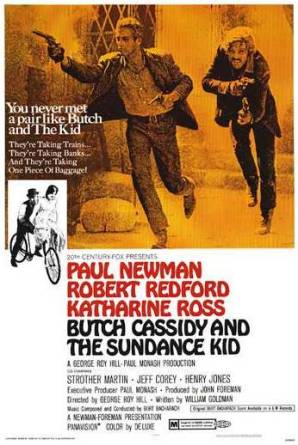
Lisa Watches An Oscar Nominee: Butch Cassidy and the Sundance Kid (dir by George Roy Hill)


Butch_sundance_poster

Should I start this post by ticking everyone off or should I start out by reviewing the 1969 best picture nominee Butch Cassidy and The Sundance Kid?

Let’s do the review first.  I recently watched Butch Cassidy and the Sundance Kid when it aired as a part of TCM’s 31 Days of Oscar.  This was actually my third time to see the film on TCM.  And, as I watched Butch Cassidy and the Sundance Kid for the third time, I was shocked to discover how much I had forgotten about the film.

Don’t get me wrong.  I remembered that it was a western and that it starred Paul Newman and Robert Redford as real-life outlaws Butch Cassidy and the Sundance Kid.  I remembered that it opened and ended with sepia-toned sequences that suggested that Butch and Sundance represented the last gasp of the old west.  I remembered that Butch won a fight by kicking a man in the balls.  I also remembered that they robbed the same train twice and, the second time, they accidentally used too much dynamite.  I remembered that, for some reason, Butch spent a lot of time riding around on a bicycle.  I remembered that Butch and Sundance ended up getting chased by a mysterious posse.  I remembered that Sundance could not swim.  And I remembered that the film eventually ended on a tragic note in South America…

And I know what you’re saying.  You’re saying, “It sounds like you remembered the whole movie, Lisa!”

No, actually I did not.  The thing with Butch Cassidy and the Sundance Kid is that the scenes that work are so memorable that it’s easy to forget that there’s also a lot of scenes that aren’t as memorable.  These are the scenes where the film drags and you’re thankful that Paul Newman and Robert Redford were cast as Butch and Sundance, because their charisma helps you overlook a lot of scenes that are either too heavy-handed or which drag on for too long.  You’re especially thankful for Newman, who plays every scene with a twinkle in his wonderful blue eyes and who is such a lively presence that it makes up for the fact that Redford’s performance occasionally crosses over from being stoic to wooden.  It can be argued that there’s no logical reason for a western to feature an outlaw riding around on a bicycle while Raindrops Keep Fallin’ On My Head plays on the soundtrack but Paul Newman’s so much fun to watch that you can forgive the film.

Newman and Redford both have so much chemistry that they’re always a joy to watch.  And really, that’s the whole appeal of Butch Cassidy and the Sundance Kid, the chance to watch two iconic actors have fun playing opposite each other.  Even though Katharine Ross appears as their shared romantic interest, the film’s love story is ultimately between Butch and Sundance (and, by extension, Newman and Redford).  You can find countless reviews that will give all the credit for the film’s appeal to William Goldman’s screenplay.  (You can also find countless self-satisfied essays by William Goldman where he does the exact same thing.)  But, honestly, the film’s screenplay is nothing special.  This film works because of good, old-fashioned star power.

Now, for the part that’ll probably tick everyone off (heh heh), I think that Butch Cassidy and the Sundance Kid is actually a pretty good pick for a future remake.  All you have to do is pick the right actors for Butch and Sundance.  I’m thinking Chris Pratt as Butch and Chris Evans as Sundance…

Oh, c’mon!  It’ll be great!

Lisa Reviews An Oscar Nominee: Bound for Glory (dir by Hal Ashby)


Bound_for_glory_Poster

One of my favorite online film reviewers is Mitch Lovell of the Video Vacuum.  The thing I like about Mitch is that he doesn’t worry about how many Oscars a film has been nominated for or whether or not a film’s politics are currently in fashion.  Unlike a lot of online reviewers, he doesn’t worry about whether or not he’s going against the “accepted” views of the critical establishment.  Instead, he’ll watch a film and tell you exactly how he felt about it.

For example, Mitch Lovell’s review of the otherwise critically acclaimed 1976 best picture nominee Bound for Glory can be summed up in three words: “boring as fuck.”  Every other online review that I’ve found for Bound for Glory offers up polite but rarely inspiring praise for this rather lengthy film about the folk singer Woody Guthrie.  Most of those reviews do acknowledge that the film moves at its own pace but we are told that we will be rewarded for being patient.  If the review was written after 2010, you can be sure that the reviewer will be sure to say that Bound for Glory reminds us of why labor unions are still important and need to be protected from the Tea Party.  (The idea apparently being that, if a film has the right politics, it doesn’t have to actually be all that interesting.)  It’s all rather predictable and that’s why we’re lucky to have reviewers like Mitch Lovell around.  Whether you agree with him or not, it’s good to have a reviewer who will go against the conventional wisdom.

I recently watched Bound for Glory as a part of TCM’s 31 Days of Oscars and, to a large extent, I have to agree with Mitch Lovell’s review.  This is a movie that is not only long but which moves slowly as well.  It’s not that the film has a deliberate pace.  It’s just slow!  (If you want to see a film that makes good use of a deliberate pace, check out Barry Lyndon.)  David Carradine plays Woody Guthrie, a sign painter who, during the Great Depression, abandons his family in Texas and, by hopping trains, makes his way to California.  He works with fruit pickers.  He tries to convince his fellow workers to form a union.  He gets beat up a lot.

And he plays his guitar.

If there’s anything that remains consistent about Bound for Glory, it’s that Woody is always playing his guitar and that every time he starts to play, something terrible either has happened or does happen.  There’s a huge dust storm.  Woody plays his guitar.  A fight breaks out at a union meeting.  Woody plays his guitar.  A bunch of hoboes on a train get beat up.  Woody plays his guitar.  Woody shows up at a textile mill and starts to play his guitar.  He gets beaten up by a bunch of thugs.  Woody impresses Pauline (Gail Strickland) by playing his guitar and soon, he’s cheating on his wife.  Woody partners up with another folk singer, Ozark Blue (Ronny Cox), and they get their own radio show where Woody plays guitar.  Woody promptly gets fired.

It quickly became apparent to me that Woody Guthrie’s guitar was cursed.  Whenever he played it, poor people ended up getting oppressed.

In many ways, Bound for Glory is a prototypical example of what it means to be an acclaimed-at-its-time-but-subsequently-forgotten best picture nominee.  It’s a big epic film that tells a fictionalized account of a real person’s life story.  Woody Guthrie is best known for writing This Land Is Your Land, which is a song that I mostly associate with pretentious super bowl commercials.  As Bound for Glory details, Woody was also a union organizer and political activist but what’s odd is that the film keeps the exact details of what he believed rather vague.  We’re given the general idea of what Woody believed but we’re not given any specifics.  As a result, Woody just comes across like another part-time social protestor as opposed to being a true political thinker (much less a revolutionary).

On a positive note, Bound for Glory is impressive to look at.  The film’s cinematographer was the famous Haskell Wexler (who also directed Medium Cool, a film that was as upfront about its politics as Bound for Glory is vague) and Wexler captures some hauntingly beautiful images of the American wilderness.  The scene where a gigantic wall of dust crashes down onto a small Texas town is especially memorable.

Otherwise, though, Bound for Glory is pretty much a snoozefest.  It was nominated for best picture of 1976 and, when you compare it to fellow nominees like All The President’s Men, Network, Taxi Driver, and even Rocky — Bound for Glory does feel a bit out of place.

Then when you consider some of the other films that came out in ’76 — Carrie,  Face to Face, The Front, God Told Me To, Logan’s Run, The Man Who Fell To Earth, Marathon Man, The Omen, The Outlaw Josey Wales, Lipstick, Robin and Marian, The Sailor Who Fell From Grace With The Sea, and The Town That Dreaded Sundown — the nomination of Bound for Glory feels like even more of a mistake.

Oh well.

Occasionally, the Academy gets it wrong.

Shocking, I know.

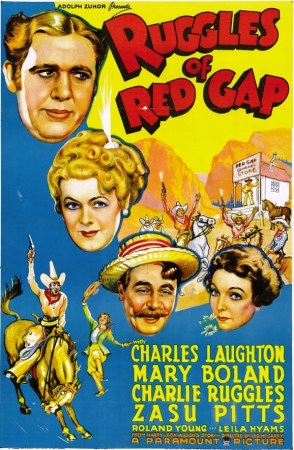
Lisa Watches An Oscar Nominee: Ruggles of Red Gap (dir by Leo McCarey)


Ruggles_of_red_gap

After watching Barry Lyndon, I decided to continue to explore my DVR by watching another film that was shown as a part of TCM’s 31 Days of Oscar.

First released way back in 1935, Ruggles of Red Gap was nominated for best picture but it lost to Mutiny of the Bounty.  Interestingly enough, both Ruggles and Bounty featured the great Charles Laughton.  In Bounty, Laughton played a tyrannical villain, Capt. Bligh.  In Ruggles, however, Laughton is the film’s hero, a gentle and comedic butler named Marmaduke Ruggles who, after having his contract gambled away in a poker game, finds himself living in the frontier town of Red Gap, Washington.

It’s also interesting to note that Ruggles of Red Gap is one of the few best picture nominees to receive absolutely no other nominations.  To a certain extent, it’s understandable.  Ruggles of Red Gap was made at a time when the Academy had less categories but still nominated ten films for best picture.  As a film, Ruggles mostly serves as a showcase for Charles Laughton but, that year, he received his best actor nomination for his work in Mutiny.  (At that time, there were no supporting categories.  Had there been, it’s likely that Laughton could have received a lead actor nomination for Ruggles and a supporting nomination for Bounty.)  The next time that someone complains that Selma only received two nominations, you remind them that’s one more than Ruggles of Red Gap received.

As for the film itself … well, for a modern audience, the film’s deliberate pace takes some getting used to.  The film’s best moments occur at the start.  Ruggles wakes up one morning to discover that his boss (Roland Young) lost him in a poker game.  Ruggles spends the day meeting and attempting to get used to his new employer, a nouveau riche cowboy named Egbert Floud (Charlie Ruggles).  The joke here, of course, is that Ruggles is stereotypically reserved and British while Egbert is loud, brash, and American.  Ruggles lives his life by the rules of the class system.  Egbert comes from a world where there is no class and everyone is equal.  Ruggles refuses to call Egbert by his first name.  Egbert gets Ruggles drunk.  The scenes of Egbert and Ruggles in Europe are a lot of fun, largely because the two actors were obviously having a lot of fun playing off each other and Laughton clearly relished getting to play comedy as opposed to villainy.

The second half of the film features Ruggles settling into life in Red Gap, Washington.  The citizens of Red Gap are, of course, all honest and hard-working folks who don’t have the slightest hint of pretension.  (Red Gap may have been in Washington but it was obviously nowhere close to Seattle.)  They welcome Ruggles into the community but they also mistake him for being a colonel and soon, everyone is under the impression that Ruggles himself is a war hero.  It’s an odd subplot, one that doesn’t seem to really be necessary to make the film’s point.

And that point, by the way, is that America is a land where everyone is equal and where butlers have the same rights as their employers.  Ruggles goes from being somewhat horrified by his new surrounding to being a proud American, an entrepreneur who is now capable of being his own man.  And it may sound corny and I’m sure all of my cynical friends are rolling their eyes but you know what?  Charles Laughton pulled it off.  As uneven as the film may sometimes be, Laughton’s sincere performance holds it all together.  He’s the main reason to watch Ruggles of Red Gap.

How proud of an American does Ruggles become?  He’s enough of an American that he can even recite the Gettysburg address!  Watch below!

Lisa Watches An Oscar Nominee: Barry Lyndon (dir by Stanley Kubrick)


Barry_Lyndon_A

“It was in the reign of George III that the aforesaid personages lived and quarreled; good or bad, handsome or ugly, rich or poor, they are all equal now.”

— Barry Lyndon (1975)

As I may have mentioned yesterday on this site, Texas has finally caught up with the rest of this frozen country.  Starting on Sunday night, it has finally been cold and wintry down in my part of the world!  For two days straight, schools have been closed and the streets have been covered in ice.  And, even though the temperature got slightly above freezing today, I have been told that I can expect to wake up tomorrow morning to a snowy wonderland.

And I hope that’s the case because I would love to stay home on Wednesday!  Ever since the 31 Days of Oscar began, I have recorded so many movies off of TCM that I am running dangerously close to running out of space on the DVR.  The best thing about being snowed (or iced) in is that it gives me an opportunity to watch some of those films.

For instance, I spent this afternoon watching the 1975 best picture nominee Barry Lyndon.  And when I say that I spent an afternoon, I mean that literally.  Clocking in at a little over 3 hours, Barry Lyndon is a film that’s so long that it even provides an intermission so the you can stand up and stretch your legs.

Seriously, I was really thankful for that intermission.

Which not to say that Barry Lyndon is a bad film.  Far from it!  It’s actually one of the best films to be included in this year’s 31 Days of Oscars.  While I may have no first hand knowledge of what it was like to live in the 1700s, I can now say that I definitely have a clue on account of the fact that I’ve seen Barry Lyndon.

Directed by the great Stanley Kubrick and based on a novel by William Makepeace Thackery, Barry Lyndon tells the story of a penniless Irishman Redmond Barry (Ryan O’Neal) who, following a duel with a wealthy British captain, is forced to flee from his home.  After being robbed by a highwayman, Barry joins the British army but, upon being sent to fight in Germany, discovers that he has no love for combat.  As such, Barry deserts but is then captured by and forced to enlist in the Prussian Army.  Once the war ends, Barry is order to spy on a professional gambler who the Prussians suspect might, himself, be a spy.  Barry and the gambler soon become partners and travel around Europe together.  However, Barry has decided that he now wants to marry into wealth and he gets that chance when he meets the Countess of Lyndon (Marisa Berensen), whose husband is dying.

And that’s when the intermission kicks in.

When we come back, Redmond Barry is now known as Barry Lyndon and appears to have everything that he’s ever wanted.  However, while Barry may have been naturally lucky when he was poor, the opposite is true once he’s rich.  Despite his new station in life, Barry is never truly accepted by his wife’s circle of friends.  Furthermore, his son, Bryan (David Morley) is injured while out riding a horse and Lady Lyndon has a nervous breakdown as a result.  Meanwhile, Barry’s stepson, Lord Bullington (Leon Vitali), hates him and spends most of his time plotting ways to get rid of his stepfather.

And, naturally enough, it all leads to one final duel in a barn, in which two men point guns while surrounded by the deafening sounds of hundreds of pigeons cooing.

I’m at something of a disadvantage when it comes to reviewing Barry Lyndon because I watched it on television and Barry Lyndon is one of those films that demands to be seen on a big screen.  For all of the dramatic moments and satirical asides (this film has a wonderfully snarky narrator), Barry Lyndon is ultimately most concerned with recreating the past as authentically as possible.  Watching this film, you really do feel as if you’ve traveled back to the 18th Century, where all of the rooms are lit by candle light and one’s station in life can be determined by the ornateness of his or her costume.

As I watched Barry Lyndon, I had to wonder — whatever happened to Ryan O’Neal?  I recently saw O’Neal in a film called The List and it was hard to believe that the terrible actor from that film was the same guy who starred in Barry Lyndon.  Kubrick may not have a reputation for being an actor’s director but Ryan O’Neal gives a great performance in Barry Lyndon.  (Compare O’Neal’s performance in the earlier Love Story to his performance here and you’ll see how good a job Kubrick did when it came to directing O’Neal.)  When we first meet Barry, he is an almost passive aggressive character, a cunning guy who has the patience necessary to wait for his opportunity to advance.  It’s only during the second half of the film that Barry becomes a truly sympathetic character, redeemed by both his love for his son and the fact that all of his enemies are even worse than him.  The strength of Ryan O’Neal’s performance can be found in the fact that Barry can be both amoral and sympathetic at the same time.

So, I’m glad that the streets were icy on Tuesday.  I’m thankful because it gave me a chance to watch Barry Lyndon.

And yes, I’m also very thankful for that intermission.

My Extremely Late Review of The 87th Oscars


24314_130094630497318_1482393676_n

This did not happen at the Oscars last night.

I really don’t know what’s wrong with me.

As I’ve made it clear many times in the past, I basically build my year around the Oscars.   I always get together with my friends and family and I force them to watch the entire ceremony with me.  Wherever I’ve lived, the Oscars have always been a national holiday.

As with any holiday, there are traditions.  To cite just one example, every year there comes the moment when I suddenly realize that Meryl Streep looks exactly like this stuck-up rich woman from Highland Park who, back in 2oo1, was so rude to my mom that she made her cry and that’s why I’ve never liked Meryl as much as some of my fellow movie bloggers.  And, of course, once I realize that, I have to tell the story to everyone else in the room.  Part of the tradition is to continue telling the story even after everyone says, “We’ve heard this story a million times, Lisa.”

Another part of the tradition is to start out with hope that something unexpected will happen.  “Oh my God,” I’ll say at some point, “maybe such-and-such movie is going to pull an upset!”  Then, an hour later, comes the tradition of realizing that there aren’t going to be any upsets and everything’s going to play out the exact way that everyone said it would.

One of the newer traditions is that, after every Oscar ceremony, I write a review and I post it here on Through the Shattered Lens. But, somehow, this year, I nearly forgot about that tradition.  Perhaps it’s because we got hit by a lot of sleet and ice last night and, as a result, I could neither go to work nor go dancing tonight.  And, don’t get me wrong,  I’ve had a lot of fun hanging around the house and being lazy today.  But it was still a pretty big change from my usual routine.  It threw me off and perhaps that’s why I’m only now getting around to reviewing the Oscar ceremony.

Then again, it could just be that last night’s ceremony was not that interesting.  I thought that Neil Patrick Harris was a good host but, in retrospect, that has more to do with his own natural charisma of a performer than with anything he actually did.  I liked his little bit about getting Octavia Spencer to keep an eye on his predictions but that was mostly because Octavia herself is such a good performer.  (Octavia is also an Oscar winner who has the talent to do a lot more than just playing a supporting role on a TV show.)

I loved Margot Robbie’s dress.  But I have to say that it really bothered me that there weren’t any true fashion disasters to be seen last night.  That’s part of the fun of the Oscars, spotting the celebs that can’t dress themselves.  When everyone looks good, the show’s a lot less interesting.

As far as the acceptance speeches were concerned, some of them were good.  But I have to admit that I always cringe a little when I see a celeb at an awards show give a politically charged speech because, as committed as they may be, they never seem to be quite sincere.  Instead, they come across as if they’re just playing another role.  What I really wish is that, instead of Bustle and Jezebel posting a hundred articles about how much Meryl Streep loved Patricia Arquette’s speech on incoming inequality, those same media outlets would actually give as much attention to the women who actually have to deal with the issue on a daily basis.  My mom had to raise four headstrong daughters on her own.  She knew more about the sad reality of income inequality than Meryl Streep ever will.  But nobody’s ever going to illustrate a story on income inequality with an animated gif of a woman, like my mom, working hard at multiple jobs, getting paid less than her male coworkers, coming home exhausted, and still managing to be there for her daughters.  Instead, we’ll just get a hundred memes of Meryl shouting “Yes,” all used to illustrate stories that insist it was a “perfect” moment.

(Because what better symbol for the fight against wage inequality than a rich white woman at an awards show?)

My question to Hollywood political activists is this: Are you actually going to try to change things or are you just going to pat yourself on the back for giving a speech at an awards show?  Because you people have given a lot of speeches and made a lot of politically-themed movies but the problems are still here.

As far as the awards themselves — I have to admit that I was not as big a fan of Birdman as some people were.  For a few minutes, I was excited because I thought that Whiplash might pull an upset.  But no, in the end, Birdman won.  I liked Alejandro Inarritu’s previous Oscar-nominated film, Babel.  But, beyond respecting it as a technical achievement, Birdman just didn’t do much for me and neither did Inarritu’s acceptance speech.

But you know who really didn’t do anything for me?

Sean Penn.

First off, if you’re going to be presenting best picture, try to take a shower before you go out on stage.  Don’t show up looking like you’re covered in a week’s worth of grime.  Looking at Sean Penn last night, I could only imagine that he probably reeked of stale cigarettes and strong body odor.  Seriously, if the Academy needed someone unwashed to hand out the biggest award of the night, they could have followed the lead of the Golden Globes and called Johnny Depp.

And then, when Penn opened the envelope, he couldn’t just announce that Birdman had won.  Instead, he had to make a joke about Inarritu’s green card.  Inarritu is the first Mexican to direct a best picture winner and Sean Penn, a man who considers himself to be enough of an expert on South America that he actually think he has the right to tell the people of Venezuela how to vote, just had to make that green card joke.  My mom was half-Spanish and had to endure her share of green card jokes (despite being a native-born American citizen).  I know the pain that jokes like that caused her and, when Sean Penn made that joke, it was a slap in the face to Latinos everywhere.  Shame on you, Sean Penn.

As far as pendejos like Sean Penn are concerned — ¡Estoy hasta el coño!

As far as Lady Gaga’s Sound of Music tribute was concerned … well, let’s just be honest.  Lady Gaga was great but The Sound of Music is probably one of the most undeserving best picture winners ever.  The Oscar should have gone to either Darling or Doctor Zhivago.

But, on a happier note, these Oscars also allowed me to make my E! debut!  Check out this screen shot:

B-e7UMLIUAA9a7VSo, the 87th Academy Awards are over with.  Here’s hoping the 88th Academy Awards are a bit more fun!

Three Films From Jeremiah Kipp: Berenice, Minions, and Painkiller


I recently had the chance to view three short horror films that were directed by Jeremiah Kipp.  Before I get into the specifics of each film, let me just say that I recommend all three of them.  As a director, Kipp does a good job of building and maintaining the proper atmosphere of dread that’s necessary for good horror (especially good short horror) to work.  If you’ve read my previous reviews on this site or over at Horrorcritic.com, you know that I am an unapologetic fan of surreal and dream-like horror and, needless to say, that’s what all three of the films below deliver.

berenice-bloody

“You and I have some unfinished business from back in the day.” — Berenice (2014)

The first film that I watched was Berenice, a 19-minute adaptation of a short story by Edgar Allan Poe.  Though the story has been updated so that it now takes place in present day New York, Berenice closely follows the original Poe short story.  Edward (Thomas Mendolia) is a mentally unstable man who seems to spend most of his time locked away in his room, where he obsessively tinkers with a light.

When his cousin, Berenice (Cheryl Koski), moves in with him and his parents, Edward is, at first, reluctant to get close to her.  However, he is slowly won over by the fact that Berenice is as much as an outsider as he is.  She is dying from an unknown illness and regularly suffers seizures.  While everyone else chooses to ignore Berenice, Edward grows closer and closer to her.  But, haunted by visions of her savagely biting off his lower lip, Edward cannot stop obsessing over her teeth…

Full of gloomy atmosphere, Berenice is an effectively morbid mood piece.  It can be appreciated as a literary adaptation but, even if you haven’t read Poe’s original short story, Berenice still works as a succession of increasingly surreal and disturbing images.  In many ways, Berenice can be positively compared to the work of the great French director, Jean Rollin.  A scene where Berenice and Edward visit a cemetery brings to mind a similar scene from Rollin’s Two Orphan Vampires.  And, in the role of Berenice, Cheryl Koski bares more than a passing resemblance to Francoise Blanchard, the star of Rollin’s The Living Dead Girl.  In the scenes were blood runs down her chin or she suddenly appears awkwardly walking naked down a dark hallway, Koski could be Blanchard’s twin.

Speaking of Cheryl Koski, she’s like a force of nature in this film.  Whether she’s somewhat desperately trying to get people to talk to her at a party or awkwardly flirting with Edward, or biting someone’s face off, Cheryl Koski gives an energetic, heartfelt, and even poignant performance.  Playing the far more repressed Edward, Thomas Mendolia deserves praise as well.  It’s not easy to make introversion compelling but he does it.

Berenice is part of a horror anthology called Creepers, which can be ordered from Creepersfilm.com

minions-long

“There’s a cruelty in your heart. Is it love or is it hate?” — The Minions

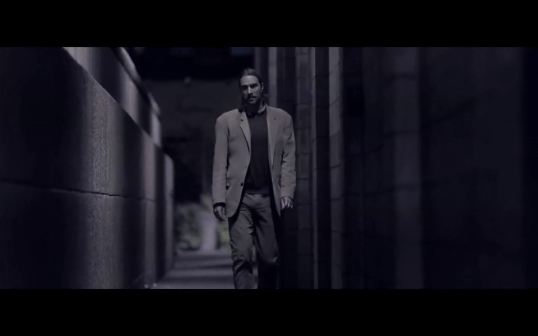
Speaking of dream-like, the next Kipp film that I watched was practically a filmed nightmare and I mean that in the best possible way.  The Minions opens with William (played by Lukas Hassel, who has a really handsome movie star look about him) standing in a dark room.  As he stares out a window, he has a conversation with an unseen woman.  Their dialogue is wonderfully cryptic.  We see flashbacks of William walking down the streets of Manhattan.  He meets two girls who appear to be drunk. He escorts them back to their apartment and he promises the drunker of the two a kiss when they reach her destination.  Needless to say, the girls are not quite what they seem and a kiss is more than just a kiss…

The Minions is only 11 minutes long but it’s an amazingly effective and atmospheric 11 minutes, full of creepy images and growing paranoia.  Looking over the notes that I took while watching the movie, I notice that I twice jotted down that The Minions has a “great soundtrack.”  That’s not just in reference to the music, though the film’s score is appropriate ominous.  Instead, I meant that The Minions is just a fascinating film to which to listen.  The music playing in the background, the footsteps of people walking through the city, the sound of constant (but never seen) traffic, and the melody of Lukas Hassel’s voice; they all combine to provide the perfect soundtrack for the film’s shadowy and haunting images.

It all adds up to a very haunting piece of moody atmosphere.

PLK1

“You’ll pay for this, won’t you?” “Someone will. Someone always does.” — Painkiller (2014)

The final Jeremiah Kipp short film that I watched was Painkiller, a wonderfully over-the-top look at pain and pleasure.

Two scientists (Kelly Rae LeGault and Berenice‘s Thomas Mendolia) are looking for a non-addictive way to treat the pain of being ill, a substitute for the drugs that — while they may relieve pain — are ultimately so addictive that they put the patient’s health at risk.  They engineer an organism (one that actually looks a bit like a miniature version of theTtingler from the classic Vincent Price film) that will attach itself to a patient’s nervous system.  The organism feeds on pain and releases endorphins while feeding.  LeGault volunteers to be the test subject and, in a scene that is full of Cronenberg-style sexual imagery, Mendolia inserts a gigantic hypodermic needle into her spine.

As they soon discover, the inserted organism works.  In fact, it works far too well.  LeGault soon becomes addicted to pain and when she doesn’t get it, she goes as far as to attack Mendolia with an iron.  (That scene made me go, “Agck!,” largely because it reminded me of when I was four and I accidentally grabbed an iron and burned my fingertips.)  Even a dominatrix, hired by Mendolia, fails to satiate LeGault’s need for pain.

However, a mysterious man in a suit (played by Jerry Janda) shows up and says that LeGault is exactly what he’s been looking for…

Now, I’m not going to tell you too much about the man in the suit because that would give away the film’s twist.  I’ll just say that Jerry Janda gives a really good and creepy performance here.  When, towards the end of film, he explains that somebody always pays, he does so with just the hint of a self-satisfied smirk, one that tells you everything that need to know about the character and how he views the world.

Along with playing that creepy man, Jerry Janda also wrote the script for Painkiller and what a script it is.  It neatly straddles the line between horror and parody, as does Kipp’s direction.  Ultimately, it’s a film that suggests that addiction is a part of human nature and that pleasure and pain need each other in order to survive.

Want to see Painkiller?  You can click here to buy or rent the film!

What Lisa Watched This Afternoon #114: Babysitter’s Black Book (dir by Lee Friedlander)


Earlier today, I watched last night’s Lifetime original movie, Babysitter’s Black Book!

babysitters-black-book-lifetime

Why Was I Watching It?

I love Lifetime movies about out-of-control teenagers.

What Was It About?

Ashley (Spencer Locke) wants to go to a good college and is terrified of getting stuck at a community college.  She’s even started a babysitting service in order to help pay for school.  However, she soon finds herself having an affair with one of her clients (Ryan McPartin).  Meanwhile, one of her employees has turned the babysitting service into a prostitution ring.

And while that may seem extreme to some, never underestimate the lengths people will go to avoid having to enroll in a community college…

What Worked?

Before I watched this film, I thought there was a very good chance that either Sugar Daddies or Back to School Mom would be the best Lifetime film of 2015.  But then I watched Babysitter’s Black Book and oh my God!  Babysitter’s Black Book is one of the best Lifetime films that I have ever seen.  How good was it?  It’s almost as good as Confessions of a Go Go Girl!

(And that’s pretty freaking good…)

Babysitter’s Black Book features everything that you could possibly want from a Lifetime film.  Melodrama, comedy, pretty clothes, sordid happenings in artfully decorated settings, and wonderfully over-the-top dialogue.  When Rachel tries to convince her friends to have sex for money, she very reasonably says, “Use it before you lose it.”  When Mark offers Ashley something to eat, he tells her, “Try it and you’ll never want to have another thing in your mouth.”  How can you not love this film?

The film was also remarkably well-directed and acted.  In the role of the greedily pragmatic Rachel, Angeline Appel stole every scene that she appeared in.  Another scene stealer was an actor named Jeff L. Williams.  Playing the role of the decadent Walker, Williams only appeared in a handful of scenes but he definitely made an impression.  The minute he smirked and said, “Let’s take some real pictures,” you just knew that bad things were going to happen.

This was exactly the type of film that we watch Lifetime to see.

What Did Not Work?

It all worked.  This was a perfect Lifetime movie.

“Oh my God!  Just like me!” Moments

Not that we ever would but, if for some reason we did decided to start a prostitution business, I would hope that my best friends and I would be as cheerful, giggly, and supportive about it as the girls in this film.  And I really do think we would be.  That’s one of the best things about Babysitter’s Black Book.  It’s a film that — much like Sofia Coppola’s Bling Ring — is honest about the fact that sometimes it’s fun to be bad.  (Especially when you’re still too sheltered and naive to understand the consequences…)

Babysitter’s Black Book perfectly captured the feeling of just how exhilarating and scary it can be to have your entire future in front of you.  Whenever Ashley dreaded the prospect of having to stay home and attend a community college, I found myself nodding and thinking, “Oh my God.  Just like me….”

Lessons Learned

Actions have consequences but it’s still fun to have money.

7_14

Lisa Watches An Oscar Nominee: The Sand Pebbles (dir by Robert Wise)


The_Sand_Pebbles_film_posterAfter watching Witness For The Prosecution, I continued TCM’s 31 Days of Oscar by watching the 1966 Best Picture nominee, The Sand Pebbles.

Considering that The Sand Pebbles is close to four hours long, it’s interesting how little there is to really say about it.  Taking place in 1926, The Sand Pebbles follows the crew of the USS San Pablo, a gunboat that patrols the Yangtze River in China.  The San Pablo is there to protect American business interests, which are in particular danger because China is caught up in a communist revolution.  For the most part, the crew of the San Pablo are portrayed as being lazy and racist.  They have little interest in understanding the culture of the people around them and they use Chinese laborer to do the work on the boat.

When Jake Holman (Steve McQueen) is transferred to the San Pablo, he upsets his fellow crewmen by insisting on working in the ship’s engine room himself, the fear being that if Holman is willing to work then the rest of them will be expected to work as well.  The ship’s commander, Lt. Collins (Richard Crenna), views Holman as being a threat to morale and starts to make plans to get Holman off of his boat.  But, first, the boat is going to have to get out of China…

The Sand Pebbles is an episodic film and some of those episodes are more interesting than others.  Typically, an episode will start out positively and then end with some sudden tragedy.  For instance, Holman trains one laborer (Mako) to be a boxer and then watches as he beats the most racist crewman on the ship.  However, just a few minutes later, the laborer is captured and savagely tortured by the communists and Holman is forced to perform a mercy killing.

In another subplot, Holman’s only friend, Frenchy (Richard Attenborough), marries a local prostitute (Emmanuelle Arsan, who would later write an autobiography that would serve as the basis for a very different type of film).  However, in order to see his wife, Frenchy has to continually swim to shore in the middle of the night.  Frenchy soon develops pneumonia and dies while his wife is dragged off and apparently executed.

And finally, Holman strikes up a romance with Shirley Eckert (Candice Bergen), an innocent missionary.  However, when her arrogant and naive boss, Jameson (Larry Gates), refuses to leave the country despite the revolution, the San Pablo is ordered to rescue them.  This, of course, leads to a final battle with the communists which leaves a good deal of the cast dead.

As I watched The Sand Pebbles, my main impression was that it was an extremely long movie.  The film’s climatic battle was exciting and Steve McQueen (not to be confused with the director of 12 Years A Slave and Shame) gave a good performance but otherwise, the film often seemed to drag.  While the movie’s theme of Americans struggling (and failing) to understand another country’s culture had a definite resonance, The Sand Pebbles did not seem to be quite sure what it truly wanted to say about it.

Let’s face it — over 500 films have been nominated for best picture.  And, while a good deal of them hold up surprisingly well and are still entertaining to watch, there’s also a handful like The Sand Pebbles, ambitious films that never quite reached their potential but were probably nominated because they seemed like the type of epic film that should be nominated.  Many of these films were nominated and a few even won.

However, in the case of The Sand Pebbles, a nomination would have to be enough.  That year, the Oscar for Best Picture was won by A Man For All Seasons.