Film Review: Destroy All Monsters (dir by Ishirō Honda)


Long before Marvel Studios convinced everyone in Hollywood that shared cinematic universes were the way of the future, Toho gave the world Destroy All Monsters!

First released in 1968, Destroy All Monsters featured almost every monster that every destroyed Tokyo.  As you can see in the picture below, this was a collection like no other.  Long before the Avengers, it was all about … The Monsters!

Check out the cast of Destroy All Monsters:
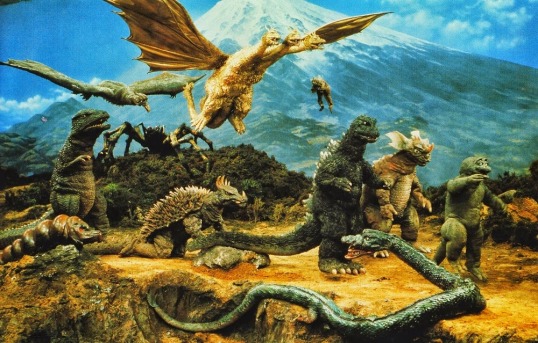
Some of these monsters are more identifiable than others.  Everyone knows Godzilla and I imagine that the majority of our readers can identify both Rodan and Mothra (who spends most of Destroy All Monsters in her larval form).  And, of course, that’s everyone’s favorite three-headed dragon, King Ghidorah, hovering in the sky.

As for the rest of the cast, they may be lesser monsters but, just like Ant-Man and the Falcon, they all have a role to play.  Up at the front of the group is Minilla, who is Godzilla’s bastard son.  Walking next to Godzilla is Baragon, who was the antagonist in Frankenstein Conquers The World.  The big snake is Manda, who previously appeared in a non-Godzilla film called Atragon.  The spiky armadillo is Anguirus from Godzilla Rides Again and directly behind him is Gorosaurus, who previously appeared in King Kong Escapes.  The big spider is Kumonga, who previously appeared in Son of Godzilla and apparently no longer wants to eat Minilla.  Meanwhile, up in the air with Rodan and Ghidorah, you’ve got Varan the Unbelievable from the film of the same name.

When Destroy All Monsters opens, all of these monsters (with the exception of Ghidorah) have been trapped on Monster Island.  Somehow, despite the fact that they’ve all tried to kill each other in the past, they’re now getting along just fine.  There’s a research station located underneath the island, where scientists can both study the monsters and keep them from escaping.  It seems like a great situation for everyone!  The monsters get a home of their own and the humans don’t have to keep rebuilding their cities.

But then, one day, all communication with Monster Island is lost and the monsters themselves start to pop up all over the world.  Rodan destroys Moscow.  Mothra takes out Beijing.  Gorosaurus totally destroys Paris.  Why doesn’t America step up to save the rest of the world?  Well, they’ve got problems of their own.  Just check out who has surfaced in New York harbor…

After years of exclusively destroying Tokyo, Godzilla has finally decided to visit New York City!  Of course, Godzilla ends up wrecking the place.  He specifically takes out the United Nations and wins the hearts of libertarians everywhere.

It turns out that, once again, a bunch of aliens have invaded Earth and are using mind control signals to force the monsters to attack humanity.  (After you watch enough Godzilla movies, you come to understand that this happens pretty regularly.)  While a team of humans try to figure out how to disrupt the control signals, the monsters are busy destroying every major city that they come across.

However, as the lead human points out, the monsters instinctively know who they’re “real enemy” is and it’s only a matter of time until they turn on the aliens.  The aliens, however, have a Plan B.  And, like so many intergalactic schemes of the past, that Plan B involves summoning King Ghidorah.

The appeal of King Ghidorah is obvious.  He’s got those big wings and those three heads and he breathes fire and he just looks like the type of monster that you would want on your side.  But, at the same time, I really do have to question the wisdom of continually trying to use Ghidorah to defeat Godzilla.  Ghidorah and Godzilla fought a countless number of times and never once did Ghidorah actually win.  He often put up a fairly impressive fight and he usually managed to knock around Godzilla’s friends but, repeatedly, Ghidorah proved to be totally ineffective when it came to actually defeating or even slowing down Godzilla.

That said, Destroy All Monsters just wouldn’t be the same without King Ghidorah.  Reportedly, this was originally envisioned as being the final Godzilla film and it’s kind of nice to see Godzilla hanging out with all of the other monsters.  Ghidorah and Godzilla may not have been friends but Ghidorah is still as important a part of Godzilla’s life as Rodan and Mothra.

Like most of the Godzilla films of the late 60s and early 70s, Destroy All Monsters spends way too much time on its human characters but, even if there isn’t as much as you might want, the rubber monster mayhem is still enjoyably silly and fun to watch.  All the monsters get together and play their role in saving the world.  Call it Godzilla: Infinity Wars.

Music Video Of The Day: The Night We Called It A Day, performed by Bob Dylan (2015, dir by Nash Edgerton)


This song, of course, has been around even longer than Bob Dylan.  It was originally published in 1941.  Frank Sinatra’s first ever solo recording was a performance of this song and he would later record two more versions of it, in 1947 and 1957.

The Bob Dylan version appeared on Dylan’s 36th studio album, Shadows in the Night.  (Shadows in the Night consists of covers of songs that Sinatra originally made famous.)  Dylan performed this song on the second-t0-last episode of Late Show with David Letterman.  Even though my musical taste usually runs the gamut from EDM to More EDM, I’ve always liked Bob Dylan.  David Letterman, on the other hand, I’m a bit less impressed with.  (Is he ever going to shave off that stupid beard?)

This nicely melancholy video feels like a throw back to the gangster films of the 30s.  Helping to create that retro atmosphere is the casting of Robert Davi, an actor who would have fit right in with Cagney, Bogart, and Edward G. Robinson.  Interestingly enough, Davi is also known as a skilled interpreter of Sinatra.

(He also once wished me a happy birthday, which was a nice of him.)

Enjoy!

Music Video of the Day: What Doesn’t Kill You by Jake Bugg (2013, dir by Andrew Douglas)


Today, we have a simple video for a pretty good song.  Of course, to say this video is simple is hardly a complaint.  The simplicity works wonderfully.

Check out the previous Jake Bugg video that I shared on this site by clicking here.

Enjoy!

Film Review: The Mean Season (dir by Phillip Borsos)


From the very first few scenes of the 1985 film, The Mean Season, one thing is abundantly clear.  People are dying in Florida.

In itself, that’s probably not a shock.  Death is a part of life, after all.  Add to that, the majority of The Mean Season takes place in Miami, the seventh most populous area of the United States.  It makes sense that the more people you have living in one area, the more people are also going to end up dead.  That’s just the way things work.

Still, Malcolm Anderson is getting tired of all the death.  Played by a youngish and sexy Kurt Russell, Malcolm’s a journalist.  He covers the crime beat for the Miami Herald.  He spends all day reporting on death and violence and he’s finally reached the point where he’s burned out.  He and his girlfriend, a teacher named Christine (Mariel Hemingway), are even planning on moving to Colorado.  Malcolm says that he could be very happy working at a small town newspaper.  His editor (Richard Masur) doesn’t believe him and, quite frankly, neither do we.  Malcolm may say that he wants peace and quiet but it’s hard not to feel as if he’s fooling himself.

One day, Malcolm gets a phone call.  The voice on the other line (which belongs to character actor Richard Jordan) is deceptively calm.  The caller explains that he’s a fan of Malcolm’s work.  The caller also claims to be responsible for a series of murders that have recently taken place.  At first, Malcolm is skeptical.  After all, he gets calls from crazy people all the time.  That’s one reason why he wants to leave Miami, after all.  But then the caller starts to give Malcolm details about the crimes, details that haven’t been released to general public…

The killings continue and, after every murder, the caller contacts Malcolm.  Soon, Malcolm is appearing on the national news, giving carefully calculated interviews about what it’s like to be a celebrity.  Malcolm is soon on the front page of all the papers.  Malcolm’s happy.  His editor is happy.  But you know who isn’t happy?  The killer.  He didn’t go to all the trouble to kill those people just so Malcolm could get famous off of his hard work!  Soon, the killer is no longer content to just call Malcolm.  Now, he wants to meet face-to-face and maybe even get to know Christine as well…

The Mean Season is one of those movies that starts out well but then falls apart towards the end.  It’s not a spoiler to tell you that the killer eventually ends up kidnapping Christine.  You probably figured out that was going to happen as soon as I told you that Malcolm had a girlfriend.  (It doesn’t help that Christine is such an underwritten character that it feels like the only reason she was put in the film was so she could be used for one gratuitous nude scene and then get kidnapped.)   Once the killer kidnaps her, he goes from being a genuinely intriguing menace to just being a typical and overly verbose movie psycho.

That’s a shame because the first half of The Mean Season is really quite good.  The film makes excellent use of its locations, capturing the humid atmosphere of Florida in the summer.  As the killer, Richard Jordan alternates between being coldly calculating and surprisingly vulnerable without missing a beat.  (Interestingly, he appears to be personally hurt when he realizes that Malcolm doesn’t consider him to be a friend.)  Not surprisingly, Kurt Russell is likable as the conflicted Malcolm but his best moments are the ones where he suggests that Malcolm has become so addicted to fame that he’s almost hoping that the killer strikes again.  As the two homicide detectives who are assigned to keep an eye on Malcolm, both Richard Bradford and Andy Garcia are perfectly cast.  A scene where Bradford tries to comfort a child who accidentally gets in the middle of the search for the killer is the best in the film.  “We’re just looking for the bad guys,” he tell the traumatized child.  It’s small moments like this that elevates The Mean Season above the typical mid-80s serial killer film.

Seen today, The Mean Season — with its emphasis on newspapers — feels like a historical artifact.  If the film were made today, Russell would definitely work for either a 24-hour cable news channel or an online news site.  It actually would be interesting to see this story updated and retold for the age of clickbait.  Somebody needs to get on that and, while they’re at it, come up with the type of ending that an otherwise intriguing story like this deserves.

Music Video of the Day: Time Is Running Out by Muse (2003, dir by John Hillcoat)


This video has kind of a nice Dr. Strangelove feel to it, which I like.  That said, it was released 15 years ago so hopefully, time is not still running out.  At the very least, let’s hope everyone was too busy dancing to launch any missiles.

It was directed by John Hillcoat, who would later direct films like Lawless, The Road, and The Proposition, along with an episode of Black Mirror.

Enjoy!

Music Video of the Day: You Make Me by Avicii (2013, dir by Sebastian Ringler)


I’ve spent the entire weekend listening to Avicii.  At some point, I know I’m going to listen to someone else but I’m just not ready to do so yet.

Anyway, this is a fun video.  As a general rule, the longer a video focuses on people skating, the better the video is going to be.  This one has dancing, fighting, and romance.  It’s got a bit of a Scott Pilgrim vs. The World feel to it.

Enjoy!

Music Video: Feeling Good by Avicii (2015, dir by ????)


Today’s video is for Avicii’s Feeling Good.  It’s a great video from a talent who was taken from us far too early.  I’ve been listening to Avicii nonstop ever since Friday afternoon and I imagine that I’ll continue to do so for many days to come.

Enjoy!


Cleaning Out The DVR: The Star Chamber (dir by Peter Hyams)


Here’s a good example of why I need to clean out my DVR more regularly:

I recorded the 1983 legal thriller, The Star Chamber, off of Starz on March 14th.  I know what you’re saying.  “Big deal!  That wasn’t that long ago.”  Well, did I mention that it was March 14th, 2017?

That’s right!  The Star Chamber sat on my DVR for over a year before I finally got around to watching it last night.  You’d be justified in asking why it took me so long and I’m afraid that I really couldn’t give you a definite answer.  I can, however, tell you the four main reasons why I recorded it in the first place:

  1. I’m always intrigued whenever I come across a movie of which I haven’t previously heard.
  2. The movie was described as being about a conflicted judge and I just happen to love legal films.
  3. I really, really liked the title.  The Star Chamber?  Did that mean it took place in a room full of stars?
  4. Before I recorded The Star Chamber, I only had 55 films on the DVR.  Since I don’t like odd numbers, recording The Star Chamber took care of that problem.

As for the film itself, The Star Chamber is another one of those movies where a group of vigilantes end up getting pissed off because liberal California judges are letting too many murderers go free because of pesky, constitutional technicalities.  The twist here is that the vigilantes are the same judges who keep tossing out evidence and ruling that confessions are inadmissible in court.  After spending their day setting free the dregs of society, the judges all gather in a nearby house and review the evidence before voting on whether or not they believe the accused was actually guilty.  If the verdict is guilty, the judges promptly hire a hit man who proceeds to clean up the streets.

The newest member of this tribunal is Judge Steven R. Hardin (Michael Douglas).  Hardin is haunted by the technicalities that forced him to toss out a case against two accused of child murderers.  (Making things even worse, the child’s father commits suicide afterward.)  Despite his initial reservations, Judge Hardin signs off on hiring an assassin to take the two men out.  But, when it becomes apparent that the two men actually were innocent, Judge Hardin is horrified to discover that there’s no way to call off the hit…

The Star Chamber is an oddly constructed movie.  When the movie starts, it feels like a typical police procedural.  From there, the movie turns into a rather talky examination of the U.S. legal system, with Judge Hardin trying to balance his idealism with the often frustrating reality of what it takes to uphold the law.  The movie then briefly turns into a conspiracy film, featuring middle-aged men in suits holding secret meetings and debating whether or not they’re serving the greater good.  And then, towards the end of the movie, it turns into an action film, with Judge Hardin being chased by two drug dealers, a contract killer, and a suspicious police detective (Yaphet Kotto).  Judge Hardin may start the movie as a conflicted liberal but he ends at someone who can blow up the entire second floor of a drug lab.  In many ways, The Star Chamber is a deeply silly film but, as directed and co-written by Peter Hyams, it’s also just pulpy enough to be entertaining.  The dialogue may be over-the-top but so is Michael Douglas’s performance so it all evens out in the end.

It may have taken me a while to get around to watching The Star Chamber but I’m glad that I finally did.  It’s a ludicrous film and all the more entertaining as a result.

Film Review: Guerrilla: The Taking of Patty Hearst (dir by Robert Stone)


“Death to the fascist insect that preys upon the life of the people!”

— Patty “Tania” Hearst

2004’s Guerrilla is not the first movie that I’ve reviewed about the kidnapping of heiress Patty Hearst.  Previously, I took a look at Abduction, a grindhouse film that was released while Hearst was still missing, and 1988’s Patty Hearst, which was based on Hearst’s own book about her ordeal.  However, Guerrilla is different from those two films in that it’s a documentary and it features interviews with people who actually knew Patty and her kidnappers.

It’s a strange and complicated story, the type that you would probably be dismissed as implausible if not for the fact that it actually happened.  In 1973, Oakland school superintendent Marcus Foster was gunned down in a parking lot.  Because Foster was the first black man to held the position of superintendent, it was originally assumed that he had been gunned down by a racist paramilitary group.  However, a neo-Marxist group known as the Symbionese Liberation Army (SLA) soon took responsibility for the murder, claiming that Foster had been tried in a people’s court and sentenced to death for his crimes.  (Foster’s “crime” was apparently trying to introduce ID cards in Oakland schools.)

Who were the SLA?  They were a small group of self-styled revolutionaries.  Though their leader was a black, escaped convict named Donald DeFreeze, the other members of the SLA were white and largely middle class.  They enjoyed sending out portentous political announcements and they went out of their way to try to portray themselves as being a highly disciplined and regimented military organization.  Donald DeFreeze changed his name to “Field Marshal Cinque.”  According to the interviews in Guerrilla, most of their fellow radicals viewed the SLA as being a joke.  (One contemporary expresses his disappointment in meeting the SLA and discovering that they were all very boring and middle class.)  No one could understand the logic behind murdering Foster, who was viewed as being a progressive educator.

If not for what happened in the months after Foster’s murder, the SLA probably would have faded into the same obscurity that has swallowed up so many activist groups.  After two members of the group were arrested, the SLA retaliated by kidnapping Patty Hearst.

At the time that she was abducted, Patty Hearst was a nineteen year-old student at Berkeley.  She was also the granddaughter of William Randolph Hearst, the publishing magnate whose life famously inspired the film Citizen Kane.  With the entire world now watching, the SLA announced that Patty would be executed unless the Hearst family arranged for every poor person in California to receive $70 worth of food.  As is portrayed in cringe-inducing detail in the documentary, the Hearst family actually attempted to meet the SLA’s demands, just to watch the food distribution program descend into chaos.  As for the SLA, they were not impressed by the Hearst family’s effort.  Even more tellingly, Patty was not impressed.  In a recording sent to the press, Patty complained that her family hadn’t made enough of an effort and assured everyone that the SLA was treating her in accordance to international law.

Shortly afterwards, the SLA released another recording.  In this recording, Patty announced that she had been given the option of either returning to her family or joining the SLA.  She had decided to join the SLA and take the new name of Tania.  Soon, Patty Hearst was robbing banks and declaring “death to the fascist insect.”

Was Patty sincere in her conversion or was she brainwashed?  That’s the question that Guerrilla explores, while leaving it to the audience to decide for themselves what was actually going on in Patty’s mind.  Though Patty is not interviewed in the film, we do get to hear the recordings that she made during her time with the SLA.  We listen as she goes from being a sacred abductee to a self-declared “urban guerrilla.”  Listening to her dull, flat voice, you get the feeling that she didn’t have much of an individual identity before she was kidnapped and she had even less of one after she converts to the SLA cause.  When she talks about how much she loves the other members of the SLA, she sounds like an actress giving a bad audition.  Before she was kidnapped, she was a Hearst.  After she was kidnapped, she was a revolutionary.  At no point do you get the feeling that she was ever just Patty.

It’s an interesting story and Guerrilla is a fascinating documentary, one that explores how idealism can sometimes be just as dangerous as cynicism.  It’s also a film that explores how the kidnapping of an heiress received more attention than the murder of a teacher.  It’s interesting to note that, while the other members of the SLA eventually ended up either dead or in prison, Patty Hearst ended up getting a full pardon from Bill Clinton.  It’s hard not to feel that the story would have been much different if the SLA had kidnapped Jane Smith instead of Patty Hearst.

Film Review: Gimme Shelter (dir by Albert and David Mayles and Charlotte Zwerin)


After you watch Woodstock, you owe it to yourself to watch another documentary from 1970.  This one is called Gimme Shelter and it deals with the infamous Altamont Free Concert.  Taking place a few months after Woodstock, Altamont was originally envisioned as being Woodstock West but, as Gimme Shelter illustrates in disturbing detail, it ultimately became something far different.

Here are a few images from both Gimme Shelter and the Altamont Free Concert:

This is Mick Jagger, the lead singer of The Rolling Stones.  The Rolling Stones were the final act to perform at the Altamont Free Concert and their performance was meant to be the conclusion of their 1969 American tour.  Gimme Shelter was originally meant to be a documentary about the final days of the tour and clips of a confident and charismatic Jagger performing in Madison Square Garden are sprinkled throughout the first 40 minutes of the film.  They provide a striking contrast to the chaos of the second half of the film, in which Jagger finds himself ineffectually trying to maintain order as fights break out in front of the stage.

This is Charlie Watts, the Rolling Stones’s drummer.  Though Gimme Shelter is usually referred to as being a documentary about the Rolling Stones, the film pretty much centers around Mick and Charlie.  Gimme Shelter‘s framing device involves Mick and Charlie watching a rough cut of the documentary itself.  While Mick always seems to maintain an air of deliberate detachment, Charlie seems to be visibly disturbed by what happened during their performance at Altamont.

(In another memorable scene, the group is shown listening to their latest recording.  While this rest of the group plays up to the filmmakers, Charlie quietly takes in the music and appears to be surprised when he notices that he’s being filmed.)

This is the Melvin Belli.  An attorney, Belli appears throughout the first half of Gimme Shelter, making the arrangements for the Altamont Free Concert and obviously having a great time showing off for the camera.  At one point, Belli makes a comment about opening for the Stones.  While Belli’s joking, it’s obvious from the tone of his voice that he’d love nothing more than to do so.  In fact, Belli is so busy being entertaining that he really doesn’t seem to notice that, even during the planning stages, the Altamont Free Concert doesn’t sound like a good idea.

This is Sonny Barger, a founding member of the Hell’s Angels.  He’s standing on the Altamont stage, watching Mick Jagger perform.  Why is Barger on stage?  He’s there because, for some reason, someone thought it would be a good idea to hire the Hell’s Angels to handle security at the concert.  (Barger is heard, in the film, saying that he was told that he could sit on the stage and drink beer and all he had to do was keep anyone else from approaching the musicians.)

What is Barger thinking as he watches Jagger perform?  This is a question that I think anyone who has ever watched Gimme Shelter has asked themselves.  Is he annoyed with or menacing Jagger or is he just doing his job and making sure that no one rushes the singer?  Perhaps it’s all of the above.

The man in green is Meredith Hunter.  This shot is the first time that Hunter appears in the film.  The second time is when he’s getting stabbed to death by a member of the Hell’s Angels security force.  Watching the documentary, Jagger asks to rewatch the scene of Hunter’s murder.  The filmmakers slow down the scene and show him both the knife being held by the Hell’s Angel and the gun being held by Hunter.

Even before Hunter’s death, Gimme Shelter has already shown us enough to convince us that the counter culture dream of Woodstock was the exception as opposed to the rule.  The final hour of Gimme Shelter takes place at the Altamont Free Concert and almost every scene feels like an angry rebuke to the positivity of Woodstock.  The crowds were angrier.  The scenery was far less aesthetically pleasing.  (Woodstock took place on a farm.  Altamont took place on a cement race track.)  Whereas Woodstock famously featured warnings about the “brown acid,” Gimme Shelter features one of the concert promoters reacting to concerns about the bad acid circulating in the crowd by saying, “Tough shit.”  Even the naked people at Altamont were far less attractive than the naked people at Woodstock.  Jefferson Airplane played at both festivals.  At Woodstock, they apparently had sound issues but otherwise, there were no problems.  At Altamont, as the cameras rolled, lead singer Marty Balin was knocked unconscious by a Hell’s Angel with a pool cue.

(“I’d like to mention that the Hell’s Angels just smashed Marty Balin in the face and knocked him out for a bit. I’d like to thank you for that,” one of the members of the band announced.)

A few more images from Altamont:

Before the concert starts, this man cheerfully yelled “LSD!  Mescaline!” at everyone walking by.  I’m not sure if that was his dog or not.  But speaking of dogs…

…this dog casually wandered across the stage during the Rolling Stones’s performance.  It’s never clear where he came from or where he went after he left the stage.

Even with the Hell’s Angels beating up everyone in sight, a few people still enjoyed the concert.  This is who I relate to in the film because she was determined to enjoy herself no matter how weird things got.

But then there’s this guy, who was standing only a few feet away from Jagger when he started to freak out:

If Woodstock is ultimately all about peace and life, Gimme Shelter is a film that is suffused with conflict and death.  If you’re going to watch one, you owe it to yourself to watch the other.  In the end, the two documentaries together provide us with a view of a counterculture that had so much potential but which couldn’t escape the darkness that hid behind the light.

(Interestingly enough, future director George Lucas was one of the cameramen at Altamont that day.  Just as how Altamont was often cited as the end of the 60s, the blockbuster success of Lucas’s Star Wars would often be cited as the beginning of the 80s.)

I’ll end this review with a quote from Grace Slick, one that is still relevant today.  As she said as she watched Altamont descend into chaos: “You don’t hassle with anybody in particular. You gotta keep your bodies off each other unless you intend love. People get weird, and you need people like the Angels to keep people in line. But the Angels also – you know, you don’t bust people in the head – for nothing. So both sides are fucking up temporarily; let’s not keep FUCKING UP!”