Horror Film Review: Flatliners (dir by Niels Arden Oplev)


Jeff and I are currently on a little road trip but we’re not going to let something like that prevent us from seeing the latest bad movies.

For instance, last night, we saw the remake of Flatliners at the AMC 8 in Ardmore, Oklahoma.  Ardmore is a lovely little town.  When I was six years old, my family briefly lived in Ardmore and I can still remember this deserted barn that was sitting right at the edge of our property.  My older sisters all told me that it was haunted and I can still remember sneaking over to the window in the middle of the night and staring at that dilapidated barn, searching for ghosts.  Even though I was only six at the time, it’s still an incredibly vivid memory and I still have dreams about that barn.  That’s the power of a good scare and that is exactly what’s missing from Flatliners.  This is seriously one of the most forgettable films that I’ve ever seen.

I did get a little excited when I discovered that the film co-starred Nina Dobrev.  Most people know her as Elena from The Vampire Diaries but, for me, she’ll always be Mia Jones on Degrassi.  (Mia was not only a high school student and a star on the spirit squad.  She was also: a single mother, a model, a drug addict, and J.T.’s girlfriend during the show’s sixth season.)  She’s one of many Canadians in the cast of Flatliners.  There’s also Ellen Page and Kiefer Sutherland.

That’s right, Kiefer Sutherland returns in the new version of Flatliners.  But don’t get too excited.  He’s not playing the same character.  If he had been playing the same character, this film would have been a lot more interesting and he could have told the new cast, “Your sins have returned in physical form … and they’re pissed off!”  Instead, he’s just playing a clueless doctor with really weird hair.  I think we’re just supposed to be impressed by the fact that he agreed to appear in the remake and I guess I would be if the first one was some sort of award-winning classic or something.  It’s not like the original Flatliners is the defining role of Kiefer Sutherland’s career.  Now, if they had gotten Oliver Platt to come back…

ANYWAY, it’s pretty much the same story all over again, just told with a lot less visual flair.  (Say what you will about Joel Schumacher as a director, he understood that the first Flatliners needed a lot of neon.)  This time, it’s Ellen Page who convinces her friends to let her die and then revive her after two minutes.  The remake does add an interesting wrinkle in that, when Page returns from being dead, she is now suddenly super smart and has total recall.  At the very least, this explains why all the rest of her friends are then so eager to try it out for themselves.  Even though it feels like a Limitless knock off, it’s still an interesting idea and I think that if the entire film had been about the students obsessively killing themselves and coming back, all in an effort to achieve some sort of Godhood, it would have made for an intriguing movie.

But that whole angle kind of gets abandoned.  Soon, it’s time for everyone’s sins to start showing up.  That means that Ellen page has to deal with her dead sister.  Nina Dobrev has to deal with a dead patient.  Another doctor has to deal with a girl she bullied.  The movie tries to make you wonder whether or not they’re just having hallucinations but why would a hallucination feel the need to sneak around a room while its target isn’t looking?

Plus, I have to wonder: there are real people out there who have been clinically dead, just to have been brought back to life.  Some of them have reported seeing the bright light and all the rest.  If you follow this movie’s logic, are they all now secretly smart and being chased around by their past sins?  If that’s the case then I’m looking forward to the sequel to Heaven Is For Real.

It’s a forgettable movie.  The first Flatliners had its own stupid charm but the remake just falls flat.
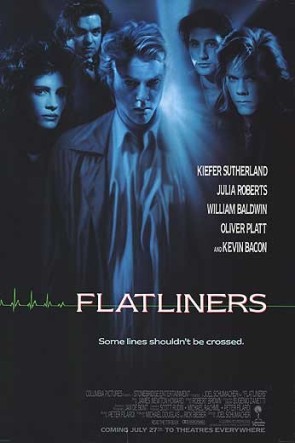
Horror Film Review: Flatliners (dir by Joel Schumacher)


“Our sins have come back in a physical form … and they’re pissed!”

That one line pretty much sums up the original 1990 version of Flatliners.  It’s a good line in that it’s one that you remember and it’s a line that you can use in almost any situation.

Have you gotten a phone call from an unknown caller?  “Our sins have come back in physical form … and they’re pissed!”

Have you and your boyfriend recently been driving across Texas and suddenly noticed that a car has been following you all the way from Lake Dallas to the border of Oklahoma.  “Our sins have come back in physical form … and they’re pissed!”

Have you ever had a stranger fail to hold a door open for you?  There’s only one possible reason for that rudeness.  “Our sins have come back in physical form .. and they’re pissed!”

And don’t even get me started on people who leave negative comments under my reviews.  We all know what’s going on with that!  “Our sins have come back in physical form … and they’re pissed!”

It’s a line that is both oddly memorable and also deeply stupid.  The same description can be applied to Flatliners.  It’s a film about a group of medical students (played by Julia Roberts, William Baldwin, Oliver Platt, and Kevin Bacon) who help Kiefer Sutherland investigate whether or not there’s actually an afterlife.  Sutherland believes that there is but he needs an atheist to be a part of the group, that’s where Kevin Bacon comes in.  And he needs a potential love interest and a Baldwin brother to be a member of the group as well, that’s why Julia Roberts and William Baldwin are there.  And, of course, someone has to provide comedic relief whenever things start to get too dark.  Say hello to Oliver Platt!  Anyway, Sutherland’s plan is to die for a minute or two and then have his fellow medical students bring him back to life.  It sounds like kind of a dumb idea but everyone agrees to it.

Anyway, it turns out that the afterlife looks a lot like an overproduced student film, full of weird camera angles, tinted lighting and disembodied voices.  When Sutherland dies, he sees a boy that he used to bully.  Julia Roberts sees her father, who committed suicide when she was younger.  Kevin Bacon sees a little girl that he used to bully.  (There are a lot of bullies in this movie.)  William Baldwin, a sex addict who is chronically unfaithful to his fiancée, sees hundreds of women, all saying, “But you said you loved me.”  Oliver Platt never actually gets to die and therefore, he sees nothing.  He does make a joke about how his vision would probably involve an angry babysitter.  I laughed.

What happens next?  “Our sins have come back in physical form … and they’re pissed!”

Flatliners has an intriguing premise but oh my God, is it ever a silly film.  It’s not really a spoiler to tell you that all of these returned sins want the characters to either atone for their mistakes or make peace with their past.  For Kevin Bacon, this means tracking down the girl that he used to bully and allowing her to bully him.  For Julia Roberts, it means getting an apology from her Dad and understanding that he was addicted to heroin.  For William Baldwin, it means making peace with never being as well-known as either Alec or Steven.  As for Kiefer … well, things are a bit more complicated for Kiefer Sutherland.

Flatliners starts out as a horror film but then it turns into a squishy movie about letting go of bitterness and learning how to forgive oneself.  It’s kind of annoying that the film couldn’t just stick to being scary because the first half of the film does have some effectively tense moments.  However, it all gets lost as the film’s plot sinks into sentimental, New Age-y quicksand.

Flatliners was directed by Joel Schumacher, who generally does well with shallow films that 1) don’t really mean anything and 2) don’t involve super heroes.  And really, the only film that I can think of that’s more shallow than the original Flatliners is the remake.  (But we’ll talk about that later…)  Schumacher’s direction here is not particularly bad — everyone looks good and the film is never boring.  It’s a very, very pretty film and one that doesn’t add up to much.

I would suggest watching it with your sins, especially after they take physical form.  Maybe they’ll be a little less pissed off afterward.

Horror On The Len: The Abominable Dr. Phibes (dir by Robert Fuest)


It’s really not October until you’ve watched at least one Vincent Price film and, for today’s horror on the lens, we have one of his most popular films, 1971’s The Abominable Dr. Phibes!

This is Price at his considerable best.  Be sure to read Gary’ review.

And watch the film below!

Enjoy!


Horror on TV: The Twilight Zone 1.23 “Shadow Play” (dir by Paul Lynch)


For tonight’s trip into the world of televised horror, we have an episode from a 1986 attempt to revive The Twilight Zone.

This episode is a remake of one of my favorite episodes of the original series, Shadow Play.  That’s the one where the guy is on death row but he says he’s not worried about being executed because he knows he’s just having a reoccuring nightmare.  Of course, this kind of freaks out some of the people around him because, if he’s just having a dream, what happens to them when the dream ends?

While the remake is nowhere near as good as the original, it’s still fairly well done.  Plus, it’s on YouTube and the original isn’t.

This episode was directed by Paul Lynch, the Canadian director who also directed the original Prom Night.

Enjoy!

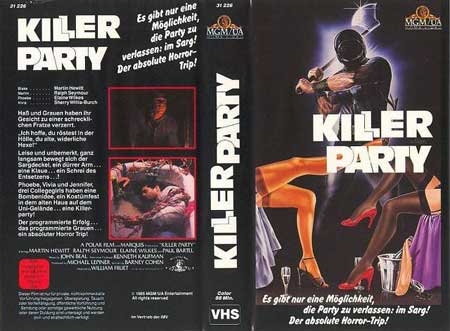
The TSL’s Horror Grindhouse: Killer Party (dir by William Fruet)


The 1986 film Killer Party is one of those late 80s slasher films that somehow has developed a cult following.  Up until recently, there was a fairly active fansite devoted to the history of Killer Party and Killer Party still regularly shows up on TCM Underground.

So, apparently, Killer Party has fans.

I’m just not sure why.

Some of it, I suppose, could have to do with the first ten minutes of the film, which are genuinely clever.  It starts out with a young woman being menaced at a drive-in theater and, just when you’ve gotten invested in her story and have started to wonder whether or not she’ll survive the entire movie, it is suddenly revealed that we’ve actually been watching a movie-within-a-movie.  And that movie-within-a-movie then turns out to be part of an incredibly silly music video, featuring a band that is so 80s that you find yourself expecting them to stop performing so they can do a line of coke and play the stock market.  At one point, the band even performs while standing on the drive-in’s concession stand.

It’s all marvelously silly and kind of clever.  The problem is that the rest of the film never lives up to those ten minutes.  In fact, you spend the rest of the movie wishing you were still watching that movie about the girl trapped at the drive-in.

I also suppose that some of the film’s cult reputation has to do with the fact that Paul Bartel has a small supporting role.  Bartel plays the same basic role that he played in almost every horror film in which he appeared.  He’s a pompous professor who says a few dismissive lines and is then promptly killed off.  Maybe it’s the Bartel factor that has led to this film developing a cult following.

Who knows?

Killer Party is essentially four movies in one.  The first movie is that part that I’ve already talked about.  The opening is clever but it only lasts for ten minutes.

After the opening, the film turns into a rather standard college comedy.  Three girls want to join the wildest sorority on campus but it won’t be easy!  Everyone on this campus is obsessed with playing pranks.  And by pranks, I mean stuff like locking a bunch of people outside while they’re naked in a hot tub and then dumping a bunch of bees on them.  Of course, that prank gets filmed and the footage is later shown at a meeting of stuffy old people.  That’ll teach those uptight members of the World War II generation!  You may have made the world safe for democracy but that was like a really, really long time ago!  So there!  It’s time for a new generation, one that will make the world safe for pranks!

During this part of the film, there are only a few hints that we’re watching a horror movie.  For instance, the sorority wants to have a party in an abandoned frat house.  Their housemother goes by the frat house and kneels in front of a grave.  She speaks to someone named Alan and tells him that it’s time to move on.  Then she promptly gets killed and no one ever seems to notice.

The comedy part of the movie segues into a remarkably bloodless slasher movie.  The cast assembles at the forbidden house.  They have a party.  Someone in a diving mask shows up and kills off the majority of the cast in 20 minutes.  Almost everyone dies off-screen so there’s really not even any suspense as far as that goes.

Then, during the last few minutes of the film, the slasher film suddenly turns into a demonic possession film and that seems like that should be brilliant turn of events but it just doesn’t work in Killer Party.  Usually, I love movies that are kind of messy but Killer Party is a rather bland and listless affair.  If you’re going to combine a campus comedy with a slasher film and a demonic possession film, you owe it to your audience to really go totally over the top and embrace the ludicrousness of it all.  Instead, Killer Party rolls out at a languid and rather dull pace.

I would not accept an invitation to Killer Party.


Horror on the Lens: Gargoyles (dir by Bill Norton)


For today’s horror on the lens, we have a made-for-TV monster movie from 1972, Gargoyles!

What happens when a somewhat condescending anthropologist (Cornel Wilde) and his daughter (Jennifer Salt) head out to the desert?  Well, they stop by a crazy old man’s shack so that they can look at his genuine monster skeleton.  Before Wilde can thoroughly debunk the old man’s claims, the shack is attacked by real monsters!

That’s right!  Gargoyles exist and they apparently live in Arizona!

This film was introduced to me by TSL contributor and Late Night Movie Gang founder Patrick Smith and we had an absolute blast watching it.  There’s nothing particularly surprising about the plot but the gargoyles are memorable creations and Bernie Casey gives a good performance as their leader.  The gargoyle makeup was designed by none other than Stan Winston, who won an Emmy for his work here and who went on to win Oscars for his work on Aliens, Terminator 2, and Jurassic Park.

As well, a very young Scott Glenn shows up in the cast.  I like to think that he’s playing the same character in both Gargoyles and Sucker Punch.

Enjoy!

Horror on TV: Tales From the Crypt 1.2 “All Through The House” (dir by Robert Zemeckis)


For tonight’s excursion into the world of televised horror, we have the 2nd ever episode of the HBO anthology series, Tales From The Crypt!

In this one, a woman (Mary Ellen Trainor) kills her husband on Christmas Eve, just to discover that she can’t properly dispose of the body because a psychotic escaped mental patient (Larry Drake), who just happens to be disguised as Santa Claus, is hanging around outside of her house.  It’s a bit of a mess, especially since the woman’s daughter is eagerly awaiting the arrival of Santa herself.

This originally aired on June 10th, 1989 and it’s an enjoyably insane package of holiday cheer and menace.  And, of course, it was directed by none other than Robert Zemeckis!

Enjoy!

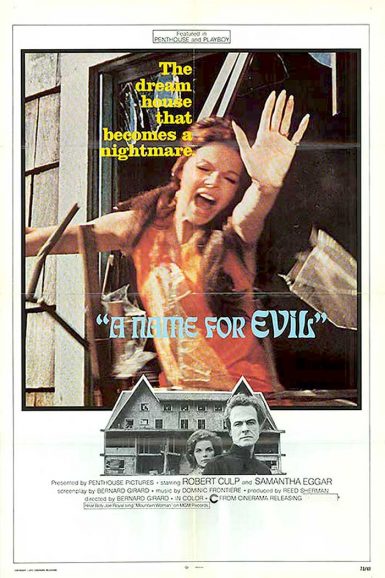
The TSL’s Horror Grindhouse: A Name For Evil (dir by Bernard Girard)


So, this is an odd one.

First released in 1973 but reportedly filmed several years before, A Name For Evil tells the story of John Blake (Robert Culp) and his wife, Joanna (Samantha Eggar).  John is a successful architect who lives in the big city.  He used to be a passionate rebel but now he’s just a boring corporate man.  Even his wife is bored with him.  John knows that he has to make some changes.  Since this movie was made in 1973, those changes start with throwing a TV out of a window.

(Trust me.  If you watch enough films from the early 70s, you will see so many TVs get tossed through so many windows that it will no longer surprise you.  Apparently, being a rebel in 1973 meant destroying a TV.  According to Wikipedia, the top five TV shows in 1973 were, in order, All In The Family, Sanford and Son, Hawaii 5-0, Maude, and the NBC Sunday Night Mystery Movie.  I choose to believe that the NBC Saturday Night Mystery Movie is what drove everyone over the edge.  Anyway…)

Anyway, John decides to quit his high-paying job and instead move up to New England and live in his grandfather’s mansion.  (His grandfather, by the way, was known as The Major.)  Joanna is reluctant to accompany him and she’s even more upset when it turns out that 1) the house is a total wreck and 2) the last tenant died under mysterious circumstances.

John, however, grows somewhat obsessed with the house.  This is despite the fact that John doesn’t seem to really like the house or the inhabitants of the nearby town that much.  For instance, there’s a scene — which might be a dream — in which John crashes the funeral of a local boy who died in Vietnam and he starts to laugh uncontrollably when the minister praises the boy for sacrificing himself for his country.  I think we’re supposed to like John during this scene but John laughs so long and so hard and he just keeps going and going that, by the end of it, I think even the most dedicated peace activist would look at him and say, “What an asshole.”

At the house, John keeps seeing strange shadows and hearing weird noises.  Occasionally, he sees someone who looks like the long-dead Major riding a white horse.  He hears voices coming from the walls and he accuses Joanna of being behind it.  Joanna tells him that he’s being paranoid.  Of course, Joanna herself is slowly coming to appreciate the house, especially after a ghost kisses her hand…

Suffering from ennui, John does what anyone in 1973 would do.  He tracks down the local hippies and he takes part in a down-with-the-establishment orgy.  Are the hippies real or are they figments of his imagination?  Is the house real or is it a figment of John’s imagination?  Is John real or is he just a figment of his imagination?  A Name For Evil does not seem to really know but you can be sure that we’ll get another shot of that TV falling out of that window before the movie ends.

On the one hand, A Name For Evil is a standard haunted house/spiritual possession type of film.  But, on the other hand, it’s obvious that A Name For Evil was trying to make some sort of grand statement about life in America in 1973.  How else do you explain the hippies, the funeral scene, and that TV flying out the window?  Robert Culp spends the entire movie so pissed off that there’s no way he wasn’t meant to be some sort of generational spokesman.  It makes for a very strange, only-in-the-70s hybrid type of film.

Now, I should mention that I actually did a little research before writing this review.  I discovered that A Name for Evil was originally produced by MGM but it spent years on the shelf until Penthouse (the magazine) bought the film and re-cut it for theatrical release.  Apparently, the first version was clear about being an attempt at social satire with a little horror and nudity thrown in.  The version that was actually released was edited to emphasize the horror and the nudity.  That probably explains why the film feels like such a strange mishmash of genres and attitudes.

If you ever get the chance, I’d recommend watching A Name For Evil.  It’s not that good but it’s just too strange not to watch.


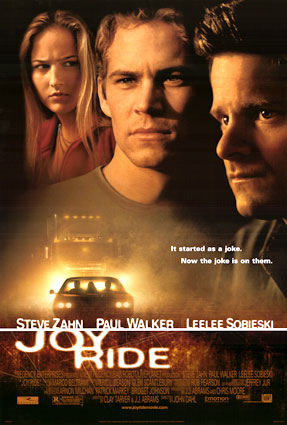
Horror Film Review: Joy Ride (dir by John Dahl)


The 2001 film Joy Ride is an example of a subgenre of horror that I like to call the Don’t Fuck With Truckers genre.  It all started with Duel back in the early 70s and since then, there’s been a large number movies about ordinary people who end up getting on the wrong side of a trucker.

Myself, I would never piss off a trucker.  First off, I have a few cousins who are proud members of the Teamsters and I can tell you, from personal experience, that you don’t want to get on their bad side.  Secondly, those trucks are really, really big and it takes a certain amount of skill to drive them, certainly more skill than it takes me to drive my little convertible.  (Truckers can make turns in those gigantic trucks and somehow do it without crashing into a stop light.  I can barely parallel park.)  Trucks block out the road, making it impossible to see anything beyond them, which makes the prospect of trying to pass them all the more frightening.  Essentially, if you get into a vehicle fight with a trucker, you’re going to die.  There’s just no way your little car is going to be able to beat that giant truck.

Now, I have to admit that I really like Joyride but sometimes, I feel like maybe I shouldn’t.  It basically comes down to two things:

Number one, I have always defended horror movies against the charge that they always feature people making the stupidest possible decisions.  My defense is usually that people in real life are actually far more stupid than they realize and that whenever anyone says, “I would never be stupid enough to wander around a deserted camp ground in the middle of the night!,” they are essentially lying.  Seriously, everyone would do that just so they could later joke about how it was just like being in a horror movie.

That said, the majority of the characters in Joy Ride are really, really dumb.  Basically, two brothers (Steven Zahn and Paul Walker) are driving from California to Colorado so that they can pick up Walker’s best friend (Leelee Sobieski).  Along the way, Zahn and Walker decide to have some fun by getting on the CB radio and telling a trucker who calls himself Rusty Nail (voiced by Ted Levine, who was also the killer in The Silence of the Lambs) that there is a prostitute named Candy Cane waiting for him in a motel room.  The joke, of course, is that Zahn and Walker know that an obnoxious businessman is actually staying in the room.

The next morning, after playing their little joke and then listening to Rusty Nail and the businessman have a huge fight, the brothers are informed that the businessman has been found on the side of the road.  He’s still alive but his jaw was ripped off.  The brothers’ reaction is to get the Hell out of town.

Okay, so far, so good.  The joke was mean but people are mean.  Leaving town instead of helping with the police investigation was selfish but people are selfish.  What drives me crazy is that, once they’re on the road, the brothers get back on the CB radio and inform Rusty Nail that there was no Candy Cane and that they were just playing a joke on him.

IDIOTS!  Seriously, you’ve just been told that the guy ripped off another man’s jaw and now you’re going to piss him off more?

My other problem is that Leelee Sobieski’s character is so underdeveloped.  The film’s nearly halfway over before Zahn and Walker reach Colorado and pick her up.  Just a few scenes later, Sobieski is kidnapped by Rusty Nail.  Characterwise, she pretty much only exists to be kidnapped and held hostage.  It seems like a waste of Sobieski’s talents and the flatness of her character is especially disappointing when you consider how well-developed the characters played by Walker and Zahn are.

And yet, despite all of that, I really like Joy Ride.  It’s just a well-made film, a relentless thrill ride that succeeds largely because director John Dahl never gives the audience any time to relax and think about whether or not the film makes any sense.  As a largely unseen threat, Rusty Nail is both plausible and seemingly supernatural at the same time.  I mean, that truck literally pops up out of nowhere sometimes.  Zahn and Walker are very well-cast as brothers, with Zahn’s natural goofiness nicely paired up with Walker’s natural earnestness.  You like them, even if they are selfish idiots.

Almost despite itself, Joy Ride is a good movie and it features an important message: Don’t fuck with truckers.

Horror on the Lens: The Cabinet of Dr. Caligari (dir by Robert Wiene)


The Cabinet of Dr. Caligari is a film that I’ve shared four times previously on the Shattered Lens.  The first time was in 2011 and then I shared it again in 2014, 2015 and 2016.  Well, you know what?  I’m sharing it again because it’s a classic, it’s Halloween, and everyone should see it!  (And let’s face it — it’s entirely possible that some of the people reading this post right now didn’t even know this site existed in 2016.  Why should they be deprived of Caligari just because they only now arrived?)

Released in 1920, the German film The Cabinet of Dr. Caligari is one of those films that we’ve all heard about but far too few of us have actually seen.  Like most silent films, it requires some patience and a willingess to adapt to the narrative convictions of an earlier time.  However, for those of us who love horror cinema, The Cabinet of Dr. Caligari remains required viewing.  Not only did it introduce the concept of the twist ending (M. Night Shyamalan owes his career to this film) but it also helped to introduce German expressionism to the cinematic world.

My initial reaction to The Cabinet of Dr. Caligari was that it simply wasn’t that scary.  It was certainly interesting to watch and I was happy that I was finally experiencing this film that I had previously only read about.  However, the film itself was obviously primitive and it was difficult for my mind (which takes CGI for granted) to adjust to watching a silent film.  I didn’t regret watching the film but I’d be lying (much like a first-year film student) if I said that I truly appreciated it after my first viewing.

But you know what?  Despite my dismissive initial reaction, the film stayed with me.  Whereas most modern films fade from the memory about 30 minutes after the end credits,The Cabinet of Dr. Caligari has stuck with me and the night after I watched it, I even had a nightmare in which Dr. Caligari was trying to break into my apartment.  Yes, Dr. Caligari looked a little bit silly staring through my bedroom window but it still caused me to wake up with my heart about to explode out of my chest.

In short, The Cabinet of Dr. Caligari passes the most important test that a horror film can pass.  It sticks with you even after it’s over.

For the curious who have 74 minutes to spare and an open mind to watch with, here is Robert Wiene’s The Cabinet of Dr. Caligari…