If this video inspires you to have a Twin Peaks flashback, do not be concerned. You’re not alone. I had the exact same reaction.
During Twin Peaks: The Return, Chromatics made three appearances as the band playing at the roadhouse and their dream-like music fit in perfectly with David Lynch’s enigmatic portrait of America in the 21st Century. Lynch also directed several videos for the Chromatics, though he didn’t direct this one. This video is credited to the band itself. Still, watching and listening, you can definitely see why Lynch was inspired to include this band in his masterwork.
I don’t know. A part of me feels like I should have held off on this video until October rolled around. It definitely has a sort of nightmarish quality to it. But, as I watched the video, I realized that it was basically almost exactly like a dream that I had a few nights ago so I took that a sign and I decided to go ahead and share it.
Basically, there’s some really messed up stuff going on in that house. And really, this is why you need to keep an eye on trees, vines, and outdoor graves. Because if you’re not careful, that stuff going to start invading your home and then you’ll never get rid of it all.
Has someone been murdered in the house? Possibly. Then again, you could probably say that about every house in America. In fact, there could be a ghost sneaking up on you right now. Who knows, right?
So, I finally sat down and watched the 2017 film, The Post.
The Post is something of an odd film. Imagine if someone made a film about the production of a movie. And imagine if, instead of focusing on the actors or the members of the crew or even the director, the film was instead about the studio executives sitting back in Hollywood and debating whether or not they should agree to give the director another million dollars to complete the film. Imagine dramatic scenes of the execs meeting with their accountants to determine whether they can spare an extra million dollars. Imagine triumphant music swelling in the background as one of the execs announces that they’ll raise the budget but only in return for getting to pick the title of the director’s next film. The Post is kind of like that. It’s a film about journalism that’s more concerned with publishers and editors than with actual journalists.
To be honest, The Post‘s deification of the bosses shouldn’t really be that much of a shock. This is a Steven Spielberg film and a part of Spielberg’s legend has always been that, of all the young, maverick directors who emerged in the 70s, he was always the one who was the most comfortable dealing with the studio execs. As opposed to directors like Martin Scorsese, Brian DePalma, and Francis Ford Coppola, Spielberg got along with the bosses and they loved him. While his contemporaries were talking about burning Hollywood down and transforming the culture, Spielberg was happily joining the establishment and reshaping American cinema. No one can deny that Spielberg is a talented filmmaker. It’s just that, if anyone was going to make a movie celebrating management, you just know it would be Steven Spielberg.
Taking place in the early 70s, The Post deals with the decision to publish The Pentagon Papers, which were thirty years worth of classified documents dealing with America’s involvement in the Vietnam War. Since the Pentagon Papers revealed that the government spent several decades lying to the American people about the situation in Vietnam, there’s naturally a lot of pushback from the government. It all leads to one of those monumental supreme court decisions, the type that usually ends a movie like this. And while the film does acknowledge that there were journalists involved in breaking the story, it devotes most of its attention to editor Ben Bradlee (Tom Hanks) and publisher Katharine Graham (Meryl Streep).
Gasp as Ben and Katharine debate whether to publish the story!
Shudder as Katharine tries to figure out how to keep the Post from going bankrupt.
Watch as Ben Bradlee talks to the legal department!
Thrill as Katharine Graham learns that her family friends, John F. Kennedy and Lyndon B. Johnson, weren’t always honest with her!
And listen, I get it. The Post isn’t as much about Nixon and the Vietnam War as it’s about Trump and the modern-day war on the media. And yes, we get plenty of scenes of Tom Hanks explaining why freedom of the press is important and the movie ends in typical Spielberg fashion, with triumphant music and all the rest. But watching The Post, it’s hard not to think about other films that celebrated journalism, films like All The President’s Menand Spotlight. Both of those films featured scenes of editors supporting their reporters. In fact, All The President’s Men featured Jason Robards playing the same editor that Tom Hanks plays in The Post. But Spotlight and All The President’s Men focused on the journalists and the hard work that goes into breaking an important story. Robards and Spotlight‘s Michael Keaton played editors who were willing to stand up and defend their reporters but, at the same time, those films emphasized that it was the underpaid and underappreciated reporters who were often putting their careers (and sometimes, their lives) on the line to break a story. Whereas Spotlight and All The President’s Men showed us why journalism is important, The Post is content to merely tell us.
The Post was a famously rushed production. Shooting started in May of 2017 and was completed in November, all so it could be released in December and receive Oscar consideration. Production was rushed because Spielberg, Streep, and Hanks all felt that it was important to make a statement about Trump’s treatment of the press. While I can see their point and I don’t deny that they had noble intentions, a rushed production is still going to lead to a rushed film. The Post is a sloppy film, full of way too much on-the-nose dialogue and scenes that just seem to be missing Spielberg’s usual visual spark. It feels less like a feature film and more like a well-made HBO production. Tom Hanks and Meryl Streep give performances that are all surface. Streep’s performance is all mannered technique while Hanks occasionally puts his feet up on his desk and furrows his brow.
It gets frustrating because, watching the film, you get the feeling that there’s a great movie to be made about the Pentagon Papers and the struggle to publish them. I’d love to know what the actual reporters went through to get their hands on the papers. But The Post is more interested in management than the workers.
All through 2017, The Post was touted as being a sure Oscar front-runner. When it was released, it received respectful but hardly enthusiastic reviews. In the end, it only received two nominations — one for best picture and one for Streep. In a year dominated by Lady Bird, Shape of Water, Get Out, and Three Billboards Outside Ebbing, Missouri,The Post turned to be a nonfactor. For all the hype and expectations, it’s the film that you usually forget whenever you’re trying to remember everything that was nominated last year.
The 2014 film, The Imitation Game, takes place in three very different time periods.
The majority of the film takes place during World War II. While the Germans are ruthlessly rolling across and conquering huge swaths of Europe, the British are desperately trying to, at the very least, slow them down. A key to that is decrypting the secret codes that the German forces use to communicate with each other. Since the Germans change the code every day, the British not only have to break the code but also predict what the next day’s code will be.
Working out of a 19th century mansion called Bletchley Park, a small group of mathematicians, chess players, and spies work to design a machine that will be able to decode the German messages. Heading up this group is a man named Alan Turing (Benedict Cumberbatch). Alan is a remote and, at times, rather abrasive figure, a man who appears to be more comfortable dealing with equations than with other human beings. The people working under him occasionally chafe at Alan’s lack of social skills. Commander Denniston (Charles Dance) suspects that Alan’s a Russian spy and would just as soon close down the entire operation. At first, the only person who seems to have any faith in Alan’s abilities appears to be Winston Churchill himself.
It’s only when Joan Clarke (Kiera Knightley) joins Alan’s team that they start to make progress. Joan brings Alan out of his shell and teaches him how to deal with other human beings. When Joan’s parents object to her being away from home, Alan even offers to marry her. Of course, Alan also explains that it would just be a marriage of convenience, one that will last until they get Christopher up and working.
Christopher is the name that Alan has given to his encryption machine. Why Christopher? Throughout the film, we get flashbacks to Alan’s time in boarding school and his close friendship to another student, a boy named Christopher.
And finally, serving as a framing device to both the World War II intrigue and Alan’s relationship with Christopher, is a scene that’s set in 1951. Alan’s home has been broken into and, as the police investigate the matter, they come to realize that Alan is hiding something about both his past and his present. Their initial assumption is that Alan must be a communist spy. The truth, however, is that Alan is gay. And, in 1951 Britain, that is a criminal offense….
The Imitation Game is based on a true story. During World War II, Alan Turing actually was a codebreaker and he did play a pivotal role in creating the machine that broke the German code. After World War II, Turing was arrested and charged with “gross indecency.” Given a choice between imprisonment or probation and chemical castration. Turing selected the latter and committed suicide in 1954. Alan Turing’s work as a cryptographer is estimated to have saved 14 million lives during World War II but he died a lonely and obscure figure, a victim of legally sanctioned prejudice.
Admittedly, The Imitation Game does take some liberties with history. For one thing, most of the people who worked with Turing described him as being eccentric but not anti-social. Though the film pretty much portrays the decoding machine as solely being Turing’s creation, it was actually a group effort. Perhaps the biggest liberty that the film takes is that the machine was never called Christopher. Instead, it was called Victory.
That said, The Imitation Game is still a strong and effective film. Anchored by a brilliant lead performance from Benedict Cumberbatch, The Imitation Game is a film that manages to be both inspiring and infuriating at the same time. It’s impossible not to get caught up in the team’s joy as they realize that they actually can beat the Germans at their own encryption game and, after spending 90 minutes listening to everyone doubt Alan’s abilities, you’re more than ready to see him and his unorthodox methods vindicated. And yet, because of the film’s framing device, you already know that Alan is not going to get the credit that he deserves for his hard work. Instead, he’s going to be destroyed by the laws of the very country that he worked so hard to save. Success and tragedy walk hand-in-hand throughout The Imitation Game and the end result is a very powerful and very sad movie.
I have to admit that it was a bit jarring when the opening credits appeared onscreen and the first words that I read were “The Weinstein Company Presents.” It’s only been a year and a half since Harvey Weinstein was finally exposed and forced out of power but it’s still easy to forget just how much the Wienstein Company used to dominate every Oscar season. In many ways, with its historical setting and its cast of up-and-coming Brits, The Imitation Game feels like a typical Weinstein Company Oscar contender. In this case, The Imitation Game was nominated for a total of 8 Oscars, including Best Actor for Benedict Cumberbatch, Best Supporting Actress for Keira Knightley, Best Director for Morten Tyldum, Best Adapted Screenplay for Graham Moore, and Best Picture. In the end, only Moore won his category. In a decision that continues to confound me, the Academy named Birdman the best film of the year.
Ennui is actually one of my favorite words and not a day passes that I don’t find an excuse to use it. For instance, a few days ago, I was stuck in traffic in downtown Dallas and I happened to notice that there was a pigeon sitting on a guard rail and it looked like it was wondering whether it should jump into traffic or if it should just continue to exist and contemplate life. So, I rolled down my window and I looked straight at that pigeon and I called out, “ENNUI!”
The pigeon looked back at me.
We had an understanding.
Anyway, this video seems like it’s full of ennui. To be honest, there’s no way to escape that feeling whenever you’re the only person standing near a swimming pool. As I watched this video, I thought about that scene in The Graduate where William Daniels forces Dustin Hoffman to sit at the bottom of the pool. I also thought about the Burt Lancaster film, The Swimmer, in which Burt attempted to swim home by going through all of the neighborhood pools. And, of course, there was Todd Field’s Little Children, where Kate Winslet spent the whole movie hanging out at the neighborhood pool.
Julia Jacklin has got a talent for these ennui-drenched videos.
As far as cover versions of classic songs go, this one is pretty good. It’s certainly better than that overwrought version of Blowing in the Wind that they’re currently using in the WGU commercials. This is a pretty simple music video but I think that visual simplicity nicely compliments the arrangement of this version of Bizarre Love Triangle.
So, instead of rambling too much, I’m going to wish you a good Wednesday and invite you to ….. enjoy!
Listen, there’s a lot of things that can be said about the 1952 Best Picture winner, The Greatest Show on Earth. Not only was it one of three Cecil B, DeMille films to be nominated for best picture (along with 1934’s Cleopatra and 1956’s The Ten Commandments) but it was also the only one to win. It brought Cecil B. DeMille his first and only nomination for best director. (DeMille lost that directing Oscar to John Ford but he still took home an award, as the producer of The Greatest Show On Earth.) The Greatest Show on Earth not only featured Charlton Heston in his first starring role but, with a finale that featured everyone involved in the same spectacular train crash, it also set the standard for the countless disaster movies that would follow.
But, with all of that in mind, the main thing that you’ll remember about this movie is that Jimmy Stewart was Buttons the Clown.
Buttons is a beloved member of the Ringling Bros. and Barnum & Bailey’s Circus. He travels with the circus across the country, entertaining children and generally helping out wherever he can. Everyone loves Buttons, despite the fact that no one has ever seen him without his makeup. (That said, you only have to hear him speak to immediately recognize him as being played by Jimmy Stewart.) Not even the circus’s no-nonsense manager, Brad Braden (Charlton Heston, naturally), knows what Buttons actually looks like. Everyone assumes that Buttons is just a dedicated performer, a method clown.
However, it turns out that Buttons has a secret. Of course, nearly everyone at the circus has a secret but Buttons’s secret is a little bit more serious than just a love triangle or a case of professional jealousy. There’s a reason why Buttons is surprisingly good at providing first aid to the members of the circus. Before he was a clown, Buttons was a doctor. And, while he was a doctor, he killed his wife.
NO! NOT JIMMY STEWART!
In Buttons’s defense, it was a mercy killing and he feels really bad about it. That, of course, doesn’t matter to the FBI agent (Henry WIlcoxon) who suspects that the doctor may be hiding among the circus performers. At first, Buttons views that train crash as the perfect opportunity to escape but then he finds out that many of his fellow performers have been seriously injured. A doctor is needed. Perhaps even a doctor in clown makeup….
Even under all that makeup, Jimmy Stewart does a great job of bringing Buttons to life. Sometimes, we associate Stewart so much with his famous way of speaking that we overlook just what a good actor Jimmy Stewart actually was. Even before you discover why Buttons is running from the cops, Stewart does a good job of capturing the sadness and the regret that lies at the heart of Button. He’s truly a tragic clown.
Buttons’s status as a fugitive is just one of the many subplots to be found in The Greatest Show On Earth. There’s a lot of drama (not to mention parades and performances) to get through before that train crashes. Brad, for instance, is struggling to keep the circus from going bankrupt. Meanwhile, his girlfriend, Holly (Betty Hutton), is torn between him and the arrogant but charming Great Sebastian (Cornel Wilde). In fact, every woman in the circus — including Gloria Grahame and Dorothy Lamour — is in love with the Great Sebastian. Sebastian is a bit self-centered but he’s famous enough to ensure that the circus won’t have to be closed. Or, at least, he is until he’s injured in a trapeze accident. Will Sebastian ever perform again? Meanwhile, there’s a jealous elephant trainer named Klaus (Lyle Bettinger) and a crooked concessionaire named Harry (John Kellog). A local gangster, Mr. Henderson (Lawrence Tierney), is trying to muscle his way into the circus’s business. Is it any surprise that Brad always seems to be in something of a bad mood? He’s got a lot to deal with!
And yes, it’s all a bit overblown and a bit silly. And yes, the film really does feel like it was meant to be a commercial for Ringling Bros. And yet, in its way, the film definitely works. There’s a sincerity at the heart of the film, one that’s epitomized by Cecil B. DeMille’s opening narration. “”A fierce, primitive fighting force that smashes relentlessly forward against impossible odds: That is the circus — and this is the story of the biggest of the Big Tops — and of the men and women who fight to make it — The Greatest Show On Earth!” DeMille was 71 years old when he made The Greatest Show On Earth and he was coming to the end of a legendary filmmaking career. DeMille was one of the founders of the American film industry and you can argue that, if not for some of his silent spectacles, Hollywood would have always remained just a neglected suburb of Los Angeles. If anyone understood that importance of that old saying, “The show must go on!,” it was Cecil B. DeMille. And really, that’s what The Greatest Show On Earth is all about. It’s a tribute to the performers who refuse to give up. Love triangles? Fugitive clowns? Injured acrobats? Lawrence Tierney? No matter what, the show must go on!
The Greatest Show On Earth is often described as being one of the worst films to win the Academy Award for Best Picture. That has more to do with the quality of the films that it beat — High Noon, The Quiet Man, Moulin Rouge, and Ivanhoe — than the film itself. The Greatest Show On Earth is old-fashioned and a bit silly but it’s still entertaining. Should it have beaten High Noon? That would be a definite no. But it’s still better than Crash.
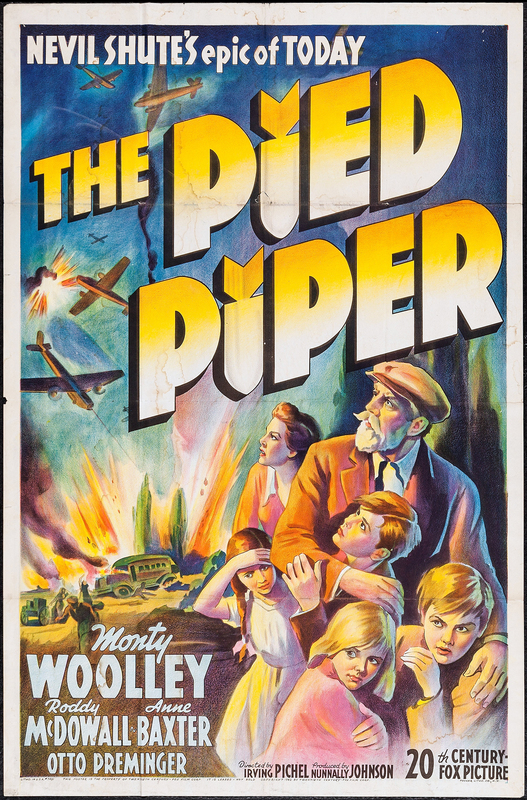
The 1942 Best Picture nominee, The Pied Piper, opens in Eastern France, shortly after the outbreak of World War II.
John Sidney Howard (played by Monty Woolley) is an Englishman on holiday. He says that he just wants to enjoy some fishing before the entire continent of Europe descends into chaos. He knows that France is going to be invaded at some point and he even suspects that the country will probably fall to the Nazis. In his 70s and still mourning the death of his son (who was killed during an air battle over occupied Poland), Mr. Howard just wants to enjoy France one last time. Despite the fact that the bearded Howard bears a resemblance to a thin Santa Claus, he’s quick to declare his dislike of both children and humanity in general. He’s a misanthrope, albeit a rather friendly one.
Howard’s plans change when the Nazis invade France sooner than he expected. With his vacation canceled, Howard just wants to get back to England. Complicating matters is that a diplomat named Cavanaugh (Lester Matthews) has asks Howard to take his children, Ronnie (Roddy McDowall) and Sheila (Peggy Ann Garner), back to England with him. Despite his self-declared dislike of children, Howard agrees. However, it turns out that getting out of France won’t be as easy as Howard assumed. After their train gets diverted by the Nazis, Howard, Ronnie ,and Sheila are forced to take a bus. After almost everyone else on the bus is killed in a surprise Nazi attack, Howard and the children are forced to continue on foot and rely on the kindness of a young French woman, Nicole Rougeron (Anne Baxer).
Throughout the journey, Howard keeps collecting more and more children. Everyone wants to get their children to a safe place and Howard soon has a small entourage following him. Unfortunately, he also has Gestapo Major Diessen (an excellent Otto Preminger) watching him. How far is Howard willing to go to ensure the safety of the children?
The Pied Piper is an interesting film, in that it starts out as something of a comedy but it then gets progressively darker as events unfold. At the beginning of the film, it appears that the whole thing is just going to be Howard getting annoyed with the precocious Ronnie and Sheila. But then that bus is attacked and Howard find himself accompanied by a young boy who has been left in a state of shock by the attack. When the group is joined by a young Jewish child named Pierre, it’s a reminder that, though the film itself may have been shot on an American soundstage, the stakes and the dangers in occupied Europe were all too real.
The Pied Piper was nominated for Best Picture of the year. Viewed today, it may seem like an unlikely nominee. It’s a well-made movie and Monty Woolley gives a good performance as John Sidney Howard. It’s the type of film that, due to the sincerity of its anti-Nazi message, should bring tears to the eyes of the most hardened cynic but, at the same time, there’s nothing particularly ground-breaking or aesthetically unique about it. Still, from a historical point of view, it’s not a surprise that this competent but conventional film was nominated. With America having just entered the war, The Pied Piper was a film that captured the national spirit. Other World War II films nominated in 1942 included 49th Parallel, Wake Island, and the eventual winner, Mrs. Miniver.
In fact, one could argue that The Pied Piper is almost a cousin to Mrs. Miniver. Both films are not only anti-German but also unapologetically pro-British. Just as Greer Garson did in Mrs. Miniver, Monty Woolley is meant to be less of an individual and more of a stand-in for Britain itself. When both Mrs. Miniver and Mr. Howard refused to surrender in the face of German aggression, these movies were proudly proclaiming that the British would never lose hope or surrender either.
The year was 2000 and Lou Pearlman, the super creepy music producer who would later die in prison, was putting together a boy band called O-Town. Because it was also the early days of reality TV, Pearlman was also producing a show called Making the Band, so that viewers could follow as Pearlman auditioned and selected the members of his new band.
In the end Pearlman selected five young men to be the members of the O-Town. He announced that not only would they be stars but that he would also pretty much control every aspect of their lives and music. Four members of the band were okay with that. Ikaika Kahoano was not. Declaring both Pearlman and O-Town to be “wack,” Kahoano left O-Town and instead, got together with two other musicians who auditioned for a spot with the boy band, Bryan Chan and Mike Miller. They were signed by Atlantic Records, who promptly held a contest in the pages of Teen People to select a name for the new band. The winner? LMNT (as in Element).
Now, since every boy band has to have at least four members, Matthew Morrison was recruited to serve as the fourth member of LMNT. If that name sounds familiar, that’s because he later went on to play Mr. Schuester on Glee. Morrison was apparently as miserable in LMNT as Kahoana was in O-Town because he left the band before they recorded their first album. Morrison was replaced by Jonas Persch.
With all the drama that went into forming the band, it can be easy to overlook their music. It was pretty much standard 2001 boy band stuff. In fact, there’s little distinguish LMNT from O-Town, except for the fact that LMNT didn’t have Lou Pearlman stalking around in the background. Instead, they had Disney. For instance, their song Hey Juliet first gained popularity when it was featured on an episode of Lizzie McGuire.
The video for Hey Juliet …. well, it’s all about doing laundry and having fantasies and, amazingly enough, there’s four members of the band and there’s four women in the laundromat so no one gets left out. If you had any doubt that this song was from 2001, the Matrix homage will erase them.
No, I don’t think that’s the case. I think she just has a lot on her mind. She’s just broken up with her boyfriend and now she’s stolen his jeep and she’s driving around South Texas. She has a destination in mind….
“Okay, then why does she keep seeing weird stuff?”
Hell, have you ever driven around South Texas in a jeep? You’re going to seem some stuff that’s going to make you doubt the existence of any sort of benevolent force in the universe….
Personally, I like to think of this video as being a sequel to From Justin to Kelly. Like maybe Kelly’s stolen Justin’s jeep and now, she’s going to kick it off a cliff. Maybe that’s why there was never a From Justin To Kelly Part 2.
Or, maybe, the jeep itself is possessed by the devil and Kelly’s visions are part of an effort to distract her from completing her mission. Maybe Kelly is on a mission for God. So, maybe this video belongs in the same genre as The Car, Christine, or The Wraith.
Well, whatever the case may be, let’s just be happy that Kelly got out before the jeep went over the cliff. Still, you do have to wonder how she’s going to get home….
I have to say that, if I ever had to deal with demonic possession, Kelly Clarkson would probably be the first person who I would call to help me out because Kelly Clarkson just kicks ass. She’s a Texas girl like me but her singing voice is like a 100 times better than mine. I’ve actually got lot of respect for Kelly because she’s one of the few American Idol winners to actually make a name for herself as an independent artist. Like you can tell that she wasn’t going to let the show prepackage her as some sort of generic, safe performer. She got what she needed out of the show and then she struck out on her own. That’s one reason why this video works. As you watch it, you have no doubt that, in real life, Kelly Clarkson would probably do the same thing that she’s doing here. Like if some rich guy in El Paso ever cheated on Kelly Clarkson? You better bet his car’s going right over the Franklin Mountains.


 Through the Shattered Lens