Guilty Pleasure No. 92: Brewster’s Millions (dir. by Walter Hill)


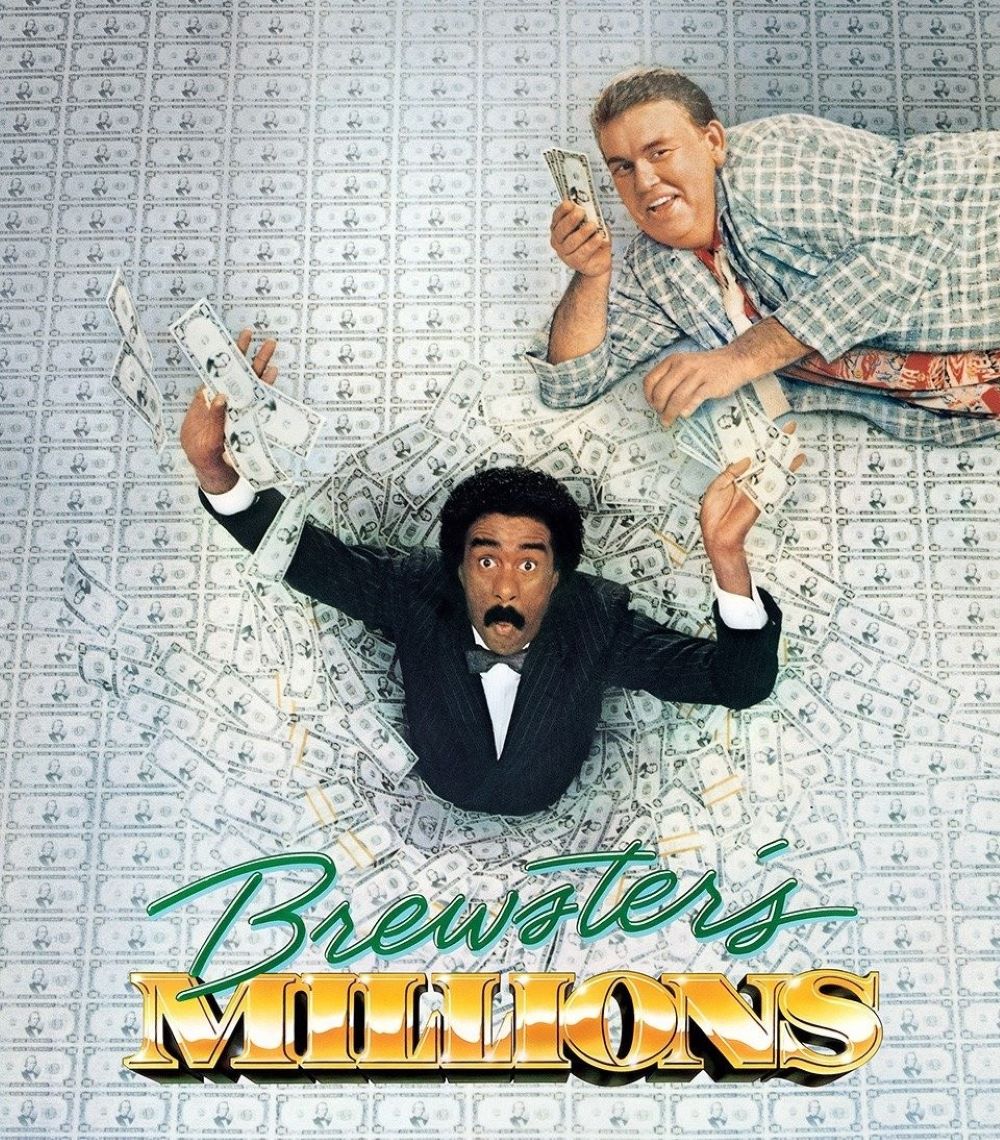
Walter Hill’s Brewster’s Millions (1985) isn’t a perfect movie by any stretch, but it’s the kind of film that sneaks up on you. It may not be sharp enough to qualify as great satire or consistent enough to hit every comedic note, but it has an undeniable charm that pulls you in regardless. It’s loud, uneven, and often ridiculous, yet few comedies from the 1980s are as weirdly entertaining when they’re firing on all cylinders. For many movie fans, it’s that quintessential “guilty pleasure”—a film you know has problems, but that somehow feels impossible to turn off once it starts. And in many ways, that’s exactly where Brewster’s Millions finds its lasting appeal.

The setup alone is too fun to resist. Richard Pryor stars as Montgomery Brewster, a minor league baseball pitcher who unexpectedly inherits the opportunity of a lifetime—to claim a $300 million fortune from a distant relative. The catch? Before he can get it, he has to spend $30 million in 30 days under a bizarre set of conditions that make financial ruin easier said than done. He can’t give the money away, can’t destroy it, can’t buy assets or investments that retain value, and can’t tell anyone why he’s doing it. Fail, and he gets nothing. Succeed, and he becomes one of the richest men alive. It’s the sort of gleefully absurd premise that could only have come from Hollywood in the 1980s, and it’s immediately clear that the film wants audiences to sit back, grab some popcorn, and watch Pryor tear through cash in increasingly funny and desperate ways.

Richard Pryor is, without doubt, the heart and soul of the movie. He imbues Montgomery Brewster with equal parts manic energy and human frustration, giving the character a real emotional arc beneath all the comic spectacle. Pryor’s talent for blending humor with exasperation makes Brewster’s predicament believable, even when it’s insane. Watching him scramble to lose money while the world keeps rewarding him is strangely satisfying. Pryor understood how to play ordinary men caught in extraordinary circumstances, and that quality grounds the film when it could have easily spiraled into total silliness. In scenes where he loses his patience with accountants, schemes wild spending sprees, or watches his good intentions backfire, Pryor’s comic timing keeps the chaos enjoyable.

John Candy adds another layer of charm as Brewster’s best friend and teammate, Spike Nolan. Candy brings warmth, loyalty, and that unmistakable good-heartedness that made him one of the decade’s most beloved comedic actors. The chemistry between Pryor and Candy keeps the film buoyant even through its weaker stretches. Their friendship defines the film’s tone—it’s loose, goofy, and full of bro-ish camaraderie. Without Candy’s infectious energy, the movie’s more hollow comedic beats might have hit the floor with a thud. Together, they create a dynamic that feels real, even inside a premise that’s totally absurd.

As a director, Walter Hill feels like an odd fit for this kind of broad comedy, but that’s part of what makes Brewster’s Millions interesting. Hill, better known for tough, kinetic action films like The Warriors and 48 Hrs., approaches this farce with a surprising amount of structure and visual precision. The film looks slicker and sharper than most comedies of its kind, which gives the excess on-screen an unintentionally epic flair. Hill’s direction keeps the story moving, and though he’s not naturally a comedic filmmaker, his grounded style adds a peculiar edge to all the craziness. It’s chaos with discipline—an aesthetic that somehow works in the movie’s favor.

Still, Brewster’s Millions can’t quite escape its shortcomings. The pacing is uneven, especially in the middle, where the film loses some steam as Brewster cycles through increasingly repetitive spending gimmicks. The story flirts with satire but rarely commits, brushing up against deeper commentary on wealth, politics, and capitalism before retreating to the comfort of broad comedy. The “Vote None of the Above” subplot, where Brewster’s money-wasting political campaign taps into voter cynicism, is one of the smartest parts of the film—but it’s introduced and resolved too quickly to leave a mark. And while the movie is full of lively energy, not every gag lands; a few supporting performances veer into caricature, and some jokes feel very much of their time.

Yet these flaws are partly what make Brewster’s Millions such a delightful guilty pleasure. It’s the cinematic equivalent of junk food—high on calories, low on nutritional value, but deeply enjoyable all the same. Pryor’s constant exasperation, the sheer absurdity of trying to “waste” money legally, and the exaggerated set pieces (like the overblown parties or his failed attempts to lose at gambling) make for irresistible entertainment. Even when the humor dips into predictable territory, the concept keeps pulling you back in. There’s a giddy satisfaction in watching Brewster try—and fail—to lose money, especially because the universe just won’t let him.

The romance subplot with Lonette McKee’s character, Angela Drake, adds just enough heart to balance the absurdity. McKee gives a grounded, intelligent performance that prevents the love story from feeling tacked on, even if it never fully takes center stage. Her presence keeps Brewster tethered to some kind of reality, and the moral through-line—learning that not everything valuable can be bought—lands gently rather than preachily. It’s not profound, but it fits the breezy tone perfectly.

As a comedy of excess, Brewster’s Millions is very much a product of its time. The slick suits, the gaudy parties, the blind faith in wealth, and the Reagan-era optimism about money’s moral neutrality all ooze from every frame. That time-capsule quality is part of its modern appeal. Watching it today, you can’t help but smile at how on-the-nose it feels—a movie from the “greed is good” decade that accidentally ends up mocking the very mindset it sprang from. It’s self-aware only in flashes, but those flashes are enough to make you recognize the movie’s satirical edge hiding beneath its loud surface.

In the end, that’s what makes Brewster’s Millions endure as a lovable guilty pleasure. It has flaws you can’t ignore—uneven pacing, scattershot tone, underdeveloped ideas—but none of them outweigh its charm. Pryor’s comic genius makes even the weakest joke land better than it should. Candy’s warmth keeps the film light. And Hill’s straightforward direction infuses the lunacy with just enough realism to make it believable. The result is a movie that’s too silly to take seriously but too fun to dismiss. You watch it, laugh at its audacity, shake your head at the logic gaps, and yet somehow come away smiling.

Brewster’s Millions may not be a comedy classic, but it’s easy to see why people keep revisiting it. It’s comfort food cinema—lighthearted, clumsy, and endlessly watchable. And like all the best guilty pleasures, it doesn’t need to be perfect to make you happy. Sometimes, seeing Richard Pryor outsmart the meaning of money for two hours is more than enough.

Previous Guilty Pleasures

  1. Half-Baked
  2. Save The Last Dance
  3. Every Rose Has Its Thorns
  4. The Jeremy Kyle Show
  5. Invasion USA
  6. The Golden Child
  7. Final Destination 2
  8. Paparazzi
  9. The Principal
  10. The Substitute
  11. Terror In The Family
  12. Pandorum
  13. Lambada
  14. Fear
  15. Cocktail
  16. Keep Off The Grass
  17. Girls, Girls, Girls
  18. Class
  19. Tart
  20. King Kong vs. Godzilla
  21. Hawk the Slayer
  22. Battle Beyond the Stars
  23. Meridian
  24. Walk of Shame
  25. From Justin To Kelly
  26. Project Greenlight
  27. Sex Decoy: Love Stings
  28. Swimfan
  29. On the Line
  30. Wolfen
  31. Hail Caesar!
  32. It’s So Cold In The D
  33. In the Mix
  34. Healed By Grace
  35. Valley of the Dolls
  36. The Legend of Billie Jean
  37. Death Wish
  38. Shipping Wars
  39. Ghost Whisperer
  40. Parking Wars
  41. The Dead Are After Me
  42. Harper’s Island
  43. The Resurrection of Gavin Stone
  44. Paranormal State
  45. Utopia
  46. Bar Rescue
  47. The Powers of Matthew Star
  48. Spiker
  49. Heavenly Bodies
  50. Maid in Manhattan
  51. Rage and Honor
  52. Saved By The Bell 3. 21 “No Hope With Dope”
  53. Happy Gilmore
  54. Solarbabies
  55. The Dawn of Correction
  56. Once You Understand
  57. The Voyeurs 
  58. Robot Jox
  59. Teen Wolf
  60. The Running Man
  61. Double Dragon
  62. Backtrack
  63. Julie and Jack
  64. Karate Warrior
  65. Invaders From Mars
  66. Cloverfield
  67. Aerobicide 
  68. Blood Harvest
  69. Shocking Dark
  70. Face The Truth
  71. Submerged
  72. The Canyons
  73. Days of Thunder
  74. Van Helsing
  75. The Night Comes for Us
  76. Code of Silence
  77. Captain Ron
  78. Armageddon
  79. Kate’s Secret
  80. Point Break
  81. The Replacements
  82. The Shadow
  83. Meteor
  84. Last Action Hero
  85. Attack of the Killer Tomatoes
  86. The Horror at 37,000 Feet
  87. The ‘Burbs
  88. Lifeforce
  89. Highschool of the Dead
  90. Ice Station Zebra
  91. No One Lives

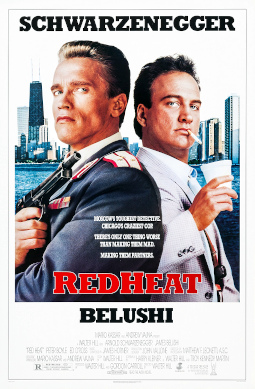
Red Heat (1988, directed by Walter Hill)


Ivan Danko (Arnold Schwarzenegger) is a Russian who lives in Moscow.  Art Ridzik (James Belushi) is an American who lives in Chicago.  They have two things in common.  They’re both cops and they both recently lost their partners while pursuing Russian drug lord Viktor Rostavali (Ed O’Ross).  When Danko comes to Chicago to bring the recently arrested Rostavali back to Moscow, Ridzik is assigned to be his handler.  When Rostavali escapes from custody, Ridzik and Danko team up to take him down.

Directed by Walter Hill, Red Heat may not be as well-remembered as some of Arnold Schwarzenegger’s other action films from the 80s but it’s still a good example of Schwarzenegger doing what Schwarzenegger did best.  Danko may not have been the quip machine that Schwarzenegger usually played but the movie gets a lot of comedic mileage out of his straight-to-the-point dialogue and the culture clash that Danko, a proud Soviet, experiences in Chicago.  It’s also an exciting action film, featuring a classic bus chase that perfectly complements Schwarzenegger’s bigger-than-life persona.

It gets a lot of mileage from the comedic chemistry of Arnold Schwarzenegger and James Belushi.  The always-talking Belushi provides a good comic foil to the steely Schwarzenegger.  Made in the waning years of the Cold War, Red Heat featured Belushi learning that the Russian cops didn’t worry about Miranda warnings and Schwarzenegger learning about “decadent” capitalism.  Belushi does a good job defending the honor of America.  Schwarzenegger, an anti-communist in real life, does an equally good job defending the Soviet Union.  Ultimately, they put aside their differences and show that even people on opposite sides can work together.

(We all know who won ultimately won the Cold War, though.)

Walter Hill specialized in buddy action movies.  Red Heat isn’t up to the level of 48 Hrs but it’s still an entertaining East-meets-West action film that packs a punch.

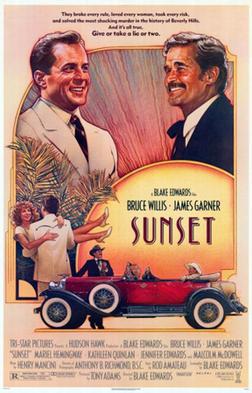
Sunset (1988, directed by Blake Edwards)


In 1920s Hollywood, famed comedian Alfie Alperin (Malcolm McDowell) has made the transition from screen stardom to working behind the scenes as a producer and studio head.  With the coming of the talkies and the death of silent cinema, Alfie plans to make his mark with an epic western starring Tom Mix (Bruce Willis) as Wyatt Earp.  The real Wyatt (James Garner) is hired to act as an on-set consultant.  Wyatt’s former girlfriend, Christina (Patricia Hodge), is now married to Alfie.

What Mix and Earp discover is that, despite his beloved public image, Alfie is actually a monster who is involved with organized crime and sex trafficking and who has the police on his payroll.  While searching for Christina’s missing son (Dermot Mulroney), Mix and Earp get caught up in a murder involving Alife’s sister (Jennifer Edwards) and a gangster named Dutch (Joe Dallesandro).  At the first Academy Awards are handed out in Beverly Hills, Tom Mix and Wyatt Earp prepare for the final showdown with their producer.

The idea behind Sunset was promising.  Wyatt Earp, a real cowboy who survived the end of the West, teams up with Tom Mix, a movie cowboy who is trying to survive the end of the silent era.  (Earp and Mix were friend in real life, as well.)  Bruce Willis comes across as being too contemporary in the role of Tom Mix but James Garner plays Wyatt Earp with a weary dignity and Malcolm McDowell does a convincing Charlie Chaplin impersonation.  Unfortunately, Blake Edwards’s direction allows the story to meander and the mystery itself is so full of red herrings that it’s impossible to follow.  Edwards didn’t seem to know if he wanted this movie to be a buddy comedy, an elegiac tribute to the end of the silent era, or a satire of Hollywood.  He tried to include elements of all three but the movie itself just doesn’t come together.  Only Garner and McDowell emerge from the film relatively unscathed.

Fortunately, for Bruce Willis, Die Hard was released just two months after Sunset.

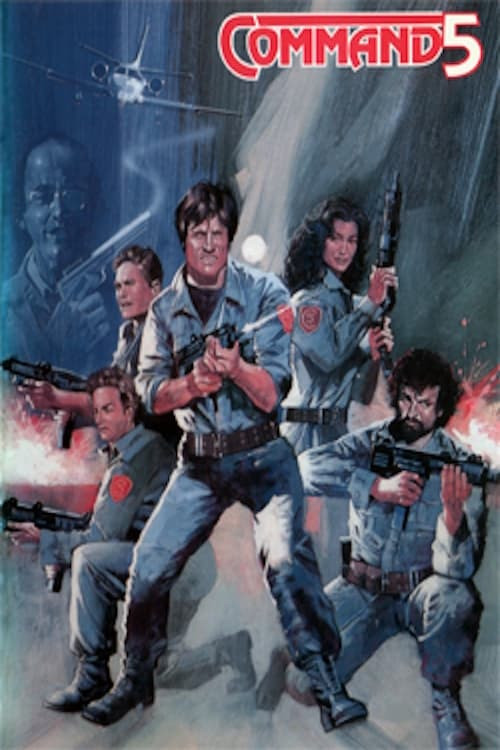
Command 5 (1985, directed by E.W. Swackhamer)


Morgan (Stephen Parr) is a mysterious government operative who puts together a special paramilitary force to take on extreme threats.  He says that only misfits are allowed to join his group because they have the edge he needs.  Smith (William Russ) is a wild Texan who drives like a maniac.  Psychiatrist Winslow (Sonja Smits) can fire an Uzi better than any man.  Kowalski (John Matuszak) is a demolitions expert who listens to Beethoven.  Jack Coburn (Wings Hauser) is a rebellious detective who is good with a throwing knife.

After a montage of their extensive training and a scene where our heroes take a look at the bullet-proof RV that they’ll be traveling the country in, the movie finally gets down to business.  A motorcycle-riding terror cult led by Delgado (Gregory Sierra) has taken an entire town hostage and is threatening to kill everyone unless they’re given a flight out of the country.  Our heroes drive their bulletproof van into town and try to defeat the bad guys.  There’s one good scene where the RV is driving down the town’s main street and getting hit nonstop with bullets.  The scene was obviously ripped off from the end of Clint Eastwood’s The Gauntlet but it’s still exciting to watch.  Otherwise, the action in this one is pretty rudimentary.

I guess Command 5 was supposed to be a pilot for television show that never went into production.  It is very much a television production.  There’s a lot of shooting but no blood.  Wings Hauser is less dangerous than usual.  The whole thing ends with Command 5 looking forward to adventures that were never to come.  Watching the pilot, you can see why it never became a show.  The characters were all thinly-written and never seemed to have much of a connection with each other and Hauser and Russ both seemed to be competing to be the loose cannon of the group.  This one is for Wings Hauser completists only.

The Demolitionist (1995, directed by Robert Kurtzman)


In the future, America is overrun by crime.  Mad Dog Burne (Richard Grieco) and his brother, Little Henry (Randy Vasquez) escape from California death row.  Mayor Eleanor Grimbaum (Susan Tyrell) wants the Burne brothers captured and she wants to be able to show the voters that she’s tough on crime.  When brave police officer Alyssa Lloyd (Nicole Eggert) is killed by Mad Dog Burne’s gang, she is brought back to life in cyborg form by Prof. Crowley (Bruce Abbott) and, after a training montage, she is let loose on the streets as a police-backed vigiliante.

The Demolitionist owes an obvious debt to Robocop, with Nicole Eggert miscast as an expressionless cyborg who launches a one-woman/one-machine war on crime.  The main problem is that The Demolitionist has none of Robocop‘s wit or its subversive subtext.  Nicole Eggert is no substitute for Peter Weller and Richard Grieco is no Kurtwood Smith.  “Booker’s a good cop!” I said whenever Grieco showed up.

The only interesting this is about the cast, which is full of horror veterans.  Jack Nance plays the prison priest who counsels the Burne brothers before they escape their scheduled executions.  Reggie Bannister plays the warden.  Sarah Douglas plays  a surgeon.  Joseph Pilato is one of Mad Dog’s followers.  And playing Mad Dog’s second-in-command is none other than Tom Savini.  Finally, the city’s most popular journalist is played by Heather Langenkamp!

The Demolitionist demolishes almost the entire town but she still can’t come up with any way to make this stale Robocop rip-off feel fresh.


A Movie A Day #219: Wild Bill (1995, directed by Walter Hill)


The year is 1876 and the legendary Wild Bill Hickok (Jeff Bridges) sits in a saloon in Deadwood and thinks about his life (most of which is seen in high-resolution, black-and-white flashbacks).  Hickok was a renowned lawman and a sure shot, a man whose exploits made him famous across the west.  Thanks to his friend, Buffalo Bill Cody (Keith Carradine), he even appeared on the New York stage and reenacted some of his greatest gun battles.  Now, Hickok is aging.  He is 39 years old, an old man by the standards of his profession.  Though men like Charlie Prince (John Hurt) and California Joe (James Gammon) continue to spread his legend, Hickok is going blind and spends most of his time in a haze of opium and regret.
Hickok only has one true friend in Deadwood, Calamity Jane (Ellen Barkin).  He also has one true enemy, an aspiring gunslinger named Jack McCall (David Arquette).  McCall approaches Hickok and announces that he is going to kill him because of the way that Hickok treated his mother (played, in flashback, by Diane Lane).  Hickok does not do much to dissuade him.

Based on both a book and a play, Wild Bill is a talky and idiosyncratic Western from Walter Hill.  Hill is less interested in Hickok as a gunfighter than Hickok as an early celebrity.  There are gunfights but they only happen because, much like John Wayne in The Shootist, Hickok has become so famous that he cannot go anywhere without someone taking a shot at him.  Almost the entire final half of Wild Bill is set in that saloon, with Hickok and a gallery of character actors talking about the past and wondering about the future.

At times, Wild Bill gets bogged down with all the dialogue and philosophizing.  (To quote The Good, The Bad, and the Ugly: “When you have to shoot, shoot.  Don’t talk.”)  Luckily, the film is saved by an intriguing cast, led by Jeff Bridges.  In many ways, his performance was Wild Bill feels like an audition for his later performance in True Grit.  David Arquette is intensely weird as the jumpy Jack McCall and Ellen Barkin brings the film’s only underwritten role, Calamity Jane, to life.  Smaller roles are played by everyone from Bruce Dern to James Remar to Marjoe Gortner.

United Artist made the mistake of trying to sell Wild Bill as being a straight western, which led to confused audiences and a resounding flop at the box office.  Ironically, years after the release of Wild Bill, Walter Hill won an Emmy for directing the first episode of HBO’s Deadwood, an episode the featured Wild Bill cast member Keith Carradine in the role of Hickok.

A Movie A Day #203: Heartbreak Ridge (1986, directed by Clint Eastwood)


The year is 1983 and things are looking bad for the Second Marine Division of the U.S. Marine Corps.  The officers are almost all college graduates like Major Powers (Everett McGill) and Lt. Ring (Boyd Gaines), men who have never served in combat but who are convinced that they know what it means to be a Marine in the 80s.  Convinced that they will never have to actually fight in a war, the latest batch of recruits is growing soft and weak.  All of the slackers have been put in the Recon Platoon, where they are so undisciplined that they think that wannabe rock star Cpl. Jones (Mario Van Peebles) is a good Marine.  MARIO VAN PEEBLES!

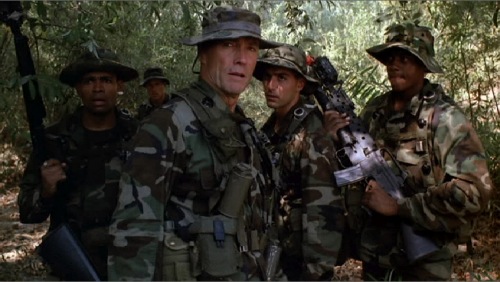
They haven’t met Sgt. Highway yet.

Gunnery Sgt. Thomas Highway (Clint Eastwood) has seen combat, in both Korea and Vietnam.  He drinks too much.  He fights too much.  He has chased away his wife (Marsha Mason), despite his attempts to understand her by reading Cosmo and Ladies Home Journal.  Major Powers may think that Highway is a relic but Highway knows better than to worry about what a college boy thinks.  The Recon Platoon may think that they can defy him but that haven’t seen Highway throw a punch yet.  Everyone may think it’s a waste of time to learn how to fight but little do they know that America is about to invade Grenada.

Heartbreak Ridge is all about Clint Eastwood.  Without Clint Eastwood, it would just be another basic training film.  With Clint Eastwood, it is a minor masterpiece and a tribute to America’s fighting spirit.  In 1986, no one was better at glaring at a young punk or glowering at a clueless superior officer than Clint Eastwood.  Even the running joke of Highway reading women’s magazines works because it is impossible not to laugh at Clint Eastwood intently studying an issue of Cosmo.   Clint may have been 56 when he directed and starred in Heartbreak Ridge but he was still believable beating up men who were less than half his age.  (Mario Van Peebles thinks he’s going to be able to stand up to Clint Eastwood?  Get outta here!)  There is never any question that Highway is going to able to whip everyone into shape.  The only question is how many terse one-liners are going to be delivered in the process.   By the time Highway and his platoon reach Grenada, everyone is ready to watch Clint put the communists in their place and Clint does not disappoint.

Reportedly, the U.S. Marine Corps. initially supported Heartbreak Ridge but, in case of life imitating art, disowned the finished picture, feeling that the film’s portrayal of The Corps was inaccurate and the sergeant’s “training” methods were too old-fashioned to actually be effective.

Thomas Highway would disagree.

One final note: Bo Svenson has a small role as the man trying to steal Marsha Mason away from Clint.  If you have ever wanted to see Dirty Harry and Buford Pusser fight over the Goodbye Girl, here’s your chance.

Cleaning Out The DVR Yet Again #32: Sister Cities (dir by Sean Hanish)


(Lisa recently discovered that she only has about 8 hours of space left on her DVR!  It turns out that she’s been recording movies from July and she just hasn’t gotten around to watching and reviewing them yet.  So, once again, Lisa is cleaning out her DVR!  She is going to try to watch and review 52 movies by the end of Wednesday, December 7th!  Will she make it?  Keep checking the site to find out!)

Sister Cities originally aired on Lifetime on September 17th.  When it first aired, I was really expecting to like it just because it’s a movie about four sisters and I’m the youngest of four sisters.  Add to that, one of the sisters was named Dallas and Dallas is my city.  Seriously, I seemed destined to like Sister Cities.

But then I actually saw the film.  And I have to admit that, for the first hour or so, I felt a little bit guilty about not liking the film.  It may have been a painfully slow film but I figured that it deserved some credit for at least trying to take the time for the viewers to get to know the four sisters.  As well, I couldn’t deny that casting did a good job when it came to selecting the four lead actresses.  You looked at them and they all had enough features and mannerisms in common that you could actually believe that they were related.

In the film, the four sisters gather together after the suicide of their mother (played, in flashbacks, by both Amy Smart and Jacki Weaver).  The sisters all have their own distinct personalities and, for some reason, three of them are named after cities.

For instance, the youngest sister is named Baltimore (Troian Bellisario).  She’s a free-spirit who does what she wants.  Now, my boyfriend is from Baltimore.  I have friends who live in Baltimore.  I’ve visited Baltimore and I loved it.  But I would not name my daughter Baltimore because Baltimore is a great name for a city but it’s a terribly clunky one for a human being.  If I was going to pick a city to name my daughter after, I’d probably go with Savannah or maybe Charlotte.  Or, for that matter, maybe Ardglass.   But not Baltimore.

Then there’s Dallas (Michelle Trachtenberg), who is the super organized and neat sister.  She’s the one who gets taunted for always wearing matching underwear but seriously, what’s wrong with that?  At least Dallas gets a pretty name.

Austin (Jess Wexler) has a pretty name too.  We’re told that she’s a successful writer.  We never believe it for a second.  Austin lived with her mother and she’s the one who called the other sisters back home.  Austin is as close as the film comes to having a central character.

And then there’s Carolina (Stana Katic), who is the oldest.  She’s a lawyer and she’s angry because her mother named her after one of the Carolinas but never clarified which one.

To be honest, it’s a bit too much.  The sisters are all exaggerated types.  The mother is an exaggerated type.  They all have cutesy names.  The nonstop theatrical quirkiness of it all is very off-putting and it doesn’t help that the film’s first hour is painfully slow.  There’s a few attempts at dark humor but it’s never as insightful or affecting as it seems to think it is.

Then we get to the second hour and the film remains painfully slow but it also turns into a rather strident screed about assisted suicide.  Eventually, the whole film comes down to an extended flashback of a beatific-looking Jacki Weaver smiling as she calmly explains that Austin will have to help her commit suicide because she’s the only sister who is emotionally strong enough to handle it.  It was all so manipulative and heavy-handed that I ended up getting so annoyed that I took off my shoes and nearly threw them at the TV.

Sorry, Baltimore.

Sorry, Dallas.

Sorry, Austin.

Sorry, Carolina.

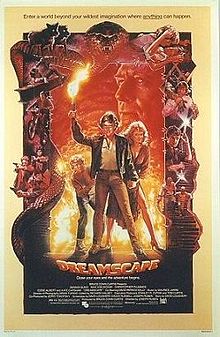
Halloween Film Review: Dreamscape (1984, directed by Joseph Ruben)


220px-Dreamscapeposter

Before there was Inception, there was Dreamscape!

DSDreamscape opens with the image of a woman running down a street while a red mushroom sprouts above the city behind her.  Just as a radioactive cloud envelopes the woman, the scene cuts to a man named John (Eddie Albert) waking up with a scream.  John is the President of the United States and he has been having reoccurring nightmares about nuclear war.  The dreams have shaken him to the extent that he plans of signing a disarmament treaty with the Soviet Union.

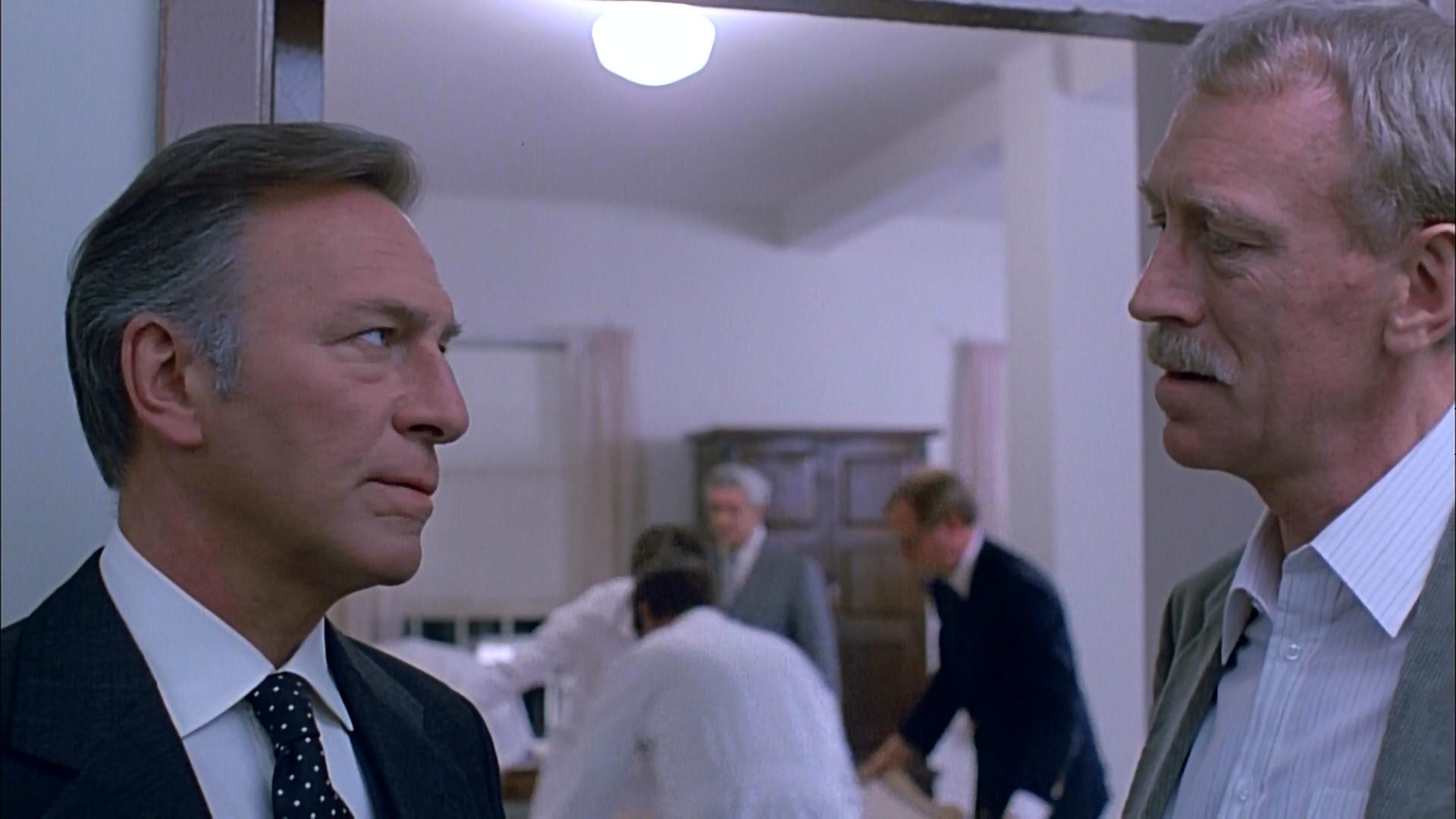
dreamscape-maxchrisBob Blair (Christopher Plummer, playing one of the slick villain roles that dominated his career until he finally won an Oscar for Beginners) is a political reactionary who works for a shadowy agency that is even feared by the CIA.  Determined to stop the President from signing that treaty, Blair recruits psychotic martial arts enthusiast Tommy Ray Glatman (David Patrick Kelly, of “Warriors, come out to play…” fame) to assassinate the President.  Tommy is a psychic who can enter people’s dreams and when you die in a dream, you die in real life.

Dreamscape_David_Patrick_KellyTommy is a part of a government-funded research project that is headed by Dr. Peter Novotny (Max Von Sydow) and Beth DeVries (Kate Capshaw).  Tommy was the program’s superstar until the arrival of Alex Gardner (Dennis Quaid).  Until he was recruited by Dr. Novotny, Alex was using his psychic abilities for gambling and womanizing.  Now, Alex has to use his abilities to save the President’s life.

Dreamscape_Capshaw1Dreamscape came out the same year as Wes Craven’s Nightmare on Elm Street and they do share a few things in common.  During one scene set in the President’s nightmare, Tommy even has razor-sharp claws.  But ultimately, Nightmare and Dreamscape are two very different films.  Whereas Nightmare was a horror film, Dreamscape is an adventure film with horror elements.  In fact, Dreamscape feels like four different films all mashed together.  It’s a political conspiracy story, with Christopher Plummer plotting to kill the President.  It’s an adventure story, with Dennis Quaid as an appealing rogue.  It’s a love story, as Alex and Beth fall in love while researching dreams.  At times, it is also a very dark comedy, like when Alex enters the dream of a man who is terrified that his wife is cheating on him with everyone that they know.

Fans of cult cinema will appreciate that Dreamscape features one of David Patrick Kelly’s best villainous performances.  In the role of Tommy, he not only gets to do his usual bravura work as a weasley psychopath but he also gets to bust out an impressive impersonation of Bruce Lee as well.

dreamscape-4Along with David Patrick Kelly at his demented best, Dreamscape also features the Snakeman, a claymation monster who may look cheesy today but probably gave many youngsters nightmares back in 1984.  Like the Snakeman, all of the film’s special effects have aged but it does not detract from the film.  Since the special effects were used to create the film’s dreams, it doesn’t matter that they no longer look 100% realistic.  Dreams are supposed to be strange so the cheesiness of some of the special effects actually works to Dreamscape‘s advantage.

Dreamscape may not be as well-known as Inception or Nightmare on Elm Street but it is still a fun and entertaining excursion into the dream world.

Dreamscape

Horror Review: Prince of Darkness (dir. by John Carpenter)


“Say goodbye to classical reality, because our logic collapses on the subatomic level… into ghosts and shadows.”

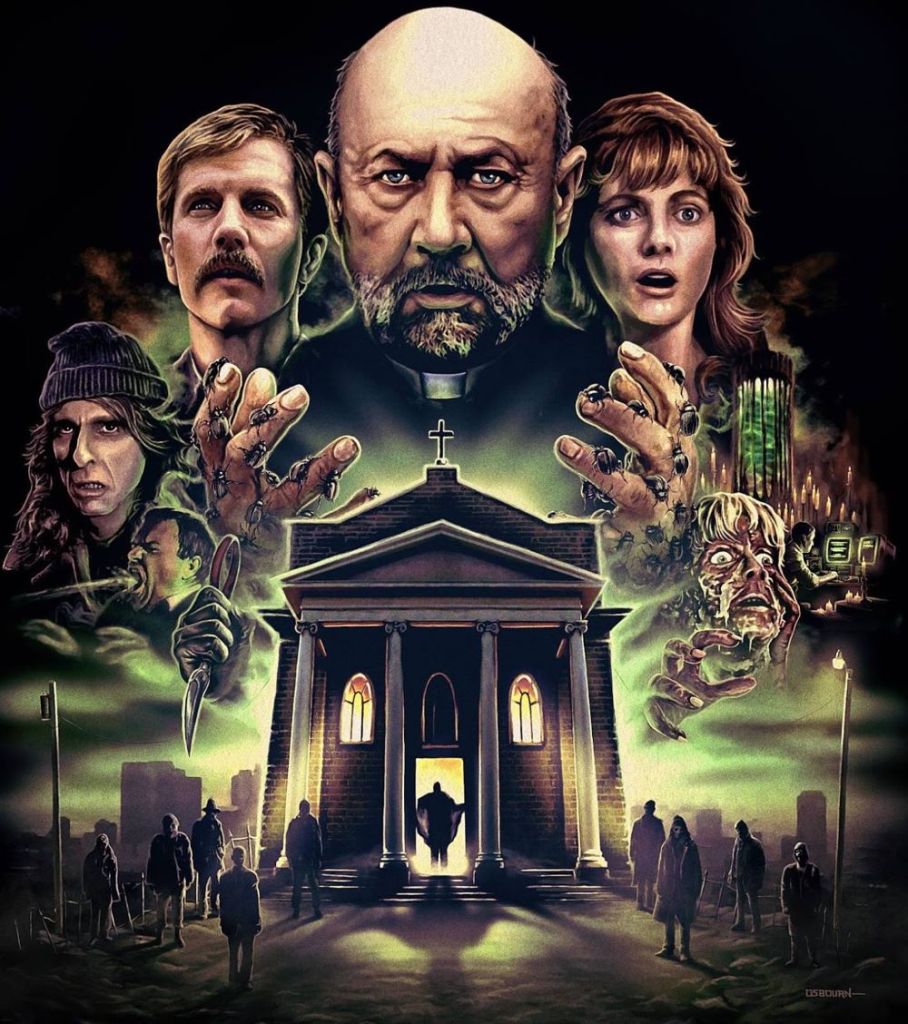
John Carpenter’s Prince of Darkness is a criminally underrated entry in his canon—a blend of philosophical, apocalyptic horror and supernatural mystery that’s as unsettling as it is deliberately strange. Released in 1987, the film often gets eclipsed by Carpenter classics like The Thing and In the Mouth of Madness. Even so, it stands out as a unique organic link between science-driven paranoia and cosmic horror—the sort of film that grows on you as you unravel its layers.

The setup is simple but immediately offbeat: In a derelict Los Angeles church, Father Loomis (Donald Pleasence, always at his nervous best) stumbles on a swirling green cylinder hidden away in the basement. Loneliness and age hang over Loomis as he realizes this is no mere relic but possibly the essence of absolute evil—the literal embodiment of Satan. Sensing he’s in over his head, the priest reaches out to Professor Birack (Victor Wong), a physicist whose rational mindset is quickly tested by the uncanny. Birack arrives with a diverse team of grad students and lab techs, each bringing curiosity, skepticism, and just enough personality to keep things lively.

What starts as an academic investigation quickly goes off the rails. Strange, shared dreams trouble the researchers—fragmented transmissions from the future, warning of disaster in unsettling, VHS-glitch style. Meanwhile, the area outside the church transforms into a kind of urban wasteland: homeless people, gripped by an unseen force, stumble with zombie-like intent, trapping the group inside. Inside, members fall prey to unsettling phenomena, from unexplained possession to increasingly grotesque violence. There’s a sense that the evil in the cylinder isn’t content to simply stay put—and the combination of supernatural implication and scientific uncertainty gives everything a persistent, gnawing tension.

Carpenter directs the film with measured, stifling precision. His color palette—rotting yellows, bruised greens, washed-out sunlight—creates a perpetually uneasy mood. He uses slow tracking shots and carefully composed frames to ratchet up suspense, and the score (co-composed with Alan Howarth) pulses with ominous synths that buzz beneath all the dialogue, making even the film’s quieter moments feel restless and charged with threat. Compared to the gooey spectacle of The Thing, the terror in Prince of Darkness is more metaphysical—less visible monsters, more eroding reality.

Sound and image work together to keep the audience on edge: moments of unsettling silence are punctuated by visual oddities, like swarms of bugs or the warped geometry of the church’s shadows. The group’s scientific attempts to decode the evil—a jumble of quantum theory, apocalyptic Christian lore, and unsettling mathematics—do more to ramp up anxiety than offer answers. Carpenter seems to delight in ambiguity; the revelations never clarify so much as deepen the void, giving shape to a primordial kind of fear.

The film’s most iconic device is its recurring nightmare sequence, where the group—cut off from the world—witnesses a cryptic, shadowy figure emerging from the church, broadcast as a tachyon transmission from the future. It’s classic Carpenter: deeply unsettling, oddly hypnotic, and open to any number of interpretations. The blending of science fiction and theological horror feels fresh and ambitious, and it’s fair to say these sequences alone have ironically kept the film alive in horror culture discussions and remixes.

The cast, featuring Pleasence and Wong, manages the film’s shifts in tone—moving from banter about theoretical physics to genuine terror with surprising ease. The grad students are likable enough for you to root for, especially Lisa Blount and Jameson Parker, who carry the emotional brunt as things collapse. Alice Cooper’s cameo as a silent, menacing street dweller further anchors the film’s reputation for “unexpected creepy” in the best way possible.

While there are flashes of gore—possessions, injuries, even some memorable stabbings—Carpenter resists making violence the centerpiece. The real horror here is psychological: paranoia, loss of agency, and the collapse of foundational beliefs. Where The Thing was about trusting (or not trusting) your friends, Prince of Darkness is about grappling with a world where even faith and science seem powerless and interchangeable in the face of the unknown.

Thematically, this is Carpenter at his most cerebral and bleak. The notion that neither faith nor science can adequately tackle the unfathomable echoes Lovecraft, yet Carpenter grounds it all in urban decay and deadpan dialogue rather than Gothic flourish. The questions get bigger—what good is faith if truth is poisonous, and what does science matter against a force older than logic? Dialogue about quantum uncertainty and theological paradoxes isn’t there to solve anything, but to make everything less secure.

If the film has a flaw, it’s that its pacing feels deliberately patient—some might say slow. Tension accumulates gradually, and you’re invited to sit in the discomfort as the group loses sleep, loses one another, and loses touch with reality. As the stakes escalate, the line between dream and waking life shreds, leading to an ending that’s haunting, ambiguous, and deeply open-ended. There’s no neat wrap-up or cathartic victory—only trauma, unsolved terror, and a lingering sense that evil never really left, just waited.

It’s this refusal to explain or comfort that gives Prince of Darkness its lasting cult appeal. Carpenter puts cosmic pessimism front and center: knowledge itself stands as a kind of curse, and both faith and reason bend beneath the weight of mystery. Rather than offer solutions, the movie warns about the dangers of peeling back reality’s surface—a theme that’s only grown more unsettling in the years since it was made.

Watching Prince of Darkness now, the film may not fit everyone’s idea of a fun Friday-night scarefest. But if you want horror that’s slow, dense, and sticks with you, this is essential viewing. Carpenter delivers a bleak, hypnotic nightmare about what happens when explanations fail—when the universe itself seems ready to swallow us whole. Whether you’re a die-hard genre fan or someone looking for something different, Prince of Darkness is cult horror at its most unshakable—proof that the scariest stories are often those that leave their deepest secrets unexplained.