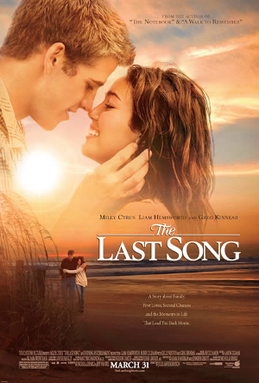
Ronnie Miller (Miley Cyrus), who is 17 and way too rebellious to be likable, travels to Georgia to spend the summer with her father, a former concert pianist named Steve (Greg Kinnear). Ronnie is a sarcastic brat up until she discovers that a racoon is trying to eat a nest of turtle eggs. She tries to protect the turtles. The aquarium sends over a volunteer named Will (Liam Hemsworth) to watch over the turtle eggs and he and Ronnie fall in love over the course of several nights on the beach. Ronnie starts to straighten out her life but then she learns that her father has cancer and that the reason he invited her and her brother to Georgia was so he could have one last summer with her.
This is a Nicholas Sparks story so, of course, someone has to die. I always tell myself that I’m not going to cry whenever I watch a Nicholas Sparks movie and then I do. Greg Kinnear was really likable as Steve and Liam Hemsworth was really cute as Will and I know I would have fallen in love with him too if we were protecting turtle eggs together. When the eggs hatched, the baby turtles were adorable.
It’s too bad Miley Cyrus can’t act because her performance was so bad that it ruined the movie. Even the racoon that tried to steal the turtle eggs outacted her. I got tired of Ronnie and her attitude. No matter what happened, Ronnie had to be sarcastic about it. Even when she finally realized that the world didn’t revolve around her, Miley still delivered all of her lines in the same flat, smartass tone of voice so I didn’t buy her change of heart at all.
1995’s Stolen Innocence opens with 18 year-old Stacy Sapp (Tracey Gold) trying to sneak back into her house after a long night of drinking and partying. Unfortunately for her, Stacey isn’t very good at sneaking around and she’s caught by her mother (Bess Armstrong) and her father (Nick Searcy).
“I’m 18!” Stacy argues.
“You’re going to end up pregnant!” her mother yells.
Stacy says that that her mother is just scared that she’s going to end up a loser “like you!” Well …. yeah, Stacy, that’s kind of the point. If your mother has experience with the life decisions necessary to become a loser, maybe you should listen to her warnings.
Anyway, Stacy runs away with a friend of her’s. After her friend decides to go back home, Stacy hitches a ride with a trucker. When the trucker stops off at a truck stop so he can get his brakes looked at, Stacy meets Richard Brown (Thomas Calabro, wearing a really bad wig). Richard is long-haired and has got a tough guy beard and a cheesy tattoo of a heart on his scrawny forearm. Stacy, of course, is totally smitten and she goes off with Richard and his “friend,” Eddie (Matt Letscher).
It doesn’t take long for us to figure out what Richard is bad news. He carries a gun. He’s financing his trip through stolen checks. He might not even own the truck that he’s driving. He and Eddie have a bizarre relationship in which Richard continually abuses Eddie but Eddie refuses to leave. Richard is obviously a bad guy and we can all see it. When Stacy finally calls her parents from the road, they immediately figure out that Stacy is in trouble. However, it takes Stacy forever to figure it out because Stacy’s kind of an idiot.
I cringed a lot while watching Stolen Innocence, not so much because of the film’s depiction of Richard’s criminal lifestyle but because I used to have a definite weakness for bad boys and I could kind of understand what was going through Stacy’s mind when she first met Richard. That said, I’m pretty sure that I would have figured things out a lot quicker than Stacy did. Stacy quickly goes from being a somewhat sympathetic rebellious teenager to being someone who you really start to get annoyed with. Oh, he’s threatening you with a gun? Okay, that’s when you leave! That’s when you start plotting your escape. You don’t make excuses for him. He’s financing his trip with stolen checks? I’m sorry, is that not a red flag? Add to that, as played by a miscast Thomas Calabro, it’s not like Richard is some boiling cauldron of charisma. From the first minute we see him, with his long hair and his cowboy hat and his tattoo, the guy seems like a joke.
Eventually, Stacy does figure out the truth but, by that point, Richard and her are holed up in a motel room and Richard is exchanging gunfire with the FBI. The film ends with a title card, reminding us that this was a true story. “He’s not a bad person!” Stacy wails to the police. I guess some people really are that stupid.
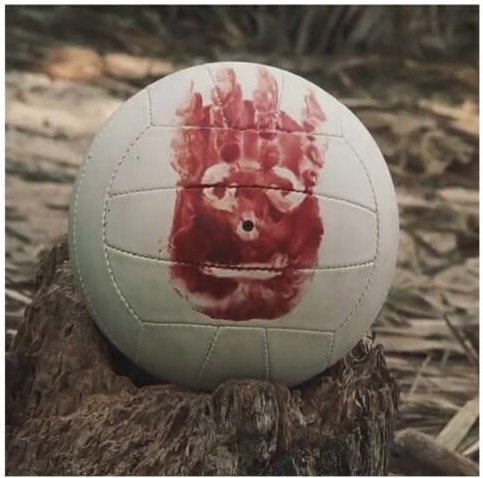
Seriously, I’m usually pretty well-behaved when I watch a movie but every time I see the 2000 film Cast Away, I find myself thinking, “Protect Wilson! You must protect Wilson!” And then, every time, I feel the sting of tears in my eyes as Wilson, with that red-face and that understanding attitude, goes floating away.
Wilson is a volleyball. When a FedEx executive named Chuck Noland (played by Tom Hanks) finds himself stranded on a desert island, Wilson becomes his only companion. A stain from Chuck’s bloody palm creates something that resembles a face on Wilson’s rubber surface and Chuck spends a lot of time talking to Wilson. It’s how Chuck maintains his sanity, even as he loses weight, sheds most of his clothes, and grows a beard.
Chuck learns how to make fire. He learns how to catch fish. He is able to survive due to the supplies that he gathers from the FedEx packages that were being carried on the plane that crashed into the island. But Chuck never stops dreaming of returning home to his girlfriend (Helen Hunt). Eventually, Chuck finds the courage to try to make the journey back to civilization. He brings Wilson with him but ultimately, this is something that Chuck is going to have to do on his own. Of course, Chuck has failed to consider that he’s been gone for years. He is presumed dead. On the Island, time seemed like it was frozen. For the rest of the world, life has continued.
CastAway is a film that a lot of people, especially online film commentators, tend to criticize. The complaint is usually that the film is essentially a commercial for FedEx, that it’s not believable that Tom Hanks could survive on that island for as long as he did, and that the film itself has a weak ending. I’ll concede that the film does make FedEx look like the nicest corporation on Earth. (FedEx’s CEO appears as himself, which should tell you something about how the company is presented.) And I will admit that the film’s time-advancing jump cut, which abruptly takes Hanks from being clean-shaven and husky to being thin and bearded, does leave a lot of unanswered questions. But I will always defend the film’s ending. The film ends on a note of ambiguity but how else could it have ended? Everyone thought Chuck Noland was dead. His girlfriend had every right to get on with her life and, in fact, it would have been psychologically unhealthy for her if she hadn’t. As for that final shot, it’s an acknowledgment that Chuck doesn’t know what lies ahead of him in the future. All he knows is that he life isn’t over yet. It’s a melancholy ending. It’s a frustrating ending. But it’s also the only way the film could have ended and therefore, it’s a perfect ending.
CastAway is a film that I will always defend and it’s also a film that really only could have worked with Tom Hanks in the lead role. He plays Chuck as being the ultimate everyman, an affable guy who was just trying to do his job and whose survival of the initial plane crash was largely due to luck. Hanks is one of those actors who is instantly sympathetic and CastAway uses his screen persona to good effect. You want him to survive because he’s Tom Hanks. He may be playing a character named Chuck Noland but ultimately, he’s Tom Hanks. He survived being trapped in space. Surely, he can survive being stranded on an island. The majority of the film is just Hanks talking to himself. This would have brought out the worst in so many actors but Tom Hanks makes it work. And yes, he’ll bring tears to your eyes as he watches Wilson float away. That’s the power of a good actor.
As for Wilson, I like to think that he washed up in Pensecola. Recently, I played a little volleyball on a beautiful Florida beach. Was that you, Wilson?
In Reagan, Dennis Quaid stars at the 40th President of the United States.
Framed as a story being told by a former KGB agent (Jon Voight) who is attempting to make a younger politician understand why Russia lost the Cold War, Reagan starts with Reagan’s childhood, includes his time as an actor and as the anti-communist head of the SAG, and then gets into his political career. Along the way, several familiar faces pop up. Robert Davi plays a thuggish Russian leader. Mena Suvari plays Reagan’s first wife while Penelope Ann Miller plays his second. Xander Berekely plays George Schultz (who was just previously played by Sam Waterston in The Dropout miniseries.) C. Thomas Howell, Kevin Dillon, Dan Lauria, and Lesley-Anne Down all have small but important roles. And the usual suspects when it comes to conservative filmmaking — Nick Searcy, Kevin Sorbo, and Pat Boone — are there to compliment Voight and Davi. I was a little surprised to see that Dean Cain was not present.
As usually happens to films that feature sympathetic Republicans, Reagan was slammed by critic but better-appreciated by the audience for which the film was made. I wasn’t particularly surprised. Movie critics tend to be liberal and Reagan is very much not that. For a professional film critic, a film like Reagan must be met with snark and derision because otherwise, one would risk cancellation. Don’t get me wrong. I’m not saying that there aren’t things to criticize about Reagan the film. I’m just saying that one should always keep in mind that critics have their own individual biases. One reason why the Rotten Tomatoes score is such an unfortunate development is because it ignores the fact that most films have things that work and things that don’t work and that quality is often in the eye of the beholder. Instead, it just tells us that a film is either a 90% or a 10%.
As for Reagan, it’s definitely a bit on the heavy-handed side but, then again, I think the same can be said for just about every political film that’s come out over the last few decades. For those who claim Reagan is somehow more heavy-handed than most, I invite them to sit through Rob Reiner’s LBJ. Indeed, the only director who has really shown a willingness to admit that a President can be both good and bad was Oliver Stone and when was the last time anyone watched Nixon? Reagan is at its weakness when it tries to recreate Reagan’s time as an actor. Dennis Quaid gives a good and charming performance throughout the film but he’s also 70 years old and, in the scenes where he plays the youngish Ronald Reagan, all of the soft-lighting and Vaseline on the lens ends up making him look like a wax figure. Once Reagan gets older, Quaid is allowed to act his age and both he and the film become much more convincing. I enjoyed the film once Reagan became President, though you should understand that I have biases of my own. I’m a fan of low taxes and individual freedom, which is why I’m also not a fan of communism or, for that matter, any extreme ideology that attempts to tell people how to live or think. “Tear down this wall!” Regan says while standing in front of the Berlin Wall and it’s a rousing moment, both in reality and on film.
In the end, Reagan is a film that will be best appreciated by people who already like Ronald Reagan. Yes, the film is heavy-handed and the framing device is a bit awkward. But Dennis Quaid’s heartfelt (and, towards the end, heartbreaking) performance carries the film. The film is not at all subtle but you know what? I’ve seen a countless number of mediocre films that have portrayed Reagan negatively, often with as little nuance and just as heavy-handed an approach as Reagan uses in its positive portrayal of the man. I sat through The Butler, for God’s sake. There’s nothing wrong with having a film that looks at the man from the other side. Those who like Ronald Reagan will feel vindicated. Those who don’t will say, “What was up with that Pat Boone scene?”
In 1990’s Days of Thunder, Tom Cruise plays Cole Trickle, a talented but headstrong racecar driver who is recruited by businessman Tim Daland (Randy Quaid) to become a NASCAR champion and to also provide some publicity for Daland’s Chevrolet dealership. Tim convinces Harry Hogge (Robert Duvall) to come out of retirement and serve as Cole’s crew chief. Harry builds cars in his barn and then he talks to them, whispering sweet nothings into their side mirrors. (This happens quite a bit.) Both Cole and Harry have something to prove. Cole has to prove that he’s the best. Harry has to prove, to himself, that an accident that killed one of his driver was not his fault. Harry also has to prove that he’s not insane. That’s not an easy thing to do when you’re always in the barn, talking to a car.
At first, Cole’s rival is Rowdy Burns (Michael Rooker) but, after Rowdy is seriously injured in a crash and told that he will never race again, Rowdy becomes Cole’s closest friend and supporter. With Rowdy off the circuit, Russ Wheeler (Cary Elwes) becomes Cole’s main rival. We know that Russ is a bad guy because he never has a hair out of place and he’s played by Cary Elwes, who for some reason was always cast as the smug bad guy in films like this despite having a rather charming screen presence.
Cole’s love interest is Dr. Claire Lewicki (Nicole Kidman), who is there to help Cole deal with his anger issues and who is surprisingly forgiving of all the times that Cole acts like a complete and total jerk. That happens quite a bit. Cole is a bit of brat but eventually, with the help of everyone around him, he learns how to be a great driver.
The first time I ever saw Days of Thunder, I was pretty dismissive of it. The film was producer and directed by the same people who were behind Top Gun and it pretty much tells the same story, except the jets are replaced with cars and the stakes are a bit less than saving democracy. Like Top Gun, it was a film where Tom Cruise played a character who wants to be the best but who has to learn how to set aside his own ego and take control of his impulsive nature. The first time I saw the film, I shrugged and said that, while Nicole Kidman and Tom Cruise had a lot more chemistry than Cruise and Kelly McGillis, it was still nothing that I hadn’t seen before.
But I have to admit that, since then, I’ve rewatched the film a few times. It’s one of those movies that I never specifically seek out but if I see it playing somewhere on cable, I’ll usually watch a bit of it. Some of it is because the race scenes actually are exciting, even if they do get a bit repetitive after a while. Tony Scott was a director who knew how to film action. The other major reason why I often find myself watching Days of Thunder is for the totally over-the-top performances of Robert Duvall and Randy Quaid.
“We looked like a monkey fucking a football out there!” Quaid exclaims, not once but twice. It’s a phrase that doesn’t make the least bit of sense and it’s one of those lines of dialogue that reminds us that Days of Thunder went into production with a script that was being written and rewritten on a daily basis. But Randy Quaid’s delivery is so emphatic that line works despite being totally stupid.
As for Robert Duvall, his performance here is a perfect example of how much fun it can be to watch a legitimately great actor overact. There’s nothing subtle about his performance and I doubt Days of Thunder will ever be a film that shows up when people are talking about the highlights of his legendary career. But when Duvall talks to his car, you believe every minute of it. It’s such a silly scene but Duvall pulls it off like the pro that he is.
Finally, if you’re going to watch a movie about two cocky race car drivers who are constantly taunting each other, wouldn’t you want them to look like Tom Cruise and Cary Elwes? Good lookin’ guys in fast cars, drivin’ around Southern racetracks, what’s not to love?
“Oh my God! A Nicolas Cage western!? This is going to be great!”
That was my initial reaction when I heard about The Old Way, a film in which Nicolas Cage plays a former gunslinger who returns to his old ways while seeking revenge for the murder of his wife. Who knew which Nicolas Cage would show up for The Old Way? Would we get the wild, unpredictable Cage? Would we get the soulful and haunted Cage? Would this be one of the films that Cage cared about or would this be one of the films that Cage clearly just made for the money? Hearing that Nicolas Cage walked off the set because of an accident with one of the guns did not fill me with confidence. (The armorer who worked on The Old Way was the same one who went on to work on Rust and again, that did not exactly fill me with confidence.) Still, I was definitely curious to see The Old Way for myself.
Unfortunately, The Old Way is neither Cage at his best nor Cage at his most eccentric. Instead, Cage gives a quiet and emotionally restrained performance as Colton Briggs. When Briggs is first seen, he’s taking part in an extrajudicial execution and then coldly killing a man who first shoots him in the back. Jump forward 20 years and, much like Clint Eastwood in Unforgiven, Colton Briggs is now a married man and a somewhat uptight shop owner who rarely shows a hint of emotion. His 10 year-old daughter (Ryan Kiera Armstrong) is as rebellious as Colton once was and she has no idea about Colton’s past. However, when the nephew of the man that Colton killed at the start of the film, murders Colton’s wife, Colton sets out for revenge. His daughter follows him, along with Marshal Jarret (Nick Searcy, giving the film’s best performance). Jarret is a former friend of Colton’s but both men make it clear that they will kill the other if they have to. That’s the old way.
It’s a typical western and, on a purely technical level, it’s not a bad one. The cinematography is frequently gorgeous and the members of the rival gang are made up of memorable character actors like Clint Howard and Abraham Benrubi. Obviously, a certain amount of care went into recreating the old west. As I said before, Nick Searcy is ideally cast as Marshal Jarret and he gives a performance that will keep you guessing as to whether or not Jarret should be trusted. Nicolas Cage is adequate in the lead role, even if he’s never quite as eccentric as most of his fans would probably prefer him to be. When he first shows up, he’s wearing an obviously fake mustache but that’s about as odd as his performance gets.
But, in the end, The Old Way just isn’t a particularly memorable film. It’s one of those films that you watch with the hope that it will suddenly spring an unexpected detail or a bizarre moment on the audience but it never happens. The Old Way is way too formulaic for its own good, borrowing liberally from True Grit and Unforgiven without ever really establishing its own identity.
I guess some people might argue that the 2002 film, One Hour Photo, isn’t really a horror film.
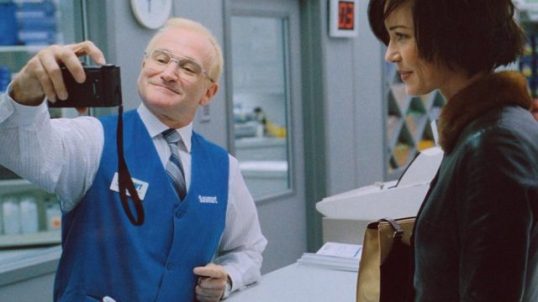
It’s an argument that I can understand. The film does have its scary moments, like the scene where Sy Parrish (Robin Williams) dreams that his eyes are exploding. But there aren’t any ghosts or vampires or hockey mask-wearing slashers to be found in One Hour Photo. Even the film’s most disturbing moment — in which we see that Sy’s apartment is nearly empty except for a giant collage of pictures that cover his living room wall — is more depressing than scary.
It’s really a very sad movie. In fact, it’s probably even more sad today than when it was originally released. Now, when you see Robin Williams’s sad eyes and you hear him talking about how reality can never live up to a photograph, it’s impossible not to think about the actor’s 2014 suicide. I remember that, when One Hour Photo and Insomnia came out in the same year, there was a lot of talk about how unexpected it was to see Robin Williams playing such dark characters. Now, of course, that darkness is a key part of Robin Williams’s persona.
In hindsight, it’s also sad because one watches the film with the knowledge that, even if Sy hadn’t lost it at the end of One Hour Photo, he still probably be a lost soul in 2019. When we first meet Sy, he’s working at the one-hour photo lab in SavMart. He talks about how much he loves developing pictures. When someone mentions that they’ve been thinking about getting a digital camera, Sy nervously chuckles and says, “Don’t do that, you’ll put us out of business.” Of course, in 2019, people take pictures with their phones and even digital cameras are viewed as being something of a relic. If Sy were around and free today, I doubt he’d have a job. If he did have a job, it’s doubtful it would be one that would allow him to cover his wall with someone else’s photos. Instead, in 2019, I imagine Sy would be one of those people following strangers on social media and printing out all their pictures and probably sending them unsolicited DMs and private messages.
Sy is obsessed with the Yorkin family, Will (Michael Vartan), Nina (Connie Nielsen), and their son, Jake (Dylan Smith). Even though the family barely knows who Sy is, he knows them because Sy has spent years developing (and stealing) their photos. Sy views them as being the perfect family. They’re the family that he wants to be a part of. “Sometimes I think of myself as being Uncle Sy,” he says at one point. But then Maya Burson (Erin Daniels) brings in her photos to be developed and Sy learns that the reality of the Yorkins is not as perfect as the photographs. And Sy loses it.
Actually, there’s quite a few reasons why Sy loses it and the film suggests that, if the Yorkins had never stepped into SavMart, Sy would have found another family on which to obsess. Something is missing inside of Sy. Incapable of dealing with reality, Sy instead deals with posed pictures of happy times. Towards the end of the film, there’s a throw-away line that attempts to offer some sort of insight into why Sy is such a lost soul. Personally, I think the film works better without an explanation. Why is less important than the fact that Sy exists.
In the end, One Hour Photo qualifies as a horror film not because of any paranormal danger but because it’s a film about the horror of everyday life. You never know who might be watching you. That friendly clerk who waits on you at the grocery store might be following you home and imagining that he’s a part of your life. You never know. One Hour Photo is the film that suggests that, lurking behind every friendly smile, there’s a blank Sy Parrish. It’s a scary thought.


 Through the Shattered Lens