October Positivity: Operation Unite (dir by Donald James Parker)


2024’s Operation Unite opens with a man standing at the front of a church and announcing that God has told him that one of the members, a blank-faced young man named Brent (Greg Carnes), is going to be a very important person in the future.  Everyone in the church is really excited, despite the fact that Brent comes across as being a little goony.

Meanwhile, at another church, Pastor Friar (Brian Scott Gilmore), peaches against “charismatic” churches.  His daughter, Kaitlyn (Kaylee Keller), feels somewhat dissatisfied with her father’s sermon but she can’t really put it into words.  Kaitlyn is 20 and she knows that she should be free to pick her own church to attend but, since she’s living at home, she has to do what her father wants.  Her father wants her to attend his mainstream Protestant church.  So be it.

When Brent sees Kaitlyn in a coffeeshop, he tells his friend that God has just told him that he’s meant to be with Kaitlyn.  Normally, I’d say “Yikes!” but this film presents this as being a positive development.  Kaitlyn leaves without talking to Brent but Brent says it doesn’t matter.  If God wants them to be together, he’ll run into Kaitlyn again.  Double yikes!

And Brent does run into Kaitlyn again.  Soon, they’re dating!  But how will Pastor Friar react when he discovers that his daughter is dating the newly-appointed youth minister of a charismatic church?

This film is about the conflict between different branches of Protestantism.  That’s actually kind of an interesting idea and that’s certainly something you would never expect to see a mainstream film attempt to tackle.  Most movies just tend to assume that all protestants are a part of the same generic church.  In this film, Friar views the charismatics as being heretics and the charismatics view Pastor Friar and his congregation as being not in touch with God.  Myself, I’m a Catholic so, as far as I’m concerned, they’re all heretics.

Interesting premise aside, this has all of the problems that one usually finds with low-budget religious films.  The pace is deadly slow, the acting is amateurish, and the script is full of little character moments that ring as being either forced or hollow.  I’ve seen a few Donald James Parker films and this definitely is one.  Conversations tend to go on forever.  It’s obvious that the filmmakers had no idea how to use something editing to create narrative momentum.  Nearly every shot is static and uninteresting.  It’s honestly difficult to watch.

Like a lot of Parker’s film, there are moments in the film when a surprising and rather disagreeable hostility bubbles up.  When Brent’s youth group singing a hymn, Brent responds by scolding them for not sounding properly enthusiastic and it really does seem to go on forever.  When Brent and Pastor Friar debate their beliefs, Brent comes across as if he’s about to take a swing at the man who he wants to be his future father-in-law.  Self-righteous, perpetually angry, and kind of dull to look at, Brent is simply not a likable character.  Not even taking into account their religious differences, I felt like Kaitlyn needed to get as far away from Brent as possible.

This movie is all about building a bridge across denominations.  I just hope they eventually found a more reliable engineer than Brent.

October Hacks: Sorority House Guillotine (dir by Gregory Hatanaka)


2026’s Sorority House Guillotine does not feature a guillotine or a sorority house. It does, however, feature a lot of footage from Bikini Guillotine and a monologue about John Cassavetes.

The majority of the film features a group of young women in bikinis hanging out at the pool. One of the women announces that she owns the house and that she’ll be having a party every weekend. Everyone says, “Whooo!” and raises their red Solo cups. Most of the footage is lifted directly from Bikini Guillotine, but it’s also obvious that a lot of it was taken from outtakes that weren’t included in that film. There are a lot of scenes where the women clearly aren’t acting, but are instead just sitting around waiting for the next shot to be set up. Members of the crew appear in the background. The shadow of the director is visible more than a few times. The camera rig is sometimes visible. There are also quite a few scenes where the women aren’t filmed from the best possible angle, and that feels rather unfair to them.

(Everyone, regardless of how attractive, has at least one unflattering angle. I’m usually pretty happy with how I photograph, but I know that if someone snaps a picture while my head is turned a certain way, all anyone is going to notice is my nose. A good director — especially one who is directing a movie in which the entire cast is half-naked for the entire running time — doesn’t include unflattering angles in the finished film.)

Because Bikini Guillotine had a nearly incoherent soundtrack, this film handles things by just featuring voice-overs over the scenes of the girls hanging out by the pool. We hear about how, when you’re young, you don’t worry about anything. “Someone says fried chicken and everyone laughs.” We’re also told that, “Gina asks Tina, ‘Why is everything so blue?’ Tina says, ‘Because you’re looking at it too long.’ ‘No, why is everyone blue?’” Wow, that’s deep. It’s the type of weed-fueled nonsense that I thought was profound during my senior year of high school.

When the voice-over isn’t talking about life, it’s talking about the movies. We’re told that the girls are talking about Charlie Chaplin and Josef von Sternberg. Eventually, they start to talk about how much they love Deep Red and the scene where David Hemmings sees his reflection in a pool of blood. Then we’re told that one of the girls is talking about how much she loves the work of John Cassavetes because Cassavetes just captured life without any studio-imposed drama. These are not the type of things that a bunch of 20-year-old girls are going to be talking about while hanging out at the pool. When I was 20, I loved movies, but I still didn’t talk about them while I was rocking a bikini next to a swimming pool. I was usually too busy trying to make sure I was giving everyone my most flattering angle.

The killer eventually shows up about 55 minutes into this 77-minute film. As opposed to the killer in Bikini Guillotine, he just wears a medical mask and carries a knife in this one. At first, I wondered if maybe the girls had been called back to shoot all-new death scenes, but as I watched, it became obvious that the scenes were actually either filmed auditions or rehearsals for the first film. The kills are once again bloodless.

What an odd movie! For all of its flaws, I do have to admit that the out-of-place voice-overs did add a bit of a surreal edge to the action. With the frequent appearances from the film crew and the cameras, one gets the feeling that Hatanaka was either trying to say something about the filmmaking process or, even more likely, he was trying to fool people into thinking he was saying something about the filmmaking process.

This film mostly just made me want to go hang out by the pool on a nice sunny day. Maybe I’ll even talk about Argento.

SOV Horror Review: City of the Vampires (dir by Ron Bonk)


The city of Braddock has a problem.

1993’s City of the Vampires opens with a news report about Braddock. The city appears to be dying, and no one is sure why. The population numbers have plunged. People are scared to go out at night. Most of the people interviewed for the news story talk about how they can’t wait to get out of Braddock. As I watched, I found myself wondering if this was the same Braddock that would later elect John Fetterman as mayor and appear in those Levi’s commercials. The commercials aired around 2009–2010 and were all about how important it was to save the city of Braddock. I remember watching them and thinking, “Why is some Yankee city more worthy of a commercial than the cities that are struggling in the South?”

(Fetterman, at the time, was branded “America’s coolest mayor” by The Guardian. People forget just how much the media loved Fetterman when he was just another predictable liberal.)

As for the movie, it follows Sam Helling (Matthew Jason Walsh) as he explores the city of Braddock at night. He’s looking for his girlfriend Christine (Anne-Marie O’Keefe), but instead he finds himself in a city that has been taken over by vampires. I should mention that some online sites insist the character is named Sam Helsing, which would seem to be a callback to Dracula’s Dr. Van Helsing. Watching the movie, though, it’s made clear that Sam’s last name is indeed Helling. Leave the Van Helsings out of this.

City of the Vampires is a shot-on-video horror film, and it definitely deserves some credit for its ambition. Whereas most SOV horror films were content to just rip off the latest slasher and zombie pictures, City of the Vampires was obviously meant to be a low-budget action epic. There are a few interesting camera angles. There’s a deliberate echo effect on some of the dialogue, the better to give it a supernatural, dreamlike feel. There are several fairly convincing shots of melting faces. Despite the low budget, the filmmakers were obviously trying to make something memorable. One could easily imagine an alternate universe where City of the Vampires launched a whole franchise about vampires taking over American cities in decline. Look out, Gary, Indiana. The bloodsuckers are coming.

That said, it’s still a shot-on-video horror film, and the low budget really does show in more than a few scenes. The film takes place largely at night, it appears to have been shot at night, and there are several scenes so darkly lit that it’s a struggle to make out what’s happening. As cool as the echo effects were, the soundtrack is generally not that clear, and I sometimes found myself straining to hear what people were talking about. Proper lighting and sound recording have been the downfall of many SOV films. They’re the kind of thing people take for granted until they’re gone.

Still, I’ll give this film credit for its ambition. I always appreciate the effort, even if it’s not fully successful.

The TSL Horror Grindhouse: Amityville La Llorna (dir by Jamie Grefe)


In 2025’s Amityville La Llorona, a couple (played by director Jamie Grefe and Sloane Tower) move into a house and spend the entire time arguing about every little thing.  Eventually, the husband has visions of a mysterious woman (Skya Theobold) and a strange figure who keeps shouting, “Mama!  Mama!”  The film is only 63 minutes.  Unfortunately, the dialogue is largely improvised and it takes forever for anything to actually happen in the movie.  I felt every one of those 63 minutes.

Since there’s really not a helluva lot to say about the film, let’s talk about La Llorona.

The legend of La Llorona is a well-known one in Mexico and the southwestern half of the United States.  It’s a story that I was told by both my mom and my aunts and, as a result, I never went off with a stranger while I was growing up.  Of course, I also had some pretty intense nightmares but that’s kind of the point.  If someone tells you the story of La Llorona and you don’t end up having a nightmare about being drowned by a weeping woman, they didn’t tell the story correctly.

La Llorona was originally named Maria.  She lived, in a rural village, with her family and she was famous for both her beauty and her virtue.  When a wealthy nobleman saw her and immediately proposed to her, Maria accepted.  However, the nobleman’s father was upset that his son was marrying into a poor family and he refused to accept Maria as his daughter-in-law.  Maria and her husband ended up having two sons and living in a house by the river.  Maria’s husband doted on their sons but he ignored her and eventually, Maria learned that he was having an affair.

In a fit of blind rage, Maria drowned her children in the river.  After realizing what she had done, Maria died of grief.  However, when she arrived at the gates of Heaven, she was asked why her children were not with her.  When Maria explained that she had lost them, she was told that she would not be allowed to enter Heaven until she found them.  Now, known as La Llorona (or “the weeping woman”), she wanders the Earth, crying and looking for her children.

Where does one find La Llorona?  It depends on who is telling the story.  Some stories say that you’ll only see her near a body of water.  My mom used to tell me that La Llorona could be anywhere, including under my bed or in the bedroom closet.  Regardless of where you might find her, La Llorona is always wearing her wedding dress and she’s always sobbing.  Approach her and she’ll grab you and either kidnap you or drown you, all the while begging for forgiveness.  Many have seen La Llorona but few have survived to tell the story.

“And that is why we do not talk to strangers,” my mother would say while I looked out the bedroom window, searching for the sight of La Llorona walking through the Texas night.

Though Skya Theobold’s character is credited as being La Llorona in Amityville La Llorana, she doesn’t have much in common with the true La Llorona.  Then again, this film also has nothing to do with any of the previous Amityville films.  Amityville, as either a town or franchise, is never mentioned in this film.  Normally, I’m willing to cut an exploitation film a little bit of slack when it comes to having a misleading title.  Usually, that’s just a part of the game.  In this case, though, it just serves to remind me of how cool a film about the real La Llorona visiting the real Amityville house would have been.

As I mentioned earlier, the dialogue in this film appears to have been improvised.  One of the unfortunate things about improv is that everyone thinks that can they do it.  They think that as long as they’re given a scene to play, they’ll be able to come up with appropriately compelling dialogue.  This film proves that is not always the case.  As I watched Amityville La Llorona, I found myself hoping that Michael Scott would kick open a door and shout, “MICHAEL SCARN, FBI!”

Michael Scarn in Amityville.  Now that would be a movie!

Previous TSL Amityville Reviews:

  1. The Amityville Horror (1979)
  2. Amityville II: The Possession (1981)
  3. The Amityville Cure (1990)
  4. The Amityville Haunting (2011)
  5. Amityville Death House (2015)
  6. Amityville Toolbox (2016)
  7. Amityville: The Awakening (2017)
  8. The Amityville Murders (2018)
  9. Amityville Cop (2021)
  10. Amityville Emanuelle (2023)
  11. Amityville A.I. (2024)

Lifetime For October: Surviving The Sleepover (dir by Patricia Fontain)


When I was 11 years old, I spent about a month and a half living in a motel with my mom and my sisters. We were between homes, and since my mom didn’t really have the money to pay for our rooms, she and my two oldest sisters would work as maids during the day while my sister Erin and I stayed in our own room and watched stuff on the television that we probably shouldn’t have been watching. (“What are you watching!?” Mom would say as either Erin or I grabbed the remote and tried to get the TV off of HBO as quickly as possible.)

In retrospect, I know that all probably sounds very dramatic and traumatic, but I have to admit that, at the time, it just felt like an adventure. I was jealous of my mom and my sisters getting to wear uniforms every day and basically go anywhere they wanted in the motel. I would ask my mom and sisters about what they found in the rooms they had to clean, and I would beg for a chance to go with them because I figured it had to be fun to see how other people lived. They always refused. Years later, my sister Megan would tell me that they usually just found discarded underwear, used condoms, and half-eaten fast food.

Sometimes I would sit in the front lobby, bothering whoever was working behind the desk and trying to overhear conversations. I loved watching the various people who checked in and out of the motel, and I would imagine amazing identities and life stories for them. At night, I would listen for sounds coming from other rooms. One time, the police were called because the people below us were fighting, and I remember watching the reflection of the red lights flashing across the walls of my room.

That said, I think my main memory of living at that motel was that there was a creek right next to the hotel (though I always envision it as a raging river whenever I think back to those days), and on the other side of that creek there was a drive-in movie theater. Every night, I would go out on the balcony and look into the distance, at the silent images flickering across the giant screens. The fact that I couldn’t actually hear what Bill Paxton and Helen Hunt were saying only made the experience more enjoyable. I could make up my own stories to go along with the images. Watching those movies became a ritual for me. I had to watch every night, at the same time, and if anyone tried to keep me from doing so, I would throw a fit. Though I didn’t fully realize it at the time, for me that drive-in came to represent stability.

I found myself thinking back to those days as I watched Surviving the Sleepover, a Lifetime film from 2024. Hannah (Sloan Mannino) is a teenage girl who has been living in a motel with her mother (Dawn Marie) ever since they moved to a new town. Hannah, whose father was killed in a fire, does not have any sisters or a drive-in to keep her company. Instead, she uploads videos and spends her time missing all of her friends. However, when popular girl Melissa (Jenna Hogan) invites Hannah to a sleepover, it seems like things might be looking up.

Of course, they’re not.

Melissa is mean as well as popular. Melissa is also obsessed with her stepbrother (Joshua Bertell), and when it becomes apparent that he likes Hannah, Melissa goes off the deep end. Soon Melissa is threatening her guests with a knife, tying people up in the attic, and basically being a very bad host.

This is an enjoyably berserk little Lifetime film, one that understands the importance of embracing the melodrama. Jenna Hogan gives an entertaining performance as the unhinged Melissa. From the moment she complained that Hannah was still “salty” just because Melissa had attempted to drown her earlier, I knew this film was going to be a Lifetime classic.

And yet, as I watched the film, my main thought was that this all could have been avoided if the nation’s drive-ins hadn’t closed. When you don’t have a drive-in theater to visit, you end up threatening people at sleepovers. That’s just the truth of the matter.

There aren’t many drive-ins left.

Protect them at all costs.

Brad’s thoughts on the rural nightmare, MACON COUNTY LINE (1974)! 


Max Baer, Jr. co-wrote, co-produced and co-starred in this southern fried thriller about a couple of good ‘ole boys (brothers Alan & Jesse Vint) who break down in the wrong county. The sheriff (Baer), who’s somewhat suspicious of the boys, goes after them with a fierce vengeance when his wife is murdered.

I’m a big fan of this classic drive-in film. Baer is excellent as the small town sheriff who eventually goes mad with rage, which he directs squarely onto a couple of brothers who happen to be passing through. The film takes its time with the story and the characters, and when everything goes to hell near the end, you can somewhat understand why the sheriff goes nuts. It’s a nightmare scenario built around the suspicion of outsiders and then jumping to the wrong conclusions when a tragedy occurs. It definitely seems like something that could happen, and that’s one of the things that makes it so good. The marketers of the film definitely agreed. In a move that was very hot at the time (THE LEGEND OF BOGGY CREEK, WALKING TALL, THE TEXAS CHAINSAW MASSACRE, etc.), the ads for the film implied that the film was based on true events. While that may not be true, the plan worked as the film was made for roughly $250,000 and would go on to earn over $30 million worldwide. Interestingly, I’ve read that Baer wrote the film’s story on the backs of his BEVERLY HILLBILLIES scripts during breaks in filming on the television classic. Eager to break free from his Jethro typecasting, he took matters into his own hands and made it happen!

I’m also a big fan of the Vint Brothers, Alan and Jesse. Both are good here as the drifting brothers looking for a little fun before reporting in for some military service the next week. Their fun turns into a horrific struggle for survival when they find themselves the target of the sheriff’s misplaced wrath. As part of the “This Week in Charles Bronson Podcast,” I was blessed to be part of an interview with Robert F. Lyons, who’s close friends in real life with the boys. He told us a fun story about them all making these motorized airplanes that they would then fly around and try to knock each other out of the sky. Robert would laugh and giggle while he talked about it. Alan had an important role a year after this was made in the Charles Bronson action hit BREAKOUT. In the film, he stands up to Bronson at a critical moment and lives to tell about it, which is not something every actor can say!

And what can I say about Jesse. Over the last few years, he’s actually become a fun acquaintance in real life. If you enjoy these 70’s “redneck” movies, I recommend one called BLACK OAK CONSPIRACY (1977) that Jesse co-wrote and stars in, with his buddy Lyons playing an over the top villain. Jesse’s a great guy, and he’s very proud of MACON COUNTY LINE. He told me one day that Tarantino has said it was one of “the best stories in cinema!” In the first season of his Video Archives podcast, I personally heard Tarantino brag on Jesse’s performance in THE FORBIDDEN WORLD. I love it when good things happen to good people.

October True Crime: She Made Them Do It (dir by Grant Harvey)


At the start of 2012’s She Made Them Do It, Sarah Jo Pender (Jenna Dewan) is a student at Purdue University who has a good-for-nothing boyfriend named Rick (Greyston Holt) and two roommates who think nothing using her tuition money to buy drugs.  At first, Sarah seems to be frustrated with the losers around her but, after smoking some weed and doing some coke, she’s soon dancing and making out with another woman while Rick plays a video game.  (Who among us hasn’t?)

Sarah leaves to get some cigarettes and, when she comes back, she discovers that her roommates have been executed by a shotgun.  A shaken Rick explains that an argument over money led to him retrieving the shotgun (one that Sarah bought for him because Rick’s criminal record made it illegal for him to buy a gun) and killing everyone else in the house.  At least, that’s what Sarah claims Rick told her.  When the police eventually arrest Rick and Sarah, Rick claims that Sarah was the mastermind behind the killings.  The prosecution describes Sarah as being a “female Charles Manson” and she’s sentenced to 110 years in prison.

Yikes!  That’s a long time!  Luckily, the prison is a pretty nice place.  Sure, some of the inmates are a little rough and everyone is initially jealous of Sarah’s combination of brains and beauty.  But the prison also hosts courtyard dance parties and eventually, Sarah proves herself as a jailhouse lawyer.  Much like Hester Prynne, Sarah show herself to be able and hard-working.  That said, prison is still prison and soon, Sarah is plotting her escape.  Luckily, there’s a smitten prison guard (Nels Lennarson) who is willing to help her out.

The title She Made Them Do It has, of course, a double meaning.  During her trial, the prosecution claims that Sarah Jo Pender made Rick murder her roommates.  Rick even produces a letter that he claims Sarah wrote to him in which she confessed to being responsible.  Even though the letter is itself dismissed as being a forgery, the courts still rule that there is more than enough evidence to argue that Sarah was involved with the murders.  However, the title also refers to the fact that everyone in prison seems to be determined to help Sarah.  Nearly everyone who she meets after she escapes tries to provide Sarah with some sort of aid.  In the end, everyone claims that she made them do it.  A few regret helping her but the majority do not.

Because the controversy over Sarah Jo Pender’s conviction is still ongoing, the film tries to play it both ways as far as the question of her guilt is concerned.  We see her version of the murder.  We see Rick’s version of the murder.  In prison, we see her helping the other prisoners.  Outside of prison, we watch as she clearly manipulates everyone that she meets.  There’s nothing wrong with a little ambiguity but this film takes it so far that Sarah often seems to be a totally different character from scene to scene.  Jenna Dewan tries her best and the film’s early scenes definitely capture the sordid atmosphere of trailer park drama but the film’s refusal to take a definite stand on Sarah’s guilt or innocence ultimately makes the story feel shallow.  It’s one thing for the prisoners and the guards to feel as if they don’t know what’s going on in Sarah Jo Pender’s head.  It’s another thing for the audience to feel that way.

As for the real Sarah Jo Pender, she is still in prison and she still claims to be innocent.  She had a lot of supporters.  I wouldn’t consider myself to be one of them.  I doubt she ‘s a female Charles Manson but I also have a hard time buying her claim that every piece of evidence against her was just a coincidence or a case of bad luck.  Unfortunately, some activists are so eager to turn every conviction into a miscarriage of justice that they ignore anything that doesn’t support their preferred narrative.  (Call it the Mumia Abu-Jamal effect.)  Sarah Jo Pender’s earliest possible relate date is 2054, when she will be 75 years old.

“Warning, Hostile Life Detected on a Planet” Review by Case Wright


He didn’t make a title card; so, I don’t have to either! Take that, Ethan! This is your run of the mill interstellar space craft crashes on an unknown alien planet and they wander around and get eaten.

Have none of these people ever gone hiking? There is dangerous stuff right here on planet Earth that should make you wary!

If you are ever on a space craft that crashes and you see bizarre abandoned stuff everywhere, don’t investigate like you’re in an 80s horror movie.

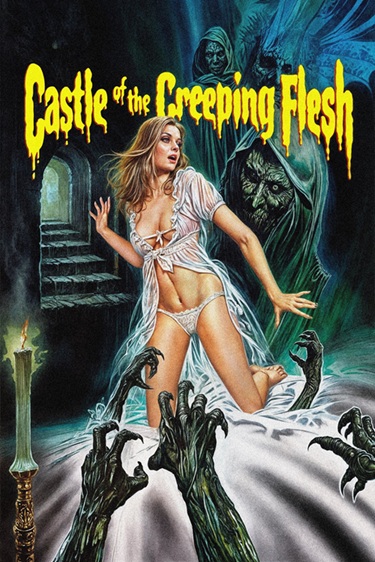
Horror Film Review: Castle of Creeping Flesh (dir by Adrian Hoven)


In 1968’s Castle of the Creeping Flesh, a group of wastrel aristocrats stumble upon a castle inhabited by Graf Saxon (Howard Vernon). It is explained to Baron Brack (Michel Lemoine) and his drunken friends that Saxon’s daughter died just an hour earlier. Everyone is sorry to hear that, but they still want to spend the night at the castle for… reasons, I guess.

Actually, their reasons aren’t that obscure. Night is falling. It’s stormy. There’s a bear on the loose. The Baron and his friends have their reasons for not wanting to travel at night, but that doesn’t change the fact that our film’s “heroes” are demanding that a grieving father not only put them up for the night but also serve them dinner. Saxon would be totally justified in kicking them all out and allowing the bear to have its way with them, but one of the Baron’s friends (Claudia Butenuth) looks just like Saxon’s dead daughter.

Scenes of Saxon looking depressed are mixed with scenes of the Baron’s friends all trying to seduce each other. Meanwhile, a group of surgeons in the castle’s basement are performing open-heart surgery. Every few moments the film cuts to documentary footage of an actual operation, and it’s pretty icky to watch. The heart is an amazing organ, but it’s not really something you want to spend a lot of time staring at. Saxon is trying either to save his daughter or to bring her back to life; the film is never really clear which.

Watching this German film, I was reminded of the work of Jess Franco, and I was not shocked to discover that Franco himself was credited with the incoherent story. The credited director is Adrian Hoven, but it would not shock me if Franco had a hand in the direction as well. Everything about the film—from the meandering storyline to the perpetually horny characters to the scenes of aristocratic decadence—brought Franco to mind. Like many of his films, Castle of the Creeping Flesh is atmospheric and totally incoherent.

Also leading me to suspect Franco contributed more than an outline is the casting of his favorite leading man, Howard Vernon, as Saxon. Vernon plays essentially the same character he did in the Dr. Orloff films. Unlike his co-stars, he is at least consistently entertaining. Outside of Udo Kier, no actor captured wasted European decadence the way Howard Vernon did. If any actor was born to play an early Bond villain, it was Vernon. (When I read Fleming’s originals I pictured him every time Blofeld appeared.) Here he gives a better performance than the material deserved. That was usually how it went with Howard Vernon.

Castle of the Creeping Flesh is a slow, incoherent film, but it has occasional moments strange enough to be entertaining. One woman sensually licks a chicken bone as part of her seduction ritual. Another character runs into that bear mentioned earlier. And of course no one seems to notice there is open-heart surgery happening a few doors down. It’s weird the way any film with Jess Franco’s fingerprints usually is.

That said, Howard Vernon is the main reason to watch. He did his best.

Horror Film Review: They Live (dir by John Carpenter)


When it comes to John Carpenter’s 1988 masterpiece, They Live, everyone remembers the moment that a drifter named Nada (Roddy Piper) first puts on the dark glasses.

They remember him putting them on and suddenly seeing that the city of Los Angeles is stark black-and-white. They remember the mix of humans and skeletal-looking aliens that surrounded Nada and they remember how the aliens were the ones who went out of their way to be rude. What they especially remember are the billboards and the magazine covers reduced to simple orders like “OBEY,” “CONFORM/STAY ASLEEP,” “CONSUME,” “DO NOT QUESTION AUTHORITY,” and “NO INDEPENDENT THOUGHT.”

What is often forgotten is that it takes a while for the film to get to that point. Carpenter starts the film with a rather lengthy first act, in which Nada arrives in Los Angeles, tries to find work, tries to stay fed, and ends up camping out at a shanty town. Nada is one of America’s forgotten people, a drifter with no real home, no past, and it would appear no future. Nada hears a blind street preacher (Raymond St. Jacques) talking about how the rich and the powerful have been recruited to control humanity and he agrees, even before he puts on the glasses. It’s not until the shanty town has been destroyed in a police raid and Nada has put on the glasses that he sees just who exactly has been doing the recruiting.

After he puts on the glasses and sees the way the world really looks (it’s even suggested that what we perceive as color is something artificial that the aliens are using to distract us), Nada hardly ever takes them off. Some of that is for self-preservation. Wearing the glasses allows him to see who is an alien and who is not. But even more importantly, it’s a sign that having now seen the truth, Nada cannot return to the lie. Instead, Nada tries to win his freedom and expose the aliens. It’s not easy. It takes a lengthy and deservedly famous fight in an alley for him to convince his friend Frank (Keith David) to wear the glasses as well. Once Frank does put them on, he automatically understands what is happening. Wearing the glasses doesn’t leave one confused. Instead, wearing them makes everything suddenly make sense.

If this is not a traditional film review, that’s because They Live is one of those films that everyone seems to already know. Even those who have not watched the entire film know what happens when Nada puts on the glasses. For a film that was not a box office hit and which was initially dismissed by many critics, They Live has become very much a part of our shared culture. Today, everyone knows the messages that are being sent through media. Unlike Nada, most people don’t try to rebel. They don’t announce that they’re all out of gum. We’ve become used to it all.

They Live is often described as being an anti-capitalist film, though John Carpenter has said that it’s not. Carpenter has also been quick to say that it’s not meant to be a Marxist film either, regardless of what the film professors may say. Indeed, the messages of “NO INDEPENDENT THOUGHT” and “CONFORM” are about as Marxist as you can get. (Wearing the glasses can be compared to taking the red pill in The Matrix, except of course leaving The Matrix means becoming a part of Zion, a community whose slogan might as well be “DO NOT QUESTION AUTHORITY.”) They Live is a film that celebrates rebellion against the establishment, regardless of how that establishment might disguise itself. In They Live, the right and the left are different sides of the same manipulative coin. The aliens and their human allies thrive regardless of who might technically be in charge. It’s not really a surprise that my more Libertarian-minded friends tend to view They Live as being a sacred text.

It should be noted that there’s a savage humor running through They Live. It’s present in the first time that Nada puts on the glasses. It’s there in his one-liners. But it’s also present at unexpected moments. I love that this movie gives George “Buck” Flower an actual character to play and, when he shows up during the third act in a suit, I can’t help but smile. The aliens, when they are gathered together, still speak in the language of sales and stockholder meetings. They’re in business and business is good.

They Live is one of those films that feels even more relevant today than when it was first released. Anyone who lived through the COVID era will be able to relate to the media telling them to obey authority and to conform with everyone else. It’s easy to imagine that, if one put on the glasses today, they would see a lot of aliens. The sad truth is that there are no aliens to blame things on. The actions of the past few years were done without any help. Carpenter ended They Live with humanity waking up. Escape from L.A. ended with Kurt Russell shutting down the country. One can only imagine how things would end today.