With Thanksgiving approaching, that can only mean that it’s time for AMC to do their annual showing of The Godfather movies.
This gives me an excuse to put up one of my favorite clips, Robert De Niro auditioning for the role of Sonny Corleone in the original 1972 Godfather.
(The role, of course, went to James Caan and De Niro went on to play the young Vito Corleone in The Godfather, Part II. Caan was nominated for an Oscar while De Niro actually won.)
This is going to be a quick review because Unstoppable is a quick movie. That’s not meant to be an insult because Unstoppable is one of those, race-against-time type films that has to move quickly to be succesful.
Unstoppable’s plot is amazingly simple. There’s a runaway train that could derail at any seconds. Since the train is being used to transport dangerous and toxic chemicals, this could potentially lead to the destruction of a small portion of Pennsylvania. However, there’s another train on the tracks. The train is being steered by Denzel Washington and Chris Pine. Washington’s a grizzled veteran type. Pine’s a callow, headstrong youth type. Can they put aside their difference and work together to save Pennsylvania? Does the sun rise in the … wait, which side of the Earth does the sun rise on?
I have to admit that I was prepared to dislike Unstoppable. For one thing, its set in Pennsylvania and right now, I’ve got some issues with that state. For several years, I liked Pennsylvania because I associated the state with The Office. But then a few months ago, that damn Levi’s Jeans commercial started up with that “Heigh Ho” song playing over grainy black-and-white images of Braddock, Pennsylvania and John Fetterman (the town’s mayor, who looks like a serial rapist) saying something about half the town being in a landfill. And those commercials made me dislike Pennsylvania because, seriously, Fetterman, you’re not fooling anyone.
(Quick disclaimer: Fetterman, to my knowledge, has never been accused, arrested, indicted, or convincted of rape. Also, Braddock has a really inspiring story that all you rich kids who know nothing about poverty can go swoon over.)
But anyway, back to Unstoppable. It’s actually a fairly entertaining movie. Scott’s direction keeps the action pretty tight and both Washington and Pine give pretty good performances even if they are playing stereotypes. Both of them have to deliver a lot of technical, “train” dialogue and they both deliver it with such confidence that it really didn’t matter that I couldn’t figure out what they were talking about most of the time.
The real star of the film, obviously, is that runway train and — roaring across the tracks and shattering through various barrier — the train does not disappoint. Give it the Oscar for Best Supporting Performance By A Machine.
In the end, watching Unstoppable is kinda like wrapping yourself up in your favorite blanket. It’s warm and familiar and it serves its purpose.
(Quick note: I always find it funny how Tony Scott is always credited as “the director of Man on Fire” as if that’s a good thing.)
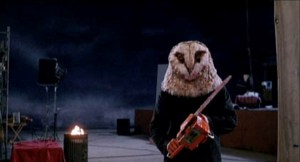
Director Michele Soavi is probably best known for directing the last great Italian horror film, Dellamorte Dellamore. However, his word in that film has been so praised that, to a certain extent, Soavi’s earlier horror films have been overshadowed. This is a shame because Soavi was (and is) a great director and — before he temporarily retired from films in the mid-1990s — he directed four of the greatest Italian horror films ever made. The first of these films (and Soavi’s directorial debut) was the 1987 slasher film Stagefright.
As written by Luigi Montefiore (who, as an actor, was better known as George Eastman), Stagefright’s basic story function almost as a parody of a stereotypical 80s slasher film. On a dark and stormy night, an eg0-crazed, cocaine-addicted theatrical director (played by David Brandon) is running a rehearsal for his latest show, a campy musical about a fictional serial killer. However, even as his cast performs fictional mayhem on stage, a real killer escapes from a nearby mental hospital and makes his way to the theater. After the real killer murders the production’s wardrobe mistress, the director decides it would be a brilliant idea to rewrite his show to make it about the real killer. Not realizing that the real killer has snuck into the building, the director secretly locks his cast inside the theater and forces them to rehearse his new show. As you can probably guess, mayhem ensues and blood (a lot of blood) is spilled.
That the film worked (and continues to work over 20 years later) is a tribute to the talent of Michele Soavi. Obviously understanding that he was working with a genre piece, Soavi embraced the expectations of the slasher film and then pushed those expectations as far as he could. The end result is a film that works as both an old school slasher film and as a commentary, of sorts, on the genre as a whole. Soavi’s camera prowls every corner of the film’s theater, creating an atmosphere of truly claustrophobic dread. To me, the most effective thing about the film is that, for once, our victims actually do the smart thing. They stick together and try to fight off the killer as a group. And they end up failing miserably in a scene of horrific choas that shows Soavi at his best.
Soavi started his career as an actor and appeared in a countless number of Italian horror films in the late 70s and early 80s. (For whatever reason, Soavi always seemed to be getting killed in some awful way…) Perhaps that’s why, of all the great Italian horror directors, Soavi always seemed to have the best instincts when it came to casting. For a slasher film, Stagefright is well-acted by a cast made up of horror regulars. Barbara Cupisti is a properly likable protagonist in the role of “final girl” while the great Giovanni Lombardo Radice does good work in the small role of Brett, a flamboyantly gay actor. However, the film is dominated by David Brandon who snorts cocaine and barks out orders as if the fate of the world depended upon it.
(Soavi, himself, appears in a small role as an ineffectual policeman who, while people are dying all around, is more concerned with whether or not anyone else agrees that he looks like James Dean. And, it should be noted, there was a resemblance.)
As opposed to a lot of other directors involved with the Italian horror genre, Soavi had (and, I hope, still has) a genuine love of film and that love is obvious in his stylish direction here. There’s something truly exhilarating about seeing a movie made by someone who is truly in love with the possibilities of film and, because of that love, has no fear of pushing genre “rules” to their extreme.
Here’s some more news from the toadsuckers and dumbfugs who make up the Academy of Motion Pictures Arts and Sciences. These are the people who give out the Academy Awards and who continue to insist that Crash, Titanic, Gladiator, Braveheart, Gandhi, The Sound of Music, Rocky, American Beauty, The Greatest Show on Earth, and How Green Was My Valley were all great films. Yes, those people.
Anyway, along with giving out Oscars for best picture, best director, and all the other awards that the general public actually cares about, the Academy also gives out an Oscar for Best Documentary Feature. Occasionally, this category does get some notice. For instance, there’s always the chance that Michael Moore will win another Oscar and start foaming at the mouth like a rabid dog again and Al Gore might give another award-winning power point presentation in the near future. But for the most part, most people just see Best Documentary as just another roadblock on the journey between Best Supporting Actress and Best Picture.
Which is a shame because Best Documentary is usually a pretty fun category to try to predict. Since hardly anyone has seen (or heard) of the majority of the nominees, you can simply pick one at random, say something vaguely serious-sounding about it, and people will assume that you’re far smarter than you ever possibly could be. For me, the best thing about the documentary category is that, since you’ll probably never actually see most of the films nominated, your final opinion on the winner is often based on the acceptance speech. If the documentarian gives a funny or sentimental speech then suddenly you realize that Gabby: The Girl Who Could Have Been is the greatest freaking documentary ever made. And if his speech is strident or angry or boring then you’ll spend the next week wondering how the Academy could ever honor a piece of trash like Pelosi: Amazon From The Bay.
Anyway, the Documentary Branch of the Academy announced the 15 finalists for the Oscar for Best Feature-Length Documentary of 2010. From these 15, the final five nominees will be determined.
Here’s the list:
“Client 9: The Rise and Fall of Eliot Spitzer,” Alex Gibney, director (ES Productions LLC)
“Enemies of the People,” Rob Lemkin and Thet Sambath, directors (Old Street Films)
“Exit through the Gift Shop,” Banksy, director (Paranoid Pictures)
“Gasland,” Josh Fox, director (Gasland Productions, LLC)
“Genius Within: The Inner Life of Glenn Gould,” Michele Hozer and Peter Raymont, directors (White Pine Pictures)
“Inside Job,” Charles Ferguson, director (Representational Pictures)
“The Lottery,” Madeleine Sackler, director (Great Curve Films)
“Precious Life,” Shlomi Eldar, director (Origami Productions)
“Quest for Honor,” Mary Ann Smothers Bruni, director (Smothers Bruni Productions)
“Restrepo,” Tim Hetherington and Sebastian Junger, directors (Outpost Films)
“This Way of Life,” Thomas Burstyn, director (Cloud South Films)
“The Tillman Story,” Amir Bar-Lev, director (Passion Pictures/Axis Films)
“Waiting for ‘Superman’”, Davis Guggenheim, director (Electric Kinney Films)
“Waste Land,” Lucy Walker, director (Almega Projects)
“William Kunstler: Disturbing the Universe,” Emily Kunstler and Sarah Kunstler, directors (Disturbing the Universe LLC)
If Exit Through the Gift Shop (which is currently my choice for the best film of 2010) had failed to appear on this list, I would have thrown a fit. Luckily, there it is. Will it make the final five? It better.
As for the other finalists, I’ve only seen Restrepo and Waiting for Superman and they’re both deserving of at least a nomination. However, I’m hoping that the film about William Kunstler gets a nomination just because I’m hoping that whoever presents the award this year will mispronounce Kunstler and get the Academy broadcast fined by the FCA.
It’s also interesting to note that I’ve probably gone to more documentaries this year than any other. And yet, I’ve only seen 3 of the 15 finalists. Certainly, I guess I could go see Inside Job this weekend but do I really need a documentary to tell me that the economy is fucked up? Seriously. The trailer — featuring Matt Damon interrogating a bunch of Wall Street types — just comes across as being incredibly smug. Client 9 should be opening up down here in Dallas pretty soon as well and I’ll probably see it but I’m not going to cry if I miss the opportunity to spend two hours with Eliot Spitzer.
To me, the best documentaries of 2010 include — along with Restrepo, Waiting for Superman, and Exit Through The Gift Shop (the best film of 2010, did I mention that?) — Winnebago Man, Joan Rivers: A Piece of Work, The Best Worst Movie, and (arguably) Catfish.
Skyline, which just opened this weekend, is currently getting almost universally terrible reviews from the nation’s mainstream critics. The consensus seems to be that the film features impressive special effects but that can’t make up for the predictable storyline, cardboard characters, and bad dialogue.
(Oddly enough, this is being said by the same critics who, last year around this time, were raving about Avatar. It’s as if these critics are trying to make up for essentially giving James Cameron a free pass by now nitpicking every single effect-driven movie to death.)
Well, to be honest, a lot of what they’re saying about Skyline is true. The characters are pretty thinly drawn, the script is pretty basic, and the plot is derivative. But you could have guessed that just from watching the movie’s trailer. Skyline is a fun and enjoyable little movie, the type that you’re already forgetting about as you walk out of the theater.
Plotwise, a bunch of rich people get together in L.A. They party, they drink, and they do things that would make their mother’s cry. The next morning, Earth is invaded by brain-sucking aliens and our hung-over protagonists, trapped in a luxury hotel, attempt to survive the next three days. And that’s pretty much it.
The cast is pretty much made up of people you’re used to seeing on TV and most of them give TV-movie-style performances. They struggle not to be overwhelmed by the special effects but, to be honest, this actually makes the film more effective. The cast’s struggle to keep up with the special effects neatly parallels humanity’s losing battle against the aliens. However, for the most part, the cast does what is required of them and they do it well enough. It is a little bit distracting that a key supporting role is played by Scubs’ Donald Faison because every time I saw him, I kept expecting to hear a Zach Braff inner monologue.
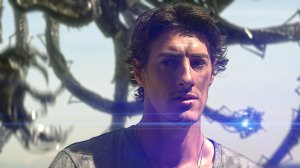
The film’s nominal lead is played by Eric Balfour, who is actually probably about as appealing as he’s ever been in his role here. In the past, I’ve always been vocal about “not getting” Eric Balfour but, lately, I’ve been starting to see his appeal. (And no, my sudden appreciation of Balfour has nothing to do with the fact that I had a kinda fun conversation with him on twitter once — well, okay, maybe a little.) I think in the past Balfour has been cast in parts where his facial hair was expected to carry the dramatic weight of the role. In this film, Balfour is actually allowed to play a sort of “everyman” type role and he’s actually very appealing in the role. Plus, I never noticed this before but Eric Balfour has like literally got the sexiest biceps ever. They’re at least in the top ten as far as sexy biceps are concerned. Also in the cast is David Zayas (you’ll recognize him from Dexter) who doesn’t have sexy biceps but is still a totally hot badass in his own mysterious way. Here he plays a concierge who shows up out-of-nowhere and quickly becomes the coolest character in the film. He gets to deliver the film’s best one-liner as well.
Ultimately, Skyline is a movie about special effects and it is here that the film triumphs. Working with a relatively low budget, the filmmakers have managed to create aliens that are not only believable and occasionally scary but kinda fun as well. These are the type of old-fashioned aliens that have come to Earth with only one purpose in mind and the special effects — the ominous mother ship floating over L.A. and the various things (they appear to be some sort of cross between animal and machine) that patrol the city in search of fresh victims — all have a retro feel to them that is undeniably appealing.
For all the criticism that Skyline has been getting, the really only inexcusable flaw is that the film is basically is 10 minutes too long. If the final ten minutes (or “Day 3” as the film puts it) had been cut out of the final film, Skyline would probably be getting much less slammed by the reviewers, the majority of whom would probably then be able to see the movie for the silly, campy, and enjoyable little b-movie that it really is. However, that ending — well, a bad ending can ruin an otherwise decent movie and if you need proof, here it is. In fact, I suggest that anyone who goes to see Skyline should leave as soon as that title — Day 3 — appears on the screen. Just stand up and walk out of the theater and allow the end of Day 2 to be the end of the movie. Trust me, you’ll have much fonder memories of the experience afterward.
Here’s the latest edition of Lisa Marie’s Favorite Grindhouse and Exploitation Trailers. (I know, I know — worst intro paragraph evuh! Following the tradition of the Pieces trailer, which can be found below, I’m keeping things simple. I’ll be back to my usual complicated self next week.)
Believe it or not, this was directed by Abel Ferrara, the same man who directed Ms. 45. Fear City is one of the few Ferrara films that I haven’t seen but the trailer just oozes sleaze doesn’t it? And speaking of sleaze, maybe that’s what all the men in this film were putting in their hair. Seriously, why not call it Gel City? And how about Billy Dee Williams there, sounding like the angel of the final judgment? Shut up, Billy Dee Williams!
This is one of Lucio Fulci’s final films and you’re either going to love it or you’re going to hate it. The film is surprisingly meta for an Italian horror film not directed by Michele Soavi. This is the one where Fulci plays himself and attempts to personally answer his critics. Anyway, the reason I love this trailer is because of the cat puppet that appears at the end. It’s so cute! (Ignore the quote from Clive Barker — he’s almost as much of a whore as Stephen King.)
I imagine this is another film that’s “exactly what you think it is.” I love trailers that show off what was considered to be chic and decadent in the past. This is one is from the 70s. (Surprised?)
While the rich people were partying in London, cannibals were apparently ruling the streets of Atlanta. According to actor John Saxon, starring in Cannibal Apocalypse made him suicidal. Cannibal Apocalypse is actually a pretty good film with an anti-war subtext and it features a great supporting performance from Giovanni Lombardo Radice so seriously — shut up, John Saxon! (Actually, Saxon gives a really great performance here — of course, his character is meant to be suicidal — and he’s the main reason that Cannibal Apocalypse works.)
Much like Cannibal Apocalypse, Cannibal Man is actually an allegory of alienation that’s disguised as a horror movie. Cannibal Man is a seriously strange movie and highly recommended.
One of my favorite movies of all time is Joe D’Amato’s haunting 1979 romance Beyond The Darkness. Not only is it one of the best Italian films ever (and the best film ever directed by D’Amato) but I think it’s also one of the best films ever made.
One reason the film is so effective is because of its soundtrack, which was composed and performed by (who else?) Goblin. The music will be familiar to any Italian horror fan, largely because it was reused by about a thousand other movies that came out in the years after Beyond The Darkness. (Director Bruno Mattei, in particular, was fond of it.)
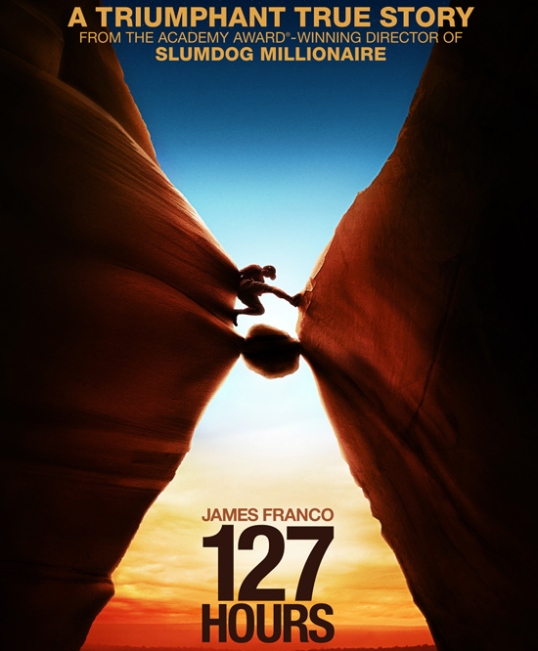
Last Friday night, my friend Jeff and I went down to the Plano Angelika and saw Danny Boyle’s new film, 127 Hours.
I have to admit that I was a little bit uneasy about seeing this film. First off, it’s a movie based on the true story about a mountain climber who spent 5 days trapped in a narrow canyon. I am intensely claustrophobic, to the extent that I’ve had panic attacks just from finding myself trapped in a crowded grocery store aisle. (Seriously, why does everyone in the world have to go shopping for La Choy Sweet and Sour sauce at the same time I do?) Secondly, the trapped climber eventually escaped by using a dull knife to saw off his right arm. I mean, ewwwwww!
But I knew I had to see the film for three reasons. Number one, it stars James Franco who I’m kinda in love with. Number two, Danny Boyle is one of my favorite directors. And, finally, 127 Hours is probably going to be nominated for best picture. So, I worked up my courage and I tried not to think about the various news reports about audience members passing out while watching the film, and I went to the movie. And I’m glad I did because 127 Hours is one of the best films that I’ve seen in quite some time.
James Franco plays Aron Ralston, a cocky but likable guy who decides to spend the weekend hiking across some place called Blue John Canyon. (Sorry, I’m not really an outdoorsey type of girl.) He tells no one of his plans and the only people who know he’s even at the canyon are two girls that he meets while there. The girls have gotten lost in the canyon and they accept Aron’s help in finding whatever grand archeological thing it is that they’re looking for. (See previous apology.)
I have to be honest here. As I watched these two girls go off with a perfect stranger, a part of me wanted to be all like, “Oh, I would never do something as stupid as go off with some stranger I met out in the middle of nowhere.” But, then again, this isn’t just some stranger. This is James Franco. So, I’ll refrain from passing judgment. I just hope that the girls had their pepper spray with them.
(The two girls, by the way, are played by Kata Mara and Amber Tamblyn. I loved Joan of Arcadia. Can you believe they cancelled it for Ghost Whisperer? Not cool, CBS.)
Anyway, after frolicking in an underground pool, Aron and the girls part company. They invite him to come to a party the next night. They tell him to just look for a big, inflatable Scooby Doo. Aron agrees, walks off, and promptly finds himself trapped in a canyon when a boulder falls on top of him and pins his right arm against the canyon wall. As quickly as that, Aron goes from being a carefree adventurer to literally being a prisoner, isolated and alone. As Franco screams for help, Boyle pulls the camera upward from Aron until eventually he’s a barely noticeable speck surrounded by a barren (and otherwise unpopulated) desert. It’s a moment that you know is coming but it’s still shocking and devastating because it stands in such stark contrast to the film’s first 20 minutes when both Boyle and Franco filled each scene with a sense of constant motion. Suddenly, everything has stopped and we’re as trapped as Aron.
The rest of the film is pretty much a one-man show. We watch as Aron spends the next five days fighting to just survive. He tries to chip away at the rock with a knife (yes, that knife). He talks to his camera, keeping a diary and leaving messages for his family. He fights off hungry ants and tries to conserve his water. He even manages to invent a pretty neat little pulley system to try to move the rock. Finally, he starts to hallucinate, seeing everything from his family disdainfully watching his predicament to a gigantic inflatable Scooby Doo stalking him in the canyon. And finally, of course, he starts to cut off his arm.
He also finds some time to think about the life he led up to the moment he found himself trapped underneath the rock. This is where Boyle really shines because, in the hands of most directors, these scenes probably would have been very maudlin and heavy-handed. However, Boyle presents these scenes in an almost impressionistic style. We see hints of the life that Aron has led but Boyle never comes out and blatantly says that, up until this point, Aron never been willing to truly connect with others. We sees scenes of Aron’s ex-girlfriend breaking up with him but we’re never specifically told what led to her leaving him. And we don’t need to be. Boyle presents us with the evidence and trusts us to draw the correct conclusion.
I am very proud to say that I watched the entire film without once having a panic attack though I did start to feel a little bit light-headed when Aron really started to get into sawing off his arm. At this point, I did end up burying my head in Jeff’s shoulder and watching the scene out of the corner of my eye. At the same time, it’s an oddly exhilarating sequence because we know that the only way Aron will survive is by cutting off his arm and, as a result of Franco’s performance, we really do want Aron to survive.
In retrospect, 127 Hours really is the ultimate guy film in that the film basically celebrates a guy who gets stranded in the desert for five days yet manages to survive without ever once having to ask for directions. However, as a result of the whole experience, he comes to realize he should have been nicer to his ex-girlfriend which means that chicks like me can enjoy the movie as well. My main concern is that the film is such a total guy flick that we might see a sudden epidemic of men amputating their limbs in order to show that they can handle it as well as James Franco did. As we left the theater, I assured Jeff that he didn’t have to chop off his hand just to impress me. Hopefully, he listened.
James Franco is generating a lot of Oscar buzz for his performance here and he should be. Franco is one of those performers who is so pretty that it’s easy to forget that he’s actually a pretty good actor. I thought he deserved a nomination for his performance in Milk. He deserves the Oscar for his performance here.
Along with a best actor nod for Franco, it seems likely that 127 Hours will also pick up nominations for best picture and best director. Interestingly enough, Boyle will probably find himself competing with the man he beat two years ago, David Fincher (previously nominated for The Curious Case of Benjamin Button and a probable nominee this year for The Social Network.) This is somehow appropriate as Danny Boyle has consistently proved himself to be the director that David Fincher is supposed to be and, by being a massively hyped film that lives up to all the praise, 127 Hours is the anti-Social Network. While The Social Network uses a “true” story as an excuse to judge and ridicule, 127 Hours uses its true story to celebrate humanity, flaws and all. Whereas Fincher seems to only celebrate film, Boyle celebrates life.
As I’m sure I’ve mentioned before, I’ve always loved to dance. Before I embraced the movies, my life was about dancing. I was going to be Prima Ballerina and my mom paid for several years of ballet class to help me reach that goal. I obsessed on it the way that I obsess, today, on Lucio Fulci and Jean Rollin. However, my brilliant career was cut short by two things — 1) I’m about as graceful as a Clydesdale and 2) I ended up tumbling down a flight of stairs when I was 17 and essentially shattering my ankle. Actually, I guess those two things might be connected. Anyway, I can’t complain because giving up my affected love of ballet allowed me to discover my very true love of film. I was never really a great dancer (though I was, and am, very enthusiastic) but I’m very good at watching movies.
However, I still love to dance and I still love movies — even mainstream movies — that feature dancing. That’s why I’m so looking forward to seeing Black Swan next month. Until then, here’s 6 of my favorite dance scenes from the movies.
Let’s start off with one of my favorite “dance” scenes of all time, my man Giovanni Lombardo Radice and Lorraine De Selle breaking it down in Ruggero Deodato’s The House On The Edge of the Park. The man in yellow is David Hess.
If anyone’s ever wondered why I was crushing on Joseph Gordon-Levitt in Inception (as opposed to Tom Hardy, Cillian Murphy, or Leonardo DiCaprio), it was largely because of this scene from (500) Days Of Summer.
Murder Rock is kinda sorta like my own personal Holy Grail — it’s a grindhouse dance movie directed by Lucio Fulci! Plus, it costars Christian Borremeo, who co-starred in The House on the Edge Of The Park and Dario Argento’s Tenebrae.
Okay, so I think Nine was definitely the worst the movie of 2009. Yes, even worse than Avatar. However, I love this scene and I love the song featured in it, Cinema Italiano. Yes, technically, it’s a really terrible song that displays an astounding ignorance of Italian cinema. If anything, the lyrics appear to be describing the French New Wave. True, the song do make reference to “neo-realism” but you get the feeling no one involved with Nine ever saw Open City or The Bicycle Thief. But the thing is do damn catchy that I still find myself singing it in the shower. Like me, Kate Hudson is obviously not much of a singer or a dancer but she’s very enthusiastic.
An Unmarried Woman was apparently very groundbreaking in 1978. Seen now, it seems like a better title for it would be An Unmarried Woman Who Can Still Afford A Penthouse Apartment In New York City. Still, the late, great Jill Clayburgh’s performance holds up well and I like the film if just because it’s still one of the few movies out there that’s willing to acknowledge that an unmarried woman can still be a sensual, happy woman. The scene below captures perfectly the exhilarating joy of just surrendering to the music and dancing. Plus, for me, this is one of those “Hey, I do that too!” scenes. In fact, my ankle is still hurting as a result of rewatching this film last Friday.
Werner Herzog’s Bad Lieutenant: Port of Call New Orleans was one of the best films of 2009. There. I said it. And I know that there’s a lot of people out there who would disagree with me on this. They would say that, at best, this film was memorable because of Nicolas Cage’s manic performance and nothing else. Well, you know what?
Those people are wrong. End of story.
Here’s one of my favorite scenes from Bad Lieutenant, one that features everything that makes this film one of the unacknowledged masterpieces of the 21st Century: Nicolas Cage going crazy, senseless violence, dancing souls, and an iguana.