A Quickie With Lisa Marie: Crossfire (dir. by Edward Dmytryk)


I recently decided that I wanted to watch and review every single movie ever nominated for the Academy Award for best picture.  As part of that mission, I recently rewatched one of my favorite also-rans, 1947’s Crossfire.

Crossfire is a message movie disguised as a B detective flick.  A group of soldiers who have just returned from World War II decide to get together for a drink.  At the bar, they run into a civilian named Joseph Samuels (Sam Levine).  The soldiers end up going back to Samuels’s apartment and the next morning, Samuels is found dead.  Obviously, he was killed by one of the soldiers but which one.  Suspicion falls on the meek (and missing) Floyd Bowers (Steve Brodie) but police detective Finlay (Robert Young) and Sgt. Peter Keeley (Robert Mitchum) both (correctly) suspect that Samuels was actually murdered by the far more outspoken and imposing Montgomery (Robert Ryan).  It quickly becomes obvious that Montgomery is an anti-Semite who killed Samuels solely because he was Jewish.  However, neither Finlay or Keeley can prove it.  The film quickly becomes a darkly intense duel between these three men as Finlay and Keeley attempt to trick Montgomery into implicating himself while Montgomery attempts to further frame Bowers for the murder.

Before Crossfire, director Edward Dmytryk specialized in making low-budget “B” movies and he brings that noir, near-grindhouse sensibility to Crossfire.  As a result, Crossfire is a one of those rare “message” films that is actually entertaining.  Only a few times does the film start to feel preachy and luckily, Robert Mitchum is there being his usual cynical self.  If anyone could deflate the pompous nature of the mid-40s message movie, it was Robert Mitchum.  The film says, “Love one another.”  Mitchum replies, “Baby, I just don’t give a damn,” and he keeps things from getting too heavy-handed.  Mitchum is one of three Roberts to star in this film.  Robert Young plays the police inspector with just the right amount of world-weary indignation while Robert Ryan is a force of nature as the film’s brutal murderer.  Don’t get me wrong.  You can pretty much peg Ryan as a killer from the first minute he shows up on-screen.  If Mitchum and Young smartly underplay their roles, Ryan goes the exact opposite direction.  He’s an obvious brute but he’s also totally believable.  You look at his character and it’s not difficult to imagine him passing the collection plate at Westboro Baptist Church.  As well, Crossfire also features an excellent supporting term by one of my favorite noir actresses, the great and wonderful Gloria Grahame.  She plays Bowers’ married girlfriend and gives a compellingly, real performance that suggests that maybe Hollywood in the 40s wasn’t quite as clueless as we all like to assume.

Crossfire was nominated for Best Picture of 1947 but it lost to another film about anti-Semitism, Elia Kazan’s Gentleman’s Agreement.  (Oddly enough, both Kazan and Dmytryk would end up naming names during the McCarthy Era.)  Like Gentleman’s Agreement, Crossfire was based on a novel.  However, in the original novel, the victim was not Jewish but instead was gay.  However, back in the 1940s, the Hollywood Production Code specifically forbade any open depiction of homosexuality and so, the crime went from being motivated by homophobia to anti-Semitism.

A Quickie With Lisa Marie: One Million Years B.C. (directed by Don Chaffey)


So, last night, I was talking Oscar fashion over on twitter and, at one point, I somehow ended up promising that if I was ever nominated for an Oscar, I would wear an outfit based the fur bikini that Raquel Welch wore in the 1966 film One Million Years B.C.  Well, everyone seemed to think that this was a pretty good idea on my part but it made me realize that I’ve never actually seen this movie.  As I was already planning on going to Fry’s to buy the Criterion edition of Fish Tank, I decided to buy One Million Years B.C. as well.  When I returned home, I kinda watched it.

I say “kinda” because One Million Years B.C. is probably one of the most draggy movies ever made and my mind wandered considerably whenever there wasn’t a dinosaur on-screen.  The movie opens with a really pompous sounding narrator who explains 1) that One Million Years B.C. was a long time ago and 2) not much else.  I mean, honestly, Mr. Narrator, I could have figured out we were dealing with prehistory just from the fact that there’s a bunch of dinosaurs wandering around.  Anyway, the movie itself is about a caveman (played by a nicely rugged actor named John Richardson) who is exiled from his own savage tribe but who eventually ends up with Raquel Welch’s tribe.  But then his new tribe gets sick of him and decides to exile him as well.  This time, Welch goes off with him and they eventually join Richardson’s old tribe which then goes to war with Welch’s old tribe and then finally, a volcano explodes.  Oh, and there’s a lot of dinosaurs wandering around as well.  On rare occasions, they attack the cave people but, for the most part, they just put out the same aloof vibe as my cat does right after he eats.

Most of the film’s dinosaurs were created through stop motion animation and they’re fun to watch.  However, for me, what truly made the film was a giant turtle that pops up about 30 minutes in.  It’s trying to make its way back to the ocean and, for its trouble, a bunch of little cave people insist on throwing spears at it.  But the turtle just kinda looks back at them and shrugs.  What a cool turtle!

There’s a certain type of viewer — and we all know the type — who will complain that One Million Years B.C. commits the sin of 1) having dinosaurs existing at the same time of cavemen and 2) having all the different dinosaurs living together at the exact same time.  And to those people, I think it’s high time that everyone just finally says, “Shut the fuck up.”  I mean, seriously, instead of nitpicking every little cinematic detail, why don’t you concentrate on losing some weight before you drop dead of a heart attack? 

Just a suggestion.

Oddly enough, this film has a weird connection to the James Bond film series in that, on the basis of their work here, both John Richardson (who also starred in Mario Bava’s classic Black Sunday) and Raquel Welch came close to being cast in On Her Majesty’s Secret Service.  However, the roles ended up going to George Lazenby and Diana Rigg instead.  (Welch was also nearly cast as a Bond girl in Diamonds are Forever.)   Though neither Welch nor Richardson ever became a part of the 007 franchise, Robert Brown (who plays Richardson’s father here) later played the role of M in a handful of Bond films.

Film Review: Black Demons (directed by Umberto Lenzi)


(Hi!  This is actually a review that I wrote a while ago for an anthology of B-movie reviews that a “friend” of mine was planning on self-publishing.  Much like this site, the book would be made up of different reviewers giving each film their own individual spin.  We were going to call it Dinner and a Cannibal Movie.  I came up with that title, by the way.  Unfortunately, the project was eventually abandoned but not before I’d written a handful of reviews.  Here’s one of the shorter ones, for Umberto Lenzi’s Black Demons.  Oh, and be warned: Because of the nature of the project it was written for, this review is full of spoilers.)

Black Demons.

My ex-roommate Kim and I have a long-standing argument concerning this film.  I claim that it’s an Umberto Lenzi zombie film that was made in 1991, long after Italian zombie cinema had run its course.  It is also my contention that we saw this movie in October of 2004.  Admittedly, we were performing our own private pagan ritual during most of the film’s 90-minute running time but we still paid enough attention to not be impressed by it.  Kim, on the other hand, argues that we never watched Black Demons and that, furthermore, there is no such film as Black Demons.  I suspect that a combination of her own rather prodigious liberal guilt and the film’s own utter banality has led her to repress the memory of it in much the same way as the protagonist of a Dario Argento thriller will often forget a key detail of a murder he has witnessed.

            Black Demons tells the story of five young people who find themselves on the bad end of some black magic.  For reasons that are never really made all that clear (largely because the entire cast has a bad habit of mumbling their dialogue), English Kevin is in Brazil with his American girlfriend, Jessica.  Tagging along with them is Jessica’s half-brother, a morose young man who is recovering from a nervous breakdown and who has the rather unfortunate name of Dick.  Along with having a vaguely incestuous relationship with Jessica (whether this was intentional on Lenzi’s part or just a case of bad acting is up for debate), Dick is also fascinated by black magic and has a tendency to wander off by himself a lot.  This leads to a lot of scenes of Kevin and Jessica repeatedly shouting, “Dick!  Dick!” as they search for him.  This provided both me and Kim a lot of giggly amusement if nothing else.

            Anyway, Dick attends a black magic ceremony that he records on audio tape and then proceeds to obsessively listen to whenever the movie needs an excuse to bring on a few zombies.  The morning after the ceremony, our threesome’s jeep breaks down out in the middle of nowhere.  Luckily, two hikers – Jose and his girlfriend, Sonya – come along and invite everyone to spend the night at Jose’s villa.  As luck would have it, there’s a big cemetery located right behind the villa and idiot Dick decides to play his little audio tape right in the middle of it. 

            (I think Kim may have exclaimed, “God, what a dick,” at this point but she denies it along with the movie itself.)

            Needless to say, this causes six zombies to rise from their graves and the usual hilarity follows.  It turns out that these zombies were, in life, African slaves who rebelled against their white masters and were put to death as a result.  Their eyes were plucked out as they died, though this doesn’t seem to keep them from being able to see once they come back to life.  It turns out that the mission of these six black zombies is to kill six white people to even the score.  Unfortunately, most of this is explained by Jose who has such an incredibly thick accent that it is next to impossible to understand a word he says.  Therefore, the plot may actually be a bit more complex than I realize.

            Though, I doubt it.

            As Kim and I immediately realized, the zombies need to kill six white people.  Yet there are only five white people in the film.  Whether this was a case of lazy writing or maybe an actor walked off the film at the last minute, I do not know.  However, Lenzi ingeniously handles this problem by killing an anonymous, never-seen white guy offscreen and then having our heroes hear about it on the radio.  Still, you have to wonder why these zombies, seeking vengeance for being slaves in their past life, would only feel the need to kill six white people.  Sure, it works out in the sense that there are six zombies and this way they only have to kill one person apiece.  But still, it seems like they’re letting the white race off a little bit easily here.  Indeed, if the solution to all of the world’s racial strife is simply to kill off the five, uninteresting losers in this film, then I have to side with the zombies on this one.

            Unfortunately, Kevin and Jessica aren’t willing to sacrifice themselves for world harmony and insist on surviving until the end of the movie.  Kevin eventually figures out that the zombies can be stopped by a well-thrown Molotov cocktail.  How exactly he figured this out isn’t really clear.  Perhaps he saw it in another, better zombie film.  (Like Lucio Fulci’s Zombie 2, for instance.  Unfortunately, beyond the Molotovs, the bad acting of the female lead, and a grisly fetish for showing eyeballs getting damaged, these two films have little in common.)  Kevin’s plan works though not before the tragic ends of Sonya, Jose, the phantom sixth white guy, and yes, even Dick.  Leaving behind a bunch of smoldering slaves, Jessica and Kevin flee the villa for a world still torn apart with racial strife and anger.  Thanks a lot, guys!

            Almost all good horror is to be found in subtext.  Such as, Dracula may be pretty intimidating with his fangs and his blood drinking and all, but it’s as a symbol of unbridled lust and secret fantasies that he’s been able to become and remain an icon for over a century.  And while Frankenstein might be frightening to look at, his true power comes from being a sign of what happens when man attempts to play God.  In an admittedly less literary vein, what else is a truly scary slasher but proof positive over how little control we truly have over our own future?  Strictly on paper, Black Demons should be a film awash in powerful subtext.  After all, these zombies wouldn’t even exist if they hadn’t been enslaved and treated like property by the ancestors of the film’s heroes.  In a world that is still struggling (and failing) to deal with the legacy of racism, a film in which a bunch of slaves come back to life and seek vengeance on only whites should have quite a bit to say.   Perhaps if Black Demons had been directed by Fulci or Deodato, it would have done just that.  However, this film was directed by Umberto Lenzi which means that it ends with Kevin assuring Jessica that their nightmare is over with the camera ominously (and, quite frankly, obscenely) pans over to a bunch of black children playing on the side of the road, basically equating those living children with a bunch of bloodthirsty, vengeful zombies on the basis of the color of their skin.  Whether Lenzi realized what he was doing or not, this one camera movement manages to be a hundred times more offensive than anything found in Cannibal Apocalypse.

Perhaps, in this case, Kim had the right idea.

Lisa Marie Does The Roommate (dir. by Christian E. Christiansen)


Because of all the snow and ice that hit Dallas earlier this month, I’ve been running a week behind when it comes to going to the movies.  For instance, I was planning on seeing The Roommate when it first opened but, because of the weather, I didn’t get a chance to see it until this previous Saturday.  I ended up seeing the movie at the AMC Valley with Jeff, my sister Erin, my friend Evelyn and her boyfriend Steven, Evelyn’s younger sister Emma, and finally Katrina, who works with my sister Erin. 

Now, you may be asking — why were so many people required just for me to see one movie?  Well, The Roommate didn’t look like a film to be seen alone.  It looked like a film that was meant to be  seen in a group of people.  The Roommate looked like the type of campy, silly little film that demanded some audience participation.  At least, that’s what it looked like.  However, as we watched the movie, it quickly became apparent that this film was neither campy nor silly.  Instead, it was just — well, it was just there.

In the Roommate, Minka Kelly plays a poor girl from Iowa who leaves home to attend college in California.  She’s a design major or something like that though she’s going to one of those movie colleges that is exclusively populated by models and where you’re only actually require to attend one class (and that class, of course, is taught by Billy Zane).  Anyway, Kelly has been randomy assigned a roommate and it turns out to be Leighton Meester.  Kelly and Meester hit it off but it quickly becomes evident that Meester has some issues.  Soon, she’s stalking all of Kelly’s other friends, cutting herself to get attention, and eventually revealing herself to be a comic book super villain.  Kelly, for her part, refuses to accept that Meester’s crazy until after the first murder has been committed and yet no one really gets upset at her for that.  Seriously, couldn’t one person have said, “You know, if you hadn’t been such a clueless idiot, a lot of trouble could have been avoided.” 

It’s a sad fact of life that most movies are rather forgettable.  Who hasn’t had the experience of sitting through a movie and then realizing, a few hours later, that you really can’t remember much about what you’ve just seen?  A similar thing happened to me when I saw The Roommate except, as opposed to forgetting about it after I saw it, I actually forgot about it while I was watching.  After about half-an-hour into the film, we all stopped paying attention and instead, me, Erin, Emma, and Evelyn started to whisper about old episodes of The O.C. and Buffy the Vampire Slayer while Jeff and Steve started to talk about sports and Katrina ended up spending the whole movie flirting with the guy sitting behind us (which I don’t think his girlfriend appreciated since she kept going “shhhhhhh!” in this really annoying, obnoxious way).  Every once in a while, I would look up at the screen and think to myself, “Oh yeah, there’s a movie playing” but, quite frankly, I never saw anything on-screen that would justify making any more than a minimum effort to pay attention.  That’s just the type of film The Roommate is.  It takes the old Radiohead song about no surprises, please to heart.

What makes this disappointing is that, concept-wise, the movie has potential.  Everyone has had that one friend that has turned out to be just a little bit too clingy for comfort.  Most of us have had more than a few.  As well, your first few semesters of college are supposed to be all about figuring out who you really are.  Are you gay, straight, or somewhere in between?  Are you a good girl or are you a bad girl?  Are you a rebel or are you a conformist?  At least that’s how I remember my first semester of college and, for me, my randomly-selected roommate was the key to answering so many of those questions.  I imagine that’s the way it is for a lot of people.  The best horror often has some sort of tenuous connection with reality so The Roommate had a chance to be, at the very least, a fun little B-movie.

Unfortunately, effective horror also requires a willingness to risk alienating the audience and The Roommate is too concerned with maintaining its PG-13 rating to take that risk.  That PG-13 rating means, in short, no nudity, no blood, and no darkness.  Instead of truly exploring the premise for all that its worth, The Roommate is more concerned with being safe for tweens and teenagers.  That was the majority of the audience when we saw the film and seeing how much they appeared to be enjoying the film made me feel really, really old.  Of course, to be honest, I probably would have enjoyed the movie to if I was only 15 years old and I’d never actually seen a good horror movie before.

However, no film is totally useless and The Roommate did inspire me to start concealing a pocket knife underneath the clasp of my bra, like Leighton Meester does in this movie.  That may be the best development in self-defense since I finally figured out how to use pepper spray without spraying it in my face.

What Lisa Watched Last Night: Less Than Zero (dir. by Marek Kanievska)


Last night, I ended up watching the 1987 anti-drug propaganda piece, Less than Zero.

Why Was I Watching It?

Last night, I was hanging out with Jeff, our friend Evelyn, and Evelyn’s friend Steven and we were flipping stations, trying to find something that we could use for background noise.  When we came across an announcement on FMC that Less Than Zero was about to start, I made the mistake of admitting that despite having read Bret Easton Ellis’s novel and heard a good deal about this film, I had never actually sat down and watched Less Than Zero. 

Well, after everyone got finished making fun of me (boo hoo), it was agreed that we simply had to watch Less Than Zero. 

“But,” I started, “isn’t Gone With Wind starting over on TCM…”

“Fuck Gone With The Wind,” someone (I think it was Evelyn because she’s a meanie) said, “you’ve never seen Less than Zero before.”

What’s It About?

It’s about rich kids in Los Angeles doing drugs.  Clay (played by Andrew McCarthy, who my cousin Jessica met once and who she says was a really nice guy) is a college student who comes home to L.A. and discovers that his ex-girlfriend Blair (Jami Gertz) and best friend Julian (Robert Downey, Jr.) are addicted to cocaine and  that Julian owes a lot of money to a drug dealer named Rip (James Spader). 

(Personally, I would never buy drugs from someone named Rip — with the possible exception of Rip Torn.)

Anyway, Clay takes it upon himself to try to save the soul of everyone in California.

What Worked?

Downey and Spader are both great in this film.  From what I’ve read, the general assumption seems to be that Downey was just playing himself here but whether or not he was, he still gives an excellent performance.  Spader, meanwhile, turns Rip into a great villain by making evil sexy.

The film, full of garish neon and defiantly tacky pastels, looks great in its decadent, shallow way.  The same thing can be said of the music.

What Didn’t Work?

Everything else.  Less Than Zero really doesn’t work as an anti-drug film because the character of Clay seems so boring when compared to Julian and Rip. 

If I had to choose between the three of them, I’d probably hang out with Rip because 1) he always seems to be having a good time, 2) he’s apparently not a drug addict himself, and 3) he’s got the most money of all of them.    That therefore makes him preferable to both Julian, who is having a good time but is also a drug addict, and Clay who isn’t a drug addict yet appears to be miserable throughout the entire film.

“Oh my God! Just like me!” Moments

One night, years ago, I found myself making out with an ex-boyfriend in a convertible while one jagged bolt of lightning split the night sky above us and hundreds of scary guys on motorcycles drove past us.  As is often the case, the memory was better than the ex.

Lessons Learned:

Drug dealers make the best dates.

Lisa Marie Has Returned With 6 More Trailers


 When last I posted, I was snowed in and I was still dealing with the trauma of seeing the Super Bowl half-time show.  Well, a week has passed.  The snow has melted, the half-time show has faded from memory, and I’m ready to start posting again.  And what better way to prove it than with a new edition of Lisa Marie’s Favorite Grindhouse and Exploitation Trailers?

1) The Streetfighter

Earlier today, when I was talking about which trailers I was thinking of including in this edition, Jeff asked me if I had included any Sonny Chiba trailers.  The way he asked the question seemed to indicate that it was the most important thing he had ever asked so, understandably, I was a little nervous when I answered, “N-no, I don’t think so.”

Well, apparently, that wasn’t the right answer because Jeff’s eyes just about popped out of his head and he’s lucky that he’s s0 cute because I might otherwise have taken his reaction personally.  Instead of taking offense, I’m going to start this edition off with Sonny Chiba in The Streetfighter.

2) House of Whipcord

This one is from one of the great, unacknowledged directors of British cinema, Peter Walker.  I think it’s always strange for Americans to hear grindhouse dialogue being delivered in an English accent.

3) Witchery

This is a trailer for an Italian film that is also known as “House 4,” “Witchcraft,” “Ghost House,” and “Demons 5.”  In Italy, it was promoted as a sequel to Sam Raimi’s Evil Dead 2. For all I know, they may have tried to sell this as an installment in the Zombi series as well.  I saw this film a few years ago when I was first starting to explore the world of Italian horror and oh my God, it gave me nightmares.  Seriously, don’t let the presence of David Hasselhoff fool you.  This is a disturbing movie that was produced (and some day actually directed) by the infamous Joe D’Amato.

Apparently, the trailer is disturbing as well as I tried to show it to my sister Erin earlier and she asked me stop it around the time the gentleman with the weird mouth showed up. 

4) Fighting Mad

“Even a peaceful man…can get fighting mad!”  Peter Fonda looked good playing archer.  This is an early film from Jonathan Demme who directed one of my favorite films ever, Rachel Getting Married.

5) Rollercoaster

I’m scared to death of rollercoasters so I probably won’t be seeing this film anytime soon.  Still this film has a surprisingly good cast — George Segal, Richard Widmark, Henry Fonda — for a movie about a rollercoaster.

6) Big Bad Mama

Not to be confused with Crazy Mama or Bloody Mama, Big Bad Mama features Angie Dickinson, Tom Skerritt, William Shatner, and a lot of tommy guns.  It’s not a great film but it is a lot more fun than Public Enemies.

Film Review: The Rite (dir. by Mikael Hafstrom)


Last night, me, Jeff, and my sister Erin braved the melting ice and snow in order to drive out to the AMC Valley View and see The Rite, which is the latest movie to come out about exorcism.

(Quick sidenote: Yes, the AMC Valley View has replaced the closed Regal Keystone as my place to see mainstream, establishment films.  It’s actually a pretty nice little theater and it’s located in Valley View Mall so, at the very least, you can do some shopping before you see your film.  Add to that, I think I’ve developed a girlcrush on the girl who always sells us our tickets because she’s 1) something like 6 feet tall and 2) she just gives off this really sarcastic, monotone, I-don’t-give-a-fuck vibe.  Oh!  And they’ve also got that old House of the Dead video game in the lobby and last night, Erin played it and Jeff and I were laughing so hard because she just started shooting everything!  That said, the theater doesn’t do matinee showing and oh my God, I hate the drive up there because it means having to cross Coit road and once you get pass Coit, nobody knows how to drive.  Bleh.  But anyway….)

The Rite begins with those dreaded words: “The following is based on true events.”  We then meet Michael Kovak (played by Colin O’Donoghue) who is the son of a mortician who lies about wanting to be a priest so he can get a scholarship to the seminary and get a college degree in psychology.   His plan, of course, is to get the degree and then resign from the deaconate before actually taking his vows.  However, when he attempts to resign, the Father Superior refuses to accept the resignation.  He also refuses to accept Michael’s claim of having no faith in God.  Instead, he convinces Michael to go to Rome and to take a class on exorcism.  The theory here — and it’s the same theory that seems to crop up in every film ever made about exorcism — is that if you can see proof of the devil then therefore, you’re seeing proof of God because one can’t exist without the other.  Some people would call that wishful thinking but regardless, Michael goes to Rome and who wouldn’t?  Rome is full of old buildings, beautiful people, stray cats, great food, and romantic possibilities, after all.

Rome is also the home of Father Lukas (played by Anthony Hopkins) who is a veteran exorcist.  When Michael expresses some doubts in Exorcism Class, he’s sent to learn from Lukas.  Michael watches as Lukas performs several exorcisms and yet, he still refuses to believe that any of it is real.  Even when the possessed start to spit up Holy Nails and pieces of the One True Cross, Michael continues to argue that it’s all a psychological condition.  But then, Michael starts to have disturbing visions of his father (played by Rutger Hauer) and Lukas starts to act strangely and Michael comes to realize that, regardless of whether he believes in the devil, the devil certainly believes in him.

The Rite actually has a few things to recommend it.  The scenes in Rome are shot to emphasize the eerie atmosphere over easy shocks and, as a result, the film creates a sense of unease that is so subtle that the viewer is almost seduced into sharing the film’s Manichean world view.  Anthony Hopkins is always fun to watch on-screen and he knows exactly how much over-the-top to go in his performance without descending to the level of camp.

Unfortunately, director Mikael Hafstrom never quite manages to settle on the correct pace for the film.  Some scenes are over much too quickly while others seem to just drag on for an eternity.  It seems to take forever for Michael just to get over to Rome and even once he does arrive in Italy, you’re never sure of how long he’s supposed to be there, how long he’s already been there, or how many days pass between his first meeting with Hopkins and the end of the film.  

The film’s other big flaw, along with the slow pace, is the character of Michael or, more specifically, Colin O’Donoghue’s passively blank performance as Michael.  Since the film is essentially meant to be about Michael’s struggle with belief, it would be good if the film’s star was capable of suggesting some sort of inner emotional life.  Instead, O’Donoghue simply comes across as a block of wood that’s been whittled into the shape of a man.   As a result, Micheal never seems to be a man in the throes of a crisis of faith.  Instead, he just seems petulant.  Anthony Hopkins is so dynamic and O’Donoghue so bland that you actually resent O’Donoghue for having more screen time.

Director Mikael Hafstrom deserves some credit for trying to make a “serious” movie about exorcism but, to be honest, I prefer the more unapologetically sordid approach of a film like The Last Exorcism.  Ultimately, The Rite tries so hard to be serious that it forgets to be entertaining.

From Vanishing Point To Shivers, Here’s 6 More Trailers


As the snow outside slowly melts and I try to decide what to wear when I go see The Rite tonight, why don’t you enjoy six more of Lisa Marie’s Favorite Grindhouse and Exploitation Trailers?

1) Vanishing Point (1971)

I had to include this trailer at some point since Vanishing Point is one of the key influences on Quentin Tarantino’s Death Proof section of Grindhouse.  Is Vanishing Point the ultimate trip?  Maybe but I think there’s one other film that came out the same year that might disagree…

2) The Jesus Trip (1971)

And here it is!  I haven’t seen this actual film but the trailer would seem to indicate that this is some sort of religious biker film.  But then you have that final scene in the trailer and you’re kinda like, “Uhmmm….sacreligious much?”  Anyway, this is one of those trailers that I find myself watching over and over again.  I guess I was destined to grow obsessed with this trailer as it appeals to both my exploitation fanatic side and my fallen Catholic side.  Put them both together and I guess you’ve got The Jesus Trip.

Seriously, this is just a weird trailer.

3) Horror House On Highway 5 (1985)

I’ve come across this film on DVD a few times and I’ve always been seriously temped to buy it just on the basis of the title.  However, I may just end up settling for having seen the trailer because, to be honest, the trailer would seem to indicate that there’s a lot of really, really ugly people in this movie.  And ugly people kinda sorta make me nervous.

4) Revenge of the Cheerleaders (1976)

I guess this is like the grindhouse version of Bring It On.  Watching the trailer, I have to wonder why high schools in 70s movies always looked so dirty and unwashed.  I mean — BLEH!  Seriously, if my school had been that dirty, I would have ended up dropping out of school when I was 15.  I mean, gawd damn!  Get out the Scrubbing Bubbles and every sanitizer you can find and just — oh my God.  I think it’s the cafeteria that really makes me shudder.  Anyway, as for the rest of the trailer, I asked my sister Erin if it looked like a truthful depiction of high school cheerleading since she used to be one and she said no because most cheerleader don’t survive getting blown up as easily as the ones in this trailer.

5) Bad Girls Go To Hell (1965)

This is a film from the notoriously odd Doris Wishman.  Someday, somebody — maybe even me — is going to turn the life of Doris Wishman into a great novel and an even better film.

6) Shivers (1975)

And let’s close things out with a little Cronenberg.  From 1975, it’s Shivers.

Film Review: Dracula A.D. 1972 (dir. by Alan Gibson)


If you’re following the news then you probably heard that Dallas got hit with like a 100 inches of snow yesterday.  Seriously, more snow fell yesterday than has even fallen in recorded history (or, at the very least, in my recorded history).  You want to talk about Snowmageddon?  Well, we had a Snowpocalypse.

The neighborhood on Friday morning (picture taken by Erin Nicole Bowman)

So, I spent most of yesterday cooped up inside with my sister and our cat and once we got over the whole fun of being able to go outside and scream, “SNOW DAY!” at the top of our lungs, there really wasn’t much to do.  So, in an attempt to fight off cabin fever, I raided my DVD collection and we ended up watching one of the old Christopher Lee-as-Dracula-films from Hammer Studios.  Specifically, we ended up watching Dracula A.D. 1972.

The film opens in 1872 with a genuinely exciting fight on a runaway carriage that ends with the death of both Count Dracula (Christopher Lee) and his nemesis, Prof. Van Helsing (Peter Cushing).  However, as Van Helsing is buried, we see one of Dracula’s disciples (played by Christopher Neame, who had an appealingly off-kilter smile) burying Dracula’s ashes nearby.  The camera pans up to the clear Victorian sky and, in a sudden and genuinely effective jumpcut, we suddenly see an airplane screeching across the sky.

Well, it’s all pretty much downhill from there.  Suddenly, we discover that a hundred years have passed and we are now in “swinging” London.  The city is full of red tourist buses, hippies wearing love beads, and upright policemen who always appear to be on the verge of saying, “What’s all this, then?”  We are introduced to a group of hippies that are led by a creepy guy named Johnny Alculard (also played — quite well, actually — by Christopher Neame). One of those hippies (Stephanie Beacham) just happens to be the great-great-granddaughter of Prof. Van Helsing.  Apparently, she’s not really big on the family history because she doesn’t notice that Alculard spells Dracula backwards.  Then again, her father (played by Peter Cushing, of course) doesn’t either until he actually writes the name down a few times on a piece of a paper.

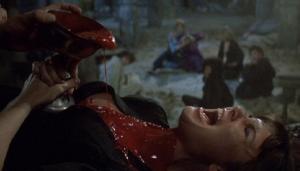
Anyway, the film meanders about a bit until finally, Alculard convinces all of his hippie friends to come take part in a black mass.  “Sure, why not?” everyone replies.  Well, I don’t have to tell you how things can sometimes get out-of-hand at black mass.  In this case, Dracula comes back to life, kills a young Caroline Munro, and eventually turns Johnny into a vampire before then setting his sights on the modern-day Van Helsings.

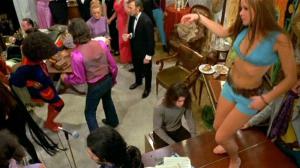
Dracula A.D. 1972 was Hammer’s attempt to breathe some new life into one of its oldest franchises and, as usually happens with a reboot, its critical and (especially) commercial failure ended up helping to end the series.  Among even the most devoted and forgiving of Hammer fans, Dracula A.D. 1972 has a terrible reputation.  Christopher Lee is on record as regarding it as his least favorite Dracula film.  And the film definitely has some serious flaws.  Once you get past the relatively exciting pre-credits sequence, the movie seriously drags.  There’s a hippie party sequence that, honest to God, seems to last for about 5 hours.  As for the hippies themselves, they are some of the least convincing middle-aged hippies in the history of fake hippies.  You find yourself eagerly awaiting their demise, especially the awkward-looking one who — for some reason — is always dressed like a monk.  (Those crazy hippies!)  But yet…nothing happens.  All the fake hippies simply vanish from the film.  Yet, they’re so annoying in just a limited amount of screen time that the viewer is left demanding blood.  Add to that, just how difficult is it to notice that Alculard is Dracula spelled backwards?  I mean, seriously…

To a large extent, the charm of the old school Hammer films comes from the fact that they’re essentially very naughty but never truly decadent.  At their heart, they were always very old-fashioned and actually quite conservative.  The Hammer films — erudite yet campy, risqué yet repressed — mirrors the view that many of my fellow Americans have of the English.  For some reason, however, that Hammer naughtiness only works when there’s the sound of hooves on cobblestone streets and when the screen is populated by actors in three-piece suits and actresses spilling out of corsets.  Dracula A.D. 1972 did away with the support of the corset and as a result, the film is revealed as a formless mess with all the flab revealed to the world.

Still, the film isn’t quite as bad as you may have heard.  First off, the film — with its middle-aged hippies — has a lot of camp appeal.  It’s the type of film that, once its over, you’re convinced that the term “groovy” was uttered in every other scene even though it wasn’t.  As with even the worst Hammer films, the film features a handful of striking images and Christopher Neame is surprisingly charismatic as Alculard. 

As with the majority of the Hammer Dracula films, the film is enjoyable if just to watch the chemistry between Christopher Lee and Peter Cushing.  Both of these actors — so very different in image but also so very stereotypically English — obviously loved acting opposite of each other and whenever you see them on-screen together, it’s difficult not to enjoy watching as each one tried to top the other with a smoldering glare or a melodramatic line reading.  As actors, they brought out the best in each other, even when they were doing it in a film like Dracula A.D. 1972.  In this film, Cushing is like the father you always you wished you had — the stern but loving one who protected you from all the world’s monsters (both real and cinematic). 

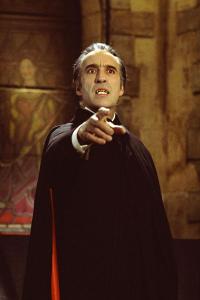
As for Lee, he’s only in six or seven scenes and he has even fewer lines but, since you spend the entire film wondering where he is, he actually dominates the entire movie.  Lee apparently was quite contemptuous of the later Hammer Dracula films and, oddly enough, that obvious contempt is probably why, of all the Draculas there have been over the years, Lee’s version is the only one who was and is actually scary.  F0rget all of that tortured soul and reluctant bloodsucker crap.  Christopher Lee’s Dracula is obviously pissed off from the minute he first appears on-screen, the embodiment of pure destructive evil.  And, for whatever odd reason, the purity of his evil brings a sexual jolt to his interpretation of Dracula that those little Twilight vampires can only dream about.  Even in a lesser films like Dracula A.D. 1972, Christopher Lee kicks some serious ass.

So, in conclusion, I really can’t call Dracula A.D. 1972 a good film nor can I really suggest that you should track down a copy of the DVD.  I mean, I love this stuff and I still frequently found my mind wandering whenever Cushing or Lee wasn’t on-screen.  However, it’s not a terrible movie to watch if you happen to find yourself trapped in the house by a mountain of snow.

Film Review: The Mechanic (dir. by Simon West)


A few years ago, I declared that January should just be renamed Statham because seriously, Jason Statham was in like almost every single freaking movie released that month.  Seriously, it was like every time I turned on the TV, there was yet a new commercial featuring Jason Statham in some movie that I had absolutely no desire to see.  “Oh look,” I’d say, “that’s Jason Statham swinging a sword.  Oh, now he’s driving a car really fast.  Oh, wow, now Jason Statham’s looking off to the side and squinting…”

Well, this January, Jason Statham is only starring in one film and it might be the best of his career.  At the very least, it’s the first time I’ve been able to kind of see the guy’s appeal as a film star.  That film is The Mechanic and it opened this week.

In the Mechanic, Jason Statham plays a contract killer.  He’s known as a mechanic because he “fixes” problems.  After Statham’s mentor (Donald Sutherland) is killed, Statham takes the man’s son (Ben Foster) under his wing and starts to teach Foster the tools of the trade.  However, unlike the cool and detached Statham, Foster is a jittery and angry psychopath.  However, despite their differing approaches, they are forced to work together when the same man (Tony Goldwyn) who ordered Sutherland’s murder decides to come after them.

As I stated before, I’ve never quite gotten the appeal of Jason Statham as an actor.  In fact, as Jeff and I waited for the film to start, I said, “I’ve never really gotten Jason Statham.”  As soon as I said that, this woman sitting in front of us turned around in her seat and I swear to God, she rolls her eyes at me in this way that said, “Bitch, please.  Like Jason Statham would ever give your raggedy ass a second look.” 

I proceeded to narrow my eyes in a way that said, “You best be watching what you say, you nasty ass ho.”

She cocked her head in a way that said, “Oh, no you didn’t!”

I flared my nostrils in a way that said, “Oh yes, I did, you hootchie ass skank…”

She leaned forward as if to say, “Gurl, you need to get Jesus in your life…” 

I smirked as if to say, “Jesus?  What does Jesus have to do with this?”

Before she could answer, the movie started.

Anyway, what was my point?  Oh yes, Jason Statham.  In the past, I’ve never gotten his appeal but in this film, I did.  For the first time, I saw him as something other than just an expressionless English guy.  Statham is athletic but, unlike a lot of other action movie stars, he’s not so ludicrously muscle-bound that you can’t believe him as some guy you might run into out on the street.  Previously, I just thought that Statham was a bad actor but, with the Mechanic, I realized that, whereas other actors act with their eyes and their voice, Statham acts with his body.  You look at Statham with his constant scowl and his cold eyes and you believe that he could kill someone in real life as well as in the movies.  Statham is perfectly cast as a professional killer and The Mechanic wisely doesn’t try to suggest that the character is anything more than just a very disciplined sociopath.  Much like the best pulp heroes, Statham’s mechanic is a hero by default.  He’s a bad guy but everyone else in the movie is worse.

Also, there’s a scene about ten minutes into the film where Statham, fresh from killing a drug lord, changes clothes in a linen closet and as soon as he removed his shirt, I said, “Oh, I see the appeal now.”

Playing opposite of Statham, Ben Foster gives another one of his intense performances.  Throughout the film, Foster is perpetually on the verge of exploding and his typically high energy performance provides a nice contrast to Statham’s typical nonperformance.  He’s the Eli Wallach to Statham’s Clint Eastwood.  However, Foster doesn’t just rely on theatric for his character.  Instead, he gives a complex, multi-faceted performance as a character who, in the hands of a lesser actor, could have just been your average psychopath.  He even manages to win some sympathy for a character who, on paper, wouldn’t seem to deserve it.  Even more importantly, he brings out the best in Statham in a way that previous co-stars like Sylvester Stallone couldn’t. 

Director West keeps the action moving quickly without ever letting the movie degenerate into just a collection of over-the-top set pieces.  When the film does break out into action, West handles it like a pro and, as spectacular as the action may get, he still manages to keep things in the realm of the believable.  However, West also invests the film with a dark, almost grim atmosphere that fills every scene with a feeling of impending doom and growing paranoia.

The Mechanic is a fast-paced, unapologetic thriller that, in its way, ultimately becomes a masterpiece of the pulp imagination.   It’s very easy to imagine this as an Antonio Margheriti film from the early 80s, starring David Warbeck and Giovanni Lombardo Radice in the Statham and Foster roles.  Both director West and the cast deserve to be applauded for making a grindhouse film for the 21st Century.