What Lisa Watched Last Night #137: The Murder Pact (dir by Colin Theys)


Last night, I watched the Lifetime original film, The Murder Pact!  And I’m glad that I did because it turned out to be one of the best Lifetime films of the years so far!

Why Was I Watching It?

Seriously, how could I not watch it?  It was a movie about murderous rich kids and it was on Lifetime!  There was no way I could resist watching The Murder Pact.

What Was It About?

It’s about murder, lies, greed, fame, guilt, and secrets.  It’s also about a beautiful house and a bunch of good-looking narcissists who have impeccable taste in clothing.  It’s exactly my type of film.

At an exclusive college, there are four friends.  Camille (Alexa PenaVega) wants to be a famous singer but, when she auditions, she is rather cruelly turned down because she’s a “nobody.”  Annabel (Renee Olstead) is a neurotic dancer who finds herself having to deal with a catty rival named Poppy (Bailey De Young, giving a wonderfully snarky performance).  Rick (Michael J. Willett) is a pill-popping athlete.  And then there’s the leader of their little group, Will (Beau Mirchoff).  Will is a wealthy model who wears blue contacts and who lives in an amazing mansion.

When these four friends are connected to the accidental death of another student, they try to cover up their involvement.  However, a rebellious student and photographer named Lisa (Sara Kapner) witnessed what happened.  Under Will’s direction, they plot to keep Lisa from revealing what she knows.

However, soon, everyone is being blackmailed by an unknown person who is demanding $4,000,000 to remain silent.  And a mysterious detective (Sean Patrick Thomas) suddenly shows up and starts asking questions…

What Worked?

Oh my God, this movie was soooooo good!  It was a stylish melodrama that kept viewers guessing up until the final scene.  All of the actors appeared to be having a ball playing their decadent characters.  They seemed to truly relish delivering every over-the-top line of dialogue and, as a result, they were all a lot of fun to watch.

I’ve always said that half the fun of a good Lifetime movie is getting to see where everyone lives and how everyone gets dressed in the morning and The Murder Pact certainly delivered on both counts.  I especially loved seeing Will’s mansion.  On twitter, the film’s screenwriter informed me that the house is currently for sale in Connecticut and I’m hoping it will still be on the market when I make my first million.

Also, I have to take a moment to appreciate the film’s cinematographer, Branden Maxham.  The film looked gorgeous.  I especially loved the chilly scenes of Will and friends plotting while standing outside in either snow or drizzling rain.

What Did Not Work?

It all worked!

“Oh my God!  Just like me!” Moments

Well, of course, I related to Lisa the photographer because we Lisas stick together!  However, as a dancer, I also knew what Annabel was going through.  I’ve known my shares of Poppys.

Lessons Learned

Rich people are dangerous.

movie-hp-the-murder-pact

The Daily Grindhouse: The Hearse (directed by George Bowers)


The_Hearse

I feel no shame in admitting that I love horror movies. I don’t think that’s any secret to anyone who has ever read my reviews on this site. When I’m feeling so restless that I can’t sit still or focus, all you have to do is give me a horror film (especially if it’s one that I’ve never never seen before) and I’ll be quiet for at least 90 minutes.

That’s why I’m always on the look out for horror movies that I haven’t seen before. If it’s a horror movie, I’ll watch it regardless of obscurity, age, or critical disdain. At its best, this habit has led to me discovering neglected cinematic gems like Sole Survivor.

And it’s worst, it’s led me to me sitting through films like 1980′s The Hearse.

The Hearse is one of those public domain film that turns up in every other Mill Creek Box Set and it tells a very familiar story. A recently divorced woman named Jane (played by Tish Van Devere, who was married to George C. Scott at the time) leaves the big city to seek peace and solace in a creepy small town that’s full of rednecks who stare at her with a combination of lust and total disdain. Jane moves into a house that once belonged to her aunt and, pretty soon, she’s hearing strange sounds and having nightmares. On some nights, she sees a hearse (which, earlier, had attempted to run her off of the road) pull up in front of her house.

Jane attempts to tell the local sheirff about the strange happenings at her house but he responds by suggesting that maybe she should move. The local townspeople respond to her concerns by telling her that her aunt made a pact with Satan. The local priest comes by and tells Jane that the necklace her aunt gave her is a symbol of Satan.

None of this really makes much of an impression on Jane, mostly because she’s busy dating this creepy guy named Tom. Tom rarely ever shows any emotion and, on those rare occasions that he does smile, his face looks like a leering skull.

Again, Jane doesn’t seem to notice any of this…

Obviously, horror requires a certain suspension of disbelief but, seriously, it’s hard not to watch The Hearse and feel as if the scariest thing about the movie is the idea that anyone could be as stupid as Jane.

That said, The Hearse isn’t a total waste of time. The nightmare sequence is genuinely effective and the film itself features a few creepy visuals but, then again, there’s no way the sight of a hearse pulling up in front of a house in the middle of the night couldn’t be creepy. Trish Van Devere does okay as Jane, though she was far better in both The Changeling and One Is A Lonely Number.   (The film also features a few too many less-than-credible scenes where the town’s teenage boys talk about how “hot and sexy” they find the aristocratic and rather uptight Jane to be.)  If, like me, you’re into film history, you’ll enjoy this film as a relic of the past, an example of what horror movies were like in a less ironic age.

Film Review: Black Fly (dir by Jason Bourque)


blackfly_s

“It’s just another fond memory of country living.”

— Noel Henson (Matthew McCaull) in Black Fly.

Black Fly, an intense psychological thriller from Canada, tells the story of two brothers.

On an isolated island, Noel Henson (Matthew McCaull) lives on the farm that was once owned by his parents.  He has a mullet, he loves his dog, and he ends each workday with a cold beer.  And maybe it’s because I’ve got plenty of country in my background as well but, as soon as I saw him, I immediately recognized Noel’s type.  He’s outwardly friendly but definitely prefers to have space of his own, the type who likes to live by his own rules and will probably never forgive you if you break one of them.  You would definitely want to help build your house but you might not necessarily invite him to come inside of it afterward.

Noel’s younger brother is Jake (Dakota Daulby).  Maybe because I’ve always had a weakness for sensitive and artistic loners, I felt that I immediately knew Jake’s type as well.  He’s the guy who has been let down one too many times by everyone around him.  He’s got a sketchbook full of drawings of monsters and fantasy girlfriends.  When it comes to someone like Jake, you’re torn between feeling sorry for him and fearing what will happen if he ever truly loses control of his anger.  When we first meet Jake, he is escaping from his abusive uncle.  When he shows up at the island, Noel is there to greet him.  It’s been years since the two brothers were together but it quickly becomes obvious that Jake idolizes Noel.

At first, everything appears to be perfect between Jake and Noel but slowly, cracks start to appear.  Jake and Noel’s childhood was hardly ideal.  Their abusive father was shot while hunting.  Their mother committed suicide.  Noel is overly possessive of his girlfriend, Paula (Christie Burke), and she appears to have some secrets of her own.  A violent motorcycle gang has recently shown up on the island and is trying to intimidate Noel into leaving his home.

And, of course, one of the brothers is a murderer.

Now, I’m not going to tell you which brother is a murderer.  One of the best things about Black Fly is that, up until we witness the film’s first murder, we are kept guessing as to which brother will turn out to be the murderous one.  At first, it’s easy to imagine either one of the two brothers turning out to be a murderer.  Both McCaull and Daulby give totally believable and authentic performances.  At first, they’re both likable but, as the film progresses, we get small clues of trouble underneath the surface.  And those small clues become bigger and bigger until the violence finally explodes on-screen.

blackfly

Black Fly was written and directed by filmmaker Jason Bourque.  That name should be familiar to our regular readers because he previously wrote the script for End of the World, a film that I enjoyed so much that, two years after it originally aired, I’m still taking advantage of any excuse to link to my review of it.  Bourque’s direction of Black Fly is atmospheric and suspenseful, making great use of some truly desolate locations.  Whether it’s the trailer park that Jake flees at the start of the film or the dilapidated farm that Noel calls home, the locations in Black Fly are just as important as the characters, with the decay of the island neatly mirroring the decay of Noel and Jake’s relationship.  As the film reaches its violent conclusion, Bourque’s direction keeps the audiences off-balance and throws us straight into the tension-filled world of the characters.

Based on a true story, Black Fly is a potent and visceral look at guilt, violence, and family secrets.  It will be having its U.S. premiere at the Arizona Underground Film Festival on September 25th, followed by two showings at the San Diego Film Festival on October 1st and October 3rd.

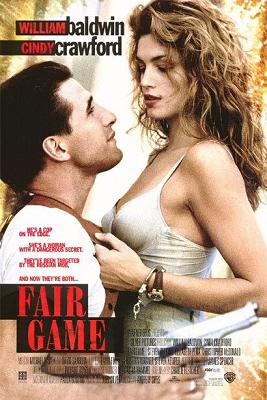
Insomnia File No. 7: Fair Game (dir by Andrew Sipes)


What’s an Insomnia File? You know how some times you just can’t get any sleep and, at about three in the morning, you’ll find yourself watching whatever you can find on cable? This feature is all about those insomnia-inspired discoveries!

Fair_game

On Tuesday night, if you were suffering from insomnia at midnight, you could have turned over to HBO Signature (commonly listed as HBOSIG) and watched Fair Game, a remarkably mindless action film from 1995.

Originally, my plan was to start this review of Fair Game by telling you, in quite a bit of detail, just how sick I am of the Russian Mafia.  Seriously, Russian mobsters have become the default villain for lazy crime films everywhere.  And, quite frankly, I’m getting bored with them.  I’m bored with how the head Russian mobster is always described as being “former KGB” and is always found sitting in the back room of restaurant, wearing an overcoat and smoking filterless cigarettes.  I am bored with how his main henchman is always some big guy with a crew cut and that guy always has a thin sidekick who wears his hair in a pony tail and has a bad mustache.  I’m sick of the overexaggerated accents of American and British accents trying to sound Russian and the way they’re always listening to EDM while driving.  It’s all so predictable and tedious.

But then I considered that Fair Game was made 20 years ago.  Even if the villains are Russian mobsters and even if they are some of the least interesting Russian mobsters in cinema history, it’s totally possible that, when Fair Game, was made, there was still some sort of novelty about the Russian Mafia.

However, even if we give Fair Game a pass on using the cliché of the Russian mob, the villains still weren’t particularly interesting.  Kazak (Steven Berkoff) is … well, the film isn’t really that clear on what Kazak’s big plan is but he has a lot of henchmen and they certainly do end up killing a lot of people.  Kazak runs his operations off of a yacht that belongs to a Cuban criminal named Emilio (Miguel Sandoval).  Emilio is in the process of getting divorced and attorney Kate McQuean (model Cindy Crawford, who made her film debut here and has never played a leading role since) is determined to repossess his boat.  So, Kazak decides that the perfect solution would be to murder Kate…

Which makes absolutely no sense.  Kazak doesn’t want anyone to discover his operation so he decides to blow up a good portion of Miami, all in pursuit of one person.  Wouldn’t it make more sense for Kazak to just blow up the boat and buy a new one?

Anyway, as the film opens, Kate is out jogging when suddenly someone driving by in a car opens fire on her.  She ends up getting grazed in the arm, not that it seems to bother her.  She wears a bandage for a few scenes but it soon vanishes.  Kate is all business so, even after getting shot, she still goes into the office and starts to make plans to repossess that yacht.  Personally, if anyone ever shot at me, I would probably be so freaked out that I would never leave the house again.

Now, you may be thinking that Kate was shot because of Kazak but actually, it turns out that the shooting was just a random thing that happened.  Apparently, the shooter was trying to shoot someone else and Kate just happened to be in the wrong place at the wrong time.  So, we never find out who actually shot Kate and that really bothered me, as that seems to be kind of a huge plot point to bring up and then refuse to resolve.

Anyway, Kate meets a detective named Max Kirkpatrick (William Baldwin) and, soon, they’re on the run from Kazak’s assassins.  The majority of the film is made up of Max and Kate running from one location to another.  One thing that really bothered me was that literally everyone that Max and Kate talked to ended up getting killed just a few minutes later.  At one point, Kate flirts with a computer service expert to get him to help them out.  The scene is played for laughs but then, five minutes later, that same innocent technician guy is being brutally tortured by a bunch of Russians and, though we don’t see it happen, it’s safe to assume that he was eventually murdered by them.  And no point do Max or Kate appear to feel any guilt or concern about the number of innocent people who are killed just for associating with them.

Anyway, Fair Game is a completely mindless film that has a rather nasty streak of sadism to it.  (I imagine, when this film was released, it probably set a record for close-ups of people getting shot and stabbed in the crotch.)  William Baldwin and Cindy Crawford both have perfect bodies and give totally wooden performances, which leads to them having a dimly-lit sex scene that is both physically hot and emotionally cold at the same time.

(I have no idea what entropy at absolute zero means but it sounds like a pretty good description of the chemistry between Cindy Crawford and William Baldwin in Fair Game.)

One good note: Salma Hayek has a small role as Max’s ex-girlfriend.  Whenever she shows up in the movie, she starts screaming at everyone.  I don’t blame her.

Fair Game

Previous Insomnia Files:

  1. Story of Mankind
  2. Stag
  3. Love Is A Gun
  4. Nina Takes A Lover
  5. Black Ice
  6. Frogs For Snakes


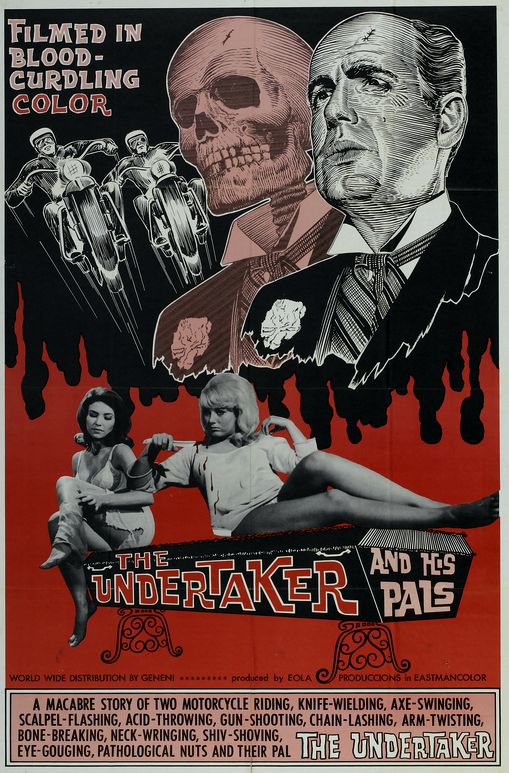
The Daily Grindhouse: The Undertaker and His Pals (dir by T.L.P. Swicegood)


undertaker_and_his_pals_poster_01

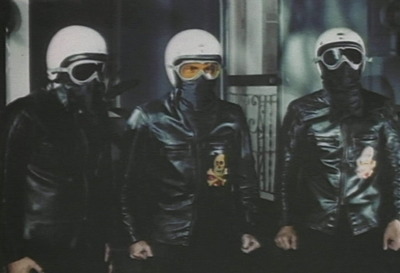
Say what you will about the overall quality of the 1966 horror-comedy, The Undertaker And His Pals, it has an absolutely brilliant opening shot.  One man on a motorcycle drives around in a circle in a parking lot.  He’s wearing a leather jacket and his features are hidden underneath a white helmet.  Soon, another man wearing a leather jacket and white helmet rides up on another motorcycle.  And again, they circle the parking lot.  And then, they’re joined by a third identically dressed man on yet another motorcycle and the three of them circle the parking lot before then driving off into the city.  The night is dark, the city streets are otherwise deserted, and the entire scene is tinted an otherworldly yellow.  It’s a truly creepy scene and, for those first few moments of the film, those three faceless riders are truly frightening.  If you ever watch The Undertaker and His Pals, be sure to appreciate that opening scene because nothing else in the film matches it.

It turns out that our three motorcycle riders are up to no good.  Two of them own a restaurant and, because they’re too cheap to actually order fresh meat, they kill people and serve them up as the special of the day.  The third one is the local undertaker.  Business has apparently been struggling so he’s started killing people so that he can get paid to provide them a funeral.  Apparently, half of each corpse is turned into lunch meat while the other half is put in a cheap, wooden casket at Shady Rest Funeral Parlor.

Now, here’s what makes The Undertaker and His Pal such a strange movie.  The murders are graphic and gory (and I imagine they were quite extreme for 1966) but the rest of the movie is an over-the-top comedy, full of bad puns and slapstick.  At the start of the film, while the latest victim is being stabbed to death, the camera continually cuts to a photograph of her sailor boyfriend, looking more and more upset with each cut.  Later, the undertaker accidentally steps on a skateboard and we watch as he uncontrollably careens into the middle of the street while everyone else in the film points and laughs.  When the undertaker finally falls off the skateboard, we even hear a waa waa on the soundtrack.  After the undertaker has his accident, the owner of the diner accidentally insults a customer and literally gets a custard pie thrown in his face.  (And again, we hear that waa waa.)

And then there’s the names!  The film’s first victim is named Sally Lamb.  The next day, the special at the diner is literally “Leg of Lamb.”  When an administrative assistant named Ann Poultry complains about the poor quality of her leg of lamb and threatens to call the health department, the next day’s special is “Breast of Chicken.”

Ann worked for and was dating a detective named Harry Glass (James Westmoreland, appearing here under the name Rad Fulton).  After her death, Harry is … well, Harry really doesn’t seem to care.  Harry is the film’s nominal hero but he really doesn’t do anything.  In fact, he is remarkably stupid.  Though he claims that he’s trying to solve his girlfriend’s murder, he seems to spend most of his time unknowingly eating her down at the diner.

The Undertaker and His Pals is weird and yet strangely watchable.  Of course, it helps that the film is only 66 minutes long and that the acting so cartoonish (and, I think, intentionally so) that it’s impossible to take the movie seriously.  (If the film was, in any way, believable, it would be almost unbearably grim and misogynistic.)  Fortunately, the film ends with clips of the entire cast coming back to life and laughing, letting us know that no one was intentionally harmed or traumatized and apparently, everyone had a great time making The Undertaker and His Pals.

I imagine the film was made to capitalize on the success of Herschell Gordon Lewis’s similarly over the top Blood Feast.  Ultimately, The Undertaker and His Pals works best as a weird time capsule of what was shocking in 1966.

undertakerpals5

Scenes That I Love: The Opening of Suspiria!


Today is not just Labor Day!

It’s also Dario Argento’s 75th birthday!  And what better way to celebrate the maestro‘s birthday than with a scene that I love?

The opening of Argento’s 1977 masterpiece, Suspiria, is about as perfect an opening as one could hope for.  American ballet student Suzy Banyon (Jessica Harper) arrives in Frieburg, Germany.  Both Argento and Harper perfectly portray Suzy’s confusion as she makes her way through the airport and, as torrential rain drenches her, attempts to hail a taxi and get a ride to the dance academy.  (What Suzy doesn’t know, of course, is that the dance academy is home to the ancient witch known as Our Mother of Sighs.)  With this opening scene, Argento both immediately establishes the off-center, nightmarish atmosphere of Suspiria and establishes Suzy as a character who we, as the audience, relate to and care about.  Suspiria is a great film and it all begins with this brilliant opening.

Happy birthday, Dario!

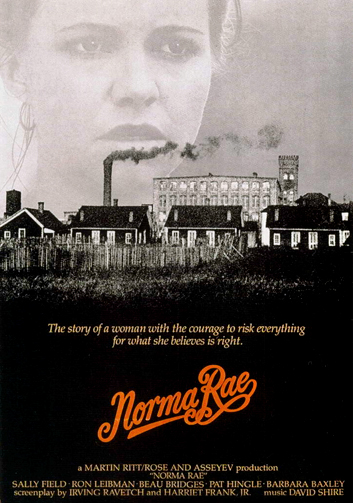
Lisa Reviews An Oscar Nominee For Labor Day: Norma Rae (directed by Martin Ritt)


Earlier, in honor of Labor Day, I reviewed one of the most anti-labor union films ever made, the 1954 Oscar winner On The Waterfront.  In the interest of fairness, it only seems right to now take a look at one of the most pro-union films ever made, the 1979 best picture nominee Norma Rae.

Norma Rae takes place in one of those small Southern towns that is defined by just one industry.  In this case, almost everyone in town works for minimum wage at the local textile mill.  Conditions are terrible, with the employees working long and brutal shifts in a hot and poorly ventilated factory.  The overwhelming roar of the machines have left the majority of the workers deaf to reality, both figuratively and literally.  The mill is run by the usual collection of slow-talking, tie-wearing rednecks who always seem to show up in movies like this.

One day, a union organizer from New York shows up in town.  Brash and cocky, Ruben Warshowsky (Ron Leibman) is determined to unionize the mill but, at first, he struggles.  Nobody wants to risk their job by being seen with him and his Yankee manners rub many of the townspeople the wrong way.

Eventually, Ruben does find one ally.  Norma Rae (Sally Field) has worked at the mill her entire life.  She’s tough and determined but she’s also regularly shunned because of her past.  A widow who has three children (“She’s had a child out of wedlock!” a judgmental union organizer tells Ruben in a near panic), Norma channels her frustration into drinking too much and having an affair with a married (and abusive) salesman.

Two things happen that give Norma Rae a new purpose in life.  First off, she meets and marries the well-meaning but chauvinistic Sonny (Beau Bridges).  Secondly, she helps Ruben in his efforts to unionize the plant, even at the risk of going to jail and losing her job.   With the mill’s management spreading untrue rumors about Norma’s relationship with Ruben, her dedication to the union soon starts to threaten her marriage to Sonny.

I have to admit that I have mixed feelings about Norma Rae.  In many ways, Ruben is an annoying character.  He’s so brash and so smugly out-of-place that I actually found it difficult to consider any of the points that he was making.  I suppose that was partly intentional.  Ruben can’t accomplish anything until he gets Norma Rae on his side.  But, at the same time, there was something very condescending about Ruben as a character.  Much like the villainous rednecks in charge of the mill, Ruben felt like a stock character.  He was Super Yankee, bravely venturing below the Mason-Dixon Line to bring the truth to all of us stupid Southerners.  Whenever Ruben smirked and started to complain about how dumb everyone else was, I was reminded of why I never wanted much to do with the whole Occupy Movement.

As well, Norma Rae is one of those films that technically takes place in the South but it’s the South of the Northern imagination.  The accents were inconsistent and the dialogue often tried way too hard to sound “authentic.”  Ultimately, Norma Rae lacked the artistry necessary to disguise its more heavy-handed moments.

And yet, I still liked Norma Rae.  It had nothing to do with the film’s political message and everything to do with the character of Norma Rae.  Sally Field gives such a good performance as Norma, making her both strong and vulnerable.  The film’s best moments are the ones where Norma stands up for herself and does what she feels is right, despite the opposition from the mill’s management, Sonny, and her father (Pat Hingle).  Towards the end of the film, there’s a simply incredible scene where Norma finally tells her children about her past and, at that moment, Norma Rae reveals itself to be a great and heartfelt tribute to the strength and resilience of women everywhere.  At that moment, Norma’s strength reminded me of the greatest woman that I’ve ever known, my mom.  It made me appreciate the struggles that my mom went through as she raised four strong-willed daughters on her own, while working crappy jobs and dealing with a society that is always threatened by and cruelly judges a woman who refuses to settle.  Personally, I think Norma could have done better than Sonny and that Ruben should have been called out for constantly talking to down to her but what’s important, in the end, is that Norma never stopped standing up for what she believed.  By the end of the film, Norma is standing in for every woman who has ever been underestimated or judged or told that her opinions didn’t matter.  Norma is standing up for all of us.

Sally Field won an Oscar for her role in Norma Rae.  Off the top of my head, I have no idea who she defeated for the award.  (Yes, I know that I could just look it up on wikipedia but that’s not the point.)  But, regardless of her competition, it’s an honor that she definitely deserved.

Norma Rae

Lisa Marie Reviews An Oscar Winner For Labor Day: On The Waterfront (dir by Elia Kazan)


On-the-Waterfront

I like On The Waterfront.

Nowadays, that can be a dangerous thing to admit.  On The Waterfront won the Oscar for Best Picture of 1954 and Marlon Brando’s lead performance as boxer-turned-dockworker Terry Malloy is still regularly cited as one of the best of all time.  The scene where he tells his brother (played by Rod Steiger) that he “could have been a contender” is so iconic that other films still continue to either parody or pay homage to it.  On The Waterfront is one of those films that regularly shows up on TCM and on lists of the greatest films ever made.

And yet, despite all that, it’s become fashionable to criticize On The Waterfront or to cite it as an unworthy Oscar winner.  Certain film bloggers wear their disdain for On The Waterfront like a badge of honor.  Ask them and they’ll spend hours telling you exactly why they dislike On The Waterfront and, not surprisingly, it all gets tedious pretty quickly.

Like all tedious things, the answer ultimately comes down to politics.  In the early 50s, as the House UnAmerican Affairs Committee conducted its search for communists in Hollywood, hundreds of actors, writers, and directors were called before the committee.  They were asked if they were currently or ever had been a member of the Communist Party.  It was demanded that they name names.  Refusing to take part was career suicide and yet, many witnesses did just that.  They refused to testify, apologize, or name names.

And then there was the case of Elia Kazan.  When he was called in front of HUAC, he not only testified about his communist past but he named names as well.  Many of his past associates felt that Kazan had betrayed them in order to protect his own career.  On The Waterfront was Kazan’s answer to his critics.

In On The Waterfront, Terry Malloy’s dilemma is whether or not to voluntarily testify before a commission that is investigating union corruption on the waterfront.  Encouraging him to testify is the crusading priest, Father Barry (Karl Malden), and Edie (Eva Marie Saint), the saintly girl who Terry loves.  Discouraging Terry from testifying is literally every one else on the waterfront, including Terry’s brother, Charlie (Rod Steiger).  Charlie is the right-hand man of gangster Johnny Friendly (a crudely intimidating Lee J. Cobb), who is the same man who earlier ordered Terry to throw a big fight.

At first, Terry is content to follow the waterfront of code of playing “D and D” (deaf and dumb) when it comes to union corruption.  However, when Johnny uses Terry to lure Edie’s brother into an ambush, Terry is forced to reconsider his previous apathy.  As Terry gets closer and closer to deciding to testify, Johnny order Charlie to kill his brother…

The issue that many contemporary critics have with On The Waterfront is that they view it as being essentially a “pro-snitch” film.  It’s easy to see that Elia Kazan viewed himself as being the damaged but noble Terry Malloy while Johnny Friendly was meant to be a stand-in for Hollywood communism.  They see the film as being both anti-union and Kazan’s attempt to defend naming names.

And maybe they’re right.

But, ultimately, that doesn’t make the film any less effective.  Judging On The Waterfront solely by its backstory ignores just how well-made, well-acted, well-photographed, well-directed, and well-written this film truly is.  Elia Kazan may (or may not) have been a lousy human being but, watching this film, you can’t deny his skill as a director.  There’s a thrilling grittiness to the film’s style that allows it to feel authentic even when it’s being totally heavy-handed.

And the performances hold up amazingly well.  Marlon Brando’s performance as Terry Malloy gets so much attention that it’s easy to forget that the entire cast is just as great.  Rod Steiger makes Charlie’s regret and guilt poignantly real.  Karl Malden, who gets stuck with the film’s more pedantic dialogue, is the perfect crusader.  Eva Marie Saint is beautiful and saintly.  And then you’ve got Lee J. Cobb, playing one of the great screen villains.

The motives behind On The Waterfront may not be the best.  But, occasionally, a great film does emerge from less than pure motives.  (Just as often, truly good intentions lead to truly bad cinema.)  Regardless of what one thinks of Elia Kazan, On The Waterfront is a great work of cinema and it’s on that basis that it should be judged.

On_the_Waterfront_poster

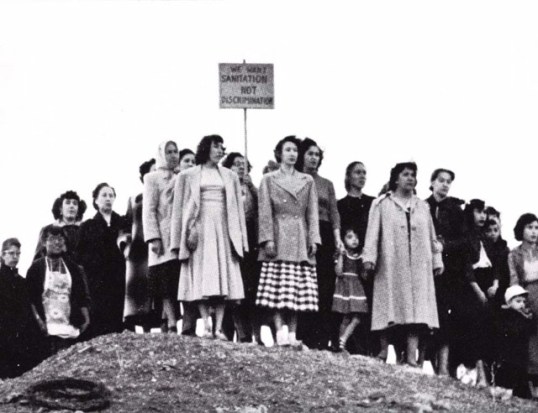
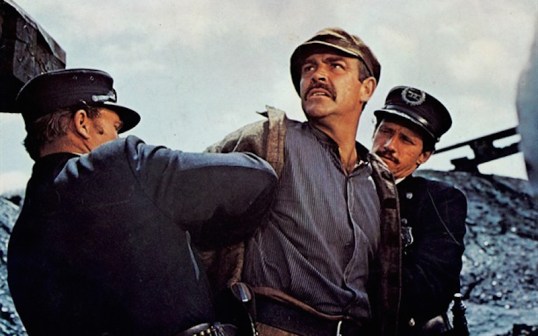
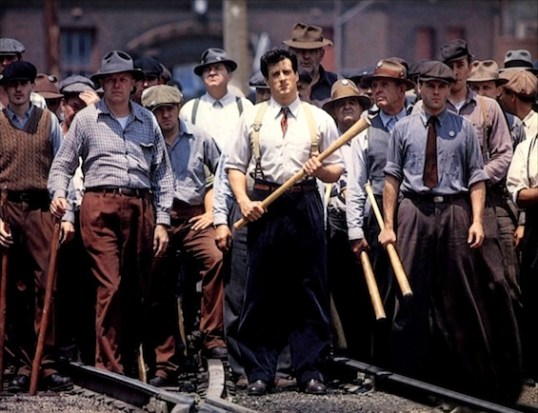
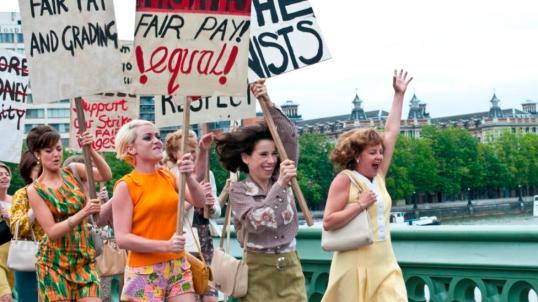
4 Shots From 4 Films: Salt of the Earth, The Molly Maguires, F.I.S.T., Made in Dagenham


4 Shots From 4 Films is just what it says it is, 4 shots from 4 of our favorite films.  As opposed to the reviews and recaps that we usually post, 4 Shots From 4 Films is all about letting the visuals do the talking.

Since it’s Labor Day, this edition of 4 Shorts From 4 Films has a theme!  All four of these shots come from films about labor!

4 Shots From 4 Films

Salt of the Earth

Salt of the Earth (1954, directed by Herbert J. Biberman)

The Molly Maguires (1970, directed by Martin Ritt)

The Molly Maguires (1970, directed by Martin Ritt)

F.I.S.T. (1978, directed by Norman Jewison)

F.I.S.T. (1978, directed by Norman Jewison)

Made in Dagenham (2010, directed by Nigel Cole)

Made in Dagenham (2010, directed by Nigel Cole)


A Blast From The Past: Red Nightmare (directed by George Waggner)


Hi there!  Happy Labor Day!

Now, I have to be honest.  I’m not really sure what the point of Labor Day is.  I have no idea what we’re supposed to be celebrating today.  I’ve got the day off, which seems kind of unfair when you consider that people who have far worse jobs than me — i.e., the actual laborers — are having to work.

Like many Americans, I spent this weekend hanging out with my extended family.  On Sunday, I did a poll of every cousin, aunt, uncle, sister, niece, and nephew that I could find and almost every single one of them agreed with me that Labor Day sounded like something tedious that Jesse Myerson would come up with and then demand that everyone celebrate.  In short, it sounded communistic.

So, with that in mind, I think the best way to start out Labor Day would be by watching this educational film from 1962.  In Red Nightmare, Jerry Donavon (Jack Kelly) takes his freedom for granted.  So, Jack Webb shows up and casts a magic spell, which causes Jerry to have a dream about what it would be like to live in a communist society.  In fact, you could even say that Jack Webb gives Jerry a red nightmare!

So, there’s two ways to review a film like Red Nightmare.  We can either debate the film’s politics and get into a big discussion about economics and policy and all that crap and OH MY GOD, doesn’t that just sound perfectly tedious?  Or, we can simply enjoy Red Nightmare for what it is, a histrionic but sincere time capsule of what was going on in the psyche of 1962 America.

Red Nightmare!  Watch it before getting brainwashed by Labor Day!