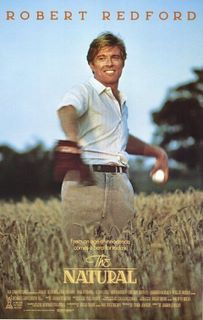
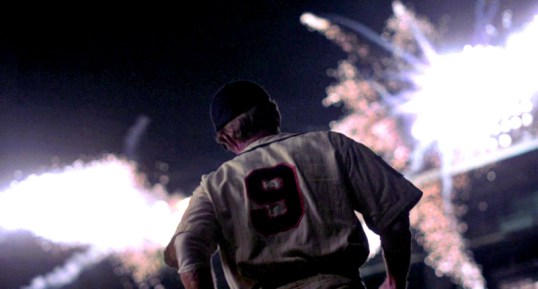
As a baseball fan, it feels like heresy to admit that it took me this long to watch The Natural. I had seen plenty of scenes from the film. I knew the music because there’s no way you can watch as much as baseball as I do without hearing it at least a few times every scene. I knew about Wonderboy and the big home run and how Roy Hobbs came out of nowhere to lead the perennially last-place New York Knights to the championship series but I had never actually watched the entire film from beginning to end.
Until this afternoon.
When the movie started, I was worried. Robert Redford plays Roy Hobbs, an outstanding hitter whose promising career appears to be over when a mysterious woman (Barbara Hersey) shoots him in the gut. At the start of the movie, Roy and his girlfriend Iris (Glenn Close) are supposed to be teenagers but Redford was nearly 50 and Glenn Close was close to 40. The whole point of the first part of the movie is that Roy and Iris are young and they have their whole future ahead of them but the actors were both clearly middle-aged. There was a scene where Roy strikes out the best batter in the league (Joe Don Baker) and the batter kept calling Roy a kid but Redford looked like he was older than Baker.
The good thing is that you only have to buy Redford as being a teenager for about 15 minutes. After he gets shot, Roy stops playing for several years. By the time Roy makes it to the major leagues, he’s supposed to be older than everyone else. No one gives Roy much of a chance when he’s first signed to the New York Knights. The other players (including Michael Madsen) don’t respect him and the manager (Wilford Brimley) refuses to play him. But when Roy Hobbs finally does get a chance to swing his home-made bat, he hits homer after homer. Roy is a natural, the next great player even if he is at an age when most players retire. A journalist (Robert Duvall) tries to uncover his background. A seductress (Kim Basinger) tries to lead him astray. A gambler (Darren McGavin) and the team’s owner (Robert Prosky) try to get him to throw the big game. Anyone who has watched a baseball game knows how it ends because we’ve all heard the music and seen that clip. But even if everyone knows how the story concludes, it’s impossible not to cheer when Roy gets a hit and to feel bad when he takes a strike. Redford may have been old for a baseball player but he looked good out there, swinging that bat and throwing that ball.
I loved The Natural. It’s extremely sentimental movie. Sometimes, it feels old-fashioned. That’s perfect for baseball, though. Baseball is a sentimental, old-fashioned game and the story of Roy Hobbs is what baseball is all about. The Knights are behind for most of the season. Roy hits a slump. But neither he nor the team ever give up because they know that baseball is a game of endurance. It’s not like football, where you just have to win 9 games to make it to the playoffs. Baseball is about never giving up, no matter what the score is. Even the movie’s supernatural aspects — the sudden storms, a lightning bolt hitting a tree and creating Wonderboy, and even Glenn Close looking like an angel in the stands — work because baseball is a mystical sport. It’s the closest thing we have to a spiritual sport.
You couldn’t make a movie like The Natural about football or basketball. Only the game of baseball could have given us The Natural.
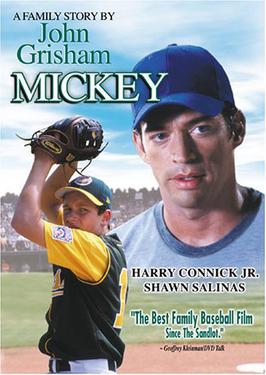
Tripp Spence (Harry Connick, Jr.) is a lawyer who cheated on his taxes. He goes on the run with his 13 year-old son, Derrick (Shawn Salinas). They settle in Las Vegas with new identities. Tripp now goes by Glenn Ryan and Derrick’s new name is Mickey. Because Derrick was given the identity of someone who was a year young than him, he is still eligible to play one more season of Little League baseball. Mickey leads his team to victory after victory and that’s no surprise. He’s a year older and a head taller than all the other players. Eventually, Mickey takes his team to the Little League World Series, where he plays a team from Cuba. Glenn knows that, with all of the publicity, the IRS is going to catch him but all that matters is that his son get to play in the big game.
I love baseball and I can get pretty sentimental when it comes to watching a Little League game. I tear up at both version of TheBadNewsBears. I also like Harry Connick, Jr. What I don’t like is cheating and it bothered me that this whole movie was built around a father encouraging his son to cheat. There wasn’t any reason why Mikey had to be thirteen. It wouldn’t have changed the plot that much if he had actually been twelve and still eligible to play. It’s one thing when major leaguers cheat by corking their bat or wiping something on their pitches. They’re adults and everyone knows that it’s a part of the game. But to encourage your son to cheat at Little League? That’s low.
Mickey was written by John Grisham, who loves baseball but who still should have known better.
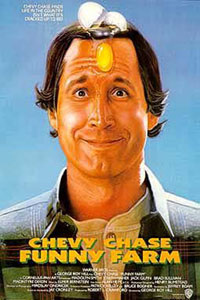
Andy Farmer (Chevy Chase) is a New York sports writer who leaves the city and moves to the small town of Rosebud, Vermont so that he can work on his novel. He and his wife, Elizabeth (Madolyn Smith), struggle to adjust to living in a small town. The delivery of their furniture is delayed by the collapse of a covered bridge. When they try to make a phone call from inside their own house, the local operator tells them to deposit ten cents. They were expecting a Norman Rockwell-type town and instead, they find themselves having to pay for the funeral of a man who was buried on their property long before they moved in. When Elizabeth makes more progress writing a children’s book than Andy does with his heist novel, their marriage starts to feel the strain.
Chevy Chase is now so much better known for the stories of his unprofessional and diva-like behavior on film and television sets that it’s easy to forget that he was, at his peak, a very funny actor. Chase may be playing a variation of his put-upon everyman but, compared to the first two Vacation movies, most of the humor in FunnyFarm is very mild. George Roy Hill was a classy director who had been making movies since the 50s and FunnyFarm feels like a throwback to the type of family-friendly comedies that Disney would make in the 60s. That I laughed as much as I did was largely due to Chase’s performance. Whether he was tripping over a Dutch door, reacting to his wife’s dislike of the first few chapters of his new novel, or offering to pay the townspeople $50 to pretend to be nice for a weekend, Chase was consistently funny and even likable. I don’t know if this is the type of performance that Chevy Chase could give today. There’s a bitterness that’s now integral to screen persona and it’s made him into someone who audience want to laugh at instead of with. It’s too bad because FunnyFarm is a reminder of the type of comedic actor that Chevy Chase used to be and who he probably still could be if not for the failed talk show and the infamous Friar’s Club roast.
As for FunnyFarm, it’s an amusing and likable comedy and it still holds up well today. Chase is the key to the film’s success but he’s not the only reason that the film works. I liked the scene where Mike Starr and Glenn Plummer, as the two movers, watch as the bridge they tried to drive over collapses. I even liked the running joke about the two ducks who refused to leave the Farmers’s property. FunnyFarm may not have been a hit when it was first released but it’s since built up a cult following. There will always be a place for a funny comedy that leaves you in a good mood.
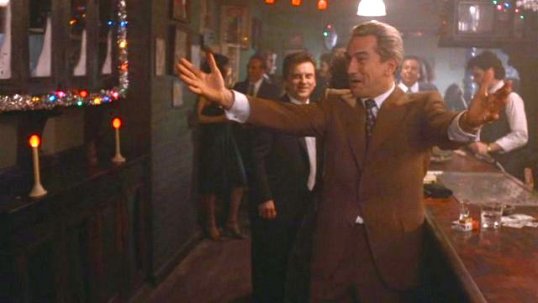
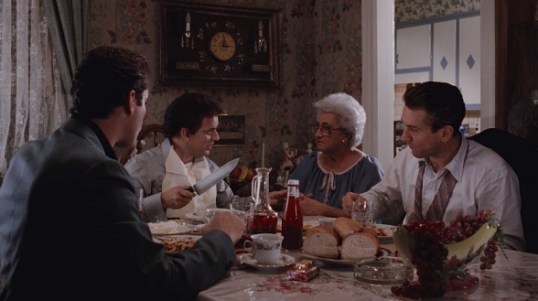
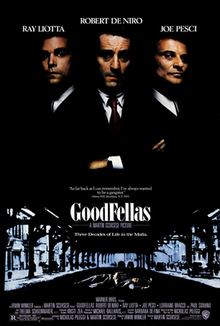
First released in 1990 and continuously acclaimed ever since, Goodfellas did not win the Oscar for Best Picture.
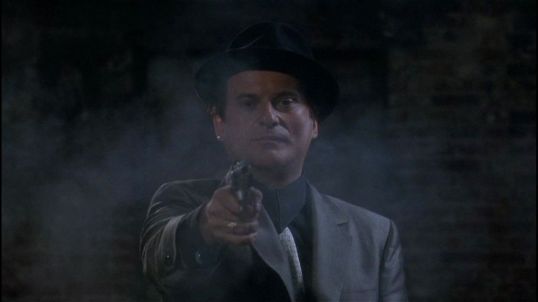
I’m always a bit surprised whenever I remember that. Goodfellas didn’t win Best Picture? That just doesn’t seem right. It’s not the other films nominated that year were bad but Goodfellas was so brilliant that it’s hard to imagine someone actually voting for something else. Seriously, it’s hard to think of a film that has been more influential than Goodfellas. Every gangster film with a soundtrack of kitschy tunes from the 6os and 70s owes huge debt to Goodfellas. Every actor who has ever been cast as a wild and out-of-control psycho gangster owes a debt to Joe Pesci’s performance as Tommy DeVito. When Ray Liotta passed away two years ago, we all immediately heard him saying, “I always wanted to be a gangster.” Robert De Niro’s Jimmy Conway remains the epitome of the ruthless gangster. For many, Paul Sorvino’s neighborhood godfather redefined what it meant to be a crime boss. Lorraine Bracco made such an impression as Karen Hill that it somehow seemed appropriate that she was one of the first people cast in The Sopranos, a show that itself would probably have not existed if not for Goodfellas. Frank Sivero, Samuel L. Jackson, Tobin Bell, Debi Mazer, Vincent Gallo, Ileana Douglas, Frank Vincent, Tony Sirico, Michael Imperioli, Tony Darrow, Mike Starr, Chuck Low, all of them can be seen in Goodfellas. It’s a film that many still consider to be the best of Martin Scorsese’s legendary career. Who can forget Robert De Niro smoking that cigarette while Sunshine of Your Love blared on the soundtrack? Who can forget “Maury’s wigs don’t come off!” or “Rossi, you are nothing but whore!?” Who can forget the cheery Christmas music playing in the background while De Niro’s Jimmy Conway grows more and more paranoid after pulling off the biggest heist of his career?
Plus, it’s a Christmas movie!
And yet, it did not win Best Picture.
Myself, whenever I’m sitting behind a garbage truck in traffic, I immediately start to hear the piano coda from Layla. For that matter, whenever I see a helicopter in the sky, I flash back to a coke-addled Henry Hill getting paranoid as he tries to pick up his brother from the hospital. Whenever I see someone walking across the street in the suburbs, I remember the scene where Henry coolly pistol-whips the country club guy and then tells Karen to hide his gun. I always remember Karen saying that she knows that many of her best friends would have run off as soon as their boyfriend gave them a gun to hide but “it turned me on.” It would have turned me on as well. Henry might be a gangster and his friends might be murderers but he doesn’t make any apologies for who he is, unlike everyone else in the world.
But it did not win Best Picture.
How many people have imitated Joe Pesci saying, “How am I funny?” How many times did Pesci and Frank Vincent have to listen to people telling them to “go home and get your fucking shinebox?” A lot of people remember the brutality of the scene where Pesci and De Niro team up to attack Vincent’s crude gangster but I always remember the sound of Donavon’s Atlantis playing on the soundtrack.
And then there’s Catherine Scorsese, showing up as Tommy’s mom and cooking for everyone while Vincent struggles to escape from the trunk of a car. “He is content to be a jerk,” Tommy says about Henry Hill. Just a few hours earlier, Tommy was apologizing to Henry for getting blood on his floor.
Goodfellas is a fast-paced look at organized crime, spanning from the 50s to the early 80s. Ray Liotta plays Henry Hill, who goes from idolizing gangsters to being a gangster to ultimately fearing his associates after he gets busted for dealing drugs. It’s a dizzying film, full of so many classic scenes and lines that it feels almost pointless to try to list them all here or to pretend like whoever is reading this review doesn’t remember the scene where the camera pans through the club and we meet the members of the crew. (“And then there was Pete The Killer….”) Goodfellas is a film that spend two hours showing us how much fun being a gangster can be and then thirty minutes showing us just how bad it can get when you’re high on coke, the police are after you, and you’ve recently learned that your associates are willing to kill even their oldest friends. No matter how many times I watch Goodfellas, I always get very anxious towards the end of the film. With the music pounding and the camera spinning, with Henry looking for helicopters, and with all of his plans going wrong over the course of one day, it’s almost a relief when Bo Dietl points that gun at Henry’s head and yells at him, revealing that Henry has been captured by the cops and not the Gambinos. Karen desperately running through the house, flushing drugs and hiding a gun in her underwear, always leaves me unsettled. It’s such a nice house but now, everything is crashing down.
There’s a tendency to compare Goodfellas to The Godfather, as their both films that re-imagine American history and culture through the lens of the gangster genre. I think they’re both great but I also think that they are ultimately two very different films. If The Godfather is sweeping and operatic, Goodfellas is the film that reminds us that gangsters also live in the suburbs and go to cookouts and that their wives take care of the kids and watch movies while the FBI searches their home. If The Godfather is about the bosses, Goodfellas is about the blue collar soldiers. The Godfather represents what we wish the Mafia was like while Goodfellas represents the reality.
Goodfellas is one of the greatest films ever made but it lost the Best Picture Oscar to Dances With Wolves, a film that left audiences feeling good as opposed to anxious. To be honest, Martin Scorsese losing Best Director to Kevin Costner feels like an even bigger injustice than Goodfellas losing Best Picture. One can understand the desire to reward Dances With Wolves, a film that attempts to correct a decades worth of negative stereotypes about Native Americans. But Scorsese’s direction was so brilliant that it’s truly a shame that he didn’t win and that Lorraine Bracco didn’t win Best Supporting Actress. It’s also a shame that Ray Liotta wasn’t nominated for playing Henry Hill. At least Joe Pesci won an Oscar for redefining what it meant to be a gangster.
Goodfellas is proof that the best film doesn’t always win at the Oscars. But it’s also proof that a great film doesn’t need an Oscar to be remembered.
First released in 1999, Summer of Sam is Spike Lee’s sprawling, frustrating, flawed, occasionally compelling, and ultimately rather intriguing film about the summer of 1977 in New York City.
As one can guess from the title, it was a summer that was dominated by the reign of terror of the serial killer known as the Son of Sam. While New York suffered one of the hottest summers on record, the Son of Sam shot couples while they sat in their cars. Because all of his victims had been women with long, dark hair, women across the city wore blonde wigs. While the police searched for the killer, the city was also caught up in the World Series. Club 57 was the hottest club in New York but a growing number of rebels, inspired by the news that was coming out of the UK, eschewed the glitz of disco for the gritty and deliberately ugly aesthetic of punk and the Mud Club.
Though the film is centered around the murders of the Son of Sam, he remains a largely shadowy figure in the film. Played by Michael Badalucco, David Berkowitz spends most of his time in his filthy home, yelling at the dog across the street and writing cryptic messages on the walls. He only gets a few minutes of screen time because the film is ultimately less about the Son of Sam’s crimes and more about how one Italian-American neighborhood in New York deals with the atmosphere of fear and paranoia created by those crimes. It’s a neighborhood that’s ruled over by the ruthless but benevolent Luigi (Ben Gazzara). When the two detectives (Anthony LaPaglia and Roger Guevener Smith) come to the neighborhood in search of information, they know that Luigi is the man to see.
Vinny (John Leguizamo) is one of the neighborhood’s citizens, a hairdresser who hasn’t let his marriage to Dionna (Mira Sorvino) stand in the way of his compulsive womanizing. Vinny is the type who cheats on his wife and then goes to Confession to get forgiveness. He’s the type who gets angry whenever Dionna wants to have sex with the lights on or do anything other than a quick three minutes in the missionary position. When he realizes that the Son of Sam was watching him while he was having sex in a car with Dionna’s cousin and that he could have been one of his victims, Vinny starts to spin out of control. Vinny’s childhood friend is Ritchie (Adrien Brody), who shocks everyone when he spikes his hair, puts on a Union Jack t-shirt, and starts speaking with a fake British accent. Ritchie and his girlfriend, Ruby (Jennifer Esposito), embrace the punk lifestyle and even put one the Son of Sam’s letters to music when they perform at the Mud Club.
It’s an ambitious film but it’s also an overlong film, one where the slow spots can truly test the viewer’s patience. With a 142-minute running time, Summer of Sam finds the time to touch on almost every trope of the late 70s. Vinny and Dionna hit the clubs, where the usually quiet Dionna truly comes to life as she dances. (Vinny’s moves are far less impressive. Tony Manero would have laughed at him.) Ritchie not only embraces punk rock but he also makes his money by performing in live sex shows. When a mysterious man offers to give Vinny and Dionna a ride in his limo, it’s hard not to smile when it’s revealed that he’s taking them to the infamous sex club, Plato’s Retreat. One can respect Lee’s ambition while still finding the film itself to be a bit too self-indulgent for it’s own good.
Spike Lee, for all of his other talents, has never been a particularly subtle director. Vinny and his friends spend a lot of time hanging out at the end of street, strategically placed in front of a sign that loudly proclaims, “DEAD END.” At one point, Vinny is inspired to run to his window and start screaming insults at the Son of Sam and Leguizamo’s histrionic delivery of the lines make it impossible to take his anguish seriously. At the same time, there are moments that work brilliantly. I particularly liked the scenes that took place during the blackout of 1977. Luigi automatically knows how to keep control in his neighborhood and he sends his men out with baseball bats, channeling their aggression into a search for the phantom serial killer. For every scene that doesn’t work, there’s a scene like the Baba O’Riley montage or Vinny, Dionna, Ritchie, and Ruby having a candlelit dinner.
“We really dig your vibe.”
John Leguizamo is shrill and miscast as Vinny, though I’m not sure if anyone could have made much of such a one-dimensional characters. I preferred the performances of Mira Sorvino, Adrien Brody, and Jennifer Esposito, who all brought their characters to authentic life. (I especially liked how Brody switched from being tough to being a wounded child at the drop of a hat.) As is so often the case with Lee’s films, it’s the supporting actors who make the strongest impression. I loved Mike Starr’s earthy performance as Ritchie’s father and Ben Gazzara’s sly turn as the neighborhood mobster. Bebe Neuwirth is underused but memorable as Vinny’s boss.
The film is overstuffed and overlong but it effectively portrays a community in the grips of paranoia and anger. In the end, the film is epitomized by a scene in which the neighbor’s dog enter David Berkowtiz’s living room and starts yelling at him in the voice of John Turturro. It’s a scene that’s so ludicrous that it somehow becomes effective. It’s a scene that most directors would have left on the editing room floor but Spike Lee included it. It takes courage to write, film, and keep a scene like that. Summer of Sam is a wreck of a film but it’s also ultimately a compelling portrait of a community coming apart. In the end, just as in real life, Berkowitz is brought to justice and a community is left wondering what to do now.
Summer of Sam features some of Spike Lee’s best work and also some of his worst. The film opens with columnist Jimmy Breslin describing New York as being the city that he both loves and hates and that’s the way that I feel about this film. For all of its flaws, there’s enough strengths to make up for them. It’s a New York story and, appropriately, it’s just as messy as the city that it is about.
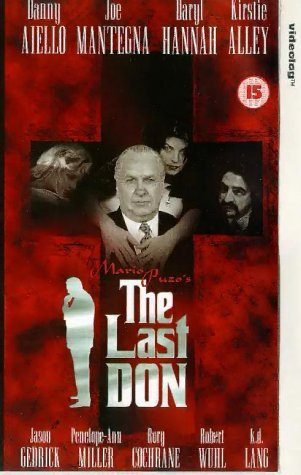
First broadcast over three nights in 1997, The Last Don tells the story of a powerful and respected Mafia family. They control politicians across the country and they own casinos in Vegas and their power even extends all the way to Hollywood. Despite having many enemies, the family has thrived due to the leadership of a wise but ruthless Don. This Don remembers the old ways and imparts lessons about honor to the members of his own family. Never let anyone know what you’re thinking. Never side against the family. If someone like you were to make enemies, they would become the Don’s enemies and then they would fear you …. you know, stuff like that.
However, times are changing and America is changing with it. The underworld is no longer run by men of honor. On top that, the Don is aging and in ill-health. Who will succeed him? One possible successor is respected by all but he’s stayed out of the dirtier aspects of the family’s business and, in fact, he seems to have no desire to be a feared man. Another possible successor is ruthless and has a terrible temper. He sometimes speaks out of turn, because the Don has a sentimental weakness for his children. This possible successor’s anger is feared but perhaps fear is the future of the organized crime in America. The old ways are changing but one thing remains the same. The Don believes in America and he believes in family and….
Wait.
Okay, is it just me or does this all sound just a little bit familiar?
If it does, that’s probably because The Last Don is based on a novel by The Godfather‘s Mario Puzo. Though the family may be called The Clerichuzios and the action may have been moved fro the 40s and the 50s to the 60s, 70s, and 80, the story is still the same basic one that was told in The Godfather. Don Clerichuzio (Danny Aiello) is an honorable man whose time is coming to an end. His grandnephew, Cross (Jason Gedrick), is the possible successor who isn’t crazy. His grandson, Dante (Rory Cochrane), is the possible successor who is violent and doesn’t know how to negotiate. Don Clerichuzio’s dream is for the family to become completely legitimate but good luck with that when the film business and the political world are just as corrupt as the Mafia. I supposed one could argue that The Last Don is narrated by Don Clerichuzio while The Godfather has no narration at all but, seriously, once you have to add a voice-over to explain what’s going on, you have pretty much already last the war.
And yes, I did mention the film business. When Francis Ford Coppola first read The Godfather, he famously hated the Hollywood sections of the book and, with the exception of Tom Hagen’s visit to Jack Woltz (and Woltz’s subsequent discovery of a horse’s head in his bed the next morning), Coppola refused to include them in the movie. The second half of The Last Don, however, goes full Hollywood and, more or less, proves Coppola’s point. Cross’s sister, Claudia (Michelle Burke, who also co-starred with Cochrane in Dazed and Confused), gets a job as an agent and one of her clients is the world’s most famous actress, the ludicrously named Athena Aquataine (Daryl Hannah). When Athena has trouble with her crazy ex-husband (Chris Meloni, bringing a spark of genuine danger to the production), Cross helps her out, falls in love, and gets involved in the production of her next film. This brings him into conflict with a studio exec named Bobby Bantz (Robert Wuhl). Unfortunately, all of the Hollywood stuff is pretty dull. One gets the feeling that Puzo was perhaps settling some old scores with the character of Bobby but Robert Wuhl is one of those goofy actors who belongs nowhere near a Mafia drama. And don’t even get me started on country singer k.d. lang, who is bizarrely cast as a film director.
(Add to that, how can anyone take a character named Athena Aquataine seriously? I never miss an Athena Aquataine movie!))
The Hollywood stuff distracts from the Mafia stuff, which is unfortunate because the Mafia stuff is at least occasionally interesting and it’s certainly better-acted than the Hollywood scenes. Joe Mantegna plays Pippi, who is Cross’s father and who, years earlier, killed Dante’s father. (Mantegna’s always good but it’s a struggle to take any character named Pippi seriously.) Kirstie Alley plays Rose Marie, who is Dante’s mentally unstable mother and the Don’s only daughter. Aiello, Mantegna, and Alley all give good performances, as do Burt Young and Seymour Cassel in the roles of family associates. As for the “younger generation” of Clerichuzios, Gedrick is a bit dull but then again, Cross isn’t a very interesting character. The slightly-built Cochrane is miscast as Dante but ultimately, that miscasting kind of works in that it reminds us that, due to his father being the scion of a rival family, Dante is destined to always be viewed as being an outsider.
As I said earlier, The Last Don was originally broadcast over three nights. I watched the whole thing — all five hours of it — in one sitting and, yes, it was a bit of an endurance test. It’s not just that it’s long but also that it keeps getting bogged down in all of the Hollywood stuff. You don’t watch a film like this because you want to spend five hours watching Robert Wuhl mug for the camera. You watch a film like this for the Mafia action and, for a film called The Last Don, there really wasn’t enough Mafia action. It has its moments but it never feels as authentic as The Godfather, Casino, Goodfellas, The Irishman, The Sopranos or any of the other classic films and shows about the Mafia.. The Last Don needed to be extremely Italian but instead, it was only slightly Italian. Robert Evans famously said that Coppola was selected to direct The Godfather because Coppola would make audiences “smell the pasta.” There’s very little pasta in The Last Don.
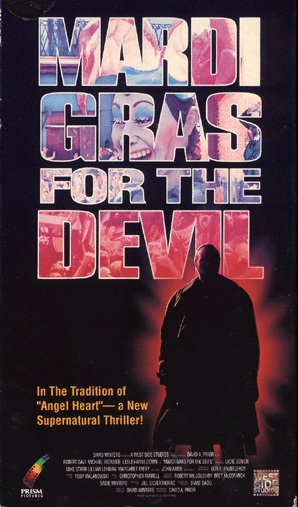
A maniac is holding New Orleans hostage! He’s committed a series of savage, Satanically-influenced homicides and the police cannot seem to even slow him down! The entire city is terrified!
Well, actually … New Orleans doesn’t seem to be scared at all. In fact, no one in this movie seems to be all that disturbed by all of the brutal murders that are happening around them. Some people would probably say that’s because this film takes place during Mardi Gras and everyone’s too drunk to notice. Why worry about being murdered when all you have to do to get a bunch of cheap beads is flash a boob? Add to that, this is New Orleans. New Orleans is a very forgiving city.
Anyway, regardless of whether people care or not, there’s a Satanic murderer prowling through the city. Who is the killer? Could he possibly be that guy who always dresses in black, who has a perfectly trimmed beard, and who is always throwing back his head and laughing before doing something evil? The guy’s name is Bishop and he’s played by everyone’s favorite Canadian character actor, Michael Ironside. As far as Michael Ironside villains are concerned, Bishop is pretty frightening though he’s nowhere near as a frightening as Darryl Revok. I mean, he does a lot of evil stuff but he doesn’t actually make anyone’s head explode.
Detective Mike Turner (Robert Davi) is obsessed with stopping Bishop. Unfortunately, Detective Turner doesn’t appear to be very good at his job. I mean, everyone he knows he keeps getting seriously injured. His first partner dies. His second partner gets run over by a bus. His ex-wife (Lesley-Anne Down) ends up trapped in a pool. His girlfriend (Lydie Denier) ends up getting tied up in a barn while a time bomb ticks down across from her. Fortunately, a few of these people do manage to survive. Turner may not be a very good cop but, fortunately, Bishop isn’t that good of a serial killer.
It soon becomes apparent that Bishop has a motive for all of his murders, one that goes beyond the usual serial killer weirdness. It turns out that Bishop’s murders are actually sacrifices and he has given his soul to Satan. Giving your soul to the devil apparently gives you the power to do whatever the script needs you to do at any particular moment in the movie. Fortunately, it also leaves you with a weakness that can be exploited whenever the movie decides to come to an end.
Am I saying that Mardi Gras For the Devil makes no sense? I most definitely am! However, that’s actually the film’s charm. The film was made with so little concern for continuity and narrative logic that it plays out like a fever dream. The cast is surprisingly good for a film like this, which means that everyone delivers the strangest of lines with the utmost sincerity. Michael Ironside plays his role without a hint of subtlety, which is exactly the type of bad guy that a film like this requires. Meanwhile, Robert Davi brings a weary cynicism to his role. You can just hear him thinking, “Satanic serial killers? I’m too old for this shit.” Combine that with a fiery ending that doesn’t even try to make sense and you have a movie that, perhaps through no intention of the film’s director, manages to create and sustain a very surreal atmosphere. The film may not be any good but it’s hard to look away from.
Though the film takes place at Mardi Gras and was released, in some countries, as both Mardi Gras For The Devil and Mardi Gras Nightmare, it actually has very little do with Mardi Gras. The opening scenes were shot during a Mardi Gras parade but that’s about it. The film was also released under the title Night Trap, which is a woefully generic title. You can find the movie on YouTube.
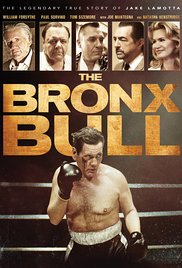
New York in the 1930s. Jake LaMotta (Morean Aria) is a tough street kid who is pushed into fighting by his abusive father (Paul Sorvino) and who is taught how to box by a sympathetic priest (Ray Wise). When Jake finally escapes from his Hellish home life, it is so he can pursue a career as a professional boxer. Ironically, the same violent nature that nearly destroyed him as a youth will now be the key to his future success.
In the late 60s, a middle-aged Jake LaMotta (William Forsythe) testifies before a government panel that is investigating that influence of the Mafia in professional boxing. LaMotta testifies that, during his professional career, he did take a dive in one of his most famous matches. LaMotta goes on to pursue an entertainment career which, despite starring in Cauliflower Ears with Jane Russell, never amounts too much. He drinks too much, fights too much, and gets into arguments with a ghost (Robert Davi). He also gets married several times, to women played by everyone from Penelope Ann Miller to Alicia Witt. The movie ends with Jake happily walking down a snowy street and a title card announcing that Jake is now 95 years old and married to his seventh wife. (The real Jake LaMotta died on September, 9 months after the release of The Bronx Bull.)
The Bronx Bull is a largely pointless movie about the later life of the antisocial boxer who was previously immortalized in Martin Scorsese’s Raging Bull. In fact, The Bronx Bull was originally announced and went into production as Raging Bull II. Then the producers of the original Raging Bull found out, filed a lawsuit, and the film became The Bronx Bull. Because of the lawsuit, The Bronx Bull could cover every aspect of Jake’s life, except for what was already covered in Raging Bull. In fact, Scorsese’s film (which undoubtedly had a huge impact on LaMotta’s later life) is not even mentioned in The Bronx Bull.
William Forsythe does what he can with the role but, for the most part, Jake just seems to be a lout with anger issues. With a cast that includes everyone from Tom Sizemore to Cloris Leachman to Bruce Davison, the movie is full of familiar faces but none of them get too much of a chance to make an impression. Joe Mantegna comes the closest, playing Jake’s best friend. The Bronx Bull was not only shot on the cheap but it looks even cheaper, with studio backlots unconvincingly filling in for 1930s Bronx. The film’s director, Martin Guigui, occasionally tries to throw in a Scorsesesque camera movement and there are a few black-and-white flashbacks but, for the most part, this is the mockbuster version of Raging Bull.
From start to end, the 1994 film Ed Wood is a nearly perfect film.
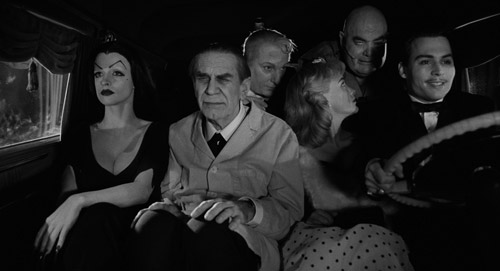
Consider the opening sequence. In glorious black-and-white, we are presented with a house sitting in the middle of a storm. As Howard Shore’s melodramatic and spooky score plays in the background, the camera zooms towards the house. A window flies open to reveal a coffin sitting in the middle of a dark room. A man dressed in a tuxedo (played to snarky and eccentric perfection by Jeffrey Jones) sits up in the coffin. Later, we learn that the man is an infamously inaccurate psychic named Criswell. Criswell greets us and says that we are interested in the unknown. “Can your heart handle the shocking facts of the true story of Edward D. Wood, Jr!?”
As streaks of lightning flash across the sky, the opening credits appear and disappear on the screen. The camera zooms by tombstones featuring the names of the cast. Cheap-looking flying saucers, dangling on string, fly through the night sky. The camera even goes underwater, revealing a giant octopus…
It’s a brilliant opening, especially if you’re already a fan of Ed Wood’s. If you’re familiar with Wood’sfilms, you know that Criswell’s appearance in the coffin is a reference to Orgy of the Dead and that his opening monologue was a tribute to his opening lines fromPlan 9 From Outer Space. If you’re already a fan of Ed Wood then you’ll immediately recognize the flying saucers. You’ll look at that octopus and you’ll say, “Bride of the Monster!”
And if you’re not an Ed Wood fan, fear not. The opening credits will pull you in, even if you don’t know the difference between Plan 9 and Plan 10. Between the music and the gorgeous black-and-white, Ed Wood is irresistible from the start.
Those opening credits also announce that we’re about to see an extremely stylized biopic. In the real world, Ed Wood was a screenwriter and director who spent most of his life on the fringes of Hollywood, occasionally working with reputable or, at the very least, well-known actors like Lyle Talbot and Bela Lugosi. He directed a few TV shows. He wrote several scripts and directed a handful of low-budget exploitation films. He also wrote a lot of paperbacks, some of which were semi-pornographic. Most famously, he was a cross-dresser, who served in the army in World War II and was wearing a bra under his uniform when he charged the beaches of Normandy. Apparently, the stories of his love for angora were not exaggerated. Sadly, Wood was also an alcoholic who drank himself to death at the age of 54.
Every fan of Ed Wood has seen this picture of him, taken when he first arrived in Hollywood and looked like he had the potential to be a dashing leading man:
What people are less familiar with is how Ed looked after spending two decades on the fringes of the film business:
My point is that the true story of Ed Wood was not necessarily a happy one. However, one wouldn’t know that from watching the film based on his life. As directed by Tim Burton, Johnny Depp plays Ed Wood as being endlessly positive and enthusiastic. When it comes to determination, nothing can stop the film’s Ed Wood. It doesn’t matter what problems may arise during the shooting of any of his films, Wood finds a way to make it work.
A major star dies and leaves behind only a few minutes of usable footage? Just bring in a stand-in. The stand-in looks nothing like the star? Just hide the guy’s face.
Wrestler Tor Johnson (played by wrestler George “The Animal” Steele), accidentally walks into a wall while trying to squeeze through a door? Shrug it off by saying that it adds to the scene. Point out that the character that Tor is playing would probably run into that wall on a regular basis.
Your fake octopus doesn’t work? Just have the actors roll around in the water.
The establishment won’t take you seriously? Then work outside the establishment, with a cast and crew of fellow outcasts.
You’re struggling to raise money for your film? Ask the local Baptist church. Ask a rich poultry rancher. Promise a big star. Promise to include a nuclear explosion. Promise anything just to get the film made.
You’re struggling to maintain your artistic vision? Just go down to a nearby bar and wait for Orson Welles (Vincent D’Onofrio) to show up.
Personally, I’m of the opinion that Ed Wood is Tim Burton’s best film. It’s certainly one of the few Burton films that actually holds up after repeat viewings. Watching the film, it’s obvious that Wood and Burton shared a passionate love for the movies and that Burton related to Wood and his crew of misfits. It’s an unabashedly affectionate film, with none of the condescension that can sometimes be found in Burton’s other film. Burton celebrates not just the hopes and dreams of Ed Wood, Bela Lugosi, Tor Johnson and Criswell but also of all the other members of the Wood stock company, from Vampira (Lisa Marie) to Bunny Breckenridge (Bill Murray), all the way down to Paul Marco (Max Casella) and Loretta King (Juliet Landau). Though Ed Wood may center around the character of Wood and the actor who plays him, it’s a true ensemble piece. Landau won the Oscar but really, the entire cast is brilliant. Along with those already mentioned, Ed Wood features memorable performances from Sarah Jessica Parker and Patricia Arquette (one playing Wood’s girlfriend and the other playing his future wife), G. D. Spradlin (as a minister who ends up producing one of Wood’s films), and Mike Starr (playing a producer who is definitely not a minister).
For me, Ed Wood is defined by a moment very early on in the film. Wood watches some stock footage and talks about how he could make an entire movie out of it. It would start with aliens arriving and “upsetting the buffaloes.” The army is called in. Deep delivers the line with such enthusiasm and with so much positive energy that it’s impossible not get caught up in Wood’s vision. For a few seconds, you think to yourself, “Maybe that could be a good movie…” Of course, you know it wouldn’t be. But you want it to be because Ed wants it to be and Ed is just do damn likable.
As I said before, Ed Wood is a highly stylized film. It focuses on the good parts of the Ed Wood story, like his friendship with Bela Lugosi and his refusal to hide the fact that he’s a cross-dresser who loves angora. The bad parts of his story are left out and I’m glad that they were. Ed Wood is a film that celebrates dreamers and it gives Wood the happy ending that he deserved. The scenes of Plan 9 From Outer Space getting a raptorous reception may not have happened but can you prove that they didn’t?
I suppose now would be the time that most reviewers would reflect on the irony of one of the worst directors of all time being the subject of one of the best films ever made about the movies. However, I’ll save that angle for whenever I get a chance to review The Disaster Artist. Of course, I personally don’t think that Ed Wood was the worst director of all time. He made low-budget movies but he did what he could with what he had available. If anything, Ed Wood the film is quite correct to celebrate Ed Wood the director’s determination. Glen or Glenda has moments of audacious surrealism. Lugosi is surprisingly good in Bride of the Monster. As for Plan 9 From Outer Space, what other film has a plot as unapologetically bizarre as the plot of Plan 9? For a few thousand dollars, Wood made a sci-fi epic that it still watched today. Does that sound like something the worst director of all time could do?
Needless to say, Ed Wood is not a horror film but it’s definitely an October film. Much as how Christmas is the perfect time for It’s A Wonderful Life, Halloween is the perfect time for Ed Wood.
1930s. New York City. For years, Stephanie St. Clair (Cicely Tyson) has been the benevolent queen of the Harlem underworld, running a successful numbers game and protecting her community from outsiders. However, psychotic crime boss Dutch Schultz (Tim Roth) is determined to move into Harlem and take over the rackets for himself. With the weary support of Lucky Luciano (Andy Garcia), Schultz thinks that he is unstoppable but he did not count on the intervention of Bumpy Johnson (Laurence Fishburne). Just paroled from Sing Sing, Bumpy is determined to do whatever has to be done to keep Schultz out of Harlem.
When I reviewed The Cotton Club yesterday, I knew that I would have to do Hoodlum today. Hoodlum and The Cotton Club are based on the same historic events and both of them feature Laurence Fishburne in the role of Bumpy Johnson. Of the two, Hoodlum is the more straightforward film, without any of the operatic flourishes that Coppola brought to The Cotton Club. Fisburne is surprisingly dull as Bumpy Johnson but Tim Roth goes all in as Dutch Schultz and Andy Garcia is memorably oily as the Machiavellian Luciano. Hoodlum is about forty minutes too long but the gangster action scenes are staged well. Bumpy Johnson lived a fascinating life and it is unfortunate that no film has yet to really do him justice, though Clarence Williams III came close with his brief cameo in American Gangster. (Interestingly enough, Williams is also in Hoodlum, playing one of Shultz’s lieutenants.)
One final note: Hoodlum features William Atherton in the role of District Attorney Thomas E. Dewey. Atherton plays Dewey as being a corrupt and sleazy politician on Luciano’s payroll. In real life, Dewey was known for being so honest that Dutch Schultz actually put a contract out on his life after he discovered that Dewey could not be bribed. I am not sure why Hoodlum decided to slander the subject of one of America’s most famous headlines but it seems unnecessary.


 New York in the 1930s. Jake LaMotta (Morean Aria) is a tough street kid who is pushed into fighting by his abusive father (Paul Sorvino) and who is taught how to box by a sympathetic priest (Ray Wise). When Jake finally escapes from his Hellish home life, it is so he can pursue a career as a professional boxer. Ironically, the same violent nature that nearly destroyed him as a youth will now be the key to his future success.


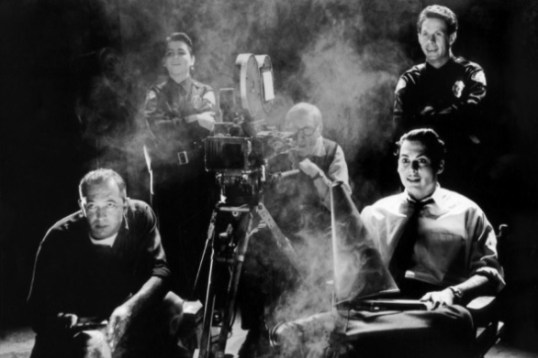
 1930s. New York City. For years, Stephanie St. Clair (Cicely Tyson) has been the benevolent queen of the Harlem underworld, running a successful numbers game and protecting her community from outsiders. However, psychotic crime boss Dutch Schultz (Tim Roth) is determined to move into Harlem and take over the rackets for himself. With the weary support of Lucky Luciano (Andy Garcia), Schultz thinks that he is unstoppable but he did not count on the intervention of Bumpy Johnson (Laurence Fishburne). Just paroled from Sing Sing, Bumpy is determined to do whatever has to be done to keep Schultz out of Harlem.
 Through the Shattered Lens