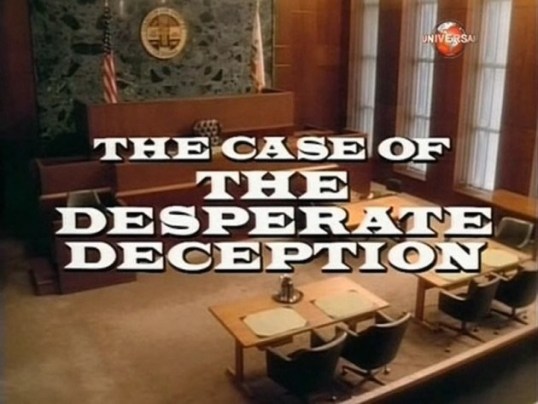
Marine Captain David Berman (Tim Ryan, who looked a lot like Bruce Willis) gets a transfer to Paris so that he can track down Dieter Krugman, a Nazi war criminal who killed his grandparents and crippled his mother (Teresa Wright). He is told that Krugman is now living under the name of Felix Altmann. David confronts Altmann at a health spa but, when someone else shoots Altmann, David is framed for the crime. Luckily, Perry Mason (Raymond Burr) is an old friend of the family’s. He and Ken Malansky (William R. Moses) hop on the first plane to Paris and Perry starts to read up on the Uniform Code of Military Justice so that he can defend David. Della (Barbara Hale) stays behind in Denver but Perry calls her a few times.
This was a good entry in the Perry Mason film series. The mystery was intriguing and the acting — from Ian Bannen, Ian McShane, Terry O’Quinn, Yvette Mimieux, and Paul Freeman — was excellent all around. Especially good was Teresa Wright as David’s mother. Some of her scenes were chilling and she gets a great moment at the end of the movie. Raymond Burr is as good as always but, for the first time, William R. Moses really feels like he belongs in the movie. This is the first time that I’ve seen Ken without wishing he was Paul.
It’s too bad Della had to stay back in America. I bet she would have enjoyed seeing Paris with Perry.
Produced, directed, financed by, and starring writer Norman Mailer, 1968’s Wild 90 is incomprehensibly bad. Words escape me when it comes to describing just how boring and pointless this film.
Over the course of four nights, Mailer and two of his friends were filmed in a shabby apartment. Norman Mailer played The Prince, a gangster who talks tough and is constantly doing stuff like punching the room’s only hanging lightbulb. Buzz Farber and Mickey Knox played Cameo and Twenty Years, the Prince’s partners in crime. Acclaimed documentarian D.A. Pennebaker served as cinematographer, using a hand-held camera to capture the three men as they drank, laughed, fought, and pretended to be gangsters.
The plot of the film is not easy to describe, both because the entire film was improvised and also because the soundtrack is so muddy that it’s often impossible to understand what anyone’s saying. As far as I can tell, the Prince’s latest criminal scheme has gone south and the Prince and his two cronies are hiding out in the apartment until the heat dies down. They don’t have much to do, other than drink and exchange profane dialogue. (The three men do their best to sound like real-life, poetically crude gangsters. It’s hard to judge how well they do any of that because the dialogue is often incomprehensible.) Some people drop by the apartment. Normally, that would liven things up but in this one, everyone just seems like they want to leave before Norman Mailer accidentally punches them. One man comes in a with a dog that start barking. Mailer barks back until the dog falls silent.
Making all of this interesting is the fact that, in the 1960s, Norman Mailer was one of America’s leading public intellectuals. Today, living in the age of influencers, it can be easy to forget that there were once public intellectuals, like Mailer, William F. Buckley, Gore Vidal, John Kenneth Galbraith, and Tom Wolfe, who disagreements were followed by the public and who made headlines when they showed up drunk on the daytime talk shows. Mailer was an acclaimed and often controversial writer, one who was as famous for his arrogance and his public feuds as for his novels and essays. Mailer was a New York fixture and a Pulitzer Prize winner He was one of the first writers to suggest that the Left and the Right could be united by a shared belief in individual freedom. A year after the release of Wild 90, Mailer ran an ill-fated campaign for mayor of New York City. His slogan was “No more bullshit!” and his campaign, which attracted some attention early on, was ultimately sabotaged by his habit of showing up drunk to his rallies and insulting his supporters.
What he was not was a very good filmmaker. Wild 90 was Mailer’s first film and it’s a nearly unwatchable disaster. (At least his later film, Maidstone, had Rip Torn around to liven things up.) With its low-budget, black-and-white look and it’s DIY aesthetic, Wild 90 may remind some of the Andy Warhol’s Factory films but Warhol (or, if we’re to be absolutely honest, Paul Morrissey) was at least trying to be subversive. Wild 90, on the other hand, is pure self-indulgence, a chance for Mailer to say, “Look how funny I am!” Farbar and Knox at least manage to give semi-believable performances. Mailer continually looks straight at the camera and seems to panic whenever either of his co-stars start to take the attention off of him. The entire film seems to be Mailer’s attempt to convince everyone that he really was a tough guy.
There is one moment of the film that does work. The film opens with some gorgeously shabby images of lower Manhattan. Norman Mailer was a proud New Yorker so it’s appropriate that the best part of the film is the part that highlights the city he loved.
What’s an Insomnia File? You know how some times you just can’t get any sleep and, at about three in the morning, you’ll find yourself watching whatever you can find on cable or streaming? This feature is all about those insomnia-inspired discoveries!
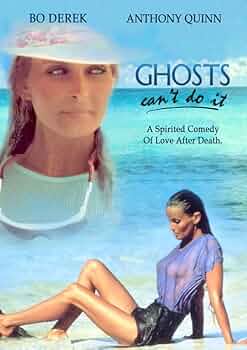
If you find yourself having trouble getting to sleep tonight or tomorrow, you may want to try watching 1989’s Ghosts Can’t Do It. It won’t necessarily put you to sleep but it will give you something to ponder while you lie in bed and stare up at the ceiling. For instance, how exactly did this movie get produced without anyone coming up with a better title than Ghosts Can’t Do It?
Bo Derek plays Kate, the wife of elderly billionaire Scott (played by Anthony Quinn, who appears to be drunk in the majority of his scenes). Despite their age difference, Kate and Scott are deeply in love. When they’re not playing in the snow and riding horses around the ranch, they’re having sex. “Sex, sex, sex, sex!” the movie seems to chant in almost every scene. But then Anthony Quinn has a heart attack, which in this film means that he spends what appears to be hours lying in the snow while trading jokes with Kate. (It’s important to be able to joke with your partner but if my man had a heart attack, my first reaction would be to get a doctor.)
Scott survives his heart attack but he’s told that, in his weakened state, he can no longer have sex. Also, he can’t get a new heart because he’s too old. Facing a future without sex, Scott shoots himself. Fortunately, Scott’s guardian angel (Julie Newmar) takes sympathy on him and sends his spirt back down to Earth. Only Kate can see and hear him and, while she’s happy to be reunited with him, they are both upset to discover that ghosts can’t do it.
Scott comes up with a plan. Kate needs to find a young, virile lover and then murder him so that Scott can possess his body and then he and Kate can have sex whenever they feel like it. Because that plan makes total sense and there’s no way that it could lead to Kate’s soul being damned to an eternity in Hell, Kate agrees. Kate travels the world, having sex and looking for a man who will be able to please her after she has murdered him. Eventually, Kate meets a charming young criminal named Fausto (Leo Damian) and decides that he’ll do. Scott can’t wait to inhabit Fausto’s body but Kate suddenly realizes that she might not have it in her to be a murderer! Well, she’ll never know unless she tries. (I never thought that I would be able to shoot down a drone but then, one night in December….)
While all of this is going on, Kate is handling Scott’s business affairs. This leads to a meeting with a famous and ruthless businessman named Donald Trump. Yes, the 45 and 47th President of the United States plays himself in this film. Kate and Trump meet in a conference room to discuss a deal. Kate mentions that she read Trump’s book. Trump smiles and nods. They have hard-boiled business dialogue. Kate tells Trump that he’s “too pretty” to be as ruthless as he is. ‘You noticed,” Trump says. It’s a pretty dumb scene but, from a historical point-of-view, it’s a reminder of the fact that, long before he was elected President, Trump was already a ubiquitous figure on the American pop cultural scene.
Ghosts Can’t Do It is definitely a misfire, albeit one that is such a huge misfire that it become interesting in the same way that trainwrecks are often interesting. Almost everything about it, from the dialogue to the attempts at humor to the nearly unreadable font that is used for the opening credits, feels wrong. There is one brief moment that works, in which Kate dances with her ghost husband and, for the first and only time in the film, we see a flicker of genuine chemistry between Bo Derek and Anthony Quinn. (Bo Derek, I will mention, is not quite as bad an actress as her reputation suggests. It’s just that she should have been playing campy soap opera villainesses on late night television as opposed to starring in her husband’s crackpot films.) Otherwise, this movie is perhaps the worst movie to ever feature both a two-time Oscar winner and a future President. And, for that reason, it’s a watchable curiosity. It’s just what insomnia demands.
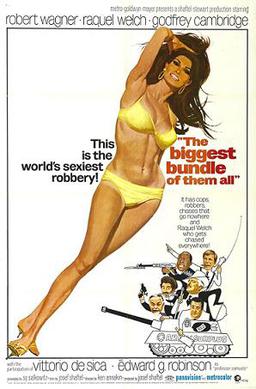
Harry Price (Robert Wagner) is a small-time tough guy with big plans. He and his gang of accomplices fly over to Italy and plot to kidnap Cesare Celli (Vittorio De Sica), a retired mafia don who is reputed to be worth millions. However, after snatching Celli from a wedding, Harry discovers that Celli is actually flat broke. Trying to be helpful, Celli suggests that Harry call up the local gangsters and demand that they pay a ransom for Celli’s release. When everyone refuses to pay, Celli comes up with another plan. Celli takes over Harry’s gang and, with the help of Celli’s old friend, Prof. Samuels (Edward G. Robinson), plots to steal $5,000,000 worth of platinum ingots from a train.
Complicating matters is that Harry and his gang are not exactly master criminals. Benny (Godfrey Cambridge) is a violinist who has moral objections to carrying a gun and who also refuses to cross a picket line, even in the course of a robbery. (“I’m a union man!”) Tozzi (Francesco Mule) is more interested in having a good dinner than pulling off the perfect heist. Davey (Davy Kaye) is short, which is apparently a problem for some reason. Finally, Harry’s girlfriend, Juliana (Raquel Welch), is more interested in dancing than in committing crimes. Still, Celli is determined to use them to pull off the heist of the century and, even more importantly, to help prove that this old criminal has still got what it takes.
The Biggest Bundle of Them All was an attempt at a wacky heist film. Unfortunately, at the time that the film was made, Robert Wagner and “wacky” didn’t belong anywhere near each other. Wagner stiffly delivers lines like, “I’ve had it, baby. Can you dig it?” and looks thoroughly out-of-place. Godfrey Cambridge and Edward G. Robinson have a few funny scenes but both Kaye and Mule are wasted in one-note role while De Sica looks like he’s trying to figure out how he went from Bicycle Thieves to this. Everyone in the movie just goes through the motions. Even while they’re robbing the train, the cast seems to be indifferent.
It almost doesn’t matter, though, because this is a Raquel Welch film. Welch doesn’t have much of a character to play but she looks amazing while doing it and that really is the appeal of any film that Welch made in the late 60s and early 70s. Welch spends a good deal of the film in a bikini and is undeniably sexy, particularly in the scene where Wagner sends her to seduce De Sica. She also gets to share a dance with Edward G. Robinson, which is such a goofy and fun scene that it’s almost worth the price of admission. (Regardless of what fun they may have been having on-screen, Robert Wagner later wrote in his autobiography that, off-screen, Robinson grew so annoyed with Welch’s chronic lateness on the set that he yelled at her until she was in tears.)
Even Raquel Welch in a bikini can only carry a film so far and The Biggest Bundle of Them All is ultimately too disjointed to work. Director Ken Annakin tries to recreate the same sort of frantic comedy that was at the heart of his previous film, Those Magnificent Men in Their Flying Machines, but the end result falls flatter than 5 million dollars worth of platinum ingots sliding out of an airplane.
The Longest Day is a pain-staking and meticulous recreation of invasion of Normandy, much of it filmed on location. It was reportedly something of a dream project for the head of the 20th Century Fox, Darryl F. Zanuck. Zanuck set out to make both the ultimate tribute to the Allied forces and the greatest war movie ever. Based on a best seller, The Longest Day has five credited screenwriters and three credited directors. (Ken Annakin was credited with “British and French exteriors,” Andrew Marton did “American exteriors,” and the German scenes were credited to Bernhard Wicki. Oddly, Gerd Oswald was not credited for his work on the parachuting scenes, even though those were some of the strongest scenes in the film.) Even though he was not credited as either a screenwriter or a director, it is generally agreed that the film ultimately reflected the vision of Darryl F. Zanuck. Zanuck not only rewrote the script but he also directed a few scenes as well. The film had a budget of 7.75 million dollars, which was a huge amount in 1962. (Until Steven Spielberg’s Schindler’s List, The Longest Day was the most expensive black-and-white film ever made.) Not only did the film tell an epic story, but it also had an epic length. Clocking in at 3 hours, The Longest Day was also one of the longest movies to ever be nominated for best picture.
The Longest Day also had an epic cast. Zanuck assembled an all-star cast for his recreation of D-Day. If you’re like me and you love watching old movies on TCM, you’ll see a lot of familiar faces go rushing by during the course of The Longest Day. American generals were played by actors like Robert Mitchum, Robert Ryan, Henry Fonda, and John Wayne. Peter Lawford, then the brother-in-law of the President of the United States, had a memorable role as the Scottish Lord Lovat, who marched through D-Day to the sounds of bagpipes. When the Allied troops storm the beach, everyone from Roddy McDowall to Sal Mineo to Robert Wagner to singer Paul Anka can be seen dodging bullets. Sean Connery pops up, speaking in his Scottish accent and providing comic relief. When a group of paratroopers parachute into an occupied village, comedian Red Buttons ends up hanging from the steeple of a church. When Richard Beymer (who is currently playing Ben Horne on Twin Peaks) gets separated from his squad, he stumbles across Richard Burton. Among those representing the French are Arletty and Christian Marquand. (Ironically, after World War II, Arletty was convicted of collaborating with the Germans and spent 18 months under house arrest. Her crime was having a romantic relationship with a German soldier. It is said that, in response to the charges, Arletty said, “My heart is French but my ass is international.”) Meanwhile, among the Germans, one can find three future Bond villains: Gert Frobe, Curt Jurgens, and Walter Gotell.
It’s a big film and, to be honest, it’s too big. It’s hard to keep track of everyone and, even though the battle scenes are probably about an intense as one could get away with in 1962 (though it’s nowhere near as effective as the famous opening of Saving Private Ryan, I still felt bad when Jeffrey Hunter and Eddie Albert were gunned down), their effectiveness is compromised by the film’s all-star approach. Often times, the action threatens to come to a halt so that everyone can get their close-up. Unfortunately, most of those famous faces don’t really get much of a chance to make an impression. Even as the battle rages, you keep getting distracted by questions like, “Was that guy famous or was he just an extra?”
Among the big stars, most of them play to their personas. John Wayne, for instance, may have been cast as General Benjamin Vandervoort but there’s never any doubt that he’s playing John Wayne. When he tells his troops to “send them to Hell,” it’s not Vandervoort giving orders. It’s John Wayne representing America. Henry Fonda may be identified as being General Theodore Roosevelt II but, ultimately, you react to him because he’s Henry Fonda, a symbol of middle-American decency. Neither Wayne nor Fonda gives a bad performance but you never forget that you’re watching Fonda and Wayne.
Throughout this huge film, there are bits and pieces that work so well that you wish the film had just concentrated on them as opposed to trying to tell every single story that occurred during D-Day. I liked Robert Mitchum as a tough but caring general who, in the midst of battle, gives a speech that inspires his troops to keep fighting. The scenes of Peter Lawford marching with a bagpiper at his side were nicely surreal. Finally, there’s Richard Beymer, wandering around the French countryside and going through the entire day without firing his gun once. Beymer gets the best line of the film when he says, “I wonder if we won.” It’s such a modest line but it’s probably the most powerful line in the film. I wish The Longest Day had more scenes like that.
The Longest Day was nominated for best picture of 1962 but it lost to an even longer film, Lawrence of Arabia.

 Through the Shattered Lens