Last Man Standing (1996, directed by Walter Hill)


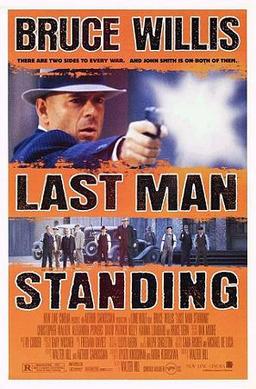
During the 1920s, at the height of prohibition, a mysterious man named John Smith (Bruce Willis) arrives in the dusty town of Jericho.  Jericho sits on the border, between Texas and Mexico, and it is the site of a gang war.  The Italian mob, led by Fred Strozzi (Ned Eisenberg) and Giorgio Carmote (Michael Imperioli), is trying to move in on the Irish mob, led by Doyle (David Patrick Kelly) and his fearsome gunman, Hickey (Christopher Walken).  After the members of the Irish mob destroy his car and leave him stranded in town, Smith offers his services as a gunman to the Italians.  Strozzi hires him but it turns out that Smith has his own agenda and soon, he is manipulating both gangs against each other.

Last Man Standing was Walter Hill’s remake of Yojimbo, with Bruce Willis playing an Americanized version of Toshiro Minfune’s wandering ronin.  (Hill does the right thing and gives Kurosawa credit for the film’s story.)  Now, it should be understood that this is in no way a realistic film.  It makes no sense for two Chicago-style gangs to be fighting over a ghost town in Texas.  Even when it came to smuggling in liquor during the prohibition era, most of it came over the Canadian border rather than the Texas border.  But Walter Hill has always been more about filming the legend than worrying about realism.  He’s the ultimate stylist, creating movies the come together to create an American mythology.  Last Man Standing is a work of pure style, a combination western/gangster movie that pays tribute to the ultimate samurai film.  Gangsters meeting in the desert while tumbleweed rolls past may not make sense but Hill knows a good visual when he sees one and he makes it work.  The plot is taken from Yojimbo.  The western setting is taken from A Fistful of Dollars.  And the gangsters are pure Americana.

Willis, back in his action star heyday, is quick with a gun and a quip and he gets a few scenes that show that, while he may be bad, he’s not as bad as the gangsters in charge of the town.  Hill surrounds Willis with a cast of great character actors, including Bruce Dern as the cowardly sheriff and William Sanderson as the owner of the hotel.  Though he might not be as well-known as some members of the cast, I especially liked Ken Jenkins as the Texas Ranger who informs Willis that he has ten days to finish up his business before the Rangers come to town and kill whoever is still standing.  And then you’ve got Walken, in one of his best villainous roles.  Hickey doesn’t show up until pretty late in the movie but we’ve spent so much time hearing about him that we already know he’s the most dangerous man in Texas and Walken gives a performance that lives up to the hype.

Unappreciated when it was first released, Last Man Standing has stood the test of time as one of Walter Hill’s best.

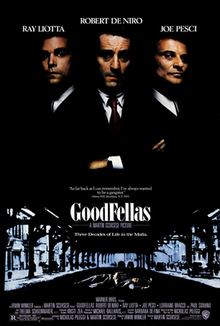
Lisa Marie Reviews An Oscar Nominee: Goodfellas (dir by Martin Scorsese)


First released in 1990 and continuously acclaimed ever since, Goodfellas did not win the Oscar for Best Picture.

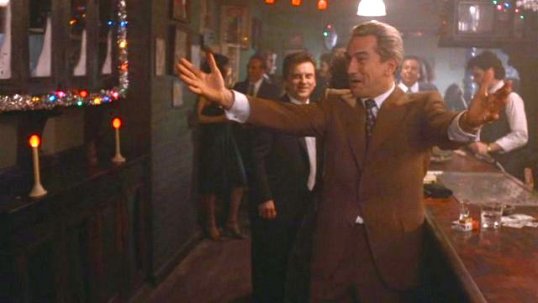
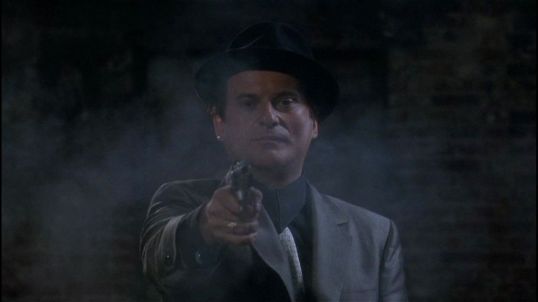
I’m always a bit surprised whenever I remember that.  Goodfellas didn’t win Best Picture?  That just doesn’t seem right.  It’s not the other films nominated that year were bad but Goodfellas was so brilliant that it’s hard to imagine someone actually voting for something else.  Seriously, it’s hard to think of a film that has been more influential than Goodfellas.  Every gangster film with a soundtrack of kitschy tunes from the 6os and 70s owes huge debt to Goodfellas.  Every actor who has ever been cast as a wild and out-of-control psycho gangster owes a debt to Joe Pesci’s performance as Tommy DeVito.  When Ray Liotta passed away two years ago, we all immediately heard him saying, “I always wanted to be a gangster.”  Robert De Niro’s Jimmy Conway remains the epitome of the ruthless gangster.  For many, Paul Sorvino’s neighborhood godfather redefined what it meant to be a crime boss.  Lorraine Bracco made such an impression as Karen Hill that it somehow seemed appropriate that she was one of the first people cast in The Sopranos, a show that itself would probably have not existed if not for Goodfellas.  Frank Sivero, Samuel L. Jackson, Tobin Bell, Debi Mazer, Vincent Gallo, Ileana Douglas, Frank Vincent, Tony Sirico, Michael Imperioli, Tony Darrow, Mike Starr, Chuck Low, all of them can be seen in Goodfellas.  It’s a film that many still consider to be the best of Martin Scorsese’s legendary career.  Who can forget Robert De Niro smoking that cigarette while Sunshine of Your Love blared on the soundtrack?  Who can forget “Maury’s wigs don’t come off!” or “Rossi, you are nothing but whore!?”  Who can forget the cheery Christmas music playing in the background while De Niro’s Jimmy Conway grows more and more paranoid after pulling off the biggest heist of his career?

Plus, it’s a Christmas movie!

And yet, it did not win Best Picture.

Myself, whenever I’m sitting behind a garbage truck in traffic, I immediately start to hear the piano coda from Layla.  For that matter, whenever I see a helicopter in the sky, I flash back to a coke-addled Henry Hill getting paranoid as he tries to pick up his brother from the hospital.  Whenever I see someone walking across the street in the suburbs, I remember the scene where Henry coolly pistol-whips the country club guy and then tells Karen to hide his gun.  I always remember Karen saying that she knows that many of her best friends would have run off as soon as their boyfriend gave them a gun to hide but “it turned me on.”  It would have turned me on as well.  Henry might be a gangster and his friends might be murderers but he doesn’t make any apologies for who he is, unlike everyone else in the world.

But it did not win Best Picture.

How many people have imitated Joe Pesci saying, “How am I funny?”  How many times did Pesci and Frank Vincent have to listen to people telling them to “go home and get your fucking shinebox?”  A lot of people remember the brutality of the scene where Pesci and De Niro team up to attack Vincent’s crude gangster but I always remember the sound of Donavon’s Atlantis playing on the soundtrack.

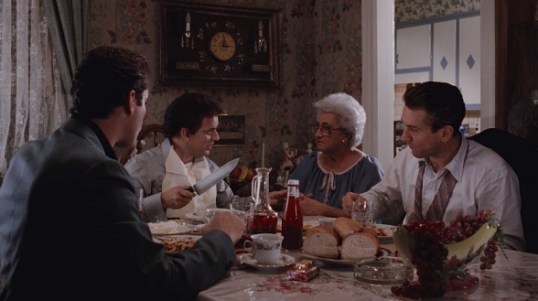
And then there’s Catherine Scorsese, showing up as Tommy’s mom and cooking for everyone while Vincent struggles to escape from the trunk of a car.  “He is content to be a jerk,” Tommy says about Henry Hill.  Just a few hours earlier, Tommy was apologizing to Henry for getting blood on his floor.

Goodfellas is a fast-paced look at organized crime, spanning from the 50s to the early 80s.  Ray Liotta plays Henry Hill, who goes from idolizing gangsters to being a gangster to ultimately fearing his associates after he gets busted for dealing drugs.  It’s a dizzying film, full of so many classic scenes and lines that it feels almost pointless to try to list them all here or to pretend like whoever is reading this review doesn’t remember the scene where the camera pans through the club and we meet the members of the crew.  (“And then there was Pete The Killer….”)  Goodfellas is a film that spend two hours showing us how much fun being a gangster can be and then thirty minutes showing us just how bad it can get when you’re high on coke, the police are after you, and you’ve recently learned that your associates are willing to kill even their oldest friends.  No matter how many times I watch Goodfellas, I always get very anxious towards the end of the film.  With the music pounding and the camera spinning, with Henry looking for helicopters, and with all of his plans going wrong over the course of one day, it’s almost a relief when Bo Dietl points that gun at Henry’s head and yells at him, revealing that Henry has been captured by the cops and not the Gambinos.  Karen desperately running through the house, flushing drugs and hiding a gun in her underwear, always leaves me unsettled.  It’s such a nice house but now, everything is crashing down.

There’s a tendency to compare Goodfellas to The Godfather, as their both films that re-imagine American history and culture through the lens of the gangster genre.  I think they’re both great but I also think that they are ultimately two very different films.  If The Godfather is sweeping and operatic, Goodfellas is the film that reminds us that gangsters also live in the suburbs and go to cookouts and that their wives take care of the kids and watch movies while the FBI searches their home.  If The Godfather is about the bosses, Goodfellas is about the blue collar soldiers.  The Godfather represents what we wish the Mafia was like while Goodfellas represents the reality.

Goodfellas is one of the greatest films ever made but it lost the Best Picture Oscar to Dances With Wolves, a film that left audiences feeling good as opposed to anxious.  To be honest, Martin Scorsese losing Best Director to Kevin Costner feels like an even bigger injustice than Goodfellas losing Best Picture.  One can understand the desire to reward Dances With Wolves, a film that attempts to correct a decades worth of negative stereotypes about Native Americans.  But Scorsese’s direction was so brilliant that it’s truly a shame that he didn’t win and that Lorraine Bracco didn’t win Best Supporting Actress.  It’s also a shame that Ray Liotta wasn’t nominated for playing Henry Hill.  At least Joe Pesci won an Oscar for redefining what it meant to be a gangster.

Goodfellas is proof that the best film doesn’t always win at the Oscars.  But it’s also proof that a great film doesn’t need an Oscar to be remembered.

October True Crime: Summer of Sam (dir by Spike Lee)


First released in 1999, Summer of Sam is Spike Lee’s sprawling, frustrating, flawed, occasionally compelling, and ultimately rather intriguing film about the summer of 1977 in New York City.

As one can guess from the title, it was a summer that was dominated by the reign of terror of the serial killer known as the Son of Sam.  While New York suffered one of the hottest summers on record, the Son of Sam shot couples while they sat in their cars.  Because all of his victims had been women with long, dark hair, women across the city wore blonde wigs.  While the police searched for the killer, the city was also caught up in the World Series.  Club 57 was the hottest club in New York but a growing number of rebels, inspired by the news that was coming out of the UK, eschewed the glitz of disco for the gritty and deliberately ugly aesthetic of punk and the Mud Club.

Though the film is centered around the murders of the Son of Sam, he remains a largely shadowy figure in the film.  Played by Michael Badalucco, David Berkowitz spends most of his time in his filthy home, yelling at the dog across the street and writing cryptic messages on the walls.  He only gets a few minutes of screen time because the film is ultimately less about the Son of Sam’s crimes and more about how one Italian-American neighborhood in New York deals with the atmosphere of fear and paranoia created by those crimes.  It’s a neighborhood that’s ruled over by the ruthless but benevolent Luigi (Ben Gazzara).  When the two detectives (Anthony LaPaglia and Roger Guevener Smith) come to the neighborhood in search of information, they know that Luigi is the man to see.

Vinny (John Leguizamo) is one of the neighborhood’s citizens, a hairdresser who hasn’t let his marriage to Dionna (Mira Sorvino) stand in the way of his compulsive womanizing.  Vinny is the type who cheats on his wife and then goes to Confession to get forgiveness.  He’s the type who gets angry whenever Dionna wants to have sex with the lights on or do anything other than a quick three minutes in the missionary position.  When he realizes that the Son of Sam was watching him while he was having sex in a car with Dionna’s cousin and that he could have been one of his victims, Vinny starts to spin out of control.  Vinny’s childhood friend is Ritchie (Adrien Brody), who shocks everyone when he spikes his hair, puts on a Union Jack t-shirt, and starts speaking with a fake British accent.  Ritchie and his girlfriend, Ruby (Jennifer Esposito), embrace the punk lifestyle and even put one the Son of Sam’s letters to music when they perform at the Mud Club.

It’s an ambitious film but it’s also an overlong film, one where the slow spots can truly test the viewer’s patience.  With a 142-minute running time, Summer of Sam finds the time to touch on almost every trope of the late 70s.  Vinny and Dionna hit the clubs, where the usually quiet Dionna truly comes to life as she dances.  (Vinny’s moves are far less impressive.  Tony Manero would have laughed at him.)  Ritchie not only embraces punk rock but he also makes his money by performing in live sex shows.  When a mysterious man offers to give Vinny and Dionna a ride in his limo, it’s hard not to smile when it’s revealed that he’s taking them to the infamous sex club, Plato’s Retreat.  One can respect Lee’s ambition while still finding the film itself to be a bit too self-indulgent for it’s own good.

Spike Lee, for all of his other talents, has never been a particularly subtle director.  Vinny and his friends spend a lot of time hanging out at the end of street, strategically placed in front of a sign that loudly proclaims, “DEAD END.”  At one point, Vinny is inspired to run to his window and start screaming insults at the Son of Sam and Leguizamo’s histrionic delivery of the lines make it impossible to take his anguish seriously.  At the same time, there are moments that work brilliantly.  I particularly liked the scenes that took place during the blackout of 1977.  Luigi automatically knows how to keep control in his neighborhood and he sends his men out with baseball bats, channeling their aggression into a search for the phantom serial killer.  For every scene that doesn’t work, there’s a scene like the Baba O’Riley montage or Vinny, Dionna, Ritchie, and Ruby having a candlelit dinner.

“We really dig your vibe.”

John Leguizamo is shrill and miscast as Vinny, though I’m not sure if anyone could have made much of such a one-dimensional characters.  I preferred the performances of Mira Sorvino, Adrien Brody, and Jennifer Esposito, who all brought their characters to authentic life.  (I especially liked how Brody switched from being tough to being a wounded child at the drop of a hat.)  As is so often the case with Lee’s films, it’s the supporting actors who make the strongest impression.  I loved Mike Starr’s earthy performance as Ritchie’s father and Ben Gazzara’s sly turn as the neighborhood mobster.  Bebe Neuwirth is underused but memorable as Vinny’s boss.

The film is overstuffed and overlong but it effectively portrays a community in the grips of paranoia and anger.  In the end, the film is epitomized by a scene in which the neighbor’s dog enter David Berkowtiz’s living room and starts yelling at him in the voice of John Turturro.  It’s a scene that’s so ludicrous that it somehow becomes effective.  It’s a scene that most directors would have left on the editing room floor but Spike Lee included it.  It takes courage to write, film, and keep a scene like that.  Summer of Sam is a wreck of a film but it’s also ultimately a compelling portrait of a community coming apart.  In the end, just as in real life, Berkowitz is brought to justice and a community is left wondering what to do now.

Summer of Sam features some of Spike Lee’s best work and also some of his worst.  The film opens with columnist Jimmy Breslin describing New York as being the city that he both loves and hates and that’s the way that I feel about this film.  For all of its flaws, there’s enough strengths to make up for them.  It’s a New York story and, appropriately, it’s just as messy as the city that it is about.

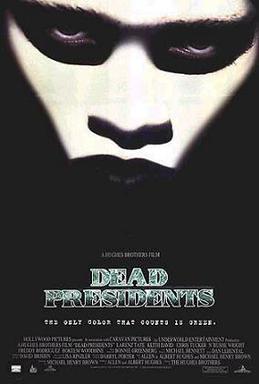
Dead Presidents (1995, directed by the Hughes Brothers)


In 1969, Anthony (Larenz Tate) graduates from high school in the Bronx and shocks his family by announcing that he will not be following in his brother’s footsteps by enrolling in city college but that he will instead be enlisting in the Marines and going off to fight in Vietnam.  While his friends taunt him for choosing to fight in a “white man’s war,” Anthony thinks that serving in the Marines will make him a man.  His two biggest heroes, his father and the local numbers boss, Kirby (Keith David), both served in Korea.  Kirby’s even lost his his leg in the war but he can still keep order in the neighborhood.

Vietnam doesn’t turn out to be what Anthony was expecting.  He serves two tours of duty and becomes an efficient killing machine but he is also forced to do things that will haunt him long after the war is over.  When Anthony finally returns to the Bronx in 1971, the old neighborhood has changed.  Crime, drugs, and poverty are destroying the community and Anthony struggles to support his girlfriend (Rose Jackson) and his daughter.

Finally, with no other opportunities available and feeling as if his country has abandoned him, Anthony agrees to take part in an armored car robbery.  Working with him are a few friends from the old days and a few members of the revolutionary Nat Turner Cadre.  Anthony thinks that he has the robbery planned out perfectly but nothing ever goes as planned.

In 1993, The Hughes Brothers made their directorial debut with Menace II Society, an incendiary film that holds up as one of the best feature debuts of any filmmaker.  Their follow-up to Menace II Society was Dead Presidents.  While Dead Presidents operates on a more epic scale than Menace II Society, it’s also a far more uneven film.  While the first part of the film (which follows Anthony and his friends during their final days of high school) is strong, things start to fall apart once the action moves to Vietnam.  The Hughes Brothers tried to recreate the Vietnam War on a Grenada Invasion budget and the action never feels credible.  When Anthony returns to the Bronx, Dead Presidents regains some of its footing but the eventual armored car heist is never as exciting as it could be.

Still, Dead Presidents has enough good moments that it’s always watchable.  Larenz Tate gives a good performance as Anthony and he’s surrounded by the some of the best black character actors of the 90s.  Keep an eye out for a young and incredibly obnoxious Terrence Howard, playing an aspiring gangster and getting a deserved beating at the hands of Anthony.  Though the movie often bites off more than it can chew, it does do a good job of seriously dealing with the issues that returning vets have to contend with when they come back home.  Anthony suffers from PTSD, which is something that a lot of people didn’t talk about in 1995, and the Hughes Brothers deserve much credit for their sensitive handling of the topic.  Dead Presidents may not be perfect but it’s impossible not to admire the film’s ambition.

Film Review: The Basketball Diaries (dir by Scott Kalvert)


When exactly did Leonardo DiCaprio become a good actor?

That may seem like a strange question because, today, Leonardo DiCaprio is often and rightfully described as being one of the greatest actors around.  He regularly works with the best directors in Hollywood, including Martin Scorsese.  His performances in The Aviator, The Wolf of Wall Street, and The Revenant should be viewed by any aspiring actor.

And yet, it’s easy to forget that Leonardo DiCaprio has been around forever.  Long before he was Martin Scorsese’s go-to actor, he was appearing in movies like Critters 3.  He started his career when he was 14 years old and spent a few years appearing in commercials and sitcoms before making his film debut in 1991.  (He was 17 when he made his first movie but, as anyone who has seen any of his early movies can attest, he looked much younger.)  When you watch those early DiCaprio films, you’re left with the impression of an actor who had some talent but who definitely needed a strong director to guide him.  Watching those early DiCaprio films, it’s always somewhat amazing to see both how good and how bad DiCaprio could be, often in the same movie.  If a scene called for DiCaprio to be quiet and introspective, he was a wonder to behold.  But whenever a scene called for big dramatic moment or gesture, DiCaprio would often become that shrill kid who made you cringe in your high school drama class.  I think that part of the problem is that the young DiCaprio was often cast as a passionate artist and, when you’re a certain age, you tend to assume that being a passionate artist means that you spend a lot of time yelling.

Take a film like 1995’s The Basketball Diaries, for instance.  In this film, Leonardo DiCaprio plays a real-life poet named Jim Carroll.  The film deals with Carroll’s teenage years, which were basically made up of going to Catholic school, writing poetry, playing basketball, committing petty crimes, and eventually getting hooked on heroin.  It’s pretty dramatic stuff and, with his face that’s somehow angelic and sardonic at the same time, the young DiCaprio certainly looks the part of a teenager who split his time between private school and the streets.  Though the young DiCaprio was way too scrawny to be believable as a star basketball player, he’s convincing in the scenes where he’s writing out his thoughts and his poems.

But then, Jim’s best friend (played by Michael Imperioli) dies of leukemia and a despondent Jim goes from pills and inhalants to heroin and both the film and DiCaprio’s performance quickly goes downhill.  Playing drug addiction (and, even worse, drug withdrawal) tends to bring out the worst instincts in even the best actors and that’s certainly the case with DiCaprio’s performance in The Basketball Diaries.  Suddenly, Leo is shaking and yelling in that shrill way that he used to do and, when he has gets emotional, he overplays the emotions to the extent that you can actually hear the snot being sorted back up his nostrils and you, as the viewer, start to get embarrassed for him.  As soon as Jim starts screaming at his mother (played by Lorraine Bracco), you really wish that the director or the writer or maybe the other actors had stepped in and said, “Leo …. dial it down a little.”  If you need proof that DiCaprio’s a far better actor today than he was in 1995, just compare Leo on drugs in The Basketball Diaries to Leo on drugs in The Wolf of Wall Street.

When The Basketball Diaries does work, it’s usually because of the actors around DiCaprio.  In one of his earliest roles, Mark Wahlberg has such an authentic presence that you kinda wish he and DiCaprio had switched roles.  (Yes, there was a time when Mark Wahlberg was a better actor than Leonardo DiCaprio.)  Bruno Kirby is chilling in a few cringey scenes as Jim’s basketball coach.  Ernie Hudson bring some welcome gravitas to the role of an ex-junkie who tries to help Jim straight out.  And then there’s poor Lorraine Bracco, bringing far more to the role of Jim’s underappreciated mother than was probably present in the script.

The Basketball Diaries is one of those films that seems profound when you’re like 15 and you come across it playing on TBS at like 2 in the morning.  Otherwise, it’s mostly interesting as evidence that, over the past 20 years, Leonardo DiCaprio has certainly grown as an actor.

Film Review: I Shot Andy Warhol (dir by Mary Harron)


When did Andy Warhol die?

The official date of death is February 22nd, 1987.  The 58 year-old artist died in his sleep of a cardiac arrhythmia.  He was at Manhattan’s New York Hospital, recovering from gallbladder surgery.  The surgery itself had been a minor procedure and, in the days before his death, Warhol was reported to be making a good recovery.  Warhol himself was scared of doctors and had continually put off having the procedure done.

Others, however, argue that Warhol might as well have died on June 3rd, 1968.  That was the day that the world-famous pop artist was shot, at point blank range, by a woman named Valerie Solanas.  Warhol barely survived the attack, spending five hours in surgery and carrying both the mental and physical scars with him for the rest of his life.  It’s debatable whether Warhol ever physically recovered from being shot.  It’s been theorized that the reoccurring gallbladder problems that led to Warhol entering the hospital were directly the result of being shot.  If that’s the case, then Solanas murdered Andy Warhol.

But even beyond the lingering physical injuries, the shooting left Warhol mentally shaken.  The artist who, in the 60s, was famous for hosting a never-ending party at The Factory became far more reclusive and paranoid.  No longer could anyone from anywhere show up in New York and, if they were interesting enough, become a member of Warhol’s entourage.   No longer would Warhol direct films that challenged the assumption of what film had to be.  Warhol spent most of the 70s doing portrait commissions and finding new ways to make money.  (As he wrote in 1975, “Making money is art, and working is art and good business is the best art.”)

It can be argued that, with the pull of a trigger, Valerie Solanas changed the course of history and yet, she has always remained an obscure figure.  (Many would argue that she deserves to remain an obscure figure.)  After the shooting, when Solanas turned herself in, she said that she had no choice but to shoot Andy because “he had too much control over my life.”  Others theorize that Solanas was upset because Andy hadn’t helped her get her book, The SCUM Manifesto, published.  Solanas was diagnosed with paranoid schizophrenia and, for nearly a killing an artist, she spent three years in prison.  While she was in prison, The SCUM Manifesto was finally published.  Ironically, she died in poverty and obscurity, just a few months after Warhol, as forgotten as Andy as was celebrated.

So, who was Valerie Solanas?  That’s the question that 1996’s I Shot Andy Warhol attempts to answer.  Lili Taylor portrays Valerie, giving a performance that is both frightening in its intensity and empathetic in its portrayal of Valerie’s desperation to be heard as a human being and respected as an artist.  Wherever Valerie goes, she’s an outsider.  As a lesbian, she’s been rejected by conventional society.  When she appears on a local talk show, the audience boos her and the host has her thrown off the set.  As a writer, she is rejected by publishers and readers who view her work as being, as one person puts it, “too sick even for us.”  When, like many aspiring artists and lost souls, she arrives at the Factory, the members of Warhol’s entourage reject her because she’s neither beautiful nor glamorous.  Valerie is stuck in a winless situation.  It’s her intensity that makes her a memorable writer but it’s the same intensity that guarantees that almost no one will be willing to read what she writes.

Valerie has written The SCUM Manifesto.  (SCUM stands for Society of Cutting Up Men.)  Throughout the film, we see black-and-white scenes of Valerie reading from the opening of her book:

“Life” in this “society” being, at best, an utter bore and no aspect of “society” being at all relevant to women, there remains to civic-minded, responsible, thrill-seeking females only to overthrow the government, eliminate the money system, institute complete automation and eliminate the male sex.”

Today, of course, Valerie could just start a tumblr or maybe get a job teaching at Evergreen State.  In the 1960s, though, Valerie believes that the only way she’ll ever be heard is by getting her work to Andy Warhol.  When she first meets Andy (Jared Harris), he seems to be receptive to her but we soon see that this film’s version of Andy is receptive to almost anyone.  I Shot Andy Warhol portrays Andy as being an emotionally detached voyeur, a master of passive aggressive behavior.  Instead of personally rejecting Valerie, he lets the more bitchy members of his entourage do it for him.  In fact, at times it seems as if the reason that Warhol surrounds himself with such angry people is so he’ll never have to get angry himself.  It’s actually a rather interesting interpretation of Warhol and the Factory, though it does rely a bit too much on the clichéd image of Andy Warhol as a passive voyeur.  Whenever Jared Harris is onscreen, you never forget that you’re watching someone imitate Andy Warhol as opposed to feeling like you’re watching Warhol yourself.

(When Andy Warhol died, he was worth 220 million dollars.  That alone should be enough to debunk the image of Andy Warhol being a passive voyeur of his own life.)

I Shot Andy Warhol is a frequently fascinating film, one that is sympathetic to both Solanas’s artistic ambitions and her desperate need to be acknowledged as a writer, while also not shying away from the fact that she was a very sick and dangerous person.  At the same time, the film does leave out one very important detail of Solanas’s later life.  After she was released from prison, she still continued to stalk Andy and other members of the New York art world.  That’s an important detail that should have, at the very least, been acknowledged.

Finally, after Andy Warhol’s death, Lou Reed wrote a song called “I believe.”  The song dealt with his feelings towards Valerie Solanas and it’s reasonable to assume that Reed spoke for many of Warhol’s associates.  Here are just a few of the lyrics: ” “I believe life’s serious enough for retribution… I believe being sick is no excuse. And I believe I would’ve pulled the switch on her myself.”

Trailer: Oldboy (Red Band)


OldboyRemake

Today saw the release of the red band trailer for the remake of Park Chan-wook’s classic neo-noir Oldboy. This remake by Spike Lee already looks to pay homage (or imitate) the look and feel of Park’s adaptation of the Japanese manga of the same name by Garon Tsuchiya and Nobuaki Mineshigi. We see quick glimpses of the hallway fight scene and a montage of the main character’s 20 years spent locked up in an unknown hotel room.

There’s a great chance for Spike Lee to make this remake his very own by using the Park film as a template but not as gospel. The Park adaptation itself took some liberties with the story told in the manga. Lee and the screenplay by Protosevich could do same to allow this Oldboy a chance to stand on its own instead of becoming another Gus Van Sant Psycho.

Though I wouldn’t mind to see what Lee has in mind as Josh Brolin’s character’s first choice of a meal once getting out.