If you haven’t, you’re probably just old or else you don’t keep up with what’s happening in the world of popular music. His real name is Conner Friel and he used to be a member of the Style Boyz. Of course, the Style Boyz eventually broke up. Kid Brain became a farmer. Kid Contact became a DJ. And Kid Conner — well, he became Conner4Real and he became a bigger star as a solo artist than he ever was as a Style Boy. His debut album, Thriller, Also, broke records.
But the follow-up, Connquest … well, Connquest wasn’t quite as acclaimed. In fact, it was hated by just about everyone. This is despite featuring classic songs like:
Finest Girl (Bin Laden Song)
Mona Lisa
and Equal Rights (featuring P!nk).
Fortunately, when Conner4Real was facing his greatest existential crisis, a film crew was present to record his struggle. For those of us who were fascinated by the career of Conner4Real, Popstar: Never Stop Never Stopping is a chance to see how Conner dealt with everything from his terminally ill pet turtle to the elaborate marriage proposal ceremony that led to Seal being attacked by wild wolves. We would have gotten to see Conner and his manager defeat a swarm of mutant bees but, unfortunately, that happened right after the only time that Conner’s manager asked the film crew to stop filming.
Oh well, these things happen.
So, as you should have guessed from all that, Popstar is not a serious film. It’s a mockumentary, with the emphasis on mock. It was also one of the funniest films of 2016, a spot-on parody of the silliness and pretensions of fame. Conner is a combination of Justin Bieber and Macklemore at their shallowest, a well-meaning but thoroughly empty-headed singer. In fact, if Conner was played by anyone other than Andy Samberg, he would be so annoying that the film would run the risk of being unwatchable.
But fortunately, Conner is played by Andy Samberg. It’s hard to think of anyone who plays dumb with quite the same panache as Andy Samberg does. There are plenty of lines in Popstar that shouldn’t work but they do, specifically because they’re being delivered by Samberg. He brings just the right amount of sweetly sincere stupidity to the role. Almost despite yourself, you find yourself hoping that things will work out for Conner and the other Style Boyz. Conner may not deserve to be as big a star as he is but it was obviously going to happen to some idiot so why not a sincere one?
Samberg is not the only funny person in Popstar. The movie is full of funny people, from Sarah Silverman to Bill Hader to the always underrated Tim Meadows. It’s also full of celebrity cameos and I have to admit that I usually tend to cringe when I see too many people playing themselves. But in Popstar, it works. One need only rewatch something like Zoolander 2to see how well Popstar pulls off its celebrity cameos.
Sadly, as funny as Popstar was, it was also one of the biggest bombs of 2016. (The trailer, it must be said, did not do the film justice.) However, I expect that it will soon develop a strong cult following. In a few years, we’ll get a sequel. It probably won’t be as as good.
Tonight’s excursion into televised horror is the 8th episode of the 5th season of HBO’s Tales From The Crypt!
In Well Cooked Hams, Billy Zane is a magician who murders an older magician (Martin Sheen) and steals that magician’s prized prop! Zane quickly learns that it’s called a Box of Death for a reason. Zane has a lot of fun being sleazy and Sheen’s over the top Russian accent simply has to be heard!
Thus episode originally aired on November 3rd, 1993!
I just finished watching the 1982 best picture winner Gandhi on TCM. This is going to be a tough movie to review.
Why?
Well, first off, there’s the subject matter. Gandhi is an epic biopic of Mohandas Gandhi (played, very well, by Ben Kingsley). It starts with Gandhi as a 23 year-old attorney in South Africa who, after getting tossed out of a first class train compartment because of the color of his skin, leads a non-violent protest for the rights of all Indians in South Africa. He gets arrested several times and, at one point, is threatened by Daniel Day-Lewis, making his screen debut as a young racist. However, eventually, Gandhi’s protest draws international attention and pressure. South Africa finally changes the law to give Indians a few rights.
Gandhi then returns to his native India, where he leads a similar campaign of non-violence in support of the fight for India’s independence from the British Empire. For every violent act on the part of the British, Gandhi responds with humility and nonviolence. After World War II, India gains its independence and Gandhi becomes the leader of the nation. When India threatens to collapse as a result of violence between Hindus and Muslims, Gandhi fasts and announces that he will allow himself to starve to death unless the violence ends. Gandhi brings peace to his country and is admired the world over. And then, like almost all great leaders, he’s assassinated.
Gandhi tells the story of a great leader but that doesn’t necessarily make it a great movie. In order to really examine Gandhi as a film, you have to be willing to accept that criticizing the movie is not the same as criticizing what (or who) the movie is about.
As I watched Gandhi, my main impression was that it was an extremely long movie. Reportedly, Gandhi was a passion project for director Richard Attenborough. An admirer of Gandhi’s and a lifelong equality activist, Attenborough spent over 20 years trying to raise the money to bring Gandhi’s life to the big screen. Once he finally did, it appears that Attenbrough didn’t want to leave out a single detail. Gandhi runs three and a half hours and, because certain scenes drag, it feels ever longer.
My other thought, as I watched Gandhi, was that it had to be one of the least cinematic films that I’ve ever seen. Bless Attenborough for the nobility of his intentions but there’s not a single interesting visual to be found in the entire film. I imagine that, even in 1982, Gandhi felt like a very old-fashioned movie. In the end, it feels more like something you would see on PBS than in a theater.
The film is full of familiar faces, which works in some cases and doesn’t in others. For instance, Gandhi’s British opponents are played by a virtual army of familiar character actors. Every few minutes, someone like John Gielgud, Edward Fox, Trevor Howard, John Mills, or Nigel Hawthorne will pop up and wonder why Gandhi always has to be so troublesome. The British character actors all do a pretty good job and contribute to the film without allowing their familiar faces to become a distraction.
But then, a few American actors show up. Martin Sheen plays a reporter who interview Gandhi. Candice Bergen shows up as a famous photographer. And, unlike their British equivalents, neither Sheen nor Bergen really seem to fit into the film. Both of them end up overacting. (Sheen, in particular, delivers every line as if he’s scared that we’re going to forget that we’re watching a movie about an important figure in history.) They both become distractions.
I guess the best thing that you can say about Gandhi, as a film, is that it features Ben Kingsley in the leading role. He gives a wonderfully subtle performance as Gandhi, making him human even when the film insists on portraying him as a saint. He won an Oscar for his performance in Gandhi and he deserved one.
As for Gandhi‘s award for best picture … well, let’s consider the films that it beat: E.T., Tootsie, The Verdict, and Missing. And then, consider some of the films from 1982 that weren’t even nominated: Blade Runner, Burden of Dreams, Class of 1984, Fast Times At Ridgemont High, My Favorite Year, Poltergeist, Tenebrae,Vice Squad, Fanny and Alexander…
When you look at the competition, it’s clear that the Academy’s main motive in honoring Gandhi the film was to honor Gandhi the man. In the end, Gandhi is a good example of a film that, good intentions aside, did not deserve its Oscar.
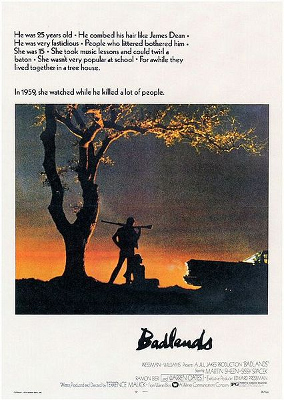
Terrence Malick is such an influential director that it is easy to forget that he has only directed nine films over the past 42 years. (One of those ten, Knight of Cups, will be released later this year. Two other are currently in postproduction.) He has received Oscar nominations for The Thin Red Line and The Tree of Life but, for me, Malick’s best work remains his directorial debut, Badlands.
Badlands is based on the real-life murder spree of Charles Starkweather and his girlfriend, Caril Ann Fugate. In 1958, 20 year-old Starkweather murdered 11 people in Nebraska and Wyoming. 14 year-old Fugate was with Starkweather at the time of the murders but has always claimed that she was Starkweather’s hostage. After the two of them were captured, Starkweather was sent to the electric chair while Fugate served 17 years of a life sentence.
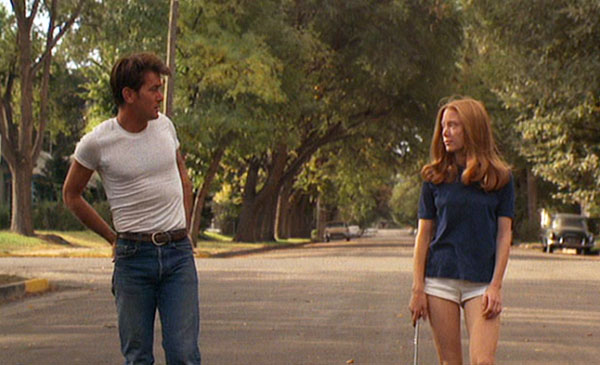
In Badlands, 25 year-old Kit (Martin Sheen) is a garbage man who has a huge chip on his shoulder. One day, Kit spots 15 year-old Holly (Sissy Spacek) outside, twirling a baton. Kit starts to talk to Holly, who thinks that he looks like her favorite actor, James Dean. Kit and Holly start dating. Holly’s father (Warren Oates), a sign painter who has never recovered emotionally from the death of his wife, tells Kit to stay away from his daughter. After Kit murders her father, Holly joins him in fleeing from the scene of the crime. With the police and bounty hunters chasing them, the two young lovers head across the midwest and leave a trail of bodies in their wake.
Badlands sticks pretty close to the facts of the real-life Starkweather/Fugate case but, at the same time, it is definitely the product of Terrence Malick’s artistic vision. It is interesting to see how, even in his first film, Malick was already exploring the themes and using the techniques that would later distinguish both The Thin Red Line and The Tree Of Life. Like those two films, Badlands is full of majestic scenery, contrasting the beauty of nature with the ugliness of humanity. Like all Malick films, Badlands also features a narrator. Holly tells us her story but, in contrast to the philosophical narrators from Malick’s later films, Holly speaks exclusively in romantic clichés and delivers her narration in a flat, unemotional style.
When we first see Holly, her white shorts, blue shirt, and red hair add up to an all-American tableau. When Holly falls in love with Kit because of his resemblance to James Dean and then either justifies or ignores every destructive thing that he does, she is predicting the rise of our current celebrity-dominated culture. Meanwhile, Kit is so determined to be James Dean that he even imitates Dean’s performance from Rebel Without A Cause while talking to the police.
Badlands is one of Malick’s most accessible films. Sissy Spacek is amazing as the childlike Holly and Martin Sheen has probably never been better than in his role here. And, of course, you have the great Warren Oates in the small but crucial role of Holly’s harsh father. Badlands is an American classic and still the best film of Terrence Malick’s legendary career.
A few years ago, I was on twitter when I came across someone who had just watched The Breakfast Club.
“Whatever happened to Emilio Estevez?” she asked.
Being the know-it-all, obsessive film fan that I am, I tweeted back, “He’s a director.”
Of course, I could not leave well enough along. I had to send another tweet, “He directed a movie called Bobby that got nominated for bunch of Golden Globes.”
“Was it any good?” she wrote back.
“Never seen it,” I wrote back, suddenly feeling very embarrassed because, if there’s anything I hate, it’s admitting that there’s a film that I haven’t seen.
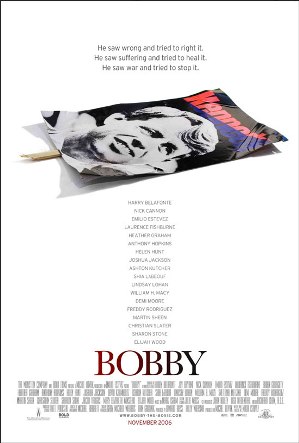
However, Shattered Politics gave me an excuse to finally sit down and watch Bobby. So now, I can now say that I have watched this 2006 film and … eh.
Listen, I have to admit that I really hate giving a film like Bobby a lukewarm review because it’s not like Bobby is a bad film. It really isn’t. As a director, Emilio Estevez is a bit heavy-handed but he’s not without talent. He’s good with actors. Bobby actually features good performances from both Lindsay Lohan and Shia LaBeouf! So, give Estevez that.
And Bobby is a film that Estevez spent seven years making. It’s a film that he largely made with his own money. Bobby is obviously a passion project for Estevez and that passion does come through. (That’s actually one of the reasons why the film often feels so heavy-handed.)
But, with all that in mind, Bobby never really develops a strong enough narrative to make Estevez’s passion dramatically compelling. The film takes place on the day of the 1968 Democratic California Presidential Primary. That’s the day that Robert F. Kennedy won the primary and was then shot by Sirhan Sirhan in the kitchen of the Ambassador Hotel. However, it never seems to know what it wants to say about Kennedy or his death, beyond the fact that Estevez seems to like him.
(Incidentally, it’s always interesting, to me, that Dallas is still expected to apologize every day for the death of JFK but Los Angeles has never had to apologize for the death of his brother.)
Estevez follows an ensemble of 22 characters as they go about their day at and around the Ambassador Hotel. As often happens with ensemble pieces, some of these characters are more interesting than others.
For instance, Anthony Hopkins plays a courtly and retired doorman who sits in the lobby and plays chess with his friend Nelson (Harry Belafonte). It adds little to the film’s story but both Hopkins and Belafonte appear to enjoy acting opposite each other and so, they’re fun to watch.
Lindsay Lohan plays a woman who marries a recently enlisted soldier (Elijah Wood), the hope being that his marital status will keep him out of Vietnam. The problem with this story is that it’s so compelling that it feels unfair that it has to share space with all the other stories.
Christian Slater plays Darrell, who runs the kitchen and who spends most of the movie talking down to the kitchen staff, the majority of whom are Hispanic. Darrell is disliked by the hotel’s manager (William H. Macy) who is cheating on his wife (Sharon Stone).
And then, you’ve got two campaign aides (Shia LaBeouf and Brian Geraghty) who end up dropping acid with a drug dealer played by Ashton Kutcher. Unfortunately, Estevez tries to visualize their trip and it brings the film’s action to a halt.
Estevez himself shows up, playing the husband of an alcoholic singer (Demi Moore). And Estevez’s father, Martin Sheen, gets to play a wealthy supporter of Kennedy’s. Sheen’s wife is played by Helen Hunt. She gets to ask her husband whether she reminds him more of Jackie or of Ethel.
(Actually, Martin Sheen and Helen Hunt are cute together. Much as with Lohan and Wood, you wish that more time had been devoted to them and their relationship.)
And there are other stories as well. In fact, there’s far too many stories going on in Bobby. It may seem strange for a girl who is trying to review 94 films in three weeks to say this but Emilio Estevez really tries to cram too much into Bobby.
At the same time, too much ambition is better none. Bobby may have been a misfire but at least it’s a respectable misfire.
Way back in October, around the same time that I first decided that I would do a series of reviews of political films and that I would call it Lisa Gets Preachy (subsequently changed to Shattered Politics), I noticed that the 1995 film The American President was scheduled to be shown on TVLand.
“Hey,” I said, “I’ve definitely got to watch and review that!”
So, I set the DVR and I recorded The American President.
And then, I just left it there.
You have to understand that it’s rare that I ever leave anything unwatched on my DVR. Usually, within an hour of recording a program, I’ll be watching it. I have even been known to go so far as to make out very long lists of everything that I have on the DVR, just so I can make check them off after I’ve watched. As a general rule, I am way too obsessive compulsive to just leave anything sitting around.
But, for whatever reason, I could never work up any enthusiasm for the prospect of actually watching The American President. I knew that, eventually, I would have to watch it so that I could review it. Unlike those folks criticizing American Sniper on the basis of the film’s trailer, I never criticize or praise a film unless I’ve actually watched it. But I just couldn’t get excited about The American President.
Can you guess why? I’ll give you a hint. It’s two words. The first starts with A. The second starts with S.
If you guessed Aaron Sorkin, then you are correct! Yes, I do know that Sorkin has a lot of admirers. And, even more importantly, I know that it’s dangerous to cross some of those admirers. (I can still remember Ryan Adams and Sasha Stone insanely blocking anyone who dared to criticize the underwritten female characters in Sorkin’s script for The Social Network.)
But what can I say? As a writer, Aaron Sorkin bothers me. And since Sorkin is such an overpraised and powerful voice, he’s that rare scriptwriter who can actually claim auteur status. The Social Network, for instance, was not a David Fincher film. It was an Aaron Sorkin film, through and through.
And, after having to deal with three seasons of the Newroom and countless Aaron Sorkin-penned op-eds about why nobody should be allowed to criticize Aaron Sorkin, I’ve reached the point where dealing with all of Aaron Sorkin’s signature quirks is a bit like listening to the drill while strapped into a dentist’s chair. I am weary of pompous and egotistical male heroes who answer every question with a sermon. I am tired to endless scenes of male bonding. I have had enough with the quippy, quickly-delivered dialogue, all recited as characters walk down an endless hallways. I have no more sympathy for Sorkin’s nostalgic idealism or his condescending, rich, white dude version of liberalism.
Most of all, I’m sick of people making excuses for an acclaimed, award-winning, highly-paid screenwriter who is apparently incapable of writing strong female characters. I’m tired of pretending that it doesn’t matter that Aaron Sorkin is apparently incapable of viewing female characters as being anything other than potential love interests or silly distractions who need to be told to go stand in a corner while the menfolk solve all the problems of the world.
Fortunately, as a result of The Newsroom, quite a few critics are finally starting to admit what they always knew to be the truth. Aaron Sorkin is not the messiah. Instead, he’s a somewhat talented writer who doesn’t understand (or, in my opinion, particularly like) women. At his best, he’s occasionally entertaining. At his worst, he’s pompous, didactic, and preachy.
And, of course, Aaron Sorkin is the man who wrote The American President.
So, The American President just sat there until a few days ago when I sighed to myself and said, “Okay, let’s watch this thing.” As I watched it, I promised myself that I would try to see past the fact that it was an Aaron Sorkin-penned film and just try to judge the film on its merits.
But here’s the thing. It’s nearly impossible to separate one’s opinion of Sorkin from The American President. If you didn’t know that Sorkin had written The American President, you’d guess it after hearing the first few lines of dialogue. The film, itself, was directed by Rob Reiner but it’s not as if Reiner is the most interesting of directors. (What’s odd is that Reiner’s first films — This Is Spinal Tap, The Princess Bride, Stand By Me — are all so quirky and interesting and are still so watchable decades after first being released that you have to wonder how Reiner eventually became the man who directed The Bucket List.) In short, The American President is totally an Aaron Sorkin film.
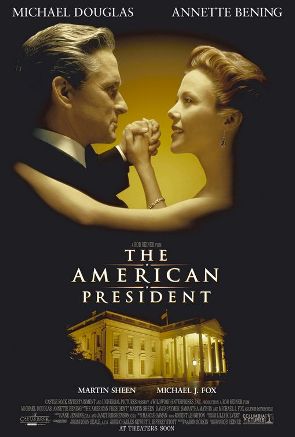
President Andrew Shepherd (Michael Douglas) is a liberal Democrat who, as he prepares to run for a second term, has a 63% approval rating. However, when Shepherd decides to push through a gun control bill, he finds that approval rating threatened. And then, when he listens to environmental lobbyist Sydney Wade (Annette Bening) and tries to push through legislation to reduce carbon emissions, his approval rating is again threatened. And then, to top it all off, he starts dating Sydney. It turns out that Sydney has protested American policy in the past. And, since this is an Aaron Sorkin film, everyone outside of the Northeast is scandalized that President Shepherd is having premarital sex in the White House.
And, to top it all off, there’s an evil Republican named Bob Rumson (Richard Dreyfuss) who wants to be President and is willing to use the President’s relationship with Sydney to further his own evil Republican ambitions.
But, ultimately, it’s not just those evil Republicans who make it difficult for Sydney and the President to have a relationship. It’s also the fact that the President agrees to a watered down crime bill and that he does not hold up his end of the bargain when it comes to reducing carbon emissions.
“You’ve lost my vote!” Sydney tells him.
But — fear not! There’s still time for President Shepherd to give a speech that will be so good and so brilliant that it will, within a matter of minutes, totally change every aspect of American culture and save the day. How do we know it’s a great speech? Because it was written by Aaron Sorkin!
Actually, I’m being too hard on the film and I’ll be the first admit that it’s because I’m personally not a huge fan of Aaron Sorkin’s. But, to be honest, The American President is Aaron Sorkin-lite. This film was written before the West Wing, before the Social Network, before that Studio Whatever show, and before The Newsroom. In short, it was written before he became THE Aaron Sorkin and, as such, it’s actually a lot less preachy than some of his other work. It’s true that, much like The Newsroom, The American President is definitely Sorkin’s fantasy of how things should work but at least you don’t have to deal with Jeff Daniels throwing stuff or Emily Mortimer not knowing how to properly forward an email.
Instead, it’s a film that will probably be enjoyed by those who share its politics. (And, make no mistake, The American President is more interested in politics than it is in the love story between Andrew and Sydney.) Michael Douglas does well in the role of the President. Meanwhile, Annette Bening is so likable and natural as Sydney that it almost make up for the fact that she’s yet another Sorkin woman whose existence is largely defined by looking up to her man while inspiring him to do the right thing and forgiving him when he doesn’t. Personally, I would have been happy if the film had ended with Sydney telling the President, “Thanks for finally doing the right thing but I have a life of my own to lead.”
So, it seems like every time that I write a review of any film based on a novel by Stephen King, I always have to start out by explaining that I think, while King’s success is undeniable, the fact that he’s overrated is also undeniable. It’s a comment that I always make and then I have to deal with people going, “But, Lisa, everyone loves Stephen King! He’s the most commercially successful author ever! He’s a modern-day Charles Dickens!”
Bleh.
Make no mistake, I think that Stephen King is a talented writer. However, I don’t think that he’s the greatest writer that has ever lived and that’s where I often come into conflict with King’s fans. (Stephen King fans tend to be like religious fanatics when it comes to defending their belief.) Having read both King’s earlier work and his more recent books, it’s hard for me not to feel that Stephen King has been growing steadily complacent. There’s a certain self-importance to his prose and his plotting that, for me, is the literary equivalent of nails on chalk board. If anyone is guilty of believing the most fawning praise of his biggest fans, it would appears to be Stephen King who, to judge from his twitter feed, appears to also believe that he’s our most important cultural critic as well.
(To be honest, I’d probably have more tolerance for King’s attempts at cultural and political criticism if he wasn’t so predictable about it all. Stephen King may write best sellers but that doesn’t mean he has anything interesting or unique to say about current events.)
Anyway, since I don’t feel like having to deal with all of that shit all over again, I’m not going to start this review by saying that I think Stephen King is overrated. In fact … whoops.
Okay, so much for that plan.
Even I have to admit that The Dead Zone is one of Stephen King’s better books. First off, it’s less than a 1,000 pages long. Secondly, the hero isn’t a writer who spends all of his time whining about the political preferences of his neighbors. Third, it deals with all of the “big” issues of faith, destiny, and morality but it does so in a far less heavy-handed manner than most of King’s books.
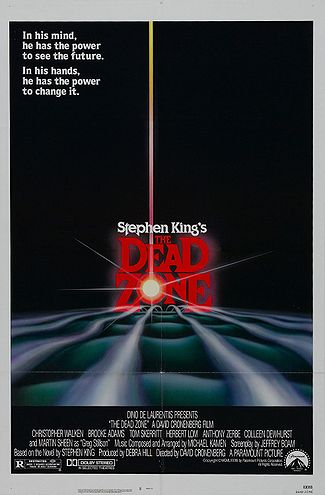
The Dead Zone is also the basis for one of the better films to be adapted from a Stephen King novel. Directed by David Cronenberg and starring Christopher Walken, the film’s plot closely follows the novel. Johnny Smith (Christopher Walken) is a high school teacher who, after a horrific car crash, spends five years in a coma. When he finally wakes up, he discovers that his girlfriend, Sarah (Brooke Adams), has married another man. His mother has become a religious fanatic. And, perhaps most importantly, whenever Johnny touches anyone, there’s a good chance that he’ll see either the person’s past or a possible future.
Needless to say, Johnny struggles with how to deal with his new powers. After he helps to catch a local serial killer, Johnny goes into seclusion. However, when he discovers that Sarah is now volunteering for ambitious politician Greg Stillson (Martin Sheen), Johnny goes to a Stillson rally, shakes the man’s hand, and has a vision. Johnny discovers that, if Stillson is elected to the senate, he’ll eventually become President and then he’ll destroy the world.
Much like The Shining, The Dead Zone benefits from being directed by a filmmaker who was both confident and strong enough to bring his own individual style to the material. (Usually, when a King adaptation fails, it’s because it followed the source material too closely, as if the film’s producers were scared of upsetting any of King’s constant readers.) Though the film’s plot may closely follow the novel, the movie itself is still definitely more of a product of David Cronenberg than Stephen King. Whereas King’s novel devoted a good deal of time to Johnny and Sarah’s relationship, it’s treated as almost an afterthought in Cronenberg’s film. Whereas King’s novel presented Johnny Smith as being an everyman sort of character, Cronenberg’s film gives us a Johnny who, from the start of the film, is a bit of an outsider even before he starts to see the future. Whereas King put the reader straight into Johnny’s head, Cronenberg approach is a bit more detached and clinical. Cronenberg’s Johnny is a bit more of an enigma than King’s version.
Fortunately, Cronenberg was fortunate enough to be able to cast Christopher Walken in the role of Johnny Smith. King’s preference for the role was Bill Murray. As odd as it may sound, you can actually imagine Bill Murray in the role when you read King’s book. But, for Cronenberg’s more detached vision, Walken was the perfect choice. People tend to spend so much time focusing on Christopher Walken’s quirky screen presence that there’s a tendency to forget that he’s actually a very talented actor as well. He’s very likable and sympathetic as Johnny and brings a humanity and a sense of humor to the role, which provides a good balance to Cronenberg’s sense of detachment.
The Dead Zone is a good book and it was later turned into an occasionally good (and, just as often, not-so-good) television series. However, the film is still the best.
The 1967 film The Incident could just as easily have been called Train of Fools. Much like Ship of Fools, it’s an ensemble piece in which a group of people — all of whom represent different aspect of modern society — find themselves trapped in their chosen mode of transportation and forced to deal with intrusions from the outside world.
That intrusion comes in the form of two sociopaths who have decided to spend the entire ride tormenting their fellow passengers. The more dominant of the two is Joe (played by Tony Musante, who would later star in Dario Argento’s Bird With The Crystal Plumage), who the film hints might also be a pedophile. His partner is Artie (Martin Sheen), who is less intelligent than Joe but just as viscous. (And yes,even though he does a good job in the role, it is odd to see an intelligent and reportedly very nice actor like Martin Sheen playing a character who is both so evil and so stupid.)
Among the passengers:
Bill (Ed McMahon) and Helen (Diana Van Der Vills) are only on the train because Bill refused to pay the extra money to take a taxi back home. Now, they’re stuck on the train with their young daughter who, in one of the film’s more disturbing scenes, Joe starts to show an interest in.
Teenage Alice (Donna Mills) is on a date with the far more sexually experienced Tony (Victor Arnold). When Joe and Artie start to harass her, her date proves himself to be pretty much useless.
Douglas McCann (Gary Merrill) is a recovering alcoholic who, before Artie and Joe got on the train, was spending most of his time scornfully watching Kenneth (Robert Otis), a gay man who previously attempted to pick Doug up at the train station and who will eventually fall victim to one of Artie’s crueler jokes.
Muriel Purvis (Jan Sterling) resents her meek husband, Harry (Mike Kellin) and see the entire incident as another excuse to cast doubts upon his manhood.
Sam and Bertha Beckerman (played by Jack Gilford and Thelma Ritter) are an elderly Jewish couple who, over the course of a lifetime, have already had to deal with far too many bullies. Sam’s attempt to stand up to Joe and Artie results in both he and his wife being trapped on the train.
Arnold (Brock Peters) and Joan (Ruby Dee) are the only black people on the train. Arnold, at first, enjoys watching the white people fight among each other and even turns down a chance to get off the train because he finds it to be so entertaining. But finally, Joe turns on him as well.
And then there’s the two soldiers, streetwise Phil (Robert Bannard) and his best friend, Felix (Beau Bridges). Felix speaks with a soft Southern accent and has a broken arm.
And finally, there’s the bum. When we first see the bum (Henry Proach) he is asleep. He doesn’t even wake up when Joe and Artie attempt to set him on fire.
One-by-one, Joe and Artie attack and humiliate every single person on the train. The other passengers, for the most part, remain passive. Even when some try to stand up to Joe and Artie, their fellow passengers don’t offer to help. It’s only when one last passenger finally stands up to the two that the rest of them show any reaction at all and even then, it’s not necessarily the reaction that anyone was hoping for.
The Incident, which shows up on TCM occasionally, is a heavy-handed but effective look at what happens when good people choose to do nothing in the face of evil. Joe and Artie can be viewed as stand-ins for any number of distasteful groups or ideologies and both Tony Musante and Martin Sheen are believable as dangerous (if occasionally moronic) petty criminals. For that matter, the entire film is well-acted with the entire cast managing to bring life to characters that, in lesser hands, could have come across as being one-dimensional. The entire film basically takes place in that one subway car but fortunately, the harsh black-and-white cinematography and the continually roaming camera all come together to keep things visually interesting.
The Incident may not be a great film (it’s occasionally bit too stagey and, after watching the first 30 minutes, you’ll be able to guess how the movie is going to end) but it’s still one to keep an eye out for.
It’s time for me to update my way too early Oscar predictions! Every month, based on a combination of buzz, reviews, gut feelings, and random guesses, I attempt to predict which films, directors, and performers will receive nominations in 2015! For the June edition, I look at how my predictions have been effected and changed by the results of the Cannes Film Festival.
Thanks to Cannes, I’m a bit more sure about some of my predictions (in particular, Foxcatcher, Mr. Turner, and Julianne Moore in Map To The Stars). But at the same time, the majority of these predictions remain the result of instinct and random guessing.
Click on the links to check out my predictions for March,April, and May!
And now, here are June’s predictions!
Best Picture
Birdman
Boyhood
Foxcatcher
The Imitation Game
Interstellar
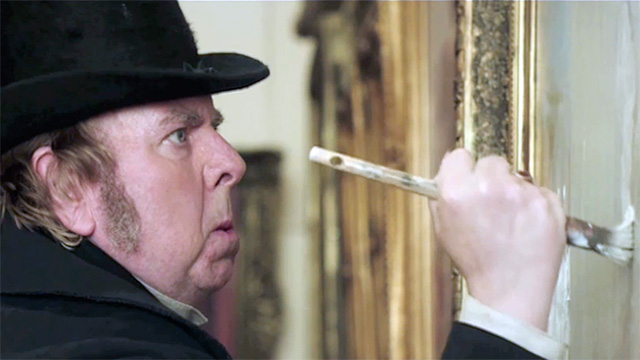
Mr. Turner
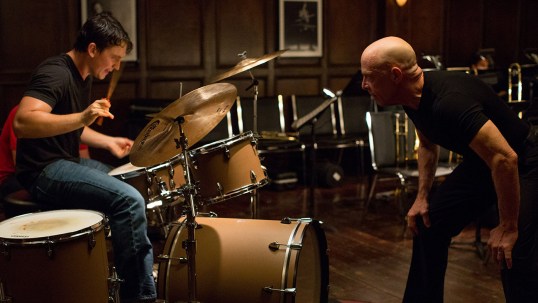
Whiplash
Wild
Based on its reception at Cannes, I’ve added Mr. Turner to the list of nominees. I’ve also dropped Unbroken from the list, largely because of how aggressively it is currently being hyped by people who have yet to see it. Traditionally, the more intensely an awards contender is hyped during the first half of the year, the more likely it is that the film itself is going to be end up being ignored once the actual nominations are announced. (This is known as the Law of The Butler.)
Best Director
Alejandro Gonzalez Inarritu for Birdman
Mike Leigh for Mr. Turner
Richard Linklater for Boyhood
Bennett Miller for Foxcatcher
Jean-Marc Vallee for Wild
I’ve dropped Angelina Jolie (Unbroken) and Morten Tyldum (The Imitation Game) and replaced them with Mike Leigh (Mr. Turner) and Bennett Miller (Foxcatcher). I’m far more confident that Cannes winner Miller will receive a nomination than Leigh.
Best Actor
Steve Carell in Foxcatcher
Benedict Cumberbatch in The Imitation Game
Ralph Fiennes in The Grand Budapest Hotel
Michael Keaton in Birdman
Timothy Spall in Mr. Turner
The big addition here is Timothy Spall, who I am predicting will be nominated for his Cannes-winning performance in Mr. Turner.
Best Actress
Amy Adams in Big Eyes
Jessica Chastain in The Disappearance of Eleanor Rigby
Rosamund Pike in Gone Girl
Reese Whitherspoon in Wild
Shailene Woodley in The Fault In Our Stars
Based on the charming but slight trailer for Magic In The Moonlight, I have removed Emma Stone from this list. I was tempted to replace her with Hillary Swank but even the positive reviews of The Homesman were curiously muted. So, I ended up going with Jessica Chastain’s performance in The Disappearance of Eleanor Rigby. I also replaced Michelle Williams with Shailene Woodley who, much like Jennifer Lawrence over the past two years, is currently starring in both a commercially successful franchise film and a critically and commercially acclaimed drama. That said, The Fault In Our Stars may have opened too early in the year to be a legitimate contender.
Best Supporting Actor
James Franco in True Story
Ethan Hawke in Boyhood
Mark Ruffalo in Foxcatcher
Martin Sheen in Trash
J.K. Simmons in Whiplash
I’ve moved Ralph Fiennes back up to Best Actor and I’ve replaced him with James Franco for True Story. That might be wishful thinking on my part because everyone knows that I have a huge crush on James Franco. However, the role — that of a real-life murderer who steals a reporter’s identity — sounds like both a chance of pace for Franco and the type of role that often leads to Oscar recognition. (Just ask Steve Carell…)
Speaking of Steve Carell, he’s not the only actor getting awards-buzz for his performance in Foxcatcher. Channing Tatum has been getting the best reviews of his career. If he’s promoted for a supporting nod, Tatum is probably guaranteed a nomination (and, in all probability, that would doom the chances of Mark Ruffalo). However, Tatum is apparently going to be promoted for best actor and his chances might be a bit more iffy in that race.
Best Supporting Actress
Patricia Arquette in Boyhood
Julianne Moore in Map To The Stars
Vanessa Redgrave in Foxcatcher
Kristen Scott Thomas in Suite francaise
Kristen Stewart in The Clouds of Sils Maria
Unlike a lot of film bloggers, I am not expecting Into the Woods to be a major Oscar contender. (See The Law of The Butler above.) While I was originally predicting that this film would manage to get Meryl Streep her annual nomination, I am now going to go out on a limb and predict that Meryl Streep will not be nominated for anything (other than maybe a Nobel Peace Prize) in 2015. I’m also dropping both Viola Davis and Marcia Gay Harden from my list of predicted nominees and I’m replacing them with three actresses who received a lot of acclaim at Cannes: Julianne Moore for Map To The Stars, Vanessa Redgrave for Foxcatcher, and Kristen Stewart for The Clouds of Sils Maria.
Yes, I know what you’re saying — “Kristen Stewart!?” Personally, if she’s as good as her reviews for The Clouds of Sils Maria seem to indicate, I think she will definitely be nominated. I think it will actually help her case that she’s not exactly an acclaimed actress. Look at it this way — people take it for granted that Meryl Streep is going to give a great performance, so much so that they’ll even make excuses for Meryl’s shrill turn in August: Osage County. When someone like Kristen Stewart shows that she’s capable of more than Twilight, people notice and remember. It’s those performances that inspire people to go, “Oh yeah, she actually can act!” that often lead to Oscar momentum.
And those are my predictions for June. Agree? Disagree? Let me know in the comments section below!
Of course, it’s way too early for me or anyone else to try to predict who and what will be nominated for an Academy Award in 2015. However, that’s not stopping me from trying to do so on a monthly basis!
I’ve dropped Get On Up from my list of best picture nominees, mostly because the film’s trailer is just too bland. As for some of the other films that some of my fellow bloggers are predicting will be contenders: The Grand Budapest Hotel may very well deserve a nomination but it may have come out too early in the year. Gone Girl may be too much of a genre piece while Inherent Vice may not be enough of one. Big Eyes would theoretically benefit from the fact that both Christoph Waltz and Amy Adams would appear to be perfectly cast but, after his last few live action films, I don’t have much faith in Tim Burton. As for Into The Woods, my instinct says that Rob Marshall’s latest musical film adaptation is going to have more in common with Nine than with Chicago.
Best Director
Alejandro Gonzalez Inarritu for Birdman
Angelina Jolie for Unbroken
Richard Linklater for Boyhood
Morten Tyldum for The Imitation Game
Jean-Marc Vallee for Wild
No changes here. I nearly dropped Angelina Jolie from the list, just because she’s being so aggressively hyped and early hype always seems to lead to later disappointment. If I had dropped her, I would have replaced her with Christopher Nolan for Interstellar.
Best Actor
Steve Carell in Foxcatcher
Benedict Cumberbatch in The Imitation Game
Michael Keaton in Birdman
Joaquin Phoenix in Inherent Vice
Christoph Waltz in Big Eyes
I dropped Chadwick Boseman from my list of predictions, again based on the blandness of the trailer for Get On Up. I also moved Ralph Fiennes down to best supporting actor. In their place: Joaquin Phoenix and Christoph Waltz.
Best Actress
Amy Adams in Big Eyes
Rosamund Pike in Gone Girl
Emma Stone in Magic in the Moonlight
Reese Whitherspoon in Wild
Michelle Williams in Suite francaise
I dropped Jessica Chastain from the list and replaced her with Michelle Williams. Why? There’s really no big reason, beyond the fact that I know more about the role Williams is playing in Suite francaise than I do about the role Chastain is playing in A Most Violent Year. If The Fault In Our Stars was being released in October (as opposed to next month), I would have probably found room for Shailene Woodley on this list.
Best Supporting Actor
Ralph Fiennes in The Grand Budapest Hotel
Ethan Hawke in Boyhood
Mark Ruffalo in Foxcatcher
Martin Sheen in Trash
J.K. Simmons in Whiplash
I dropped both Robert Duvall and Channing Tatum from this list, largely because I don’t know enough about Duvall’s character in The Judge and because I have a feeling that, when it comes to Foxcatcher, the Academy will either nominate Ruffalo or Tatum but not both of them. My first replacement is Martin Sheen for Trash, largely because Sheen has never been nominated for an Oscar and the role of an activist priest seems to be perfect for him. My second replacement is Ralph Fiennes for The Grand Budapest Hotel. Originally, I was predicting Fiennes would get a best actor nod but — as is explained in this article over at AwardsWatch — a pretty good case can be made for Fiennes getting a supporting nod instead.
Literally minutes before clicking publish on this post, I also decided to remove Christopher Walken and replace him with Ethan Hawke. With three nominations already — one for acting and two for writing — Hawke seems to be popular with Academy voters and he always seems to do his best work for Richard Linklater.
Best Supporting Actress
Patricia Arquette in Boyhood
Viola Davis in Get On Up
Marcia Gay Harden in Magic In The Moonlight
Kristen Scott Thomas in Suite francaise
Meryl Streep in Into The Woods
Two changes: I dropped Amy Ryan and replaced her with Kristen Scott Thomas. Again, it’s mostly just because I know more about the role Scott Thomas is playing than I do about Ryan’s role. I also, shortly before posting this, decided to remove Kiera Knightley and replace her with Patricia Arquette for Boyhood.
So, those are my predictions for this month! Agree? Disagree? Please feel free to let me know in the comments section below.





 Through the Shattered Lens