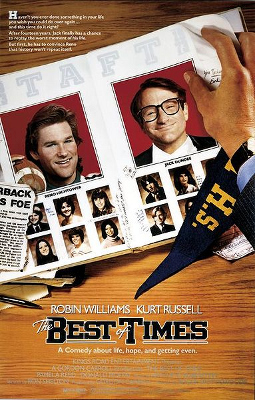
The Best Of Times (1986, directed by Roger Spottiswoode)


For years, banker Jack Dundee (Robin Williams) had been haunted by a pass that he dropped in high school.  The pass was perfectly thrown by quarterback Reno Hightower (Kurt Russell) but Jack couldn’t bring it in and, as a result, Taft High lost to its rival, Bakersfield.  Adding to Jack’s humiliation is that he now works for The Colonel (Donald Moffat), a confirmed Bakersfield fan who also happens to be Jack’s father-in-law.  When Jack visits a “massage therapist” (Margaret Whitton) and tells her about his problems, she suggests that he needs to replay the game.  Getting everyone interested in replaying the game is not easy.  No one wants to be humiliated a second time and Reno, who now fixes vans for a living, fears the he’s lost his edge.  Jack dresses up in the Bakersfield mascot’s uniform and vandalizes the town.  Finally, everyone is ready for the game.  Now, it’s a matter of town pride.

The Best of Times is a likable comedy about getting older and wishing you could have just one more chance to be young again and to have your entire future ahead of you.  Jack is haunted by that one dropped pass, feeling that it has cast a cloud over his entire life.  Reno is still a town hero but he’s struggling financially and in debt to Jack’s bank.  Replaying the game isn’t going to fix their lives but it is going to give them one last chance to relive their former glory and maybe an opportunity to learn that, even if they are getting older, they’re still living in the best of times.  The world that these two men live in is skillfully drawn and believable, with character actors like Moffat, M. Emmet Walsh, R.G. Armstrong, and Dub Taylor adding to the local color.  Jack and Reno’s wives are played by Holly Palance and Pamela Reed and they are also strong and well-developed characters.  Finally, Robin Williams and Kurt Russell are a strong comedic team.  Russell is perfectly cast as the aging jock and Williams gives one of his more restrained performances as Jack, allowing us to see the sadness behind Jack’s smile.

The stakes aren’t particularly high in The Best Of Times.  It’s just a football game between some middle-aged men looking to regain their youth.  But the story sticks with you.

Film Review: Left Behind: World At War (dir by Craig R. Baxley)


With the 2005 film, Left Behind: World At War, the Left Behind series enter special guest star territory.  Kirk Cameron and Brad Johnson, while still present in the film, were largely pushed to the background and Louis Gossett, Jr. and Charles Martin Smith popped up as Nicolae Carpathia’s two main adversaries.

Gossett plays President Gerald Fitzhugh.  Smith plays Vice President John Mallory.  (Speaking as someone of Irish descent, it fills me with pride to think that America will someday be led by the presidential ticket of Fitzhugh and Mallory.)  Despite the fact that Carpathia (again played by Gordon Currie) spent the previous film talking about how, under his leadership, there would be no more borders, it appears that there still are borders.  However, Carpathia has a plan to take care of that.  Mallory has discovered the plan but, right after he tells Fitzhugh about it, they’re attacked by Carpathia’s goons.  The presidential limo is blown up and with it, John Mallory.  (Poor Charles Martin Smith.)  Fitzhugh manages to escape, thanks to the help of the Tribulation Force.

It turns out that Carpathia’s latest scheme is to steal the few remaining bibles in the world, lace them with anthrax, and then distribute them back to the believers.  Gossett gets to go full action hero as he tries to stop Carpathia and good for him.  As for the other members of the Tribulation Force, Buck (Kirk Cameron) marries Chloe Steele (Janaya Stephens) and Chloe’s father, Rayford (Brad Johnson), meets his former lover, Hatti Dunham (Chelsea Noble).  Hattie is now Carpathia’s lover and is pregnant with his child.  Some members of the Tribulation Force die over the course of the film.  Buck has a moment of anger at God, which is the best scene in the film because it at least acknowledges that one can believe and still be angry.  The majority of the film, however, is Lou Gossett, Jr. wandering around with a “How did I go from winning an Oscar to appearing in this?” look on his face.

Anyway, credit where credit is due.  World at War is the most action-packed of the Left Behind films and, while it’s still definitely an evangelical film, it’s considerably less preachy than either the first Left Behind film or Tribulation Force.  World at War is pure melodrama, with a lot of plotting and evil cackling and overdone action scenes.  If you don’t want to listen to the dialogue, you can focus on just how small the film’s version of the Oval Office is.  That’s what happens when you try to a globe-spanning epic on a low budget.  Sometimes, you have to settle for a small replica of the Oval Office instead of trying for the real thing.

That’s not to say that World At War is a particularly good film.  Brad Johnson gets even less to do than in the second film and Kirk Cameron is still Kirk Cameron.  Since he lost his job at the end of Tribulation Force, we’re no longer asked to believe that Kirk Cameron’s playing a respected journalist.  Instead, Buck is now just a self-righteous evangelist and, for obvious reasons, it’s easy to believe Kirk Cameron in that role but Kirk Cameron is one of those actors who is far more likable when he’s miscast than when he’s playing himself.  Much as with Tribulation Force, World At War can’t seem to decide just how powerful Carpathia actually is.  He’s got supernatural powers and is apparently actually immortal and yet, he is often easily deceived by the simplest of ruses and is incapable of killing anyone until their usefulness to the film’s narrative has expired.

Louis Gossett, Jr. was smart enough to play a character who dies at the end of World At War, therefore freeing him from having to appear in any more Left Behind movies.  It turned out to be a moot point, however.  This was the last Left Behind film until the recent unsuccessful attempt to reboot the franchise with Nicolas Cage as Rayford Steele.

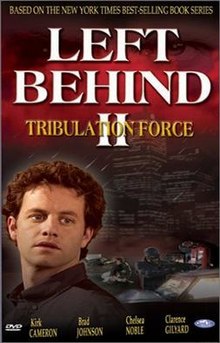
Film Review: Left Behind 2: Tribulation Force (dir by Bill Corcoran)


The 2002 film, Left Behind II: Tribulation Force, begins a week after the Rapture.  I have to admit that it took me by surprise when they mentioned that only a week had passed since the events that kicked off the first Left Behind film because the action in the original film seemed to go on for a lot longer than week.  I guess, if nothing else, that’s a lesson in the importance of keeping your film moving at a steady pace.

Speaking of pacing, Tribulation Force has a bit of quicker pace than the first film.  Now that everyone knows what happened, Rayford Steele (Brad Johnson) and Buck Williams (Kirk Cameron) can jump into action and start working to try to thwart the evil plans of Nicolae Carpathia (Gordon Currie).  Of course, at the start of the film, they’re told that it’s impossible to thwart the evil plans of Carpathia because the Bible has already predicted that he can’t be thwarted.  However, the Bible has also predicated that people will still try so I guess Rayford and Buck really don’t have that much of a choice.

Both Buck and Rayford get minor subplots that are designed to bring some humanity to all of the apocalyptic melodrama.  Rayford is still coming to terms with being left behind and struggling to forgive himself for not going to church with his wife and son.  To give some credit where credit is due, Brad Johnson is this film’s secret weapon.  He doesn’t really get to do much but Johnson brings just enough emotional reality to the role that his scenes have some depth that the rest of the film is missing.

As for Buck, he’s pursuing a tentative relationship with Rayford’s daughter, Chloe (Janaya Stephens).  Unfortunately, he’s also letting his assistant Ivy crash at his apartment and when Chloe stops by and discovers Ivy wearing a towel and an engagement ring, she assumes the worst.  Luckily, Buck’s able to say, “She’s my assistant” and that takes care of that.

Kirk Cameron is pretty much at the center of Tribulation Force, which is a problem because he’s totally miscast as a tough and respect journalist.  Carpathia, who really should have known better seeing as how he’s the son of Satan and everything, decides to turn Buck into the public face of his global news channel.  Unfortunately, there’s nothing about Kirk Cameron that suggests that any character he would play would ever have the gravitas or the charisma necessary to be the public face of any government.  As in the first film, Cameron comes across as being extremely earnest and a little bit dull.  He’s like the intern who accidentally screws up everyone’s lunch order.

Anyway, in Tribulation Force, everyone in the world loves Carpathia, even though he’s the most obviously evil dictator ever.  (The Rapture left behind not just the nonbelievers but also the extremely stupid.)  Carpathia announces the birth of a new world without borders and without religion.  Buck and Rayford plan to televise an interview with the Two Witnesses, who are waiting at the Wailing Wall.  But, to do that, they’re going to have to figure out a way to work around the fact that Carpathia controls all of the news channels….

Despite the fact that Tribulation Force is not as slow as the first film, the bulk of the film is still made up of people having long conversations about Biblical prophecy.  Like a lot of early faith-based films, Tribulation Force gets bogged down in explaining its message as opposed to showing the audience what that message means.  When Buck does finally reach the Wailing Wall, we do get to see some people get set on fire but, other than that, this is a very talky film.  As well, Tribulation Force can’t ever seem to decide just how powerful and all-knowing Carpathia is supposed to be.  At times, he has nearly supernatural powers and yet, at the same time, he’s totally incapable of seeing that Buck and Rayford are both plotting against him.  Is Carpathia a victim of his own hubris or is it just bad plotting on the part of the film?  I’ll leave it up to you decide.

Tribulation Force was followed by one more Left Behind film, World At War.  I’ll review that one in about 15 minutes!  Hope to see you then.


Film Review: Left Behind: The Movie (dir by Vic Sarin)


As I watched the 2000 film Left Behind: The Movie (not to be confused with the remake starring Nicolas Cage), I found myself thinking about names.

For instance, if your name is Rayford Steele, you really probably don’t have any choice but to become a pilot and maybe star in a low-budget action movie.  I mean, let’s just be honest.  People with names like Rayford Steele don’t end up working the night shift at 7-11.  In Left Behind, Rayford Steele is played by Bad Johnson and Johnson has just the right look to play a character named Rayford Steele.  He’s handsome in a somewhat old-fashioned, Gary Cooperish sort of way.

And yes, Rayford is a pilot.  He had a wife who resents the fact that Rayford is always flying off and abandoning his family.  She goes to church and she worries that he’s not a believer.  Rayford, meanwhile, is having an affair with flight attendant Hattie Dunham (Chelsea Noble).  That affair, however, may have to soon come to an end because Hattie has a new job with the UN.  Poor Hattie.  Nothing good ever comes from working at the UN!

Just as anyone named Rayford Steele would have to become a pilot, I imagine that anyone named Buck Williams would have to become a globe-trotting journalist.  We’re told that Buck is one of the most famous and successful journalists in the world.  Someone even mentions that Buck is so brave that he would have reported from Hiroshima while the first atomic bomb was being dropped.  (I assume that would have been a fairly short broadcast.)  Unfortunately, it’s a bit of a struggle to buy Buck Williams as a crusading journalist because he’s played by Kirk Cameron.  Buck is described as being tough and cynical.  There’s absolutely nothing tough about Kirk Cameron.  At his best, he projects an earnest blandness.  At his worst, he reminds you that he’s the guy who, years after starring in this film, would claim that a conspiracy of atheists was responsible for Saving Christmas receiving bad reviews.

Finally, if your name is Nicolae Carpathia, you’re pretty much destined to grow up to be very wealthy and also very evil.  You’re not going to end up living in the suburbs, mowing your own lawn and complaining about property taxes.  No, with a name like Nicolae Carpathia, you’re destined to end up using your position at the UN to take over the world.  When you declare that your goal is to lead the world into “seven years of peace,” everyone knows that you’re planning on doing the exact opposite.

Or, at the very least, everyone should know.  As played by Gordon Currie, Nicolae Carpathia is obviously evil from the minute he first appears.  (Even if you didn’t know his name, you would think he was evil just from the way he smirks.)  However, in the world of Left Behind, almost everyone loves Nicolae Carpathia.  When thousands of people mysteriously vanish, all at the same time, Carpathia is the person to whom humanity turns their tear-brimmed eyes.  The viewers know that it’s the Rapture and Rayford Steele and Buck Williams come to realize that it was the Rapture but Carpathia sees it as an opportunity to lead humanity into a …. dare I say it? …. new world order.

Left Behind is an odd film.  For the most part, it’s a fairly ludicrous film, a low-budget and excessively preachy attempt to create a religious epic on a Wal-Mart budget.  Kirk Cameron is miscast as a journalist and the film’s special effects are so obviously cheap that one can’t help but feel the filmmakers got a bit too ambitious for their own good.  (Just check out the scene at the start of the film when Buck Williams reports while “bombs” explode all around him.)  With a running time of one hour and 40 minutes, the film drags a bit and the characters are often frustratingly dense.  (Even non-evangelicals have, at the very least, heard that there’s a thing called the Rapture.)  And yet, occasionally, there will be moments when the film actually comes close to working.  Brad Johnson, for instance, gives about as good a performance as anyone could as Rayford Steele.  The scene where Carpathia manipulates a subordinate into committing suicide may not be terrible original but it’s still surprisingly effective.

Despite the fact that the film itself barely made a profit, Left Behind would go on to spawn two sequels.  We’ll look at the first, Tribulation Force, in 15 minutes.  Hope to see you then!

Under the Sea: Goliath Awaits (1981, directed by Kevin Connor)


1939.  War is breaking out across Europe.  The British luxury liner Goliath is torpedoed by a German U-boat.  Presumed to be lost with the ship are a swashbuckling film star, Ronald Bentley (John Carradine), and U.S. Senator Oliver Barthowlemew (John McIntire), who may have been carrying a forged letter from Hitler to Roosevelt when the boat went down.

1981.  Oceanographer Peter Cabot (Mark Harmon, with a mustache) comes across the sunken wreck of the Goliath.  When he dives to check out his discovery, he is shocked to hear big band music coming from inside the ship.  He also thinks that he can hear someone tapping out an S.O.S. signal.  When he looks into a porthole, he is stunned to discover a beautiful young woman (Emma Samms) staring back at him.

Under the command of Admiral Sloan (Eddie Albert), who wants to retrieve the forged letter before it does any damage to the NATO alliance, Cabot and Command Jeff Selkirk (Robert Forster) are assigned to head an expedition to explore Goliath.  What they discover is that, for 40 years, the passengers and crew have survived within an air bubble.  Under the leadership of Captain John McKenzie (Christopher Lee), they have created a new, apparently perfect society within the sunken ship.  Cabot discovers that the woman that he saw was McKenzie’s daughter, Lea.

McKenzie is friendly to Cabot and his crew, explaining to them the scientific developments that have allowed the passengers and crew to not only survive but thrive underwater.  The only problems are a group of outcasts — the Bow People — who refuse to follow McKenzie’s orders and Palmer’s Disease, an infection that only seems to infect people who are no longer strong enough to perform the daily tasks necessary to keep McKenzie’s utopia functioning.   Even when people on the boat die, they continue to play their part by being cremated in Goliath’s engine room and helping to power the ship.

Everything seems perfect until Cabot announces that he has come to rescue the survivors of the Goliath.  Even though Goliath is starting to decay and will soon no longer be safe, McKenzie is not ready to give up the perfect society that he’s created.  McKenzie sets out to prevent anyone from escaping the Goliath.

Goliath Awaits is a massive, 3-hour production that was made for television and originally aired over two nights.  (The entire 200-minute production has been uploaded to YouTube.  Avoid the heavily edited, 91-minute version that was released on VHS in the 90s.)  It’s surprisingly good for a made-for-TV movie.  Because a large portion of the film was shot on the RMS Queen Mary, a retired cruise ship that was moored in Long Beach, California, Goliath looks luxurious enough that you understand why some of the passengers might want to stay there instead of returning to the surface.  Beyond that, Goliath Awaits takes the time to fully explore the society that McKenzie has created and what it’s like to live on the ship.  McKenzie may not be as benevolent as he first appears to be but neither is he a one-dimensional villain.

Mark Harmon is a dull lead but Robert Forster is just as cool as always and Christopher Lee is perfect for the role of misguided Capt. McKenzie.  The movie is really stolen by Frank Gorshin, who is coldly sinister as Dan Wesker, the Goliath’s head of security.  McKenzie may by Goliath’s leader but Wesker is the one who does the dirty work necessary to keep the society running.

Goliath Awaits also features several character actors in small roles, with John Carradine, Duncan Regehr, Jean Marsh, John McIntire, Jeanette Nolan, Alex Cord, Emma Samms, and John Ratzenberger all getting to make a good impression.  (Ignore, if you can, a very young Kirk Cameron as one of the children born on the Goliath.)

Goliath Awaits is far better than your average made-for-TV movie from the 80s.  With any luck, it will someday get the home video release that it deserves.