International Horror Film Review: The Lift (dir by Dick Maas)


I almost always take the stairs.

There are reasons for this.  A big one is for the exercise.  I’ve always liked my legs.  Why wouldn’t I want to take care of them?  (As my mom used to say whenever I complained about inheriting her nose, “Yes, but you also inherited my legs so stop crying!”)

As a lover of films, I appreciate the fact that stairwells are very cinematic.  When I’m taking the stairs, I’m thinking about Vertigo.  Sometimes, if I’m in the right mood, I’m thinking about Barefoot In The Park.  I’m thinking about Breakfast at Tiffany’s.  I’m thinking about all of the Bond movies that have featured twisty staircases.  I’m thinking about all of the romantic comedies that have featured people kissing in the middle of stairwells.  I thinking about climbing a fire escape in the rain.  I’m thinking about all of the famous shots of people moving up and down staircases.

Another reason why I avoid elevators is that I like the symbolism of going up the stairs.  I like the idea of ascending, step-by-step.

Of course, the main reason for taking the stairs is that I find elevators to be incredibly creepy.  When I was seven or eight, I heard a story on the news about a woman who got her necklace caught in the doors of an elevator and, as a result, she was decapitated when the elevator started to move.  AGCK!  I’ve never quite gotten that image out of my head.

The minute those elevator doors close, you’re pretty much trapped until the elevator reaches the next floor.  And even then, there’s no guarantee that the doors are actually going to open.  There’s always the possibility that the elevator could get stuck between floors and you could be trapped in that little room for hours or even days.  Even worse, someone else could be stuck in there with you and that person could be a stranger.  That person could be carrying a straight razor or they could just have bad breath but either way, I wouldn’t necessarily want to be trapped in an elevator with them.  And don’t even get me started on the possibility of an elevator cable snapping and the elevator plunging down 30 flights at breakneck speed.

Seriously, elevators are scary!

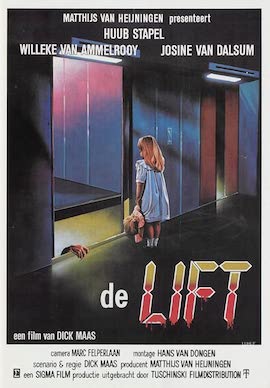
The 1983 Dutch film, The Lift, is all about one very scary elevator.  For, instance, the elevator stops moving after a lightning storm takes out all the power in Amsterdam and four people end up trapped inside of it.  When the power is finally restored, the elevator doors still refuse to open.  Eventually, the doors have to be forced open.  Fortunately, the four trapped people are saved before they suffocate but a few others aren’t so lucky.  One elderly man falls down an empty elevator shaft.  A security guard is decapitated when his head gets stuck in the elevator doors.  A janitor vanishes.

Felix (Huub Stabler) is assigned to figure out why the elevator is malfunctioning.  What he discovers suggests that the elevator has a mind of its own.  Of  course, no one believes that and Felix becomes obsessed with proving his theory.  He becomes so obsessed with the building and the elevator that his wife leaves him.  Felix’s only ally is a reporter named Mieke (Willeke van Ammelrooy),  Mieke is investigating Rising Sun, a computer company who was responsible for designing the system that runs the elevator.  Are the deaths the result of a corporate incompetence or is Felix correct?  Is the elevator alive?

The Lift works precisely because it understands that elevators are creepy.  More than being about a haunted elevator, The Lift is actually about the absurd amount of trust that people put into technology.  (This is a theme that’s even more relevant today than it probably was in 1983.)  People get on the elevator because they’ve been told that it’s safe and that there are safeguards in place to prevent any problems.  Even when the elevator starts to malfunction and otherwise behave in a threatening manner, people still assume that it’s a problem that can be easily fixed because they’ve been told that it was designed with the most advanced technology available.  More than just being a horror film about a haunted elevator, The Lift is a film about society that has put such blind trust in technology that it doesn’t know how to handle things when the system develops of mind of its own.  People may have been conditioned to trust the system but, when the elevator comes to life, everyone’s going down.

8 Shots From 8 Horror Films: 1980


4 Or More Shots From 4 Or More Films is just what it says it is, 4 shots from 4 of our favorite films. As opposed to the reviews and recaps that we usually post, 4 Shots From 4 Films lets the visuals do the talking!

This October, I’m going to be doing something a little bit different with my contribution to 4 (or more) Shots From 4 (or more) Films.  I’m going to be taking a little chronological tour of the history of horror cinema, moving from decade to decade.

Today, we take a look at a very important year: 1980

8 Shots From 8 Horror Films: 1980

Inferno (1980, dir by Dario Argento, DP: Romana Albano)

Without Warning (1980, dir by Greydon Clark, DP: Dean Cundey)

Friday the 13th (1980, dir by Sean S. Cunningham, DP: Barry Abrams)

Maniac (1980, dir. William Lusting, DP: Robert Lindsay)

City of the Living Dead (1980, dir by Lucio Fulci, DP: Sergio Salvati)

Dressed To Kill (1980, dir by Brian De Palma, DP: Ralf D. Bode)

Night of the Hunted (1980, dir by Jean Rollin)

The Shining (1980, directed by Stanley Kubrick, DP: John Alcott)

Horror Film Review: Dead & Buried (by Gary Sherman)


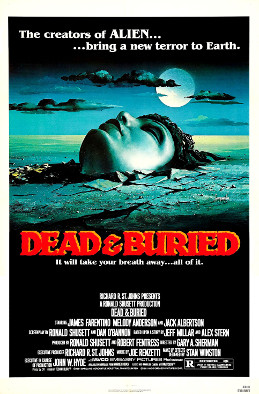
The 1981 horror film, Dead & Buried, takes place in the small town of Potters Bluff.  It seems like it should be a nice place to live.  The people are friendly.  The scenery is lovely.  The town is right on the coast of the ocean so the view is great.  It’s a bit of an artist’s colony, the type of place where you would expect to find Elizabeth Taylor painting the sunset while Richard Burton battles a hangover in the beach house.  It’s the type of small town that used to by very popular on television.  It’s just one Gilmore girl away from being an old CW show.

It’s such a nice town.  So, why are so many people dying?

That’s the mystery that Sheriff Dan Gillis (James Farentino) has to solve.  Actually, it’s one of the many mysteries that Dan has to solve.  There’s also the mystery of why his wife, Janet (Melody Anderson), has been acting so strangely.  And then there’s the mystery of what happened to the person who, one night, Dan ran into with his car.  The person ran away but he left behind his arm.  When Dan gets some skin from the arm analyzed, he’s told that the arm belongs to someone who has been dead for at least four months!

Who can explain all of this?  How about William G. Dobbs (Jack Albertson), the folksy coroner who seems to enjoy his work just a little bit too much.  In fact, Dr. Dobbs seems to be a bit more than just a tad eccentric.  One would necessarily expect a coroner to have a somewhat macabre view of life but Dr. Dobbs seems to take things to extreme.  Is it possible that Dr. Dobbs knows more than he’s letting on?

Dead & Buried has a reputation for being something of a sleeper, a deliberately-paced and often darky humorous horror film that had the misfortune to be released at a time when most horror audiences were more interested in watching a masked man with a machete kill half-naked teenagers.  Because the studio wasn’t sure how exactly to market Dead & Buried, it failed at the box office and it was only years later, after it was released on home video, that people watched the film and realized that it was actually pretty good.  And make no mistake about it, Dead & Buried is a fairly clever horror film, one that is full of effective moments and which does a good job of creating a creepy atmosphere.  If I’m not quite as enthused about this film as others, that’s because I do think that it’s occasionally a bit too slow and the film’s twist ending, while well-executed, didn’t particularly take me by surprise.  This is one of those films that you enjoy despite the fact that you can see the surprise conclusion coming from a mile away.

In the end, Dead & Buried fills like a particularly twisted, extra-long episode of one of those old horror anthology shows, like Night Gallery, Twilight Zone, or maybe even Ghost Story.  It’s a nicely done slice of small town horror, featuring a study lead performance from James Farentino and an enjoyably weird one from Jack Albertson.  Though the film is not heavy on gore, Stan Winston’s special effects are appropriate macabre.  Even if it’s not quite up there with Gary Sherman’s other films (like Vice Squad and Death Line, to name two), Dead & Buried is an entertainingly eccentric offering for Halloween.

Horror on the Lens: The Creeping Terror (dir by Vic Savage)


Watching The Creeping Terror is an October tradition here at the Shattered Lens.  How could anyone resist a film about a killer carpet, especially one that features a random dance party?  This film was directed by an enigmatic figure named Vic Savage.  No one is really sure who he actually was.  No one is sure what happened to him after The Creeping Terror was finally released.  But what we do know is that he made a film unlike any other.

Read my review here.

Read Patrick’s review here.

And enjoy the film!

Horror On TV: Ghost Story 1.13 “Time of Terror” (dir by Robert Day)


Tonight’s episode of Ghost Story stars Patricia Neal as a woman who wakes up one morning in a hotel and discovers that her husband is missing.  She’s told that her husband checked out without her but no one will give her a straight answer as to where he went.

This episode was written by Jimmy Sangster, who also wrote several Hammer films.  It originally aired on December 22nd, 1972.

The TSL’s Horror Grindhouse: Attack of the Giant Leeches (dir by Bernard Kowalski)


It’s time for nonstop drama in the bayous!

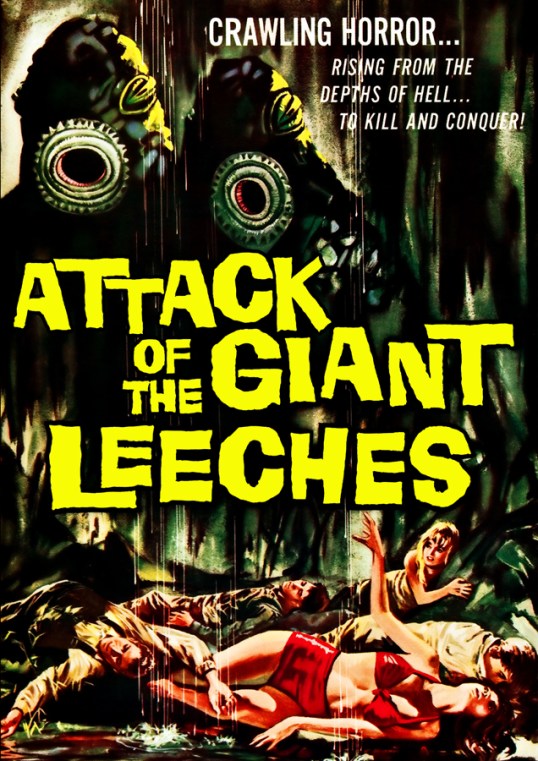
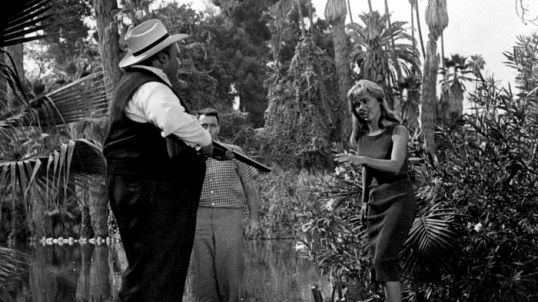
Shopkeeper Dave Walker (Bruno VeSota) knows that his wife, Liz (Yvette Vickers), is cheating on him with his best friend, Cal (Michael Emmett)! Dave is determined to catch them in the act and force them to walk out into the middle of the swamp at the end of his shotgun. That would be bad enough but what makes the swamp even more dangerous is the fact that there are two giant leeches living in the water, grabbing whoever they can get and dragging them back to their underground cave! Agck! While Dave plots to get revenge on his cheating wife, game warden Steve Benton (Ken Clark) tries to convince everyone that something really needs to be done about those giant leeches.

Filmed and released in 1959 and produced by Roger Corman, Attack of the Giant Leeches is not a particularly complicated film. The leeches live in the swamp. For various reasons, people keep wandering into the swamp. The leeches keep feeding until eventually, the authorities decide to do something about it. The simplicity of it all is why the film works. Why are there giant leeches in the swamp? How did the leeches become giants in the first place? Who cares? What’s important is that they’re there and they’re hungry for blood. At this point, why doesn’t matter. What matter is what is going to be done about them.

Clocking in at barely an hour and filmed by TV director Bernard L. Kowalski, Attack of the Giant Leeches is an enjoyably overhearted slice of Southern melodrama, full of humid atmosphere and sultry dialogue.  The film does a wonderful job of capturing the overheated feeling of being stuck in the country and not having anything better to do than cause some trouble.  I mean, it’s very easy for people to say what other should or shouldn’t do in their spare time.  But, when you’re actually living in a swamp, you do what you have to do in order to pass the time.  At its best, Attack of the Giant Leeches is like Roger Corman meets Tennessee Williams.  It’s Southern Gothic, with even bigger leeches than usual.  Flannery O’Connor would have been proud.

Yvette Vickers plays the role of Liz with a wonderfully defiant attitude. She’s going to do what she wants when she wants to and if that means running the risk of being forced to walk into the swamp, so be it. If she’s stuck in the bayous, she might as well have a good time.  Liz may be frustrated but can you blame her? Meanwhile, VeSota turns Dave into a rather tragic buffoon. Even when he finally thinks that he’s about get his revenge, it turns out that the universe has other plans in store for him.  In the end, Dave is fortune’s fool.  No wonder stiff but earnest Ken Clark really can’t compete with either of them when it comes to capturing the audience’s attention.

Attack of the Giant Leeches is short but enjoyable and, because the copyright wasn’t renewed, it’s in the public domain and it’s very easy to watch for free. Watch it this Halloween and definitely stay out of the swamp!

Game Review: A House On A Hill (2022, Devin Cummings)


There’s a house on a hill that everyone says in haunted.  Your friends Ingram and Ryan have dared you to enter the house, even though you might get sick from something you find in there or you might even die.  You can try to convince one of them to enter the house with you.  You can enter the house alone.  Or you can go home.

If there’s one thing that every good Interactive Fiction writer understands, it’s that you can get a player to do anything if you suggest that doing otherwise would make them a coward.  Saying “Go Home Coward” is the equivalent of making chicken noises.

Once you enter the house, you can search the rooms and you get a chance to make a few simple decisions about whether or not to do certain things.  Throughout it all, you are given the option to turn around leave.  You’ll get called a coward but considering what does happen if you stay, sometimes it is worth being called a coward.

This is a simple Twine game and it shouldn’t take anyone longer than 10 minutes to play it.  But there are enough different areas of the house to explore and enough possible outcomes that the game itself can be replayed several times.

Play A House On A Hill.

Horror Scenes That I Love: The Hospital Battle from Zombi 2


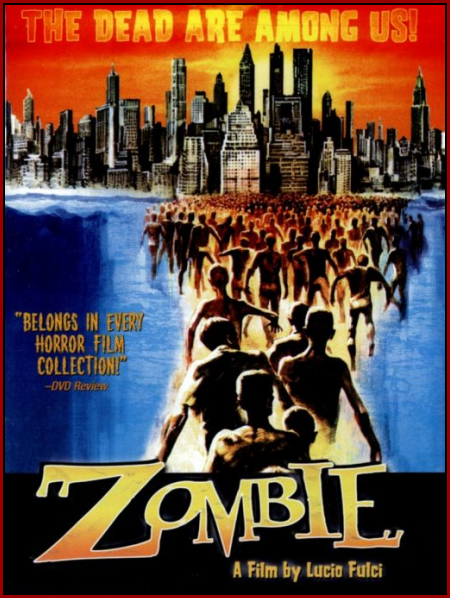
In this scene from 1979’s Zombi 2, a group of humans try to destroy the zombies that are invading a small hospital on an isolated island.  Director Lucio Fulci later pointed out, in many interviews, that he used the same clips of Al Cliver throwing a Molotov cocktail and firing a shotgun multiple times in the scene.

Two things to note about this scene:

First off, it captures what is truly scary about zombies.  They are relentless.  They do not stop coming.  No matter how many you destroy, there’s always another one following behind it.

Secondly, Italian zombies actually looked like decaying walking corpses that are on the verge of falling apart.  That was one huge difference between the Italian zombie films and many of the ones that were made in America.