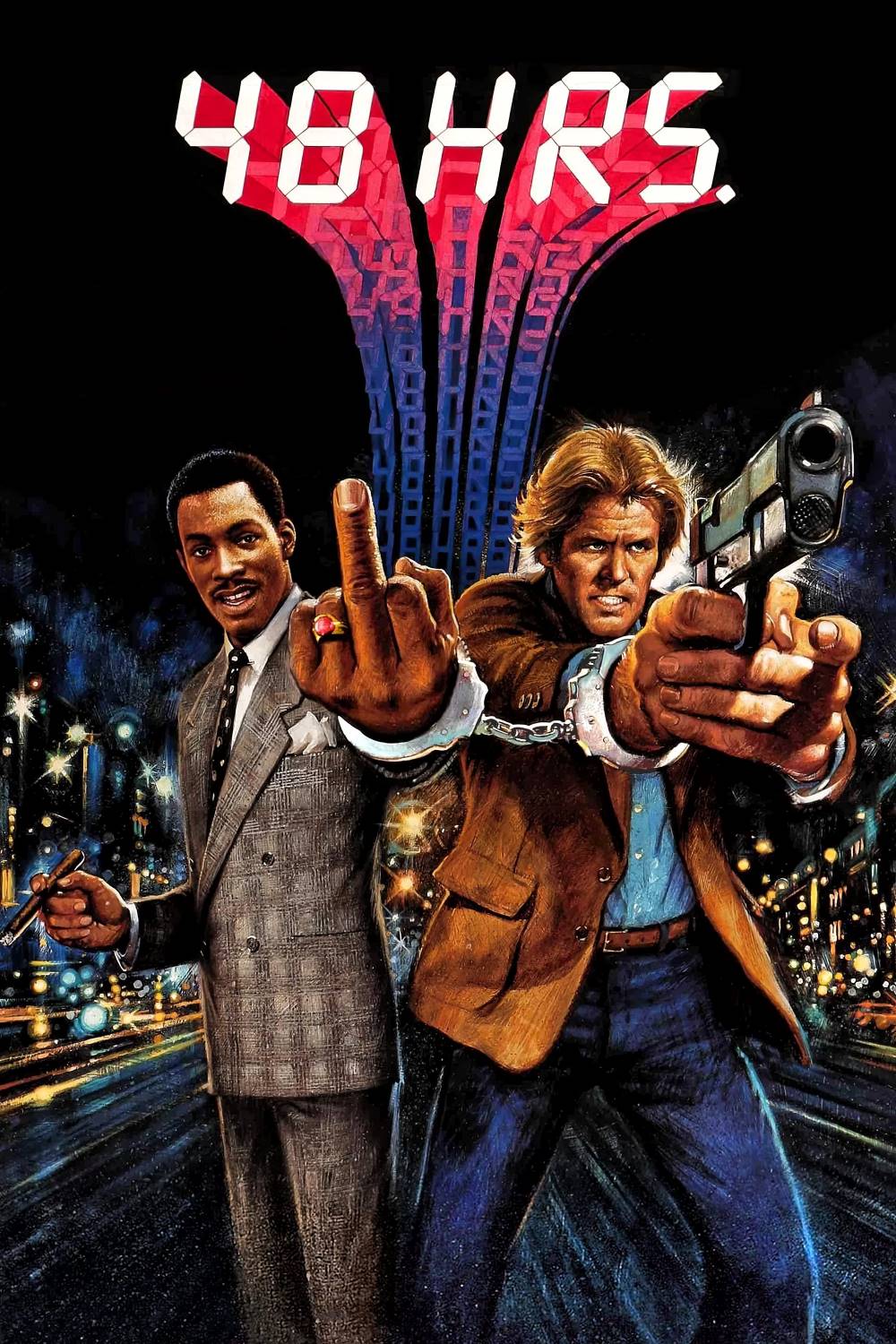
Review: 48 Hrs. (dir. by Walter Hill)


“This ain’t no god damn way to start a partnership.” – Reggie Hammond

48 Hrs. bursts onto the screen with a gritty prison breakout that sets the stage for chaos in the foggy streets of San Francisco, where a pair of ruthless killers slip away after gunning down a cop’s partner in cold blood. Jack Cates, the surviving detective, is left battered and furious, piecing together a case that points to a slick convict named Reggie Hammond holding the key to the crooks’ whereabouts—and a stash of stolen cash. With time ticking down, Jack pulls strings to get Reggie out on a 48-hour pass, thrusting these two polar opposites into a reluctant alliance that turns the city into their personal battlefield of bullets, banter, and bad blood.

From the jump, Jack comes across as the ultimate rough-around-the-edges cop, nursing a flask under his trench coat, snapping at colleagues, and charging headfirst into danger like a man who’s got nothing left to lose. His apartment is a mess of empty bottles and regret, and his rocky relationship with his girlfriend underscores how the job has chewed him up and spit him out, leaving him more beast than man. Reggie, by contrast, rolls in with street-honed swagger, his prison jumpsuit barely containing the energy of a guy who’s survived by being quicker on his feet and sharper with his mouth than anyone around him. He’s got a girlfriend waiting with that hidden money, and no intention of playing nice with a cop who’s eyeing him like fresh meat.

The beauty of their pairing lies in how the film lets their friction spark from the very first shared car ride, where Jack’s growled commands clash against Reggie’s nonstop ribbing, turning a simple stakeout into a verbal demolition derby. Picture them peeling out after a lead goes south, tires screeching through narrow alleys while Reggie gripes about the beat-up car and Jack slams the dash in frustration—it’s these raw, unscripted-feeling moments that make the movie breathe. As they hit up seedy bars, chase informants through strip joints, and dodge ambushes, the script peels back layers: Jack’s not just a bully, he’s haunted by close calls; Reggie’s bravado masks real fear of ending up dead or broke.

One standout sequence drops them into a hillbilly roadhouse packed with hostile locals, where Reggie grabs the mic for an impromptu takedown that flips the room from menace to mayhem, buying them time while Jack backs him up with sheer firepower. It’s tense, hilarious, and perfectly timed, showing how their skills complement each other—Jack’s brute force meeting Reggie’s silver tongue—in ways neither saw coming. The villains, led by a stone-cold Luther and his trigger-happy sidekick, keep the heat cranked high, popping up for savage hits that leave bodies in the gutter and force the duo to improvise on the fly, like hot-wiring rides or shaking down lowlifes for scraps of intel.

Walter Hill’s direction keeps it all taut and visceral, with handheld cameras capturing the sweat and grime of every punch thrown or shot fired, no glossy filters to soften the blows. The San Francisco backdrop shines through rain-slicked hills, neon-lit dives, and shadowy piers, giving the action a grounded, almost documentary edge that amps up the stakes. Sound design punches too—the roar of engines, the crack of gunfire, the thud of fists—layered over a pulsing ’80s score that shifts from funky grooves during chases to ominous drones in quieter beats, mirroring the push-pull between comedy and threat.

Diving deeper into the characters, Jack’s arc feels earned through small touches: a hesitant phone call to his ex, a flicker of respect when Reggie saves his skin, moments that humanize the hardass without forcing redemption. Reggie evolves too, his initial scam-artist vibe giving way to flashes of loyalty, like when he risks his neck to protect that cash not just for himself, but to build something real outside the walls. Supporting roles flesh out the world—the precinct captain barking orders, the sultry singer tangled with the bad guys, Reggie’s tough-as-nails woman who won’t take guff—but they never overshadow the core duo, serving as sparks for conflict or comic relief.

Pacing-wise, the film rarely pauses for breath, clocking in under two hours yet packing in a full meal of twists, from double-crosses at motels to a frantic foot chase across rooftops that leaves you winded. The 48-hour ticking clock adds urgency without gimmicks, every dead end ramping tension as dawn breaks on their deadline. Humor lands organically too, not from slapstick but from character-driven zingers—Reggie calling out Jack’s outdated tough-guy schtick, Jack grumbling about Reggie’s flashy clothes—keeping the tone light even as blood spills.

Of course, watching through modern eyes, the dialogue packs some era-specific punches, with raw language around race, cops, and crooks that reflects ’80s attitudes head-on, for better or worse. It’s unapologetic, mirroring the film’s macho pulse, but adds texture to the time capsule feel, making replays fascinating for how boldly it leaned into taboos. The women, while fierce in spots, often play second fiddle to the bromance brewing, a hallmark of the genre that 48 Hrs. helped cement before it evolved.

What elevates this beyond standard action fare is how it nails the buddy dynamic’s slow burn: no instant high-fives, just gradual thaw from shared survival, culminating in a dockside finale where alliances solidify amid explosions and last stands. The editing zips between high-octane set pieces and downtime breather scenes, like a roadside diner heart-to-heart that reveals backstories without halting momentum. Cinematography plays with shadows and neon to heighten paranoia, turning everyday spots into pressure cookers.

Influence-wise, you can trace lines straight to later hits—the grizzled vet and smooth-talking newbie formula got refined here, blending Lethal Weapon grit with Beverly Hills Cop wit years ahead of schedule. Performances anchor it all: the leads’ chemistry crackles, carrying weaker beats on sheer charisma, while Hill’s lean style ensures every frame earns its keep. Runtime flies because it’s efficient, no fat, just muscle.

Final stretch ramps to operatic violence on those windswept docks, bullets flying as personal scores settle, leaving our heroes bloodied but bonded in a way that feels hard-won. 48 Hrs. endures as a rowdy blueprint for the genre, blending laughs, thrills, and toughness into a package that’s addictive on first watch and rewarding on revisit. It’s got heart under the bruises, edge in the jokes, and a vibe that’s pure ’80s adrenaline—grab it for a night of no-holds-barred entertainment that still packs a wallop over four decades later.
Guilty Pleasure No. 84: Last Action Hero (dir by John McTiernan)


Oh, Last Action Hero.

Ever since this film was first released in 1993, it’s usually held up as an example of a Hollywood fiasco.  The script was originally written to be a modest satire of action films.  The screenwriters wrote the character of Jack Slater, an movie action hero who comes into the real world, for Dolph Lundgren.  Instead, the film became an Arnold Schwarzenegger extravaganza and the studio ended up tossing a ton of money at it.  When the film was originally released, the reviews were mixed and the box office was considered to be disappointing.  (That it went up against the first Jurassic Park was definitely an underrated issue when it came to the box office.)  Ever since then, The Last Action Hero has had a reputation for being a bad film.

Well, I don’t care.  I like The Last Action Hero.  Yes, it’s a bit overproduced for a comedy.  (It breaks my own rule about how no comedy should run longer than two hours.)  Yes, it gets a bit sentimental with ten year-old Danny Madigan (Austin O’Brien) using a magic, golden ticket to enter the film world of his hero, Jack Slater.  If you want to argue that the film should have devoted more time to and gone a bit deeper into contrasting the film world with the real world, I won’t disagree with you.  But I will also say that Sylvester Stallone starring as The Terminator in Jack’s world was actually a pretty funny sight gag.  Danny knowing better than to trust a character played by F. Murray Abraham made me laugh.  Danny’s fantasy in which Arnold Schwarzenegger played Hamlet was made all the better by the fact that his teacher was played by Laurence Olivier’s wife, Joan Plowright.   Danny DeVito as Whiskers the Cartoon Cat makes me laugh as well, even if it is perhaps a bit too bizarre of a joke for this particular film.  (There’s nothing else about the Jack Slater films that would explain the presence of a cartoon cat.)

When you set aside the idea of the Last Action Hero being a symbol of Hollywood bloat and just watch it as a film, it emerges as an enjoyably goofy action movie, one that captures the joy of watching movies (because who hasn’t wanted to enter a movie’s world at some point in their life), and also one that features a rather charming performance from Arnold Schwarzenegger.  (Schwarzenegger, I should add, plays both himself and Jack Slater.  One of my favorite jokes is when the real Schwarzenegger is at a premiere and he mistakes the evil Ripper for Tom Noonan, the actor who played him in the previous Jack Slater film.)  Yeah, the golden ticket is a little bit hokey but who cares?  Underneath all of the special effects and action and money spent on star salaries, Last Action Hero is an action movie and comedy with a heart.  Danny meets his hero but also gets to become a hero himself.  And Jack Slater turns out to be everything you would hope your movie hero would be.  In the end, it’s obvious that a lot of the criticism of this film has more to do with the appeal of riding the bandwagon as opposed to what actually happens on screen.

Last Action Hero is a movie that I’ll happily defend.

Previous Guilty Pleasures

  1. Half-Baked
  2. Save The Last Dance
  3. Every Rose Has Its Thorns
  4. The Jeremy Kyle Show
  5. Invasion USA
  6. The Golden Child
  7. Final Destination 2
  8. Paparazzi
  9. The Principal
  10. The Substitute
  11. Terror In The Family
  12. Pandorum
  13. Lambada
  14. Fear
  15. Cocktail
  16. Keep Off The Grass
  17. Girls, Girls, Girls
  18. Class
  19. Tart
  20. King Kong vs. Godzilla
  21. Hawk the Slayer
  22. Battle Beyond the Stars
  23. Meridian
  24. Walk of Shame
  25. From Justin To Kelly
  26. Project Greenlight
  27. Sex Decoy: Love Stings
  28. Swimfan
  29. On the Line
  30. Wolfen
  31. Hail Caesar!
  32. It’s So Cold In The D
  33. In the Mix
  34. Healed By Grace
  35. Valley of the Dolls
  36. The Legend of Billie Jean
  37. Death Wish
  38. Shipping Wars
  39. Ghost Whisperer
  40. Parking Wars
  41. The Dead Are After Me
  42. Harper’s Island
  43. The Resurrection of Gavin Stone
  44. Paranormal State
  45. Utopia
  46. Bar Rescue
  47. The Powers of Matthew Star
  48. Spiker
  49. Heavenly Bodies
  50. Maid in Manhattan
  51. Rage and Honor
  52. Saved By The Bell 3. 21 “No Hope With Dope”
  53. Happy Gilmore
  54. Solarbabies
  55. The Dawn of Correction
  56. Once You Understand
  57. The Voyeurs 
  58. Robot Jox
  59. Teen Wolf
  60. The Running Man
  61. Double Dragon
  62. Backtrack
  63. Julie and Jack
  64. Karate Warrior
  65. Invaders From Mars
  66. Cloverfield
  67. Aerobicide 
  68. Blood Harvest
  69. Shocking Dark
  70. Face The Truth
  71. Submerged
  72. The Canyons
  73. Days of Thunder
  74. Van Helsing
  75. The Night Comes for Us
  76. Code of Silence
  77. Captain Ron
  78. Armageddon
  79. Kate’s Secret
  80. Point Break
  81. The Replacements
  82. The Shadow
  83. Meteor

48 Hrs (1982, directed by Walter Hill)


48 Hrs. begins with a violent and bloody jailbreak.  The fearsome Billy Bear (Sonny Landham) helps his criminal associate, Albert Ganz (James Remar), escape from a chain gang and kills several guards in the process.  Billy and Ganz then head to San Francisco, where they start killing their former associates while searching for Luther (David Patrick Kelly).  Another bloody shootout leaves several detectives dead and SFPD Detective Jack Cates (Nick Nolte) looking for revenge.

That’s not the way you might expect one of the most famous comedies of the 80s to begin.  It’s not until Jack arranges for another associate of of Ganz’s to be released from prison for 48 hours that anything humorous happens in the film.  However, because Reggie Hammond is played by Eddie Murphy, 48 Hrs. quickly becomes very funny.

Murphy was appearing on Saturday Night Live when he was cast in 48 Hrs, in a role that was written with Richard Pryor in mind.  One of the first things that Murphy requested was that the character’s name be changed from Willie Biggs to Reggie Hammond.  Murphy made the role his own and watching him, it’s hard to believe that he was only 21 and also that 48 Hrs was his first film.  Murphy performs with the confidence of a natural movie star.  He’s good in the film’s most famous scene, where he pretends to be a cop and talks down an entire bar full of rednecks.  (I can’t repeat his most famous line but everyone knows it.)  But Murphy is even better in the scenes where he’s just reacting to Nolte’s slovenly cop.

The comedy in 48 Hrs comes from the mismatched partnership and initially hostile chemistry of Jack Cates and Reggie Hammond.  Cates has a job to do while Reggie, understandably, wants to enjoy as much freedom as he can before he gets sent back to prison.  The humor is so effective because it’s almost entirely character-based.  There are no gags but there are two well-written characters with differing ways of looking at the world who have to learn how to work with each other.  The two of them start out disliking and distrusting each other but ultimately become best friends, even if Jack does punch Reggie and Reggie does keep trying to steal Jack’s lighter.  Because this is a Walter Hill movie, there’s still a lot of action.  Nolte and Murphy may make you laugh but there’s nothing funny about full-on psycho performances of James Remar and Sonny Landham.  48 Hrs. not only allows Murphy and Nolte to show off their comedic ability but it also allows them to be true action heroes.

Popular with critics and audiences, 48 Hrs. was the most commercially successful film of 1982.  It set the standard for most buddy-cop movies to this day and it introduced the world to Eddie Murphy.

Retro Television Reviews: Poochinski 1.1 “Pilot”


Welcome to Retro Television Reviews, a feature where we review some of our favorite and least favorite shows of the past!  On Thursdays, I will be reviewing Poochinski, which aired on NBC in 1990.  The entire show is currently streaming on YouTube!

This week, we take a look at another one-episode wonder, Poochinski!

Episode 1.1 “Pilot”

(Dir by Will Mackenzie, originally aired on July 9th, 1990)

Detective Stanley Poochinski (Peter Boyle) is a veteran of the mean streets of Chicago.  He’s rude and crude but he’s also a good cop, one who is mentioned as having once caught a mad bomber.  I mean, I guess you have to be good at your job to capture someone who not only knows how to make bombs but who is also mad about it.

Poochinski shows his softer side when he comes across a bunch of teenagers taunting a stray English bulldog.  Poochinski pulls his gun and threatens to kill a 12 year-old.  That may sound extreme but it works!  (The 12 year-old, I should mention, was also holding a switchblade.)  Poochinski adopts the dog and starts to bring it to work with him, much to the consternation of Poochinski’s uptight and ambitious partner, Detective Robert McKay (George Newbern, a talented actor who somehow always seemed to turn up in stuff like this).  McKay dislikes the fact that the dog is flatulent and so is Poochinski.

However, Detective Poochinski is run down by two thieves during a pursuit.  As Poochinski dies, the dog runs over to him.  They stare into each other’s eyes.

Cut to Poochinski’s funeral.  Detective McKay attends with the dog.  After everyone else leaves, the dog starts to talk to McKay in Poochinski’s voice!

That’s right …. Poochinski has been reincarnated as a dog!  Except, of course, the dog was already alive when Poochinski died so I guess it’s not reincarnation.  I guess Poochinski’s soul just entered the dog’s body.  But what about the dog’s soul?  These are the unanswered questions that haunt me.

Probably because this was only a 21-minute episode and didn’t really have much time to spare, McKay quickly accepts that his partner is inhabiting the body of a dog.  McKay adopts the dog and names it Poochinski.  While McKay helps Poochinski come to terms with the fact that he’s now a dog, Poochinski gives McKay advice on how to flirt with the neighbor (Amy Yasbeck).  Working together, they also set out to catch the criminals responsible for Poochinski’s “death.”

Probably the creepiest thing about Poochisnki is that, half the time, the dog is played by a real dog.  But whenever Poochisnki starts talking, the real dog is replace by a terrifying rubber puppet that doesn’t even look like the original dog.  Watching the rubber dog talk, I couldn’t help but be reminded of that scene in Spike Lee’s Summer of Sam when the neighbor’s dog enters David Berkowitz’s house and orders him to “KILL!” while happily wagging its tail.

There was only one episode of Poochinski.  The pilot was not picked up for a series but it was still aired on NBC during the dog days of summer.  It’s easy to see why the pilot did not lead to more shows.  Poochinski says that he only wants to do two things: catch a criminal and lick himself.  He does both in the pilot so there really wasn’t much left for this devil dog to do, other than turn evil and taunt McKay into transforming into the Son of Poochinski.

(That said, I did smile at the fact that the police sergeant’s name was Sgt. Shriver.  But that’s just because I’m a history nerd who has spent way too much time reading about the Kennedy family.)

Some TV shows only need one episode and Poochinski was definitely one of them.

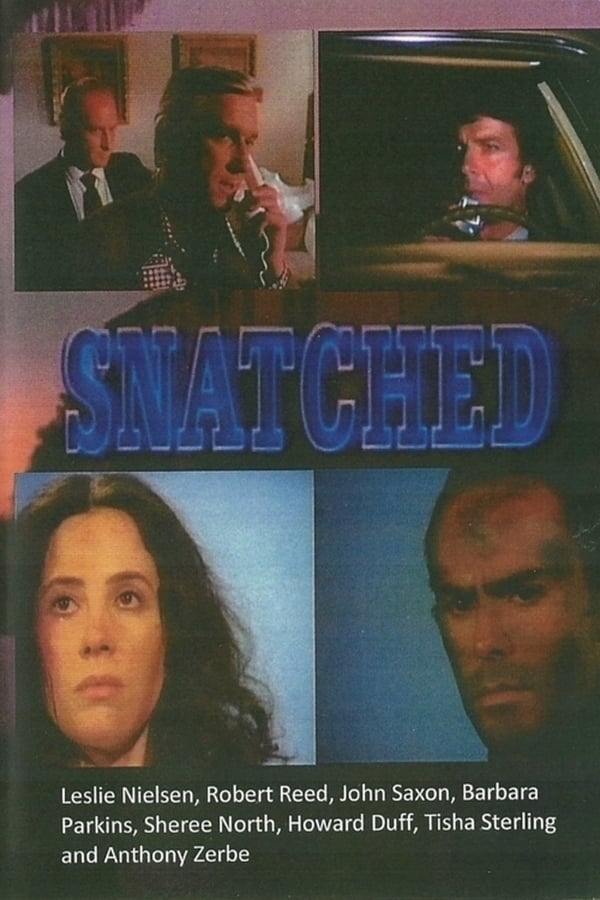
Snatched (1973, directed by Sutton Roley)


Three women have been kidnapped and are being held prisoner in a lighthouse.  Robin Wood (Tisha Sterling), Kim Sutter (Sheree North), and Barbara Maxvill (Barbara Parkins) are married to three wealthy men and the kidnappers (one of whom is played by the great Anthony Zerbe) assume that the husband will be willing to pay whatever is necessary to get back their wives.  Paul Maxvill (John Saxon) and Bill Sutter (Leslie Nielsen!) are willing to put up the money but Duncan Wood (Howard Duff) scoffs at the idea of paying a million dollars just to see his adulterous wife again!

It sounds like the set-up for a Ransom of Red Chief-type of comedy but Snatched is actually a very serious and intelligent thriller, one that will definitely keep you on your toes as you try to keep up with who is working for who.  Kim is diabetic and is growing weaker every minute that she’s being held in the lighthouse.  Paul, Bill, and police detective Frank McCloy (Robert Reed) try to get Duncan to pay his share of the ransom but Duncan is convinced that his wife has been cheating on him and he refuses to pay for her.  On top of that, it turns out that one of the wives might be in on the scheme.  When she tells the kidnappers that she’s actually the one who came up with the plan, is she just trying to protect the other wives or is she telling the truth?  It leads to betrayal and a surprisingly downbeat ending.

Snatched is a well-produced made-for-TV movie.  The mystery will keep you guessing and the cast is made up of a collection of old pros.  Leslie Nielsen, cast here long before he reinvented himself as a comedic actor, is especially good as Bill Sutter and John Saxon gives one of his better performances as Paul.  Even Robert Reed gives a good performance.  Snatched is a classic made-for-TV mystery.

Film Review: Tracks (1977, dir by Henry Jaglom)


The 1977 film, Tracks, opens somewhere in America.

Jack Falen (Dennis Hopper) sits on a bench, waiting for a train.  He’s wearing a military uniform.  He claims that he’s a 1st sergeant.  He claims that he’s just returned from Vietnam.  He’s traveling with a flag-draped coffin.  He says that the coffin contains the remains of his best friend from Nam.  Jack is accompanying the coffin back to his friend’s hometown.  Jack says that he’s going to make sure that his friend gets a proper burial.

From the minute we meet Jack, we get the feeling that there’s something off about him.  He’s a little bit too quick to smile and, when he laughs, it’s the guttural sound of someone who has learned how to show joy by watching other people but who has perhaps never felt it himself.  Sometimes, he’s quiet.  Sometimes, he is loquacious and verbose.  When he does speak, he rarely looks anyone in the eyes.  Jack is jumpy, as if he’s constantly afraid that he’s about to be exposed as a liar.

Soon, Jack is riding a train across the country.  While the rest of the passengers look out the windows and takes in the American landscape, Jack nervously wanders around the train.  He gets involved in a regular chess game.  He befriends a mysterious man named Mark (Dean Stockwell).  He starts a tentative relationship with a student named Stephanie (Taryn Power).  He tells anyone who will listen that he’s traveling with the body of his best friend.  When a black Korean war vet complains that Jack is acting like he’s the only person who lost a friend in a war, an offended Jack replies that his friend was black.

Jack sees things.  When he sees that the other passengers are assaulting Stepanie, he pulls out a small gun and aims it at the back of the train, just to suddenly realize that Stephanie is sitting unbothered at the back of the train.  While we know that Jack was hallucinating the attack on Stephanie, we still wonder if he really pulled out that gun.  If he did, no one else seems to have noticed.

Sometimes, the passengers say things to Jack that don’t seem to make any sense, leaving Jack staring at them in confusion.  Other times, Jack sees dark figures walking through the train.  At night, he wanders around naked.  Jack spends the trip watching the other passengers with a slightly dazed look on his face.  He plays chess with a man who later insists that he’s never played chess with Jack.  Sometimes, he thinks that he and Stephanie are outside of the train.  When Mark approaches Jack and asks for help, Jack explains that he can’t help anyone.  While a soundtrack of old World War II propaganda songs thunders in the background, Jack struggles to keep track of what’s real and what isn’t.

And so does the audience.  As we watch, it occurs to us that Jack’s stories about Vietnam don’t really seem to add up.  Add to that, we never actually saw Jack board the train.  Instead, we saw him sitting on a bench and waiting for the train.  We’re left to wonder if the train’s real or if the whole movie is just a figment of Jack’s damaged imagination.  And what about the coffin?  Tracks is full of unanswered questions but, in the film’s incendiary final moments, we do learn the truth about that coffin … maybe.

Henry Jaglom has been making independent films for several decades now.  Tracks is one of his better films, if just because Jaglom’s loose, seemingly improvised style actually works well at communicating Jack’s own struggle to keep up with what’s really happening and what he’s imagining.  As deceptively random as the film’s collections of scenes may appear, it’s all anchored by Dennis Hopper’s wonderfully unhinged performance.  Hopper brings a method actor’s intensity to Jack’s struggle to not only keep straight what’s real and what isn’t but also to keep his fellow passengers from understanding that he’s deeply unbalanced.  This film was made during Hopper’s drug-fueled lost years and he plays Jack like a man who is desperately trying to keep the world from seeing that he’s in the throes of withdrawal.  Unlike Hopper, Jack’s addiction isn’t to drugs.  Instead, Jack’s addicted to war, or at the very least his obsession with war.  (By the end of the movie, you have your doubts about whether Jack’s ever been to Vietnam or not.)  The use of World War II propaganda songs on the soundtrack may occasionally get annoying but they actually play up the contrast between our often simplistic view of war and the far more complex reality.

If nothing else, I would recommend Tracks for Hopper’s performance.  As well, since he co-stars with Dean Stockwell, it’s easy to imagine Tracks as being a bit of a prequel to Blue Velvet.  Who’s to say that Jack Falen didn’t change his name to Frank Booth?

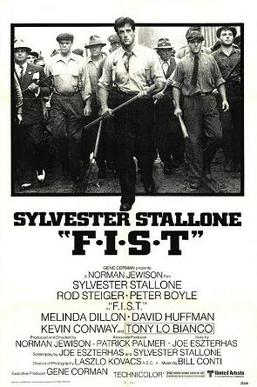
A Movie A Day #355: F.I.S.T. (1978, directed by Norman Jewison)


Sylvester Stallone is Jimmy Hoffa!

Actually, Stallone plays Johnny Kovak, a laborer who becomes a union organizer in 1939.  Working with him is his best friend, Abe Belkin (David Huffman).  In the fight for the working man, Abe refuses to compromise to either the bosses or the gangsters who want a piece of union.  Johnny is more pragmatic and willing to make deals with ruthless mobsters like Vince Doyle (Kevin Conway) and Babe Milano (Tony Lo Bianco).  Over thirty years, both Johnny and Abe marry and start families.  Both become powerful in the union.  When Johnny discovers that union official Max Graham (Peter Boyle) is embezzling funds, Johnny challenges him for the presidency.  When a powerful U.S. senator (Rod Steiger) launches an investigation into F.I.S.T. corruption, both Johnny and Abe end up marked for death.

Obviously based on the life and mysterious disappearance of Jimmy Hoffa, F.I.S.T. was one of two films that Stallone made immediately after the surprise success of Rocky.  (The other was Paradise Alley.)  F.I.S.T. features Stallone in one of his most serious roles and the results are mixed.  In the film’s quieter scenes, especially during the first half, Stallone is surprisingly convincing as the idealistic and morally conflicted Kovak.  Stallone is less convincing when Kovak has to give speeches.  If F.I.S.T. were made today, Stallone could probably pull off the scenes of the aged, compromised Johnny but in 1978, he was not yet strong enough as an actor.  Far better is the rest of the cast, especially Conway, Lo Bianco, and Boyle.  If you do see F.I.S.T., keep an eye on the actor playing Johnny’s son.  Though he was credited as Cole Dammett, he grew up to be Anthony Keidis of the Red Hot Chili Peppers.

The box office failures of both F.I.S.T. and Paradise Alley led Stallone back to his most famous role with Rocky II.  And the rest is history.


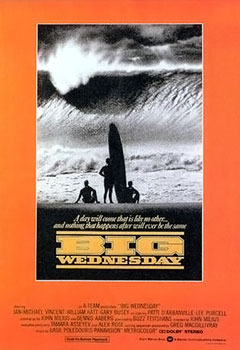
A Movie A Day #165: Big Wednesday (1978, directed by John Milius)


If there is a male bonding hall of fame, Big Wednesday has to be front and center.
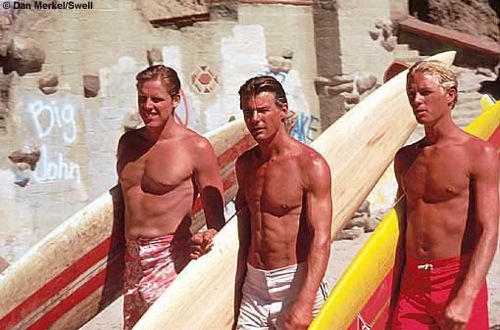
This episodic movie follows three legendary surfers over twelve years of change and turmoil.  Jack Barlowe (William Katt) is the straight arrow who keeps the peace.  Leroy “The Masochist” Smith (Gary Busey) is the wild man.  Matt Johnson (Jan-Michael Vincent) is the best surfer of them all but he resents both his fame and the expectation that he should be some sort of role model for the younger kids on the beach.  From 1962 until 1974, the three of them learn about love and responsibility while dealing with cultural turmoil (including, of course, the Vietnam War) and waiting for that one legendary wave.

After writing the screenplays for Dirty Harry and Apocalypse Now and directing The Wind and The Lion and Dillinger, John Milius finally got to make his dream project.  Big Wednesday was based on Milius’s own youth as a California surfer and he has said that all three of the main characters were based on different aspects of his own personality.  Expectations for Big Wednesday were so high that Milius’s friends, George Lucas and Steven Spielberg, exchanged percentages points for Star Wars and Close Encounters of  The Third Kind for a point of Big Wednesday.  The deal turned out to be worth millions to Milius but nothing to Lucas and Spielberg because Big Wednesday was a notorious box office flop.  Warner Bros. sold the film as a raunchy comedy, leaving audiences surprised to discover that Big Wednesday was actually, in Milius’s words, a “coming-of-age story with Arthurian overtones.”

I can understand why Big Wednesday may not be for everyone but it is one of my favorite movies.  It is one of the ultimate guy films.  Some of the dialogue and the narration may be overwrought but so are most guys, especially when they’re the same age as the surfers in Big Wednesday.  We all like to imagine that we are heroes in some sort of epic adventure.  The surfing footage is amazing but it is not necessary to be a surfer to relate to the film’s coming-of-age story or its celebration of the enduring bonds of friendship.  Katt, Vincent, and Busey all give great performances.  Considering their later careers, it is good that Big Wednesday is around to remind us of what Gary Busey and Jan-Michael Vincent were capable of at their best, before their promising careers were derailed by drugs and mental illness.  Be sure to also keep an eye out for infamous 70s character actor Joe Spinell as an army psychiatrist, a pre-Nightmare on Elm Street Robert Englund, playing a fellow surfer and providing the film’s narration, and Barbara Hale, playing the patient mother of her real-life son, William Katt.

One final note: At a time when the shameful stereotype of the psycho Vietnam vet was becoming popular and unfairly tarnishing the reputation of real-life vets, Big Wednesday was unique for featuring a character who not only joins the Army but who appears to return as a better person as a result.

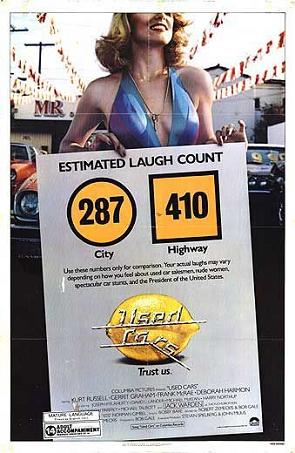
Shattered Politics #46: Used Cars (dir by Robert Zemeckis)


Used_Cars_film_poster

“Do you think we like being associated with the President of the United States?  I mean, we run an honest business here!” —

Jeff (Gerrit Graham) in Used Cars (1980)

As a film lover, I’ve sat through so many disappointing commentary tracks that, when I come across one that’s actually fun and informative, it causes me to like the film even more.  One of the best commentary tracks that I’ve ever heard was the one that Robert Zemeckis, Bob Gale, and Kurt Russell recorded for the DVD release of the 1980 comedy Used Cars.

The film — which was an early credit for both director Zemeckis and screenwriter Gale — tells the story of two rival used car lots.  The bad guy car lot is owned by Roy L. Fuchs (Jack Warden).  The good guy car lot is owned by Roy’s brother, Luke Fuchs (also played by Jack Warden).  The top salesman at the good guy car lot is Rudy Russo (Kurt Russell).  The film shows what happens when Luke dies and Rudy tries to prevent Roy from taking over the lot.

The commentary track is distinguished by just how much Zemeckis, Gale, and Russell seem to truly enjoy watching and talking about the film.  Kurt Russell, in particular, has an incredibly engaging laugh and his sense of fun is contagious.  However, for me, the most interesting part of the commentary track came when Bob Gale explicitly compared Rudy Russo and Luke’s daughter (played by Deborah Harmon) to Bill and Hillary Clinton and then even starts to do a surprisingly good imitation of Bill’s hoarse Arkansas accent.

What made it interesting was that the comparison was absolutely correct.

Politicians are salesmen.  Much as politicians will say anything to get your vote, the salesmen in Used Cars will say and do anything to get your money.  Politicians sell promises that are too good to be true.  Rudy Russo and Roy L. Fuchs do the same thing, claiming that their used cars are just as good and safe as a car that’s never been owned before.

In fact, one of the major plotlines in Used Cars is that Rudy is plotting to make the move from selling cars to buying votes.  There’s a vacancy in the state senate and Rudy is planning on running for the seat.  All he has to do is come up with the $10,000 necessary to buy the nomination from the local political machine. (I imagine it would be more expensive to buy a nomination today.)  Luke agrees to loan Rudy the money but, before he can, Luke goes on a test drive with a former race car driver.

The driver works for Luke’s evil brother, Roy.  Roy knows that Luke has a heart condition and he specifically sends over that driver to give Luke a fatal heart attack.  Just as Rudy is trying to sell a car to a costumer who is skeptical about whether or not he should pay an extra fifty dollar for something he doesn’t want (“$50.00 never killed anyone!” the customer insists), Luke staggers into the office and dies.

(The shocked customer agrees to pay the extra fifty dollars.  Ever the salesman, Luke grabs the fifty before he dies.)

With Luke dead and his estranged daughter nowhere to be seen, Roy is next-in-line to take over Luke’s car lot.  So, Rudy hides the body and tells everyone that Luke is down in Florida.  Both he and his fellow salesman, the hilariously superstitious Jeff (Gerrit Graham), conspire to make as much money as possible before anyone discovers the truth.

How do they do it?  Illegally, of course!

First off, they break into the broadcast of a football game and do an ad.  Then, they use strippers to attract customers.  And finally, Rudy comes up with his master plan, interrupting a televised address from the President of the United States.

“You can’t fuck with the President!” Jeff says.

“Hey, he fucks with us…” Rudy responds.

Seriously, I love Rudy.

In fact, I really liked Used Cars.  It’s a good combination of broad humor and clever satire and both Kurt Russell and Gerrit Graham give such likable performances that you can ignore the fact that they’re both playing total jerks.  (In fact, I would argue that one reason that we love Rudy is because he’s so honest about being so crooked.)  Not every scene worked perfectly.  The scene where Rudy and Jeff interrupt that football game goes on forever and, after a spokesmodel’s dress is ripped off, becomes so uncomfortable to watch that it actually takes the film a while to recover.  But then, after that, you get the interruption of the President’s speech.  You get Jeff freaking out over whether or not red cars or unlucky.  You get some fun driving school humor.  And, of course, you get a cute dog that can do tricks and helps to sell cars.  The film recovers and, ultimately, Used Cars is a celebration of small businesses everywhere.

And you know what?

I really hope Rudy did make it into the state senate.

We need more Rudy Russos in government.

And we really need more commentary tracks featuring Kurt Russell!