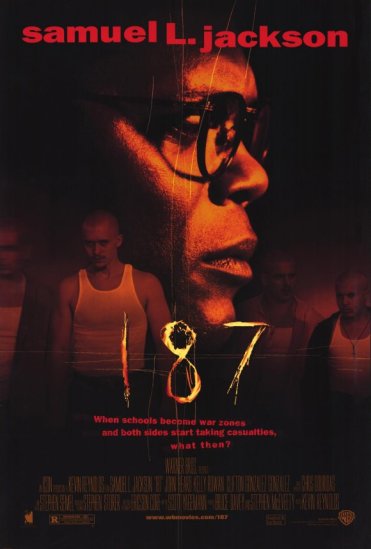
Back to School Part II #35: One Eight Seven (dir by Kevin Reynolds)


one_eight_seven_ver1

I’m writing this review from memory so you’re going to have to bear with me.  187 is one of those films that seems to show up on late night cable constantly, which is how I saw it.  I probably should rewatch it for this review but … no.  I don’t want to have to sit through it again.

See, here’s the thing with 187.  It’s a film where Samuel L. Jackson plays a high school science teacher and, just by definition, that should make it the greatest film ever and yet it isn’t.

Originally, Jackson’s working in New York but then he ends up failing one of his students (played by Method Man).  Method Man ends up giving Jackson a textbook on which he has written 187 on every single page.  Jackson immediately realizes that 187 is the name of the movie that he’s in.  “Always good to meet a fan,” he thinks but then suddenly, it dawns on him that 187 is also police code for homicide!  Jackson asks the school administration for help.  They ignore him (probably because everyone knows that Samuel L. Jackson is too much of a badass to be scared by some numbers in a textbook) and he ends up getting stabbed several times in the back.

Agck!

We jump forward 15 months.  Jackson has recovered from nearly being killed and he’s still determined to teach.  He wants to make a difference!  But he’s decided that New York kids are too homicidal so he transfers to a school in Los Angeles.  Surprise!  It turns out that students in Los Angeles are just as dangerous as the ones in New York.  During his first day as a substitute teacher, Jackson is writing his name on a chalk board.  Someone throws a crumpled ball of paper at him.  Jackson flinches as it hits his back.

FLASHBACK TIME!

Now, here’s the thing: the idea of Samuel L. Jackson teaching in an inner city high school and taking on a bunch of gang members sounds totally kickass.  And you spend this entire two-hour movie waiting for Samuel L. Jackson to have one of those wonderful Samuel L. Jackson moments when he fixes someone with that powerful glare and suddenly speaks in the voice of angry and vengeful God.  You keep waiting but, with the exception of a few moments, it never seems to happen.

I mean, don’t get me wrong.  I wasn’t expecting Jackson to say, “I’m sick of these motherfucking gangstas in this motherfucking classroom!”  It would have been great if he had said that but, after a few minutes of watching the movie, I realized that he probably wouldn’t.  187 is obviously meant to be a serious movie about America’s educational crisis.  Watching it, you get the feeling that 187‘s director, Kevin “I know Kevin Costner” Reynolds, woke up every morning and said, “I am making the most important film ever today!”

But whatever good intentions that the filmmakers may have had, it’s no excuse for totally wasting Samuel L. Jackson.  When you’ve got a powerful actor like Samuel L. Jackson, why do you waste him in such a thinly written role?  When you finally do allow him to do something big and Samuel L. Jackson-like, why do you waste so much dramatic potential by having him do almost all of it off-screen?  Jackson finally does get a great Samuel L. Jackson moment towards the end of the film but that’s just because there’s a big plot twist that doesn’t make any sense.  The end of 187 reminds the viewer that an ironic ending has to be earned.  It just can’t be slapped onto the film.

I mean, I don’t want to toss out any spoilers because, for all I know, 187 is going to be on Cinemax tonight.  If you’re up at 3 in the morning, you might end up watching it and God knows, I don’t want to be accused of giving away the ending.   But let me ask you this — if you’ve finally captured someone who you’ve spent an entire two-hour film trying to kill, would you then suddenly decide to play a game of Russian roulette?

Anyway, 187 should be avoided because it totally wastes Samuel L. Jackson and that’s kind of unforgivable.
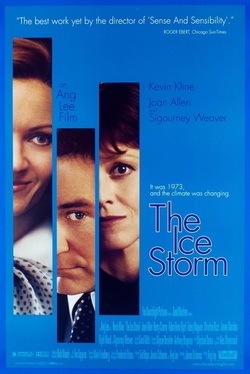
Back to School Part II #34: The Ice Storm (dir by Ang Lee)


the-ice-storm

The 1997 film The Ice Storm is kind of a schizophrenic film, which makes sense since it’s set in 1973 and, just from what I’ve seen in the movies, it appears that the early 70s were kind of a schizophrenic time.

It’s a film that deals with two sets of people who all live in an upper class Connecticut community.  One part of the film deals with parents who are freaking out about suddenly being adults.  The other part of the film deals with the children, most of whom seem destined to make the same mistakes as their parents.  It’s a film that is occasionally bracingly realistic and relatable, one that reminds us that being directionless in the 70s isn’t necessarily that different from being directionless in 2016.  At other times, the film feels a bit too studied for its own good.  This is one of those films that features a Tobey Maguire voice-over and, as good an actor as Maguire has always been, he’s always at his worse when reciting a pseudo-profound voice over.  And then there are other times when the film feels a bit too cartoonish for its own good.  Elijah Wood’s a stoner.  Sigourney Weaver walks around with a bullwhip.  David Krumholtz shows up as a character named Francis Davenport.

Fortunately, the film is directed by Ang Lee and Ang Lee is probably one of the few filmmakers who can overcome tonal inconsistency.  Lee is so good with actors and is such a good storyteller that even his lesser films are usually worth watching.  The Ice Storm would just be another silly sin-in-the-suburbs film if it had been made by any director other than Ang Lee.

The main adult in the film is Ben Hood (Kevin Kline).  Ben is married to Elena (Joan Allen) but he’s having an affair with his neighbor, Janey (Sigourney Weaver).  Elena may be upset when she finds out about the affair but she’s still willing to accompany her husband to a key party.  A key party was a 70s ritual in which husbands would throw their car keys into a big punch bowl and then the wives would randomly pick a key and have sex with the owner.  Basically, anytime a TV show or a movie takes place in the suburbs during the 70s, there has to be at least one key party.

And The Ice Storm‘s key party is kind of fun to watch.  Kevin Kline and Joan Allen both give really good performances and Ben is such a loser that it’s fun to watch him freak out when Janey gets a key other than this own.  Elena, meanwhile, ends up going off with Janey’s husband (Jamey Sheridan, pretty much looking the same in this 1997 film as he did in Spotlight and Sully) and they share a really good scene together, one that reveals that none of the film’s adults are really as mature or liberated as they claim to be.

While the adults attempt to play, their children attempt to find some sort of meaning to their empty existence.  Ben and Elena’s daughter, Wendy (Christina Ricci), wears a Richard Nixon mask and enjoys sexually teasing her classmates, especially Janey’s youngest son, Sandy (Adam Hann-Byrd).  Ben and Elena’s oldest son, Paul (Tobey Maguire) is in New York, hoping to lose his virginity to Libbits (Katie Holmes) despite the fact that Libbets is far more interested in his boarding school roommate, Francis Davenport (David Krumholtz).  Paul also compares his family to the Fantastic Four so, assuming Paul survived both the 70s and 80s, he’s probably still living in Connecticut and telling everyone who disappointed he was with last year’s film.

And, of course, there’s Mickey (Elijah Wood).  Mickey is Janey’s oldest son and he’s permanently spaced out.  When the ice storm of the title occurs, Mickey is the one who decides to wander around outside and appreciate the beauty of nature’s remorseless wrath.

Needless to say, the ice storm is also a really obvious metaphor for the way all of these very unhappy (but very prosperous) characters tend to view and treat each other.  Despite all the attempts to pretend otherwise, everyone has a frozen soul.  Nobody’s capable of maintaining any sort of real emotional connection.  Of course, someone dies and everyone’s forced to take a look at the sad reality of their lives and the film ends with a sudden and spontaneous display of actual human emotion.  It’s one of those ideas that probably works better as a literary conceit than a cinematic one.

That said, The Ice Storm is flawed but very watchable.  I enjoyed it, even if it did occasionally seem to be trying way too hard.  It’s well-acted and, if nothing else, I enjoyed getting to see all of the amazingly tacky clothes and the interiors of all those big houses.  These people love their wide lapels and their shag carpeting.  The Ice Storm is not Ang Lee’s best but it’s still good enough.

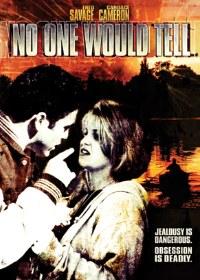
Back to School Part II #33: No One Would Tell (dir by Noel Nosseck)


no_one_would_tell

Do you remember when Chris Brown performed The Man In The Mirror at the 2010 BET Awards?  It was during a tribute to Michael Jackson and Brown broke down crying while singing the song.  Afterwards, he accepted an award and he said, “I let you all down before, but I won’t do it again.  I promise you.”

This, of course, was about a year after Brown had pled guilty to physically abusing Rihanna.  I remember being on twitter during Brown’s performance and seeing literally thousands of tweets from people talking about how brave Chris Brown was and how amazing his performance had been.  Chris Brown was looking at the man in the mirror and asking him to change his ways.  Chris Brown was promising not to let anyone else down by nearly killing any future girlfriends.  A lot of people on twitter claimed this was amazing.  I thought it was disgusting and I tweeted out my opinion.  I really didn’t give a fuck if Chris Brown was asking the man in the mirror to change his ways.  The man in the mirror was (and is) an abusive asshole.  The man in the mirror beats women.  The man in the mirror is not capable of changing his ways.  “FUCK THE MAN IN THE MIRROR!” I tweeted.

And, oh my God, the reaction my little twitter rant inspired.  What was especially disturbing was that the majority of people who tweeted me in Brown’s defense were other women.  Yes, they all agreed, Chris Brown had beat Rihanna but he admitted what he had done, he was asking the man in the mirror to change his ways, and hey, Rihanna probably deserved it.

My favorite excuse — and this was used by quite a few of Brown’s defenders — was this: “Only God can judge Chris Brown.”  Well, you know what?  I asked God and he says Chris Brown’s an abusive asshole.

I’m tempted to say that it amazes me that Chris Brown still has fans but actually, it doesn’t.  Sadly, when it comes to a celebrity, people are willing to make excuses for almost anything.  If you ask most people, they’ll say that they’re against domestic abuse and they think abusers should suffer the worst punishment imaginable.  But when the abuser is someone who they know (or, in the case of a celebrity like Chris Brown, someone who they feel they know), the excuses start.  The equivocations are heard.  The blame is assigned to everyone but the abuser.  We start hearing bullshit about how people make mistakes and only God can judge.

In short, people are willing to talk but when it matters, they rarely act.

That’s also the theme of a powerful and sad movie called No One Would Tell.  No One Would Tell was originally made for television in 1996 and it still shows up fairly regularly on Lifetime.  Though the names and certain details have been changed, it’s based on a true story.  In fact, the film feels like it’s based on several true stories.  The plot of No One Would Tell is one that has occurred and continues to occur on far too regular of a basis.

Stacy Collins (played by Candace Cameron, before she added the Bure to her name) is a 16 year-old high school student.  She’s quiet, shy, and insecure.  When she first starts to date a popular jock named Bobby Tennison (Fred Savage), it seems like a dream come true.  But soon, Bobby starts to show another side.  He’s controlling and possessive.  He grabs her wrist hard enough to leave bruises.  He shoves her into a wall when they have an argument.  When she wears a skirt that he thinks is too short, he grabs her in the school hallway and demands that she change immediately.  When she isn’t home to answer his calls, he assumes that she most be cheating on him.  And, when she finally breaks up with him, he kills her.

What’s infuriating is that, throughout the film, Bobby’s abuse is witnessed by all of his and Stacy’s friends.  Everyone sees him push her.  Everyone sees the bruises.  Everyone knows that Bobby is unstable and that Stacy is afraid of him.  And yet, nobody says a word.  Nobody does a thing.  Instead, they just make excuses for Bobby’s behavior.  Some of them even blame Stacy.  No one is willing to get involved and it eventually costs Stacy her life.

For a TV movie from the mid-90s, No One Would Tell holds up surprisingly well.  Admittedly, Fred Savage overacts in the role of Bobby (and maybe it would have been better if the role had been played by Eric Balfour, who appears as Bobby’s best friend) but Candace Cameron does a perfect job as the tragic Stacy, capturing both her insecurity and her vulnerability.  Some of the film’s best moments are the ones shares by Cameron and Michelle Phillips.  In those scenes, we see how Stacy learned how to make excuses for Bobby’s behavior from watching the way that her mother made excuses for the men who similarly abused her.  No One Would Tell is a powerful film, one that offers an unflinching look at abuse and one that dares to demand that its audience take a stand.

No One Would Tell is a film that should be watched by anyone who thinks that the man in the mirror can change his ways.

A Cat’s Perspective On The Fifty Shades Darker Teaser


OLYMPUS DIGITAL CAMERA

Meh!  Humans are weird!  Not only do they have trailers for movies but they also have teasers for trailers!  They need to be more like me — sleep, eat, and learn to love the ennui!

Humans are also weird because they read books like The Fifty Shades trilogy and spend all their time talking about how bad they are.  The flame-haired one even threw her copy of Fifty Shades of Grey across the living room once and totally woke me up!  (Don’t worry, I was able to get back to sleep … eventually.)  But then after hating the book, they get all excited about the movie and then they get all upset when the movie turns out to suck too!  I ate a spider once and it tasted terrible so you know what?  I stopped eating spiders.  If I was a human, I guess I would think, “Spiders are yucky!  Let’s go eat a few while watching a movie about them!”  Meh!

There’s a new Fifty Shades movie coming out and it’s called Fifty Shades Darker! It’s based on another book that the flame-haired one threw across the living room but she’s still planning on seeing it!  It’s such a big deal that instead of just releasing a trailer, the humans are releasing a teaser and then a trailer!  If they make another Fifty Shades movie, maybe they can release a teaser for the teaser of the trailer!

Someday, maybe they’ll stop making movies all together and they’ll just make teasers for trailers of pretend movies.  People will watch the teaser and say, “This is going to be a great trailer!”  I hope that happens because if there’s no more movies that means even less to distract from feeding the kitty!

Here’s the teaser for Fifty Shades Darker!  The trailer’s coming out tomorrow and the flame-haired one will probably share it because the kitty is planning on sleeping through Wednesday.  Meh!

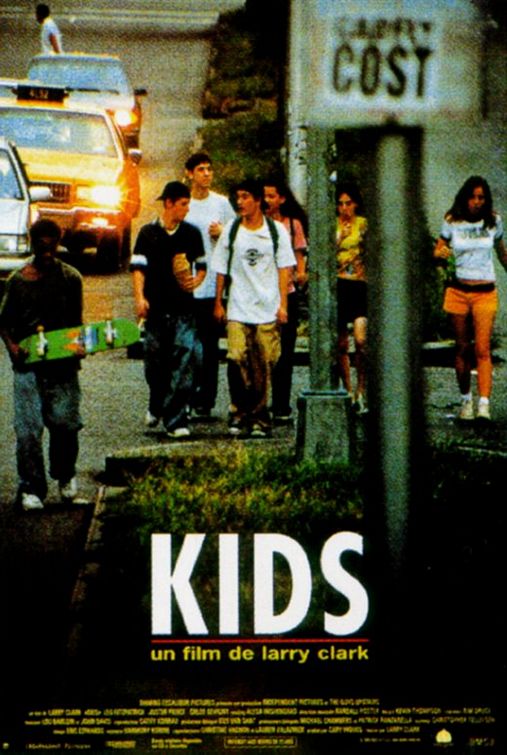
Back to School Part II #32: Kids (dir by Larry Clark)


kids_film

The first time that I ever saw Kids, the 1995 directorial debut of Larry Clark, my initial response was to wonder what the Hell everyone was talking about.

Seriously, I couldn’t understand a word that anyone was saying.  The two main characters — 15 year-old Telly (Leo Fitzpatrick) and his friend Casper (Justin Pierce) — talked almost constantly.  In fact, Telly even narrated the film.  But both of them had such thick Northern accents and both of them were so inarticulate that I spent 75% of the movie trying to understand what they were going on about.  (Add to that, Casper is pretty much either drunk or stoned through the entire film.)  Don’t get me wrong.  I understood enough to know what was going on in the movie.  I knew that Telly was obsessed with having sex with virgins and that he didn’t know that he was HIV positive.  I knew that Casper considered himself to be the “dopest ghost in town,” and that he ended the film by coming out of his daze long enough to look straight at the camera and ask, “What the fuck happened?”  But a lot of the dialogue in-between got lost as a result of Telly growling and Casper slurring.

So, when I rewatched Kids for this review, I turned on the close captioning so that I could read what it was that Telly and Casper were actually saying to each other while they were walking around New York City.  After a few minutes, I started to really wish that I had just remained ignorant.  Seriously, you may hate Telly but you’ll hate even more once you understand everything that he actually says during the opening scenes of the film.  Telly is literally one of the most disgusting pervs to ever be at the center of a motion picture.  “Virgins,” he announces at the start of the film, “I love them!”  He also infects them and what’s truly disturbing is that you get the feeling that, even if he knew he was HIV positive, Telly wouldn’t change his behavior at all.

Reportedly, Leo Fitzpatrick got death threats after starring in Kids.  Because he was making his film debut in Kids and because the film’s cast was reportedly made up of actual street kids, many viewers assumed that Fitzpatrick was playing himself.  Fitzpatrick is one of the few members of the cast to have actually maintained an acting career after Kids and, by most accounts, he’s not Telly.  That said, Telly is such a demonic character and Fitzpatrick does such a good job playing him that, admittedly, it is strange to see him subsequently play characters who are far different from Telly.  (His performance as faux hitman in Clark’s Bully is one of the highlights of that film.)

Justin Pierce also continued to act after Kids, though his efforts to maintain a career were reportedly hampered by his own personal demons.  Sadly, Pierce committed suicide in 2000, hanging himself in Las Vegas.  As raw as it may be, Pierce probably gives the best performance in Kids.  I’m sure that some would be tempted to say that Pierce was just playing himself but there’s also a sly humor to his performance that isn’t necessarily present in the script.  Casper is a despicable character who not only possibly beats a man to death but who also rapes one of his so-called friends when she’s passed out on a coach.  At times, Casper seems to almost be brain-dead.  (We’re told that he’s been sniffing glue since the 4th grade.)  But then there’s a few scenes where we get hints of who Casper could have been if he hadn’t fried his brain.

(For instance, it’s interesting to note that, alone among the male characters, Casper is the only one who occasionally behaves in a generous manner.  He may steal a piece of fruit but he then gives it to a young girl waiting outside of a dilapidated building.  In the famous scene in which a legless man asks for money while singing, “I have no legs/I have no legs,” Casper gives him money while Telly rolls his eyes.  Casper may be awful but, unlike Telly, he’s not a total sociopath.)

(It’s also interesting to note that, while we meet Telly’s mom and hear from her that Telly has a strained relationship with his dad, we never meet or hear about Casper’s family.  While Kids may be critical of Telly and Casper and their friends, it’s true scorn is reserved for the frequently unseen adults who all either seem to either be in denial or just incredibly callous as far as their children are concerned.)

And then there’s Chloe Sevigny and Rosario Dawson, both making their film debut in Kids.  They play friends who, at the start of the movie, both go to a clinic to get the results of their HIV tests.  The promiscuous Ruby (Dawson) is negative.  Jennie (Sevigny), however, is positive.  Since she’s only had sex with one person, she knows that she caught it from Telly.  What little plot that Kids has deals with Jennie’s efforts to track down Telly before he has sex with another virgin.  From the minute that Jennie starts searching for Telly, you know that it’s a pointless mission.  Even if Jennie did manage to track down Telly, it’s doubtful he would listen to her.

Kids was the directorial debut of Larry Clark.  It was also the screenwriting debut of Harmony Korine and reportedly, it was considered to be very shocking and controversial when it was first released.  I have to admit that, even speaking as someone who grew up far away from the streets of New York on which Kids was cast and filmed, I’ve never been that shocked by Kids.  Don’t get me wrong — it’s a raw and powerful film and the scene where Sevigny sits in a cab and repeats to herself that she’s not going to die brought tears to my eyes.  But, no — the idea of kids and teenagers having sex, doing drugs, and getting violent is no longer shocking (if it ever was).

It’s just another day.

Doc Bowman Takes A Look At The Trailer For Are We Not Cats


OLYMPUS DIGITAL CAMERA

I was super excited to see a trailer called Are We Not Cats because I thought it would be about me!  But then I watched it and there’s no cats at all in this trailer!  Meh!

According to the description on YouTube: “After losing his job, his girlfriend, and his apartment in a single day, a young man attempts to restart his life, but is diverted when he meets a woman who shares his strangest habit; an inclination for eating hair!” Eating hair does not make you a cat!  Grooming is not the same as eating, silly humans!  Meh!

Here is the trailer!  It doesn’t have a U.S. release date yet but the movie opened in Italy on Friday!  There’s a lot of good cats in Italy but they’re not allowed in theaters!  Meh!

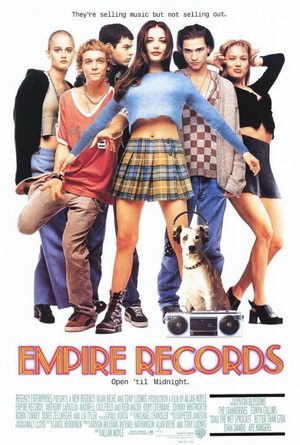
Back to School Part II #31: Empire Records (dir by Allan Moyle)


empire_records_poster

The 1995 film, Empire Records takes place in a fictional record store.  The store is located in a state called Delaware, which I’m pretty sure is fictional as well.  (Have you ever actually met anyone from Delaware?  And don’t say Joe Biden because we all know he’s just a hologram…)  Empire Records is a beloved institution, an independent record shop that’s as well-known for its lively employees as its amazing selection of music!

However, things are not perfect in the world of Empire Records.  The store is owned by a heartless businessman named Mitchell (Ben Bode).  Mitchell hates Empire Records and usually just lets the store manager, former drummer and Scott Stapp-lookalike Joe (Anthony LaPaglia), run the place.  However, Mitchell has decided to sell Empire Records to the soulless and corporate Music Town franchise.  Oh my God!  If Empire Records becomes a Music Town, the employees will have to wear orange aprons!  They won’t be allowed to wear anything too revealing or have any visible piercings!  And nobody will be allowed to dance in the aisles!

Over the course of just one day, can the staff of Empire Records find a way to save their store!?

It would be easier if not for the fact that a hundred other things happen over the course of that same day.  A shoplifter (Brendan Sexton III, who co-starred in the very different Welcome to the Dollhouse the same year that he appeared here) keeps trying to steal stuff and, at one point, he even shows up at the store with a gun!  Is it possible that he just wants to join the Empire Records family and is just hoping that he’ll be offered a job?

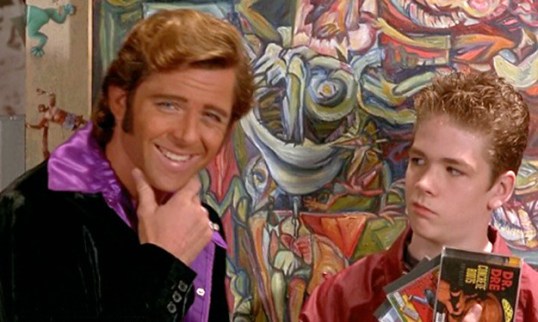
And then there’s Rex Manning!  That’s right — it’s Rex Manning Day!  Who is Rex Manning?  Well, he used to star on a show called The Family Way and his nickname is Sexy Rexy.  He has truly memorable hair.  Middle-aged people love him but most young people think that he’s a joke.  Rex is going to signing copies of his latest album at Empire Records and you better believe that he’s brought blue cheese salad dressing with him.  There’s a reason they call him Sexy Rexy and it’s not just that Rex Harrison is no longer around to object.  Rex is played by Maxwell Caulfield.  Caulfield steals every scene that he appears in and it’s hard not to feel that he’s playing a version of who he could have become if Grease 2 hadn’t bombed at the box office.

rexmanningday

And, of course, all the members of Empire Records staff have their own personal problems to deal with.  Fortunately, since this is a breezy and comedic movie, nobody has problem that can’t be solved within ten to fifteen minutes.

For instance, Debra (Robin Tunney) is suicidal and shows up for work with a big bandage on her wrist.  After clocking in, she promptly shaves her head.  Debra is depressed and troubled but guess what?  All she needs is for her friends to hold a mock funeral in the break room.  (And who is taking care of the customers while everyone else is eulogizing Debra?  Probably Andre but we’ll talk more about him in a moment…)

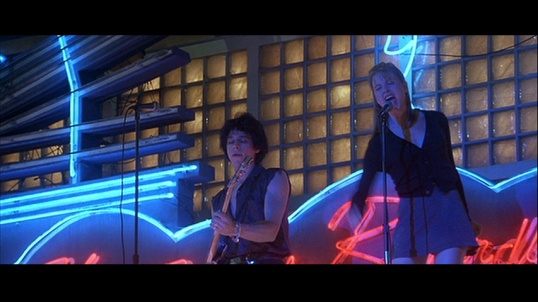
Berko (Coyote Shivers) appears to be Debra’s boyfriend but he doesn’t seem to be that good of a boyfriend.  Berko’s a musician and he wants to make it big.  Solution to his problem: an impromptu concert on the roof of Empire Records!  And you know what?  Coyote Shivers was not the world’s best actor but the song he performs, Sugar High, will stay in your head long after you hear it.

Eddie (James ‘Kimo’ Williams) has no problems, probably because he also works at a pizza place and he makes the best brownies in the world.  Except, they’re not ordinary brownies … hint hint hint….

Mark (Ethan Embry) only has one problem: his character, as written, is pretty much interchangeable with Eddie’s.  But, fortunately, Embry gives such a totally weird performance that you never forget who he is.

Lucas (Rory Cochrane) tried to help Joe out by taking the previous night’s cash receipts to Atlantic City.  Lucas, however, is not a very good gambler and ends up losing all of the money at the result of one roll of the dice.  Lucas’s problem is that Joe is going to kill him.  The solution is to spend almost the entire movie sitting on the break room couch and making snarky comments.

Gina’s problem is that everyone thinks that she’s a slut, mostly because that’s how the character is written.  Fortunately, Gina is played by Renee Zellweger and she brings a lot of depth to an otherwise underwritten role.  One of the film’s best moments is when Gina and Berko perform together because Zellweger really throws herself into the song.  Watching that scene always makes me want to sing along with them.  It’s funny that Zellweger has even a stronger Texas accent than I do and yet, she can really sing while I mostly certainly cannot.

sugar-high

Then there’s Andre!  Andre’s problem is that he ends up getting cut out of the film.  However, he’s still listed in the credits, which is how we know that he was played by Tobey Maguire.

A.J. (Johnny Whitworth) is an artist.  How can you not love a struggling artist?  His problem is that he’s in love with Corey (Liv Tyler) but Corey is obsessed with losing her virginity to Rex Manning.

Actually, that’s not the only problem that Corey has.  Corey, who is in high school but has recently been accepted to Harvard, is a driven overachiever.  Occasionally, we see her popping a pill.  Oh my God, is she using speed!?  Of course. she is.  How else is she going to be able to both study late and maintain her figure?  If I don’t seem too concerned about Corey’s pills, it’s because I pretty much take the same thing to keep my ADD under control.  They’ve worked wonders for me!

But not so much for Corey.  In fact, they cause Corey to kinda freak out and attack a cut-out of Rex Manning.  Fortunately, the solution to her drug problem is pretty simple.  She just has to splash some water on her face.

As for her virginity problem, well … it is Rex Manning Day!  Judging from this film and Stealing Beauty, it would appear that film goers in the mid-90s were obsessed with Liv Tyler losing her virginity.

Anyway, there are like a hundred overly critical things that I could say about Empire Records.  I’ve seen this film a number of time and there are certain scenes that always make cringe — like Debra’s funeral or when Joe starts banging away on his drum set.  A lot of the dialogue is overwritten and the whole things occasionally seems to be trying too hard.

And yet, I can’t dislike Empire Records.  In fact, I actually really like it a lot.  It’s just such an earnest and sincere movie that you can’t help but enjoy it.  Meanwhile, the cast has so much energy and chemistry that they’re just fun to watch.  This is one of those films where it’s best just to shut off your mind, say “Damn the man!,” and enjoy what you’re watching for what it is.

Add to that, I love that ending.  Everyone dancing on top of the store?  Perfect.

Film Review: Sully (dir by Clint Eastwood)


sully_xxlg

The new film Sully is about several different things.

Most obviously, it’s about what has come to be known as the Miracle on the Hudson.  On January 15th, 2009, US Airways Flight 1549 had just departed from New York’s LaGuardia Airport when it was struck by a flock of geese.  (They say that it was specifically hit by Canadian Geese but I refuse to believe that Canada had anything to do with it.)  With both of the engines taken out and believing that he wouldn’t be able to get the plane back to either LaGuardia or an airport in New Jersey, the flight’s plot, Chelsey “Sully” Sullenberger (played by Tom Hanks) landed his plane on the Hudson River.  Not only did Sullenberger manage to execute a perfect water landing but he also did so without losing a single passenger.

I’m sure that we can all remember that image of that plane sitting on the river with passengers lined up on the wings.  We can also remember what a celebrity Sully became in the days following the landing.  At a time of national insecurity and cynicism, Sully reminded us that people are still capable of doing great things.  It also helped that Sully turned out to be a rather humble and self-effacing man.  He didn’t use his new-found fame to host a reality TV show or run for Congress, as many suggested he should.  Instead, he wrote a book, raised money for the National Suicide Prevention Lifeline, and appeared in two commercials for St. Jude Children’s Research Hospital.

Wisely, Sully opens after the Miracle on the Hudson, with Sully still struggling to come to terms with suddenly being a celebrity.  (That said, we do get to see the landing in flashbacks.  In fact, we get to see it twice and it’s harrowing.  The “Brace! Brace!” chant is pure nightmare fuel.)  Tom Hanks plays up Sully’s modesty and his discomfort with suddenly being a hero.  Even while the rest of the world celebrates his accomplishment, Sully struggles with self-doubt.  Did he make the right decision landing the plane on the Hudson or did he mistakenly endanger the lives of all the passengers and crew members?

A lot of people would probably say, “What does it matter?  As long as he succeeded, who cares if he actually had to do it?”  Well, it matters to Sully.  Some of it is a matter of professional pride.  And a lot of it is because the soulless bureaucrats at the National Transportation Safety Board are investigating Sully’s landing.  If it’s determined that he could have made it back to airport and that he unnecessarily endangered the lives of everyone on the plane, he could lose his job and his pension.  As we see in a few scenes with Sully’s wife (Laura Linney, who is somewhat underused), the Sullenbergers really need that pension.

That brings us to another thing that Sully is about.  It’s a celebration of not only individual heroism but individuality itself.  The NTSB claims that they have computer-generated recreations that prove Sully had enough time and fuel to return to an airport but, as Sully himself points out, the NTSB has ignored the human element in their recreations.  As a result of their obsession with regulation and procedure, the bureaucrats have forgotten that planes are not flown by computers but individuals who have to make split-second decisions.

That’s one of the things that I loved about Sully.  In this time when we’re constantly being told that our very future is dependent upon always trusting the bureaucrats and following their rules and regulations, Sully reminds us that the government is only as good as the people who work for it.  And, far too often, the people are smug and complacent morons.

(For the record, Sullenberger has said that the real-life hearings were not as confrontational as the ones depicted in the film.  However, even taking into account the dramatic license, the overall message still rings true.)

And finally, Sully is a film about what America has become in the wake of 9-11.  Just as in real-life, the film’s Sully suffers from PTSD in the days immediately following the Miracle on the Hudson.  Even while the rest of the world celebrates him, Sully has nightmares about what could have happened if he hadn’t made the landing.  When we watch as Sully’s plane collides with a New York skyscraper, it’s impossible not to be reminded of the horrible images of September 11th.  Not only does it drive home what was at stake when Sully made that landing but it also reminds us that, regardless of what some would want us to beg, there are still heroes in the world.  Not every story has to end in tragedy.  People are still capable of doing great things.  Heroism is not dead.  With tomorrow being the 15-year anniversary of the day when 3,000 people were murdered in New York, Pennsylvania, and D.C., it’s important to be reminded of that.

Sully is a powerful and crowd-pleasing film.  (The normally cynical audience at the Alamo Drafthouse broke into applause at the end of the movie.)  Director Clint Eastwood tells this story in a quick, no-nonsense style.  During this time of bloated running times, Sully clocks in at 97 minutes and it’s still a million times better than that 150-minute blockbuster you wasted your money on last week.  Toss in Tom Hanks at his best and you’ve got one of the best films of the year so far.

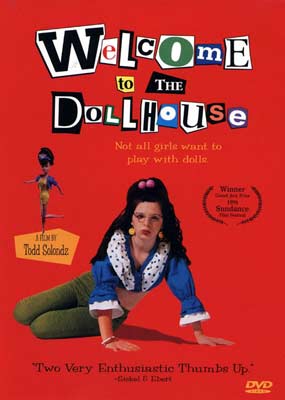
Back to School Part II #30: Welcome to the Dollhouse (dir by Todd Solondz)


wdollhousemovieposter

1995’s Welcome to The Dollhouse is a seriously dark movie.

That really shouldn’t be too surprising.  The film was written and directed by Todd Solondz, a filmmaker who goes out of his way to showcase the darkest corners of human existence.  For that matter, the film stars Heather Matarazzo.  Matarazzo won an Independent Spirit Award for playing Dawn Wiener, a 12 year-old outcast who is nicknamed “Wiener Dog” and essentially spends Welcome to the Dollhouse being tormented by almost everyone in her life.  According to Wikipedia, upon winning the award, Matarzzo announced that she hoped to spend her career playing characters “whom are ostracized for some reason.”

And, if nothing else, Dawn is certainly ostracized.

There’s been a lot of movies that have claimed to be about teen outcasts.  Whenever you watch those films, one thing you immediately notice is that the “outcasts” rarely seem to truly be outcasts.  Instead, they’re often portrayed as artistic types who just need to take off their glasses, let down their hair, and go on a shopping spree.  For instance, Rachael Leigh Cook was an outcast in She’s All That but it turned out that all she needed to do was go out on a date with Freddie Prinze, Jr.  Sissy Spacek, Chloe Grace Moretz, and Emily Bergl all played outcasts in different versions of Carrie but, fortunately, they could always use their psychic powers to kill all the bullies at their school.  Unfortunately, Dawn doesn’t have psychic powers and it’s doubtful that even dating Freddie Prinze, Jr. would help her out.

There’s a scene in Welcome to The Dollhouse in which Dawn witnesses a group of bullies shoving another outcast into a locker.  When Dawn steps forward to ask him if he’s okay, her fellow outcast snaps, “Leave me alone, Weiner Dog!” and then runs off.  Dawn is the outcast that even the other outcasts make fun of.

The entire film is pretty much told from her point of view.  It’s a true journey into the life of an outcast and a chance to see what life looks like when you’re on the outside looking in.  We watch as her family ignores her and instead lavishes their attention on her bratty younger sister, Missy (Daria Kalinina).  When Missy is briefly kidnapped (largely because Dawn neglected to let Missy know that their mother wouldn’t be able to pick her up after ballet class), Dawn even goes, by herself, to New York City and searches for her.  Dawn wants to be the hero of this story but not only does she not find her sister but, when Dawn returns, she discovers that no one even noticed that she was gone.

Dawn does have two friends.  One is a fifth grader whose friendship she quickly loses.  The other is Brandon (Brendon Sexton III), an angry delinquent who, before becoming her friend, tries to rape her.  Brandon, who has a horrific and abusive home life, lights a joint at one point.  Dawn tells him that she doesn’t smoke but then earnestly adds that she does think marijuana should be legal.

Dawn does have an older brother named Mark (Matthew Faber).  Mark is as nerdy as his sister but he appears to have made peace with it.  (Either that or he’s so used to being on the outside that he doesn’t even notice anymore.)  Mark assures Dawn that things will get better but it’ll be a few years.  He also starts a band, which leads to Dawn getting a huge crush on the lead singer, Steve (Eric Mabius).  In fact, Steve is so handsome and charismatic (in a teenage rock star wannabe sort of way) that Dawn doesn’t even realize that, during the rare times that he does talk to her, he’s actually talking down to her…

Welcome to the Dollhouse is one of those films that you watch and you keep waiting for that one moment that Dawn is going to be allowed some sort of victory.  You wait for her to get a compliment.  You wait for her to make a new friend.  You wait for her to smile after coming to some sort of sudden realization.  And it never happens.  If anything, Dawn is more miserable at the end of the movie than she was at the beginning.

In the end, you realize that her only triumph comes from the fact that she’s managed to survive and she now has a better understanding of just how much life is going to suck.  It’s not exactly a happy movie.  It gets even worse if you know that Solondz’s 2004 film, Palindromes, opens with Dawn’s funeral.  (Dawn, we learn, committed suicide after getting pregnant in college.)

And yet, Welcome to the Dollhouse remains compulsively watchable.  Heather Matarazzo does such a good job as Dawn that you find yourself rewatching and hoping things turn out differently.  Whenever I watch Welcome to the Dollhouse, I always think to myself that I would have been nice to Dawn if I had known her.  Of course, that’s probably not true.  No one was nice to Dawn in the movie and no one would probably be nice to her in real life.  At the best, if I had gone to school with Dawn Weiner, I probably would have just patted myself on the back for not being mean to her face.

What sets Welcome to the Dollhouse apart from other teen films is that Todd Solondz is willing to admit this.


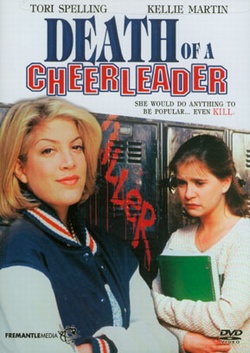
Back to School Part II #29: A Friend To Die For a.k.a. Death of a Cheerleader (dir by William A. Graham)


death_of_a_cheerleader

Over the past couple of year, I’ve had so much fun making fun of Tori Spelling’s performance in the original Mother, May I Sleep With Danger? that I almost feel like I have an obligation to review a movie in which she gave a halfway decent performance.

That film would be another 1994 made-for-TV-movie.  It was apparently originally broadcast as A Friend To Die For but most of us know it better as Death of a Cheerleader.  That’s the title that’s used whenever it shows up on Lifetime.  There actually was a time when Death of a Cheerleader used to show up on almost a monthly basis but that was a while ago.  Lifetime has since moved on to other movies about dead cheerleaders.

Technically, as my sister immediately pointed out when I made her watch the movie, the title isn’t quite correct.  Though Stacy Lockwood (Tori Spelling) does try out for and is named to her school’s cheerleading squad, she never actually gets to cheer.  Instead, shortly after the school assembly in which her selection is announced, Stacy is found stabbed to death.  But really, Death of A Future Cheerleader doesn’t quite have the same ring to it.

As for who killed Stacy … well, it’s no secret.  This is one of those true crime films where the murderer is not only portrayed sympathetically but is the main character as well.  Angela Delvecchio (Kellie Martin) was a high school sophomore who was obsessed with trying to become popular.  She looked up to Stacey and desperately wanted to be her best friend.  (Why she didn’t just offer to bribe Stacey, I don’t know.  Maybe she hadn’t seen Can’t Buy Me Love….)  When Stacey got a job working in the school office, so did Angela.  Of course, the school’s somewhat sleazy principal (Terry O’Quinn, coming across like John Locke’s worst nightmare) only made it a point to talk to Stacey and pretty much ignored Angela.  When Stacey applied to work on the yearbook, so did Angela.  When Stacey tried out for cheerleading, so did Angela.

In fact, the only time that Angela stood up to Stacey was when Angela was taunting the school’s token goth (played by Kathryn Morris).  That turned out to be a mistake because Stacey never forgave her.  When Angela invited Stacey to a party, Stacey was reluctant to go.  When Stacey did finally accept the invitation, Angela stabbed her to death.

A Friend to Die For/Death of a Cheerleader is based on a true story and the film tries to lay the blame for Angela’s crime on the affluent neighborhood she was raised in.  Just in case we missed the message, the film actually features a Priest (played by Eugene Roche) who says that the community put too much pressure on Angela to succeed.

Uhmmm….okay, if you say so.

Seriously, this is a pretty good little true crime film and both Tori Spelling and Kellie Martin give really good performances but this whole “It’s society’s fault” argument is typical, mushy, made-for-TV, bourgeois liberal BS.  Angela picked up the knife, Angela committed the crime, end of story.  That said, A Friend To Die For is pretty good as far as these movies go.  I already mentioned the performances of Spelling and Martin but also keep an eye out for Marley Shelton, who gets a really good scene in which she explains that she never liked Stacey that much while she was alive.

You can watch A Friend To Die For/Death of a Cheerleader below!