4 Shots from 4 Films is just what it says it is, 4 shots from 4 of our favorite films. As opposed to the reviews and recaps that we usually post, 4 Shots from 4 Films lets the visuals do the talking!
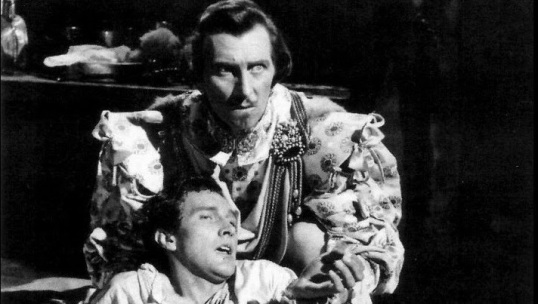
Today is Peter Cushing’s birthday! This edition of 4 Shots From 4 Films is dedicated to him, his memory, and his career!
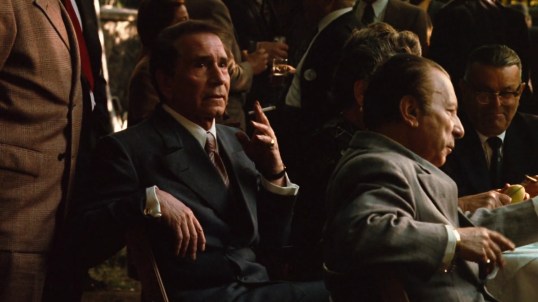
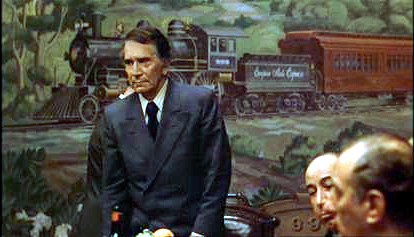
As played by Richard Conte in The Godfather, Barzini is far different from many of the other mob bosses that we meet over the course of Mario Puzo’s and Francis Ford Coppola’s Mafia epic. He doesn’t yell. He doesn’t threaten. If anything, Barzini comes across as almost being a statesman. When it’s time to broker a peace between the Tattaglia and the Corleone families, Barzini is the one who sits at the head of the table. When it’s time to determine how the drug trade will be divided, Barzini is the one who offers up the “sensible” solution. Barzini keeps calm. He knows how to deal with volatile people. He just wants to make sure that peace is restored and everyone gets a fair cut of the profit. “We are not communists,” he says.
It’s after that meeting that Vito Corleone finally realizes that everything that has happened, from the nearly successful attempt on his life to the exile of Michael to the death of Santino, was Barzini’s doing. Barzini perhaps a got a bit too clever for his own good. By so coolly and efficiently brokering the peace, Barzini revealed that was far more clever than the “pimp” Philip Tattaglia. Whereas Tattaglia was too crude to put together a coalition against the Corleones, Barzini was just the type of pitiless manipulator who could convince a group of otherwise powerful people to sign away their own futures. Perhaps he was a communist after all.
Of course, most viewers (and readers) will have figured out that Barzini is the main bad guy long before Vito does. From the first minute that we see Barzini at the wedding reception at the Corleone Compound, we know that he’s a sinister figure. While everyone else at the wedding is being emotional, sentimental, and delightfully Italian, Barzini watches without a hint of emotion. Indeed, the only time we see any real emotion from Barzini is when he smirks at Vito’s funeral.
After his goons unsuccessfully attempt to assassinate Don Vito, Sollozzo famously tells Tom Hagen that “the Don was slipping.” And it’s hard not to feel that Sollozzo had a point. Consider Vito Corleone’s track record in The Godfather. He failed to teach Sonny the basics of being a good Don. He promoted Tom Hagen to consiglieri despite the fact that Tom was viewed as being an outsider by the other Families. When it came time to send someone undercover to investigate the Tattaglias, he gave the job to Luca Brasi despite the fact that everyone knew there was no way that Brasi would actually betray Vito. He stopped to buy fruit, despite not being accompanied by his bodyguards. Worst of all, Vito somehow missed that it was Barzini all along. Vito was slipping. He got complacent. He failed to see how the world was changing and how the old honor system was being discarded. That allowed him to be victimized by Barzini.
Fortunately, Michael was there to take charge. Unfortunately, for Barzini, Al Neri was also there to put on his policeman’s uniform and wait for Barzini to exit from his latest meeting. Barzini took several bullets to the back. Barzini’s driver was caught in the cross-fire. I’ve always felt bad about that. I mean, the driver was just asking why he had been given a parking ticket and Neri shot him. If nothing else, we can see why Neri didn’t make it as a cop.
Barzini and Vito had a lot in common. They were both diplomats who could use violence when necessary. It’s perhaps not a surprise to learn that, before he was cast as Barzini, Richard Conte was one of the many actors considered for the role of Vito Corleone. How different would the film have been with the sinister Conte — as opposed to the likable Brando — in the lead role?
Luckily, Coppola made the right decision. Just as Brando was the perfect Vito, Richard Conte was the perfect Barzini.
It’s hard to imagine that someone could overact while playing a corpse but Louise Fletcher somehow manages to do just that in 1983’s Brainstorm and I think we owe her some respect for that. The underrated Fletched won an Oscar for playing Nurse Ratched in One Flew Over The Cuckoo’s Nest and she appeared in a handful of other films that I’ve liked (Strange Behavior, the 2012 restoration of Once Upon A Time In America) but, now that I’ve watched Brainstorm, I will always think of her playing a dead character with the biggest, hammiest facial expression ever on her otherwise lifeless face.
In Brainstorm, Fletcher plays Dr. Lillian Reynolds, a chain-smoking scientist who is always upset about something. When Lillian isn’t lighting a cigarette or yelling, “You sold me out!,” she’s clutching her chest and taking her heart pills. Working with her partner, Dr. Michael Brace (Christopher Walken), Lillian has developed a brain-computer interface that allows people’s brain waves to be recorded on tape so that others can then experience what they experienced. In practice, this looks like putting on a helmet and then seeing what appears to be a home movie. What fun! Lillian thinks that the interface can be used to change and save the world. Dr. Brace thinks he can use the interface to discover why his marriage to Karen (Natalie Wood) fell apart. Their associate, Hal (Joe Dorsey), thinks he can use it to experience his friend screwing the babysitter over and over and over again. Meanwhile, Alex Taber (Cliff Robertson) thinks that it can be used as a military weapon.
(Hal is probably the one who comes the closest to what people would actually use this technology for.)
Lillian is not happy about her technology being turned over to the military. She gets upset about it over and over again. Eventually, she suffers one of the most overdramatic heart attacks ever recorded on film. Before she dies, she hooks herself up to the machine and records her dying vision. Michael becomes obsessed with seeing what Lillian saw as she entered the afterlife. Unfortunately, the mean military folks have the tape so it looks like Michael is going to have to unleash some chaos. I can’t think of any other film that mixes Christopher Walken having a beatific vision with a bunch of slapstick humor featuring an out-of-control robot and a bunch of soap bubbles.
Today, if Brainstorm is known for anything, it’s as the film that Natalie Wood was shooting when she died. One popular theory about the circumstances surrounding Wood’s death is that she was having an affair with Christopher Walken. Watching the two of them in this film should disabuse anyone of that notion as the two of them have absolutely zero chemistry as a couple. (For the record, I think Wood’s death was an accident and that a lot of self-styled Internet sleuths owe Robert Wagner an apology.) If there’s anything that this film should be known for, it should be that it features a large number of Oscar nominees and winners and they all end up giving absolutely lousy performances. Even the usually wonderful Christopher Walken seems to be playing someone imitating himself. Watching this film, I was never quite sure why anyone was actually doing anything.
Director Douglas Trumbull was best known for designing the Stargate sequence in 2001: A Space Odyssey and, not surprisingly, Brainstorm’s vision of the afterlife is actually pretty effective. One gets the feeling that Trumbull was more comfortable with the special effects than he was with the human actors.
I have to admit that I always smile a little at films where scientists are shocked — shocked, I tell ya! — to discover that their technology is going to be used for military purposes. Why did they think the government was funding them in the first place? Lillian seems to believe that her technology will be used to allow people to experience what it’s like to ride a roller coaster. That’s what IMAX is for.
Hi, everyone! Tonight, on twitter, I will be hosting one of my favorite films for #MondayMania! Join us for 2017’s Deadly Sorority!
You can find the movie on Prime and then you can join us on twitter at 9 pm central time! (That’s 10 pm for you folks on the East Coast.) See you then!
Today, we wish a happy birthday to Cillian Murphy!
Two years ago, Murphy won the Oscar for his role in Oppenheimer. However, before playing the lead role in Christopher Nolan’s epic, Cillian Murphy been an intriguing cinematic presence for over two decades. I first became aware of him after watching Danny Boyle’s 2002 classic, 28DaysLater. Here he is, showing what he can do without even uttering a word of dialogue, in a haunting scene from that film.
4 Shots From 4 Films is just what it says it is, 4 shots from 4 of our favorite films. As opposed to the reviews and recaps that we usually post, 4 Shots From 4 Films lets the visuals do the talking!
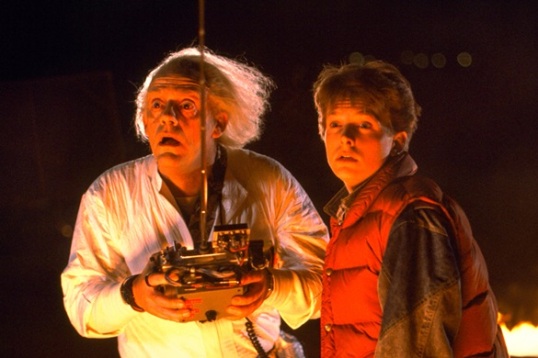
Today, the Shattered Lens wishes a happy birthday to screenwriter Bob Gale! It’s time for….
4 Shots From 4 Films Written By Bob Gale
I Wanna Hold Your Hand (1978, dir by Robert Zemeckis, DP: Donald M. Morgan)
1941 (directed by Steven Spielberg, DP: William A. Fraker)
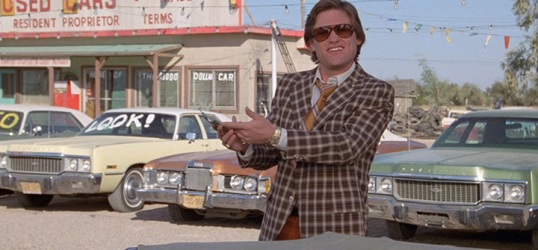
Used Cars (1980, dir by Robert Zemeckis, DP: Donald M. Morgan)
Back to the Future (1986, dir by Robert Zemeckis, DP: Dean Cundey)
As some of our regular readers undoubtedly know, I am involved in hosting a few weekly live tweets on twitter and occasionally Mastodon. I host #FridayNightFlix every Friday, I co-host #ScarySocial on Saturday, and I am one of the five hosts of Mastodon’s #MondayActionMovie! Every week, we get together. We watch a movie. We snark our way through it.
Tonight, for #MondayActionMovie, the film will be Lavalantula!
If you want to join this watch party, just hop onto Mastodon, pull up Kid Cannabis on YouTube, start the movie at 8 pm et, and use the #MondayActionMovie hashtag!
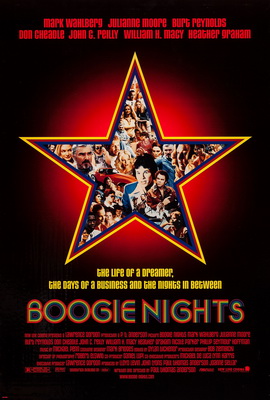
Today is John C. Reilly’s 61st birthday. This provides me with a great reason to share a scene that I love from 1997’s Boogie Nights. After falling out with his director, 70s porn star Dirk Diggler (Mark Wahlberg) attempts to reinvent himself as a rock star. Providing support, both emotionally and musically, is his best friend and frequent co-star, Reed Rothchild (John C. Reilly).
Now, obviously, Wahlberg’s brilliantly tuneless singing usually gets the most attention here but there’s something really touching about Reed’s loyalty in these scenes. It may just be because of the cocaine but you can tell that Reed is perhaps even more convinced of Dirk’s talent than Dirk is.
4 Or More Shots From 4 Or More Films is just what it says it is, 4 shots from 4 of our favorite films. As opposed to the reviews and recaps that we usually post, 4 Shots From 4 Films lets the visuals do the talking!
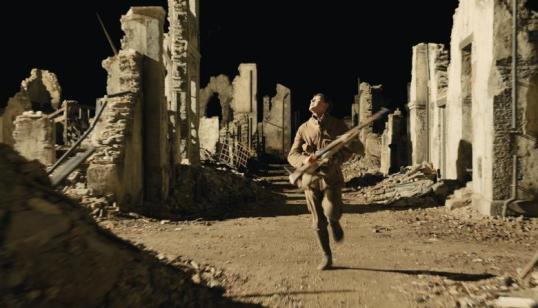
Today, the Shattered Lens wishes a happy birthday to the legendary cinematographer, Roger Deakins! It’s time for….
4 Shots From 4 Roger Deakins Film
Nineteen Eighty-Four (1984, dir by Michael Radford, cinematography by Roger Deakins)
Fargo (1996, dir by the Coen Brothers, cinematography by Roger Deakins)
Kundun (1997, dir by Martin Scorsese, cinematography by Roger Deakins)
1917 (2019, dir by Sam Mendes. cinematography by Roger Deakins)
Well, another Cannes Film Festival has come to a close. Here in America, coverage of this year’s festival felt considerably more low-key than previous festivals. In fact, the conventional wisdom — again, here in America — seems to be that this year’s festival was a disappointment. Personally, I think there’s just some hurt feelings that only two American films were selected to compete this year.
Neither Paper Tiger nor The Man I Love won anything. (Fear not, I’m sure that James Gray will be back with another drama about the Russian mafia next year.) Instead, the Palme d’Or went to Fjord, a film about a traditional Catholic family that finds itself being targeted by a group of progressives. The Guardian gave Fjord a negative review so I imagine it’s pretty good. I look forward to seeing it. It should be noted that, as of the last few years, winning the Palme d’Or has been a plus when it comes to a film’s Oscar chances. (Even the now universally-derided Emilia Perez starting things off by winning at Cannes.) We’ll see if the same holds true for Fjord.
Here are the winners from Cannes:
Palme d’Or: Fjord by Cristian Mungiu
Grand Prix: Minotaur by Andrey Zvyagintsev
Jury Prize: The Dreamed Adventure by Valeska Grisebach
Best Director:
Javier Ambrossi and Javier Calvo for The Black Ball
Paweł Pawlikowski for Fatherland
Best Actress: Virginie Efira and Tao Okamoto for All of a Sudden
Best Actor: Emmanuel Macchia and Valentin Campagne for Coward
Best Screenplay: Emmanuel Marre for A Man of His Time
Un Certain Regard
Un Certain Regard Prize: Everytime by Sandra Wollner
Jury Prize: Elephants in the Fog by Abinash Bikram Shah
Special Jury Prize: Iron Boy by Louis Clichy
Best Actress: Daniela Marín Navarro, Marina de Tavira and Mariangel Villegas for Forever Your Maternal Animal
Best Actor: Bradley Fiomona Dembeasset for Congo Boy
Caméra d’Or
Caméra d’Or: Ben’Imana by Marie Clémentine Dusabejambo
Short Films Competition
Short Film Palme d’Or: For the Opponents by Federico Luis