Film Review: Tobor The Great (dir by Lee Sholem)


Last week, along with my friends and fellow members of the Late Night Movie Gang, I watched the 1954 sci-fi film, Tobor The Great.

As you can probably tell by looking at the top of this review, Tobor came with a really great poster.  It’s a poster that promises all sorts of sci-fi thrills and chills.  It screams, “B-movie masterpiece!”  You look at that poster and you think to yourself, This film is probably extremely silly but I absolutely have to watch it!

Of course, if you know anything about the B-movie aesthetic of the 50s and 60s, you won’t be shocked to learn that the poster has next to nothing to do with the actual film.  True, there is a robot is featured in the film.  The poster is honest about that.  And Tobor actually looks just as good in the movie as he does on the poster.  And there is a subplot about space travel but, at no point, do we see Tobor walking across the surface of Neptune or Jupiter or wherever it is that Tobor is supposed to be in this poster.  Maybe he’s on one of the moons of Saturn.  Who knows?

Also, at no point, does Tobor carry around a woman.  In fact, Tobor is pretty much a film for kids.  The main character, other than Tobor, is an 11 year-old boy named Gadge (Billy Chapin).  I can only imagine how audiences reacted when they went into the film expecting to see the scene in the poster and instead, they were confronted with a movie about a little boy and his robot.

Tobor is one of those films that opens with several minutes of stock footage.  Rockets take off.  The stars shine in the sky.  Scientists and engineers do stuff.  It all looks pretty impressive but, of course, none of it was actually shot for this film.  In fact, the use of all that stock footage mostly serves to highlight how cheap the rest of the movie looks.

As for the film’s plot, it has apparently been determined that it’s too dangerous to send humans into space.  So, Professor Nordstrom (Taylor Holmes) and Dr. Harrison (Charles Drake) build a robot that is specifically designed to fly an interstellar craft.  They name their creation Tobor, because that’s robot spelled backwards.  (Tobor even points out that his name is robot spelled backwards.)  In order to help Tobor explore the universe, they design him to be able to simulate human emotions.  In fact, they’re so successful at it that Tobor ends up befriending Nordstrom’s grandson, the aforementioned Gadge.

The press and the military are all very impressed with Tobor.  Unfortunately, it’s the 1950s and that means that the communists are impressed by Tobor as well!  Can the scientists and their families keep Tobor from getting abducted by a bunch of Russian agents!?  Let’s hope so because there’s a lot of space that needs to be explored….

Anyway, Tobor The Great is silly but kind of fun.  It has its slow spots but it also has a really cool robot and it’s always fun to watch the commies get thwarted.  It’s a real time capsule film, one that not only reflects the decade in which it was made but which also has a somewhat charming innocence to it.  If nothing else, it’s nice to think that, in the days before CGI, the filmmakers actually had to make a Tobor of their own.  Apparently, Tobor is currently in a private collection and I hope whoever has him is treating him well.

Here’s The Trailer for Mission: Impossible — Fallout!


We’re a few days later in sharing this but, as always, it’s better to be late than never!

Say what you will about Tom Cruise.  He’s definitely an actor who I have mixed feelings about.  On the one hand, he’s got undeniable talent and, whenever I watch him in a good movie (like Edge of Tomorrow), I’m surprised to be reminded of just how compelling he can be onscreen.  (Hell, I’d even defend his performance in The Mummy.)  On the other hand, I have some friends who flat-out refuse to watch anything that feature Cruise, specifically because they find the whole Scientology thing to just be too creepy.

But, with all that in mind, the Mission: Impossible films have consistently been exciting and entertaining.  While Daniel Craig’s James Bond spends all of his time drowning in self-pity, Tom Cruise’s Ethan Hunt reminds us of why we love spy films in the first place.

Here’s the trailer for Mission Impossible — Fallout!  This film will be in theaters on July 17th.


Here’s The Trailer For Shock and Awe (which appears to deliver little of either)


Here’s the trailer for Shock and Awe, which is apparently a film about the media at the start of the Iraq War.

Don’t get too excited.  It was directed by Rob Reiner, who hasn’t done anything worthwhile in quite some time.  To be honest, this sounds like exactly the type of project that will bring out all of Reiner’s worst, most middlebrow instincts as a filmmaker.

But who knows?  At least Tommy Lee Jones is in it.

Here’s The Super Scandalous Red Band Trailer For The Happytime Murders!


So, at the start of this year, I thought that The Happytime Murders might be a one of those surprising, no-one-saw-it-coming Oscar nominees.  The film takes place in a world where both humans and puppets co-exist, though puppets are treated like second class citizens.  The film is a murder mystery but, obviously, the plot would seem to suggest that there’s a possibility that there could be a lot more going on underneath the surface.

Then I watched the trailer.

And … yeah, it’s probably not going to be an Oscar nominee.  The Academy has changed a lot of over the last few years but I still don’t know if they’re ready to embrace a film that features muppet jizz.  The trailer for this one so reminded me of Sausage Party that I was shocked to discover that Seth Rogen is not in the film.

However, Joel McHale is!  He’s so adorable.

Also, I noticed that the trailer bragged about being from the same people behind the recent Muppets TV show.  Uhmm … I’ll have to ask Leonard for sure, because I think he’s the only TSLer who regularly watched it, but didn’t everyone hate that show?

Anyway, here’s the red band trailer for The Happytime Murders!  If you have kids, be sure to take them.  You know how much kids love puppets…


Film Review: Fahrenheit 451 (dir by Francois Truffaut)


Tonight, HBO will be premiering a film version of Ray Bradbury’s Fahrenheit 451.  This version will star Michael B. Jordan as “fireman” Guy Montag and Michael Shannon as Montag’s boss, Captain Beatty.  It’s one of the more eagerly anticipated films of the current television season but it’s not the first version of Fahrenheit 451 to be filmed.

The first version was released, by Universal Pictures, in 1966.  It was the first (as well as only) English langauge film to be directed by the great French filmmaker, Francois Truffaut.  (It was also Traffaut’s first color film, allowing the flames to burn in bright yellow and red.)  Unfortunately, Truffaut would later describe the film as being his “saddest and most difficult” film making experience.

Though there are a few noticeable differences, the film sticks closely to the plot of Bradbury’s novel.  Guy Montag (Oskar Werner) is a “fireman” in the near future.  Montag lives in a society where books have been banned and the populace is kept to docile through a combination of pharmaceuticals and mindless television programming.  Montag’s wife, Linda (Julie Christie), is content to live life without questioning anything.  However, when Montag meets a school teacher named Clarisse (also played by Christie), all of his previous assumptions are challenged.  What if the government isn’t always right?  What if ignorance isn’t bliss?  What would happen if, instead of burning books, Montag actually read one?  After witnessing a woman choosing to self-immolate herself so that she can die with all of her books, Montag is finally ready to quit being a fireman.  But his captain (Cyril Cusack) tells Montag that he needs to go on one more call, this one to Montag’s own house.

Truffaut’s film leaves out most of the overly sci-fi elements of Bradbury’s original novel.  For instance, in the novel, Montag is terrified of the robots dogs that the firemen use but the dogs never appear in Truffaut’s film.  As well, Traffaut totally eliminates the character of Faber, the former English professor who uses a portable communicator to keep in contact with Montag.  (Today, of course, that hardly seems like science fiction.)  In Truffaut’s film, the setting is designed to appear as contemporary and familiar as possible, a reminder that the story may have been sent in the future but that the issues it dealt with were relevant to the present.  With this film, Truffaut asked the audience, “How different is the world today from the world of Bradbury’s novel?”

Truffaut’s other big departure from Bradbury’s text was to cast Julie Christie as both Clarisse and Linda.  In the book, Montag’s wife was named Mildred and Bradbury went of out of his way to establish her as being the exact opposite of Clarisse.  In Truffaut’s film, the double casting of Christie seems to suggest that Clarisse and Linda are two sides of the same character.  Montag loves them both, though each appeals to a different part of Montag’s psyche.  Linda appeals to the side of Montag that wants to just accept things the were they are and be happy.  Clarisse, meanwhile, represents the part of Montag that wants to be free to feel everything, even if it means occasionally being unhappy or uncertain.  When Montag finally meets the Book People, he discovers that they are just as fanatical about memorizing and reciting books as Linda was about watching her television shows.  Was this intentional on Truffaut’s part, a suggestion that both the government and the rebels are, like Clarisse and Linda, two sides of the same coin?

It’s an intriguing but uneven movie.  Truffaut apparently didn’t have a great working relationship with Oskar Werner and, at times, Werner doesn’t seem to be particularly invested in the role of Montag.  (Interestingly enough, it’s also been suggested that Jacqueline Bisset’s character in Day For Night was inspired by Truffaut’s experiences working with Julie Christie in this film.)  When the characters interact, the dialogue sometimes feel stiff and dull, as if Truffaut never got over his discomfort with having to direct a film in something other than his native French.  At the same time, the film is full of hauntingly beautiful images, from the defiant woman standing in the middle of her burning books to the Book People walking through the snow.  Truffaut makes brilliant use of color and the visuals are often strong enough to overcome even Oskar Werner at his most sullen.

Fahrenheit 451 is an imperfect movie but one worth seeing.  Will the new HBO version be able to match it?  We’ll find out soon enough.

Here’s What Won At Cannes 2018!


This year’s strangely low-key Cannes Film Festival has come to a close!  Here’s what won at Cannes this year:

In Competition

Palme d’Or: Shoplifters by Hirokazu Kore-eda
Grand Prix: BlacKkKlansman by Spike Lee
Best Director: Paweł Pawlikowski for Cold War
Best Screenplay:
Alice Rohrwacher for Happy as Lazzaro
Jafar Panahi for 3 Faces
Best Actress: Samal Yeslyamova for Ayka
Best Actor: Marcello Fonte for Dogman
Jury Prize: Capernaum by Nadine Labaki
Special Palme d’Or: Jean-Luc Godard

Un Certain Regard

Un Certain Regard Award: Border by Ali Abbasi
Un Certain Regard Jury Prize: The Dead and the Others by João Salaviza and Renée Nader Messora
Un Certain Regard Award for Best Director: Sergei Loznitsa for Donbass
Un Certain Regard Jury Award for Best Performance: Victor Polster for Girl
Un Certain Regard Award for Best Screenplay: Meryem Benm’Barek-Aloïsi for Sofia

Cinéfondation

First Prize: The Summer of the Electric Lion by Diego Céspedes
Second Prize:
Calendar by Igor Poplauhin
The Storms in Our Blood by Shen Di
Third Prize: Inanimate by Lucia Bulgheroni

The question that we ask every year is whether the Cannes Film Festival will have any effect on the Oscar race.  We especially ask that whenever an American film wins the Palme d’Or or an American or British performer takes home one of the acting prizes.  This year, BlacKkKlansman was the highest rewarded American film, though it didn’t pick up the Palme.  That said, even if it didn’t win the top prize, BlacKkKlansman did receive rapturous reviews, certainly enough justify it’s current status as a possible Oscar nominee.

So, in the end — who knows?

Cleaning Out The DVR: Widsom (dir by Emilio Estevez)


(I recorded the 1986 film, Wisdom, off of Retroplex on Mary 1st.)


(SPOILER ALERT!  The ending of this film is so extremely stupid that there’s no way I’m not going to discuss it in this review.)

Meet John Wisdom (Emilio Estevez)!

He’s got one of those ironic names, as people in pretentious movies often do.  He’s extremely naive but his name is Wisdom.  He does a lot of stupid crap but his name is Wisdom.  And I guess the audience is meant to feel that Wisdom understands more than even he knows.

Or something like that.

Who knows?

Anyway, John Wisdom has got some issues.  He’s a college dropout who can’t get a good job because he has a criminal record.  He didn’t really do anything wrong, of course.  All he did was steal a car on the night of his high school graduation.  Hey, who hasn’t done that?  Anyway, Wisdom would be happy to just spend all day sitting around in his bathtub but his father (Tom Skerritt) insists that Wisdom find some sort of employment.

Eventually, Wisdom ends up working in a fast food restaurant.  It turns out that he’s not very good at it, which leads me to suspect that Wisdom probably wouldn’t be very good at any of the other jobs that he was pursuing either.  To be honest, the main reason that Wisdom works at the restaurant is so that Charlie Sheen can have a cameo as Wisdom’s boss.

(Strangely, Martin Sheen is nowhere to be found in the movie.  It wouldn’t surprise me if Emilio Estevez — who both directed and wrote the script — originally envisioned Martin playing his father.  Tom Skerritt does an extended Martin Sheen impersonation as Daddy Wisdom.)

Anyway, Wisdom decides that since the system refuses to give him a fair chance, he’s going to live the rest of his life as an outlaw.  So, Wisdom starts to rob banks.  However, instead of stealing all of the money, Wisdom is more interested in setting fire to mortgage and loan records.  Wisdom explains, via voice over, that he’s concerned about the working people who keeps getting screwed over by the banks.  That’s all good and well but I thought the whole reason that Wisdom started robbing banks was because there was no other way for him to make any money.  So, when did Wisdom go from being a greedy criminal to an altruistic rebel?

Naturally, Wisdom and his girlfriend, Karen (Demi Moore), becomes folk heroes.  Everyone wants to meet Wisdom and protect him from the police.  But eventually, Karen gets gunned down by a police helicopter.  Poor Karen.  She didn’t even want to rob banks.  Well, actually, she did want to rob banks.  And then she didn’t.  And then she did again.  Karen’s motivation and personality changes from scene-to-scene, largely because she’s a poorly written character.  But no matter.  She’s dead now.

But Wisdom’s still alive!  Except, soon, he finds himself surrounded by cops.  Standing in the middle of a football field (Oh my God!  The symbolism!), Wisdom is gunned down by law enforcement…

…except suddenly, Wisdom’s back in the bathtub.  Apparently, he was just daydreaming about his girlfriend getting gunned down in front of him.  Wait … what?  Seriously, what type of ending is that!?  At the very least, the film could have ended with Wisdom robbing a bank for real and accepting that his dream is destined to come true.  I mean, that would have been stupid but at least it would have been something.  Instead, things end with Wisdom leaving the bathroom.

So, basically, the entire film was just Wisdom daydreaming about robbing banks and eventually getting gunned down on a football field.  Oh, Wisdom.  You got some issues, sweetie!

Emilio Estevez directed this film a year after appearing in The Breakfast Club.  Like many directorial debuts, it’s incredibly dumb.  You can tell that Estevez wasn’t sure what he wanted to say but he was still damn determined to say it.  Why do so many actors end up directing such pretentious and/or boring movies?  On the plus side, there were a few attempts at deliberate humor (Wisdom is not a particularly organized bank robber) and Demi Moore did a fairly good job playing an inconsistent character.  Otherwise, Wisdom is mostly memorable for having one of the worst endings of all time.

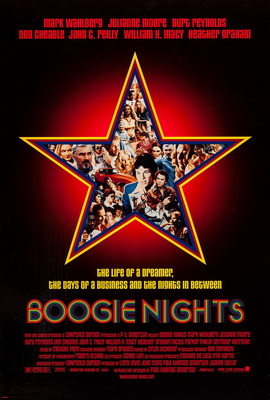
Scenes That I Love: The Awards Ceremony From Boogie Nights


I would like to think that when the Palme d’Or is awards in Cannes, it’ll be half as exciting as when Dirk Diggler (Mark Wahlberg) picked up his second Best Actor trophy in Paul Thomas Anderson’s Boogie Nights.

Now, the scene below is actually the extended version of the scene that actually appeared in the movie.  In the movie, you just see Jack Horner (Burt Reynolds) watching his latest film and then cut to Dirk picking up his award.  In the extended version, we get to see everyone’s reaction to Dirk winning.  They’re all there — Burt Reynolds, William H. Macy, Nina Hartley, John C. Reilly, Melora Waters, Luis Guzman, Julianne Moore, Heather Graham, Don Cheadle, Robert Ridgely (as the memorably corrupt Colonel), and, of course, the dearly missed Philip Seymour Hoffman.

I can understand why Anderson chose to go with a shortened version of this scene.  Boogie Nights is a long film and obviously, it wasn’t totally necessary to see how everyone reacted to Diggler’s victory.  (By that point, in the film, we already knew how everyone felt about him.)  That said, I do prefer the extended version.  If nothing else, it’s a reminder that Boogie Nights was more than just the story of Dirk Diggler.  Instead, it was the story of a group of outcasts who became a family.

Anyway, let’s hope that whoever wins the Palme d’Or will be a bit more enthusiastic about it than Dirk.

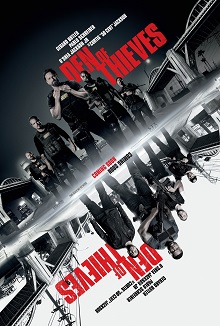
Film Review: Den of Thieves (dir by Christian Gudegast)


Den of Thieves is quite simply one of the most exhausting films that I’ve ever sat through.

It’s not just that the film itself is overly long, though that’s definitely an issue.  (Den of Thieves last 2 hours and 20 minutes.  For the sake of comparison, that’s 17 minutes longer than last year’s best picture winner, The Shape of Water.)  Instead, the real problem is that there’s really not a single unexpected moment to be found in Den of Thieves.  Every cliché imaginable shows up in Den of Thieves and, after a while, the film’s predictability becomes a bit much to take.

It’s a bank heist film.  We know that because it opens with a strangely portentous title card that informs us that more banks are robbed in Los Angeles than anywhere else in the country.  This is one of those heist films where a self-destructive police detective goes head-to-head with a ruthless yet sympathetic criminal mastermind.  If you’re thinking that this sounds a lot like Heat, you’re right.  In fact, imagine if they remade Heat without any of the stuff that made Heat more than just another crime film and you have a pretty good idea what you’re going to get with Den of Thieves.

The detective is named Big Nick O’Brien (Gerard Butler) and we know he’s a badass because he’s got a lot of tattoos and a beard and when he’s not busting criminals, he’s either getting drunk or getting served with divorce papers.  Nick’s an asshole but that’s okay because Nick … NICK GETS RESULTS, GODDAMMIT!  Nick has a crew that’s devoted to him.  Of course, a lot of them will be dead by the end of the movie.  That’s just the way things go when you’re living in a clichéd crime film.

Big Nick wants to take down Merrimen (Pablo Schreiber), who is a former marine turned bank robber.  We know that Merrimen is a badass because he’s got a beard and he’s got even more tattoos than Nick!  In fact, his entire crew is covered with tattoos!  You have to wonder how smart these criminals are, all getting body art that will make it very easy for the police to identify them.  But they’re a good crew.  In fact … THEY’RE THE BEST!  THEY GET RESULTS!  And only Nick can take them down because … ONLY THE MOTHERFUCKING BEST CAN TAKE DOWN THE MOTHERFUCKING BEST, GODDAMMIT!

Sorry, am I yelling a lot?  This is one of those films where everyone yells a lot.  Basically, this entire movie is drenched in testosterone.  This is one of those films where no one gets interrogated with getting knocked around beforehand and where every meeting is some sort of confrontation.  When the end credits rolled, I was shocked to learn that some of these people actually had names.  Just from listening to the dialogue, I assumed everyone in the film was named “Motherfucker.”

And again, it just all gets exhausting after a while.  Maybe if Den of Thieves had been a 90 minute action flick or had featured any of the self-aware humor of Baby Driver, it would have been entertainingly dumb.  But 140 minutes is a long time to spend with a bunch of thinly drawn stereotypes.

Now, there are two positive things that can be said about Den of Thieves.

First off, one of the thieves is played by O’Shea Jackson, Jr. and he’s got enough screen presence that he can overcome some clunky scenes.  (A scene where he’s interrogated by the police literally seems to go on forever.)

Secondly, the film itself looks great.  The film’s opening scenes do a good job of capturing Los Angeles’s unique mix of grit and glitz.  The opening shootout is pretty well-done and briefly suggests some promise on which the film ultimately doesn’t deliver.

Anyway, Den of Thieves came out this January and despite middling reviews, it did well enough at the box office to earn itself a sequel.  So, in 2020, look forward to more scenes of Gerard Butler … GETTING RESULTS!

Cannes Film Review: The Silent World (dir by Jacques Cousteau and Louis Malle)


In the history of Cannes Film Festival, only two documentaries have won the Palme d’Or.

The second documentary to win was Michael Moore’s Fahrenheit 9/11, which won in 2004 despite not being a particularly good film.  In fact, even by the standards of Michael Moore, it was deceptive and sloppy.  However, it was also anti-Bush at a time when the entire world was anti-Bush and that was enough for it to win.  (Hilariously, at the time, there was serious talk that Fahrenheit 9/11 would somehow keep Bush from winning reelection, as if anyone who was even thinking of voting for Bush would have ever bothered to sit through Moore’s film.)

Far more interesting than Moore’s screed is the first documentary to win the Palme, 1956’s The Silent World.  Narrated and co-directed (with Louis Malle) by the famed oceanographer, Jacques Cousteau, the film follows Cousteau and the crew of Calypso over the course of two and a half years, as they explore the Mediterranean Sea, the Persian Gulf, the Red Sea and the Indian Ocean.  The film was one of those first to make use of underwater color photography, which at the time was quite revolutionary.  Chances are that, for many audiences in 1956, The Silent World was their first chance to see what the undersea world was actually like.

Unfortunately, Jacques and his merry band of divers spend a good deal of the documentary destroying stuff.  Watching the film, it’s obvious that the divers don’t understand the potential damage of their actions and Cousteau would go on to renounce a lot of the exploration techniques used in The Silent World but still, it’s hard not to occasionally cringe.  Watching the divers as they explore the underwater depths, you immediately notice that they seem to be rather grabby, snatching everything that they can off of the ocean floor.  When Cousteau feels that a coral reef is getting in the way of his research, he solves the problem with dynamite.  Then there’s the scene where the crew of Calypso kill several sharks that are eating the carcass of a baby whale.  (Cousteau explains that the shark is the diver’s natural enemy, which may be true but doesn’t excuse the slaughter that follows.)  Making all of this even worse is that the baby whale wouldn’t have died in the first place if it hadn’t been hit by the Calypso’s propeller.  Scenes like that leave you wondering if maybe it would be better for everyone is Jacques and his crew just went home.

And yet, at the same time, this documentary features scenes of underwater beauty that remains breathtaking even after 62 years.  The underwater camera captures schools of beautiful fish ducking out-of-the-way of the human invaders and, in the films most haunting sequence, we follow a diver as he explores a sunken ship.  In these moments, the beauty of the underwater world overwhelms you and you forget about your reservations about what’s going on with the crew of the Calypso.  In these moments, you embrace the beauty of it all and the world suddenly seems as if its full of limitless possibilities.

In those moments, you can understand why The Silent World not only won an Oscar for Best Feature Documentary but the coveted Palme d’Or as well.