4 Shots From 4 Films is just what it says it is, 4 shots from 4 of our favorite films. As opposed to the reviews and recaps that we usually post, 4 Shots From 4 Films lets the visuals do the talking!
Today is Jack Nicholson’s 83rd birthday!
It’s been ten years since Jack Nicholson last appeared in a movie, the forgettable How Do You Know. Rumor has it that he’s basically retired from acting, though it’s said that Nicholson himself has denied it. However, whether he’s working or not, he remains a screen icon with a filmography that is a cinema lover’s dream. He’s worked with everyone from Roger Corman to Stanley Kubrick to Milos Forman to Martin Scorsese and, along the way, he’s become a symbol of a very American-type of rebel. Though often associated with the counter-culture, his style has always been too aggressive and idiosyncratic for him to be a believable hippie. Instead, he’s one of the last of the beats, an outsider searching for meaning in Americana.
Over the course of his career, Nicholson has won three Oscars and been nominated for a total of 12. He’s the only actor to have been nominated in every decade from the 1960s to the 2000s. If he ever writes his autobiography, you know that we’ll all run out and buy a copy. When the day comes that Jack Nicholson is no longer with us, it will truly be the end of an era.
Happy birthday, Jack Nicholson. May you have many happy returns!
4 Shots From 4 Films is just what it says it is, 4 shots from 4 of our favorite films. As opposed to the reviews and recaps that we usually post, 4 Shots From 4 Films lets the visuals do the talking!
Today would have been Edie Sedgwick’s 77th birthday. Unfortunately, she died under tragic circumstances in 1971, after having briefly found fame as a model, a “youthquaker” (as some in the media called her), an actress, and Andy Warhol’s muse. Her tragic life is often held up as a cautionary tale and perhaps it is. For all of her talent and her appeal (not to mention that sharp wit that made her an outsider in the 60 but which would have made her a fascinating interview subject in 2020), Edie was far too often exploited by those who should have been protecting her. She was too beautiful not to be famous but, at the same time, too sensitive not be hurt by the experience. She’s truly a tragic figure but, because she also epitomizes everything that the New York underground art scene in the 60s represents in the popular imagination, she’s also an inspiring one. Edie lives forever as a symbol and a muse. Personally, I’ve been fascinated by her life for as long as I can remember.
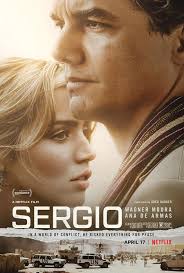
Sergio, which dropped on Netflix last Friday, is a biopic of the Brazilian diplomat, Sérgio Vieira de Mello. Sergio spent 34 years as a diplomat with the United Nations, going to some of the most dangerous places in the world and trying to negotiate with people who were determined to kill one another. Sergio was so respected within the UN that he was seen as a likely candidate for Secretary-General. Instead, in 2003, Sergio was killed in a terrorist attack while he was in Baghdad, observing the American occupation of Iraq.
Starring Wagner Moura in the title role, Sergio opens with Sergio arriving in Baghdad. For the majority of the film, he’s buried in the rubble of his blown-up office, thinking about his past life while an American soldier (played, with quiet authority, by Garret Dillahunt) tries to dig him and his assistant, Gil (Brian F. O’Byrne) out. Through the use of flashbacks, we watch as Sergio negotiates peace in East Timor and argues against the occupation of the Iraq. We also watch as he meets and falls in love with Carolina (Ana de Armas), pursuing a passionate affair with her despite being married.
Sergio is a rather staid biopic. If you’re expecting to see an Adam McKay-style screed about international diplomacy and American war crimes, that is not what this film is and we should be happy for that because, seriously, have you tried to watch The Big Short or Vice lately? Instead, Sergio is more like a Jay Roach film without the attempts at humor. It’s a blandly liberal biopic that is conventionally structured and a bit too convinced that the audience is going to automatically agree with its points. Indeed, one of the film’s most glaring flaws is that it assumes that we’re all as enamored with the UN as it is. Instead of making a case for why the UN should be taken seriously, Sergio just assumes that it is.
The other big problem with the film is that it’s just boring. There’s nothing interesting about the film’s structure and, as portrayed in the rather bland script, both Sergio and Carolina come across as being ciphers. We’re constantly told that Sergio is charismatic and controversial but we really don’t see much evidence of it. The film itself doesn’t seem to know what made Sergio tick but what’s even worse is that it doesn’t seem to be particularly interested in finding out. There’s not much interest in digging into Sergio’s mind or his motives, The film forgets that you can portray someone as a hero and celebrate their accomplishments without necessarily idealizing them. With the exception of one or two scenes (and there is an effective moment where one of Sergio’s assistants does call him out for putting everyone’s life in danger by refusing to accept protection from the U.S. army), Sergio is portrayed in such an idealized that he comes across as being a bit dull. Wagner Moura is an appealing actor but there’s no depth to his performance. Meanwhile, Ana de Armas is reduced to playing the stock girlfriend with a social conscience role.
All that said, I almost feel guilty about not liking Sergio. The film was made with good intentions but good intentions don’t necessarily translate to compelling storytelling.
A couple checks into a vacation rental, only to find that the anonymous host likes to play games on its guests and you!
Ashley Bell (The Last Exorcism) and Noureen DeWulf (Good Girls) as a couple who soon regrets renting this picturesque home for their long awaited vacation.
Quote:
“Dear Guest, you are staying in my home now. You are locked in so don’t try to run.”
My Review:
Dear Guestis only about a 12 minute short horror movie. However, in those short 12 minutes Megan Freels Johnston (Director and writer) did everything she could to intrigue, scare, and horrify. After watching it several times I am still shaken. The music that plays in the background is just so enticing and enchanting…before you know it you are completely…Locked in….
Would I Recommend this movie?
Seriously, in less than 12 minutes ‘Dear Guest’ scared me, not only scared me, horrified me beyond most recent short books, movies, and novellas I have watched or read recently. So, for short story horror fans…. This!
I’m not sure how to explain it, but…. Enjoy Your Stay….
Earlier tonight, as I watched the 2008 Italian film, Il Divo, it occurred to me that political corruption really is an international language.
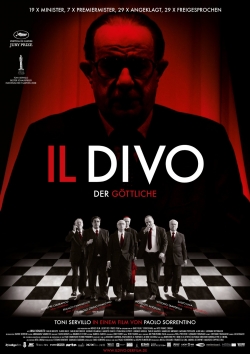
The film is heavily stylized biopic of Giulio Andreotti. Andreotti (who died five years after the release of this film) is nearly unknown figure in the United States but, in Italy, he spent several decades as a member of the country’s political elite. He was a controversial figure, a man who served several terms as prime minister and was later appointed senator for life but who was also accused of being politically corrupt and affiliated with some of the worst elements of the Mafia. People who threatened to investigate Andreotti or who could have contributed to his downfall had a habit of ending up dead. No sooner has Il Divo begun then we’re treated to a lengthy montage of Andreotti’s associates getting killed in various ways. Some are gunned down. One is found hanging underneath a bridge. One is in an exploding car. The film also opens with a title card that informs us that, over the course of Andreotti’s long career, he was rumored to be one of the leading members of the P2, a masonic lodge that counted among its members some of the most powerful men in Italy. P2 is one of those organizations that conspiracy theorists love to obsess upon.
Directed by Paolo Sorrentino, Il Divo is an Italian film that deals with the life of a prominent Italian political figure and, needless to say, it was made for an Italian audience. For an American viewer like me, it was often impossible not to get confused as I tried to keep up with who was working with who and who had just been killed. In short, this film was made to be viewed by people who already know who Guilo Andreotti was and who are familiar with the details of his long career. It was not made for someone like me who is still struggling to wrap her mind around the fact that Italy has both a prime minister and a president.
But, in the end, it really didn’t matter if I occasionally struggled to follow every twist and turn of Andreotti’s career. Il Divo may technically by a biopic of Giulio Andreotti but, on a larger scale, it’s about how power corrupts and the banality of evil. Those are universal themes and you certainly do not have to be any particular nationality to be familiar with the fact that people who dedicate their lives to accumulating political power often turn out to be, at the very least, willing to cut some ethical corners. I may not have always understood every detail of Il Divo‘s story but I did understand exactly what the film was ultimately about.
As played by Toni Servillo, Andreotti does not come across as being particularly charismatic politician. With his hunched back and his bat-like ears, Andreotti almost seems like a caricature of a corrupt leader. In the film, one immediately sees that Andreotti hasn’t held onto his power because he’s particularly loved by the people. Instead, he’s held onto power by being smarter than those who would try to defeat him. No matter how determined his enemies may be, Andreotti is always just a little bit more ruthless. Andreotti succeeds because he’s willing to do what he has to do to succeed and he’s willing to ally himself with people who have a stake in his continued success. While the film never comes out and says that Andreotti was personally responsible for ordering the deaths of any of his enemies, it does suggest that he purposefully surrounded himself with men who would do anything to keep Andreotti in power, if just to protect their own fiefdoms of corruption.
There’s an early scene in Il Divo where Andreotti’s allies all arrives for a meeting with the prime minister. Most of them are politicians. One of them is a cardinal. Another is simply identified as being a “businessman.” They pull up in their expensive cars and then we watch as they walk across the screen in slow motion, arrogantly confident in the fact that they’re above any and all legal or ethical considerations. They’re all wealthy men and they all seem to understand the importance of keeping Andreotti happy. Carlo Buccirosso plays Paolo Cirino Pomicino, who was one of Andreotti’s chief allies. Buccirosso plays Pomincino as being glibly hyperactive, a cheerfully corrupt ball of energy who seems to be having all of the fun that Andreotti denies himself. Because Andreotti denies himself an interest in anything other than wielding and holding power, he is invulnerable to attack and prosecution but sometimes it’s hard not to wonder if he would have rather have been Pomincino, dancing at parties and sliding across tiled floors.
Indeed, Andreotti begins and ends Il Divo as an enigma. How deeply involved is he in the murders occurring around him? Is he ordering them or is he just turning a blind eye? What makes Andeotti tick? By the end of the film, his main motivation seems to be bitterness. Death may be inevitable but he’s not going to go until everyone else goes first. That is a motivation that many politicians across the world probably share. Corruption is universal.
The 1961 film, King of Kings, was the final biblical film that I watched on Easter. Like The Greatest Story Ever Told, it tells the story of Jesus from the Nativity to the Ascension. Like The Greatest Story Ever Told, it’s an epic film that was directed by a renowned director. (In this case, Nicholas Ray.) Like The Greatest Story Ever Told, King of Kings also has a huge cast and there’s a few familiar faces to be seen, though it doesn’t really take the all-star approach that George Stevens did with his telling of the story.
Probably the biggest star in King of Kings was Jeffrey Hunter, who played Jesus. Hunter was in his 30s at the time but he still looked young enough that the film was nicknamed I Was A Teenage Jesus. (Some of that also probably had to do with the fact that Nicholas Ray was best known for directing Rebel Without A Cause.) But then again, for a man who had so many followers, Jesus was young. He hadn’t even reached his 40th birthday before he was crucified. As well, his followers were also young while his many opponents were representatives of the establishment and the old way of doing things. It makes perfect sense that Jesus should be played by a young man and Hunter gives a good performance. As opposed to so many of the other actors who have played Jesus in the movies, Jeffrey Hunter is credible as someone who could convince fishermen to throw down their nets and follow him. He’s passionate without being fanatical and serious without being grim. He’s a leader even before he performs his first miracle.
King of Kings is one of the better films that I’ve seen about the life of Jesus. While remaining respectful of its subject, it also feels alive in the way that so many other biblical films don’t. Perhaps not surprisingly, Nicholas Ray focuses on the idea of Jesus as a rebel against the establishment. Ray emphasizes the casual cruelty of the Romans and their collaborators. When John the Baptist (Robert Ryan) is arrested by Herod (Frank Thring), it’s not just so the filmmakers can have an excuse to work Salome (Brigid Bazlen) in the film. It’s also to show what will happen to anyone who dares to challenge the establishment. When Jesus visits John the Baptist in his cell, it’s a summit between two rebels who know that they’re both destined to die for the greater good. When Pilate (Hurd Hatfield) makes his appearance, he’s smug and rather complacent in his power. He’s not the quasi-sympathetic figure who appears in so many other biblical films. Instead, he’s the epitome of establishment arrogance.
As a director, Nicholas Ray keeps things simple. This isn’t Ben-Hur or The Ten Commandments. The emphasis is not on grandeur. Instead, the film is about common people trying to improve the world in which they’re living, while also preparing for the next. Jeffrey Hunter gives an excellent performance as Jesus and, all in all, this is one of the better and more relatable biblical films out there.
The 2016 film, Forty Nights, opens with John the Baptist (Terry Jernigan) baptizing a surprisingly mellow Jesus (DJ Perry) while John’s followers watch. After Jesus is baptized, the voice of God echoes through the land and, once again, the thing that struck me was just how laid back God sounded. It’s rare that we ever see either Jesus or his Father portrayed as being so calm and easy-going and I have to say that I found it to be a somewhat nice change of pace from the more intense approach the most actors tend to take. Of course, I don’t know if that was intentional or just a happy accident. It was probably the latter.
After getting baptized, Jesus spent 40 days and 40 nights, fasting in the Judaen desert and proving his own faith. During that time, Jesus was tempted three times by the Devil, who appeared in various guises and tried to convince Jesus to not only break his fast but to also wantonly display his power. The Devil tempted Jesus to turn stones into bread. He tempted Jesus to jump from the pinnacle of a temple so that the angels might break his fall. Finally, he offered to give Jesus all of the kingdoms of the world in return for Jesus worshiping him. Not surprisingly, this confrontation between Satan and Jesus has proven popular with both writers and filmmakers. For instance, The Greatest Story Ever Told featured Donald Pleasence as a smug Satan. The more recent Last Days In The Desert featured Ewan McGregor playing both Jesus and Satan.
Forty Nights takes a no-frills approach to the 40 days and nights that Jesus spent in the wilderness, alternating between scenes of Jesus being tempted and flashbacks to Jesus’s youth. Sometimes, the low-key approach is effective and sometimes, you find yourself longing for the more over-the-top approach that other films brought to the same material. For a battle between good-and-evil, there’s not really much of a battle to be found in this film. Over and over again, Satan appears, taunts Jesus, and then Jesus tells him to go away. While that may be faithful to the narrative, it doesn’t quite work in the film because, at no point, does there seem to be any risk of Jesus giving into Satan’s temptations. Because Jesus, in this film, never seems to be truly tempted, there’s less triumph to him refusing to give in. Instead of being about Jesus showing strength and faith, Forty Nights often seems like it’s more about Satan’s inability to take the hint and go away. The film is at its best when Satan and Jesus are debating each other atop of the temple and oddly enough, the effectiveness of that scene is largely due to how badly the film’s green screen effects are integrated into the film. It gives the entire scene an otherworldly, almost dream-like feel.
Anyway, Forty Nights is a film that will probably be best appreciated by those who already agree with the film’s viewpoint. This is not the faith-based film that’s going to convert unbelievers and ultimately, it fails to maintain any sort of real narrative momentum. Still, the temptation in the wilderness is still an effective and intriguing narrative and one to which filmmakers will probably continue to return.
The 1965 biblical epic, The Greatest Story Ever Told, tells the story of the life of Jesus, from the Nativity to the Ascension. It’s probably the most complete telling of the story that you’ll ever find. It’s hard to think of a single details that’s left out and, as a result, the film has a four hour running time. Whether you’re a believer or not, that’s a really long time to watch a reverent film that doesn’t even feature the campy excesses of something like The Ten Commandments.
(There’s actually several different version of The Greatest Story Ever Told floating around. There’s a version that’s a little over two hours. There’s a version that’s close to four hours. Reportedly, the uncut version of the film ran for four hour and 20 minutes.)
Max von Sydow plays Jesus. On the one hand, that seems like that should work because Max von Sydow was a great actor who gave off an otherworldly air. On the other hand, it totally doesn’t work because von Sydow gives an oddly detached performance. The Greatest Story Ever Told was von Sydow’s first American film and, at no point, does he seem particularly happy about being involved with it. von Sydow is a very cerebral and rather reserved Jesus, one who makes his points without a hint of passion or charisma. When he’s being friendly, he offers up a half-smile. When he has to rebuke his disciples for their doubt, he sounds more annoyed than anything else. He’s Jesus if Jesus was a community college philosophy professor.
The rest of the huge cast is populated with familiar faces. The Greatest Story Ever Told takes the all-star approach to heart and, as a result, even the minor roles are played by actors who will be familiar to anyone who has spent more than a few hours watching TCM. Many of them are on screen for only a few seconds, which makes their presence all the more distracting. Sidney Poitier shows up as Simon of Cyrene. Pat Boone is an angel. Roddy McDowall is Matthew and Sal Mineo is Uriah and John Wayne shows up as a centurion and delivers his one line in his trademark drawl.
A few of the actors do manage to stand out and make a good impression. Telly Savalas is a credible Pilate, playing him as being neither smug nor overly sympathetic but instead as a bureaucrat who can’t understand why he’s being forced to deal with all of this. Charlton Heston has just the right intensity for the role of John the Baptist while Jose Ferrer is properly sleazy as Herod. In the role Judas, David McCallum looks at the world through suspicious eyes and does little to disguise his irritation with the rest of the world. The Greatest Story Ever Told does not sentimentalize Judas or his role in Jesus’s arrest. For the most part, he’s just a jerk. Finally, it’s not exactly surprising when Donald Pleasence shows up as Satan but Pleasence still gives a properly evil performance, giving all of his lines a mocking and often sarcastic bite.
The Greatest Story Ever Told was directed by George Stevens, a legitimately great director who struggles to maintain any sort of narrative momentum in this film. Watching The Greatest Story Ever Told, it occurred to me that the best biblical films are the ones like Ben-Hur and The Robe, which both largely keep Jesus off-screen and instead focus on how his life and teachings and the reports of his resurrection effected other people. Stevens approaches the film’s subject with such reverence that the film becomes boring and that’s something that should never happen when you’re making a film set in Judea during the Roman era.
I do have to admit that, despite all of my criticism of the film, I do actually kind of like The Greatest Story Ever Told. It’s just such a big production that it’s hard not to be a little awed by it all. That huge cast may be distracting but it’s still a little bit fun to sit there and go, “There’s Shelley Winters! There’s John Wayne! There’s Robert Blake and Martin Landau!” That said, as far as biblical films are concerned, you’re still better off sticking with Jesus Christ Superstar.
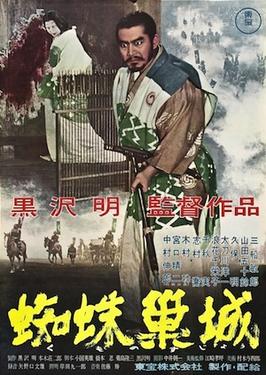
In feudal-era Japan, two great Samurai commanders, Miki (Akira Kubo) and Washizu (Toshiro Mifune) stumble upon a mysterious spirit (Chieko Naniwa) who tells them both their futures. Though her prophecies are cryptic, it appears that she is predicting that, some day, Washizu will become the “Lord of the Spider Web’s Castle” and that he will eventually be succeeded by Miki’s son. When Washizu later returns to his wife, Asaji (Isuzu Yamada), he tells her about the prophecy. The ambitious Asaji encourages to make the prophecy come true by murdering the local lord, Lord Tsuzaki (Hiroshi Tachikawa)….
Does this sound familiar? The 1957 Japanese film, Throne of Blood, is a version of Macbeth, with the action moved from Scotland to Japan and the three witches replaced by one spirit. It’s an enthralling film, though it probably does help to already be familiar with the plot of Macbeth before watching the film. Director Akira Kurosawa keeps the action moving at a quick pace and he doesn’t always stop to carefully explain everyone’s motivations. That’s not a complaint, by the way. Kurosawa emphasizes the confusion of living in a world of constant war and constant scheming. As envisioned by both Shakespeare and Kurosawa, the worlds of Macbeth and Thrones of Blood are worlds where violence is a part of life and the only thing certain is that everyone is going to die eventually. To try to deny fate is to be destroyed by it.
The world of Throne of Blood seems to be covered in a constant fog. Perhaps it’s the fog of war or maybe it’s the fog of an uncertain future but, for me, the defining image of Throne of Blood is one of armored and bloody men emerging from a thick mist. The viewer is never sure who might be hiding in the mist and, even more importantly for both those watching the movie and those existing inside of it, it’s impossible to see what might be waiting down the road. The only person who can see through the mist is the Spirit but, just as in Shakespeare’s play, people tend to only hear what they want to hear when the Spirit speaks. In the world of Throne of Blood, even those who have eyes have been rendered blind.
It’s a world where you can change the present but you can never escape the past. Asaji finds herself vainly trying to wash the blood off of her hands. Washizu finds himself haunted by the ghost of the man that he killed. Even while Washizu shouts at a ghost that only he can see, it’s obvious that those around him are already plotting the best way to get him out of the way. There is no real loyalty in Throne of Blood and it all leads to death and more death. It’s hard to say that anyone really achieves any sort of victory in Throne of Blood. That’s just not the way the world works.
Throne of Blood is basically a filmed nightmare, one that takes place in a world that’s drenched with blood and duplicity. Toshiro Mifune gives another great performance in the role Washizu, though the film is ultimately stolen by Isuza Yamada as Washizu’s wife, who pushes her husband to murder and then finds herself driven to insanity by his actions. Throne of Blood is both a superior Shakespeare adaptation and a great Kurosawa film.
A film about David, the young shepherd and musician who eventually became the second king of Israel?
That sounds like a great idea!
After all, David is one of the most compelling figures in history. Whether it’s the slaying of Goliath or his ill-fated friendship with Jonathan or his uneasy relationship with Saul, every detail about David’s youth feels perfect for cinematic drama. And then, once David become king of Israel, the drama doesn’t end. David finds himself dealing with both politics and temptation. He falls in lust with Bathsheba and, in a moment of terrible weakness, he arranges for her husband to be killed in battle. His own son, Absalom, turns against him and then, despite David’s very clear orders to the contrary, Absalom is executed while he helplessly hangs from a tree. For every triumph in David’s life (like the time he used a slingshot to take down Goliath), there’s a tragedy. For all of David’s attempts to be a good and wise king, he still struggles with his own weaknesses. Every detail of David’s life seems like it belongs on the big screen.
So, now that we’ve agreed that the life of David would be perfect for a movie, consider this: A film about David, a master of both poetry and politics who was known for his deep emotions, starring Richard Gere?
Uhmmmm….
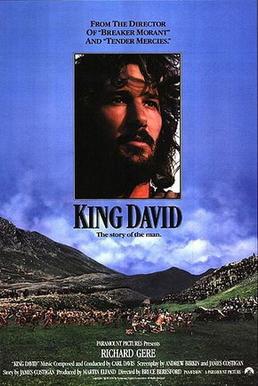
The 1985 film, King David, has all the potential to be a great film but it’s pretty much doomed by the fact that David is played by Richard Gere. Today, of course, Richard Gere is an above average character actor who is well-cast as older, seemingly successful men who have never quite conquered their own self-doubt. That’s not the Richard Gere who shows up in King David. The Richard Gere who shows up in King David is the blank-faced, youngish Richard Gere who was best-known for films like An Officer and a Gentleman and American Gigolo. Richard Gere is so miscast as David that just the sight of him takes you out of the film’s reality. While the film plays out, you find yourself saying, “Richard Gere just killed Goliath. Richard Gere just spied on Bathsheba. Richard Gere is dancing through the streets of Jerusalem.”
There are a few good things about King David. Edward Woodward gives a good performance as Saul, who has always been overshadowed David but who was, in his own way, almost as compelling a character. The film does a credible-enough job recreating the ancient world and it’s entertaining to see the iconic Italian actor George Eastman show up as Goliath. Far too often, though, King David becomes one of those films where every big action scene is shown in slow motion and there’s too many close-ups of swords being tossed into the air.
According to Wikipedia (that’s right, I did some “serious” research for this review), King David was actually made because it was felt that the film would be able to draw in the same audience that loved Star Wars. That turned out to not be true as the film was a huge flop and apparently damaged a lot of careers. But, flop or not, it was still on TV last night, which just proves that movies are forever.












 Through the Shattered Lens