Horror Film Review: X: The Man With X-Ray Eyes (dir by Roger Corman)


X: The Man With The X-Ray Eyes (1963, dir by Roger Corman, DP: Floyd Crosby)

Eyes.  They’re one of the most important parts of our body but they’re also frightening easy to damage. Unlike the heart or the liver or the brain, they don’t have a protective covering of skin and bone.  They sit exposed and  are easily injured.  They can be ripped out of one’s head, which is a scary thought.  As well, they tend to grow weaker over time.  I love my multi-colored eyes and I think they’re one of my best features but I still spend a lot of time wishing that they weren’t quite as vulnerable as they are.  I often say that I’m blind without my contacts or my glasses.  That’s not quite true, of course.  I can see enough to get by if I forget to put in my contacts but I still have to do a lot of squinting, enough so that most people can take one look at me and say, “You forgot to put in your contacts, didn’t you?”  In my case, my eyesight has definitely gotten even worse over the past few years.  I’ve been told that’s normal but it still freaks me out.  I worry about waking up one day and not being able to see anything at all.

Director Lucio Fulci, a diabetic who was slowly going blind during the final years of his life, was infamous for including scenes of eyes being either pierced or gouged out in his films.  The New York Ripper even featured one scene where an eye was slit in half with a razor blade.  (This occurred in a close-up, no less!)  In Joe D’Amato’s Beyond the Darkness, there’s a scene where a mad taxidermist replaces the eyes of his dead fiancée with glass and for me, that’s one of most disturbing elements of the film.  Horror directors understand the vulnerability of the eyes and the sadness when life is extinguished from those eyes.  Eyes are said to be the windows to soul and when those eyes are lifeless, it’s a reminder that a living soul is a fleeting thing.

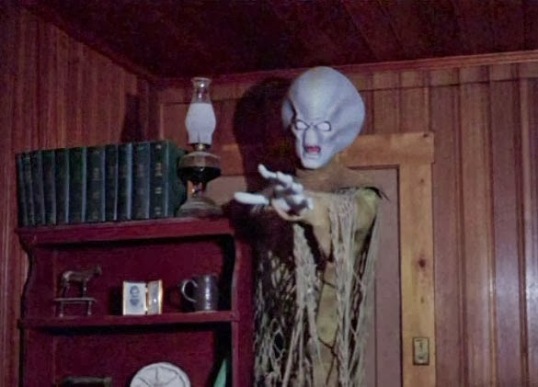
Perhaps that’s why 1963’s X: The Man With The X-Ray Eyes is such an effective work of art.  Directed by Roger Corman, the film tells the story of Dr. James Xavier (Ray Milland), a doctor who has developed eye drops that, when taken, allow one to have x-ray vision.  Dr. Xavier claims that the eye drops will allow doctors to more easily diagnose their patients and certainly, he has a point there.  His friend, Dr. Sam Brant (Harold J. Stone), points out that the eyes are directly connected to the brain and that using experimental eye drops on them could potentially drive a person mad.  Dr. Xavier proves Dr. Brant’s point by losing his tempter and accidentally pushing him out of a window.

Ah, x-ray vision.  It all starts out fun.  Dr. Xavier is performing miracle surgeries and seeing what everyone looks like naked.  (The swinging jazz party scene is a classic example of how 60s B-movies teased audiences while never quite showing everything.) But once he’s forced to go on the run from the police, Xavier finds himself making a living as a carnival psychic while still trying to refine his eyedrops.  Xavier’s sleazy manager (Don Rickles) tries to turn Xavier into a faith healer but, with Xavier’s x-ray vision growing more erratic and more intense, Xavier ends up running off to Vegas with a former colleague, Dr. Diane Fairfax (Diana Van der Vils).

And again, it’s all fun and games as Xavier uses his powers to cheat at cards.  But then the megalomania kicks in and, after Xavier basically announces that he’s cheating, he finds himself being chased through the desert by a police helicopter and freaking out as more and more of the universe is revealed to him.  Much like a Lovecraftian protagonist who has been driven mad by the sight of the Great Old Ones, Xavier finds himself overwhelmed by the center of the universe.  At a tent revival, a preacher shouts, “If thine eye offends thee, pluck it out!”

The film’s final image is a shocking one and it stays with you.  (There were rumors that the film originally ended with Xavier shouting, “I can still see!” but Corman himself said that never happened.)  Even without that final image, this would be one of Corman’s best films, a surprisingly intelligent and rather sad story about a man who, in trying to see what is usually hidden, was driven mad by what he discovered.  Ray Milland was well-cast as Dr. Xavier and watching him go from being a somewhat stiff but good-hearted scientist to a raving madman at a revival is quite an experience, a testament to the vulnerability that all humans share.  In the name of science, Xavier goes from being a respected researcher to being chased through the desert by a helicopter.  The man who wanted to be able to see everything finds himself wishing to be forever blinded.  Sometimes, the film suggests, it’s best not to be able to see everything around us.  Sometime, the mysteries of the universe should remain mysteries and the rest of us should respect our own vulnerabilities.

Horror on the Lens: The Terror (dir by Roger Corman, Francis Ford Coppola, Jack Hill, Monte Hellman, Dennis Jakob, and Jack Nicholson)


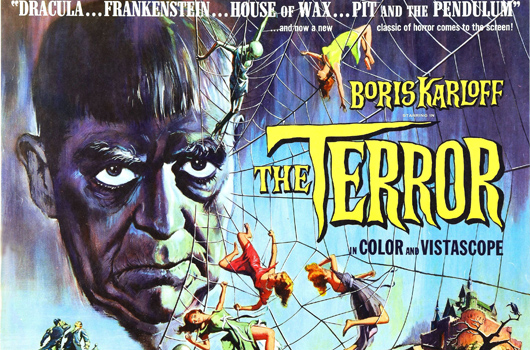
Have you ever woken up and thought to yourself, “I’d love to see a movie where a youngish Jack Nicholson played a French soldier who, while searching for a mysterious woman, comes across a castle that’s inhabited by both Dick Miller and Boris Karloff?”

Of course you have!  Who hasn’t?

Well, fortunately, it’s YouTube to the rescue.  In Roger Corman’s 1963 film The Terror, Jack Nicholson is the least believable 19th century French soldier ever.  However, it’s still interesting to watch him before he became a cinematic icon.  (Judging from his performance here and in Cry Baby Killer, Jack was not a natural-born actor.)  Boris Karloff is, as usual, great and familiar Corman actor Dick Miller gets a much larger role than usual.  Pay attention to the actress playing the mysterious woman.  That’s Sandra Knight who, at the time of filming, was married to Jack Nicholson.

Reportedly, The Terror was one of those films that Corman made because he still had the sets from his much more acclaimed film version of The Raven.  The script was never finished, the story was made up as filming moved alone, and no less than five directors shot different parts of this 81 minute movie.  Among the directors: Roger Corman, Jack Hill, Monte Hellman, Francis Ford Coppola, and even Jack Nicholson himself!  Perhaps not surprisingly, the final film is a total mess but it does have some historical value.

(In typical Corman fashion, scenes from The Terror were later used in the 1968 film, Targets.)

Check out The Terror below!

October Positivity: The Wager (dir by Judson Pearce Morgan)


In 2007’s The Wager, Randy Travis plays Michael Steele, an Oscar-nominated actor who….

Stop laughing, that’s not nice.

Okay, I’ll be the first to admit that Randy Travis is not exactly the first person that I would cast as an Oscar-nominated actor.  And, I’ll also be the first to admit that having Randy Travis act in this film makes it even harder to believe him as someone who could someday be nominated for an Oscar.  A lot of country music stars have tried their hand at acting and most of them have been able to survive on the basis of their own authenticity.  But there’s nothing authentic about Travis’s performance here.  Even when he picks up a guitar and sings a song about the difficulties that he’s facing, he’s not convincing.  In this, it’s not so much that Travis is a stiff actor as he just seems to evaporate whenever he’s on screen.

As for the film, Michael Steele is an actor who is known for his strong faith and his refusal to do sex scenes.  When a director (Bronson Pinchot) throws a fit over Steele’s refusal to shoot once such scene, Steele says that he’ll do the scene but only if it’s followed by a scene in which his co-star has to deal with being a single mother.  OUCH!  Michael Steele seems like he’s fun at parties….

(Apparently, it doesn’t occur to Michael that his character could wear a condom.)

Wait a minute.  This guy has the same name as that jackass who is always on the news talking about how he’s a Republican who thinks everyone should vote for the Democrats.  I wonder if that’s intentional.  Anyway….

Michael Steele’s career has had its up and downs.  His recent divorce from Annie (Nancy Stafford) has damaged his family friendly image.  But his Oscar nomination and the fact that he’s expected to win has once again made the world’s most popular star.  But then — scandal!  A tabloid photographer snaps a picture of Michael talking to a young actress at his house.  In the background, a little kid watches.  Now, the kid is a part of the Big Brother program and Michael was just trying to help the younger woman with her career but it doesn’t matter.  Soon, Michael finds himself being portrayed as being some sort of pervert.  When he punches a photographer, he finds himself getting arrested — RIGHT IN FRONT OF HIS CHURCH!

Now, as you may have guessed, this is yet another retelling of the story of Job, with Michael having his faith tested by one disaster after another.  He doesn’t lose his faith and, as a result, he wins both an Oscar and he also becomes a hero when he rescues the kid from the Big Brother program from his abusive stepfather.  Anyone who thinks that God wouldn’t have a hand in who wins an Oscar obviously did not listen to Will Smith’s acceptance speech.

The Wager is a film that would probably not be made today.  Today, you’re not likely to see a socially conservative, faith-based film where a successful actor is wrongly accused of being a pervert.  Then again, you also probably wouldn’t see a politically liberal film in which a successful white male actor was wrong accused of being an abuser, not in today’s cultural climate.  On both the Left and the Right, attitudes towards Hollywood have changed.  Beyond the film’s political and cultural subtext, its portrait of the Oscars as being the most important event of the year also feels rather old-fashioned.  I imagine it felt old-fashioned in 2007 as well….

Then again, this is a film in which Randy Travis plays the best actor of his generation so perhaps it’s best not to take any of it too seriously.  The miscasting of Travis pretty much sabotages the movie from the start but, on the positive side, Bronon Pinchot is amusing as a bitchy director and Jude Ciccolella has a few good scenes as Michael’s supportive agent.  Give those men an Oscar!

“Documentary” Review: Paul McCartney Really Is Dead: The Last Testament of George Harrison? (dir by Joel Gilbert)


There’s a reason why I put the word Documentary is scare quotes when I titled this review.

Yes, 2010’s Paul McCartney Really Is Dead is listed as a documentary on Tubi, Prime, and probably every other streaming site in which it has appeared.

Yes, the film is full of archival footage of the Beatles and it opens with a lengthy discussion about the time that John Lennon said that group was bigger than Jesus.

And yes, the film does present itself as being a documentary.

That said, I don’t believe any of the claims made in this film and I doubt the filmmakers do either.  Much like that time travel documentary that I reviewed a few years ago, this film is obviously a mockumentary, a hoax that a few people online have taken seriously.  Fortunately, it doesn’t appear that as many people have taken this film seriously as they did with that Man From 3036 film.  I guess that counts as progress.

(I should note that, after writing the paragraph above, I looked up Joel Gilbert’s YouTube profile and saw that he has specifically stated that the film is a mockumentary.  So, good for Gilbert!)

As for Paul McCartney Is Really Dead, it opens with director Joel Gilbert explaining that his production company received several mysterious cassette tapes.  They were mailed from the UK.  The man on the tapes claims to be George Harrison and says that he’s recording the tapes on his death bed.  He explains that, in 1966, Paul McCartney was killed in a car crash.  A fake Paul (nicknamed Faul) was brought into the group and, for the next four years, the Beatles recorded with this imposter.  John Lennon, fearing that the fans would turn on the band if they ever learned of the deception, inserted clues throughout the Beatles’s album covers and in their songs.  A lot of those clues were only evident to those who played the song backwards.  Turn me on, dead man!

The conspiracy theory that Paul McCartney was decapitated in a car accident and was replaced by a man named William Campbell has been around for a while.  It’s generally agreed that the rumor first started to circulate way back in 1966 and it’s been theorized that the Beatles themselves were aware of the rumor and they occasionally made references to it as a private joke.  Of course, it’s just as possible that the Beatles knew nothing of the rumor and all of the “clues’ were actually just coincidences that were overanalyzed by conspiracy theorists with too much free time on their hands.  For instance, one widely cited clue was a picture of Paul McCartney wearing a patch that apparently said “OPD.”  The theorists decided that OPD stood for “Officially Pronounced Dead,” whereas the patch was actually one worn by members of the Ontario Provincial Police and it actually read “OPP.”

Paul McCartney Is Really Dead features someone pretending to be George Harrison going over all of the clues on the album covers and in the songs.  He hits all the major points, including the famous Abbey Road cover.  However, the faux Harrison goes on to claim that the Beatles were forced to pretend that Paul was alive by a sinister MI5 agent named Maxwell.  Maxwell explained that word of Paul’s death would lead to a suicide epidemic amongst young British woman and it would also leave the UK vulnerable to the communists.  Yes, you read that correctly.  Of course, as unbelievable as that sounds, it’s really not that much different from a lot of “real” conspiracy theories that can currently find circulating online.  A spoof works best when its credible.  While the theory that Paul is dead may not be credible, the fact that people will believe the dumbest things is.

It’s easy to laugh at first, largely because the guy doing George Harrison’s voice doesn’t even seem to have a British accent.  While the Beatles looked at the dead Paul, Maxwell commented that the injuries Paul had sustained in the car crash had left him looking like a walrus.  “I AM THE WALRUS!” John supposedly shouted at Maxwell.  If you can’t smile at that, what can you smile at?  But then, towards the end of the documentary, it’s suggested that John’s assassination and the near fatal attack that George Harrison suffered in 1999 were actually due to John and George threatening to reveal the truth about Faul.  At that point, the whole thing gets rather offensive.  This could have been an enjoyably daft hoax if the filmmakers hadn’t tried to pass the tapes off as being from George Harrison.  (Personally, I would have used either Maxwell or Rita, the girl in blue who was supposedly with Paul at the time of the accident, as the narrator.)

As for myself, I love conspiracy theories but I don’t believe 99% of them.

Guilty Pleasure No. 71: Submerged (dir by Fred Olen Ray)


THUNDERSTRIKE!

Listen, if you’re going to watch the 2000 film Submerged, you better be a  big fan of the term “Thunderstrike,” because it’s repeated so many times that one gets the feeling that the actors just loved saying it.

Thunderstrike is a satellite that was built by western businessman Buck Stevens (Dennis Weaver).  He and his daughter (Nicole Eggert) and her sort-of boyfriend (Hannes Jaenicke) are all flying to Hawaii so that they can conduct more tests on the Thunderstrike.  However, arms dealer Owen Cantrell (Tim Thomerson) wants the Thunderstrike for himself so he sends a mercenary named Jeff Cort (Coolio.  Yes, Coolio.) to steal the plans from the airplane.  The plan is to kill the pilot, substitute a new pilot, and then crash the plane into the ocean …. which is pretty much what happens, despite the best efforts of heroic CIA agent, Rex Manning (Maxwell Caulfield).

Actually, wait a minute.  Maxwell Caulfield’s character is named Jim Carpenter.  Well, I don’t care.  He’ll always be Rex Manning to me!

While Special Agent Mack Taylor (Brent Huff) tries to stop Cantrell from stealing the Thunderstrike, Captain Masters (Fred Williamson) tries to figure out a way to bring the plane to the surface.

If this sound familiar, it’s because Submerged has the same plot as Airport ’77.

If it looks familiar, it’s because Submerged lifts a lot of footage from Airport ’77, including the scene where the plane crashes, the scene where the plane settles on the ocean floor, and the scene where the plane is lifted off the ocean floor.  Even a scene of water pouring into plane is lifted from Airport ’77, which means that the plane in Submerged suddenly has a staircase that no one apparently noticed before.

Submerged was directed by the wonderful Fred Olen Ray and seriously, how can you not love it?  Between the cast and the fact that it features all of the best parts of Airport ’77, this is a film for which the term guilty Ppeasure was invented!  It helps that the cast, for whatever reason, appears to be taking the film rather seriously.  This film was Dennis Weaver’s final screen appearance and he seems to be having a ball playing a cheerful good old boy who can’t wait to put a dangerous satellite in the sky.

Plus, the film features Rex Manning!

Plus, Jack Deth!

Plus, Black Caesar!

Plus …. THUNDERSTRIKE!

Previous Guilty Pleasures

  1. Half-Baked
  2. Save The Last Dance
  3. Every Rose Has Its Thorns
  4. The Jeremy Kyle Show
  5. Invasion USA
  6. The Golden Child
  7. Final Destination 2
  8. Paparazzi
  9. The Principal
  10. The Substitute
  11. Terror In The Family
  12. Pandorum
  13. Lambada
  14. Fear
  15. Cocktail
  16. Keep Off The Grass
  17. Girls, Girls, Girls
  18. Class
  19. Tart
  20. King Kong vs. Godzilla
  21. Hawk the Slayer
  22. Battle Beyond the Stars
  23. Meridian
  24. Walk of Shame
  25. From Justin To Kelly
  26. Project Greenlight
  27. Sex Decoy: Love Stings
  28. Swimfan
  29. On the Line
  30. Wolfen
  31. Hail Caesar!
  32. It’s So Cold In The D
  33. In the Mix
  34. Healed By Grace
  35. Valley of the Dolls
  36. The Legend of Billie Jean
  37. Death Wish
  38. Shipping Wars
  39. Ghost Whisperer
  40. Parking Wars
  41. The Dead Are After Me
  42. Harper’s Island
  43. The Resurrection of Gavin Stone
  44. Paranormal State
  45. Utopia
  46. Bar Rescue
  47. The Powers of Matthew Star
  48. Spiker
  49. Heavenly Bodies
  50. Maid in Manhattan
  51. Rage and Honor
  52. Saved By The Bell 3. 21 “No Hope With Dope”
  53. Happy Gilmore
  54. Solarbabies
  55. The Dawn of Correction
  56. Once You Understand
  57. The Voyeurs 
  58. Robot Jox
  59. Teen Wolf
  60. The Running Man
  61. Double Dragon
  62. Backtrack
  63. Julie and Jack
  64. Karate Warrior
  65. Invaders From Mars
  66. Cloverfield
  67. Aerobicide 
  68. Blood Harvest
  69. Shocking Dark
  70. Face The Truth

October Hacks: Death Rink (dir by Daniel Zubiate)


It’s time for the local roller rink to close for the night.  Manager Rachel (Katheryn McCune) and her crew are shutting the place down.  You might think that would be a relatively simple task but you’ve never seen people who do as little work as Rachel and her crew.  They probably could shut the place down in a matter of minutes and then go have fun somewhere else.  Instead, they sit around and talk and smoke some weak weed and then they play foosball and someone else plays pinball and then they talk some more and then someone calls on the phone so everyone gathers around to listen to Rachel talk to the guy and then Daley (Robert Posey) hits on Rachel and tells her, “You know I’m over 18, right?”  Considering that Daley looks like he’s about 50, I’m sure Rachel figured that out.  And then….

Did I mention this is a slasher film?  It’s easy to forget because the film is only 74 minutes long and we don’t even see the killer’s mask until the first murder occurs at the 44 minute mark.  Some of the killings — well, two of them — are creatively nasty but they still feel like an afterthought, as if the director suddenly remembered that he was making a slasher film and not a mumblecore epic about a bunch of losers working at a roller rink.

Death Rink is dull.  There’s no other way to put other than to say that Death Rink in one of the most mind-numbingly boring movies that I have ever sat through.  The pacing of this film makes you appreciate the power of a good editor.  The almost total lack of background music makes you appreciate a good composer.  The dark lighting will make you appreciate all the more the value of a cinematographer who understands the importance of setting the proper mood.  Everything about this film will make you appreciate films that at least manage to be mediocre.

Now, I will say this.  It’s hard for me judge because it’s not like I’ve ever had a real job but I imagine that this film does capture just how boring it would be to work at a small-town roller rink.  The total monotony of the character’s lives is absolutely believable.  If this film set out to be a portrait of what it’s like to have a dead end life in the middle of nowhere, it succeeded.  The film also captured the torture of listening to dumb people attempt to have a conversation.  It’s a movie that definitely reminded me of why I don’t like to listen to dumb people talk about their lives.

And I’ll also give the film this.  At the end of the film, one of the final living characters fights the killer with a broom and that was almost weird enough to work.  Of course, it would have been even better if the scene had been properly lit so that I could have actually seen the characters without squinting so hard that I was worried I was going to pop a blood vessel.  But I guess I can’t have everything.

As far as roller rinks go, I’ll stick with Skatetown USA.

The TSL’s Horror Grindhouse: Without Warning (dir by Greydon Clark)


1980’s Without Warning opens with a father (Cameron Mitchell) and his gay son (Darby Hinton) on a hunting trip.  The father taunts his son about not being what the father considers to be a real man.  He says that his son would have no chance of surviving in the wilderness.

“Why does it always have to be like this?” the son asks with a sincerity that will break your heart.

Suddenly, a bloodsucking starfish flies through the air, lands on the father, and starts to suck out his blood with a phallic stinger.  The father dies while his son watches.  The son picks up his rifle and prepares to fight back.  This will be the son’s chance to prove that his father was incorrect.  This is the son’s chance to prove that he can survive in the wilderness and….

Just kidding.  The son forgot to load the rifle and promptly gets a starfish to the eye.

That’s the type of film that Without Warning is.  Characters are introduced.  The majority of them are played by B-actor who have seen better days.  They get a few minutes of character development.  Then, they die and the viewer is left feeling a bit depressed because they all seemed like they deserved just a bit more screentime than they received.  Larry Storch shows up as a boy scout leader who gets a starfish to the back while trying to light a cigarette.  Neville Brand, Ralph Meeker, and Sue Anne Langdon hang out in a bar and refuse to believe that the Earth has been invaded by blood-sucking starfish.  Jack Palance plays a hunter and gas station owner who wants to capture an alien as a trophy.  Martin Landau plays Sarge, an unbalanced Vietnam Vet who has been telling people for years that there are aliens out there.  Everyone laughed at old Sarge but they won’t be laughing for long!  At the time this film was made, Palance was a two-time Oscar nominee.  He finally won his Oscar for City Slickers, a decade after Without Warning.  Martin Landau, for his part, won his Oscar 15 years after Without Warning.  Good for them.  If nothing else, this movie should remind everyone who has dismissed Eric Roberts’s chances that there’s still time!

That said, none of these familiar faces are the stars of the film.  Instead, the majority of the film follows four teenagers on a road trip, Sandy (Tarah Nutter), Greg (Christopher S. Nelson), Beth (Lynn Theel), and Tom (David Caruso).  David Caruso as a sex-crazed teenager sounds more amusing than it actually is.  If anything, the sight of him wearing shorts and t-shirt is almost blinding.  (As a fellow redhead, I sympathize.  We burn but we don’t tan.)  Tom and Beth die early on, leaving Greg and Sandy to try to escape from the alien (Kevin Peter Hall) who is tossing around the starfish.  Both characters are pretty generic but Christopher Nelson is at least likable.

Without Warning has a reputation for being the best film that Greydon Clark ever directed and I would agree that it’s one of his better ones, though I prefer The Forbidden Dance.  Then again, when you consider some of the other films that Clark directed, it’s easy to see that Without Warning didn’t exactly have a huge bar to clear.  Though the script borrows a bit too much from nearly every other horror film ever made, Without Warning is nicely paced and the killer starfish are genuinely frightening and their bloodsucking is almost Cronenbergian in its ick factor.  Just as he would for John Carpenter, cinematographer Dean Cundey gives us some nicely eerie shots of the alien.  Landau and Palance go all out, understanding that subtlety has no place in a film like this.  Without Warning is a dumb B-movie but it’s definitely entertaining.

Without Warning (1980, dir by Greydon Clark, DP: Dean Cundey)

The Eric Roberts Collection: Wolves of Wall Street (dir by David DeCoteau)


2002’s Wolves of Wall Street tells a story of high finance and lycanthropy.

Jeff Allen (William Gregory Lee) dreams of being a rich and successful stockbroker but he runs into a huge problem when he tries to find a job on Wall Street.  No one is willing to hire him without experience and he can’t get any experience because no one is willing to hire him.  A sympathetic bartender named Annabella (Elisa Donovan) tells him to apply for Wolfe Brothers and she even promises to put in a good word for him.  Annabella, as we soon learn, has a very powerful friend at Wolfe Brothers.

Jeff is given an internship with Wolfe Brothers and, after a week, he’s offered a job by the head of the firm, Dyson Keller (Eric Roberts).  Jeff not only has his dream job but he’s also convinced the initially reluctant Annabella to date him.  However, it soon becomes obvious that there are some strange things going on at Wolfe Brothers.  The brokers spend a lot time talking about the importance of working as a “pack” and about how they are all kin now.  At the end of the week, they hold wild but ritualized parties with prostitutes and neck biting.  Jeff is told that he’s not allowed to have any outside interests.  He life now revolves around Wolfe Brothers and that means that everything he has also belongs to his bosses.  Afterall, they’re the Alphas….

As you’ve probably already guessed, Jeff is working with a bunch of werewolves!

They’re not your usual werewolves.  Though they howl at the moon and enjoy biting strangers and they can pick up on scents and pheromones, they don’t actually seem to turn into wolves.  And while I’m sure that the lack of dramatic transformation scenes was probably a budget thing, it actually makes the film all the more effective.  It leaves you to wonder if the brokers are really werewolves or if they’re just people who have been brainwashed into accepting the Wolfe Brothers lifestyle.  In this film, being a werewolf becomes the equivalent of being in a cult.

Eric Roberts makes for a wonderfully sinister cult leader, though I should note that there is a pretty big twist involving his character that I didn’t see coming.  With his smirk of a smile and his friendly but nervous manner, Roberts gives a wonderfully sinister performance and, even with limited screentime, he elevates the entire film.  Wolves of Wall Street is a wonderfully pulpy and sordid B-movie and one of director David DeCoteau’s best.

Previous Eric Roberts Films That We Have Reviewed:

  1. Star 80 (1983)
  2. Blood Red (1989)
  3. The Ambulance (1990)
  4. The Lost Capone (1990)
  5. Love, Cheat, & Steal (1993)
  6. Love Is A Gun (1994)
  7. Sensation (1994)
  8. Dark Angel (1996)
  9. Doctor Who (1996)
  10. Most Wanted (1997)
  11. Mr. Brightside (2004)
  12. Six: The Mark Unleased (2004)
  13. Hey You (2006)
  14. In The Blink of an Eye (2009)
  15. Enemies Among Us (2010)
  16. The Expendables (2010) 
  17. Sharktopus (2010)
  18. The Dead Want Women (2012)
  19. Deadline (2012)
  20. The Mark (2012)
  21. Miss Atomic Bomb (2012)
  22. Lovelace (2013)
  23. The Mark: Redemption (2013)
  24. Self-Storage (2013)
  25. This Is Our Time (2013)
  26. Inherent Vice (2014)
  27. Road to the Open (2014)
  28. Rumors of War (2014)
  29. Amityville Death House (2015)
  30. A Fatal Obsession (2015)
  31. Stalked By My Doctor (2015)
  32. Joker’s Poltergeist (2016)
  33. Prayer Never Fails (2016)
  34. Stalked By My Doctor: The Return (2016)
  35. The Wrong Roommate (2016)
  36. Dark Image (2017)
  37. Black Wake (2018)
  38. Stalked By My Doctor: Patient’s Revenge (2018)
  39. Clinton Island (2019)
  40. Monster Island (2019)
  41. The Savant (2019)
  42. Seven Deadly Sins (2019)
  43. Stalked By My Doctor: A Sleepwalker’s Nightmare (2019)
  44. The Wrong Mommy (2019)
  45. Exodus of a Prodigal Son (2020)
  46. Free Lunch Express (2020)
  47. Her Deadly Groom (2020)
  48. Top Gunner (2020)
  49. Deadly Nightshade (2021)
  50. Just What The Doctor Ordered (2021)
  51. Killer Advice (2021)
  52. The Poltergeist Diaries (2021)
  53. The Rebels of PT-218 (2021)
  54. A Town Called Parable (2021)
  55. Bleach (2022)
  56. My Dinner With Eric (2022)
  57. Aftermath (2024)

Horror Scenes That I Love: “Dentist!” from Little Shop of Horrors


Since we’ve been talking a lot about the original Little Shop of Horrors today, I thought I would only be appropriate to share a scene from the remake for today’s scene of the day.

From 1986’s Little Shop of Horrors, here is Steve Martin performing Dentist!  Because there’s nothing scarier than going to the dentist, right?

(Yes, I nearly picked Mean Green Mother From Outer Space but …. I don’t know.  It bothers me that the film remake changes the dark ending of both the original film and the stage production.)

October True Crime: Chapter 27 (dir by J.P. Schaefer)


On December 8th, 1980, John Lennon was shot and killed in New York City by a man named Mark David Chapman.

While much has been written about John Lennon and his life and his beliefs, Mark David Chapman, serving a life sentence and rarely giving interviews, has always remained more of an enigma.  What exactly motivated him to shoot John Lennon remains a mystery.  At the time of the shooting, Chapman was carrying a copy of Catcher In The Rye and some accounts insist that Chapman believed himself to be Holden Caulfield or that he shot Lennon to try to bring more attention to the book.  Depending on which source you go to, Chapman was either a Beatles superfan or he was someone who rarely listened to rock ‘n’ roll.  Chapman either worshipped Lennon or he was offended by Lennon’s flippant remark about the Beatles being bigger than Jesus.  Some people claim that Chapman was looking for fame by killing someone famous.  Others claim that Lennon was not even Chapman’s main target and Chapman, in one of the few interviews that he did give, listed a long list of targets — including several other celebrities and politicians — that he considered going after at one point or another.

If anything, Mark David Chapman would appear to be a lot like Arthur Bremer, the directionless drifter who seriously wounded Governor George Wallace in 1972 and whose diary inspired Paul Schrader to create the character of Travis Bickle in Taxi Driver.  Like Chapman, Arthur Bremer traveled the country without apparent direction.  Like Chapman, Bremer considered many different targets before settling on Wallace.  And like Chapman, Bremer gave a lot of conflicting reasons for his actions.  One gets the feeling that neither Chapman nor Bremer (nor a lot of other assassins) really understood why they were driven to kill (or, in Bremer’s case, attempt to kill) so they grasped at whatever solution seemed to convenient at the time.  Apparently, anything was preferable to just admitting to being a severely damaged human being.

2007’s Chapter 27, follows Mark David Chapman (played by Jared Leto) as he travels to Manhattan and spends several days camped outside of the famous Dakota Apartment Building, hoping to see John Lennon (played by Mark Lindsay Chapman, who reportedly missed out on an earlier opportunity to play Lennon because he shared the same name as Lennon’s assassin).  The film is narrated by Mark David Chapman, who tries to talk tough just like Holden Caulfield but who can’t hide the fact that he’s basically just a fat loser who has no idea how to communicate with any of the other people that he meets in New York.  He creeps out a friendly groupie (played by Lindsay Lohan).  He gets into an argument with a photographer (Judah Friedlander).  He annoys countless Dakota doormen.  About the only person who isn’t annoyed by Chapman is Lennon himself, who politely signs an autograph just a few hours before Chapman shoots him in the back.

It’s a well-made and well-directed film and Jared Leto gives a memorably creepy performance as Mark David Chapman.  (That said, the accent that he uses while speaking as Chapman once again proves the danger of giving a method actor any role that involves a Southern accent.)  Leto gained a good deal of weight to Chapman and he’s thoroughly believable as a very familiar type of obsessive fan.  That said, the film still can’t make Chapman into a particularly compelling character because there’s really nothing compelling about someone like Mark David Chapman.  The man he killed was compelling, regardless of what you may think about the politics of a song like Imagine.  But Chapman himself was just a fat loser.  Leto does a good job of portraying Chapman as being a fat loser but it’s still hard to watch the film without wondering what the point of it all is.  We don’t need a movie to tell us that Mark David Chapman was a loser.

At its best, the film creates a sense of claustrophobia.  Almost the entire film is told from Chapman’s point of view and the best moments are the ones where Chapman finds himself overwhelmed by 1980s New York.  It’s a film that does inspire one to consider how strange it is that someone like Mark David Chapman could change the course of the culture through one deadly action.  (The film did cause me to think about how different things would have been if Chapman had boarded a Greyhound and left New York without returning to the Dakota that night.)  But, in the end, the film cannot answer the question of why Chapman did what he did.  Perhaps that’s because there really is no answer, beyond the randomness of fate and the dangers of fame.