While the goth ballerina side of me will always have a special place in my heart for Suspiria and its two sequels, I think that 1982’s Tenebraemay very well be director Dario Argento’s best film. Certainly, it was (to date) his last truly great film before he entered the current, frustratingly uneven stage of his career.
Tenebrae was a return to Argento’s giallo roots after the supernatural-themed horror of Suspiria, Zombi, and Inferno. It was also the work of an audaciously confident director. That confidence is fully on display in the scene below in which the film’s killer menaces a journalist and her lover. Featuring a truly impressive tracking shot in which the camera appears to literally swoop in, out, and over a journalists house without a single cut, the scene ends with one of Argento’s more memorable murders.
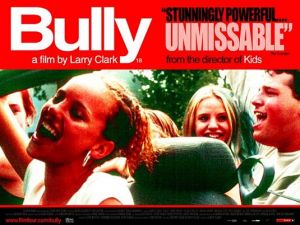
Bullying has been in the news a lot lately. The fact that some people are bullies is hardly a new development, it’s just that now people are actually paying attention to the possible consequences of cruelty. Tragically, it appears it takes people killing themselves for the rest of the world to consider that “Hey, maybe concentrated, socially accepted sadism isn’t a harmless thing.” With so many people finally admitting what they had to have known was true all along, now seems like a good time to reconsider Larry Clark’s controversial and much-maligned 2001 film, Bully.
I can still remember the night, five years ago, that I first saw Bully. I was at a party with a group of friends. Nine of us ended up in a random bedroom, drinking, smoking, and going through all the closets and dressers. I might add, we found some very interesting things while searching. Anyway, someone eventually turned on the TV and there was Bully, playing on one of the movie stations. Since we knew Bully was supposed to be a very explicit, very controversial movie, we left the TV playing and hung out in a stranger’s bedroom for two more hours. There was, obviously, a lot going on in that room and I have to admit that I only paid attention to bits and pieces of the movie. But what I saw stuck with me enough that the next chance I got, I bought the movie on DVD so I could actually devote my full attention to it. In the years since, Bully is not a film that I revisit frequently because, to be honest, it’s the type of movie that makes you take a shower after watching it. It’s also an unusually powerful and disturbing film that sticks with you for a long time after it ends. It’s not a film that I would recommend anyone watch a hundred times. But it’s definitely worth viewing at least once (or maybe even four times if you’re like me).
The bully of the title is 20 year-old Bobby Kent (played by Nick Stahl). Bobby’s “best friend” is passive, blank-faced Marty Puccio (Brad Renfro). Despite being physically stronger, Marty allows himself to be totally dominated by Bobby. Marty accepts Bobby’s constant insults and physical abuse with the meek acceptance of a battered spouse. Bobby, who is on the verge of starting college and presumably making a life for himself that high school dropout Marty could never dream of, even forces Marty to moonlight as a male stripper and to take part in making cheap, gay-themed porn videos. (Bobby insists that he’s not gay himself and, like most guys in denial, goes out of his way to act as much like an insensitive asshole as possible as if to scream to the world, “I’m straight!” despite all the evidence to the contrary.)
As the film begins, Ali (Bijou Philips) and her friend Lisa Marie Connelly (Rachel Miner) step into sandwich shop where both Bobby and Marty work. (Bobby, of course, is the boss.) Apparently, they are appropriately impressed by the sight of Bobby slamming Marty’s head against a refrigerator because soon, all four of them are going out on a double date. While Ali’s content to just give Bobby a blow job, the far more insecure Lisa decides that Marty is the love of her life and starts a relationship with him that the ever-passive Marty simple accepts. However, what Lisa has failed to take into account, is that Marty is already in a relationship and Bobby isn’t ready to just let go. Bobby expresses this by walking in on Marty and Lisa while they’re having sex, beating Marty up, and then (unlike everything else in this movie, this is never explicitly shown) raping Lisa. After this, Lisa discovers that she’s pregnant but she doesn’t know if the baby’s father is the man she claims to love or the man who raped her.
(One thing that surprised me, that night I first watched Bully out of the corner of my eye while me and my friends searched through a stranger’s lingerie, was just how little sympathy most of my friends had for Lisa. While I wasn’t surprised that the majority of guys in the room seemed to feel that Lisa was somehow to blame for disrupting all that precious male bonding, it was the reaction of some of the other girls that truly caught my off guard. While none of them went as far as to say that Lisa deserved to be raped by Bobby, quite a few of them took the attitude that she either brought it on herself or she was lying. Unlike the boys, these girls also felt the need to make several snide remarks about Rachel Miner’s physical appearance. At the time, their attitude really bothered me and I have to admit that I wasn’t as close to any of them afterward.)
(Of course, we Lisa Maries have to stick together…)
Despite having raped his girlfriend, Bobby still considers himself to be Marty’s best friend and Marty — again like an addicted spouse — proves himself to be incapable to simply cut off all ties with Bobby even as the abuse gets worse and Bobby grows increasingly unstable. In one of the film’s more controversial scenes, Bobby and Ali are about to have sex when Bobby decides that the only thing the scene is missing is a gay porn video playing in the background. Ali finds the idea to be disgusting and insinuates that Bobby must be gay. Bobby responds by raping Ali.
Finally, Lisa tells Marty and Ali that they have little choice but to murder Bobby. While this starts out as a somewhat innocent suggestion of the “I wish he was dead,” kind, Lisa soon begins to insist that Bobby must die. Ali recruits her friend Heather (Kelli Garner) and an ex-boyfriend named Donny (a truly scary Michael Pitt) into the conspiracy. (Heather and Donny both agree that Bobby must die though neither one has ever met him.) Lisa, meanwhile, brings in her cousin, video-game geek Derek. Finally, and most fatefully, they decide to get some pointers from the neighborhood hitman (Leo Fitzpatrick).
That’s right. The neighborhood hitman. He’s actually a pretty familiar figure in the suburbs. He’s the 17 year-old white boy who tries to stare out at the world with hateful eyes. He brags to you about how he’s a member of a gang. He tries to rap and speaks in dialogue lifted from Grand Theft Auto. In short, he’s the guy that everyone laughs at whenever he’s not around. His lies should be obvious to anyone with a brain which is exactly why Lisa, Marty, and Ali all assume that he’s an actual hitman. The Hitman agrees to direct their murder and help them kill a person who (like almost everyone else now involved in the conspiracy) he has never actually met.
It all climaxes in one of the most disturbingly graphic and harrowing murder scenes I’ve ever seen, one that manages to snap the audience back into reality after the (needed) comic relief of Fitzpatrick’s absurd wannabe gangster. As he’s repeatedly attacked by this group of made up of bumbling strangers and his “best” friend, Bobby proves himself to be not quite as powerful a figure as everyone had assumed. Instead, he’s revealed as a pathetic, frightened teenager who begs Marty to forgive him (for “whatever I did”) even as Marty savagely stabs him to death.
Unlike the standard rape-revenge flick (and have no doubt, that’s what Bully essentially is), the film’s climatic act of violence doesn’t provide any sort of satisfaction or wish-fulfillment empowerment. Instead, it just sets up the chain of events that leads to the film’s inevitable and disturbing conclusion.
When it first came out, Bully was controversial because of its explicit sex and violence. As a director, Clark employs his customary documentary approach while, at the same time, allowing his camera to frequently linger over the frequently naked bodies of his cast. More than one reviewer has referred to Clark as “a dirty old man” while reviewing this film. (More on that in a minute.) What those critics often seem to fail to notice is that, as explicit as the movie is, some of the most powerful and disturbing elements (like Bobby’s repressed homosexuality) are never explicitly stated.
After seeing this movie a few more times, the thing that gets me is that — in the end — the film’s nominal villains — Bobby and Lisa — are also the only two compelling characters in the entire movie. While all the other characters are essentially passive, Bobby and Lisa are the only ones actually capable of instigating any type of action. As such, they become — almost by default — the heroes of the movie. On repeat viewings, it’s apparent that Bobby and Lisa are really two sides of the same coin. The film’s title could refer to either one of them. They are both insecure, unhappy with who they are, and both of them seem to find a personal redemption by dominating Marty. One of the great ironies of the film is that Bobby and Lisa are essentially fighting a war for the soul of a guy who is eventually revealed to be empty inside. For his part, Marty simply shifts his “forbidden” relationship with Bobby over to Lisa, a relationship that is just as exploitive and destructive as his friendship with Bobby but which is also more socially acceptable because it’s so heterosexual in nature that he’s even knocked up his girlfriend. When Marty finally does kill Bobby, he’s not only killing a bully but he’s attempting to kill of his own doubts about his sexual identity. It’s his way of letting the world know that he’s a “real” man. As for the other characters — Ali, Donny, Heather, and even the swaggering hitman — they are all defined by their utter shallowness. While its clear that none of them are murderous on their own, it also becomes clear that none of them have enough of an individual identity to resist the Bobbys and Lisas of the world.
Despite playing shallow characters, nobody in the cast gives a shallow performance. Down to the smallest role, the actors are all believable in their roles. Whether it’s Michael Pitt’s blank-faced aggression or Leo Fitzpatrick’s comedic swagger, all of the actors inhabit these characters and give performances that are disturbingly authentic. The late Brad Renfro gave one of his best performances as Marty, just hinting at the anger boiling below the abused surface. However, the film belongs to Miner and Stahl. Stahl displays a sordid charm that makes his character likable if never sympathetic while Miner manages to do something even more difficult. She makes Lisa into a character who is sympathetic yet never quite likable. When Bully first came out, critics spent so much time fixating on the fact that Miner’s frequently naked on the film that they forgot to mention that she also proves herself to be an excellent actress.
As I stated, Bully is not a universally beloved film. Most of the reviews out there are negative with a few of the more self-righteous critics accusing the film of being “pornographic” as if the whole thing was filled with close-up money shots of Brad Renfro ejaculating on Rachel Miner’s ass. Strangely enough, you can find hundreds of critics complaining that Clark filmed full frontal nudity but next to none complaining that Clark filmed a brutal and realistic murder scene.
The two most frequent criticisms of Bully are that 1) it plays fast and loose with the true story that it’s based on and 2) that the film is exploitive.
Both criticisms are valid but the first one is the only one that would really bother me. I have to admit that I don’t really know much about the real life murder of Bobby Kent. I just know the version presented in this movie and in the Jim Schultze book that the movie was based on. Of course, everyone arrested and convicted for Kent’s murder has been quick to claim that the movie makes them look more guilty than they actually are. That’s to be expected. However, the main difference between the film and the reality — for me — was that, in reality, victim Bobby Kent did not look a thing like Nick Stahl. Whereas Stahl is clearly no physical match for any of the characters in the film (and hence, it’s easier to feel sorry for him when everyone attacks him at once), pictures of the real-life Bobby Kent reveal an intimidating, muscular, young man who few people would probably ever chose to mess with. Stahl’s Bobby is a bully because everyone else in the film is too passive to stand up to him. The real Bobby could probably get away with being a bully because he literally looked like he could rip another man’s arm off.
The other criticism is that this movie — with its combination of tits and blood — is essentially just an “exploitation” film. Well, it is. But as I’ve explained elsewhere, just because a film is exploitive, that doesn’t mean that it’s not a good movie. Art and exploitation, more often than not, are clandestine lovers and not bitter enemies. Yes, all of the characters — male and female — do spend a good deal of time showing off their bodies but then again, what else would these otherwise empty characters do? Their surface appearance is really all they have. Yes, the camera does linger over all the exposed flesh but then again, so do most people. If anything, critics attempted to punish Clark for openly acknowledging that majority of his audience is waiting to either see Bijou Phillips’ twat or Nick Stahl’s dick. Yes, Bully is exploitation but it’s exploitation in the best grindhouse tradition. It’s a film that’s honest specifically because it is so sordid and exploitive.
When all is said and done, Bully is the epitome of a movie that is too sordid to ever be corrupted.
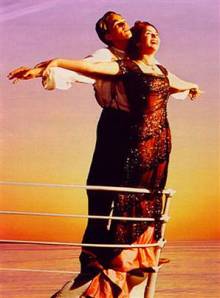
Recently, I tried to rewatch an obscure art film from 1997 called Titanic. From the time I was 12 until I was 16, I watched this movie a lot and, without fail, I cried and cried at the movie’s end. (Admittedly, it was pretty easy to make me cry back then.) I decided to rewatch it because I was curious as to whether or not Titanic could still make me cry.
For those of you who aren’t into art films, here’s a quick synopsis and review of Titanic.
The film’s plot: Bill Paxton and an obnoxious fat guy are held hostage on a submarine by a senile old biddy who insists on telling them the story of how she lost her virginity 98 years ago.
Meanwhile, in London, Leonardo DiCaprio steals some poor kid’s sketch book and then sneaks onto a cruise ship where, pretending to be an artist, he seduces and murders lonely widows.
Also on the cruise ship is Kate Winslet. Kate’s engaged to Billy Zane but she’s unhappy about it because — well, there’s some men you fuck and there’s some men you marry and let’s just say that you don’t marry Billy Zane. Once the boat sets sail, Kate decides to jump overboard. However, just before she can jump, she’s spotted by Leo. Leo quickly tosses a burlap sack containing the corpse of Lady Astor into the Atlantic and then rescues Kate.
Kate rewards him by taking him down to her cabin and showing him a painting by Someone Picasso. (Early on in the film, Billy correctly says that Someone Picasso will never amount to anything and that’s true. Someone was always overshadowed by his older brother Pablo.) Leo looks at the painting and says, “Look at what he does with color here.” As a former Art History major, that line made me smile. That’s the type of statement that is regularly uttered by people who can’t think of anything else to say. When a guy looks at a painting and says, “Look at what he does with color here,” what he’s actually saying is, “Look, babe, I went to the damn art museum with you so there better be a blow job in my immediate future.”
Leo has dinner with Billy and Kate. Leo says, “I’m just a tumbleweed blowing in the wind.” Over at the next table, a shifty young man named Bob Dylan overhears and thinks, “That would make a good song. But the little man must die so nobody knows I stole that line from him…”
Anyway, Leo eventually slips Kate a rohypnol, convinces her to pose naked while he secretly tapes her for Youtube, and then proceeds to have sex with her in the back seat of a car. Afterward, Kate says, “Do you want to hang out tomorrow?” Leo replies, “Uhmm…I might be busy. I’ll call you.” “My God,” I said as I watched all this, “it’s like reliving my freshman year of college all over again.”
Anyway, 8 more hours pass. All the rich passengers on the ship do rich things while all the poor passengers get drunk and trash the lower levels of the boat. Suddenly, without warning, the boat is besieged by the living dead. Billy Zane insists that they would be safer in the basement. Leo disagrees while Kate says, “So, you think you can just fuck me and leave!? No way!”
12 more hours pass. The living dead manage to rip a hole in the side of the boat. Billy chases Leo and Kate around the Titanic as it sinks. “I hope you’ll be very happy together!” he screams. Meanwhile, up top, two rich guys put on tuxedos and one of them says something like, “We’re going to die like gentlemen.” Which I guess is what they end up doing though, honestly, it sounds to me like the guy’s just being a smartass.
Eventually, Kate and Leo end up sitting on an iceberg together. Kate wonders if this is a dream. Leo proceeds to spin a top on the ice to find out. Suddenly, Bob Dylan floats by in a rowboat. “This machine kills fascists!” he shouts as he shoots Leo with a crossbow. Leo sinks into the water. Bob Dylan smirks. “How does it feel to be on your own?” he asks.
The end.
A quick review: I guess the easiest way to review Titanic is to answer my original question. Does the film still make me, at the age of 24, cry like it did when I was 12? No, it does not. To be honest, the only tears that I shed while rewatching Titanic were tears of shame and boredom. This is the movie that I once thought was the greatest thing ever? True, I was young and stupid but still…
On the plus side, Kate Winslet gives a good performance even if her character is basically just a sexist male fantasy. Billy Zane is also a lot of fun as her jilted suitor.
On the negative side, there’s everything else. The script — written by Someone Cameron — is full of laughably bad lines and plotwise, the film has all the depth of a lanced boil. The romantic elements of the plot made me cry back when I was 12 because I didn’t have a whole lot of real world experience to compare Titanic’s fantasy against. Now, at the age of 24, I’ve actually had to deal with my fair share of guys who say actually do make dumbfug statement about things like being a tumbleweed blowing in the wind (not to mention being king of the world). I’m not saying that a good movie can’t present a romantic idealization of reality. I’m just saying that a good movie can do that without insulting the viewer’s intelligence like Titanic does.
One last note — Leo DiCaprio has become a great actor. But, in Titanic, he just comes across like a shrill poseur.
I Learned Something Today Conclusion: Just because you and a million others think that a movie is great today, that doesn’t mean that the movie’s going to be anywhere near as good 12 years later. In this age of Avatar and the Social Network, that’s a lesson that I think many self-appointed film “gurus” would do well to consider before they throw a hissy fit just because a complete stranger on the Internet disagrees with them.
Welcome to the latest installment of Lisa Marie’s Grindhouse Trailers. Since I’ve been battling a pretty bad cold for about a week now, I thought I would use this installment to highlight a few trailers that prove that the rest of the world is just as sick.
I’ve read so much about this 1976 film but — for whatever reason — it has never officially been released on DVD (though there all bootlegs out there as well as an “all-regions” DVD that apparently is not “all-regions.”) From what I’ve read, this is apparently a political satire disguised as a high school revenge film. The trailer has an oddly off feel to it. Maybe it’s just the exploding locker…
I first saw this film (directed by Mark Lester) on DVD about three years ago. I was expecting to see a silly, urban vigilante film from the early 80s so imagine my surprise when I discovered that Class of 1984 is a seriously dark and oddly disturbing movie. Tim Van Patten (he’s the one going, “I am the future…”) is now a pretty succesful television commercial. He actually gives a pretty good performance in this film, something that’s not necessarily obvious from this trailer.
Yes, another high school revenge film. In this one, Linda Blair’s sister is raped so Linda tracks and down and kills the Class of 1985. Usually, this is where I’d make my standard argument that this is a case of exploitation serving to empower. Honestly, though, it would be more empowering if the film’s villains weren’t so silly and stupid (you get the feeling that they’re all going to die soon anyway regardless of what Linda does) and if the avenging angel was played by someone other than Linda Blair.
For extra fun, imagine the “gang” from Savage Streets trying to fight any of the gangs in this trailer.
5) Sweden: Heaven and Hell (not available from Amazon.com)
The previous trailers paint a pretty grim picture of America. According to the “documentary” Sweden: Heaven and Hell, the best thing about America is that it wasn’t Sweden.
Sweden: Heaven and Hell is actually an Italian mondo film, a rather vile form of “documentary” that was big from the mid-60s up until Ruggero Deodato did the world a favor and satirized the genre out of existence with Cannibal Holocaust. It was released in the States in 1968 (I think). This is one of those movies that I know by reputation as I’ve never actually seen the actual film. However, the trailer is grindhouse tackiness at its absolute best. Everything from the narrator’s leering tone to the “shocking” footage (a woman dancing with another woman — gasp!) makes this trailer a perfect time capsule of the Grindhouse Era.
6) Skatetown USA (not available in any format on Amazon. com — how odd)
But, as sick as Sweden apparently was, can it possibly be sicker than whatever it was that was going on at Skatetown, USA? Seriously, what was wrong with this country in the 70s? That said, I do like this ludicrous trailer if just for the sight of a young and dangerous Patrick Swayze. Plus, how can you dislike any trailer that claims to be advertising “the greatest story ever rolled?”
Seriously, what was the deal with people roller skating at a disco? Is that what passed for fun back in the 70s? Weird. Maybe it was all the cocaine. I came across this trailer while I was downloading the Skatetown USA preview and I just had to include it. Not only is the movie called Roller Boogie but it’s directed by the director of Class of 1984 and it stars the star the Savage Streets. So, everything ties together.
8 ) Finally, since I hate to end things on an odd number, here’s a silly little trailer that I made for my DVD collection.
This rather lengthy sequence comes towards the end of Walter Hill’s 1981 action film, Southern Comfort. Two national guardsmen (played by Keith Carradine and Powers Boothe), after spending the majority of the movie being chased through the Louisiana bayou by “bad” Cajuns, find a few moments of fleeting peace with “good” Cajuns. While I love the way Hill builds up the tension in the scene, it’s the authentic atmosphere that makes this sequence memorable. Hill filmed this sequence with nonprofessional extras who pretty much just did their thing.
(As a sidenote: I’m fluent in French but less so in Cajun.)
Be warned: two hogs are gunned down and gutted about halfway through this scene. Since this film was made by Walter Hill and not Umberto Lenzi, I doubt the hogs were specifically murdered just for the movie. To be honest, as a former farm girl who has spent more than a little time down around the bayous, I find it diffilcult to cry too hard over a hog. Trust me, they’re nothing at all like Babe.
The music here, by the way, was performed by the legendary Dewey Balfa.
Hi there. Lisa Marie here. I know that usually when I show up on this site, it’s too either toss up 6 more exploitation trailers or to present a review of a film that’s been unfairly dismissed (or foolishly overpraised) by the mainstream media. It’s what I love doing and I hope everyone gets at least a little occasional pleasure out of it. (If you don’t — well, please don’t tell me. I’m surprisingly sensitive.)
Last week, I expected that, at this time, I would have posted a review (probably negative) of the mainstream’s latest attempt to make an art film — David Fincher’s The Social Network.
Unfortunately, life in general — and my body in specific — had other plans. I’ve been sick since Wednesday and, for the first time in over a year, I did not spend my weekend at the movies. It’s enough to make a girl cry.
(That said, I did spend most of the weekend lounging about in various states of undress so maybe concentrating on that image will help to lessen the sting of no Social Network review…)
However, while I may not be able to give you my Social Network review, I do feel that I can give you my Social Network pre-viewing review.
Just based on the evidence presented to me so far, the Social Network sucks.
Consider the evidence:
1) Peter Travers of Rolling Stone says that the Social Network will make me “believe in film again.” Excuse me? Francios Truffaut coming back from the dead — or at least Jean-Luc Godard making one more vaguely entertaining movie before dying– will make me believe in film again. I refuse to join a religion based on a movie about fucking Facebook. Sorry, Mr. Travers.
2) Andrew O’Heir at Salon.com has compared The Social Network to — wait for it — Citizen Kane. Hopefully, when the zombie apocalypse comes, Zombie Orson Welles will eat Andrew O’Heir first.
3) According to Rotten Tomatoes — the web’s greatest resource of Mainstream Opinion — The Social Network is the best-reviewed film of 2010 so far. For a film to be that loved, it must be really needy. And what do needy things do? They manipulate, they lie, and they go out of their way to beg you to like them. A great film doesn’t give a fuck what you think.
4) The movie stars Jesse Eisenberg who has already been in 3 great movies — The Squid and the Whale, Adventureland, and Zombieland. Sorry, Jesse but only Giovanni Lombardo Radice is allowed to appear in four great films in just four years.
5) The movie is written by Aaron Sorkin. This movie is being advertised as the “defining” movie as my generation. Sorry, but the defining movie of my generation isn’t going to be written by some smug, 50 year-old, male, sexist, crackhead.
6) The movie is directed by David Fincher which normally would be a good sign except all the reviews are concentrating on Aaron Sorkin. So, is our Mr. Fincher so needy for an Oscar that he’s basically abandoned his own vision in the service of some smug, 50 year-old, male, sexist, crackhead?
7) Apparently, this movie celebrates rich kids getting richer. Just what America needs right now. Yes, let’s celebrate the dumbfug toadsuckers of the world while the guy flipping your burger over at McDonald’s loses his health insurance.
8 ) The Social Network is apparently number one at the box office after this weekend and apparently has gotten great word of mouth. You know who else got great word of mouth at one time? Adolf Hitler, that’s who. Up until it was no longer socially acceptable, the mainstream loved him too.
9) The Social Network has a really crappy, first draft title. Seriously, that’s the name of the movie?
10) Sasha Stone, over at Awardsdaily.com, loves this fucking movie and to me, that’s reason enough to assume it’s going to be an overrated piece of foolishness. Seriously, Awardsdaily.com is a great site if you want to keep up with all the Oscar buzz but — when it comes to reviews — Sasha Stone, Ryan Adams, and the rest of the site are all so middle class and predictable. (Of course, what do you expect from a site that regularly quotes William Goldman?)
So, that’s my pre-viewing review of The Social Network. Hopefully, I’ll see it next weekend and be able to post an actual review. Then we’ll be able to see if the film simply conformed to my own biases or if it truly is worthy of all the hype.
Until then, I’d love to hear your thoughts on The Social Network and the growing chorus of mainstreamers who insist that this is the greatest film of all time. Am I being too hard on it or is this yet another example of the mainstream emperor wearing no clothes?
I’ve been trying for about three days now to figure out how to explain why Wall Street: Money Never Sleeps is one of the most disappointing films of 2010. Notice I didn’t use the term “worst film.” There’s enough in the movie that works (Michael Douglas is fun to watch as Gordon Gekko and there’s a handful of scenes that perfectly capture the modern atmosphere of financial panic) to keep it from being a truly awful movie. But just because the movie isn’t awful, that doesn’t necessarily mean that it’s any good.
Oh, Wall Street — how did you fail? Let me count the ways.
1) Michael Douglas gives a great performance but he actually has less screen time here than he did in the original Wall Street. Yes, it’s fun to watch Gekko claw his way back up to the top but, once you take those scenes out of the equation, you still have about 1oo minutes of non-Gekko material to slog through.
2) Instead most of the screen time goes to Shia LeBouf. Let me repeat that — most of the screen time goes to Shia LeBouf. In this film, Shia plays a cocky young financial genius. Let me repeat that. In this film, Shia LeBouf plays a genius. Back before Shia became the human face of the Transformers franchise, I’ll admit that I thought he was kinda cute in his geeky, awkward way. However, in Wall Street, his character isn’t supposed to be geeky or awkward. He’s supposed to be some sort of financial genius.
3) We’re also supposed to automatically sympathize with Shia LeBouf’s character because, while he’s a part of the system that created the recession, he’s also dedicated to funding some sort of green energy project. Much like James Cameron in Avatar, Oliver Stone trots out a simplistic environmental theme here and expects to be praised just for mentioning it. The message is: “Love my film or Mother Earth gets it.”
4) The film’s plot: Shia LeBouf’s mentor and boss — played by Frank Langella — commits suicide after being run out of business by evil millionaire Josh Brolin. So, Shia takes a job working with Brolin. Meanwhile, Shia is also engaged to the daughter of Gordon Gekko. This leads to him taking Gekko on as a mentor. Shia apparently wants to take Brolin down. Or does he? Unfortunately, LeBouf doesn’t seem to know for sure and that comes across in his performance. As a result, the majority of the film is about as exciting as watching anyone else go to work.
5) Josh Brolin’s the villain here. We know he’s a villain because everyone else in the film keeps insisting he’s the villain and Brolin plays the role as if he’s auditioning for a role in the next James Cameron film. Which is to say, Brolin gives a dull and lifeless performance.
6) The little guy who is creating this alternate source of energy that Shia is so obsessed with? The little guy is played by Austin Pendleton who, I swear to God, is one of the most annoying character actors ever. Seriously, Pendleton, stop fucking smiling all the time!
7) Having seen both this and the original Wall Street, I can now say that I have no idea how the stock market works and I really don’t care to learn. I just want everyone to stop yelling and throwing paper all over the place. Seriously, Stone tries to make the “market” scenes exciting here but, once you get over the fact that Stone knows how to use a zoom lens, they’re pretty dull. Lucio Fulci and Jean Rollin — they would have found a cool way to film those scenes. Stone just resorts to the same old tricks.
8) That little smiley face looks so cute with his sunglasses on.
9) As with the original Wall Street, this is yet another film about little boys and their daddy issues. Which father figure will Shia choose? Meanwhile, Shia’s mother (a grating performance from Susan Sarandon) and his girlfriend (Carey Mulligan) are portrayed as total fools. Mulligan, after her performance in An Education, especially deserve better than to be stuck playing some sexist fantasy of a human being. Sarandon is blamed for the housing collapse while Mulligan’s character is cheated out of a fortune towards the end of the film. The message here, I guess, is don’t let women have money because we’ll just fuck everything up. I love how I can always count on “progressive” filmmakers to prove themselves to be a bunch of pigs at heart.
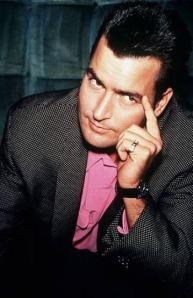
10) Charlie Sheen shows up for a really awkward cameo. He’s supposed to be playing his Bud Fox character from the original film but, watching his performance, you get the feeling that Charlie doesn’t remember being in the original film. Showing up at a charity dinner with a separate date on either ar, Bud Fox is presented as being just as corrupt as Gordon Gekko. Michael Douglas, quite frankly, looked somewhat embarrassed by the whole scene. However, as awkward as the scene was, it did manage to perfectly capture the theme of this movie:
Eventually, even Bud Fox will grow up to be Charlie Sheen.
Yesterday, me and my friend Jeff were planning on seeing Wall Street: Money Never Sleeps. However, there was one problem — I’d never seen the original Wall Street. Though I owned the movie on DVD, I’d never actually bothered to sit down to watch it. Don’t get me wrong, I knew that this was the movie that won Michael Douglas an Oscar. I knew that Douglas played a character named Gordon Gekko who, at one point in the film, delivered the line, “Greed is good.” Who hasn’t seen that clip?
So, yesterday, before leaving to see the sequel (which I’ll be reviewing in the near future), I sat down and watched the original. I discovered that there’s a reason why everyone remembers Gordon Gekko’s little “Greed is good” speech. It’s literally the only memorable part of the entire movie.
Wall Street tells the tale of Bud Fox (Charlie Sheen), a young stock broker who becomes a protegé to an intense and amoral businessman named Gordon Gekko (Michael Douglas). Gekko specializes in taking over other companies and putting people out of work. He wants to take over an airline that employs Bud’s father. Bud’s father is played by Martin Sheen and he’s such a self-righteous, judgmental, blue-collar asshole that you find yourself hoping that Gekko does put him out of work. Anyway, Bud engages in insider trading (which is apparently a crime though I’m not sure as the film seems to assume that everyone already understands how the stock market works) yet then finds his conscience awakened when Gekko’s greed threatens his dad’s job. Yes, this is yet another one of those laughably masculine films in which an overage boy has to pick a father figure.
I guess we’re supposed to care about whether or not he picks the right father but seriously, Bud Fox is such a dull character and Charlie Sheen is so miscast that I found myself wondering when the film’s real hero was going to show up. I had some hope when James Spader popped up in a supporting role but no, the lead character here is Bud Fox and he’s played by Charlie Sheen.
Not surprisingly, this is pretty much a male-dominated film. There’s only two notable female characters in the film. Darryl Hannah plays a ditz and Sean Young plays a bitch and neither one gets a chance to even have fun with the stereotypes. However, we all know that this film is really just about Gordon Gekko plunking his twanger over money and Bud Fox jackin’ the beanstalk to Gekko.
However, once you see Michael Douglas’s performance as Gordon Gekko, it’s a bit easier to understand why he causes Bud to walk Willie the One-Eyed Wonder Worm. Douglas truly is amazing in this role. In fact, Douglas is so charismatic in the role that it actually hurts the movie. It’s hard to take much pleasure in listening to Martin Sheen talk about how much he loves his union when you realize that all he’s doing is taking up time that could have been devoted to Michael Douglas fucking over poor people. I don’t know if a bad film can ever be truly redeemed by just one good performance but Douglas definitely makes Wall Street — with all of its awkward moralizing and sexist (and sexual) confusion — worth seeing.
As little as I thought of Wall Street, I still found myself excited about seeing the sequel. Why? Because I knew Michael Douglas was coming back and Martin Sheen wasn’t. Perhaps, I thought, this sequel will simply focus on Gekko being an over-the-top, charming viper instead of forcing us to sit through a repeat of the first film’s heavy-handed moralizing and simplistic political posturing. Of course, I was wrong but that’s another review for another day.
Oh, one last note: Oliver Stone’s direction is far better than his script. I once read an old review from Pauline Kael in which she said that Oliver Stone directed “as if someone held a gun to his head and shouted, ‘Go!'” and this is certainly the case with Wall Street. That said, I still find it hard to stay interested in any scene that features stock brokers screaming at each other and tossing around little bits of paper. Seriously, how does the Stock Market work? Whenever I see any footage from the New York stock exchange, it just looks incredibly silly.
Hi, my name is Lisa Marie Bowman and I hate just about every movie you’ve ever made. Well, that’s not totally true. First off, I haven’t seen every movie you’ve ever made. And I have to admit that when I was 12, I would cry and cry whenever I saw Titanic. So, let’s just say that I hate Avatar and I thought it was kinda fun to watch your ex-wife kick your ass at the Oscars earlier this year.
From my research, it appears that you take issue with people who disagree with you or who dare to suggest that you might not be the greatest filmmaker since DeMille. So, let me just add that this letter is being written by me and me only. When you send out your army of Orcs to punish the heretic at Through The Shattered Lens, they need only come for me. I may think you’re just a cranky, old dumbfug toadsucker but that’s my opinion and mine alone.
See, good people can have differing opinions. Unfortunately, just judging from some of your comments in the past, I don’t think you quite understand that. Maybe that explains why, rather than defend your movie, you always seem to end up accusing your critics of supporting global warming and the war in Iraq. Maybe that’s why the few Oscars that Avatar won were all accepted by balding little eunuchs who spent their whole acceptance speech praising your name as if they knew that if they didn’t, you’d end up going all psycho killer on them.
Listen, James, I’m going to help you out. Here’s my plotline for Avatar 2, which, trust me, is a lot more interesting than anything you’re planning on doing.
The film opens on Earth. As you explained in the first film, there “is no green” on Earth. But there are television networks and there are documentary crews. One of these networks has recently sent a group of young filmmakers to Pandora. Their assignment? To track down the Na’vi and to make a documentary about these “brutal savages” and their life on the green hell that is Pandora.
(Yes, James, this film is a prequel. Perhaps you could have Jake’s brother getting murdered in the background of one of the opening New York City shots.)
However, a week after the documentary crew first arrived on Pandora, all contact with them has been lost. The television networks hires a portly anthropology professor to go to Pandora and find out what has happened. Before the professor leaves on his mission, he is informed that the documentarians frequently staged the very atrocities that their films are known for.
Our anthropology professor — let’s call him Nick, since I know you like to dumb things down — goes to Pandora. With the help of a native guide, he manages to track down the Na’vi and win their trust. Taken to the Na’vi village, he discovers that the remains of the documentary crew are hanging from the Soul Tree. He realizes that they were captured and eaten by the Na’vi. However, the Na’vi did not destroy any of the film crew’s cameras. The footage of their final days in the jungles of Pandora has been preserved. Nick steals the footage and manages to make it back to “civilization” even as hordes of angry Na’vi chase after him (not mention Sigourney Weaver who can do a cameo somewhere around here).
While all this is going on, the film will occasionally pause to show grainy stock footage of various jungle animals being killed in various sickening ways.
Nick returns to Earth with the film. Sitting in a dark theater with the television executives, Nick views the footage.
Now, James, this is the tricky part. The “found footage” will dominate the last 40 minutes of Avatar 2. It’s important that the footage look so authentic that, for decades after, various dumbfugs will swear that they’re watching actual footage of actual people being eaten on camera. So, you’re going to have to abandon the 3-D for this part of the film. Instead, you’ll have to develop a multi-billion dollar process that will make the film look damaged. I’m talking about random scratches, unsynchronized sound, solarization, the whole deal.
As for the footage itself, this is what will make Avatar 2 special. We’ll see how the documentary crew staged “reality.” We’ll watch as they set a Na’Vi village on fire and how they arrogantly assumed that they’re superior to the natives. Finally, however, the Na’Vi will strike back and, in the film’s final moment, we’ll watch as the documentarians are eaten by the Na’Vi while their own cameras silently record the massacre.
Before I get to my review, you should understand that I nearly didn’t see The Town last night. Earlier, on Friday morning, I had to leave work early because I was so sick and nauseous that I was on the verge of passing out. Once I got home, I had to 1) convince my aunt that I wasn’t pregnant (“Are you sure?” she said after I reassured her) and 2) had to convince myself that my appendix wasn’t about to burst (and it’s not so don’t worry). After all that, there was a part of me that said, “The Town can wait. I’ll go on Saturday or maybe even later in the week.”
But I ignored that part of me and I went and saw the movie anyway. Why? Well, I wanted to review it for this site. (That’s dedication for you!) Plus, I knew my friend Jeff wanted to see it with me and I wanted to see it with him and since when has a little thing like a ruptured appendix ever been an excuse not to have a good time? Last but not least, The Town is Ben Affleck’s second movie as a director. His first was 2007’s Gone, Baby, Gone. Personally, I think Gone, Baby, Gone is one of the best crime films ever made. It’s certainly one of my favorite. I was curious to see if The Town would be a worthy follow-up or would it just prove Gone, Baby, Gone to have been a fluke.
The Town takes place in the Charlestown section of Boston. At the opening of the film, we’re told that Charlestown apparently produces more professional armed robbers than any other place in the entire world. It’s a practice that is handed down from father-to-son. (Or, in the case of this movie, from Chris Cooper to Ben Affleck.)
Affleck plays Doug, a former hockey player who is now the head of a gang of Charlestown bank robbers. His second-in-command is Jem (played by Jeremy Renner). Over the course of the film, we learn Doug’s father (Chris Cooper) is a career criminal who is currently serving a life sentence in prison. When his father went to prison, Doug was taken in by Jem’s family. Doug even ended up dating Jem’s sister (Blake Lively) and might be the father of Lively’s daughter. For this reason, Doug and Jem are fiercely loyal to each other despite the fact that Doug is essentially a nice guy and Jem is not.
(As a sidenote, why is it in the crime films that people are always shocked when the psychotic supporting character ends up doing psychotic? I mean, have these people never gone to the movies before? Have they never checked out Goodfellas from Netflix? Did they miss the whole Joe Pesci “How am I funny?” thing?)
At the start of the film, Doug, Jem, and the gang rob a bank. Doug is a model of professionalism. Jem goes a little bit crazy and beats one bank employee nearly to death. This gives the bank manager, Clare (Rebecca Hall), just enough time to set off a silent alarm. Realizing that the police are on the way, Jem responds by taking Clare hostage as the gang flees. Clare is later released on a desolate beach.
However, there’s a problem. Before releasing her, Jem stole Clare’s ID. Looking at it after the robbery, he discovers that Clare lives in Charlestown and, as a result, there’s now a risk that she might simply see one of the gang on the street and identify him. Jem wants to kill her but Doug says that he’ll take care of her himself.
By “taking care of,” Doug means that he’ll follow her around town, eventually strike up a conversation with her, and then end up pursuing a romance with her (while declining, of course, to mention that he already knows her). Jem, however, was under the impression that “taking care of” meant to kill. So, needless to say, he’s a little bit miffed when he stumbles across Doug and Clare having a lunch date.
Soon, Doug finds himself trapped in the life he’s created for himself. In love with Clare but torn by his loyalty to the increasingly unstable Jem, Doug agrees to one more big job. All the while, he is pursued by two relentless FBI agents (Jon Hamm and Titus Welliver) and he has to deal with an Irish mob boss (Pete Postlewaite) who has an agenda of his own.
The Town works largely because Ben Affleck has, unexpectedly, turned out to be an intelligent, no-nonsense director. The movie features three robbery scenes and, in each one of them, Affleck creates genuine tension and excitement without ever once resorting to outlandish stunts or random slow motion. Unlike a lot of (bad) actors turned director, Affleck never seems to feel the need to toss in any showy (but ultimately empty) tricks to try to convince us that he’s a director. This is a confident movie that shows that Gone, Baby, Gone wasn’t a fluke. (That said, Gone, Baby, Gone remains the superior film for reasons that I’m getting to.)
Also, as with Gone, Baby, Gone, The Town benefits from Affleck’s obvious love for the city and people of Boston. Shot on location and featuring a number of local actors, The Town has a wonderful sense of place to it. By the end of it, you feel as if you know Charlestown even if, like me, you’re just a country girl from Texas.
Ben Affleck the director also manages to do something truly surprising — he gets a good performance out of Ben Affleck the actor. In the past, I’ve always enjoyed looking at Ben Affleck on-screen but I never really wanted to hear him talk. Because as soon as he would open his mouth, whatever appeal that Affleck possessed would immediately dissolve. In the past, as an actor, Affleck often epitomized that whole concept of “there’s no there there.” However, in this film, he gives a low-key, subtle performance that really helps to hold the entire film together. I still wouldn’t call Affleck a good actor. Instead, he’s one of those rare directors who (like fellow bad actor Quentin Tarantino) knows how to get good performances even from the most unlikely of performers.
Affleck is well-supported by Hall, Lively, and Renner. Hall has a difficult job because she’s not so much playing an actual human being as much as she’s playing an idealized concept. Her character really doesn’t have any purpose beyond offering Doug a chance at redemption and (this is obvious more in retrospect than during the actual film) really doesn’t have much of an identity beyond how her life touches Doug’s. Hall, however, is so vulnerable in the role that, while you’re watching the film, that none of this really becomes obvious until a few hours after the movie ends. Lively (better known for her role on Gossip Girl) is only in a few scenes and, in many ways, her character is even less developed than Hall’s. If Hall has to represent the Madonna part of the Whore/Madonna complex, guess what Lively represents. Still, Lively brings some much needed humor to the role and to the film. She’s having fun playing her drunken, drug-addled character and she steals almost every scene that she’s in.
However, the film is ultimately dominated by Jeremy Renner. With his angelic voice and deceptively soft voice, Renner is the psychopath that you can’t help but love. Movie psychos are a dime-a-dozen so when an actor comes along and actually finds something new to do with the role, it’s impossible not to be impressed.
So much works in The Town that I almost feel guilty talking about what doesn’t. For all its strengths, it also has three rather glaring flaws. As with all things, the final verdict on this film depends on just how willing the viewer is to overlook these flaws.
First off, Ben Affleck proves himself to be a better director than writer. The Town’s story is well told but the majority of it will still be awfully familiar to anyone who has ever seen a heist film. Unlike Quentin Tarantino, Martin Scorsese, or Michael Mann, Affleck doesn’t embrace the conventions in order to deconstruct them. Instead, he uses the conventional storyline as an excuse to explore the Charlestown culture. As a result, this flaw arguably works to the film’s advantage. Still, those viewers who are expecting to be surprised by the film’s plot should consider themselves warned.
As well acted as the movie is, there is one big exception in the cast and that is Mad Men’s Jon Hamm. Hamm plays the FBI agent who is determined to capture Affleck. He’s the Javert to Affleck’s Valjean. Unfortunately, as played by Jon Hamm, he’s also a cinematic black hole. Hamm may be an excellent television actor but, playing a key supporting role and surrounded by actual film actors, it’s obvious that Hamm has no idea how to act for the big screen. As a result, he never comes across as a worthy or even dangerous adversary and his pursuit of Affleck never becomes compelling nor do we ever worry that Affleck might not be able to outsmart him. There’s a scene, towards the end of the film, where Hamm yells something like, “Drop your weapon, asshole!” I have to admit that I stunned just about everyone in the theater when I burst into laughter at the sound of Hamm shouting “asshole” and sounding, more or less, like an overgrown kid on a playground.
(Hamm’s sidekick, by the way, is played by another tv actor, Titus Welliver. Welliver is probably best known for playing the Man In Black on the final season of Lost. Though he gets next to nothing to do, Welliver dominates every scene that he’s in. Unlike Hamm, he knows how to act on a big screen.)
The most glaring flaw with The Town, however, is that the entire plot pretty much depends on the viewer accepting that Hall’s character, just days after being traumatized by being held hostage and seeing one of her co-workers nearly beaten to death because he attempted to protect her, would so easily trust and open up her life to a stranger (even if that stranger is Ben Affleck). Never mind the fact that we are then expected to believe that she would stay loyal to Affleck even after learning the truth. Realistically, this would seem to indicate that the character’s something of a sadomasochist but the film really doesn’t explore that (or really anything else that might make Hall’s character anything more than just an idealized Madonna figure).
I mean, I’m always open to experimentation in a relationship. Different people enjoy different things and I’ve never been one to judge anyone else’s particular fetish. However, just speaking for myself, the day that you stick a gun in my face, put a blindfold over my eyes, and then abandon me out on the beach is the same day that I decide that there’s probably not going to be a long-term relationship there.
So, once again, it’s all a question of whether or not you can accept these flaws. I have to admit that, as I watched the film, I occasionally had a hard time doing so. If you can agree to overlook the flaws, however, then The Town is an entertaining, well-acted crime thriller with an authentic sense of place. And if you can’t overlook those flaws, than The Town is a good but imperfect movie that still indicates that Ben Affleck has got quite a future as a director.