Embracing The Melodrama Part III #7: True Confessions (dir by Ulu Grosbard)


The 1981 film True Confessions tells many different stories.

It’s a story about Los Angeles.  It’s not necessarily a story about Los Angeles as it exists.  Instead, it’s a story about Los Angeles as we always imagine it.  It’s the late 40s and, having vanquished the Nazis in Europe, men are returning to California and looking for a new life.  Meanwhile, aspiring starlets from across the country flood into Hollywood, looking for stardom.  It’s a city where glitz and ruin exist right next to each other.  It’s the mean streets that were made famous by Raymond Chandler and, decades later, James Ellroy.

It’s a murder mystery, one that is based on one of the most notorious unsolved homicides of all time.  The bisected body of woman named Lois Fazenda has been found in a vacant lot.  When the newspapers discover that Lois was both a prostitute and a Catholic, she becomes known as “the Virgin Tramp.”  One need not have an encyclopedic knowledge of unsolved crimes to recognize that Lois Fazneda is meant to be a stand-in for Elizabeth Short, the tragic and infamous Black Dahlia.

It’s a story about corruption.  Crooked cops.  Rich perverts.  Greedy politicians.  Sinful clergy.  They’re all present and accounted for in True Confessions.  As quickly becomes apparent, Los Angeles is a city where you can do anything as long as you have the money to pay the right people off.

And finally, it’s a film about two brothers.  Tom and Des Spellacy grew up in a strong Irish Catholic family but, as they got older, their lives went in different directions.  Tom (Robert Duvall) became a detective, the type who is willing to cut corners but who, in the end, takes his job seriously.  Des (Robert De Niro) entered the priesthood and is now a monsignor in the Los Angeles diocese.  Des is ambitious and he has a powerful mentor, Cardinal Danaher (Cyril Cusack).

Though Tom and Des have gone their separate ways, they are still linked by Jack Amsterdam (Charles During).  To the public, Jack is a wealthy and respected businessman.  However, Tom and Des both know the truth.  When Tom first joined the department, he worked as a bagman for Jack and he knows that Jack made most of his money through a prostitution ring.  Des know that Jack donates to the Church as way to cover up his own corruption but Des looks the other way.  The Cardinal, after all, wants Jack’s money.

When Tom starts to investigate Lois’s death, it doesn’t take him long to figure out that Jack is probably the one responsible.  Meanwhile, Jack and his lawyer (Ed Flanders) start to pressure Des to convince his brother to let the case go.  Finding justice for Lois Fazneda could mean the end of both Tom and Des’s career.

Based on a novel by John Gregory Dunne, which was adapted into a screenplay by Dunne and Joan Didion, True Confessions is an imperfect but intriguing film.  This is one of Robert Duvall’s best performances and he brings a manic edge to the role that keeps the audience off-balance.  In the role of Jack Amsterdam, Charles Durning is the epitome of casual corruption and Burgess Meredith does a good job as an aging priest.  On the other hand, Robert De Niro seems strangely uncomfortable in the role of Des and you never quite believe that he and Duvall are actually brothers.  Director Ulu Grosbard does a good job of creating a proper noir atmosphere but, at the same time, he denies the audience the dramatic climax to which the film appears to be building up to.

That said, for whatever flaws True Confessions may have, it’s an always watchable and thought-provoking film.

Embracing the Melodrama Part III #4: The Grasshopper (dir by Jerry Paris)


“It’s very simple what I want to be: totally happy; totally different; and totally in love.”

— Christine Adams (Jacqueline Bisset) in The Grasshopper (1970)

Seriously, is Christine asking for too much?

Total happiness?  That may sound like a lot but trust me, it can be done.

Totally different?  That’s a little bit more challenging because, to be honest, you’re either different or you’re not.  If you have to make the effort to be different, then you definitely are not.

Totally in love?  Well, it depends on how you define love…

At the start of The Grasshopper, Christine thinks that she’s heading to America to find love.  While an oh-so late 60s/early 70s theme song plays in the background, Christine leaves her small hometown in Canada and she heads down to California.  She’s planning on meeting up with her boyfriend Eddie (Tim O’Kelly) and taking a job as a bank teller.

Of course, it soon turns out that working in a bank isn’t as exciting as Christine originally assumed.  Eddie expects Christine to just be a conventional girlfriend and that’s not what Christine is looking for. As well, it’s possible that Christine may have seen Targets, in which O’Kelly played an all-American boy who picks up a rifle and goes on a killing spree.

And so, Christine abandons Eddie and heads to Las Vegas.  Since this movie was made in 1970 and Uber didn’t exist back then, Christine’s preferred method of traveling is hitchhiking.  This gives her a chance to meet the usual collection of late 60s weirdos who always populate movies like this.  One driver crosses herself when Christine says that she plans to have a baby before getting married.  Another is a hacky Las Vegas comic.

In Vegas, Christine applies for a job as a showgirl.  As she explains to sleazy casino owner Jack Benton (Ed Flanders), she “once did Little Women in school.”

“Did you do it nude?” Jack replies.

Yep, that’s Vegas for you!  It’s the city of Showgirls, Casino, and Saved By The Bell: Wedding in Vegas, after all!

Anyway, thing do get better once Christine meets and falls in love with Tommy Marcott (Jim Brown), a former football player who is now working as a door greeter in Jack’s casino.  Everyone tells Christine not to get involved with Tommy.  One of Jack’s men, a menacing hitman who looks just like Johnny from Night of the Living Death (he even wears glasses), warns Christine to watch herself.

Through a long series of events, Christine ends up on her own again.  The usual collection of 70s events occur: murder, drugs, prostitution, and ultimately a stint as the mistress of a rich man played by Joseph Cotten.  The important thing is that it all eventually leads to Christine and a skywriter getting stoned, stealing a plane, and deciding to write a message in the sky.

That’s when this happens:

Yes, it’s all very 1970!

Anyway, The Grasshopper is one of those films that tries to have it both ways.  Establishment audiences could watch it and think, “Wow, those kids are really messed up.”  Counterculture audiences could watch it and say, “Old people are such hypocrites.”  Oddly enough, The Grasshopper was written by future director Garry Marshall and it’s an incredibly overwrought film.  There’s not a subtle moment to be found in the entire film and the film’s direction is flashy but empty.  However, for those of us who love history, it’s as close to 1970 as we’re going to get without hopping into a time machine.

A Movie A Day #326: MacArthur (1977, directed by Joseph Sargent)


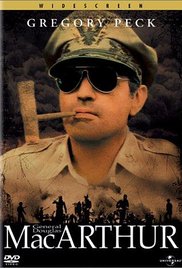
The year is 1962 and Douglas MacArthur (Gregory Peck), the legendary general, visits West Point for one last time.  While he meets the graduates and gives his final speech, flashbacks show highlights from MacArthur’s long military career.  He leaves and then returns to Philippines.  He accepts the Japanese surrender and then helps Japan rebuild and recover from the devastation of the war.  He half-heartedly pursues the Presidency and, during the Korean War, gets fired by Harry Truman (Ed Flanders).
MacArthur is a stolid biopic about one America’s most famous and controversial generals.  It was produced by Frank McCarthy, a former general who knew MacArthur and who previously won an Oscar for producing Patton.  McCarthy was obviously hoping that MacArthur was do its subject what Patton did for George Patton and both films follow the same basic pattern. a warts-and-all portrait of a World War II general with all of the action centered around the performance of a bigger-than-life actor in the title role.  Though obviously made for a low budget, MacArthur is a well-made and well-acted movie but it suffers because Douglas MacArthur was just not as interesting a figure as George Patton.  Gregory Peck does a good job subtly suggesting MacArthur’s vanity along with capturing his commitment to his duty but he never gets a scene that’s comparable to George C. Scott’s opening speech in Patton.  The main problem with MacArthur, especially when compared to Patton, is that George Patton was a born warrior while Douglas MacArthur was a born administrator and it is always going to be more exciting to watch a general lead his men into battle then to watch him sign executive orders.

A Movie A Day #234: The Final Days (1989, directed by Richard Pearce)


Since yesterday’s entry in movie a day featured Philip Baker Hall playing Richard Nixon in Secret Honor, I decided to use today’s entry to talk about a movie that featured Lane Smith in the same role.

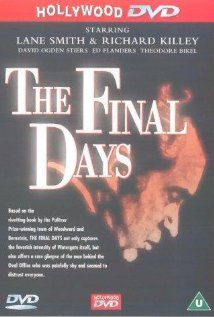
Based on Bob Woodward and Carl Bernstein’s follow-up to All The President’s Men, The Final Days is about the final months of the Nixon presidency.  The movie begins shortly after the resignations of Nixon aides John Ehrlichman and H.R. Haldeman and follows Nixon (Lane Smith) as he grows increasingly more isolated and reclusive in the White House.  All the familiar moments are here, Nixon ranting against the Kennedys and the establishment, Kennedy talking about his difficult childhood, and, most famously, Nixon asking Henry Kissinger (Theodore Bikel) to pray with him on the night before his resignation.  The Final Days also focuses on the ambitious men who surrounded Nixon during his downfall and who helped to engineer his eventual resignation, especially Al Haig (David Ogden Stiers).

A lot of very good actors have played Richard Nixon.  Anthony Hopkins and Frank Langella both received Oscar nominations for playing him and Philip Baker Hall probably should have.  Rip Torn, John Cusack, Kevin Spacey, Dan Hedaya, and Bob Gunton have all taken a shot at the role.  But, in my opinion, no one has done a better job as the 37th president than Lane Smith, who bore about as close a resemblance to Nixon as anyone could without a prosthetic nose.  Even more than Anthony Hopkins did in Oliver Stone’s Nixon, Lane Smith captured not only Nixon’s insecurity and paranoia but also his provides hints of the great leader that Nixon could have been if not for his own self-destructiveness.


A Movie A Day #15: Special Bulletin (1983, directed by Ed Zwick)


specialbulletin2

“We interrupt our regularly scheduled programming for a special report…”

Led by veteran anchor John Woodley, the RBS news team is providing continuing coverage of a developing crisis in Charleston, South Carolina, where terrorists are holding several members of the coast guard, a local new reporter, and his cameraman hostage on a small tugboat.  These are not typical terrorists, though.  Two of them are nuclear scientists.  One of them is a social worker.  Another one is a nationally-renowned poet.  The final terrorist is a former banker robber who was just recently released from prison.  This unlikely group has only two demands: that the U.S. government hand over every single nuclear trigger device at the U.S. Naval Base and that RBS give them a live television feed so that they can explain their actions to the nation.  If either of those demands are not met, a nuclear bomb will be detonated and will destroy Charleston.

This made-for-TV movie was shot on video tape, to specifically make it look like an actual news broadcast.  Though much of the movie seems dated when compared to today’s slick, 24-hour media circus, Special Bulletin was convincing enough that, when it was originally broadcast in 1983, it caused a mini-panic among viewers who missed the opening disclaimer:

specbull_disclaimer

Because the movie deals with the threat of nuclear terrorism instead of a U.S.-Soviet nuclear war, it still feels relevant in a way that many of the atomic disaster films of the 1980s do not.  Beyond making an anti-nuclear statement, Special Bulletin is also a critical look at how the news media sensationalizes every crisis, with the RBS news team going from smug complacency to outright horror as the situation continues to deteriorate.  David Clennon and David Rasche are memorable as the two most outspoken of the terrorists and Ed Flanders is perfectly cast as a veteran news anchor struggling to maintain control in the middle of an uncontrollable situation.  Special Bulletin won an Emmy for Outstanding Drama Special and can be currently be found on YouTube.

Keep an eye out for Michael Madsen, who shows up 57 minutes in and gets the movie’s best line: “That guy’s a total psycho ward.”

madsen-special-bulletin

Horror Scenes I Love: Salem’s Lot (Part 3)


This particular scene was my third favorite from Tobe Hooper’s Salem’s Lot.

There’s much to love about this scene. It’s a very claustrophobic sequence with our protagonist Ben Mears (played by David soul) left in the morgue by his friend Bill Norton for just a few minutes. The scene itself gradually builds in tension as Ben realizes that at any second the body on the morgue table could get up. The word vampire rarely gets uttered during the first third of the series, but Ben suspects the worst and he knows that he’s ill-prepared to deal with his fears if they bear fruit.

There’s a definite tv network quality to the way the scene is shot, but Hooper milks the creeping dread and terror with each passing second as Ben creates a makeshift crucifix and begins to chant random Bible passages as a way to bless his home-made icon. When his fears have been confirmed there’s not a sense of relief that he’s not crazy, but one of sheer terror.

This third joins part one and part two of my favorite scenes from Salem’s Lot and when witnessed as a set should give an idea just how terrifying and underrated this mini-series adaptation of the classic Stephen King vampire novel really is.