6 Other Films That I Saw in 2014: The Best Offer, Borgman, Illiterate, In Secret, Scorpion in Love, and Tercera Llamada


The Best Offer (dir by Guiseppe Tornatore)

Virgil (Geoffrey Rush, giving a very Geoffrey Rush type of performance) is the owner of a prestigious auction house.  He’s hired by the mysterious Claire (Sylvia Hoeks) to auction off all of her dead parent’s possessions.  Virgil finds himself growing obsessed with Claire and, with the help of his assistant Robert (Jim Sturgess), finally manages to strike up a tentative relationship with her.  However, it quickly turns out that there’s more to Claire and Robert than Virgil originally assumed.

The Best Offer is a disappointing film.  It’s not terrible but it moves far too slowly for its own good and most of the cast seems to be going through the motions.  The one exception is Donald Sutherland, who is a lot of fun as a sleazy con artist.  Sutherland managed to partially redeem Fierce People, another bad film that I recently reviewed, and he comes close to doing the same for The Best Offer.

Borgman (dir by Alex van Warmerdam)

Borgman is a disturbing and dark film from the Netherlands that was released over here in U.S. by Drafthouse Films.  This summer, Jeff and I saw it at our local Alamo Drafthouse with the usual group of self-styled cinema experts. Nobody quite knew what they were about to see and, after the film ended, an uneasy air descended over the theater as we all wondered what we had just watched.

Jan Bijvoet plays Camiel Borgman, a homeless man who is first seen living in the woods, hidden away in an underground cavern.  When he’s chased out of the woods by a priest and two men, Borgman eventually finds himself at the home of the arrogant and wealthy Richard (Jeroen Perceval).  Richard refuses Borgman’s request to enter the home for a bath and then physically attacks him.  When Borgman returns to the house the next day, Richard’s wife, Marina (Hadewych Minis), allows him to stay in the garage.  Though Borgman originally says he’s only going to stay a day, he is soon living in the garage.  Everyone — Marina, her children, and the nanny — is aware that Borgman is now a part of their household.  Everyone, except for Richard who remains blissfully unaware.  Soon, Marina is having violent nightmares while Borgman crouches over her and more and more of Borgman’s followers are showing up at the house…

Borgman is a horrific fable with a dark sense of humor.  (As frightening as Borgman is, it’s impossible not to be amused by just how clueless Richard turned out to be.)  In the best tradition of Michael Haneke, it all leads to an inevitable and unsettling conclusion.

Illiterate (dir by Moisés Sepúlveda)

Now this is a special film.

In this Chilean film, Ximena (Paulina Garcia) is an angry and sarcastic woman who is secretly ashamed to be illiterate.  When Jackeline (Valentina Muhr) volunteers to teach Ximena how to read, she has to deal with both Ximena’s stubborn nature and her own anger over the years that she’s lost, imprisoned by her inability to understand the written word.  And while this may sound like the basis of a typical Lifetime movie, the story takes on a special significance if you know something about the history of Chile and you understand that Ximena is a part of the generation that was previously held prisoner by a military dictatorship.  Ximena’s attempt to learn how to read mirror the attempt of a country to learn how to be free.

Garcia and Muhr both give excellent performances.  The film is a bit stagey but ultimately, it’s very touching.

In Secret (dir by Charlie Stratton)

How do you not enjoy a film like In Secret?  Taking place in 19th century Paris, In Secret tells the story of Therese (Elizabeth Olsen), who is forced by her haughty aunt (Jessica Lange) to marry her sickly cousin Camille (Tom Felton).  However, Therese does not love Camille and, bored with life in general, she ends up having an affair with Camille’s friend, the libertine Laurent (Oscar Isaac).  Soon, Camille has been murdered, Theresa and Laurent are married, and how can you not love all of this melodrama?

In Secret is over-the-top but enjoyable, like a Lifetime movie with explicit sex and costumes to die for.  It’s just a lot of fun.

Scorpion In Love (dir by Santiago Zannou)

In this Spanish film, Julian (Alex Gonzalez) is a young Neo Nazi who attempts to achieve redemption through boxing but who fears that his violent past will catch up with him.  It’s not, by any means, a bad film.  It’s just an extremely predictable one.  Javier Bardem shows up playing a Nazi leader and he’s just as dangerously charismatic as you might expect but, otherwise, the film doesn’t offer much insight into what exactly would lead someone like Julian to become a Nazi in the first place.

Tercera Llamada (dir by Francisco Franco Alba)

This comedy from Mexico tells the story of an attempt by a theater company to put on a production of Albert Camus’s Caligula.  The film is full of the usual types — the dedicated director, the craven producer, the innocent ingenue, and the difficult diva.  It’s predictable but likable.  If you’ve ever been involved in a community theater production that you just knew was going to probably be a disaster, you’ll find a lot to appreciate in Tercera Llamada.
For Your Consideration #6: Jennifer Lawrence in The Hunger Games: Mockingjay Part One


Mockingjay

Of the three The Hunger Games films released so far, Mockingjay Part One is definitely the weakest.  That does not, however, mean that it’s a bad film.  It’s just that it doesn’t quite reach the grandeur of the first film, nor does it have the same political immediacy as the second one.  However, there’s a lot of good things to be said about Mockingjay.  Julianne Moore is perfectly cast as the charismatic but faintly sinister Alma Coin.  Philip Seymour Hoffman’s performance reminds us of what a towering talent we lost earlier this year.  Donald Sutherland continues to transform President Snow into a villain for the ages.  Even though he’s only in the film for a few minutes, Stanley Tucci is perfectly vapid as Caesar Flickerman.

In fact, the only real problem with Mockingjay is that it’s so obviously a prologue to something bigger.  Much as with The Maze Runner, we watch Mockingjay with the knowledge that it’s only part one and that the majority of the issues raised by the film will not be settled until next year.  The film itself knows this as well and, as such, it lacks the immediacy and much of the excitement of the first two Hunger Games films.

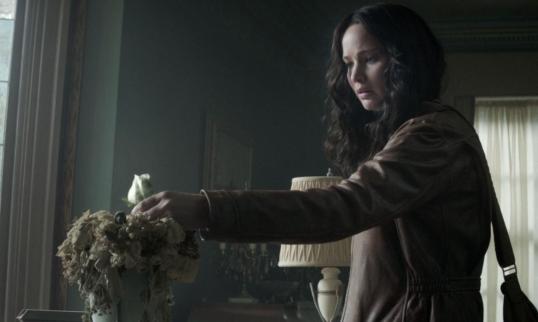
But yet, with all those flaws in mind, Mockingjay still works and it’s largely because of Jennifer Lawrence’s performance as Katniss Everdeen.  Whereas the first two Hunger Games films featured a Katniss who was always at the center of the action and always taking charge of any situation that she found herself in, Mockingjay features a Katniss who has far less control over her fate.  (One of the neater ironies of the series is that Katniss was actually more independent as a prisoner of President Snow than as a “guest” of Alma Coin.)  In Mockingjay, Katniss finds herself forced — with more than a little reluctance — to become the figurehead for the entire revolution and the film’s best moments are the ones in which others debate how to best “market” her.  These scenes are all about how Katniss — who is now not only a celebrity but a political icon as well — deals with losing control over her own public image.  Considering that Jennifer Lawrence’s rise to fame and acclaim occurred just as abruptly as Katniss’s, it’s probable that — even more so than in the previous films — the actress brought a lot of herself to the character.

So, yes, I would argue that Jennifer Lawrence does perhaps deserve some awards consideration for her performance in Mockingjay.  However, she truly deserves it for the consistent quality of her performance throughout the entire Hunger Games franchise.  From the very first film, Jennifer Lawrence’s performance has been iconic.  Fiercely independent without giving into the usual cinematic clichés that come with that, Katniss Everdeen has provided an alternative role model for a generation of girls who, otherwise, might have only had the likes of Bella Swan to look up to.

If that’s not worthy of being honored, then I don’t know what is.

Teaser Trailer: The Hunger Games: Mockingjay Part One


At this point, does it even matter what scenes they put into the trailer for Mockingjay?  I mean, we all know that we’re going to see it and we’re probably going to love it, right?  They could probably release this film without doing a bit of advertising and it would still make box office history.

But what fun would that be?

Here’s the latest teaser f0r Mockingjay!  It’s interesting to note that, along with the expected emphasis on Jennifer Lawrence, the trailer really is dominated by Philip Seymour Hoffman.

Embracing the Melodrama #56: Fierce People (dir by Griffin Dunne)


Fierce People

Much as how Inside Out is a perfect example of how one bad plot twist can ruin an otherwise good film, the 2007 sin-among-the-wealthy melodrama Fierce People shows how one good actor can partially redeem a really bad movie.  That actor’s name is Donald Sutherland and Fierce People is worth seeing for one reason: his performance.

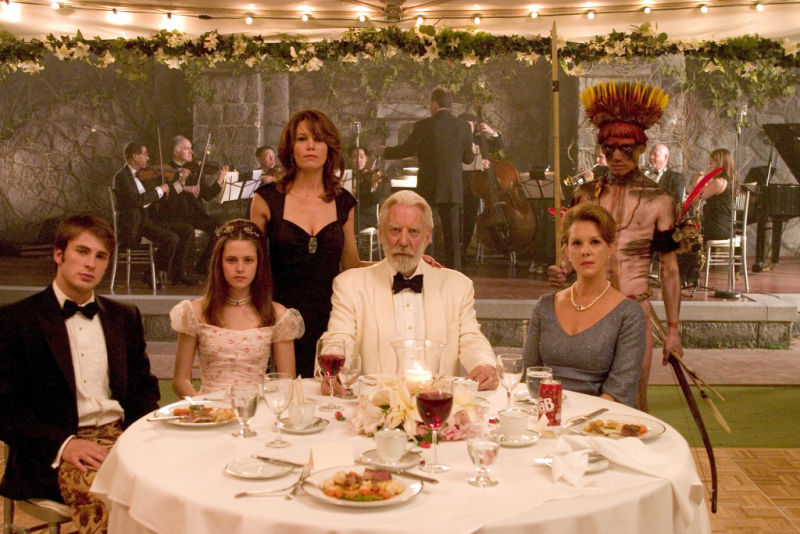
Fierce People tells the story of a teenager named Finn Earl (Anton Yelchin).  As a character, Finn Earl is almost as annoying as his cutesy name.  He’s a permanently sarcastic 16 year-old who goes through life with the same judgmental smirk on his face, while the whole time delivering some of the smuggest narration ever recorded for a voice over in an American film.  Finn’s mother is Liz (Diane Lane), a massage therapist with a drug problem.  Finn’s father is some jerk who spends all of his time in South America, studying cannibal tribes.  (Actually, he’s studying a real-life Indian tribe known as the Yanomami, or the Fierce People.  However, I prefer to assume that he was actually studying a cannibal tribe because that means it’s entirely possible that he was eaten at some point and therefore, Finn will never get a chance to spend any time with father.  That’s the type of reaction that Finn, as a character, inspires.)

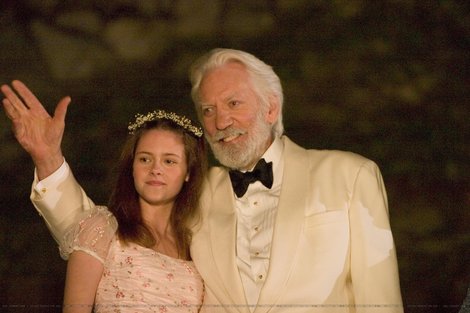
Liz and Finn are invited to spend the summer living the guesthouse of the fabulously wealthy Ogden Osburne (Donald Sutherland).  At first, Finn is weary of Ogden and assumes that he must be sleeping with Liz.  However, in a scene that works only because of the performance of Donald Sutherland, Ogden very graphically shows Finn why he’s not interested in having an affair with Liz.  Instead, Ogden is just a nice, rich eccentric.  Unfortunately, the other wealthy people who live around Ogden are not quite as nice and they soon, they start to resent the presence of Finn and his mother.  Finn does manages to befriend Ogden’s decadent grandson (played by Chris Evans) and even starts a tentative romance with Ogden’s granddaughter (Kristen Stewart) but the rest of the Osburne clan is not prepared to be so accepting.  Soon, the film goes from being an annoying comedy to being an annoying drama with a burst of violence and murder.

Fierce People is not a very good movie.  It’s based on a novel and, even if you didn’t know that beforehand, you would guess just from the way that the film tries and fails to present a lot of themes that undoubtedly work better on the page than on the screen.  The film’s attempts to draw parallels between the Yanomami and the wealthy (They’re two tribes and they’re both fierce — OH MY GOD, MIND BLOWN!) are way too obvious and the film’s sudden lurch into drama is handled rather clumsily.  It’s interesting to see Chris Evans before he became Capt. America and Kristen Stewart before she became Bella (and both of them, by the way, give good performances) but Anton Yelchin’s performance as Finn alternates between being smug and being whiny.  (In Yelchin’s defense, he’s developed into a pretty good actor and I loved him in Like Crazy.)

And yet, Fierce People works as an example of what a truly great actor can do with so-so material.  As played by Donald Sutherland, Ogden becomes the jaded moral center of the universe.  Sutherland plays Ogden with a perversely regal air and yet also makes us totally believe that Ogden actually could be helping the Earls out of the kindness of his heart.  It’s a great performance and every minute that Sutherland is on screen, Fierce People works.

If the film had simply been called Fierce Ogden, it would have been a hundred times better.

Donald Sutherland and Kristen Stewart

Embracing the Melodrama #32: Ordinary People (dir by Robert Redford)


ordinary_people_oc87rd_1

For the past seven days, I’ve been reviewing — in chronological order — fifty of the most memorable melodramas ever filmed.  We started with a silent film from 1916 and now, we have reached the 80s.  What better way to kick off the decade than by taking a look at the 1980 Best Picture winner, Ordinary People?

Directed by Robert Redford, Ordinary People tells the story of the upper middle class Jarrett family.  On the surface, the Jarretts appear to be the perfect family.  Calvin Jarrett (Donald Sutherland) has a successful career.  Beth (Mary Tyler Moore) keeps a perfect home and appears to be the ideal suburban matriarch.  However, one summer, their oldest son drowns in a sailing accident and their youngest son, sensitive Conrad (Timothy Hutton), attempts to commit suicide.  After spending four months in a psychiatric hospital, Conrad come back home and the family struggles to put their lives back together.  Even though he starts to see a therapist (Judd Hirsch) and starts dating his classmate Jeannine (Elizabeth McGovern), Conrad still struggles with his feelings of guilt over having survived.  Beth’s struggle to maintain a facade of normalcy leads to several fights between her and Conrad with Calvin trapped in the middle.

Among my fellow film bloggers, there’s always going to be a very vocal group that is going to hate Ordinary People because it won the Oscar for best picture over challenging black-and-white films directed by Martin Scorsese (Raging Bull) and David Lynch (The Elephant Man).  They always tend to complain that Ordinary People is a conventional film that tells a conventional story and that it was directed by a very conventional director.  More than once, I’ve seen an online film critic refer to Ordinary People as being a “big budget Lifetime movie.”

Well, you know what?

I love Lifetime.  Lifetime is the best network on television and to me, a big budget Lifetime movie would be the best Lifetime movie of all.  And, at the risk of alienating all of my film-loving friends, if I had to choose between watching Raging Bull and Ordinary People, I’m going to pick Ordinary People every time.  Raging Bull is visually stunning and features great performances but it’s also two hours spent watching an incredibly unlikable human being beating the crap out of anyone who is foolish enough to love him.  Ordinary People may essentially look like a TV show but it’s also about characters that you can understand and that, as the film progresses, you grow to truly care about.

Yes, I do wish that the character of Beth had been given more of a chance to talk about her feelings and it’s hard not to feel that Ordinary People places too much blame on the mother.  But, even so, the film still ends with vague — if unlikely — hope that Beth will eventually be able to move past her anger and reconnect with her family.  The film may be hard on Beth but it never gives up on her.  That’s what distinguishes Ordinary People for me.  In many ways, it’s a very sad film.  It’s a film that was specifically designed to make you cry and I certainly shed a few tears while I watched it.  But, even with its somewhat ambiguous ending, Ordinary People is also a very optimistic movie.  It’s a movie that says that, as much pain as we may have in our life,we can recover and life can go on and it’s okay to be sad and its also okay to be happy.

And that’s an important lesson to learn.

(That said, if I had been alive and an Academy voter in 1981, I would have voted for The Elephant Man.)

And, for all you Oscar lovers out there, here are clips of Timothy Hutton and Robert Redford winning Oscars for their work on Ordinary People.

44 Days of Paranoia #31: The Hunger Games: Catching Fire (dir by Francis Lawrence)


For our latest entry in the 44 Days of Paranoia, we take a look at a film that might, at first, seem out-of-place in this series — The Hunger Games: Catching Fire.

Why is Catching Fire included in a series of films about conspiracy and paranoia?  Because, even more than the first film, Catching Fire is a film with a political subtext.  Beneath its franchise surface, Catching Fire is about how the government and media establishment manipulates its citizens and how, occasionally, the citizens are smart enough to manipulate them.

When reviewing Catching Fire, probably the first and most important question is how it compares to The Hunger Games.  Is it that film’s equal, is it better, or is it worst?  That’s not necessarily an easy question to answer because Catching Fire is a very different film from The Hunger Games.

One of the main reasons that I loved The Hunger Games is because, after a countless number of Twilight-style films that all featured teenage girls willingly sacrificing their independence for a boyfriend, The Hunger Games finally gave us a female protagonist who kicked ass and made no apologies for doing so.  Katniss Everdeen was defined by her mind and her soul and not her relationship status.  I loved The Hunger Games because, like Brave, it celebrated female strength and independence.  While I have always been willing to defend the Twilight films for what they are, I would not want my niece or my future daughter to grow up to be Bella Swan.  Katniss Everdeen, however, is a role model for both our times and our future.  The Hunger Games was all about celebrating girl power and, for that reason, I loved it.

Katniss Everdeen is still a worthy and independent role model in Catching Fire but the film itself is far more political than The Hunger Games.  Whereas The Hunger Games was all about establishing Katniss as a strong woman, Catching Fire is about how that strength can be used to challenge the status quo.

As the film opens, Katniss (played, of course, by Jennifer Lawrence, who I have such a girl crush on) and Peeta (Josh Hutcherson) have returned to District 12 after having “won” the 74th Hunger Games.  Realizing that their act of defiance could lead to a full-scale revolution, President Snow (Donald Sutherland) attempts to co-opt their rebel image.  He orders that Katniss and Peeta continue to pretend to be in love so that, during their Victory Tour, the citizens of the other districts will be convinced that Katniss’s actions were the result of love and not of defiance.

This is actually a very interesting premise and definitely that shows a lot more sophistication than what we, as filmgoers, have been conditioned to expect from a movie based on YA fiction.  While thousands of films have depicted love as a form of political rebellion, Catching Fire is unique in suggesting that love (or the appearance of love) can also be used to maintain political suppression.

During the Victory Tour, both Katniss and Peeta balk at having to play the roles that Snow has assigned them.  While at District 11, Katniss pays tribute to Rue and then watches in horror as Snow’s “peacekeepers” executes a man who dared to hold up the three-finger salute.  Trying to avoid further violence, Katniss agrees to become engaged to Peeta.

Snow, however, realizes that, as long as Katniss is alive, she’ll be a threat to him.  He announces a special all-star edition of The Hunger Games, in which all the tributes will be past winners.  Since Katniss is the only female tribute from District 12 to have ever survived the Hunger Games, she knows that she’s going to have to compete for a second time. When Haymitch (Woody Harrelson) is selected to be the male tribue, Peeta immediately volunteers to go in his place.

The first hour of Catching Fire, which deals with the media and political manipulation surrounding the Victory Tour, is brilliant.  The second half, which features Katniss and Peeta competing in their second Hunger Games, feels a bit familiar and rushed.  It’s not that the second half of the film isn’t good.  It’s just far more predictable.

But here’s what’s important — everything that worked about The Hunger Games works for Catching Fire.  Josh Hutcherson seems a lot more confident here than he did in the first film, Donald Sutherland makes for a great villain, Stanly Tucci is a lot of fun as Caesar Flickerman (what a great name!), and the film is a visual feast.  Among the new cast members, Jena Malone is perfectly cast as tribune Johanna Mason while Philip Seymour Hoffman is properly Philip Seymour Hoffmanish as the new director of the Hunger Games.

However, the film belongs to and works because of Jennifer Lawrence.  Whether she’s playing Katniss or Mystique or Ree Dolly or Tiffany Maxwell or Rosalyn Rosenfeld, Jennifer Lawrence kicks ass.

Yes, that is my official review as a film critic.

Jennifer Lawrence kicks ass.

Other Entries In The 44 Days of Paranoia 

  1. Clonus
  2. Executive Action
  3. Winter Kills
  4. Interview With The Assassin
  5. The Trial of Lee Harvey Oswald
  6. JFK
  7. Beyond The Doors
  8. Three Days of the Condor
  9. They Saved Hitler’s Brain
  10. The Intruder
  11. Police, Adjective
  12. Burn After Reading
  13. Quiz Show
  14. Flying Blind
  15. God Told Me To
  16. Wag the Dog
  17. Cheaters
  18. Scream and Scream Again
  19. Capricorn One
  20. Seven Days In May
  21. Broken City
  22. Suddenly
  23. Pickup on South Street
  24. The Informer
  25. Chinatown
  26. Compliance
  27. The Lives of Others
  28. The Departed
  29. A Face In The Crowd
  30. Nixon

44 Days of Paranoia #6: JFK (dir by Oliver Stone)


JFK-John-F-Kennedy-DVD-Yon-OLIVER-STONE__76044126_0When I first decided to do this series of reviews of conspiracy-themed films, I knew that I would eventually have to review the 1991 Oliver Stone film JFK.

JFK is one of those films that continues to divide audiences.  Those who think that John F. Kennedy was killed by a conspiracy tend to love this film and are given to describing JFK as being “one of the most important films ever made.”  Those who believe that Lee Harvey Oswald was the lone assassin dismiss Stone’s film as being left-wing propaganda.  Just check out  the message board at the imdb if you need evidence of just how worked up people get over this film and its subject matter.

It seems that very few of the people who criticize or praise JFK ever review it as a work of cinema.  Instead, they focus on the film’s politics.  If I criticize the film for wasting the talents of Sissy Spacek or featuring one of Kevin Costner’s least interesting performances then I’m running the risk of having to deal with angry conspiracy theorists telling me that I need to open my eyes to the reality of American history.  On the other hand, if I praise Tommy Lee Jones’s wonderfully decadent turn as one of the film’s conspirators, chances are that someone is going to accuse me of being a naive leftist.

Then again, perhaps that reaction is to be expected.  Oliver Stone is one of our most political and least subtle filmmakers.  His movies are specifically designed to challenge the status quo.  For that reason, it’s not surprising to discover that Stone considers JFK to be the best of all of his films.

JFK is based (rather loosely, some claim) on the true story of New Orleans District Attorney Jim Garrison (played by Kevin Costner) and how, in 1967, he charged businessman Clay Shaw (played by Tommy Lee Jones) with being a part of a conspiracy to kill John F. Kennedy.  Shaw was eventually acquitted and both Jim Garrison and his investigation remain controversial to this day.

JFK courts controversy immediately with its portrayal of Jim Garrison.  I’ve read several accounts of the Garrison investigation and the one thing that they all seem to agree on is that Jim Garrison was a flamboyant, bigger-than-life figure who enjoyed publicity.  Even among those who believe that Garrison uncovered some valuable evidence as a result of his investigation, there is a good deal of ambiguity about Garrison’s motives.  However, in Stone’s film, Jim Garrison is played by Kevin Costner and is portrayed as being an incorruptible, all-American idealist.  It’s not that Costner gives a bad performance.  Instead, it’s just a rather uninteresting one, especially when one compares Costner’s Garrison to some of the stories about the real-life Garrison.

However, as the film unfolds, it becomes obvious that Stone is using Costner’s blandness to the film’s advantage.  Over the course of three hours, JFK slowly peels back layers of secrecy and cover-ups and reveals the shadow world that, according to Stone, lurks underneath everyday reality.  Costner’s Garrison might not be interesting but he is a stable presence.  He anchors the film, giving us someone to relate to while the film itself grows more and more bizarre.

While Costner’s might give the least interesting performance of his career in this film, the same cannot be said of the rest of the cast.  JFK is full of familiar faces, many of whom are only on-screen for a few minutes but all of which play an important role in creating Stone’s shadow universe.  Kevin Bacon, Gary Oldman, Joe Pesci, Michael Rooker, Donald Sutherland, and Tommy Lee Jones; they all have small roles but every single one of them makes an undeniable impression.  Whether you agree with the film’s conclusions are not, it’s impossible not to enjoy JFK for the chance to spot a bunch of familiar faces giving memorably bizarre performances.

But ultimately, its impossible to review JFK without considering the film’s conclusions.  JFK makes the case that John F. Kennedy was killed as the result of a massive right-wing conspiracy that involved the military, business interests, the CIA, the FBI, anti-Castro Cubans, and the mafia.  By the end of the film, the question becomes less who killed JFK and more who didn’t kill JFK.

Myself, I’m not going to claim to be enough of an expert on the Kennedy assassination to argue whether JFK is accurate or if it’s just propaganda.  However, as a film reviewer, I can say that it’s a very well-made and powerful film but it’s also one of those films that works better the first time you see it than the second time.

The first time you see it, the film overwhelms you.  It leaves you convinced that yes, there was a conspiracy and yes, everyone was involved and yes, Jim Garrison was right!  It convinces you so thoroughly that you end up using exclamation points, just to make sure everyone knows how convinced you are.

However, with each subsequent time that you view JFK, you became a bit more aware of just how manipulative and one-sided it truly is.  You become a bit more aware of the technique underneath the outrage and, if you’re a smart film watcher, you remember that JFK is a recreation as opposed to being a historical document.  You become more and more aware that Stone approached the material with a destination in mind and, like any good director, he has specifically shaped the material to make sure that you reach that destination at the end of the journey.

That was certainly my experience with JFK.  I first saw it in high school and it convinced me that JFK was the victim of a conspiracy.  Then, when I was in college, I watched it for a second time and, though I still believed the film’s conclusions, I also found myself much more aware of how the film’s length and Stone’s direction were designed to beat the audience into submission.  When I saw the film a third time, I found myself resenting the film’s manipulative nature and, as a result, I found it a lot more difficult to accept Stone’s conclusions.

However, when I rewatched the film last night for this review, I was surprised to discover that JFK actually holds up pretty well.  It’s still way too long (and, unlike a lot of other reviewers, I am not impressed by the droning speech that Costner delivers at the end of film) and Stone’s lack of subtlety does backfire on a few occasions.  However, perhaps because I was finally watching the film as entertainment as opposed to judging the film on its political or historical merits, I discovered that JFK is a watchable and entertaining film, one that does a pretty good job of making Stone’s case.  If nothing else, it’s worth watching just for the chance to see the wonderfully snarky performances of Tommy Lee Jones, Kevin Bacon, and Gary Oldman.

Perhaps the best thing that I can say about JFK is that its the type of film that will inspire smart people to do their own research and come to their own conclusions, which may or may not be the same conclusions that Oliver Stone reaches.

And, honestly, isn’t that the most that we can ask of any film?

JFK

Horror Quickie Review: Virus (dir. by John Bruno)


Virus

Not every comic book film is about superheroes. There’s been quite a bit of comic books adapted to film that has no superheroes, capes and superpowers at all. One such film came out in 1999. It was a film adapted from Chuck Pfarrer’s Dark Horse Comics mini-series titled Virus. This was a comic book that had a unique art-style to it that lent itself well to its scifi and body horror tale.

The film itself skews close enough to the comic book with some minor changes. Instead of a Chinese research vessel where most of the story takes place we find the film set on a derelict Soviet research ship. Even with the changes from comic book to film they both shared one common denominator and that would be the alien lifeform that has decided to systematically kill all humans aboard the ship.

Virus stars Jamie Lee Curtis and Donald Sutherland in two roles they probably wish they took a pass on or asked more money to do. While the film has some imaginative set pieces involving the melding of robotics and scavenged human body parts to create something bigger and homicidal the majority of the film involves pretty much every cast member in one stage or another of hysteria, incredulity and denial. Really, the only person in the whole film who seemed to go through the story with a clear and level head was Cliff Curtis’ seaman Hiko. All this means was that he would be one not to survive to the end of the film.

While the comic book itself was a nice piece of scifi horror storytelling then film stumbles right out of the gate not just because of the terrible acting, but just a dull and boring adaptation of the story. While, as stated earlier, some of the robotic designs were quite good and the use of practical effects made the killer robots something terrible behold, director John Bruno didn’t seem to have any ideas on how to put together an exciting sequence to take advantage of these inventive pieces at his disposal.

Virus was one film that comic book fans who read the mini-series were quite excited to see when it was first announced as a film in production. Stills of gruesome effects work would be admired and just add to the high expectations. What we got instead was a huge pile of a mess that was neither horrific, terrifying or remotely entertaining. Virus is one such film that I wouldn’t even bother catching on TV being shown for free.

Trailer: The Hunger Games: Catching Fire (Exclusive Teaser)


CatchingFire

The next installment in The Hunger Games series, Catching Fire, looks to return later this year with a new director taking over the reins. Gary Ross began the series as director of the first film and the film enjoyed massive success and very positive reception from the critics-at-large. So, it was surprising news that Ross wouldn’t be returning to continue the series and instead Lionsgate replacing him with Francis Lawrence (Constantine, I Am Legend).

This sequel brings back everyone who survived the first film and adds some new faces in the cast such as Philip Seymour Hoffman, Toby Jones, Jena Malone and Jeffrey Wright.

The Hunger Games: Catching Fire is set for a November 22, 2013 release date.