Guilty Pleasure No. 92: Brewster’s Millions (dir. by Walter Hill)


Walter Hill’s Brewster’s Millions (1985) isn’t a perfect movie by any stretch, but it’s the kind of film that sneaks up on you. It may not be sharp enough to qualify as great satire or consistent enough to hit every comedic note, but it has an undeniable charm that pulls you in regardless. It’s loud, uneven, and often ridiculous, yet few comedies from the 1980s are as weirdly entertaining when they’re firing on all cylinders. For many movie fans, it’s that quintessential “guilty pleasure”—a film you know has problems, but that somehow feels impossible to turn off once it starts. And in many ways, that’s exactly where Brewster’s Millions finds its lasting appeal.

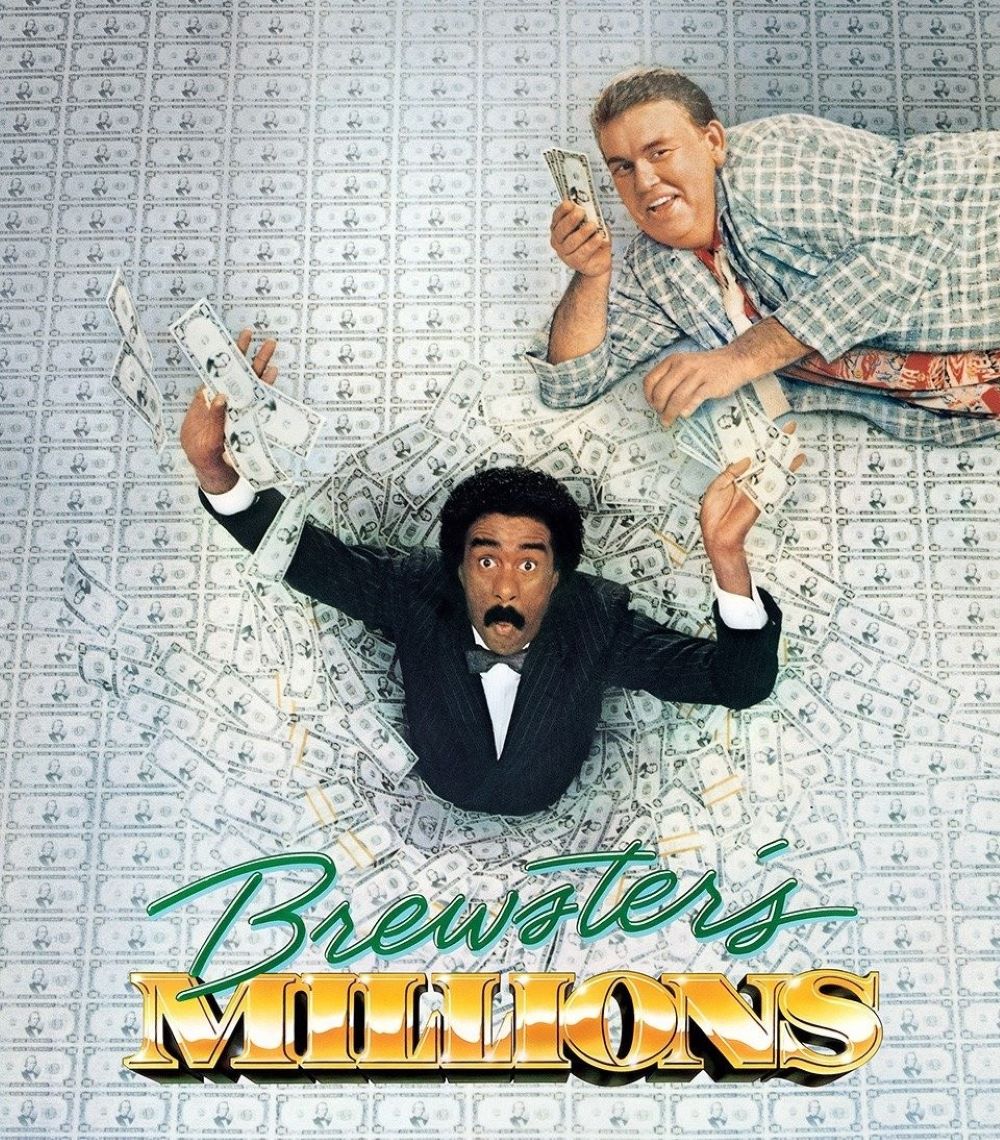
The setup alone is too fun to resist. Richard Pryor stars as Montgomery Brewster, a minor league baseball pitcher who unexpectedly inherits the opportunity of a lifetime—to claim a $300 million fortune from a distant relative. The catch? Before he can get it, he has to spend $30 million in 30 days under a bizarre set of conditions that make financial ruin easier said than done. He can’t give the money away, can’t destroy it, can’t buy assets or investments that retain value, and can’t tell anyone why he’s doing it. Fail, and he gets nothing. Succeed, and he becomes one of the richest men alive. It’s the sort of gleefully absurd premise that could only have come from Hollywood in the 1980s, and it’s immediately clear that the film wants audiences to sit back, grab some popcorn, and watch Pryor tear through cash in increasingly funny and desperate ways.

Richard Pryor is, without doubt, the heart and soul of the movie. He imbues Montgomery Brewster with equal parts manic energy and human frustration, giving the character a real emotional arc beneath all the comic spectacle. Pryor’s talent for blending humor with exasperation makes Brewster’s predicament believable, even when it’s insane. Watching him scramble to lose money while the world keeps rewarding him is strangely satisfying. Pryor understood how to play ordinary men caught in extraordinary circumstances, and that quality grounds the film when it could have easily spiraled into total silliness. In scenes where he loses his patience with accountants, schemes wild spending sprees, or watches his good intentions backfire, Pryor’s comic timing keeps the chaos enjoyable.

John Candy adds another layer of charm as Brewster’s best friend and teammate, Spike Nolan. Candy brings warmth, loyalty, and that unmistakable good-heartedness that made him one of the decade’s most beloved comedic actors. The chemistry between Pryor and Candy keeps the film buoyant even through its weaker stretches. Their friendship defines the film’s tone—it’s loose, goofy, and full of bro-ish camaraderie. Without Candy’s infectious energy, the movie’s more hollow comedic beats might have hit the floor with a thud. Together, they create a dynamic that feels real, even inside a premise that’s totally absurd.

As a director, Walter Hill feels like an odd fit for this kind of broad comedy, but that’s part of what makes Brewster’s Millions interesting. Hill, better known for tough, kinetic action films like The Warriors and 48 Hrs., approaches this farce with a surprising amount of structure and visual precision. The film looks slicker and sharper than most comedies of its kind, which gives the excess on-screen an unintentionally epic flair. Hill’s direction keeps the story moving, and though he’s not naturally a comedic filmmaker, his grounded style adds a peculiar edge to all the craziness. It’s chaos with discipline—an aesthetic that somehow works in the movie’s favor.

Still, Brewster’s Millions can’t quite escape its shortcomings. The pacing is uneven, especially in the middle, where the film loses some steam as Brewster cycles through increasingly repetitive spending gimmicks. The story flirts with satire but rarely commits, brushing up against deeper commentary on wealth, politics, and capitalism before retreating to the comfort of broad comedy. The “Vote None of the Above” subplot, where Brewster’s money-wasting political campaign taps into voter cynicism, is one of the smartest parts of the film—but it’s introduced and resolved too quickly to leave a mark. And while the movie is full of lively energy, not every gag lands; a few supporting performances veer into caricature, and some jokes feel very much of their time.

Yet these flaws are partly what make Brewster’s Millions such a delightful guilty pleasure. It’s the cinematic equivalent of junk food—high on calories, low on nutritional value, but deeply enjoyable all the same. Pryor’s constant exasperation, the sheer absurdity of trying to “waste” money legally, and the exaggerated set pieces (like the overblown parties or his failed attempts to lose at gambling) make for irresistible entertainment. Even when the humor dips into predictable territory, the concept keeps pulling you back in. There’s a giddy satisfaction in watching Brewster try—and fail—to lose money, especially because the universe just won’t let him.

The romance subplot with Lonette McKee’s character, Angela Drake, adds just enough heart to balance the absurdity. McKee gives a grounded, intelligent performance that prevents the love story from feeling tacked on, even if it never fully takes center stage. Her presence keeps Brewster tethered to some kind of reality, and the moral through-line—learning that not everything valuable can be bought—lands gently rather than preachily. It’s not profound, but it fits the breezy tone perfectly.

As a comedy of excess, Brewster’s Millions is very much a product of its time. The slick suits, the gaudy parties, the blind faith in wealth, and the Reagan-era optimism about money’s moral neutrality all ooze from every frame. That time-capsule quality is part of its modern appeal. Watching it today, you can’t help but smile at how on-the-nose it feels—a movie from the “greed is good” decade that accidentally ends up mocking the very mindset it sprang from. It’s self-aware only in flashes, but those flashes are enough to make you recognize the movie’s satirical edge hiding beneath its loud surface.

In the end, that’s what makes Brewster’s Millions endure as a lovable guilty pleasure. It has flaws you can’t ignore—uneven pacing, scattershot tone, underdeveloped ideas—but none of them outweigh its charm. Pryor’s comic genius makes even the weakest joke land better than it should. Candy’s warmth keeps the film light. And Hill’s straightforward direction infuses the lunacy with just enough realism to make it believable. The result is a movie that’s too silly to take seriously but too fun to dismiss. You watch it, laugh at its audacity, shake your head at the logic gaps, and yet somehow come away smiling.

Brewster’s Millions may not be a comedy classic, but it’s easy to see why people keep revisiting it. It’s comfort food cinema—lighthearted, clumsy, and endlessly watchable. And like all the best guilty pleasures, it doesn’t need to be perfect to make you happy. Sometimes, seeing Richard Pryor outsmart the meaning of money for two hours is more than enough.

Previous Guilty Pleasures

  1. Half-Baked
  2. Save The Last Dance
  3. Every Rose Has Its Thorns
  4. The Jeremy Kyle Show
  5. Invasion USA
  6. The Golden Child
  7. Final Destination 2
  8. Paparazzi
  9. The Principal
  10. The Substitute
  11. Terror In The Family
  12. Pandorum
  13. Lambada
  14. Fear
  15. Cocktail
  16. Keep Off The Grass
  17. Girls, Girls, Girls
  18. Class
  19. Tart
  20. King Kong vs. Godzilla
  21. Hawk the Slayer
  22. Battle Beyond the Stars
  23. Meridian
  24. Walk of Shame
  25. From Justin To Kelly
  26. Project Greenlight
  27. Sex Decoy: Love Stings
  28. Swimfan
  29. On the Line
  30. Wolfen
  31. Hail Caesar!
  32. It’s So Cold In The D
  33. In the Mix
  34. Healed By Grace
  35. Valley of the Dolls
  36. The Legend of Billie Jean
  37. Death Wish
  38. Shipping Wars
  39. Ghost Whisperer
  40. Parking Wars
  41. The Dead Are After Me
  42. Harper’s Island
  43. The Resurrection of Gavin Stone
  44. Paranormal State
  45. Utopia
  46. Bar Rescue
  47. The Powers of Matthew Star
  48. Spiker
  49. Heavenly Bodies
  50. Maid in Manhattan
  51. Rage and Honor
  52. Saved By The Bell 3. 21 “No Hope With Dope”
  53. Happy Gilmore
  54. Solarbabies
  55. The Dawn of Correction
  56. Once You Understand
  57. The Voyeurs 
  58. Robot Jox
  59. Teen Wolf
  60. The Running Man
  61. Double Dragon
  62. Backtrack
  63. Julie and Jack
  64. Karate Warrior
  65. Invaders From Mars
  66. Cloverfield
  67. Aerobicide 
  68. Blood Harvest
  69. Shocking Dark
  70. Face The Truth
  71. Submerged
  72. The Canyons
  73. Days of Thunder
  74. Van Helsing
  75. The Night Comes for Us
  76. Code of Silence
  77. Captain Ron
  78. Armageddon
  79. Kate’s Secret
  80. Point Break
  81. The Replacements
  82. The Shadow
  83. Meteor
  84. Last Action Hero
  85. Attack of the Killer Tomatoes
  86. The Horror at 37,000 Feet
  87. The ‘Burbs
  88. Lifeforce
  89. Highschool of the Dead
  90. Ice Station Zebra
  91. No One Lives

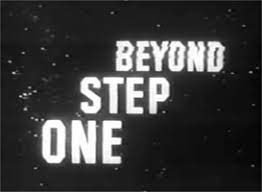
Horror On TV: One Step Beyond 2.1 “Delusion” (dir by John Newland)


On tonight’s episode of One Step Beyond.

A young woman (Suzanne Pleshette) desperately needs a blood transfusion.  Fortunately, the police have managed to track down one of the only people to share her blood type, an accountant named Harold Stern (Norman Lloyd).  Harold seems like a nice, rather mild-mannered guy and he has a long history of donating blood.  However, when the police approach him, Harold refuses to donate.

“What type of crumb are you!?” the police demand.

Harold explains that, whenever he gives someone blood, he develops a psychic connection with that person.  He can see their future.  And that’s simply a burden that he can no longer shoulder….

This episode of One Step Beyond originally aired on September 15th, 1959.  Norman Lloyd, who plays Harold, got his start as a member of Orson Welles’s Mercury Theater and he also played the villain in Alfred Hitchcock’s Saboteur.  (Speaking of Hitchcock, Suzanne Pleshette played the doomed school teacher in The Birds.)  When Lloyd appeared in this episode of One Step Beyond, he was 44 years old.  He would go on to live for another 62 years, making his final film appearance at the age of 101!

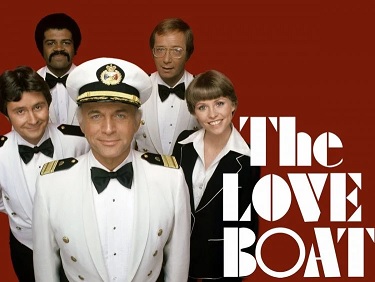
Retro Television Reviews: The Love Boat 1.13 “Too Hot to Handle / Family Reunion / Cinderella Story”


Welcome to Retro Television Reviews, a feature where we review some of our favorite and least favorite shows of the past!  On Wednesdays, I will be reviewing the original Love Boat, which aired on ABC from 1977 to 1986!  The series can be streamed on Paramount Plus!

It’s Love!

Episode 1.13 “Too Hot to Handle / Family Reunion / Cinderella Story”

(Dir by James Sheldon and Richard Kinon, originally aired on January 7th, 1978)

It’s time for another cruise with three separate stories!

Newlyweds George (John Rubinstein) and Sally Allison (a youngish Kathy Bates) board the Pacific Princess, hoping to enjoy the ideal honeymoon.  Instead, it turns out to be one disaster after another.  Sally gets sunburned.  George gets poison ivy.  Having gotten off the boat in Mexico, Sally returns to discover a totally different couple staying in what she thinks is her cabin.  Uh-oh.  It turns out that Sally accidentally got on the Sun Princess and the Pacific Princess has already set sail without her!  This was a pretty simple storyline and, if anything, it mostly seemed to exist so that the show’s writers could see how many bad things that they could do to one perfectly innocent couple.  But John Rubinstein and Katy Bates are so likable as George and Sally that the story works.  You can’t help but hope the cruise gets a little better for them.  Kathy Bates was 29 when she appeared on The Love Boat and there’s nothing about her performance that would necessarily make you say, “Hey, that’s a future Oscar winner!”  But still, both she and John Rubinstein do a good job with the material that they’ve been given.

Meanwhile, Tommy (Bob Crane) is a middle-aged man who has been hired to work as a steward on the ship.  Captain Stubing takes an immediate dislike to the irresponsible, womanizing Tommy.  When he discovers that Tommy has been drinking on the job, Stubing comes close to firing him.  However, Tommy confesses that he’s drinking because he’s just discovered that the daughter who he abandoned years ago is on the cruise.  Wendy (Dori Brenner) has always believed that her father died in a shipwreck and she hopes that Stubing might know something about the wreck.  Seeking to help out Tommy, Stubing tells a lot of lies about Wendy’s “deceased” father but Tommy finally breaks down and confesses the truth.  At first, Wendy rejects Tommy but, with the help of her understanding husband (Robert Hays), she eventually forgives her father.

This storyline hinges on a huge coincidence.  What are the chances that Tommy and Wendy would just happen to end up on the same cruise together and that Tommy would be assigned to serve as Wendy’s steward?  On top of that, what are the chances that Wendy would just happen to have a picture of her mother sitting out where Tommy could see it?  It’s all fairly predictable but, if you’ve seen Auto Focus, it’s interesting to watch Crane’s performance here.  This episode aired just a few months before Crane was murdered in Arizona and it’s easy to see the charismatic but irresponsible and self-destructive Tommy as being a reflection of who Bob Crane himself had reportedly become at the time of his death.  Tommy is a character who lives with a lot of emotional pain and regret and Crane is so surprisingly effective in the role that it’s hard not to wonder if perhaps, on some level, he related to Tommy.

Finally, in the show’s final storyline, Bill Edwards (Bruce Solomon) is a supermarket manager who has booked a cruise with his wife, Doreen (Judy Luciano).  When a wealthy advertising exec cancels his trip, Julie and Gopher decide to let Bill and Doreen stay in the man’s luxury cabin.  This, of course, leads to Stubing mistaking Bill for the ad exec!  Suddenly, Bill and Doreen are sitting at the captain’s table and competing for an advertising contract!  Eventually, the truth comes out but business tycoon Greg Beatty (David White) is so impressed with Bill’s ideas that he arranges for Bill to get a job with an actual advertising company.  Mad Men it’s not!  However, it’s still a charming little story, largely due to the performances of Bruce Solomon and Judy Luciano.

If last week’s episode was a “lesser Love Boat,” this week’s episode show just how much fun The Love Boat could be.  Yes, all of the stories are fairly predictable but the guest stars all perform their roles with a lot of energy.  Bob Crane brings a poignant sense of regret to his performance as Tommy while Bruce Solomon and Judy Luciano are exactly the type of attrative couple that you would want to meet on a cruise.  And, as I said already, it’s impossible not to like John Rubinstein and Kathy Bates as the newlyweds who just can’t catch a break.  The regular cast is used sparingly but effectively in this episode.  Fred Grandy gets a nice scene where he has to explain to John Rubinstein that Kathy Bates got on the wrong boat.  Bernie Kopell plays Doc Bricker as being an agent of chaos.  It’s a fun episode and what more can you ask for?

Horror On TV: One Step Beyond 2.1 “Delusion” (dir by John Newland)


On tonight’s episode of One Step Beyond.

A young woman (Suzanne Pleshette) desperately needs a blood transfusion.  Fortunately, the police have managed to track down one of the only people to share her blood type, an accountant named Harold Stern (Norman Lloyd).  Harold seems like a nice, rather mild-mannered guy and he has a long history of donating blood.  However, when the police approach him, Harold refuses to donate.

“What type of crumb are you!?” the police demand.

Harold explains that, whenever he gives someone blood, he develops a psychic connection with that person.  He can see their future.  And that’s simply a burden that he can no longer shoulder….

This episode of One Step Beyond originally aired on September 15th, 1959.  Norman Lloyd, who plays Harold, got his start as a member of Orson Welles’s Mercury Theater and he also played the villain in Alfred Hitchcock’s Saboteur.  (Speaking of Hitchcock, Suzanne Pleshette played the doomed school teacher in The Birds.)  When Lloyd appeared in this episode of One Step Beyond, he was 44 years old.

Today, Norman Lloyd is 105 years old and guess what?  He’s still active!  He had a role in Trainwreck and still occasionally appears on television.

Enjoy!

Horror On TV: One Step Beyond 2.1 “Delusion” (dir by John Newland)


On tonight’s episode of One Step Beyond.

A young woman (Suzanne Pleshette) desperately needs a blood transfusion.  Fortunately, the police have managed to track down one of the only people to share her blood type, an accountant named Harold Stern (Norman Lloyd).  Harold seems like a nice, rather mild-mannered guy and he has a long history of donating blood.  However, when the police approach him, Harold refuses to donate.

“What type of crumb are you!?” the police demand.

Harold explains that, whenever he gives someone blood, he develops a psychic connection with that person.  He can see their future.  And that’s simply a burden that he can no longer shoulder….

This episode of One Step Beyond originally aired on September 15th, 1959.  Norman Lloyd, who plays Harold, got his start as a member of Orson Welles’s Mercury Theater and he also played the villain in Alfred Hitchcock’s Saboteur.  (Speaking of Hitchcock, Suzanne Pleshette played the doomed school teacher in The Birds.)  When Lloyd appeared in this episode of One Step Beyond, he was 44 years old.

Today, Norman Lloyd is 103 years old and guess what?  He’s still acting!  He had a role in Trainwreck and still occasionally appears on television.

Enjoy!

Film Review: My Little Sister (dir by Roberto and Maurizio del Piccolo)


If there’s anything that I’ve learned, from my long history of watching horror films, it’s that only fools go camping.  Seriously, nothing good ever comes from wandering around in the woods or sleeping in a tent.  Inevitably, you’re either going to attacked by a zombie while you’re skinny dipping in the nearby pond or a man with a machete is going to show up while everyone’s busy having sex in a tent.  In short, nudity and the great outdoors equals death.

And really, it makes sense.  When you’re camping, you’re in an isolated place and you are totally at the mercy of the elements, the killers, and occasionally the zombies.  There’s a reason why so many horror films center around unlucky campers.  Because, seriously, camping is terrifying!

Just check out My Little Sister, for instance.

My Little Sister is the latest film from directors Roberto and Maurizio del Piccolo.  It opens in the wilderness, with shots of an old woman wandering through the woods.  The old woman looks happy but it’s a disturbing sort of happiness.  First off, she’s wearing a nightgown, which isn’t exactly the most practical wandering around in the woods outfit.  Secondly, her wrists are heavily bandaged.  And finally, she doesn’t really seem to have an easily identifiable reason for being out there in the woods.  She spends a while picking up leaves and smiling at them.  Occasionally, she crawls around in the dirty.  As we watch her, we occasionally cut to black-and-white photographs of an unhappy looking family and headlines about missing tourists.

While the old woman plays with leaves, something far more disturbing is happening in a nearby house.  In one room, a bound and terrified woman (Sofia Pauly) watches as her boyfriend is murdered and another woman is killed with a weed whacker.  Doing the killing is a hunched over, grunting man (Saverio Percudani) who appears to be horribly disfigured…

In another room of the house, an unmoving figure sits in front of a TV and watches grainy footage of a young girl holding an older man a bottle of what appears to be water.  The man pours the liquid on his face and suddenly starts to scream.  Hmmm…apparently, it wasn’t water…

Meanwhile, in the woods, campers Sheila (Holli Dillon) and Tom (Mattia Rossellini) watch as the old woman plays with the leaves and they laugh at her, which may seem mean but I think most of us would probably do the same thing.  Sheila and Tom are supposed to meet up with their friends but their friends are nowhere to be seen.  Instead, there’s just an empty campsite and an eccentric woodsman (David White) warning them to beware of someone that he calls the little sister…

Of course, all of these storylines converge but I’m not going to tell you how.  You may think that you’ve figured out some of it just by reading the review up to this point but My Little Sister has a few surprises up its sleeve.  There’s a little twist at the end that my horror-loving soul absolutely loved.  Let’s just say that, in this film, no one is every truly safe.

My Little Sister plays out like a mix of Friday the 13th, The Texas Chainsaw Massacre, and — believe it or not — Sinister.  At its best, My Little Sister achieves a dreamlike intensity.  The wilderness is filmed to look both beautiful and threatening at the same time and the scenes in the house, in particular, are pure nightmare fuel.  When it comes to a film like this, the effectiveness depends on how much you care about the potential victims and fortunately, both Holli Dillon and Sofia Pauly give totally believable, sympathetic, and relatable performances.  As I watched them try to survive, I kept wondering what I would do if I found myself in the same situation.  I doubt it would end well.

Finally, there’s no way I can finish this review without making a special mention of Lucia Castellano, who gives a really good and genuinely surprising performance as the crazy old woman in the wilderness.  She is both frightening and sympathetic at the same time.

My Little Sister is a brutally effective and entertaining horror film.  Keep an eye out for it!

http://www.youtube.com/watch?v=odmx-QhVW90

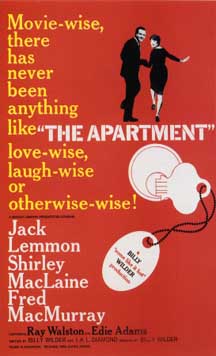
Lisa Watches The Oscar Winners: The Apartment (dir by Billy Wilder)


Apartment_60

After the Nun’s StoryI continued to experience TCM’s 31 Days of Oscar by watching the 1960 best picture winner, The Apartment.  The Apartment is unique among Oscar winners in that it’s one of the few comedies to win best picture.  (Though, in all honesty, it would probably be more appropriate to call The Apartment a dramedy.)  It was also, until the victory of The Artist, the last completely black-and-white film to win best picture.

(And, as long as we’re sharing trivia, it was also the first best picture winner to feature a character watching a previous best picture winner.  At the start of the film, Jack Lemmon deals with insomnia by watching Grand Hotel.)

The Apartment tells the story of C.C. “Bud” Baxter (Jack Lemmon), an anonymous officer worker who is determined to climb the corporate ladder despite not being very good at his job.  However, Baxter does have one advantage over his co-workers.  He’s single and therefore, his apartment has become the place to go for corporate executives who need a place where they can safely cheat on their wives.  Bud spends his day trying to coordinate who is going to be in his apartment and when.  Meanwhile, he spends his nights exiled from his own home and wandering around New York.  In fact, the only beneficial thing about this arrangement is that all of Bud’s supervisors have been giving him good evaluations in return for using his apartment.  (Well, that and Bud’s neighbor, played by Jack Kruschen, is convinced, based on the thinness of the apartment walls, that Bud must be a great lover.)

When Bud finally does get his promotion, it’s only because the personnel director, Jeff D. Sheldrake (an amazingly sleazy Fred MacMurray), wants to use Bud’s apartment.  Bud celebrates his promotion by finally working up the courage to ask out Fran (Shirley MacClaine), an elevator operator who works in the office.  What Bud doesn’t realize is that Fran is also the woman who Sheldrake wants to bring to the apartment….

Fran is convinced that Sheldrake is going to leave his wife for her.  What she doesn’t realize — and what Fred MacMurray’s performance makes disturbingly clear — is that Jeff Sheldrake is basically just a guy having a midlife crisis.  He’s the type of middle-aged guy that every woman has had to deal with at some point, the guy who pulls up next to you in a red convertible and stares at you from behind his sunglasses, attempting his best to entice you into helping him relive the youth that he never had.  When Fran eventually learns the truth about Sheldrake, it leads both to near tragedy and to Bud having to decide whether he wants to be a decent human being or if he wants to keep climbing the corporate ladder.

When one looks over a chronological list of all of the best picture winners, it’s a bit strange to see The Apartment listed in between Ben-Hur and West Side Story.  As opposed to those two grandly produced and vibrantly colorful films, The Apartment is a rather low-key film, one that devotes far more time to characterization than to spectacle.  And while both Ben-Hur and West Side Story are ultimately very idealistic films, The Apartment is about as cynical as a film can get.  The Apartment may be a comedy but the laughs come from a place of profound sadness.

Because it’s more interested in people than in spectacle, The Apartment holds up better than many past best picture winners.  We’ve all known someone like Bud.  We’ve all had to deal with men like Sheldrake.  And, in one way or another, we all know what it’s like to be someone like Fran.  The Apartment remains a truly poignant and relevant film.

http://www.youtube.com/watch?v=B4OXm9-E8OQ

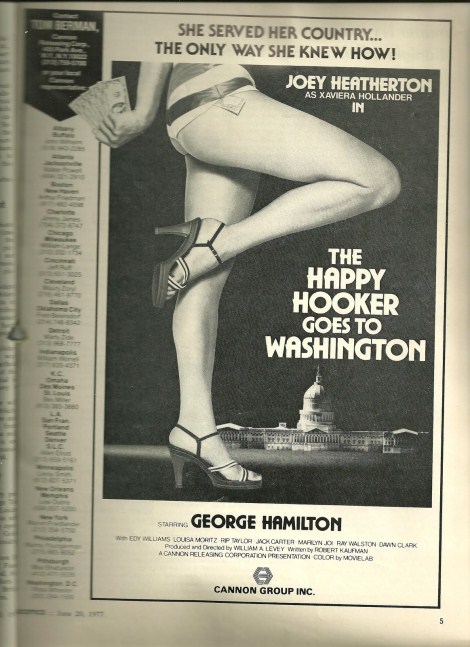
Shattered Politics #40: The Happy Hooker Goes To Washington (dir by William A. Levey)


happy-hooker-470-x-647

“God bless you, Ms. Hollander!  You have saved us from recession!”

— Dialogue from The Happy Hooker Goes To Washington (1977)

Le sigh.

The things that I do for this site!

If I wasn’t currently in the process of watching and reviewing 94 films about politicians and politics, I can guarantee that I would never have watched The Happy Hooker Goes To Washington.  However, while I was looking for films to review for this series, I went over to Netflix and did a search on “Washington.”

Guess which film came up first?

If you guessed The Happy Hooker Goes To Washington, you would be correct!  And you know what?  I watched this movie with an open mind.  As anyone who has read this site knows, I have never been shy about my love of old exploitation films.  The fact of the matter is that some of the most imaginative films ever made were low-budget grindhouse movies.  Nothing angers me more than elitist film bloggers who dismiss a film just because it originally played in grindhouse cinema.

But, honestly, The Happy Hooker Goes To Washington is just bad.  It’s boring.  The acting is terrible.  The jokes fall flat.  The attempts at political satire are about as clever as what you’d find on any site trying to read like the Onion without actually being the Onion.

In the Happy Hooker Goes To Washington, Joey Heatherton plays Xaviera Hollander, a former madam who is now a businesswoman, magazine publisher, and sex advise columnist.  She is apparently the world’s leading authority on sex.  We know this because, when she first appears, she’s surrounded by reporters.  “When sex is news, you’re news!” one of them tells her.

Xaviera has been called to testify in front of the Senate Committee To Investigate Sexual Excess In America.  And goddamn, this movie is stupid.  But anyway, Xaviera goes to Washington to stand up for sexual freedom.  Accompanying her is an attorney named Ward Thompson (George Hamilton) and, quicker than you can say “Fifth place on Dancing With The Stars,” Ward is explaining to Xaviera why her testimony is so important.

“We’re heading right into the teeth of a new puritanism,” he tells her.  “Under the new puritanism, there won’t be any happy hookers!”

Anyway, Xaviera testifies in front of the committee and we get a few flashbacks to some of Xaviera’s past accomplishments.  And then she gets recruited by a dwarf (Billy Barty) and is sent to seduce an Middle Eastern ruler and … well, it just keep going and going.  This is one of the longest 84-minute films ever released.

Anyway, this movie sucks.  (And so does Xaviera!  That’s the level of humor that you can expect when you watch The Happy Hooker Goes To Washington.)  It’s still lurking around Netflix.  Avoid it at all costs.

Shattered Politics #15: Sunrise at Campobello (dir by Vincent J. Donehue)


Sunrise_at_Campobello_film

I can still remember that day like yesterday.

I was either 10 or 11 and I was at a big family gathering in Arkansas.  I was at my aunt’s house.  My great-grand uncle was sitting in a corner of the living room and watching the TV.  Because he was nearly blind, only an inch or two separated his face from the screen.  And, because he was almost deaf, the television was blaring.  When we first arrived, he was watching what sounded to be a cartoon but, after a few minutes, he changed the channel.

Apparently, whatever channel he was watching was showing a program about the Great Depression because my great-grand uncle snorted a little and yelled (not because he was mad but because he was deaf), “Some people like Roosevelt!  I say he was a dictator!”

That blew my young mind.  It wasn’t because I necessarily knew that much about Franklin D. Roosevelt, beyond the fact that he had been President.  Instead, it shocked me because that was the first time that I had ever heard anyone call a U.S. President a dictator.  It was the first time that I truly understoodd that not everyone shared the same opinions, especially when it came to politics and history.

Looking back, so many of the things that define me as a person — my skepticism about conventional wisdom, my mistrust of authority, and my tendency to dismiss “experts” — are the result of that day, that documentary on the Great Depression, and my great-grand uncle’s opinion of Franklin D. Roosevelt.

(Want to know why I hate it when the headlines of clickbait articles say stuff like, “Neil deGrasse Tyson gave his opinion on the movies and it was glorious?”  Blame me great-grand uncle.  Nobody was going to tell him FDR wasn’t a dictator.  Nobody’s going tell me what’s glorious.  I’ll make up my own mind.)

And, let’s face it — FDR is a controversial figure.  Most of what you read about Roosevelt is positive but if you glance under the surface, you realize that the legacy of the New Deal is far more ambiguous than most people are willing to admit.  You realize that there are serious questions about whether Roosevelt knew about the upcoming attack on Pearl Harbor.  You discover that Roosevelt wanted to reform the Supreme Court so that it would be a rubber stamp for the executive branch.  And, of course, his decision to run for a third term set up exactly the type of precedent that — if not for a constitutional amendment — could have been exploited by the wrong people.

And, yet, as ambiguous as his legacy may be, how can you not be inspired by FDR’s personal story?  He went from being a dilettante who was often dismissed as being an intellectual lightweight to being four-times elected President of the United States.  In between running unsuccessfully for vice president in 1920 and being elected governor of New York in 1928, Roosevelt was crippled by polio.  It’s always been a huge part of the Roosevelt legend that his battle with polio transformed him and made him into the President who led the country during the Great Depression and World War II.

It’s an inspiring story, regardless of what you may think of Roosevelt’s political ideology or his legacy of government intrusion.

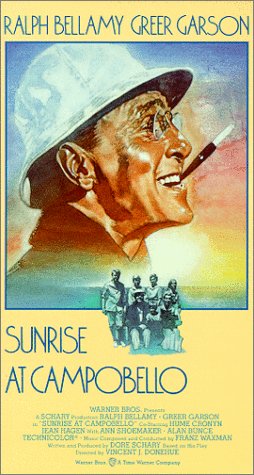
It’s also a story that’s told in our 15th entry in Shattered Politics, the 1960 film Sunrise at Campobello.  This film opens with FDR (played by Ralph Bellamy) as an athletic and somewhat shallow man who, while on a vacation with his family, is struck down my polio.  The film follows he and his wife, Eleanor (Greer Garson), as they learn how to deal with his new physical condition.  Throughout the film, Roosevelt remains upbeat and determined while Eleanor remains supportive and eventually — after being out of the public eye for three years — Roosevelt gets a chance to relaunch his political career by giving a nominating speech for Gov. Al Smith at the Democratic National Convention.

(A little bit of history that everyone should know: Al Smith was the first Catholic to ever be nominated for President by a major political party.)

Sunrise at Campobello is one of those films that tends to show up fairly regularly on TCM.  It’s a well-acted film with Ralph Bellamy and Greer Garson really making the aristocratic Roosevelts into sympathetic and relatable characters.  At the same time, whenever I’ve watched the film, I’ve always been struck by how long it seems.  (The movie itself is only 144 minutes, which means its shorter than the average Christopher Nolan flick but it’s one of those films that seems longer than it actually is.)  Sunrise at Campobello was based on a stage play and it’s directed like a stage play as well, with little visual flair and emphasis on dialogue and character.  The end result is a film that I can’t really recommend for the casual viewer but one that is, at the very least, interesting for students of history like me.