The TSL Horror Grindhouse: Messiah of Evil (dir by Gloria Katz and Willard Huyck)


I can still remember the first time that I saw the 1973 film, Messiah of Evil.

It was on a Monday night, many years ago. I had recently picked up a 10-movie DVD box set called Tales of Terror and I was using the movies inside to try to deal with a bout of insomnia. I had already watched The Hatchet Murders (a.k,a. Deep Red) and The House At The Edge of the Park and, at two in the morning, I was faced with a decision. Should I try to sleep or should I watch one more movie?

Naturally, I chose to watch one more movie and the movie I picked was Messiah of Evil. So, there I was at two in the morning, sitting at the edge of my bed in my underwear and watching an obscure horror movie while rain fell outside.

And, seriously — this movie totally FREAKED me out!

Messiah of Evil opens with a man (played by future director Walter Hill) stumbling through the night, obviously trying to escape from something.  A mysterious woman appears and kills him.  We’re left to wonder who the man was supposed to be as the film doesn’t ever really return to his murder.  In most films this would be a weakness but it feels appropriate for Messiah of Evil, a film that plays out with the visual style and fragmented logic of a particularly intense nightmare.

The rest of the story tells the story of Arletty (Marianna Hill), a neurotic woman who drives to an isolated California town in order to visit her father. Her father is an artist who specializes in painting eerie pictures of large groups of black-clad people. However, once she arrives at his home, Arletty discovers that her father has vanished and left behind a diary where he claims that a darkness has overtaken the town.  Meanwhile, it sometimes appear as if the people in the paintings are moving or threatening to come out of the walls.

Meanwhile, one crazed man (Elisha Cook, Jr.) explains that “the dark stranger” is returning.  An albino (Bennie Robinson) drives a truck up and down the street and talks about how he likes to listen to “Wagner.”  The back of the truck is full of blank-faced people staring at the sky and the Albino eats a rat.  Finally, a mysterious man named Thom (Michael Greer) is wandering about town with two groupies (played by Anitaa Ford and Joy Bang) and interviewing random townspeople.  After meeting Arletty, they all end up moving into her father’s house.

Messiah of Evil is literally one of the strangest films that I’ve ever seen. It’s shot in a dream-like fashion and the much of the film is left open to the viewer’s interpretation.  Joy Bang goes to see a Sammy Davis, Jr. western and doesn’t notice as the theater slowly fills up with pale, red-eyed townspeople.  Anitra Ford goes to a grocery store late at night and discovers the townspeople indulging in their appetites.  If the film was only distinguished by those two scenes, it would still be worth saying.  However, Messiah of Evil is a total and complete experience, a film where every scene matters and the audience is tasked with putting the puzzle together.

This film was directed by Gloria Katz and Willard Huyck, two longtime associates of George Lucas.  (They wrote the screenplay for American Graffiti and Huyck directed Howard The Duck.)  There’s absolutely nothing else in their filmography that is as surreal as Messiah of Evil, leading me to suspect that the film itself might be a very fortunate accident.  Apparently, the production ran out of money before Katz and Huyck finished principal photography, which is what led to the film’s disjointed nature.  Accident or not, Messiah of Evil is a masterpiece of surreal horror.
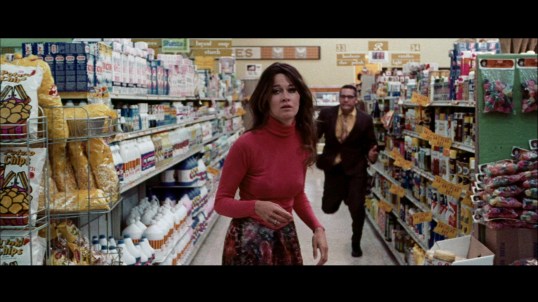
Messiah of Evil (1973, directed by Willard Huyck and Gloria Katz)
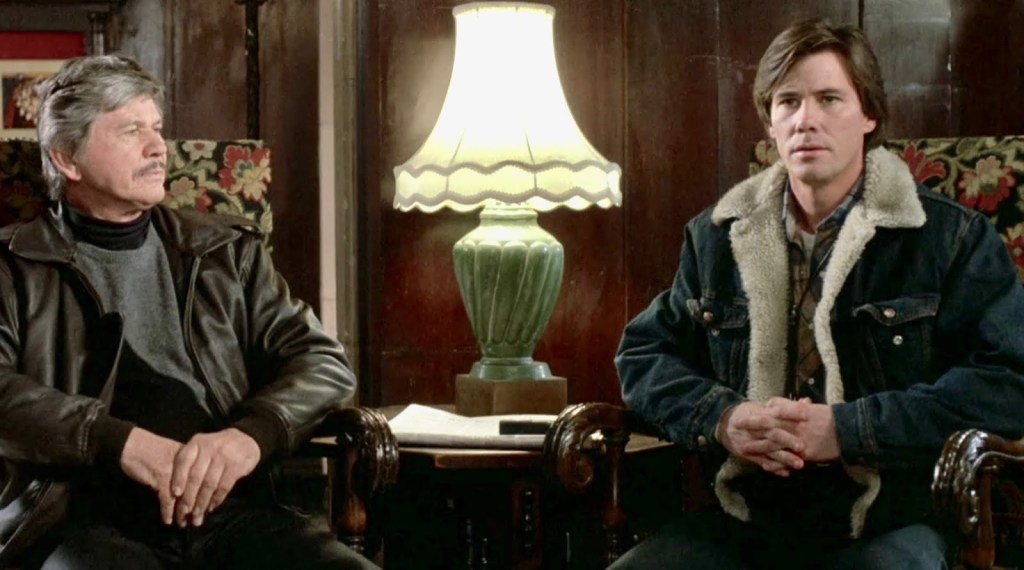
Brad’s “Charles Bronson Movie of the Week” – MESSENGER OF DEATH (1988)


Charles Bronson and Gene Davis, together again 5 years after TEN TO MIDNIGHT (1983)

A couple of years ago, I decided I would rank my favorite Charles Bronson films. The rules were fairly simple… 1) only starring roles, so movies like THE MAGNIFICENT SEVEN and THE GREAT ESCAPE were excluded, 2) no TV movies were included, and 3) my rankings were based on how much I like watching the movies, and not on some BS critical consensus. It was an interesting undertaking, and while I’ve played around with the rankings a little bit, for the most part I’ve kept them the same from that initial ranking. Because I’m obsessed with Charles Bronson, it’s fun for me to write about him and share things about his movies. As such, about once a week or so, I’ll probably share a movie from my list, give my ranking, and talk a little bit about the films. These will not necessarily be reviews, but mostly just some basic thoughts on the films.

My first Bronson movie of the week is MESSENGER OF DEATH (1988), which I rank as 33rd out of 41 Bronson starring roles. What’s interesting is that even though that’s a pretty low ranking, I still enjoy the film for trying to do something different with Bronson at that point in his career in the late ’80s, mainly by casting him as a reporter and not as a cop. He destroys the opposition with superior investigative reporting skills, without having to resort to oversized handguns. Now that his filmography is complete, and has been for over 25 years, I’ve grown to appreciate the times Bronson tried something a little different (with the exception of LOLA). MESSENGER OF DEATH also benefits from a solid cast of veteran actors and actresses, including Trish Van Devere, Laurence Luckinbill, Daniel Benzali, Charles Dierkop, Jeff Corey, John Ireland, and Gene Davis. It’s fun watching these seasoned performers, many of whom have worked with Bronson in the past, do their thing. And last, but not least, with filming locations at the Colorado National Monument and the mountain town of Glenwood Springs, CO, it’s definitely a beautiful film to look at! The older I get the more I appreciate movies that get out of the cities and show us beautiful sights around the country and world. Jeff shared some of his own thoughts on MESSENGER OF DEATH back in 2017!

As of the date of this post, MESSENGER OF DEATH is streaming on Amazon Prime and Tubi if you want to watch it yourself. It’s a film that I’ve enjoyed more with repeat viewings. I’ve also included the trailer below for your viewing pleasure. Feel free to let me know your thoughts on MESSENGER OF DEATH, starring the legendary Charles Bronson!

Horror On The Lens: Messiah of Evil (dir by Willard Huyck)


MOE Mariana HillWith only a few days left until Halloween, I wanted to make sure that I continued an important tradition here at the Shattered Lens by sharing this film with our faithful and wonderful readers.  Messiah of Evil was first released in 1973 and, since it’s in the public domain, it has since been included in a countless number of bargain box sets from Mill Creek.

I can still remember the first time that I saw Messiah of Evil.  It was on a Monday night, many years ago.  I had recently picked up a 10-movie DVD box set called Tales of Terror and I was using the movies inside to try to deal with a bout of insomnia.  I had already watched The Hatchet Murders (a.k,a. Deep Red) and The House At The Edge of the Park and, at two in the morning, I was faced with a decision.  Should I try to sleep or should I watch one more movie?

Naturally, I chose to watch one more movie and the movie I chose was Messiah of Evil.  So, there I was at two in the morning, sitting at the edge of my bed in my underwear and watching an obscure horror movie while rain fell outside.

And, seriously — this movie totally FREAKED me out!

Messiah of Evil tells the story of Arletty (Marianna Hill), a neurotic woman who drives to an isolated California town in order to visit her father.  Her father is an artist who specializes in painting eerie pictures of large groups of black-clad people.  However, once she arrives at his home, Arletty discovers that her father has vanished and left behind a diary where he claims that a darkness has overtaken the town.

Meanwhile, a mysterious man named Thom (Michael Greer) is wandering about town with two groupies (played by Anita Ford and Joy Bang) and interviewing random townspeople.  One crazed man (Elisha Cook, Jr.) explains that “the dark stranger” is returning.  After meeting Arletty, they all end up moving into her father’s house.

But that’s not all.   There’s also an odd albino man who shows up driving truck and who eats mice….

Messiah of Evil is literally one of the strangest films that I’ve ever seen.  It’s shot in a dream-like fashion and the much of the film is left open to the viewer’s interpretation.  There are two classic scenes — one that takes place in a super market and one that takes place in a movie theater and the movie’s worth watching for these two scenes alone.

Messiah of Evil is a film that will be appreciated by all lovers of surrealism and intelligent horror and I’m happy to share it with you today.

Retro Television Review: Fantasy Island 5.12 “The Magic Camera/Mata Hari/Valerie”


Welcome to Retro Television Reviews, a feature where we review some of our favorite and least favorite shows of the past!  On Tuesdays, I will be reviewing the original Fantasy Island, which ran on ABC from 1977 to 1984.  Unfortunately, the show has been removed from most streaming sites.  Fortunately, I’ve got nearly every episode on my DVR.

This week’s episode presents your erstwhile reviewer with a bit of an ethical quandary.

Episode 5.12 “The Magic Camera/Mata Hari/Valerie”

(Dir by Don Chaffey and Don Weis, originally aired on January 16th, 1982)

I don’t feel completely comfortable about reviewing this episode of Fantasy Island and I’ll tell you why.

Occasionally, Fantasy Island would broadcast an extra-long episode.  These episodes would typically feature three fantasies as opposed to the usual two.  Unfortunately, when these long episodes were syndicated, one of the fantasies would be edited out so the episode would fit into an hour-long slot.  Usually, the editing was not particularly smooth, either.  The end result would usually be an episode that seemed oddly paced and the performances of Ricardo Montalban and Herve Villechaize would often seem uneven as well.  As such, it’s neither easy nor particularly fair to review those edited episodes.  When it comes to reviewing, I always want to see the complete episode.

And yet, now that the original Fantasy Island is no longer streaming anywhere (seriously, what the Hell, Tubi?), I’m stuck using the episodes that I have on my DVR.  And that means reviewing the edited, syndicated versions of these episodes.

As you can probably guess, this is one of those edited episodes.  The Valerie fantasy was removed for syndication.  That’s a shame because Valerie featured the final televised performance of actor Christopher George, a charismatic B-movie veteran who is pretty popular around the Shattered Lens offices.  It also featured Michelle Phillips, though apparently she did not return as the mermaid who she played earlier on the show.  I’d love to review Valerie but I can’t.  And that sucks,

As for the other two fantasies, one is basically a remake of the Lillian Russell fantasy, except this time Martha Harris (Phyllis Davis) goes into the past and finds herself transformed into her great-grandmother, Mata Hari.  She gets to dance.  She gets to spy.  She gets thrown in prison and sentenced to death but, fortunately, her life is spared when the firing squad’s rifles are filled with blanks and she’s given a drug by one of the men who is in love with that makes her appear to be dead.  This was a enjoyable fantasy, mostly because of the costumes and the melodrama.

The other fantasy features Bob Denver, coming to the Island for the second week in a row.  This time, he’s a photographer who wants to take the type of pictures that the world’s greatest photographers couldn’t.  Because of the awkward way the fantasy was stated, the photographer ends up with a camera that takes pictures of the future.  At first, the photographer is really happy and uses his camera to commit a little insider trading.  But then he takes a picture of a newspaper and sees a headline announcing his death in a fiery auto accident.  Uh-oh!

Again, neither of the two fantasies is bad (though the second one does require a certain tolerance for Bob Denver that some people may not have) but it was hard for me to enjoy them knowing that I was missing out on a third fantasy.  For that reason, I assigning this episode a grade of incomplete.  If I ever get a chance to watch the complete episode, uncut, I’ll revisit this review but until then, I really can’t give an overall grade to this episode.

Finally, for those keeping track, both Julie and Tattoo join Roarke when it’s time to greet the guests.  That’s only second time that’s happened this season.

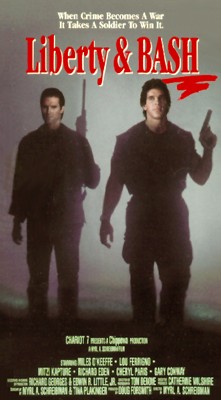
Liberty & Bash (1989, directed by Myrl A. Schreibman)


Liberty (Miles “How much Keeffe is in this film?” O’Keeffe) and Bash (Lou Ferrigno) served together in Nam and then came back to Los Angeles to clean up the streets.  Liberty is a parole officer who doesn’t take no for an answer.  Bash owns a gym and runs a Guardian Angels type of operation.  Their friend and fellow vet, Jesse (Richard Eden), has a mullet and wears acid-washed mom jeans.  Jesse lives with his sister, Melissa (Cheryl Paris), who never wears pants.  When Jesse is murdered by a drug lord who spends almost all of his time soaking in the tub, Liberty and Bash eventually get around to seeking revenge.

The movie is called Liberty & Bash but Bash is actually only in a few minutes of the movie and Lou Ferrigno’s voice is dubbed by another actor.  This was probably done because Ferrigno is partially deaf and, as a hard-of-hearing person who happens to be a big Lou Ferrigno fan, that really bothered me.  Of the many storylines that floated through Liberty & Bash, Lou Ferrigno leading a Guardian Angels chapter was probably the one with the most potential but Liberty & Bash doesn’t do much with that.  When Bash wasn’t around, the other characters should have been saying, “Hey, where’s Bash?”

Instead, the movie is all about Liberty.  Even though Liberty is trying to bring the drug lord to justice and prove that Jesse didn’t commit suicide, the majority of the film is taken up with scenes of Liberty arguing with his girlfriend, a social worker named Sarah (Mitzi Kapture).  Sarah is pregnant but she’s considering getting an abortion.  Liberty spends almost the entire movie trying to talk her out of getting an abortion.  Sarah and Liberty even argue about it during the film’s climatic action scene.  I’m not kidding.  This is the first action film that I’ve ever seen where the action was regularly interrupted by the abortion debate.  The movie is obviously on Liberty’s side but Liberty is so obnoxious about it that the audience will be on Sarah’s side.  Sarah can’t make up her mind until one of the bad guys points a gun at her belly and she says, “My baby!”  

It’s a weird movie and doesn’t add up to the much.  If not for a little profanity and some brief nudity, Liberty & Bash could have passed as the pilot for syndicated, Stephen J. Cannell cop show.  Mr. B (Charles Dierkop) is Los Angeles’s least intimidating drug lord.  Mitzi Kapture is sexy, elegant, and displays the patience of a saint as Sarah.  Miles O’Keeffe is usually the coolest cat this side of Michael Pare but in this movie, he’s surly and won’t stop yelling at his girlfriend. Cheryl Paris spends almost the entire movie in her underwear, showing that the filmmakers at least knew who their target audience was.  Those who like to keep an eye out for mullets and off-the-shoulder t-shirts will find the film to be a feast.  The movie had miles of Keeffe but it needed more Bash.

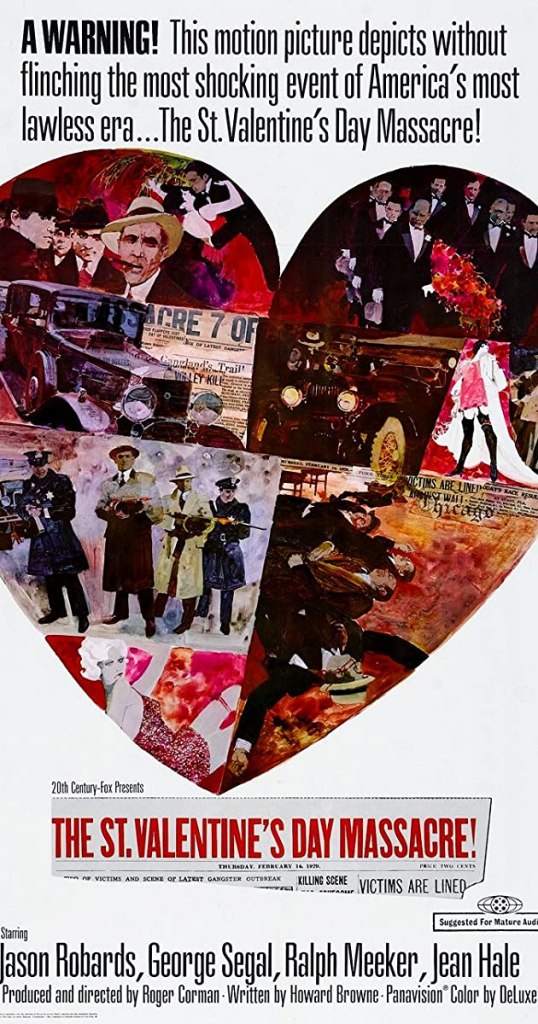
An Offer You Can’t Refuse #18: The St. Valentine’s Day Massacre (dir by Roger Corman)


On February 14th, 1929, seven men were murdered in a garage in Chicago, Illinois.  Five of the seven men were known to be associates of gangster George “Bugs” Moran.  The other two men were considered to be innocent bystanders, a mechanic and a dry cleaner who just happened to enjoy hanging out with gangsters.  Though no one was ever convicted of the crime, it was well-known that the murders were carried out on the orders of Al Capone.

In many ways, the St. Valentine’s Day Massacre was a turning point in America’s relationship with organized crime.  Before the massacre, Capone had become a bit of a folk hero.  He knew how to talk to the press and he was viewed as merely breaking a law (in this case, prohibition) that most people opposed in the first place.  However, after the murders, public opinion soured on Capone.

Some of it was the brutality of the crime.  It’s been said that over five hundred bullets were fired in that garage, all to kill seven defenseless men who were lined up against a wall.  Grisly pictures of the victims were released to the press.  Perhaps if the seven men had been carrying weapons and had been involved in a shootout with their murderers, the public’s reaction would have been different.  But this was a cold-blooded execution.

Personally, I think the fact that the killers disguised themselves as cops also played a role in the public’s outrage.  It was a very calculated move on the part of the killers and it highlighted just how much planning went into the St. Valentine’s Day Massacre.  As well, it undoubtedly made people paranoid.  If a bunch of killer could dress up like cops, who knew who else they could dress up as?

Finally, I think that Capone’s biggest mistake was carrying out the crime on Valentine’s Day.  You don’t murder people on a holiday.  Anyone should know that.  If Capone had waited until February 20th, he probably could have gotten away with it.

The 1967 film, The St. Valentine’s Day Massacre, details the rivalry between Capone and Moran, starting with them fighting for control over the Chicago rackets and ending with the title event.  Moran is played by Ralph Meeker while Jason Robards plays Capone.

Now I know what you’re probably thinking.  Perennial WASP Jason Robards as Al Capone?  That may sound like odd casting and, let’s just be honest here, it is.  However, it actually kind of works.  Robards may not be convincingly Italian but he is convincingly ruthless.  Add to that, one of the major subplots of the St. Valentine’s Day Massacre is that, even as the head of the Chicago Outfit, Capone still feels like an outsider in the world of organized crime because, while he is Italian, he isn’t Sicilian.  Capone feels as if Lucky Luciano and all of the major New York crime bosses look down on him and one reason why he’s so ruthless about taking over Chicago is that wants to show Luciano that he can be just as effective a crime lord as any Sicilian.  Capone feeling out of place in the Mafia is reflected by Robards initially seeming to be out of place in a gangster film.  By the end of the movie, of course, Capone has proven himself and so has Jason Robards.

Robards isn’t the only familiar face to be found in The St. Valentine’s Day Massacre.  Though this film was released by 20th Century Fox, it was directed by Roger Corman and Corman fills the production with members of his stock company.  Dick Miller, Jonathan Haze, and Jack Nicholson all have small roles as gunmen.  Bruce Dern plays the unlucky mechanic who enjoys hanging out with gangsters.  Buck Taylor, Leo Gordon, and Joe Turkel all have small roles.  John Agar plays Dion O’Bannon and is gunned down in his flower store.  Though not members of the Corman stock company, George Segal and David Canary plays brothers who work for Moran.  There’s a lot of characters wandering through this film but Corman makes sure that everyone gets a chance to make an impression.

It’s a good gangster film.  Though he was working with a larger budget than usual, Corman still brought his exploitation film aesthetic to the material and the end result is a violent, melodramatic gangster film that looks really impressive.  The film’s recreation of 1920s Chicago is a visual delight and looking at the well-dressed and stylish gangsters walking and driving down the vibrant city streets, you can understand why organized crime would have such a draw for some people.

The St. Valentine’s Day Massacre is a classic gangster film and a classic Corman film.  It’s an offer you can’t refuse.

Previous Offers You Can’t (or Can) Refuse:

  1. The Public Enemy
  2. Scarface
  3. The Purple Gang
  4. The Gang That Could’t Shoot Straight
  5. The Happening
  6. King of the Roaring Twenties: The Story of Arnold Rothstein 
  7. The Roaring Twenties
  8. Force of Evil
  9. Rob the Mob
  10. Gambling House
  11. Race Street
  12. Racket Girls
  13. Hoffa
  14. Contraband
  15. Bugsy Malone
  16. Love Me or Leave Me
  17. Murder, Inc.


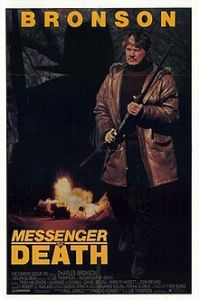
A Movie A Day #22: Messenger of Death (1988, directed by J. Lee Thompson)


messenger_of_deathIn rural Colorado, the three wives and all the children of Orville Beecham (Charlie Dierkop) have been murdered.  Veteran journalist Garret Smith (Charles Bronson) discovers that Orville is the son of an excommunicated Mormon fundamentalist named Willis Beecham (Jeff Corey).  Willis, who lives on a heavily armed compound, practices polygamy and wants nothing to do with the outside world.  However, Willis’s brother, Zenas (John Ireland), long ago split with Willis and set up a compound of his own.  At first, Garret suspects that Orville’s family was killed by Zenas.  As Zenas and Willis go to war, Garret discovers that there’s actually a bigger conspiracy at work, one dealing with corporate greed and water rights.  (Forget it, Bronson, it’s Chinatown.)

Messenger of Death was the 2nd to last film that veteran tough guy Charles Bronson made for Cannon Films.  Especially when compared to the other films that he made for Cannon (10 To Midnight, Kinjite, Murphy’s Law, three Death Wish sequels), Messenger of Death features Bronson in a surprisingly cerebral role.  While there is violence, very little of it is actually the result of anything that Bronson does.  For once, Charles Bronson isn’t running around with a gun and blowing away bad guys. If Death Wish‘s Paul Kersey ever did start blowing away muggers in Colorado, Garret would probably be the first to condemn him in a carefully written editorial.  The only time he fights is in self-defense and even then, it’s hand-to-hand combat.  Instead, he spends most of the film doing research and asking questions.  As a result, Messenger of Death is never as much fun as the other films that Bronson made for Cannon but it’s still interesting to see him playing a regular guy.

Lisa Reviews an Oscar Winner: The Sting (dir by George Roy Hill)


Earlier tonight, as a part of their 31 Days of Oscar, TCM aired The Sting, the film that the Academy selected as being the best of 1973.  I just finished watching it and what can I say?  Based on what I’ve seen of the competition (and there were a lot of great films released in 1973), I would not necessarily have picked The Sting for best picture.  However, the movie is still fantastic fun.

The Sting reunited the director (George Roy Hill) and the stars (Robert Redford and Paul Newman) of Butch Cassidy and the Sundance Kid and told yet another story of likable criminals living in the past.  However, whereas Butch Cassidy largely satirized the conventions of the traditional Hollywood western, The Sting is feels like a loving homage to the films of 1930s, a combination of a gritty, low-budget gangster film and a big budget musical extravaganza.  The musical comparison may sound strange at first, especially considering that nobody in The Sting randomly breaks out into song.  However, the musical score (which is famously dominated by Scott Joplin’s The Entertainer) is ultimately as much of a character as the roles played by Redford, Newman, and Robert Shaw.  And, for that matter, the film’s “let-pull-off-a-con” plot feels like an illegal version of “let’s-put-on-a-show.”

The film takes place in the 1936 of the cultural imagination, a world dominated by flashy criminals and snappy dialogue.  When con artists Johnny Hooker (Robert Redford) and Luther Coleman (Robert Earl Jones) inadvertently steal money from a gangster named Lonnegan (Robert Shaw), Lonnegan has Luther murdered.  Fleeing for his life, Hooker goes to Chicago where he teams up with Luther’s former partner, veteran con man Henry Gondorff (Paul Newman).  Gondorff used to be one of the great con artists but he is now living in self-imposed obscurity, spending most of his time drinking and trying to avoid the FBI.  Hooker wants to get revenge on Lonnegan by pulling an elaborate con on him.  When Gondorff asks Hooker why, Hooker explains that he can either con Lonnegan or he can kill him and he doesn’t know enough about killing.

The rest of the film deals with Hooker and Gondorff’s plan to con Lonnegan out of a half million dollars.  It’s all very elaborate and complicated and a bit confusing if you don’t pay close enough attention and if you’re ADHD like me.  But it’s also a lot of fun and terrifically entertaining and that’s the important thing.  The Sting is one of those films that shows just how much you can accomplish through the smart use of movie star charisma.  Redford and Newman have such great chemistry and are so much fun to watch that it really doesn’t matter whether or not you always understand what they’re actually doing.

It also helps that, in the great 70s tradition, they’re taking down stuffy establishment types.  Lonnegan may be a gangster but he’s also a highly respected and very wealthy gangster.  When Newman interrupts a poker game, Lonnegan glares at him and tells him that he’ll have to put on a tie before he’s allowed to play.  Lonnegan may operate outside the law but, in many ways, he is the establishment and who doesn’t enjoy seeing the establishment taken down a notch?

As entertaining as The Sting may be and as influential as it undoubtedly is (Steven Soderbergh’s Ocean films may be a lot more pretentious — which makes sense considering that Soderbergh is one of the most pretentious directors in film history — but they all owe a clear debt to The Sting), it still feels like an unlikely best picture winner.  Consider, for instance, that The Sting not only defeated American Graffiti and The Exorcist but Ingmar Bergman’s Cries and Whispers as well.  On top of that, when you consider some of the films that were released in 1973 and not nominated — Mean Streets, Badlands, The Candy Snatchers, Day of the Jackal, Don’t Look Now, Jesus Christ Superstar, and The Long Goodbye — it’s debatable whether The Sting should have been nominated at all.  That’s not a criticism of The Sting as much as it’s an acknowledgement that 1973 was a very good year in film.

So, maybe The Sting didn’t deserve its Oscar.  But it’s still a wonderfully entertaining film.  And just try to get that music out of your head!

Embracing the Melodrama Part II #30: The Sweet Ride (dir by Harvey Hart)


The_Sweet_Ride_FilmPosterThe 1968 film The Sweet Ride takes the audience on a ride through Malibu and reminds us all that, in many ways, the 1960s sucked.

The Sweet Ride opens with actress Vicki Cartwright (Jacqueline Bisset) losing her top while swimming in the ocean.  While Vicki panics and tries to figure out how to get back to the beach without anyone seeing her breasts, she’s spotted by a surfer named Denny McGuire (Michael Sarrazin).  Denny hands her a towel and then leads her back to the beach house that he shares with aging tennis player Collie (Anthony Franciosa) and stoned musician Choo-Choo (Bob Denver).

The rest of the film is a 90 minute tour of California beach life in the late 60s.  Despite Collie’s cynical warning against falling in love, Denny does just that, despite the fact that Vicki refuses to tell him anything about her past or even where she lives.  Meanwhile, Collie spends his time hustling on the tennis court and the married Choo-Choo pretends to be gay in an attempt to get out of being drafted.  (Choo-Choo probably could have gotten out of the draft by pointing out that he appears to be 40 years old but the filmmakers decided to have him walk around with a poodle and speak in falsetto.  Just in case you had any doubt that this film was made in 1968…)  It’s a mix of comedy, romance, and drama and it’s features footage of some real bands performing in actual Malibu nightclubs and that’s a good thing for all of us history nerds.

And, since The Sweet Ride was made in 1968, the whole film gets progressively darker as it reaches its conclusion.  Choo-Choo does get drafted and it’s hard to believe he’ll survive a day in Viet Nam.  Collie’s perfect life is revealed to be an empty facade.  Denny realizes that his friends are all immature losers.  And Vicki ends up getting assaulted by a high-power studio executive (Warren Stevens).  It all leads to more violence, disillusionment, and general ennui.

For some reason, The Sweet Ride shows up on FXM fairly regularly.  It’s a strange film because it doesn’t really work and yet it’s also compulsively watchable.  It tries to be about everything and, as a result, it often feels like it’s about absolutely nothing.  And yet, somehow, it remains compelling…

Why is the film compelling despite itself?  It’s not because of the main characters, that’s for sure.  The boys in the beach house are probably some of the least likable film protagonists in cinematic history.  Anthony Franciosa gave some great performances in his career (check him out in A Face in the Crowd and Tenebrae) but Collie is such a smug jerk that you find yourself hoping that someone will just punch him in the face.  Meanwhile, Denny tends to come across like a weak-willed and obsessive stalker and Choo-Choo — well, Choo-Choo often seems to be a character in a totally different movie.  As for Vicki, her character pretty much exclusively exists to be victimized.

Ultimately, I think The Sweet Ride is watchable because it is such an imperfect time capsule.  If I wanted to know what it was like to be alive in the 60s, The Sweet Ride is one of the films that I would watch.  It’s not the best film ever made but it is a chance to look into the past.

(Incidentally, The Sweet Ride was directed by Harvey Hart, who also directed the underrated Shoot.)


Lisa Watches An Oscar Nominee: Butch Cassidy and the Sundance Kid (dir by George Roy Hill)


Butch_sundance_poster

Should I start this post by ticking everyone off or should I start out by reviewing the 1969 best picture nominee Butch Cassidy and The Sundance Kid?

Let’s do the review first.  I recently watched Butch Cassidy and the Sundance Kid when it aired as a part of TCM’s 31 Days of Oscar.  This was actually my third time to see the film on TCM.  And, as I watched Butch Cassidy and the Sundance Kid for the third time, I was shocked to discover how much I had forgotten about the film.

Don’t get me wrong.  I remembered that it was a western and that it starred Paul Newman and Robert Redford as real-life outlaws Butch Cassidy and the Sundance Kid.  I remembered that it opened and ended with sepia-toned sequences that suggested that Butch and Sundance represented the last gasp of the old west.  I remembered that Butch won a fight by kicking a man in the balls.  I also remembered that they robbed the same train twice and, the second time, they accidentally used too much dynamite.  I remembered that, for some reason, Butch spent a lot of time riding around on a bicycle.  I remembered that Butch and Sundance ended up getting chased by a mysterious posse.  I remembered that Sundance could not swim.  And I remembered that the film eventually ended on a tragic note in South America…

And I know what you’re saying.  You’re saying, “It sounds like you remembered the whole movie, Lisa!”

No, actually I did not.  The thing with Butch Cassidy and the Sundance Kid is that the scenes that work are so memorable that it’s easy to forget that there’s also a lot of scenes that aren’t as memorable.  These are the scenes where the film drags and you’re thankful that Paul Newman and Robert Redford were cast as Butch and Sundance, because their charisma helps you overlook a lot of scenes that are either too heavy-handed or which drag on for too long.  You’re especially thankful for Newman, who plays every scene with a twinkle in his wonderful blue eyes and who is such a lively presence that it makes up for the fact that Redford’s performance occasionally crosses over from being stoic to wooden.  It can be argued that there’s no logical reason for a western to feature an outlaw riding around on a bicycle while Raindrops Keep Fallin’ On My Head plays on the soundtrack but Paul Newman’s so much fun to watch that you can forgive the film.

Newman and Redford both have so much chemistry that they’re always a joy to watch.  And really, that’s the whole appeal of Butch Cassidy and the Sundance Kid, the chance to watch two iconic actors have fun playing opposite each other.  Even though Katharine Ross appears as their shared romantic interest, the film’s love story is ultimately between Butch and Sundance (and, by extension, Newman and Redford).  You can find countless reviews that will give all the credit for the film’s appeal to William Goldman’s screenplay.  (You can also find countless self-satisfied essays by William Goldman where he does the exact same thing.)  But, honestly, the film’s screenplay is nothing special.  This film works because of good, old-fashioned star power.

Now, for the part that’ll probably tick everyone off (heh heh), I think that Butch Cassidy and the Sundance Kid is actually a pretty good pick for a future remake.  All you have to do is pick the right actors for Butch and Sundance.  I’m thinking Chris Pratt as Butch and Chris Evans as Sundance…

Oh, c’mon!  It’ll be great!