May Noir: The Big Sleep (dir by Michael Winner)


Raymond Chandler’s detective classic, The Big Sleep, has twice been adapted for film.

The first version came out in 1946, just seven years after the book’s publication.  That version starred Humphrey Bogart as detective Philip Marlowe and Lauren Bacall as Vivian, the daughter of a man who has hired Marlowe to discover who is trying to blackmail him.  Directed by Howard Hawks and co-written by William Faulkner, this version of The Big Sleep is considered to be a classic noir, one that was cited as being a major influence on director Akira Kurosawa.

The 1978 version was directed by Michael Winner, takes place in London in the 1970s, and features Robert Mitchum as Marlowe.  Despite a strong ensemble cast and an excellent lead performance from Mitchum, this version of The Big Sleep still features one of the worst performances ever put on film.

Sarah Miles plays the role of Charlotte Sternwood Regan, the eldest daughter of General Sternwood (James Stewart).  Miles is playing the role that Lauren Bacall played in the first film and, despite the fact that they both earlier co-starred to a certain amount of acclaim in Ryan’s Daughter, Miles and Mitchum do not have a hint of chemistry in this film.  Actually, Miles doesn’t have chemistry with anyone in this film.  She seems detached from the action and her frequent half-smiles come across as being not mysterious but instead somewhat flakey, as if she doesn’t quite understand that she’s in a noir.  Sarah Miles is not a bad actress (as anyone who has seen Hope and Glory can tell you) but her performance here is incredibly dull.  That said, she is not the one who gives the worst performance in the film.

Instead, that honor goes to Candy Clark, playing General Sternwood’s youngest daughter, Camilla.  Camilla is meant to be mentally unstable and potentially dangerous.  Clark plays the role like a giggly teenager, constantly fidgeting and literally hissing in more than a few scenes, as if she’s been possessed by a cat.  Clark overacts to such an extent that you’ll be more likely to laugh at than be disturbed by her antics.  It doesn’t help that she shares nearly all of her scenes with Robert Mitchum, a man who was a master when it came to underacting.  If you’re going to give a bad performance, you don’t want to do it opposite someone who will make you look even worse by comparison.

The mystery of who is blackmailing General Sternwood is twisty and full of disreputable people.  At times, the film feels like a a parade of character actors.  Edward Fox, Joan Collins, Richard Boone, Oliver Reed, Harry Andrews, Richard Todd, and John Mills all show up throughout the film and, as a viewer, I was happy to see most of them.  They all brought their own sense of style to the film, especially the menacing Oliver Reed.  That said, director Michael Winner was never known for being a particularly subtle director and the film gets so mired in its own sordidness that it becomes be a bit of a slog to sit through.  As a filmmaker, Winner was a shameless.  That sometimes worked to a film’s advantage, as with the original Death Wish.  That film needed a director who would dive into its Hellish portrayal of New York City without a moment’s hesitation and that’s what it got with Michael Winner.  With Winner’s adaptation of The Big Sleep, however, the film gets so caught up in trying to shock and titillate that it’s hard not to miss the wit that made the first adaptation so special.

That said, The Big Sleep does feature the truly special opportunity to see Robert Mitchum and James Stewart acting opposite each other.  Both give good and heartfelt performances, with Mitchum plays Marlowe as a cynic with a heart and Stewart capturing the pain of knowing that your children don’t deserve all that you do for them.  Stewart and Mitchum bring a lot of emotion and sincerity to their scenes and, for at least a few minutes, The Big Sleep becomes about something more than just bloody murders and revealing photographs.  It becomes about two aging men trying to find their place in a changing world.  The Big Sleep was one of Stewart’s final feature films and he shows that, even late into his career, he was always one of the best.


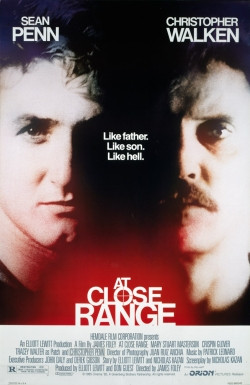
At Close Range (1986, directed by James Foley)


Brad Whitewood, Sr. (Christopher Walken) is known as Big Brad, a rural crime lord who rules the backwoods of Pennsylvania.  When his son, Little Brad (Sean Penn, trying too hard to be James Dean), comes to live with him, Big Brad goes out of his way to try to bring the teenager into his criminal lifestyle.  At first, Little Brad loves being a part of the family business but witnessing a murder and falling in love with Terry (Mary Stuart Masterson) caused Little Brad to start to move away from his father.  With the FBI closing in on the Whitewood family, Brad Sr. starts to eliminate everyone who he considers to be a threat, including the members of his own family.

Based on a true story, this neo-noir features a great cast, including Chris Penn, Millie Perkins, Kiefer Sutherland, Crispin Glover, David Strathairn, Tracey Walter, and Mary Stuart Masterson.  Unfortunately, the movie itself moves at a plodding pace.  There are some good and disturbing scenes, like the montage where Big Brad starts to eliminate the members of his gang.  The film does a good job of showing how seductive Big Brad’s criminal lifestyle can be to a bunch of kids who have basically been written-off by society.  But the story itself is so bleak that most people will end up tuning out long before Little Brad finally turns against his father.

Whatever other flaws it may have, At Close Range does feature one of Christopher Walken’s best performances.  Walken is chillingly evil as Big Brad.  He’s got enough charisma to be believable as someone who could bring a gang together but he’s also frightening as he starts killing anyone who he thinks might talk to the police or the FBI.  Big Brad is a remorseless killer and Walken plays him as being a classic sociopath, someone who cannot understand why the members of his gang and family would get upset when he starts killing some of them.  To Big Brad, that just goes with the territory.  It’s a part of doing business.  With his distinct way of speaking and his trademark tics, Walken is someone who has inspired many impersonators and it can be easy to forget that he’s also a damn good actor.  Films like At Close Range remind us of just how talented Walken actually is.

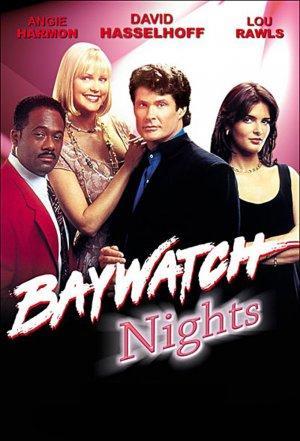
Late Night Retro Television Reviews: Baywatch Nights 1.5 “Just A Gigolo”


Welcome to Late Night Retro Television Reviews, a feature where we review some of our favorite and least favorite shows of the past!  On Tuesdays, I will be reviewing Baywatch Nights, an detective show that ran in Syndication from 1995 to 1997.  The entire show is currently streaming on Youtube!

This week, Mitch and Ryan go undercover!

Episode 1.5 “Just A Gigolo”

(Dir by Martin Pasetta, originally aired on October 28th, 1995)

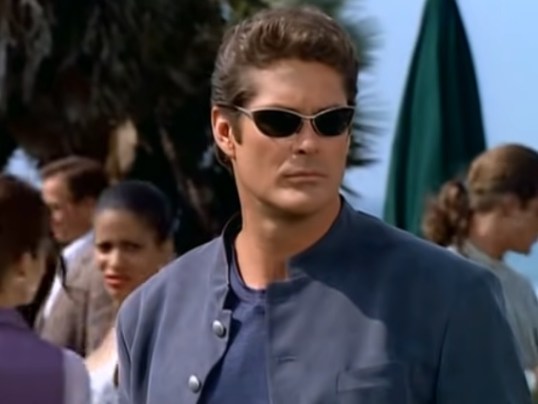
David Hasselhoff is a gigolo!

No, not really.  Mitch may be wearing sunglasses and speaking broken French but that’s just because he has gone undercover as a con artist.  He’s trying to expose the actual gigolo, a younger man named Grant Styles (Joel Beeson).  Grant swindled a good deal of money from Mitch’s friend, Julie (Candy Clark), but, because Julie voluntarily handed over the money and told Grant that he didn’t have to pay her back, no crime was committed.

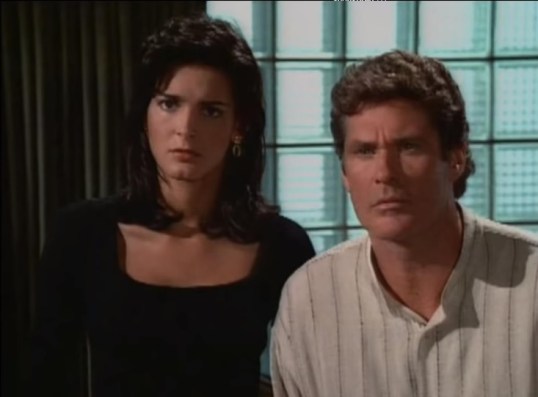
“To catch a gigolo,” Mitch tells us, “I decided to become a gigolo.”  This is followed by a lengthy exercise montage.  Finally, after a week of lifting weights and jogging on the beach, Mitch is ready to make his debut at the local country club.  Accompanying him is Ryan (Angie Harmon), who is pretending to be a wealthy divorcee.  (Mitch’s aunt agrees to allow Ryan to use her mansion.)  Grant immediately starts hitting on Ryan and Mitch can only watch as Ryan flirts back.  Mitch actually starts to feel jealous and Ryan, for her part, starts to feel jealous whenever she sees Mitch flirting with the older women at the club.  Could Mitch and Ryan be falling in love?

Actually, Mitch and Ryan do kind of make a cute couple.  I mean, seriously, they just look like they belong together.  From the first episode of this series, David Hasselhoff and Angie Harmon have had a playful chemistry and their personalities definitely compliment each other.  These two definitely need to get together.

For now, though, the important thing is exposing Grant and his “manager,” Margo Curtis (future reality star Lisa Vanderpump).  Though Mitch can’t stand the idea of Grant spending time with Ryan, he still has to do things like stand perfectly still while Grant beats him up because fighting back would apparently blow his cover.  (To be honest, I think the only reason the fight scene was included was so Hasselhoff could look directly at the camera and do a “Why me?” shrug.)  After Grant beats up Julie, Mitch and Ryan realize that Grant is far more dangerous than the average gigolo.  After Grant, while flying a paraglider, tries to shoot Mitch on the beach, Mitch and Ryan trick him into breaking into Ryan’s mansion so that he can be captured and sent away.

While all of this is going on, Garner (Gregory Alan Williams) and Destiny (Lisa Stahl) worked together to  catch a notorious bail jumped named Bobby Bahama (Jeff Dashnaw).  Most bail jumpers would probably try to leave the state but Bobby jumps bail and then decides to just keep hanging out at the beach and his favorite club.  Destiny meets Bobby at the club, invites him to her hotel room, and then handcuffs him to the bed.

“Kinky,” Bobby says.

No, Bobby, the term is “captured.”

I enjoyed this episode, not so much for the basic plot but for the chemistry between Angie Harmon and David Hasselhoff.  Like I said earlier, they’re an appealing couple and they have a fun chemistry whenever they’re acting opposite each other.  Any show that features David Hasselhoff pretending to be a gigolo is going to have a bizarre appeal to it but Mitch’s relationship with Ryan was strong enough that not even a rather silly storyline could sabotage it.

Horror On TV: The Hitchhiker 4.12 “Secret Ingredient” (Dir by Colin Bucksey)


On tonight’s episode of The Hitchhiker, Dean Paul Martin (son of Dean) plays a vitamin salesman who discovers that competition can be deadly!  This episode features a wonderfully sleazy turn from Dean Paul Martin and enjoyably macabre ending.  Sadly, this would be one of Dean Paul Martin’s final appearances before his death in a 1987 aviation accident.

This episode originally aired on May 5th, 1987.

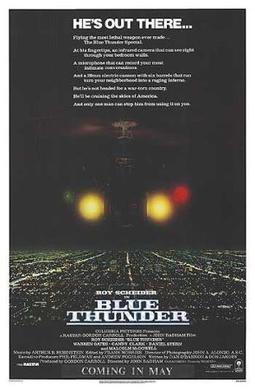
Blue Thunder (1983, directed by John Badham)


Frank Murphy (Roy Scheider) is a Vietnam vet-turned-cop who pilots a police helicopter for the LAPD.  Every night, he and his partner, Richard Lymangood (Daniel Stern) fly over Los Angeles, helping to keep the peace and peeping on anyone undressing in a high-rise apartment.

Murphy is selected to serve as the test pilot for what is described as being the world’s most advanced military helicopter, Blue Thunder.  Blue Thunder is so advanced that the pilot can control the gun turrets just by turning his head and it’s also been supplied with the latest state of the art surveillance equipment.  The pilot of a Blue Thunder can literally spy on anyone while listening to and recording their conversations.  With the Olympics coming up, the city of Los Angeles wants to test out the Blue Thunder as a way to control the crowds and prevent crime during the Games.

Murphy may be impressed by the helicopter but he has his reservations about the program.  He immediately sees that Blue Thunder could be a dangerous tool in the wrong hands.  Those wrong hands would belong to Col. Cochrane (Malcolm McDowell), who was Blue Thunder’s first pilot and also Murphy’s commanding officer during Vietnam.  Murphy is still haunted by the atrocities that he saw committed by Cochrane during the war.

When it turns out that Murphy was right to be suspicious of Cochrane’s intentions, the movie turns into an exciting aerial chase above Los Angeles, with Murphy in Blue Thunder, trying to outrun F-16s, heat-seeking missiles, and eventually Cochrane, who enters the chase in a Blue Thunder of his own.

I’m always surprised that Blue Thunder doesn’t have a bigger following than it does.  It’s an action classic, with a gritty performance from Roy Scheider, a villainous performance from Malcolm McDowell, and comedic relief from the always reliable Daniel Stern.  Even Warren Oates is in the movie, playing Murphy’s LAPD commander!  The script actually does have something relevant to say about the militarization of America’s police forces (and it feels downright prophetic today) and the chase scenes are all the more exciting because they were filmed in the era before CGI and have an authenticity to them that is missing from most modern action films.

Blue Thunder is a perfect example of the “don’t do this really cool thing” style of action film.  The Blue Thunder helicopter is described as being a danger to everyone in the country and the movie even ends with a note saying that real-life Blue Thunders are currently being designed.  But I don’t think anyone who has ever watched this film has thought, “I hope they stopped making those helicopters.”  Instead, this movie makes you want to have a Blue Thunder of your very own.  They’re so cool, who wouldn’t want to fly one of those things?

Film Review: Cocaine and Blue Eyes (1983, directed by E.W. Swackhamer)


When San Francisco-based private investigator Michael Brennen (O.J. Simpson) gives a ride to Joey Crawford (John Spencer) on Christmas Eve, he doesn’t know that it’s going to lead to the biggest case of his career.  When Joey asks Michael to help him track down his ex-girlfriend, Michael assumes that Joey would never be able to pay for his investigative services.  But one week later, Michael gets something in the mail from Joey.  Inside the envelope, there’s a picture of both Joey’s ex and a thousand dollar bill.  Ever after he discovers that Joey was mysteriously killed the night before, Michael decides to take on the case.  His investigation will take him not only to Joey’s ex but it will also lead to him uncovering a drug ring that involves one of San Francisco’s most prominent families.

Simpson not only starred in this made-for-TV movie but he also served as executive producer.  Watching the movie, it’s obvious that it was meant to serve as a pilot for a Michael Brennen TV series and it’s also just as obvious why that series never happened.  O.J. Simpson was not a terrible actor but, ironically for someone who set records as an NFL player, there was nothing tough about him.  Simpson may be playing a two-fisted, cash-strapped P.I. but, in every scene, he comes across like he can’t wait to hit the golf course.  Simpson’s pleasant demeanor may have served him well in other areas of his life but it didn’t help him with this role.  Whenever Simpson has to share a scene with John Spencer, Candy Clark, Cliff Gorman, or any of the other members of this film’s surprisingly talented supporting cast, Simpson’s bland screen presence and lack of gravitas becomes all the more apparent.

Of course, when seen today, the main problem with Cocaine and Blue Eyes is that it’s impossible to watch without thinking, “Hey, didn’t the star of this movie get away with killing his wife and an innocent bystander?”  Even the most innocuous  of lines take on a double meaning when they’re uttered by O.J. Simpson.  It doesn’t help that the movie opens with Michael visiting his estranged wife and their children on Christmas Eve and getting chased around the neighborhood by a guard dog.  When the movie was made, this scene was probably included so that O.J. could show off some of the moves that made him a star at UCLA and with the Bills.  Seen today, the scene takes on a whole different meaning.

Without O.J. Simpson, Cocaine and Blue Eyes could easily pass for being an extended episode of Magnum P.I., Simon and Simon, or any other detective show from the 80s.  With Simpson, it becomes a pop cultural relic.  I don’t think it’s ever been released on DVD but it is available on YouTube, where it can be viewed by O.J. Simpson completists everywhere.

After The French Connection: Popeye Doyle (1986, directed by Peter Levin)


In this made-for-television movie, a pre-Married With Children Ed O’Neill takes over the role that won Gene Hackman an Oscar.

Popeye Doyle (played by O’Neill) is a hard-drinking, hard-living Irish police detective working out of New York City.  Along with his more emotionally stable partner, Tony Parese (Matthew Laurence), Doyle spends his time busting drug dealers, going on stakeouts, and chasing junkies through the mean streets of NYC.  When Jill, a beautiful young model (Audrey Landers) turns up dead, everyone assumes that it was an overdose.  Doyle, however, has his doubts.  All of her friends say that Jill never used drugs and, when Popeye searches her apartment, he doesn’t find any evidence that would point to her being junkie.  Instead, he finds tapes that Jill made for various wealthy men.  Convinced that Jill was murdered, Popeye is soon investigating the type of powerful people who are not used to being investigated.

In 1986, someone at NBC thought it would be a good idea to launch a series based on The French Connection.  Since Gene Hackman was busy making movies and hadn’t come anywhere close to appearing on television since losing the role of the father on The Brady Bunch to Robert Reed, the role of Popeye was given to Ed O’Neill.  At that time, O’Neill was an unknown who had appeared in a handful of plays, two movies, and one Red Lobster commercial.  The movie, Popeye Doyle, was meant to serve as a pilot for the proposed television series.  Needless to say, the film did not lead to a series.  If it had, Ed O’Neill probably wouldn’t have been available to take the role of Al Bundy on Married With Children.

O’Neill is probably the main reason that anyone today would want to see Popeye Doyle, which is otherwise a routine cop movie.  Except for a few scenes where he seems to be trying too hard to imitate Hackman’s iconic performance, O’Neill brings authentic working class swagger to the role.  He drinks too much, he often says the wrong thing, and he pisses off all the right people.  There are some scenes where O’Neill seems to blend right in with the pilot’s gritty visual style.  (It was shot on location in Ed Koch-era New York.)  There are other scenes where he gets so manic that he seems to be a man possessed.  In the scene where he watches Candy Clark do an impromptu striptease, O’Neill as Doyle gets so excited that you worry about him.  Interestingly, Doyle wanders through the film dressed like a slob and acting like a schlub but every beautiful woman he meets wants to have sex with him.  In that regard, it is easy to imagine the movie as being some sort of elaborate daydream that Al Bundy had while selling shoes.

As for the events in The French Connection, they’re mentioned briefly at the start of the movie, when a reporter asks Doyle about that time he accidentally shot and killed a federal agent.  Popeye Doyle still has many scenes that are meant to remind viewers of the first film.  There’s a stakeout scene, where Doyle and Parese sit out in the cold while their target enjoys a nice night.  There’s a scene where Doyle works undercover as a bum.  And, of course, there’s a car chase, though it’s nowhere near as exciting as the one from The French Connection.

Popeye Doyle has never been officially released on DVD (or even VHS), though it is available on YouTube.

Horror Film Review: Buffy the Vampire (dir by Fran Rubel Kuzui)


Watching this movie was such a strange experience.

Now, of course, I say that as someone who grew up watching and loving the television version of Buffy the Vampire Slayer.  Back when Buffy was on TV, I was always aware that the character had first been introduced in a movie but every thing I read about Buffy said that the movie wasn’t worth watching.  It was a part of the official Buffy mythology that Joss Whedon was so unhappy with what was done to his original script that he pretty much ignored the film when he created the show.

So, yes, the 1992 movie version of Buffy the Vampire Slayer showed how Buffy first learned that she was a slayer, how she fought a bunch of vampires in Los Angeles, and how her first watcher met his end.  But still, Joss Whedon was always quick to say that the film should not be considered canonical.  Whenever anyone on the TV show mentioned anything from Buffy’s past, they were referencing Joss Whedon’s original script as opposed to the film that was eventually adapted from that script.  (For instance, on the tv series, everyone knew that Buffy’s previous school burned down.  That was from Whedon’s script.  However, 20th Century Fox balked at making a film about a cheerleader who burns down her school so, at the end of the film version, the school is still standing and romance is in the air.)  In short, the film existed but it really didn’t matter.  In fact, to be honest, it almost felt like watching the movie would somehow be a betrayal of everything that made the televisions series special.

Myself, I didn’t bother to watch the film version of Buffy the Vampire Slayer until several years after the television series was canceled and, as I said at the start of the review, it was a strange experience.  The movie is full of hints of what would make the television series so memorable but none of them are really explored.  Yes, Buffy (played here by Kristy Swanson) has to balance being a teenager with being a vampire slayer but, in the film, it turns out to be surprisingly easy to do.  Buffy is just as happy to be a vampire slayer as she is to be a cheerleader.  In fact, one of the strange things about the film is just how quickly and easily Buffy accepts the idea that there are vampires feeding on her classmates and that it’s her duty to destroy them.  Buffy’s watcher is played by Donald Sutherland and the main vampire is played by Rutger Hauer, two veteran actors who could have played these roles in their sleep and who appear to do so for much of the film.  As for Buffy’s love interest, he’s a sensitive rebel named Oliver Pike (Luke Perry).  On the one hand, it’s fun to see the reversal of traditional gender roles, with Oliver frequently helpless and needing to be saved by Buffy.  On the other hand, Perry and Swanson have next to no chemistry so it’s a bit difficult to really get wrapped up in their relationship.

I know I keep coming back to this but watching the movie version of Buffy is a strange experience.  It’s not bad but it’s just not Buffy.  It’s like some sort of weird, mirror universe version of Buffy, where Buffy starts her slaying career as a senior in high school and she never really has to deal with being an outcast or anything like that.  (One gets the feeling that the movie’s Buffy wouldn’t have much to do with the Scooby Gang.  Nor would she have ever have fallen for Angel.)  Kristy Swanson gives a good performance as the film version of Buffy, though the character is not allowed to display any of the nuance or the quick wit that made the television version a role model for us all.  Again it’s not that Buffy the movie is terrible or anything like that.  It’s just not our Buffy!

The TSL’s Horror Grindhouse: Q (dir by Larry Cohen)


This 1982 film from Larry Cohen is a strange one.

Q stands for Quetzalcoatl, a winged-serpent that was once worshiped by the Aztecs.  In New York someone has been performing ritual sacrifices, flaying victims of their skin.  As a result, Q has flown all the way to New York City and has taken residence in the Chrysler Building.  She’s also laid an egg, from which a baby Q will soon emerge.

Now, I’ve always heard that it’s next to impossible to surprise a New Yorker.  Apparently, living in New York City means that you’ve seen it all.  And that certainly seems to be the case with this film because no one in New York seems to notice that there’s a winged serpent flying over the city.  Somehow, Q manages to snatch up all sorts of people without anyone noticing.  When Q beheads a window washer, Detectives Shepard (David Carradine) and Powell (Richard Roundtree) aren’t particularly concerned by the fact that they can’t find the man’s head.  Shepard just shrugs and says the head will turn up eventually.

Q is really two films in one.  One of the films deals with a winged serpent flying over New York and killing people.  This film is a throwback to the old monster movies of the 50s and 60s, complete with some charmingly cheesy stop motion animation.  The film is silly but undeniably fun.  Director Cohen is both paying homage to and poking fun at the classic monster movies of the past and both Carradine and Roundtree gamely go through the motions as the two cops determined to take down a flying monster.

But then there’s also an entirely different film going on, a film that feels like it belongs in a totally different universe from the stop-motion monster and David Carradine.  This second film stars Michael Moriarty as Jimmy Quinn, a cowardly but charming criminal who would rather be a jazz pianist.  Quinn may be a habitual lawbreaker but he always makes the point that he’s never carried a gun.  He does what he has to do to survive but he’s never intentionally hurt anyone.  In Quinn’s eyes, he’s a victim of a society that has no room for a free-thinker like him.

However, when Quinn stumbles across Q’s nest, he suddenly has an opportunity to make his mark.  As he explains it to the police, he’ll tell them where to find the serpent and her eggs.  But they’re going to have to pay him first….

In the role of Quinn, Michael Moriarty is a jittery marvel.  Whenever Moriarty is on screen, he literally grabs the film away from not only his co-stars but even his director and makes it his own.  Suddenly, Q is no longer a film about a monster flying over New York City.  Instead, Q becomes a portrait of an outsider determined to make the world acknowledge not only his existence but also his importance.  After spending his entire life on the fringes, Jimmy Quinn is suddenly the most important man in New York and he’s not going to let the moment pass without getting what he wants.  Thanks to Moriarty’s bravura, method-tinged performance, Jimmy Quinn becomes a fascinating character and Q becomes far more than just another monster movie.

It makes for a somewhat disjointed viewing experience but the film still works.  With its charmingly dated special effects and it’s surprisingly great central performance, Q is definitely a film that deserves to be better-known.

TV Review: Twin Peaks: The Return “Part 6” (dir by David Lynch) (SPOILERS)


It’s time to take another trip into the world Twin Peaks!  Below is my recap of the latest episode.  Along with reading my thoughts, be sure to check out Ryan’s review of the episode as well!  And, if you want to see where my mind was immediately after the end of Part 6, check out my initial thoughts here!
I have to admit that I cringed a little when Part 6 opened with Cooper/Dougie (Kyle MacLachlan, of course) still staring at that statue.  It was an image that was somehow both touching and annoying.  There’s an innocence to Cooper/Dougie that makes you want to protect him and, at the same time, it’s hard not to want the old Cooper back.  No matter what, I do have to admire David Lynch for having the courage to take the risk of maintaining such a leisurely pace when it comes to telling this story.  It goes against all conventional wisdom.

After coming across Dougie/Cooper still staring at the statue, a friendly police officer takes him home.  (Dougie/Cooper is obsessed with the officer’s badge and can still only identify his house by using the red door.)  Janey-E (Naomi Watts) has finally reached the point where she’s willing to accept that Cooper/Dougie needs to see a doctor but she still seems to be in denial about just how strange her “husband” is acting.  If anything, the Cooper/Dougie storyline demonstrates the lengths that some people will go to in order to pretend that everything’s normal.

Dougie/Cooper is sent upstairs, by Janey-E, to say goodnight to Sonny Jim (Pierce Gagnon).  This leads to a genuinely sweet scene, in which Sonny Jim and Dougie/Cooper take turns clapping their hands and making the lights go out and come back on.

However, that fun is interrupted by Janey-E.  While going through the file that Dougie/Cooper brought home from work, she comes across an unmarked brown envelope.  Inside is a picture of Dougie with Jade (Nafessa Williams).  Janey-E realizes that not only has Dougie/Cooper not paid the money that he owed the loan sharks but that he’s also been seeing a prostitute.  “You are in the dog house, mister!” she shouts.  Dougie/Cooper, on the other hand, is just happy to see a picture of Jade.

“Jade,” he smiles, remembering that she once gave him a ride to a casino.  (“Jade gave two rides,” Dougie/Cooper says, blankly.)

Suddenly, the phone (a landline!) rings.  “Maybe it’s Jade calling!” Janey-E snaps.

“Jade,” Dougie/Cooper smiles.

Janey-E answers and discovers that it’s the loan sharks calling.  They want their money.  Janey-E tells them that there’s no way that Dougie/Cooper is going to be able to pay, especially if they do the typical loan shark thing and break his legs.  (Naomi Watts, incidentally, totally kicks ass in the role of Janey-E.)  Janey-E agrees to meet with Dougie/Cooper’s “friends” the next afternoon.

“Tomorrow’s a big day!” Janey-E snaps at him.

“Big day,” Dougie/Cooper agrees.

“Yes, sweetheart,” Janey-E agrees.

Meanwhile, somewhere — perhaps in Twin Peaks — a green light turns red and there is the sound of electricity.  In the Black Lodge, One-Armed MIKE (Al Strobel) walks with his one arm raised to the air.

Suddenly, MIKE appears in Dougie/Cooper’s living room.  “You have to wake up!  Wake up!  Don’t die.  Don’t die!  Don’t die!” he tells Dougie/Cooper before vanishing.  Dougie/Cooper responds by drawing what appears to be a ladder and steps on his work files.  It’s hella creepy.

Cut to Albert Rosengfield (Miguel Ferrer) driving through the rain.  (Is he in New York?  That’s what I assumed, mostly because I assume all big, unnamed cities are meant to be New York.)  After parking his car and getting out in the rain, Albert struggles with umbrella and then shouts, “Fuck Gene Kelly!  You motherfucker!”  It’s a funny line but also a sad one, as it reminds us of the great actor we lot when we lost Miguel Ferrer.

Albert steps into a trendy bar.  He approaches a blonde woman at the bar.  “Diane?” he says.  She turns around.  OH MY GOD, IT’S LAURA DERN!

(Yes, after 25 years, we’ve finally met the Diane that Cooper always spoke of.  Even better, she’s played by the one living performer — Jack Nance, sadly, is no longer with us — who is as closely linked to David Lynch as Kyle MacLachlan.)
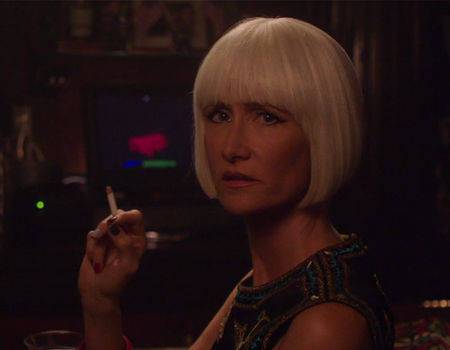
Laura Dern as Diane

Cut to Twin Peaks.  At a lumber yard, psycho Richard Horne (Eamon Farren) has apparently just snorted the greatest cocaine ever.  He’s at a meeting with Red (Balthazar Getty) and several heavily armed men.  Apparently, Red is the new Twin Peaks drug lord.  (I guess the Renault family has gotten out of the game.)  Red says that he’s been in town for a few weeks and he likes it.  (During Part One, we briefly saw Red at the Roadhouse, making eyes at Shelley.)

Red is a typically talkative David Lynch drug dealer.  He says that he has problems with his liver.  He wants to know if Richard has ever really studied his hand.  Red talks about how much he likes The King and I.  In between all the random comments, he worries that Richard doesn’t have his drug use under his control and then says, “I’m going to be watching you, kid.”

“Don’t call me kid,” Richard says.

Red thinks that’s the funniest thing he ever heard.  Red also explains that, if Richard screws up, he’ll saw open Richard’s head and eat his brains.  Red does an elaborate magic trick with a dime, flipping it into the air where it apparently hangs in suspended animation before briefly appearing in Richard’s mouth.  Richard pulls the dime from his mouth, just to have it disappear from his hand.  Suddenly, the dime falls into Red’s hand.  Red explains that the dime represents the two of them.  “Heads, I win,” Red explains, “tails you lose.”

(Balthazar Getty is totally and completely chilling as Red.  He’s certainly a better actor now than he was when he made Lost Highway.)

Anyway, Richard doesn’t take this well because, in the very next scene, he’s driving his pickup truck, crying, and screaming, “Fuck you, man!”

Meanwhile, at a nearby trailer park, Carl (Harry Dean Stanton) is starting his day.  (You may remember Carl as the trailer park manager from Twin Peaks: Fire Walk With Me.  Apparently, he’s moved to Twin Peaks.)  Carl, who says he’s mostly just waiting for die, is driven into town by a friend.  Accompanying them is a man (Jeremy Lindholm) who talks about his wife, Linda.  She’s in a wheel chair and the man says that it’s taken forever for the government to send them their money.

“Fucking war,” Carl says, “Fucking government.”

(Damn straight, Carl!  Also, remember in Part One, the Giant told Cooper that he needed to find Richard and Linda.  Well, we’ve already met Richard Horne and, in this episode, we learned about Linda.  But are the same Richard and Linda that Cooper needs to find?)
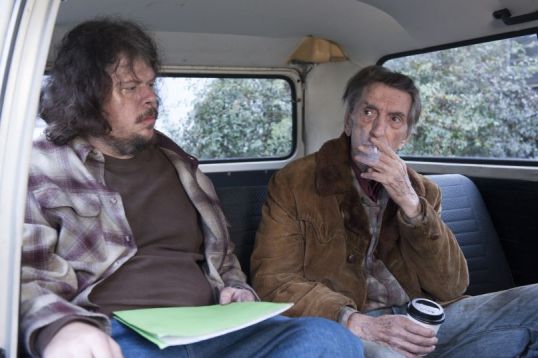
At the Double R, we discover that apparently there hasn’t been any staff turnover in 25 years.  Shelley (Madchen Amick) is ringing up customers.  The German waitress is still taking orders.  A customer named Miriam (Sarah Jean Long) says that she loves Double R coffee.  She’s a teacher.  “The kids this year are so cute!” she says.  There’s much giggling.  Surely, nothing bad could possibly be about to happen with all of this happiness going on…

Uh-oh, Richard’s still driving and yelling.  “I’ll show you a kid!” he shouts, slamming down on the accelerator.  Damn, Richard — is that any way for a Horne to behave!?

Carl sits in a park and stares up at the trees.  He watches a mother playing with her young son.  He smiles at them.  Carl appears to have calmed down considerably over the past 25 years.

Richard, being the worst human being ever, runs a stop sign.  Well, what could go wrong on such a beautiful day, right?  I mean it’s not safe but — OH SHIT, RICHARD JUST RAN OVER THE KID!  And then he keeps on driving, all the while screaming that it’s not his fault!  While he’s yelling, he suddenly realizes that Miriam — who is standing outside of the Double R — has seen his truck and his face.

Meanwhile, the mom is left cradling her dead son, while a group of onlookers stare at them.  Carl runs out to the street and sees a yellow flame (the boy’s soul, maybe?) floating into the atmosphere.  Of all the witnesses, only grizzled old Carl attempts to provide any comfort to the sobbing mother.

As the scene ends, the camera zooms in on the power lines.  We hear the crackling of electricity.  Remember how Killer BOB was always connected to electricity during the show’s initial run?

In Las Vegas, Duncan Todd (Patrick Fischler) sees a large red square on his laptop.  He gets an envelope out of a cabinet and puts it on his desk.  The envelope has a black dot on it.  (In case you’ve forgotten, Todd appeared briefly during Part 2.  He’s a Vegas business executive who apparently is in some sort of debt to some powerful and frightening people.)

At Rancho Rosa, the cops are looking over the remains of Dougie’s car, which exploded last episode.  One cops find the license plate on the roof of the house.  Meanwhile, across the street, Druggie Mom (Hailey Gates) chants, “One one nine!  One one nine!”

At a motel, a little person named Ike “The Spike” Stadtler (Christophe Zajac-Denek) sits at desk and plays with some dice.  Why is he called The Spike?  Well, we’re about to find out.  Someone slips an envelope under his door.  (It looks like the same envelope that was on Duncan’s desk.)  Inside the envelope are pictures of Dougie and Lorraine (Tammy Baird), the woman who was previously hired to kill Dougie.
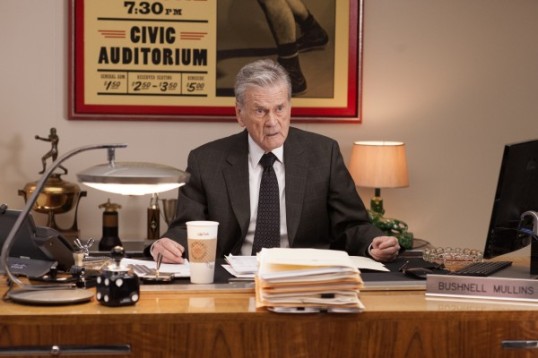
Meanwhile, Dougie/Cooper is back at work.  He’s got his big case file with him.  Unfortunately, his boss, Bushnell Mullins (Don Murray) is not impressed with Dougie/Cooper’s ladder drawing.  “Look at all of these childish scribbles,” he says, “how am I going to make any sense of this?”

“Make sense of it,” Dougie replies.

(Judging from the poster in his office, Bushnell was once a professional boxer.)

Suddenly, after looking at a few more of Dougie/Cooper’s drawings, Bushnell says, “Dougie, thank you.  I want you to keep this information to yourself.  I’ll take it from here but I may need your help again.”  Bushnell smiles.  “You’ve certainly given me a lot to think about.”

“Think about,” Dougie/Cooper replies.

“You’re an interesting fellow,” Bushnell says.

Meanwhile, Janey-E meets with the two men who claim that Dougie owes them money.  They explain that Dougie put a bet on a football game and lost.  They try to be intimidating but they don’t know who they’re dealing with.  Janey-E doesn’t have any time for their crap and she’s not afraid to let them know it.  She’s especially not impressed with their claim that Dougie owes them $52,000 when the bet was only for $20,000.

Nope, Janey-E’s not having it.

“We are not wealthy people!” Janey-E snaps, “We drive terrible cars!  We are the 99 per centers and we are shit on enough and we are certainly not going to be shit on by the likes of you!”  (If this seems surprisingly political for the normally apolitical David Lynch, it’s worth remembering that the script was co-written by Mark Frost, who is far more outspoken politically.  As a general rule, overly political stuff bores me to tears but Naomi Watts really kicks ass in his scene, totally selling every line.)  Janey-E gives them $25,000 and tells them to go away.

“What kind of a world are we living in where people can treat each other like this!?”  Janey-E says, before driving away.  “We are living in a dark, dark age.”

Meanwhile, Ike attacks Lorraine in her office and, in a disturbingly graphic scene, stabs her and at least two other women to death with a spike.  (Hence, his nickname.)

Back in Twin Peaks, Richard parks his truck in a field and tries to clean off the boy’s blood.

In the Sheriff’s Department, Deputy Hawk (Michael Horse) is in the men’s room when he sees a dime roll across the floor.  He follows the dime into a stall and, after picking it up, sees a metal sign proclaiming that the stall was built by Nez Perce Manufacturing.  And apparently, Nez Perce’s logo is a Native American chief.  Hawks sees that the top of the door is split open.  Hawk splits the door open further and finds several pieces of paper.
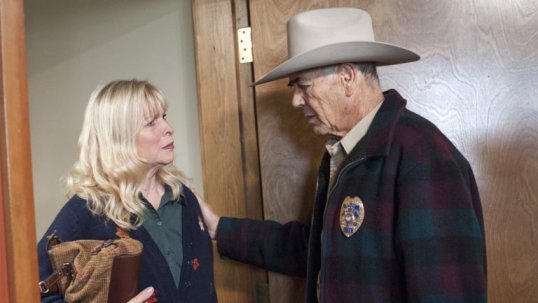
Meanwhile, Doris Truman (Candy Clark) comes by and yells at Frank (Robert Forster).  Doris is upset because her father’s car is not running right.  “Why are you always against me!?” Doris demands.  The other deputies say they wouldn’t put up with Doris but Maggie (Jodi Thelen) tells them that they don’t know what they’re talking about.  Doris, Maggie explains, changed after their son committed suicide.

“I know that,” one of the deputies says, mockingly, “he couldn’t take the pressure of being a soldier.”

(Is it possible that the death of Truman’s son — who it sounds like may have had PTSD — could be related to Linda, who — judging by Carl’s comments about the “fucking war” — may have been wounded while serving in the Army?)

And we close out with another haunting musical performance at the Roadhouse, the week courtesy of Sharon Van Etten.
Twin Peaks on TSL:

  1. Twin Peaks: In the Beginning by Jedadiah Leland
  2. TV Review: Twin Peaks 1.1 — The Pilot (dir by David Lynch) by Lisa Marie Bowman
  3. TV Review: Twin Peaks 1.2 — Traces To Nowhere (directed by Duwayne Dunham) by Jedadiah Leland
  4. TV Review: Twin Peaks 1.3 — Zen, or the Skill To Catch A Killer (dir by David Lynch) by Lisa Marie Bowman
  5. TV Review: Twin Peaks 1.4 “Rest in Pain” (dir by Tina Rathbone) by Leonard Wilson
  6. TV Review: Twin Peaks 1.5 “The One-Armed Man” (directed by Tim Hunter) by Jedadiah Leland
  7. TV Review: Twin Peaks 1.6 “Cooper’s Dreams” (directed by Lesli Linka Glatter) by Lisa Marie Bowman
  8. TV Review: Twin Peaks 1.7 “Realization Time” (directed by Caleb Deschanel) by Lisa Marie Bowman
  9. TV Review: Twin Peaks 1.8 “The Last Evening” (directed by Mark Frost) by Leonard Wilson
  10. TV Review: Twin Peaks 2.1 “May the Giant Be With You” (dir by David Lynch) by Leonard Wilson
  11. TV Review: Twin Peaks 2.2 “Coma” (directed by David Lynch) by Jedadiah Leland
  12. TV Review: Twin Peaks 2.3 “The Man Behind The Glass” (directed by Lesli Linka Glatter) by Jedadiah Leland
  13. TV Review: Twin Peaks 2.4 “Laura’s Secret Diary” (dir by Todd Holland) by Lisa Marie Bowman
  14. TV Review: Twin Peaks 2.5 “The Orchid’s Curse” (dir by Graeme Clifford) by Lisa Marie Bowman
  15. TV Review: Twin Peaks 2.6 “Demons” (dir by Lesli Linka Glatter) by Leonard Wilson
  16. TV Review: Twin Peaks 2.7 “Lonely Souls” (directed by David Lynch) by Jedadiah Leland
  17. TV Review: Twin Peaks 2.8 “Drive With A Dead Girl” (dir by Caleb Deschanel) by Lisa Marie Bowman
  18. TV Review: Twin Peaks 2.9 “Arbitrary Law” (dir by Tim Hunter) by Lisa Marie Bowman
  19. TV Review: Twin Peaks 2.10 “Dispute Between Brothers” (directed by Tina Rathbone) by Jedadiah Leland
  20. TV Review: Twin Peaks 2.11 “Masked Ball” (directed by Duwayne Dunham) by Leonard Wilson
  21. TV Review: Twin Peaks 2.12 “The Black Widow” (directed by Caleb Deschanel) by Leonard Wilson
  22. TV Review: Twin Peaks 2.13 “Checkmate” (directed by Todd Holland) by Jedadiah Leland
  23. TV Review: Twin Peaks 2.14 “Double Play” (directed by Uli Edel) by Jedadiah Leland
  24. TV Review: Twin Peaks 2.15 “Slaves and Masters” (directed by Diane Keaton) by Lisa Marie Bowman
  25. TV Review: Twin Peaks 2.16 “The Condemned Woman” (directed by Lesli Linka Glatter) by Leonard Wilson
  26. TV Review: Twin Peaks 2.17 “Wounds and Scars” (directed by James Foley) by Lisa Marie Bowman
  27. TV Review: Twin Peaks 2.18 “On The Wings of Love” (directed by Duwayne Dunham) by Jedadiah Leland
  28. TV Review: Twin Peaks 2.19 “Variations on Relations” (directed by Jonathan Sanger) by Lisa Marie Bowman
  29. TV Review: Twin Peaks 2.20 “The Path to the Black Lodge” (directed by Stephen Gyllenhaal) by Lisa Marie Bowman
  30. TV Review: Twin Peaks 2.21 “Miss Twin Peaks” (directed by Tim Hunter) by Leonard Wilson
  31. TV Review: Twin Peaks 22.2 “Beyond Life and Death” (directed by David Lynch) by Lisa Marie Bowman
  32. Film Review: Twin Peaks: Fire Walk With Me (dir by David Lynch) by Lisa Marie Bowman
  33. Here’s The Latest Teaser for Showtime’s Twin Peaks by Lisa Marie Bowman
  34. Here’s The Newest Teaser for Showtime’s Twin Peaks by Lisa Marie Bowman
  35. 12 Initial Thoughts About Twin Peaks: The Return Parts One and Two by Lisa Marie Bowman
  36. This Week’s Peaks: Parts One and Two by Ryan C. (trashfilm guru)
  37. TV Review: Twin Peaks: The Return Parts One and Two (dir by David Lynch) by Lisa Marie Bowman
  38. 4 Shots From 4 Films: Special Twin Peaks Edition by Lisa Marie Bowman
  39. This Week’s Peaks: Parts Three and Four by Ryan C. (trashfilm guru)
  40. 14 Initial Thoughts About Twin Peaks: The Return Part Three by Lisa Marie Bowman (dir by David Lynch)
  41. 10 Initial Thoughts About Twin Peaks: The Return Part Four by Lisa Marie Bowman (dir by David Lynch)
  42. TV Review: Twin Peaks: The Return Parts Three and Four (dir by David Lynch) by Lisa Marie Bowman 
  43. 18 Initial Thoughts About Twin Peaks: The Return Part 5 (dir by David Lynch) by Lisa Marie Bowman
  44. This Week’s Peaks: Part Five by Ryan C. (trashfilm guru)
  45. TV Review: Twin Peaks: The Return: Part 5 (dir by David Lynch) by Lisa Marie Bowman
  46. 14 Initial Thoughts On Twin Peaks Part 6 (dir by David Lynch) by Lisa Marie Bowman
  47. This Week’s Peaks: Part Six by Ryan C. (trashfilm guru)