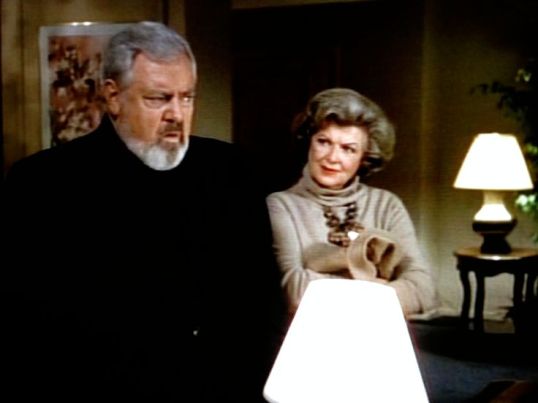
Perry Mason (Raymond Burr) has spent a semester teaching moot court at a law school. When one of his students, Frank Wellman Jr. (John Allen Nelson), is murdered, the accused is another student named Ken Malansky (William R. Moses). Despite being a close friend of the victim’s father (Brian Keith), Perry thinks that Ken is innocent and agrees to defend him. Ken’s ex-girlfriend, Amy Hastings (Alexandra Paul), pays Ken’s bail and helps him and Perry investigate the crime, even though Ken spends the whole movie talking about how “crazy” she is.
No William Katt. No David Ogden Stiers. Barbara Hale’s barely in it. The Case of the Lethal Lesson was the start of a new era in the Mason movies and I didn’t like it. Ken and Amy are Perry’s new assistants but I didn’t like either one of them. Amy was stalkerish but Ken still cried too much about her being the one who paid his bail. Did Ken just want to stay in jail? Ken just wasn’t very likable and it bothered me that the movie never explained why Paul wasn’t available to help. Both Paul and William Katt deserved better. Meanwhile, the new prosecutor (Marlene Warfield) didn’t have the same friendly rivalry that her predecessor did. The mystery element was okay until some cartoonish gangsters showed up. I didn’t buy any of it.
Give it up for my sister, though. A few minutes into the movie, Lisa said, “I bet that’s the murderer,” and she was right! If Perry Mason had her helping him instead of Ken and Amy, he could have solved this case a lot quicker.
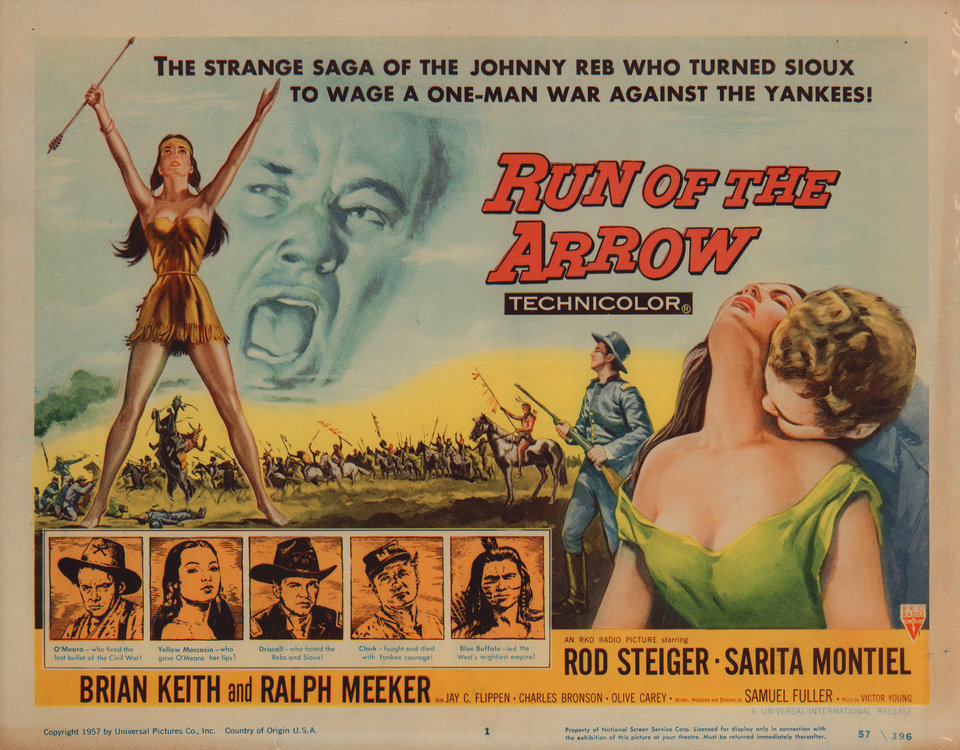
RUN OF THE ARROW opens up on April 9th, 1963, with confederate sharpshooter O’Meara (Rod Steiger) shooting a Union lieutenant named Driscoll (Ralph Meeker). This turns out to be the final shot fired in the Civil War as General Lee is in the process of surrendering to General Grant. It also turns out to be Driscoll’s lucky day, as a slight warping of the bullet causes O’Meara’s aim to be off just enough for him to survive. With no more war to fight and with a heart full of hate for the Yankees, O’Meara declares himself to be a man without a country and decides to head out west towards the land of the Indians. As part of his travels he happens across Walking Coyote (Jay C. Flippen), an aging, renegade Sioux scout who’s headed back home to die. Walking Coyote takes O’Meara under his wing and teaches him the Sioux language, as well as many of their customs. When they’re captured by a band of Sioux warriors led by Crazy Wolf (H.M. Wynant), and are being prepared to be killed, Walking Coyote invokes the “run of the arrow”, a ritualistic game that could save their lives. Unfortunately, no one has ever survived the run of the arrow. But today, it seems there’s a first time for everything, as O’Meara survives just long enough to be found, hidden, and saved by the beautiful Indian squaw Yellow Moccasin (Sarita Montiel). Yellow Moccasin nurses him back to health and presents him to her tribal chief, Blue Buffalo (Charles Bronson), who spares his life since he survived the run. Blue Buffalo also welcomes O’Meara into their tribe and allows O’Meara and Yellow Moccasin, who have fallen in love, to get married and adopt the mute orphan boy, Silent Tongue, as their own son. Things seem to be going well until Sioux Leader Red Cloud (Frank DeKova) and Army General Allen (Tim McCoy) reach an agreement that allows for an Army Fort to be built in a narrowly defined area. While the construction of the fort is entrusted to an honest man of integrity named Captain Clark (Brian Keith), the agreement is ultimately sabotaged by the murderous Crazy Wolf, and then further by the Indian hating Captain Driscoll… yes, that same Union soldier that O’Meara shot on the last day of the war! When the fighting starts again, will O’Meara prove himself to truly be a Sioux warrior willing to kill American army soldiers, or is a part of his heart still with his country?
Director Samuel Fuller’s RUN OF THE ARROW is a movie about the damage that occurs when human beings allow their hearts to be so filled with bitterness and hate that they quit caring about other people. It’s also about what happens when those same people run into rational people of good will, and we find out if they’re still capable of even considering the possibility that their own hate has blinded them from the truth. In other words, it’s a film that’s possibly more relevant today than it was when it was made in 1957. Bitterness and hate is represented by the characters of O’Meara (Steiger), Crazy Wolf (Wynant), and Lieutenant Driscoll (Meeker). O’Meara hates Yankees, Crazy Wolf hates the white man, and Driscoll hates the Indians. The rational people of good will are the characters of Yellow Moccasin (Montiel), Blue Buffalo (Bronson), and Captain Clark (Keith). Yellow Moccasin saves O’Meara, when everyone else would have just let him die. Blue Buffalo engages in honest conversation with O’Meara and even welcomes him into their tribe. Captain Clark shows O’Meara an empathetic ear and kindness when so many others have told him to just get over himself. The actions and fates of the characters play out against this dynamic of hatred versus humanity, with the results underscoring just how tragic it is when people focus on the things that separate us rather than the things that unite us. It’s all so unnecessary, but it’s also a realistic vision of the world we live in. The film also struck me as particularly violent for a 50’s western, which also underscores that reality.
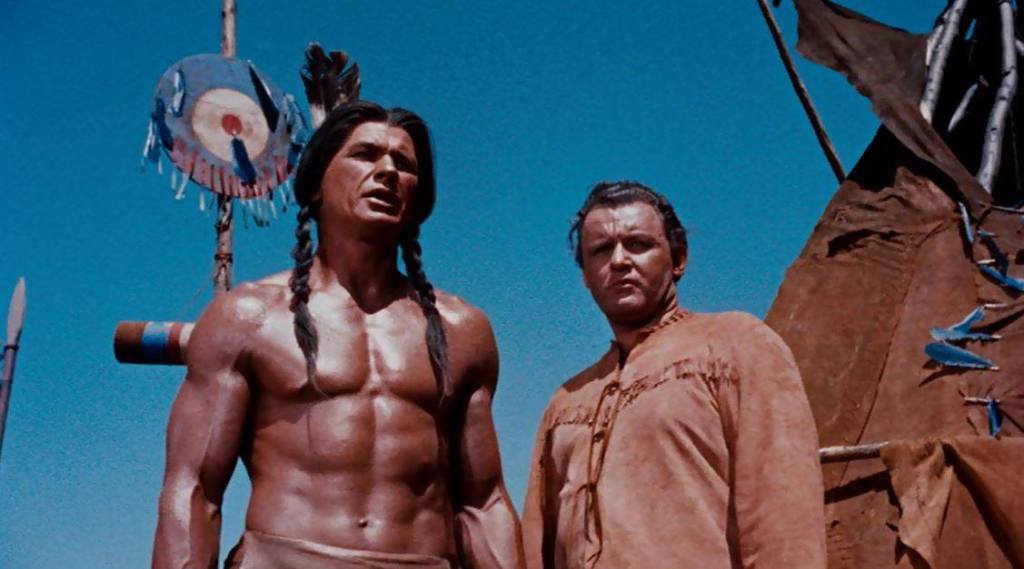
Some of the performances are very effective in the film. Rod Steiger’s Irish, confederate Sioux is an interesting character and the actor gives it his all as you’d expect. I’m a big fan of Steiger and his performance here only solidifies my respect for him. Brian Keith’s Captain Clark arrives fairly late in the proceedings and comes across as a tough, but honest man of integrity at a point when the movie really needs him. He has an excellent scene with Steiger where he debates the old confederate’s reasons for renouncing his citizenship with both sound logic, empathy, kindness and a hint of likable sarcasm all at the same time. It’s one of the best scenes in the film. And likewise, Charles Bronson, the most buff Hollywood Indian to ever strip down to a loincloth, comes across as a reasonable and kind tribal chief in his dealings. Bronson had played Indians before, but he was usually more of the renegade, warpath variety, so it was nice seeing him as a good guy here. H.M. Wynant took the renegade Indian role here which you might have expected for Bronson at the time. He’s suitably fierce but one-dimensional. The same can be said for Ralph Meeker as Lieutenant Driscoll. He’s pretty much just a stereotypical jerk. He’s good at being a jerk though! And Sarita Montiel, voiced by Angie Dickinson, is quite the beauty as Yellow Moccasin. We discussed H.M. Wynant and RUN OF THE ARROW with author Steven Peros on the “This Week in Charles Bronson Podcast.” Check out that interview below:
I’ve recently heard RUN OF THE ARROW compared to Kevin Costner’s DANCES WITH WOLVES, and there are definitely many similarities. I won’t go into all of those here, but one of the things I appreciated the most about RUN OF THE ARROW is the fact that the movie makes its feelings known about politics. In a movie filled with characters who have had their lives upended by the various decisions of political leaders, director Samuel Fuller has crafted a story that focuses most sharply on defining the quality of men based on what’s in their “hearts.” When it’s all said and done, oftentimes the only control we have is the way we respond to the events in our lives, and that’s not politics, it’s personal. To drive this home, in one of their conversations, Walking Coyote tells O’Meara that he could have been a chief if he had wanted to be. When O’Meara pushes the old scout on why he didn’t want the position, Walking Coyote responds with, “Because I hate politics!” On that point, I couldn’t agree more.
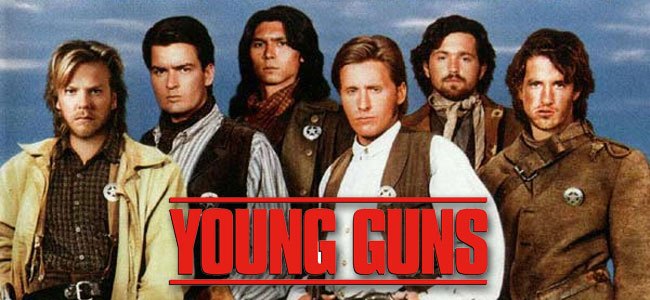
Every Monday night at 9:00 Central Time, my wife Sierra and I host a “Live Movie Tweet” event on X using the hashtag #MondayMuggers. We rotate movie picks each week, and our tastes are quite different. Tonight, Monday May 19th, we are showing YOUNG GUNS (1988) starring Emilio Estevez, Kiefer Sutherland, Lou Diamond Phillips, Charlie Sheen, Dermot Mulroney, Casey Siemaszko, Terence Stamp, Jack Palance, Terry O’Quinn, Brian Keith, and Patrick Wayne.
This movie focuses on a group of young gunmen, led by Billy the Kid (Emilio Estevez), who become deputies to avenge the murder of John Tunstall (Terence Stamp), the rancher who took them in, gave them jobs, and taught them how to read. But when Billy takes their authority too far, they soon find themselves to be the outlaws and the ones being hunted down.
Join us tonight for #MondayMuggers and watch the extremely fun YOUNG GUNS! It’s on Amazon Prime. The trailer is included below:
1979’s Meteor is about a big rock that is tumbling through space. Earth is directly in its path and, if it hits the planet, it could be an extinction-level event. Unfortunately, little bits of the rock keep breaking off and crashing into Earth, destroying cities and fleeing extras. Goodbye, Hong Kong. Goodbye, Switzerland, which is destroyed via stock footage lifted from Avalanche. Goodbye, New York, which blows up in such spectacular fashion that the scene was later re-used in The Day After.
It might seem like the planet is doomed. The meteor is unstoppable. Bruce Willis hasn’t become a star yet. But fear not! Some of the brightest faces of the 70s have been recruited to stop the meteor. Natalie Wood, in one of her final films, plays a translator and gets covered in muddy river water. Sean Connery wears a turtleneck and curses in that Scottish way of his. Karl Malden wears a hat and tells people to calm down while he calls the President. Brian Keith plays a Russian with all the grace and skill of a cat trying to rip open a bag of treats. Martin Landau is the military official who doesn’t think that the scientist know what they’re talking about. Henry Fonda is the president. That’s a lot of balding men for one movie and it’s hard not to notice that both Malden and Keith often seem to be wearing a hat whenever they share a scene with Connery. My personal theory is that the production, having spent all of their money on blowing up New York, couldn’t afford more than two toupees so everyone had to take turns wearing them. (The few scenes where Malden is hatless while in Connery’s presence are often oddly filmed, with either Connery on Malden standing with their back to the camera, almost as if the scenes were actually done with a stand-in.)
We’re supposed to breathe a sigh of relief when we see that Henry Fonda is playing the President but I’ve seen FailSafe and I remember him allowing the Russian to nuke New York City. Interestingly enough, New York gets destroyed in this film too. Why didn’t President Fonda care about New York City? Of course, the scientists and the military folks are all located in a control center that’s located under the city. Malden mentions that they’re right next to the Hudson River. It doesn’t seem to occur to anyone that this is a bad idea but, then again, they also elected Henry Fonda president again.
My late friend and colleague Gary Loggins described Meteor as being a “crashing bore.” I have to admit that this is one of the few times that I have ever disagreed with Gary. Meteor is a tremendous amount of fun, as long as you’re watching it with a group of people and nobody takes it seriously. (The first time I saw it was at one in the morning while I was in college. Jeff and I watched it in the lounge of one of the dorms. We may be the only two people to have romantic memories of Meteor.) Meteor features a cast of champion scenery chewers. Karl Malden, Sean Connery, Martin Landau, Brian Keith, none of them were exactly subtle actors and giving them an excuse to argue about how to deal with a meteor allows for a lot of very enjoyable overacting. As well, the special effects are so cheap and obviously fake that it’s hard not to laugh out loud whenever the film cuts to that shot of the meteor rolling through space or the incredibly shiny American and Russian missiles slowly heading towards it.
Meteor’s a lot of fun, even if it is one of those movies where no one points out that our heroes inevitably seem to make every situation worse with their own stupidity. It’s very much at the tail-end of the 70s disaster boom. Watch it for the stars. Watch it for the rock. And watch it for the hairpieces.
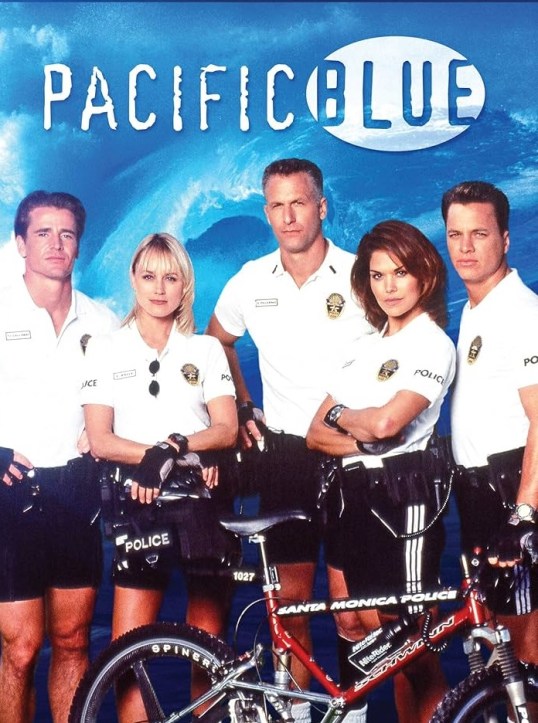
Welcome to Late Night Retro Television Reviews, a feature where we review some of our favorite and least favorite shows of the past! On Tuesdays, I will be reviewing Pacific Blue, a cop show that aired from 1996 to 2000 on the USA Network! It’s currently streaming everywhere, though I’m watching it on Tubi.
This week, the bicycle cops continue to expect to be taken seriously.
Episode 1.2 “First Shoot”
(Dir by Michael Levine, originally aired on March 9th, 1996)
It’s a busy time for the bicycle cops of Santa Monica.
Elvis (David Lander), the bicycle repairman who speaks with an indecipherable accent, is paranoid because a group of Bulgarian men are wandering the beach and asking if anyone knows where they can find him. It turns out that the men are not dangerous but instead, they are the members of Bulgaria’s Olympic bicycling team. They want Elvis to be their official team repairman. However, Elvis previously had an affair with the girlfriend of one of the Olympians so he declines the offers. He prefers the glamour of California.
Meanwhile, a pickpocket is robbing people on the boardwalk. When he makes the mistake of grabbing the wallet of an old Italian man named Mr. Tataglia (Joseph Campanella), Tataglia goes to Lt. Palermo and explains that he wants the wallet back because it contains a picture of his wife. He would consider it a matter of personal respect if Palermo retrieved the wallet and he promises to repay the favor. Fortunately, the brave bicycle cops do catch the pickpocket. Mr. Tataglia watches from a distance and nods. I guess Mr. Tataglia is meant to be a mobster. Believe it or not, not all Italians are in the Mafia. I’m a fourth-Italian and I’m fairly sure that side of my family is not mob-related.
While that’s going on, Chris and Del Toro ride their bikes out to a film set and provide security for a spoiled movie star named Scott Magruder (Bojesse Christopher). Chris is the one who has a crush on Magruder but it’s Del Toro who is seduced by the prospect of fame. When Magruder gives Del Toro a line in the movie, Del Toro has visions of movie stardom in his head. But then the scene gets cut. Sorry, Del Toro, looks like you’re just going to have to spend the rest of your life riding around the beach on a Schwinn like a dumbass. Scott later gets arrested in a bar fight but it turns out it was a publicity stunt. Chris is saddened to learn that celebs aren’t as likable in real life as they are in the gossip pages. Myself, I’m just wondering why Chris has gone from being the smart and driven character that she was in the pilot to being a total airhead just one episode later.
Finally, Cory and the bike cops help the real cops bust a group of drug dealers. Cory shoots an aspiring rapper named Rasheed (Jeremiah Birkett). Rasheed claims that he didn’t have a gun. Cory is determined to prove that he did. Apparently, this was the first time that Cory ever shot anyone. Strangely, it doesn’t seem to rattle her at all that she nearly ended someone else’s life. I mean, it seems like most people would have a more emotional reaction to nearly killing a man, even if that guy was a criminal with a gun. Cory, however, is cool and calm and kind of creepy about it. It’s established that Cory comes from a family of cops so maybe that’s why the shooting doesn’t faze her.
There was a lot going on in this episode. Actually, there was probably too much going on. This is only the second episode of the show and it’s not like any of the characters have really developed much of an individual personality. Everyone is still pretty much interchangeable. As a result, none of the action in this show carried much of an emotional impact. The characters are all still strangers to me.
Maybe things will improve next week.
(Seriously, let’s hope so! I’ve got a lot of episodes to make my way through before I’m done with Pacific Blue.)
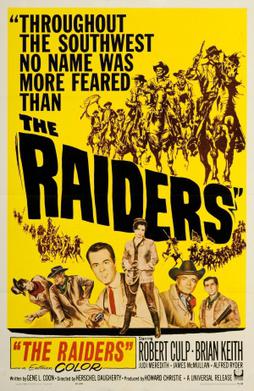
In the years immediately following the Civil War, seven Texas cattleman, led by Col. John McElroy (Brian Keith), try to drive their cattle into Missouri. The terrains proves treacherous and the local Pawnees refuse to allow the cattlemen to pass through their land without paying a hefty fee for the right. McElroy and his followers go to Fort Hays and demands that the local railroad magnate, Huntingon Lawford (Addison Richards), extend his line into Texas. When both Lawford and martinet Calvary officer Capt. Benton (Alfred Ryder) refuse to help, McElroy and his man start sabotaging the railroad’s western expansion.
This brings them into conflict with Wild Bill Hickok (Robert Culp), Buffalo Bill Cody (Jim McMullan), and Calamity Jane (Judi Meredith), all of whom are working for the railroad! Hickok is an old friend of McElroy’s and Cody is sympathetic to McElroy’s cause but will they be able to broker a peace between the two sides? When Captain Benton plans to lure McElroy into a trap where he and his friends will fired on with a Gatling gun, it’s up to Cody and Hickok to try to prevent a massacre.
The Raiders starts out as a downbeat look at a cattle drive in the years when America was still trying to rebuild from the devastation of the Civil War. Brian Keith was one of those actors who was always ideally cast in westerns and war movies and he’s convincing as the tough but fair-minded McElroy. If the film had just been about McElroy, it would have been a good B-western. Instead, it brings heavily fictionalized versions of Wild Bill Hickock, Buffalo Bill Cody, and Calamity Jane into the story. Robert Culp, Jim McMullan, and especially Judi Meredith all overact in their roles and a lot of time is wasted on subplots like Calamity Janes being in love with Wild Bill and Buffalo Bill trying to prove himself to the older man.
The Raiders started out as a made-for-TV movie and it appears that it was a pilot for a proposed TV show about Calamity Jane and the Bills. (Brian Keith is even listed in the credits as being a “special guest star.”) When the pilot wasn’t picked up, the film was given a theatrical release but The Raiders still has the flat look and unimaginative editing of a television show. No matter how authentic Brian Keith’s performance might be, he can’t make up for the fact that the majority of the film was clearly shot on a studio backlot.
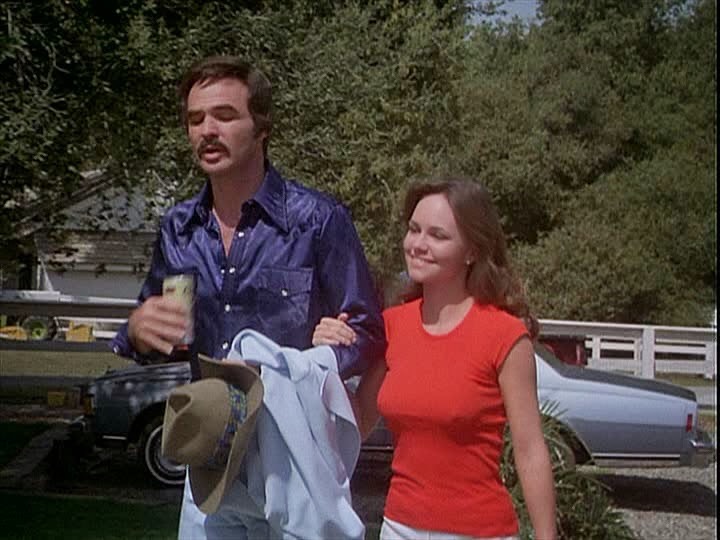
Reuniting the Smokey and the Bandit team of director Hal Needham and stars Burt Reynolds and Sally Field, Hooper is a film that pays tribute to stuntmen.
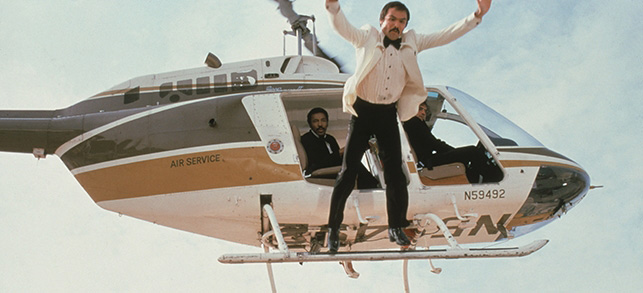
Hooper (Burt Reynolds) is a respected but aging stunt coordinator who is currently working on an overblown action film called The Spy Who Laughed At Danger. (The spy is played by Adam West, who appears as himself.) Hooper knows that he’s getting too old to keep putting his life at risk but he’s addicted to thrill of doing what he calls “gags.” Every morning, Hooper wakes up, pops pills, has a beer, and then falls off a building or crashes a car. When he’s not doing movies, he’s getting into bar brawls. As demonstrated during a visit to Dodge City, Hooper and his friends are modern day cowboys but time is catching up to them. Hooper’s girlfriend, Gwen (Sally Field), wants Hooper to settle down and retire from the business before he ends up a physical wreck like her father (Brian Keith). Hooper feels that he has to do one last, record-setting stunt before he passes the torch over to younger stuntmen like Ski Shidski (Jan-Michael Vincent).
Hooper is a classic Burt Reynolds film, with everything that you expect from late 70s Burt. As always, Burt is deceptively laid back. Sally Field is cute as a button. Old hands like Brian Keith and James Best provide strong support while Robert Klein plays the type of pompous Hollywood director who is just begging to get slugged at the end of the movie. (He does.) The plot of Hooper is even simpler than the plot of Smokey and the Bandit but Hooper is a more heartfelt film. Hal Needham was a stuntman before he became a director and this film was his tribute to the underappreciated people who risked their physical well-being to make movie magic. Needham knew men like Hooper and his friends. They were his people. Needham’s love for the stunt players comes through in every scene.
As for the stunts, they’re real and they’re spectacular.
Hal Needham, of course, will always be associated with Burt Reynolds. Before moving into directing, Needham frequently served as Reynolds’s stunt double and the two were such close friends that Needham spent 12 years living in Reynolds’s guest house. Quentin Tarantino’s Once Upon A Time In Hollywood was partially inspired by the friendship of Burt Reynolds and Hal Needham, with Leonardo Di Caprio and Brad Pitt playing characters who were based on the two men. (Reynolds was even originally cast in Once Upon A Time In Hollywood as George Spahn but he died before he could shoot his scenes. The role was taken over by Bruce Dern.) Needham was responsible for directing some of Burt’s best films (Cannonball Run, Smokey and the Bandit and this one) and some of his worst (Stroker Ace and Cannonball Run II). Needham also directed Megaforce, which didn’t feature Burt but which is still, in its own way, unforgettable.
Hal Needham (1931 — 2013)
The critics may not have loved the movies that Hal and Burt made together but audiences did. Needham’s best films are just as entertaining today as they were when they were originally released. They don’t demand much but they deliver everything you could possibly want. Whenever the real world is getting to be overwhelming, I’m thankful that I can turn on a Hal Needham film and return to a world where the only thing that matters is driving fast, loving hard, and having a good laugh while you’re doing it. Today, more than ever, the legacy of Hal Needham is just what we need.
As a genre, film noir has always been associated with crime: murder, brutish gangsters, seductive femme fatales, and occasionally a cynical private detective doing the right thing almost despite himself. However, not all film noirs are about criminals. Some are just about desperate characters who have found themselves on the fringes, living in a shadow-filled world that appears to be monstrously indifferent to all human suffering.
That’s certainly the case with the 1951 noir, 14 Hours. The film centers around Robert Cosick (Richard Basehart, who previously played a murderer in another classic noir, He Walked By Night). Robert isn’t a gangster. He’s not a private detective. He doesn’t carry a gun and he doesn’t provide any sort of hard-boiled narration. In fact, for the majority of the film, Robert is defined by less who he is and more by what he’s doing. Robert Cosick, having earlier checked into a room on the 15th floor of a New York hotel, has climbed out of a window and is now standing on a ledge. Robert says that he’s going to jump.
What has driven Robert Cosik to consider such an extreme action? The film never settles on any one reason, though it gives us several clues. When his father (Robert Keith) and his mother (Agnes Moorehead) show up at the scene, they immediately start bickering about old family dramas. When Robert’s ex-fiancee (Barbara Bel Geddes) begs him to step in from the ledge, he listens a bit more to her than he did to his parents but he still refuses to come in from the ledge.
But perhaps the real reason that Robert Cosick is out on that ledge can be found in the film’s shadowy visuals. Directed in a semi-documentary fashion by Henry Hathaway and featuring harsh, black-and-white cinematography that’s credited to Joe MacDonald, Fourteen Hours emphasizes the indifference of the city. From the menacing landscape of concrete buildings to the crowds gathering below the ledge to see if Robert lives or dies, New York City is as much as a character in this film as Robert, his family, or the cop (played by Paul Douglas) who finds himself trying to talk Robert into reentering his hotel room. When night falls, the city may light up but it does nothing to alleviate the shadows that seem to be wrapping themselves around Robert. For the fourteen hours that Robert is on that ledge, he may be the center of the world but the film leaves little doubt that New York City will continue to exist in all of its glory and its horror regardless of how Robert’s drama plays out. Whether he lives or dies, Robert appears to be destined to be forgotten.
When the film isn’t concentrating on the cops trying to talk Robert into getting back in the hotel room, it shows us the reactions of the people who see him standing out on that ledge. (If this film were made today, everyone would be holding up their phones and uploading Robert’s plight to social media.) Some people are moved by Robert’s struggle. For instance, a young woman played by Grace Kelly (in her film debut) reaches a decision on whether or not to get a divorce based on what she sees happening on the ledge. Two office workers (played by Jeffrey Hunter and Debra Paget) even strike up a romance as they wait to see what will happen. Some people view Robert as being a madman. Others see him as being a victim. And then there’s the many others who view him as being either a minor distraction or a piece of entertainment. For them, it’s less important why Robert’s on the ledge or even who Robert is. What’s important to them is how the story is going to end.
It’s not a particularly happy film but it’s made watchable by Hathaway’s intelligent direction and the performances of Paul Douglas and Richard Basehart. With its theme of instant fame and hollow indifference, it’s a film that remains as relevant today as when it was initially released.
In a fictional Middle Eastern country, tough-as-nails Col. Halloran (Brian Keith) has been kidnapped by terrorists. The leader of the terrorists is named Jihad and he is played by the No Mercy Man himself, Rockne Tarkington. The American ambassador (Paul Winfield) is a weak-willed Carter appointee who says, “We have to go through proper channels.” Gunnery Sgt. Burns (Fred Dryer) ain’t got no time for the proper channels. All of his men have been killed. His mentor has been kidnapped and is being tortured with a power drill. Even if it means breaking all the rules, Sgt. Burns is going to rescue Halloran, defeat Jihad, and kill anyone who has ever chanted “Death to the U.S.A.”
Totally a product of the 80s and about as politically incorrect as they come, Death Before Dishoner was an attempt to turn former football player-turned-TV star Fred Dryer into a movie star. It did not work, though Fred does his best Clint Eastwood impersonation, chugging beer and speaking exclusively in tough one-liners. Death Before Dishonor is dumb but entertaining. (It may have been made for New World Pictures but it’s a Cannon Film at heart.) The movie’s highlight if Fred Dryer chasing the bad guys in a jeep, keeping one hand on the steering wheel while using the other hand to fire a bazooka. A close second is Brian Keith barely flinching while taking a power drill to the back of the hand. No one’s tougher than an 80s action hero!
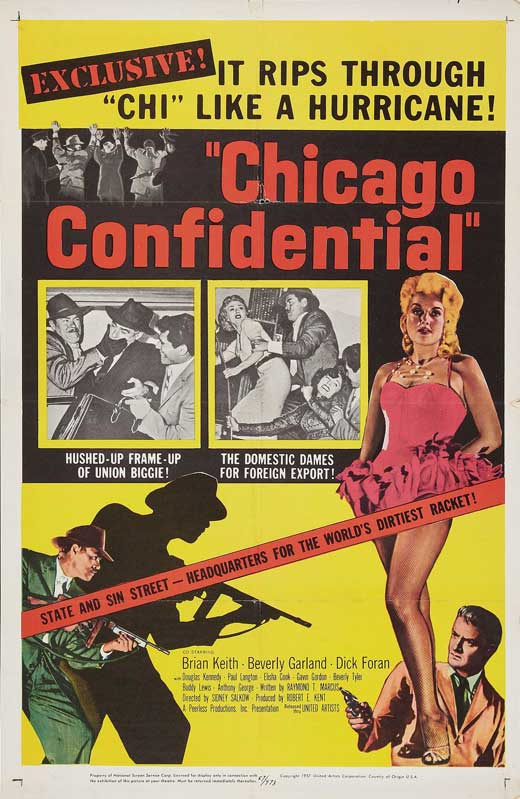
CHICAGO CONFIDENTIAL is just a routine ‘B’ crime drama, one of many churned out in the 50’s. Yet the performances of stars Brian Keith , Beverly Garland , and an above-average supporting cast helped elevate the by-the-numbers material into something watchable. It’s those Familiar Faces we all know and love from countless movies that made CHICAGO CONFIDENTIAL work for me.
The story revolves around racketeers muscling in on the Worker’s National Union so they can bring their “numbers rackets and ‘B’ girls” to the city. Politically ambitious State’s Attorney Jim Fremont is dead set on busting them up, and when the union’s treasurer is murdered, the finger of suspicion is pointed at honest Union President Artie Blane. Blane’s been framed by his rival, VP Ken Harrison, who takes his orders from “disbarred attorney” Alan Dixon, “one of the masterminds of the old Capone gang”. Blane is brought to trial and, thanks to some chicanery by an “old derelict” with the…


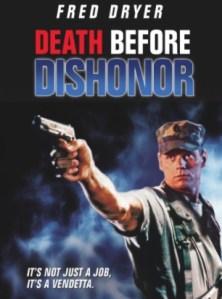 In a fictional Middle Eastern country, tough-as-nails Col. Halloran (Brian Keith) has been kidnapped by terrorists. The leader of the terrorists is named Jihad and he is played by the No Mercy Man himself, Rockne Tarkington. The American ambassador (Paul Winfield) is a weak-willed Carter appointee who says, “We have to go through proper channels.” Gunnery Sgt. Burns (Fred Dryer) ain’t got no time for the proper channels. All of his men have been killed. His mentor has been kidnapped and is being tortured with a power drill. Even if it means breaking all the rules, Sgt. Burns is going to rescue Halloran, defeat Jihad, and kill anyone who has ever chanted “Death to the U.S.A.”
 Through the Shattered Lens