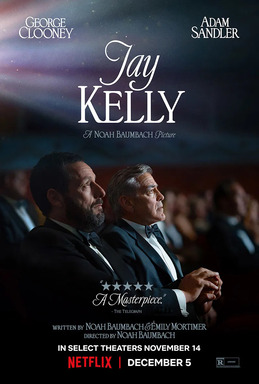
The Films of 2025: Jay Kelly (dir by Noah Baumbach)


Jay Kelly features George Clooney at both his best and his worst.

Clooney plays the film’s title character, an actor who has just hit 60 and who is having an existential crisis as he realizes everything that he’s lost as a result of being rich and famous.  Clooney’s best moments are when he plays Jay as being essentially a prick, a guy who might be well-meaning but who lacks the self-awareness necessary to understand just how condescending and fake he tends to come across to the people who know him.  This is the Jay who insists on having a drink with Tim (Billy Crudup), a former actor who lost a key role to Jay and who has never forgiven him for it.  (It starts out as a friendly drink but it eventually becomes a fight after Tim reveals that he hates Jay and Jay responds by being smug.)  This is the Jay who has alienated both of his daughters (Riley Keough and Grace Edwards) and who doesn’t seem to understand that the rest of the world doesn’t travel with an entourage.

Jay is gloriously unaware in those scenes and they give Clooney a chance to show that he’s still capable of giving a sharp comedic performance.  Watching him in those scenes, I was reminded of the gloriously dumb characters that he played for the Coen Brothers, in both Burn After Reading and Hail, Caesar.  For that matter, I was also reminded of his burned-out hatchet man from Up In the Air, who was not a dumb character but still was someone who, like Jay Kelly, always seemed to be performing.

Unfortunately, as the film progresses, Jay himself starts to wander into flashbacks of himself as a young actor and, even worse, he starts to talk to himself about everything that he’s lost due to his fame and suddenly, he transforms into the insufferably smug Clooney who spent the earlier part of this year in greasepaint, lecturing us all about Edward R. Murrow.  The flashbacks to Jay Kelly’s past often feel like stand-ins for flashbacks to George Clooney’s past (and it’s probably not a coincidence that both Kelly and Clooney are from Kentucky) but they don’t really add up to much.  Jay Kelly is a character who becomes less compelling the more that one learns about him.

The characters around Jay Kelly are far more interesting than Jay himself, though I have my doubts whether that was intentional on the part of director Noah Baumbach.  (An overly long and indulgent sequence on a train would seem to suggest that Jay Kelly was envisioned as being a more fascinating character than he turned out to be.)  Just as he did in Baumbach’s The Meyerowitz Stories, Adam Sandler gives the film its heart, playing the role of Jay’s loyal but unappreciated manager.  Sandler and Laura Dern have a few showy scenes together but Sandler’s best moments come opposite Patrick Wilson as a client who feels that he’s being neglected in favor of Jay Kelly.  (For that matter, Wilson is so good in those scenes that I almost wish he had switched roles with Clooney.)  One might not expect the star of Jack and Jill and That’s My Boy to emerge as one of Hollywood’s best sad-eyed character actors but that’s what has happened in the case of Adam Sandler.

With all that in mind, I have to admit that I enjoyed Jay Kelly more than I thought I would.  Some of that has to do with expectations.  Jay Kelly is currently getting so roasted on social media that I was expecting the film to be a self-indulgent disaster.  While the film is definitely self-indulgent and about 30 minutes too long, it’s not a disaster.  When Clooney’s performance works, it really works.  (Unfortunately, the inverse is also true.)  Adam Sandler, Billy Crudup, Riley Keough, and Stacy Keach all give performances that elevate the occasionally shallow script.  Cinematographer Linus Sandgren captures some beautiful shots, especially towards the end of the film.  Visually, Jay Kelly is a marked improvement on the bland imagery of Marriage Story.  Like its title character, Jay Kelly is imperfect and occasionally annoying but it does hold your attention.

As for the film’s Oscar chances, the reviews are mixed but it’s a film about how tough it is to be an actor and one should not forget that the Actor’s Branch is the biggest branch of the Academy and the majority of the voters are people who are probably going to watch Jay Kelly and say, at the very least, “Hey, I know that guy!”  (Few will admit, “I am that guy,” but that will still definitely be a factor in how they react to the film.)  Regardless of how social media feels about the film, I imagine Jay Kelly will be remembered when the nominations are announced.

Film Review: Public Enemies (dir by Michael Mann)


2009’s Public Enemies is a portrait of the battle for the soul and imagination of America.

The films take place during the Great Depression.  With Americans struggling to pay their bills and many citizens out-of-work and feeling desperate, a new breed of folk hero has emerged.  Men like my distant relative Pretty Boy Floyd (Channing Tatum) and Alvin Karpis (Giovanni Ribisi) may be criminals who make their living by robbing banks but, to a nation of angry people who feel like they’ve been forgotten by the government and betrayed by the wealthy, they’re rebels who are challenging the system.  They are viewed as being modern-day Robin Hoods, even though very few of them actually bother to give the money that they steal back to the poor.

John Dillinger (Johnny Depp) is perhaps the most famous of the criminals who have been declared a “public enemy” by the FBI.  The handsome and charismatic Dillinger becomes almost a living legend, the man who cannot be captured by law enforcement.  He becomes a folk hero but with the twist that his own death seems inevitable.  Dillinger lives by his own set of rules and the press loves him even as they hungrily anticipate his violent end.

Pursuing Dillinger and the other so-called public enemies is a young FBI agent named Melvin Purvis (Christian Bale).  Purvis’s job is not only to capture or eliminate men like Dillinger.  It’s also to somehow figure out a way to replace them in the public’s imagination.  Through the use of what was then-considered to be revolutionary techniques (like fingerprinting and phone taps), Purvis tracks down one public enemy after another and soon, he’s becoming as much of a folk hero as the people that he’s pursuing.  If Dillinger and his cohorts represent the ultimate rebellion against an ineffectual system, Purvis and his success suggest that maybe the system actually can get something accomplished.  Unfortunately, for Purvis, he not only has to deal with the challenge of capturing Dillinger but also with the growing jealousy of his publicity-hungry boss, J. Edgar Hoover (Billy Crudup).  As is typical of the heroes of Michael Mann’s film, Dillinger and Purvis may be on different sides of the law but they have more in common than they realize.  Neither one can trust the people that they’re working with.

I remember that I was really excited about Public Enemies when it was first released in 2009.  I’m fascinated by the Depression-era outlaws and Dillinger’s story is certainly an interesting one.  (I’ve always enjoyed the theory that Dillinger faked his death, even though I don’t believe it for a second.)  Michael Mann seemed like the perfect director for the material and Johnny Depp seemed like ideal casting.  I have to admit that I was a little bit disappointed in the film itself, which was poorly paced and stuck so closely to the facts of the case that it led me to realize that Dillinger will always be more interesting as a legend than an actual person.  (I’ll concede that was probably the film’s point.)  There were moments of brilliance in the film.  The scene where Dillinger escaped from custody was wonderfully done.  Stephen Graham’s unhinged performance as Baby Face Nelson was excellent.  Johnny Depp had the right look for Dillinger but I have to admit that I found myself a little bit bored with Christian Bale’s Melvin Purvis.

Looking back today, though, the film feels almost prophetic.  That may seem like an odd thing to say about a film set in the past but Public Enemies portrait of an America caught between celebrating the rule of law and the excitement of rebellion feels very relevant to what’s happening today.  In retrospect, Public Enemies is a portrait of the contradiction at the heart of America, a country with a culture of both rebellion and loyal patriotism.  Public Enemies portrays a battle the continues to this day.

Public Enemies (2009, dir by Michael Mann, DP: Dante Spinotti)

Here Are The 2024 AARP Movies For Grown-Ups Nominations


The awards precursor season is getting started …. kinda.

The AARP Movies For Grown-Ups Nominations were announced last week, on the 20th.  I’m only now getting around to sharing them because I’m not a member of AARP and therefore, I had no idea these nominations had even been announced.  It seems a bit earlier than usual, for them.  Then again, you know how retired folks are about getting up early.

How influential are the AARP nominations?  Not very.  These nominations were not made being film critics or people who work in the industry.  They were made by the editors of AARP’s magazine.  That said, it’s always good to get mentioned somewhere.  If nothing else, this list might indicate which films are resonating with the over-5o set.

Or maybe I just like long lists.

Anyway, here are the nominations!  The winners will be announced on January 11th, during the Denny’s breakfast special.

Best Picture/Best Movie for Grownups
A Complete Unknown
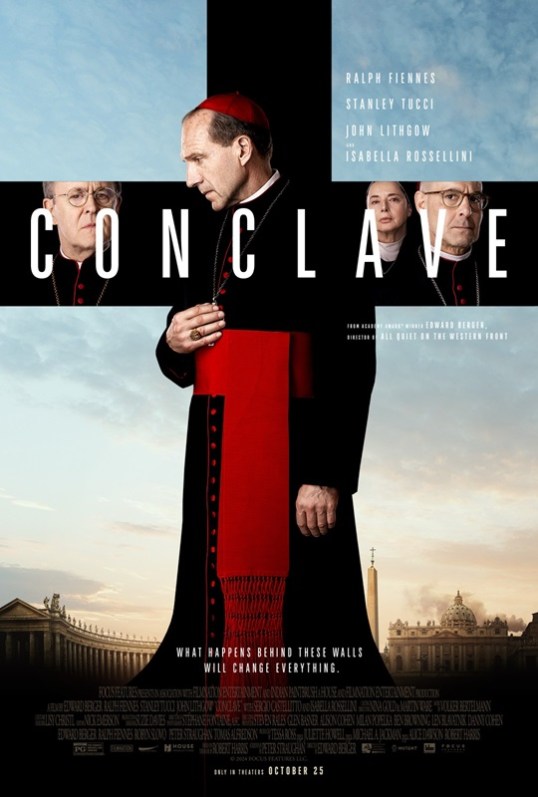
Conclave
Emilia Pérez
Gladiator II
September 5

Best Actress
Pamela Anderson (The Last Showgirl)
Marianne Jean-Baptiste (Hard Truths)
Nicole Kidman (Babygirl)
Demi Moore (The Substance)
June Squibb (Thelma)

Best Actor
Adrien Brody (The Brutalist)
Daniel Craig (Queer)
Colman Domingo (Sing Sing)
Ralph Fiennes (Conclave)
Jude Law (The Order)

Best Supporting Actress
Joan Chen (Didi)
Aunjanue Ellis-Taylor (Nickel Boys)
Lesley Manville (Queer)
Connie Nielsen (Gladiator II)
Isabella Rossellini (Conclave)

Best Supporting Actor
Clarence Maclin (Sing Sing)
Guy Pearce (The Brutalist)
Peter Sarsgaard (September 5)
Stanley Tucci (Conclave)
Denzel Washington (Gladiator II)

Best Director
Pedro Almodóvar (The Room Next Door)
Jacques Audiard (Emilia Pérez)
Edward Berger (Conclave)
James Mangold (A Complete Unknown)
Ridley Scott (Gladiator II)

Best Screenwriter
Jacques Audiard, Thomas Bidegain, Nicolas Livecchi (Emilia Pérez)
Jay Cocks and James Mangold (A Complete Unknown)
Winnie Holzman (Wicked)
Peter Straughan (Conclave)
Denis Villeneuve and Jon Spaihts (Dune: Part Two)

Best Ensemble
A Complete Unknown
Beetlejuice Beetlejuice
His Three Daughters
September 5
Sing Sing

Best Actress (TV)
Jennifer Aniston (The Morning Show)
Jodie Foster (True Detective: Night Country)
Jean Smart (Hacks)
Meryl Streep (Only Murders in the Building)
Sofia Vergara (Griselda)

Best Actor (TV)
Billy Crudup (The Morning Show)
Idris Elba (Hijack)
Jon Hamm (Fargo)
Gary Oldman (Slow Horses)
Hiroyuki Sanada (Shōgun)

Best TV Series or Limited Series
The Crown
Hacks
Palm Royale
Shōgun
Slow Horses

Best Intergenerational Film
Didi
Here
His Three Daughters
The Piano Lesson
Thelma

Best Time Capsule
A Complete Unknown
The Brutalist
Here
Maria
September 5

Best Documentary
I Am: Celine Dion
Luther: Never Too Much
Piece by Piece
Super/Man: The Christopher Reeve Story
Will & Harper

Horror Film Review: Alien: Covenant (dir by Ridley Scott)


Why did Alien: Covenant fail?

It’s a legitimate question.  Alien itself is such an iconic horror film that, 38 years after it was first released, blatant rip-offs like Life are still being produced and, in many case, are still doing pretty well at the box office.  When John Hurt died earlier this year, he left behind a long and distinguished filmography but almost every obituary opened by discussing his role in Alien.  

Alien: Covenant received a good deal of pre-release publicity, mostly centering on the fact that Ridley Scott was not only the filming the latest installment of the franchise but that this was going to be a true Alien film, as opposed to a strange hybrid like Prometheus.  Personally, when I first saw the trailer, I thought it looked like something was a little off about it.  The spaceship looked way too clean and, for that matter, so did all the humans.  Whereas Alien and Aliens were all about sweaty, profane men and women stuck in dark and cramped locations, the humans in Alien: Covenant just looked too damn perky.  In at least one of the trailers, they were all smiling.  No one smiles in space, at least not in an Alien movie.  Still, everyone else seemed to be super excited about the trailer so I figured that maybe I was just being overly critical.

Then the movie came out.  It got some respectful but somewhat restrained reviews, though it did seem like quite a few critics were more interested in praising the longevity of the series as opposed to actually talking about the film itself.  At the box office, it performed a bit below expectations during the first week but then again, that’s pretty much been the story for almost every film that’s been released in 2017.  But then, during the second week, it plunged from being the number one movie in America to being the number four movie in America.  In the third week, it plunged again and, in the fourth week, it left first-run theaters and headed for the dollar cinemas.  When a widely anticipated film like that — especially one that is part of a historically popular franchise — heads to purgatory after only four weeks, the only thing you can blame is word of mouth.

Why did Alien: Covenant fail?

Well, there’s several reasons why this film failed to connect with audiences.

First off, the plot is rather familiar.  In the future, the crew of a spaceship picks up a radio transmission for a nearby planet and the captain (played, in this case, by Billy Crudup) sends down an expedition to investigate.  Of course, it turns out that the planet is full of facehuggers and xenomorphs and all the other stuff that audiences typically expect from an Alien film.  Also on the planet is David (Michael Fassbender), the replicant who is the sole survivor from Prometheus.  (Fassbender actually plays two roles in Covenant.  He also plays Walter, another replicant.  One is bad and one is good.)  Basically, Covenant takes the plots of Alien and Aliens and mashes them together.  But it never answers the question of why audiences wouldn’t be better off just watching the originals.

The humans themselves are rather blandly written and somewhat interchangeable.  There’s no one who is memorably quirky like Bill Paxton or Harry Dean Stanton.  Katherine Waterston makes for a bland substitute for both Sigourney Weaver and Noomi Rapace.  Usually, I like Danny McBride but he seems out of place in an Alien film.  Genuinely interesting actors, like James Franco, Amy Seimetz, and Carmen Ejogo, are all dispatched far too early.  Probably the best performance in the film comes from Michael Fassbender but, for anyone who has any knowledge of what usually happens with replicants in the Alien franchise, there’s no surprises to be found in either of his characters.

But ultimately, the main problem with Alien: Covenant is that it just wasn’t scary.  Some might say that this is due to the fact that we’re no longer shocked by the sight of aliens bursting out of people’s chests.  However, I recently watched Alien.  I watched it with the full knowledge that, as soon as John Hurt sat down to eat, that little bugger was going to burst out of his chest and that blood and bones were going to fly everywhere.  I also knew that Harry Dean Stanton was going to end up walking right underneath the alien.  I knew that Tom Skerritt’s radio was going to go dead.  I knew that the alien would be waiting for Sigourney Weaver in the escape pod.  I knew all of this and Alien still scared the Hell out of me, as it has every time that I’ve watched it.

And I also had the same reaction when I recently watched Aliens.  Yes, I knew that the space marines weren’t going to be able to fight the aliens.  I knew what was going to happen to Paul Reiser.  I knew that Bill Paxton was going to end up chanting, “Game over, man!”  I knew that aliens were going to be bursting off of chests all over the place.  I knew it was all going to happen and yet, turning out all the lights and watching Aliens still left me feeling shaken.

The difference between those two films and Alien: Covenant is that the first two films felt authentic.  The ships felt lived in.  The characters felt real.  Both films were full of rough edges and small details that invited you to try to look closer.  You could watch those films and imagine yourself on those ships and talking to those characters.  You got scared because you knew that there was no way you’d be one of the survivors.  Everyone pretends that they would be Sigourney Weaver but most of us know that, in reality, we’re going to be Veronica Cartwright, sobbing and useless.

Alien: Covenant, on the other hand, is a very slick movie.  Nothing about it feels real and there’s no real emotional impact when the aliens show up and start killing people.  You never feel as if you know the characters, beyond whatever feelings you may have toward the actors involved.  “Oh,” you say, “the alien just burst out of Billy Crudup’s chest.  Well, he’s got another movie coming out so he’ll be fine…”

For all of the technical skill that went into making it, Alien: Covenant has no soul.  And, for that reason, it’s never scary.  (Sadly, Life felt like a better Alien movie than Covenant did.)  Hopefully, if there is another Alien film, that soul will be rediscovered.

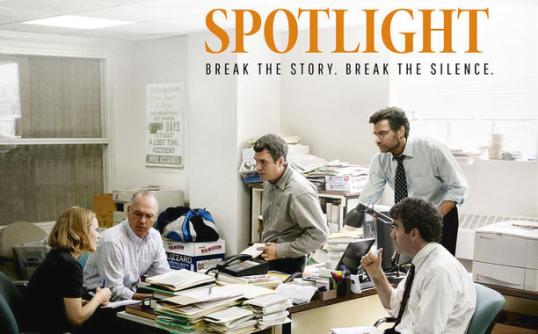
Playing Catch-Up: Spotlight (dir by Tom McCarthy)


Spotlight

Earlier today, I finally got to see Spotlight, the film that is currently the front-runner to win the Oscar for best picture.  Spotlight tells the story of how the Spotlight team, a group of journalists working for the Boston Globe, investigated the shameful history of sexual abuse of children by Catholic priests in the Archdiocese of Boston.  Starting with charges against one priest, the Spotlight team eventually uncovered sexual abuse by at least 70 priests and also revealed that the revered Cardinal Law was involved in covering up the crimes.

Having now seen Spotlight, I can say it’s a good film.  It’s well-made.  It’s well-acted.  The script contains some memorable lines.  I’ve talked to a few friends of mine who have actually worked as journalists and they have all assured me that Spotlight gets the details of their profession correct and that it’s pretty much an authentic look at what it’s like to be a reporter at a major newspaper.  There’s a lot of good things that can be said about Spotlight.

And yet, I’m not particularly enthusiastic about it.  I think my main issue with the film is that it’s just such an old-fashioned and rather conventional film.  It’s a throw back of sorts, an earnest exploration of a real-life outrage.  (Even the fact that the heroes are journalists makes the film feel as if it was made a decade or two in the past.)  On the one hand, you have to respect that director Tom McCarthy had the guts to tell his story in the least flashy way possible.  But, occasionally, his by-the-book approach is not as compelling as you want or need it to be.  Spotlight is a good film but it’s not a particularly challenging film and it’s the films that challenge us that truly stay with us after the final credits conclude.

Yes, it’s a good film but some are declaring that Spotlight is the best film of the year and I’m afraid that I just don’t see it.  There are a lot of 2015 films that will probably still be fondly remembered 5 years from now: Ex Machina, Mad Max: Fury Road, Inside Out, Sicario, and others.  When compared to those films, Spotlight feels more like an admirable made-for-TV movie.  It feels more like something that should sweep the Emmys than the Oscars.

That said, Spotlight does feature some excellent performances.  In fact, the entire cast does such a good job that it’s difficult to really single anyone out.  They come together as a nearly perfect ensemble.  (That said, I’m a bit torn on whether Mark Ruffalo came across as being passionate or merely mannered.)  Michael Keaton, especially, does a good job, embodying everyone’s ideal image of a journalist with integrity.

Spotlight‘s a good film but my favorite Tom McCarthy movie remains Win Win.

Playing Catch-Up: The Stanford Prison Experiment and The Tribe


The_Stanford_Prison_Experiment

The Stanford Prison Experiment (dir by Kyle Patrick Alvarez)

The Stanford Prison Experiment tells a true story.  It’s important to point that out because this is one of those films that, if you didn’t know it was based on a true story, you would probably be inclined to dismiss as being totally improbable.

In 1971, Professor Philip Zimbardo (played in the movie by Billy Crudup) conducted a psychological experiment at Stanford University.  A fake prison was built in the basement of a campus building, complete with cells and even a room to be used for solitary confinement.  15 students volunteered to take part in the experiment.  For $15.00 a day, some of the students were randomly assigned to be prisoners while others got to be guards.  The experiment was supposed to last for two weeks but Zimbardo ended it after 6 days.  Why?  Because the students had started to the take the experiment very seriously, with the guards growing increasingly sadistic towards their “prisoners.”  Afterwards, many of the prisoner students claimed to have been traumatized while the guard students felt they were just playing a game.

(As one of the guards says in the film, “Am I still going to get paid?”)

The Stanford Prison Experiment tells the story of that controversial experiment and it is, at times, quite a harrowing experience.  Interestingly, when the film begins, the focus is on the prisoners.  I immediately noticed that Ezra Miller was one of the prisoners and, being familiar with his work in Perks of Being A Wallflower and We Need To Talk About Kevin, I naturally assumed that the majority of the film would revolve around him.  After all, among the actors playing the prisoners, Ezra Miller was the “biggest name.”  And, when the film began, it did seem to be centered around Miller’s likable and rebellious presence.

But then something happened.  Miller faded into the background.  In fact, all of the “prisoners” faded into the background and the actors became almost indistinguishable from each other.  Instead, the film started to focus on one of the guards.  Outside of the prison, Christopher Archer (Michael Angarano) is a laid back and rather amiable California college student.  But, once he shows up for the night shift, Archer starts to talk about all of the prison films that he’s seen.  He starts to speak in a Southern accent.  He says stuff like, “What we have here is a failure to communicate.”  And soon, Archer is making the rules inside the prison.

In much the same way that Christopher Archer takes over the experiment, actor Michael Angarano takes over the film.  While Zimbardo and his colleagues watch Archer’s actions with a mix of fascination and fear, the film’s audience becomes enthralled with Angarano’s intense performance.  Wisely, neither Angarano nor the film allow Archer to turn into a cardboard villain.  He’s not a bad guy.  Instead, he’s playing a role.  He’s been told to act like a guard and that’s what he’s going to do, regardless of whatever else may happen.  The most fascinating part of the film becomes the contrast between Archer the likable student and Archer the fascist authority figure.

It’s frustrating that more people didn’t see The Stanford Prison Experiment when it was released in 2015.  Considering the blind trust in authority that is currently so popular in certain parts of the American culture, The Stanford Prison Experiment is a film that a lot of people really do need to see and learn from.

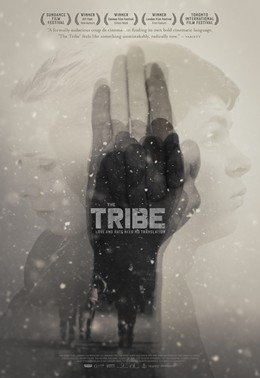
The_Tribe_poster

The Tribe (dir by Myroslav Slaboshpytskiy)

Anyone who says that they truly understand everything that happens in the disturbing Ukrainian film The Tribe is lying.  Taking place at a school for the deaf and exclusively cast with deaf actors, The Tribe is a film where everyone communicates in Ukrainian Sign Language and there are no subtitles.  However, the actors are often filmed with their back to the camera and occasionally, their hands are out of frame so, even if you do know Ukrainian Sign Language, there’s still going to be scenes where you have no idea what anyone is saying.

And it’s appropriate really.  The Tribe is a film about alienation and, by refusing to give us either an interpreter or subtitles, it forces the audience to feel the same alienation that the film’s characters have to deal with on a daily basis.  It quickly becomes obvious that these permanent outsiders have created their own society and the least of their concerns is whether the rest of the world understands it.

What can be learned about the film’s story largely comes from the body language of the actors and the audience’s own knowledge of gangster movies, which is what The Tribe basically is.  A new student at a boarding school for the deaf is recruited into a gang that deals drugs and pimps out two female students as prostitutes at a truck stop.  When the new student falls in love with one of the girls, it leads to some truly brutal acts of violence, all of which are somehow made more disturbing by the fact that they take place in total silence.

(The talkative criminals of most gangster films allow audiences to focus on something other than the violence.  When people talk about the opening of a film like Pulp Fiction, they talk about John Travolta and Samuel L. Jackson talking about Amsterdam.  They don’t focus on the guys getting gunned down in their apartment.  In The Tribe, there are no quips or one-liners before people are hurt and we are forced to pay more attention to the consequences of brutality.)

The Tribe is made up of only 34 shots.  The wide-angle lens forces us to consider these alienated characters against the barren Ukrainian landscape and the camera constantly moves with the characters, tracking them as closely as fate.  Intense and dream-lie, The Tribe is a hauntingly enigmatic film.  It’s not an easy film but it is a rewarding one.

Film Review: Blood Ties (dir by Guillame Canet)


So, there’s this fucking movie called Blood Ties and it’s about a lot of fucking guys who live in fucking New York City in the fucking 70s and they’re all kind of a bunch of fuck-ups but they all know how to fucking use the word fuck as both an adjective and an adverb.  That’s the main impression that I took away from Blood Ties, a film that feels a lot like a mash-up of Place Beyond The Pines and every Martin Scorsese film ever made.

The year is 1974.  After serving several years on a murder conviction, 50 year-old Chris (Clive Owen) has been released from prison.  Chris’s transition back into society is a bumpy one.  For one thing, his ex-girlfriend (Marion Cotillard) is now a prostitute and refuses to let Chris see his children.  Though he gets a new girlfriend (Mila Kunis), he still finds himself struggling to hold down a job and he soon finds himself tempted to once again pursue a life of crime.

What might make that difficult for him is the fact that his younger brother, Frank (Billy Crudup), is now a cop with an old school porn star mustache.  Frank makes little secret of how much he resents his older brother and it isn’t long before the two of them are constantly fighting.  However, Frank has problems beyond Chris.  For one thing, he’s romantically pursuing Vanessa (Zoe Saldana), despite the fact that he earlier put her husband, Anthony (Matthias Schoenaerts), in prison.

In order to keep their dying father (James Caan) happy, Chris and Frank try to put aside their differences.  However, when Frank sees Chris fleeing from the scene of a robbery, it becomes harder and harder for him to ignore his brother’s activities.  Meanwhile, Chris has to decide whether or not to potentially sacrifice his freedom to keep his brother safe from a vengeful Anthony…

When Blood Ties was originally released at the beginning of the year, I considered seeing it but — for some reason — I ended up seeing The Legend of Hercules instead.  (Don’t you hate it when that happens!)  And I have to admit that I had forgotten about Blood Ties until I discovered that we were getting EPIX for free this holiday weekend.  Blood Ties is one of the films that’s currently showing on EPIX and, when I saw it was available, I thought to myself, “I can’t wait to see A Most Violent Year but until that opens up down here in Dallas, why not watch another violent New York period piece?”

And so I watched Blood Ties and … well, bleh.  Actually, bleh may be too harsh of a judgment.  The film is full of fun period details and Billy Crudup gives a really good performance as Frank.  There are some well done action scenes and I appreciated the fact that, for the most part, the film did not try to make violence look glamorous or fun.  The film has a great soundtrack though, for the most part, most of the songs here can also be heard in a countless number of superior Scorsese films.

But, ultimately, Blood Ties is never as good as you want it to be.  The film’s plot is about as predictable as can be and, far too often, scenes that start out interesting quickly degenerate to various characters standing around and yelling at each other.  And while that may often be what happens in real life, it still doesn’t make it particularly interesting to watch.  And then you’ve got poor Clive Owen, a good actor who is seriously miscast here.  Casting Clive Owen as a streetwise New York gangster is a bit like casting Ray Liotta as a member of the Queen’s Guard.  It just doesn’t work.

For those of us hoping for a great New York City crime epic — well, we’re just going to have to keep hoping that A Most Violent Year turns out to be just as good as everyone says it is…

Blood_Ties_poster


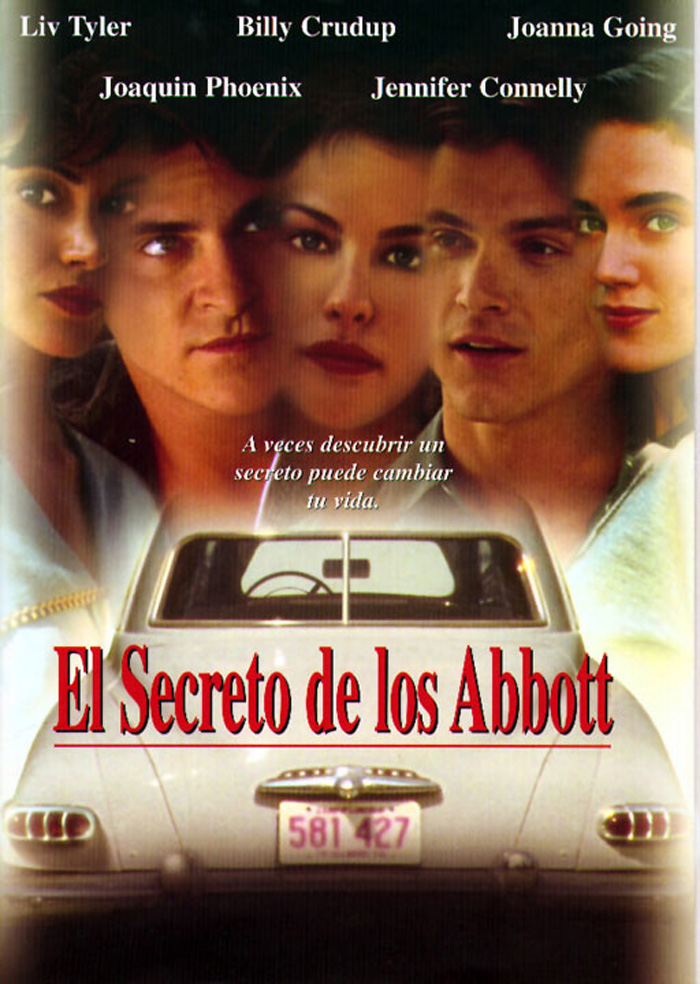
Embracing the Melodrama #45: Inventing the Abbotts (dir by Pat O’Connor)


First released in 1997, Inventing the Abbotts is a small town, romantic melodrama about two families in the 1950s.  One family is poor.  One family is rich.  As you can probably guess, each is fated to determine the destiny of the other.

Decades ago, Lloyd Abbott (Will Patton) and Holt were business partners.  However, after Lloyd had an affair with Holt’s wife (Kathy Baker), their friendship ended.  Lloyd eventually becomes the richest man in town and has three beautiful daughters: dutiful Alice (Joanna Going), wild Eleanor (Jennifer Connelly), and virginal Pam (Liv Tyler).  Holt is long since dead and his two sons, Jacey (Billy Crudup) and Doug (Joaquin Phoenix) live next door to the Abbotts.  While the bitter Jacey is obsessed with the Abbott family and ends up pursuing both Eleanor and the married Alice, Doug claims not to care about the Abbotts.  However, despite his claimed indifference, Doug soon finds himself falling in love with Pam.  Will Doug and Pam be together or will Lloyd succeed in keeping them apart?

To be honest, Inventing the Abbotts is not a particularly good film.  It moves way too slowly, Doug and Jacey frequently swtich personalities whenever the plot demands it, the story is way too predictable, the voice over narration is way too obvious, and Jennifer Connelly’s character leaves the film way too early.  This is one of those films that is determined to make sue that you never forget that it’s taking place in the 50s and you can be sure that every cliché that you associate with that decade will pop up at least once.  There are a few scenes that could have been easily been replaced with a picture of Joaquin Phoenix holding a sign reading, “It’s the 50s,” without causing us to miss out on any important information.

And yet, I still liked Inventing the Abbotts.  I think it really comes down to the fact that I’m the youngest of four sisters and therefore, I have a weakness for movies about sisters.  And the sisters in Inventing the Abbotts are all perfectly cast and believable as siblings so, for me, the movie was redeemed because of the number of scenes to which anyone who is a sister or who has a sister will be able to relate.

As such, despite its flaws, Inventing the Abbotts is definitely a guilty pleasure for me.

Your results may vary.

Inventing the Abbotts