Truman Gates (Patrick Swayze) may have been raised in Appalachia but, now that he lives in Chicago, he’s left the old ways behind. He has a job working as a cop and his wife (Helen Hunt) is pregnant with their first child. When Truman’s younger brother, Gerald (Bill Paxton), shows up in town and asks for Truman’s help, Truman gets him a job as a truck driver. But, on his first night on the job, Gerald’s truck is hijacked by a Sicilian mobster named Joey Rosellini (Adam Baldwin) and Gerald is killed. Truman’s older brother, Briar (Liam Neeson), soon comes to Chicago and declares a blood feud on the mob.
Of the many action films that Patrick Swayze made between Dirty Dancing and Ghost, Roadhouse may be the best known but Next of Kin is the best. Next of Kin spends as much examining the family dynamics of Rosellini’s family as it does with Truman’s, suggesting that there is not much of a difference between the two groups. There’s even a scene where Joey’s uncle (played by Andreas Katsulas) tells Joey that the Sicily was the Appalachia of Italty. Next of Kin also has a better supporting cast than most of the films that Swayze made during this period. Along with Paxton and Neeson, the hillbillies are represented by actors like Ted Levine and Michael J. Pollard while Ben Stiller has an early role as Joey’s cousin. Patrick Swayze gives one of his better performances as Truman but the entire movie is stolen by Liam Neeson, who is a surprisingly believable hillbilly.
Tonight, I am going to share two dance scenes that I love!
Why?
Because I love dancing and, even more importantly, I love our wonderful readers!
Our first scene was suggested to me by Valerie Troutman. It’s from a 1984 film called Reckless. I haven’t even seen this film but I liked this little scene. The dancing starts at 2:20 and let’s just say that you’ll never look at Aidan Quinn the same way again.
Our second scene is one that I’ve shared before but it’s just such an odd little scene that I feel like I have to share it again. Who knows — maybe someone out there is depressed and could use some cheering up. In this scene from 1991’s Zandalee, Judge Reinhold and Nicolas Cage share a dance while Erika Anderson watches.
For the past seven days, I’ve been reviewing — in chronological order — fifty of the most memorable melodramas ever filmed. We started with a silent film from 1916 and now, we have reached the 80s. What better way to kick off the decade than by taking a look at the 1980 Best Picture winner, Ordinary People?
Directed by Robert Redford, Ordinary People tells the story of the upper middle class Jarrett family. On the surface, the Jarretts appear to be the perfect family. Calvin Jarrett (Donald Sutherland) has a successful career. Beth (Mary Tyler Moore) keeps a perfect home and appears to be the ideal suburban matriarch. However, one summer, their oldest son drowns in a sailing accident and their youngest son, sensitive Conrad (Timothy Hutton), attempts to commit suicide. After spending four months in a psychiatric hospital, Conrad come back home and the family struggles to put their lives back together. Even though he starts to see a therapist (Judd Hirsch) and starts dating his classmate Jeannine (Elizabeth McGovern), Conrad still struggles with his feelings of guilt over having survived. Beth’s struggle to maintain a facade of normalcy leads to several fights between her and Conrad with Calvin trapped in the middle.
Among my fellow film bloggers, there’s always going to be a very vocal group that is going to hate Ordinary People because it won the Oscar for best picture over challenging black-and-white films directed by Martin Scorsese (Raging Bull) and David Lynch (The Elephant Man). They always tend to complain that Ordinary People is a conventional film that tells a conventional story and that it was directed by a very conventional director. More than once, I’ve seen an online film critic refer to Ordinary People as being a “big budget Lifetime movie.”
Well, you know what?
I love Lifetime. Lifetime is the best network on television and to me, a big budget Lifetime movie would be the best Lifetime movie of all. And, at the risk of alienating all of my film-loving friends, if I had to choose between watching Raging Bull and Ordinary People, I’m going to pick Ordinary People every time. Raging Bull is visually stunning and features great performances but it’s also two hours spent watching an incredibly unlikable human being beating the crap out of anyone who is foolish enough to love him. Ordinary People may essentially look like a TV show but it’s also about characters that you can understand and that, as the film progresses, you grow to truly care about.
Yes, I do wish that the character of Beth had been given more of a chance to talk about her feelings and it’s hard not to feel that Ordinary People places too much blame on the mother. But, even so, the film still ends with vague — if unlikely — hope that Beth will eventually be able to move past her anger and reconnect with her family. The film may be hard on Beth but it never gives up on her. That’s what distinguishes Ordinary People for me. In many ways, it’s a very sad film. It’s a film that was specifically designed to make you cry and I certainly shed a few tears while I watched it. But, even with its somewhat ambiguous ending, Ordinary People is also a very optimistic movie. It’s a movie that says that, as much pain as we may have in our life,we can recover and life can go on and it’s okay to be sad and its also okay to be happy.
And that’s an important lesson to learn.
(That said, if I had been alive and an Academy voter in 1981, I would have voted for The Elephant Man.)
And, for all you Oscar lovers out there, here are clips of Timothy Hutton and Robert Redford winning Oscars for their work on Ordinary People.
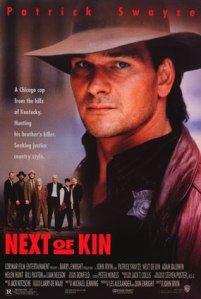 Truman Gates (Patrick Swayze) may have been raised in Appalachia but, now that he lives in Chicago, he’s left the old ways behind. He has a job working as a cop and his wife (Helen Hunt) is pregnant with their first child. When Truman’s younger brother, Gerald (Bill Paxton), shows up in town and asks for Truman’s help, Truman gets him a job as a truck driver. But, on his first night on the job, Gerald’s truck is hijacked by a Sicilian mobster named Joey Rosellini (Adam Baldwin) and Gerald is killed. Truman’s older brother, Briar (Liam Neeson), soon comes to Chicago and declares a blood feud on the mob.

