Horror Book Review: Fevre Dream by George R. R. Martin


First published in 1982, George R. R. Martin’s Fevre Dream is a novel that centers on two men.  Captain Abner Marsh may be considered physically unattractive and lacking in certain social graces but he’s also known as one of the best steamboat captains in pre-Civil War Mississippi.  Joshua York may be wealthy and charming (if a bit pale and fond of a strange-tasting red liquor) but he knows little about how to actually run a steamboat.  That said, as York explains it to Marsh, he wants to build the fastest and most luxurious steamboat ever made.  Marsh may initially be weary of the seemingly eccentric York but he needs the money.

When the steamboat (which is christened the Fevre Dream) is eventually constructed, it turns out to be everything that York said it would be.  Soon, Marsh is sailing the boat up and down the Mississippi River.  The command of the boat and its passengers is largely left in Marsh’s hands.  York requests is that he and his friends be left alone in their cabins.  York doesn’t particularly enjoy coming out during the day….

Could York be a vampire?  Of course, he is!  But he’s not the type of vampire that everyone’s read about.  Instead, York is a visionary vampire.  His dream is to set his people free from their compulsive blood-drinking.  However, there’s another vampire moving up and down the river.  His name is Damon Julian and he has plans of his own for the Fevre Dream….

A vampire novel by George R. R. Martin!?  Indeed, it is!  Of course, since this is a Martin book, the vampires of Fevre Dream aren’t like the traditional vampires that we all know and love.  These vampires are a totally different species of being and one of the key points of the book is that humans cannot be transformed into vampires.  Indeed, the vampires view human as being mere “cattle,” being bred for their hunger.  York’s concern is that, if the vampires continue to feed on humans, the humans will eventually rise up and destroy them.  Damon, of course, is far less concerned about that.  Just as how the white slave owners arrogantly assume that their slaves have no desire to free, Damon and his followers arrogantly assume that the humans will always stay in their place.  Damon even has a human servant, Billy Tipton, who has been fooled into thinking that he might someday become a vampire as long as he does everything that Damon orders him to do.

It’s an interesting novel, one that does a good job of incorporating it’s paranormal story into an authentic, historical background.  If you’re really into vampires and steamboats, there’s a lot of both to be found in this book.  Unfortunately, I get the feeling that the people reading for the vampires will probably get bored with all pages devoted to steamboats while steamboat enthusiasts might not care much for the vampires.  Myself, I’m a history nerd and a lover of all things vampiric so there’s no way I wouldn’t appreciate a novel about vampires in 19th century Mississippi.

It may not be for everyone but Fevre Dream is a well-written and compulsively readable historical vampire epic.
International Horror Film Review: Nosferatu, the Vampyre (dir by Werner Herzog)


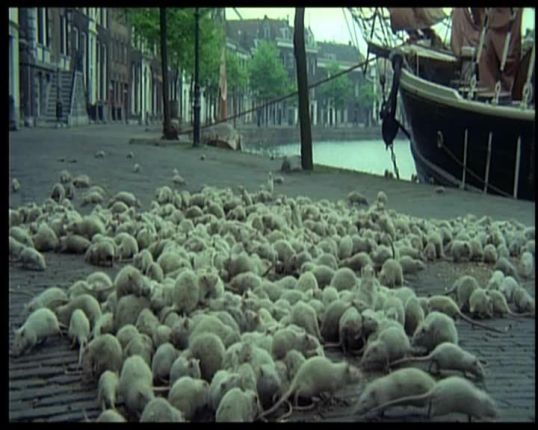
Agck!  The rats!

Nosferatu, Werner Herzog’s 1979 remake of the F.W. Murnau’s classic silent vampire film, may be best known for Klaus Kinski’s feral performance of Count Dracula but, for me, I’ll always remember the rats.

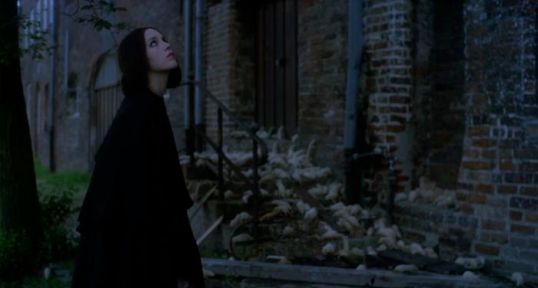
When Dracula first comes to the city of Wismar, he travels via a boat.  Spending the day in his coffin, he arises at night to kill the crew of the ship.  (Eventually, the captain’s dead body ends up tied to the wheel to ensure that the boat’s course is not altered.)  In order to keep the people of Wismar from realizing that they have a vampire in their midst, Dracula travels with thousands of rats and forges the ship’s log to make it seem as if the crew has fallen victim to the plague.  When the boat docks at Wismar, thousands of rats flood into the streets.  When Lucy (Isabelle Adjani) later walks through the streets of the Wismar, it becomes obvious that the rats have conquered the city.  The remaining people are too busy burying their dead and preparing for the end to do much about the rats.  One group cheerfully eats a lavish meal while thousands of rats wait behind them.  Later, the rodents have taken over the table.  The people are gone but the rats remain.

Werner Herzog has often cited the original Nosferatu as one of the films that most inspired him as a young filmmaker.  His remake is both a respectful homage to the original film and also a uniquely Herozgian work.  Much as the Spanish expedition at the center of Aguirre, The Wrath of God ended with the raft being conquered by monkeys, the city of Wismar is conquered by both rats and mythology.  Even towards the end of the film, when it becomes obvious that a vampire has come to town, the people refuse to believe it.  Some wait for God to save them.  Some just decide to celebrate the end.  But only Lucy, who we are told is pure of heart, is willing to sacrifice herself for the people of Wismar.  And yet, the film leaves us wondering if that sacrifice would really be worth it.  Are the people of Wismar worth saving?  This version of Nosferatu suggests that perhaps they’re not.


Lucy is the wife of estate agent Jonathan Harker (Bruno Ganz).  As with almost every version of Dracula, Nosferatu opens with Harker traveling to Dracula’s castle, dismissing the claims of local villagers are being mere superstition, and then eventually meeting the count himself.  Klaus Kinski may be made up to look like Max Schreck from the original film but he still turns Dracula into a uniquely Kinski-like creation.  Kinski’s Dracula has little of the old world charm of Bela Lugosi or even Christopher Lee.  Instead, he’s like a feral animal, hissing out his dialogue and almost always hiding in the shadows.  It’s been such a long time since this Dracula was human that he no longer knows how interact with them.  Instead, like an abused animal, he cringes when Harker attempts to speak to him.  There’s a loneliness to this Dracula and an unexpected sadness in his eyes.  Asking him to control his thirst for blood would be like asking a wild animal not to obey its natural instinct to kill.  The only time that this Dracula doesn’t seem to be full of self-loathing is when he’s actually hunting blood.  Then he moves like a calculating predator.

As one might expect from a Herzog film, Nosferatu moves at its somewhat odd but deliberate pace.  (Harker’s lengthy journey to reach Dracula’s remote castle will remind you of Klaus Kinski trying to conquer the Amazon in Aguirre and Fitzcarraldo.)  The imagery is surreal and dream-like.  I already mentioned the rats and the scene of Kinski stalking the captain of the boat feels like it was taken from a filmed nightmare.  It’s also impossible to forget the images of black-clad men, marching down the streets of Wismar and carrying coffins on their shoulders, all ignoring Lucy as she begs them to understand that there is something even deadlier than the plague at work in Wismar.

Both the original and the remake of Nosferatu are classic vampire films.  I suggest watching both.  Herzog shot two version of Nosferatu, one in German and one in English.  Though both versions are essentially the same, I recommend the German version just because, in the English version, it’s obvious the actors are occasionally having trouble performing in a foreign language.  The German version feels more authentic.  Since the film is basically a visual poem, it’s effective even if you’re watching it without subtitles.


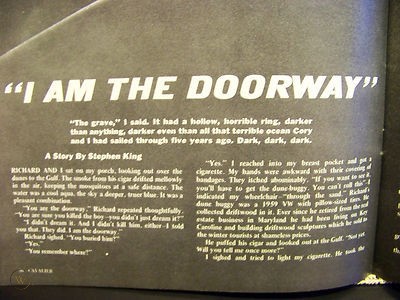
“I Am The Doorway”, Story Review by Case Wright


Cavlier

How free are we?  “I am the doorway” by Stephen King is an early work. It was published in 1971, when he was just 24. For context, we’d just gotten back from the moon 2 years prior.  The stories in Night Shift were gathered from this time period.  “I am the doorway” was published by Cavalier (see above).  I always thought that was odd not that Stephen King was getting published, but Cavalier?  Cavalier was a “Men’s” magazine.  I always thought that was strange and must be unique to the 1960s and early 1970s where people paired their Men’s magazines with literature and poetry.  Shel Silverstein wrote poetry for Playboy.  I guess that’s where The Sidewalk really ended?

The stories in Night Shift, and “I am the doorway” revolve around free will and how free we actually are by outside influence.   The occult is present of course, but that’s tangential.  The real meat of Stephen’s stories are always about the people living with the monsters.  In these early stories, it’s the people who are the monsters.  Either people are pulling their strings, life is pulling their strings, or monsters because this was his life.  He was newly married, he had kids on the way, and he was working jobs from substitute teaching and doing laundry to meet the bills.  Very few of us are free and if you think you are one of the Select, stop paying your credit card or student loan for a couple of cycles and get back to me.

The will once given up can’t be retrieved, you’re trapped like Richard in Quitters Inc..  Blood called to blood in Jerusalem’s Lot from generations forward, poking free will right in the eye. In Salem’s Lot, Ben Mears described his oddly fortuitous meeting of Susan Norton – Ben Mears’ love interest- as if the “universe were making some sort of cosmic bread.” When the will is taken away, it can be retrieved with a cost like in Jerusalem’s Lot or in this story “I am the Doorway”. The main point is that if we give into the darkness like the teenagers did in Night Surf, we are gone for good.  The will itself is like origami beautiful, fragile, and unique to the individual.  The will is cajoled, stolen, sold, and bought back.  The will for King appears to be akin to the soul.  Perhaps that’s why giving up one’s will to a higher power is so challenging and difficult to do?

“I am the doorway” is told as a first person narrative by Arthur who was an astronaut to Venus.  He gets exposed to alien cooties and starts to morph…grossly.  He develops eyes on his hands, which allows the aliens from Venus to see into our world.  Although he is disabled, when he falls asleep, the Venusians hijack his body and make him kill with lightning bolt powers.  The first victim is a child.  He understands that the Venutians will invade using him as a portal somehow.  Maybe he could try Atkins and get really small? To stop the invasion, he tries to burn the eyes off of his hands with Kerosene, but 7 years later, eyes open on his chest or as Stephen King would write “Sometimes They Come Back”.

Arthur can get his will back and stop the murders and the invasion, but the price will be the highest he can pay.  Like Arthur, we have these external forces in our lives.  Whether we are really free or not, I don’t really think so.  However, I know that some will is meant to be abdicated.  You give some freedom for the best moments in your life: marriage and children.  Both take up time and limit your freedom (no spur of the moment Vegas Trips and getting out the door can be interminable), but they complete a part of yourself that was missing and desperately needed to be found and they kinda look you and act like you, or the UPS man. Maybe giving up some of our will is the only way we can grow? Perhaps the doorway for us is to wisdom.

4 Shots From 4 Films: Child’s Play, Faceless, The Lair of the White Worm, Night of the Demons


4 Shots From 4 Films is just what it says it is, 4 shots from 4 of our favorite films. As opposed to the reviews and recaps that we usually post, 4 Shots From 4 Films lets the visuals do the talking!

This October, we’re using 4 Shots From 4 Films to look at some of the best years that horror has to offer!

4 Shots From 4 1988 Horror Films

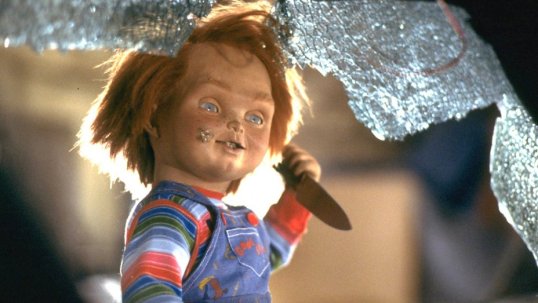
Child’s Play (1988, dir by Tom Holland)

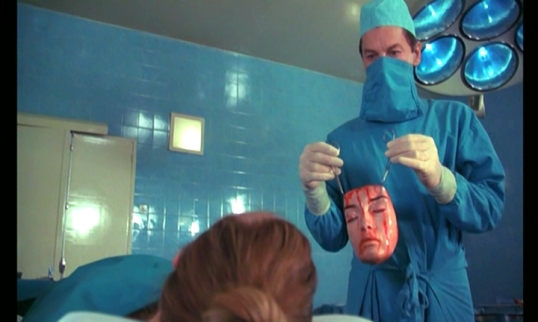
Faceless (1988, dir by Jess Franco)

The Lair Of The White Worm (1988, dir by Ken Russell)

Night of the Demons (1988, dir by Kevin Tenney)

Horror Film Review: One Hour Photo (dir by Mark Romanek)


I guess some people might argue that the 2002 film, One Hour Photo, isn’t really a horror film.

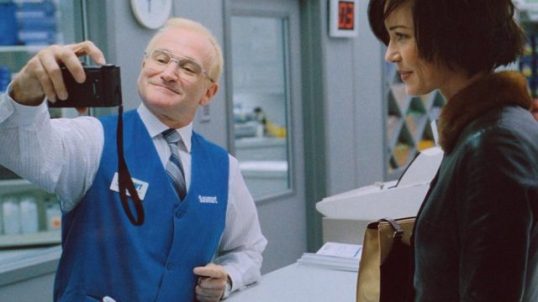
It’s an argument that I can understand.  The film does have its scary moments, like the scene where Sy Parrish (Robin Williams) dreams that his eyes are exploding.  But there aren’t any ghosts or vampires or hockey mask-wearing slashers to be found in One Hour Photo.  Even the film’s most disturbing moment — in which we see that Sy’s apartment is nearly empty except for a giant collage of pictures that cover his living room wall — is more depressing than scary.

It’s really a very sad movie.  In fact, it’s probably even more sad today than when it was originally released.  Now, when you see Robin Williams’s sad eyes and you hear him talking about how reality can never live up to a photograph, it’s impossible not to think about the actor’s 2014 suicide.  I remember that, when One Hour Photo and Insomnia came out in the same year, there was a lot of talk about how unexpected it was to see Robin Williams playing such dark characters.  Now, of course, that darkness is a key part of Robin Williams’s persona.

In hindsight, it’s also sad because one watches the film with the knowledge that, even if Sy hadn’t lost it at the end of One Hour Photo, he still probably be a lost soul in 2019.  When we first meet Sy, he’s working at the one-hour photo lab in SavMart.  He talks about how much he loves developing pictures.  When someone mentions that they’ve been thinking about getting a digital camera, Sy nervously chuckles and says, “Don’t do that, you’ll put us out of business.”  Of course, in 2019, people take pictures with their phones and even digital cameras are viewed as being something of a relic.  If Sy were around and free today, I doubt he’d have a job.  If he did have a job, it’s doubtful it would be one that would allow him to cover his wall with someone else’s photos.  Instead, in 2019, I imagine Sy would be one of those people following strangers on social media and printing out all their pictures and probably sending them unsolicited DMs and private messages.

Sy is obsessed with the Yorkin family, Will (Michael Vartan), Nina (Connie Nielsen), and their son, Jake (Dylan Smith).  Even though the family barely knows who Sy is, he knows them because Sy has spent years developing (and stealing) their photos.  Sy views them as being the perfect family.  They’re the family that he wants to be a part of.  “Sometimes I think of myself as being Uncle Sy,” he says at one point.  But then Maya Burson (Erin Daniels) brings in her photos to be developed and Sy learns that the reality of the Yorkins is not as perfect as the photographs.  And Sy loses it.

Actually, there’s quite a few reasons why Sy loses it and the film suggests that, if the Yorkins had never stepped into SavMart, Sy would have found another family on which to obsess.  Something is missing inside of Sy.  Incapable of dealing with reality, Sy instead deals with posed pictures of happy times.  Towards the end of the film, there’s a throw-away line that attempts to offer some sort of insight into why Sy is such a lost soul.  Personally, I think the film works better without an explanation.  Why is less important than the fact that Sy exists.

In the end, One Hour Photo qualifies as a horror film not because of any paranormal danger but because it’s a film about the horror of everyday life.  You never know who might be watching you.  That friendly clerk who waits on you at the grocery store might be following you home and imagining that he’s a part of your life.  You never know.  One Hour Photo is the film that suggests that, lurking behind every friendly smile, there’s a blank Sy Parrish.  It’s a scary thought.

Horror on the Lens: Plan 9 From Outer Space (dir by Edward D. Wood, Jr.)


Watching Ed Wood’s infamous Plan 9 From Outer Space is something of an October tradition here at the Shattered Lens!  And you know how much I love tradition!

Some people say that this film has a reputation for being the worst film ever made.  Personally, I don’t think that it deserves that reputation.  Is it bad?  By traditional standards of quality, I guess it can be argued that Plan 9 From Outer Space is a bad movie.  But it’s also a lot of fun and how can you not smile when you hear Criswell’s opening and closing statements?

Enjoy and be sure to read Gary’s review!

(And also be sure to read Jedadiah Leland’s tribute to Criswell!)

(On another note: Watch this as quickly as you can because, over the least year or so, it seems like all the films of Ed Wood get yanked off YouTube as soon as they are posted.  Copyright violations, they say.  Personally, I think that’s shameful.  First off, Ed Wood is no longer alive.  Wood had no children and his widow died in 2006, having never remarried.  Whatever money is being made off of his films is not going to support his family.  Wherever he is, I think Ed would be more concerned that people see his films than some faceless corporation make money off of them.)

(It seems like, every year, someone threatens to either remake Plan 9 or produce a sequel.  Again, the original is all that is needed.)

Music Video of the Day: Sweet Dreams (Are Made Of These), covered by Marilyn Manson (1996, dir by Dean Karr)


Goddamn, that pig freaks me out!

Seriously, though, we all know what Marilyn Manson is about and what you’re going to get when you watch one of his videos and he’s been around for so long that it’s kind of hard to get shocked by him.  I mean, he’s been imitated by so many other artists that he now almost seems kind of quaint.

But that said, this video is still seriously freaky.

And, of course, this song shows what Marilyn Manson does so well, taking a song that was formerly not scary at all and then making it his own.  I mean, seriously….

Enjoy!

Horror on TV: The Veil Episode 8 “Summer Heat” (dir by George Waggner)


On tonight’s episode of The Veil.…

There’s been a murder!  Or has there?  Edward Paige (Henry Bartell) swears that he saw someone murdered in a nearby apartment but, when the police investigate, they discover that the apartment appears to be totally deserted.  Still convinced that he saw something, Edward is sent for a psychiatric evaluation from Dr. Mason (Boris Karloff, playing a sympathetic role for once).  Dr. Mason says that Edward’s not making it up.  Edward swears that he saw something.  But what?

This is a pretty good episode.  Think of it as being Rear Window with an extra twist.  Boris Karloff hosts as well as co-stars.

Enjoy!

Monster Chiller Horror Theatre: Deadly Companion (1980, directed by George Bloomfield)


Deadly Companion starts with John Candy sitting in a mental institution and snorting cocaine while happily talking to his roommate, Michael Taylor (Michael Sarrazin).  Michael has been in the institution ever since the night that he walked in on his estranged wife being murdered.  Because of the shock, he can’t remember anything that he saw that night.  When his girlfriend Paula (Susan Clark) comes to pick Michael up, Michael leaves the institution determined to get to the truth about his wife’s murder.  Once Michael leaves, John Candy disappears from the movie.
Michael suspects that his wife was killed by her lover, Lawrence Miles (Anthony Perkins) but there is more to that night than Michael is remembering.  Deadly Companion is a typical low-budget shot-in-Toronto thriller from the early 80s, with familiar Canadian character actors like Michael Ironside, Al Waxman, Kenneth Welsh, and Maury Chaykin all playing small roles.  Michael Sarrazin is a dull lead but Anthony Perkins gets to do what he did best at the end of his career and plays a thoroughly sarcastic bastard who gets the only good lines in the film.

What’s interesting about Deadly Companion isn’t the predictable plot and it’s certainly not Michael Sarrazin.  Instead, what’s strange is that several cast members of SCTV show up in tiny supporting roles, though none of them get as much of a chance to make as big an impression as John Candy.  Deadly Companion is a serious thriller that just happens to feature Candy, Joe Flaherty, Eugene Levy, Catherine O’Hara, and Dave Thomas.  It’s strange to see Michael Sarrazin trying to figure out who killed his wife while Eugene Levy loiters in the background.  It leaves you waiting for a punchline that never comes.

The SCTV people are in the film because it was directed by George Bloomfield, who also directed several episodes of SCTV.  Since this film was made before SCTV really broke into the American marketplace, it was probably assumed that no one outside of Canada would ever find the presence of John Candy in a dramatic murder mystery distracting.  Of course, when Deadly Companion was later released on VHS in the late 80s, Candy and the SCTV crew were all given top billing.

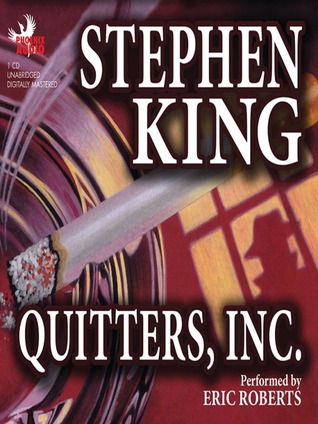
Quitters Inc, Story Review, by Case Wright


quitters.jpg

Smoking is a nasty habit.  I did smoke for 10 years and quit.  I didn’t do it any other way than to stop altogether.  To this day, when I smell one, I want one- except for Dorals because they’re gross.  Don’t let anyone tell you different; it is an addiction.  Richard Morrison, the protagonist, is a advertising man who shared my addiction.  Richard is in nadir of his life.  His son is severely mentally disabled and lives at an inpatient school, his wife nags him constantly, his overweight, and Rick smokes.

He smokes until he meets Jimmy McCann who tells him about Quitters Inc.  It’s strictly word of mouth and free.  Richard attends Quitters Inc.  Once you commit, you can’t leave.  It’s free because the founder, a mobster, bequeathed his fortune to get people to stop smoking the way the mob does they threaten you, your family, harm you, harm your family, or all or some of the above.

Richard learns that he will be under surveillance and if he smokes they will beat his wife. If he smokes again, they will beat his son and do escalating harm to his family and himself.  They even go beyond smoking and threaten to cut off his wife’s finger if he doesn’t lose weight.  Quitters Inc. runs life choices.

This is one of Stephen King’s early works and it’s written very tight. There’s no extra words or passages.  It reads like it went through many edits to purposefully ratchet up the tension.  You feel for Richard because he’s trying to succeed, but like all of us, he comes close to failure.  Every time Richard fails, you feel it in the pit of your stomach because you know the retribution is coming for his family.

The odd part of the story is that his life improves when Quitter’s Inc takes over.  You wonder if maybe free will is not for everyone.  In Richard’s case, free will destroyed his health and free will got him to accept unknown entity into his life that harms his family.  Freedom isn’t free, but giving up free will isn’t free either.