Let’s just be honest. It’s not a Super Bowl without a spot for the latest Fast and Furious film.
Here’s the spot for Fast and Furious 9. Yes, Han is back. These movies are kinda ludicrous but I just can’t help but love them.
Let’s just be honest. It’s not a Super Bowl without a spot for the latest Fast and Furious film.
Here’s the spot for Fast and Furious 9. Yes, Han is back. These movies are kinda ludicrous but I just can’t help but love them.
I was kind of skeptical about Mulan but this actually looks pretty exciting. Mulan will be in theaters on March 27th.
Here it is! The Top Gun: Maverick Super Bowl spot!
This spot admittedly doesn’t really tell you a lot about the film. Tom Cruise is back, but we already knew that. Val Kilmer shows up for a second or two. Lots of airplanes, of course. And really, that’s probably all that this preview needed to be effective.
Me: “Am I the only person in the world who doesn’t like SpongeBob?”
World: “Yes!”
Me: “Oh. Okay.”
Well, regardless of how I might feel about SpongeBob, the rest of the world seems to be excited about his upcoming movie. Here’s the Super Bowl spot!
I guess the point of this trailer is that Sonic The Hedgehog is really, really fast.
At least he doesn’t look no longer looks like he’s going to kill someone, so that’s an improvement. Seriously, film twitter takes a lot of criticism but this is one of those rare cases where the folks at Paramount should be thanking everyone who complained online.
Well, it’s Super Bowl Sunday and you know what that means! It’s time for everyone to watch the commercials. As we do every year, we’re going to post every single teaser and trailer that drops during the big game. Actually, it may be a little bit easier than usual this year because, apparently, there aren’t going to be as many trailers as there have been in the past. It’s not cheap to advertise during the Super Bowl and a lot of studios apparently decided that money could be put to better use elsewhere. It makes sense, really. Why spend millions to run one commercial during the Super Bowl when you can just drop the ad on YouTube and then have your star tweet out the link?
That said, we should still have a few trailers to look forward. For instance, here’s the Super Bowl teaser for A Quiet Place 2!
Since Jon Krasinski’s character died at the end of the first film, I’m going to assume that this sequel is going to be, at least partially, a prequel. So, we’ll get to see how the Earth got invaded and all that good stuff. I thought the first A Quiet Place was absolutely brilliant so I’m definitely looking forward to seeing if the sequel can live up to it!
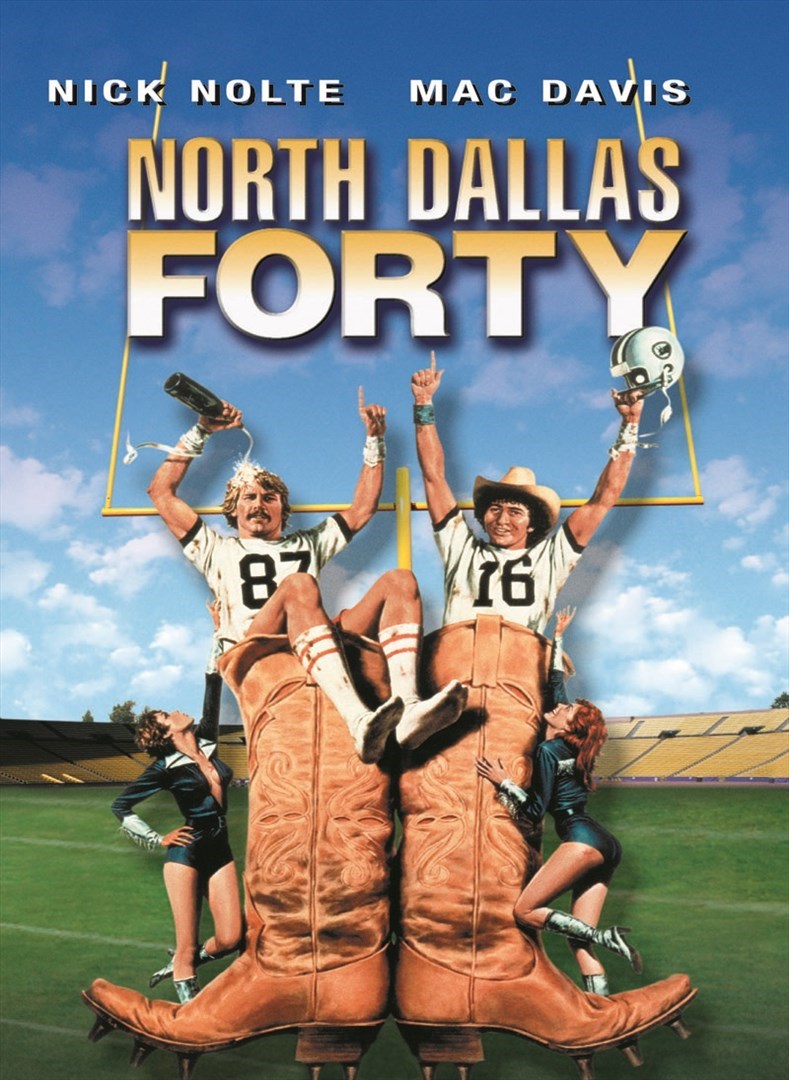 Pete Gent was a college basketball star at Michigan State University who, in 1964, received a tryout with the Dallas Cowboys. Intrigued by the $500 that the team was offering to any player who attended training camp that summer, Gent accepted. Despite the fact that Gent had never before played football, the Cowboys were impressed with his athleticism and they signed him to the team.
For five seasons, Gent played wide receiver. During that time, he caught a lot of balls, became close friends (or so he claimed) with quarterback Don Meredith, and got under the skin of Coach Tom Landry with his nonconformist attitude. After several injuries kept him off the field during the 1968 season, Gent was traded to the Giants who waived him before the next regular season began.
Out of work and with no other team wanting to sign him, Gent wrote a thinly veiled autobiographical novel about his time with the Cowboys. North Dallas Forty was published in 1973 and it immediately shot up the best seller charts. When the book was published, football players were still regularly portrayed as being wholesome, all-American athletes and the Dallas Cowboys were still known as America’s Team. North Dallas Forty shocked readers with its details about groupies, drugs, racism, and gruesome injuries. The NFL, of course, claimed that Gent was just a disgruntled former player who was looking to get back at the league. When asked about the book (which portrayed him as being a marijuana-loving good old boy), Don Meredith was reported to have said, “If I’d known Gent was as good as he says he was, I would have thrown to him more.”
Meredith had a point, of course. In the book, Pete Gent portrays himself as not only being the smartest man in football but also as having the best hands in the league. Men want to be him. Women want to be with him. And the North Dallas Bulls (which is the book’s version of the Dallas Cowboys) don’t know what they’re losing when they release him for violating the league’s drug policy. Today, when you read it and you’re no longer shocked by all of the drugs and the sex, North Dallas Forty comes across as mostly being a case of very sour grapes.
Luckily, the film version is better.

Nick Notle plays Phil Elliott, a broken-down receiver who wakes up most mornings with a bloody nose and who can barely walk without first popping a hundred pills. Phil is a nonconformist and a rebel. He loves to play the game but he hates how it’s become a business. Mac Davis plays Seth Maxwell, the team’s quarterback and Phil’s best friend. Seth is just as cynical as Phil but he’s better at playing politics. G.D. Spradlin is B.A. Strother, the cold head coach who is a thinly disguised version of the legendary Tom Landry. In the novel, B.A. Strother was portrayed as being a hypocritical dictator. The film’s version is more sympathetic with Strother being portrayed as stern but not cruel. Strother even tells Phil that he “can catch anything.”
Both the film and the book take place over the course of one week leading to a big game against Chicago. In the book, Phil says that he and Seth don’t care about whether or not they win. In the movie, they much do care but, at the same time, they know that they’re being held back by a system that cares more about whether or not they follow the rules than if they win the game. While Phil’s teammates (including Bo Svenson as Joe Bob Priddy and John Mantuszak as O.W. Shaddock) behave like animals, Phil falls in love with Charlotte Caulder (Dayle Haddon), who doesn’t care about football.
Pete Gent was originally hired to write the film’s screenplay but left after several disagreements with producer Frank Yablans. (The screenplay was completed by Yablans, directed Ted Kotcheff, and an uncredited Nancy Dowd.) The movie loosely follows the novel while dropping some of its weaker plot points. As a result, the film version has everything that made the novel memorable but without any of Gent’s lingering bitterness over how his career ended. The novel used football as a metaphor for everything that was going wrong in America in the 60s and 70s but the movie is more of a dark comedy about one man rebelling against the system.
There’s only a few minutes of game footage but North Dallas Forty is still one of the best football movies ever made, mostly because Nick Nolte is absolutely believable as an aging wide receiver. He’s convincing as someone who can still make all the plays even though he’s usually in so much pain that it’s a struggle for him to get out of bed every morning. He’s also convincing as someone who loves the game but who won’t give up his freedom just to play it. This is a definite improvement on the novel, in which Phil seemed to hate football so much that it was hard not to wonder why he was even wasting his time with it. Country-and-western signer Mac Davis is also convincing as Seth Maxwell and fans of great character actors will be happy to see both Charles Durning and Dabney Coleman in small roles.
Whether you’re a football fan or not, North Dallas Forty is a great film. Coming at the tail end of the 70s, it’s a character study as much as its a sports film. It’s also one of the few cinematic adaptations to improve on its source material. As a book, North Dallas Forty may no longer be shocking but the movie will be scoring touchdowns forever.


Well, another Sundance Film Festival has come to a close! Here’s what won at this year’s festival. If this year is like other years, a few of the films mentioned below will also be players once Oscar season begins later this year. For instance, just from what I’ve read, I wouldn’t be surprised to see Minari‘s name come up quite a bit between now and next January.
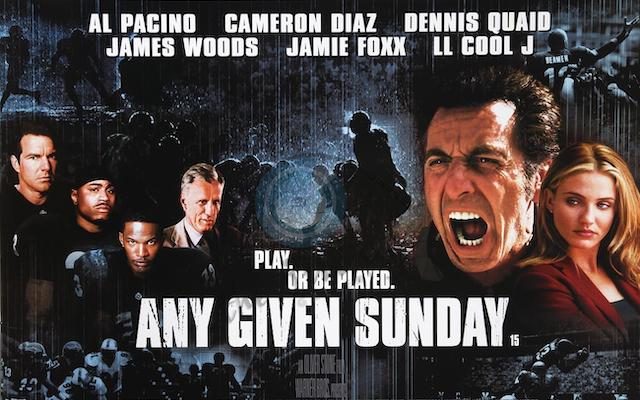
With Any Given Sunday, Oliver Stone set out to make the ultimate football movie and he succeeded.
Any Given Sunday is not just the story of aging coach Tony D’Amato (Al Pacino). It’s also the story of how third-string quarterback Willie Beamon (Jamie Foxx) allows celebrity to go to his head while the injured starter, Cap Rooney (Dennis Quaid), deals with his own mortality and how, at 38, he is now over-the-hill. It’s also about how the team doctors (represented by James Woods and Matthew Modine) are complicit in pushing the players beyond their limits and how the owners (Cameron Diaz) view those players as a commodity to be traded and toyed with. It’s about how the Sharks represent their home city of Miami and how cynical columnists (John C. McGinley plays a character that is obviously meant to be Jim Rome) deliberately set out to inflame the anger of the team’s fans. It’s about how politicians (Clifton Davis plays Miami’s mayor and asks everyone to “give me some love”) use professional sports to further their own corrupt careers while the often immature men who play the game are elevated into role models by the press. It’s a film that compares football players to ancient gladiators while also showing how the game has become big business. In typical Oliver Stone fashion, it tries to take on every aspect of football while also saying something about America as well.
In the role on Tony D, Pacino famously describes football as being “a game of inches” but you wouldn’t always know it from the way that Oliver Stone directs Any Given Sunday. As a director, Stone has never been one to only gain an inch when he could instead grab an entire mile. (Stone is probably the type of Madden player who attempts to have his quarterback go back and throw a hail mary on every single play.) Tony tells his players to be methodical but Stone directs in a fashion that is sloppy, self-indulgent, and always entertaining to watch. One minute, Al Pacino and Jim Brown are talking about how much the game has changed and the next minute, LL Cool J is doing cocaine off of a groupie’s breast while images of turn-of-the-century football players flash on the screen. No sooner has Jamie Foxx delivered an impassioned speech about the lack of black coaches in the league then he’s suddenly starring in his own music video and singing about how “Steamin’ Willie Beamon” leaves all the ladies “creamin’.” (It rhymes, that’s the important thing.) When Tony invites Willie over to his house, scenes of Charlton Heston in Ben-Hur are on TV. Later in the movie, Heston shows up as the Commissioner and says, about Cameron Diaz, “she would eat her young.”
Any Given Sunday is Oliver Stone at both his best and his worst. The script is overwritten and overstuffed with every possible sports cliché but the football scenes are some of the most exciting that have ever been filmed. Only Oliver Stone could get away with both opening the film with a quote from Vince Lombardi and then having a player literally lose an eye during the big game. Stone himself appears in the commentator’s both, saying, “I think he may have hurt his eye,” while the doctor’s in the end zone scoop up the the torn out eyeball and put it into a plastic bag. Only Stone could get away with Jamie Foxx vomiting on the field during every game and then making amazing plays while a combination of rap, heavy metal, and techno roars in the background. Stone regulars like James Woods and John C. McGinely make valuable appearances and while Woods may be playing a villain, he’s the only person in the film willing to call out the coaches, the players, the owners, and the fans at home as being a bunch of hypocrites. Stone’s direction is as hyper-kinetic as always but he still has no fear of stopping the action so that Foxx can see sepia-toned images of football’s past staring at him from the stands. Stone directs like defensive lineman on steroids, barreling his way through every obstacle to take down his target. No matter what, the game goes on.
Any Given Sunday is the ultimate football movie and more fun than the last ten super bowls combined.

The Art Directors Guild have announced their picks for the best of 2019!
And here they are:
NOMINEES FOR EXCELLENCE IN PRODUCTION DESIGN FOR FILM
PERIOD FILM
Ford v Ferrari, Production Designer: François Audouy
The Irishman, Production Designer: Bob Shaw
Jojo Rabbit, Production Designer: Ra Vincent
Joker, Production Designer: Mark Friedberg
1917, Production Designer: Dennis Gassner
WINNER – Once Upon a Time… in Hollywood, Production Designer: Barbara Ling
FANTASY FILM
Ad Astra, Production Designer: Kevin Thompson
Aladdin, Production Designer: Gemma Jackson
WINNER – Avengers: Endgame, Production Designer: Charles Wood
Dumbo, Production Designer: Rick Heinrichs
Maleficent: Mistress of Evil, Production Designer: Patrick Tatopoulos
Star Wars: The Rise of Skywalker, Production Designers: Rick Carter, Kevin Jenkins
CONTEMPORARY FILM
A Beautiful Day in the Neighborhood, Production Designer: Jade Healy
John Wick: Chapter 3 – Parabellum, Production Designer: Kevin Kavanaugh
Knives Out, Production Designer: David Crank
WINNER – Parasite, Production Designer: Lee Ha-Jun
Us, Production Designer: Ruth De Jong
ANIMATED FILM
Abominable, Production Designer: Max Boas
Frozen II, Production Designer: Michael Giaimo
How To Train Your Dragon: The Hidden World, Production Designer: Pierre-Olivier Vincent
The Lion King, Production Designer: James Chinlund
WINNER – Toy Story 4, Production Designer: Bob Pauley
NOMINEES FOR EXCELLENCE IN PRODUCTION DESIGN FOR TELEVISION
ONE-HOUR PERIOD OR FANTASY SINGLE-CAMERA SERIES
A Series of Unfortunate Events: “Penultimate Peril: Part 1,” Production Designer: Bo Welch
The Crown: “Aberfan,” Production Designer: Martin Childs
Game of Thrones: “The Bells,” Production Designer: Deborah Riley
The Mandalorian: “Chapter One,” Production Designer: Andrew L. Jones
WINNER – The Marvelous Mrs. Maisel: “Ep. 305, Ep. 308,” Production Designer: Bill Groom
ONE-HOUR CONTEMPORARY SINGLE-CAMERA SERIES
Big Little Lies: “What Have They Done?” “The Bad Mother,” “I Want to Know,” Production Designer: John Paino
The Boys: “The Female of the Species,” Production Designer: Dave Blass
Euphoria: “The Trials and Tribulations of Trying to Pee While Depressed,” “And Salt the Earth Behind You,” Production Designer: Kay Lee
The Handmaid’s Tale: “Mayday,” Production Designer: Elizabeth Williams
WINNER – The Umbrella Academy: “We Only See Each Other at Weddings and Funerals,” Production Designer: Mark Worthington
TELEVISION MOVIE OR LIMITED SERIES
Black Mirror: “Striking Vipers,” Production Designer: Anne Beauchamp
Catch-22, Production Designer: David Gropman
WINNER – Chernobyl, Production Designer: Luke Hull
Deadwood: The Movie, Production Designer: Maria Caso
Fosse/Verdon, Production Designer: Alex DiGerlando
HALF HOUR SINGLE-CAMERA SERIES
Barry: “ronny/lily,” Production Designer: Tyler B. Robinson
Fleabag: “Ep. 5,” Production Designer: Jonathan Paul Green
GLOW: “Up, Up, Up,” Production Designer: Todd Fjelsted
The Good Place: “Employee of the Bearimy,” “Help Is Other People,” Production Designer: Ian Phillips
WINNER – Russian Doll: “Nothing in This World is Easy,” Production Designer: Michael Bricker
MULTI-CAMERA SERIES
WINNER – The Big Bang Theory: “The Stockholm Syndrome,” “The Conference
Valuation,” “The Propagation Proposition,” Production Designer: John Shaffner
The Cool Kids: “Vegas, Baby!,” Production Designer: Stephan Olson
Family Reunion: “Remember Black Elvis?,” Production Designer: Aiyanna Trotter
No Good Nick: “The Italian Job,” Production Designer: Kristan Andrews
Will & Grace: “Family, Trip,” “The Things We Do for Love,” “Conscious
Coupling,” Production Designer: Glenda Rovello
SHORT FORMAT: WEB SERIES, MUSIC VIDEO OR COMMERCIAL
Apple: “It’s Tough Out There,” Production Designer: Quito Cooksey
Ariana Grande, Miley Cyrus, Lana Del Rey: “Don’t Call Me Angel,” Production Designer: Emma Fairley
WINNER – MedMen: “The New Normal,” Production Designer: James Chinlund
Portal for Facebook: “A Very Muppet Portal Launch,” Production Designer: Alex DiGerlando
Taylor Swift: “Lover,” Production Designer: Kurt Gefke
VARIETY, REALITY OR EVENT SPECIAL
WINNER – Drunk History: “Are You Afraid of the Drunk?,” Production Designer: Monica Sotto
91st Oscars, Production Designer: David Korins
Rent: Live, Production Designer: Jason Sherwood
Saturday Night Live: “1764 Emma Stone,” “1762 Sandra Oh,” “1760 John Mulaney,” Production Designers: Keith Raywood, Akira Yoshimura, Joe DeTullio, Eugene Lee
Taylor Swift Reputation Stadium Tour, Production Designers: Tamlyn Wright, Baz Halpin

 Through the Shattered Lens