My Week With Marilyn is apparently based on a true story.
We know this because the film not only uses the opening title card to tell us that the story is true but the movie itself is narrated by Colin Clark (played by Eddie Redmayne) and Colin tells us pretty much the same thing, over and over again. (Seriously, this film reminded me of why I usually don’t care much for first person narration.) Anyway, the film takes place in the late 1957. Colin is the 3rd Assistant Director, working with Laurence Olivier (a haughty and pompous yet oddly touching performance from Kenneth Branagh) on a film called The Prince and the Showgirl. The film stars Marilyn Monroe (Michelle Williams) who quickly starts to annoy Olivier when it becomes obvious that she’s painfully insecure, self-destructive, and dominated by her agent, acting coach, and cold husband. Colin, however, is smitten with Marilyn and, despite the ominous warnings delivered by everyone else in the film, he soon finds himself falling in love with her and giving this film a title by spending a week with Marilyn.
My Week With Marilyn has been getting a lot of attention lately because many Oscar watchers are expecting to see Michelle Williams receive a Best Actress nomination for her performance as Marilyn Monroe. Lately, Kenneth Branagh has become something of a dark horse for a best supporting actor nomination and personally, I would say that Julia Ormond (as a paranoid Vivien Leigh) and Judi Dench (as a supportive actress) both deserve some consideration as well.
The film is ultimately dominated by Michelle Williams and it works whenever she’s on-screen. (And, unfortunately, it pretty much falls apart whenever she’s not.) Williams has the daunting job of playing an icon here and she manages to be both believable as an icon and as a very fragile and poignant human being. The script, to be honest, doesn’t give her much help. As written, Marilyn is alternatively presented as being a helpless damsel in need of a white knight, a calculating seductress who threatens to lead Colin off of the straight and narrow path (represented here by Emma Watson as the girl that Colin treats quite badly) and a convenient symbol of a lost age. The brilliance of Michelle Williams is in how she manages to use these three conflicting characterizations to create one very believable Marilyn Monroe.
The main problem with this film is that it’s not called Marilyn. Instead, it’s My Week With Marilyn and, as a result, the film is actually about the male gaze of the “My” of the title. As good a performance as Williams gives, it’s hard to avoid the fact that, as far as this film is concerned, Marilyn ultimately exists just to teach Colin a few life lessons. Unfortunately, as a character, Colin Clark is so thinly written that he’s never all that compelling and, as the film progresses, it’s hard not to feel that he’s ultimately using Marilyn just as surely as everyone else is.
(In all honestly, however, I have to admit that one of my issues with Colin is that he’s played by Eddie Redmayne. Don’t get me wrong, Redmayne is a good actor and he manages to make Colin almost likable but I simply cannot look at him without flashing back to Redmayne’s performance in Savage Grace. That’s the movie where he plays a schizophrenic who has an incestuous relationship with his mother (Julianne Moore) before murdering her. Redmayne was so effectively creepy in that film that, as unprofessional as it may be for a film critic, I had a hard time accepting him in the role of white knight.)
I’ve read a lot of reviews that have complained that this film is basically just a big budget Lifetime Movie and, in many ways, it is. Director Simon Curtis is a veteran of television and the film has the crisp but flat look of a tv show. But even more than just the cinematography, My Week With Marilyn feels like a TV movie because its script hesitates to raise any issues that can’t be resolved in two hours. That said, it’s really not sordid or silly enough to be a great Lifetime movie and it’s far too well acted to be a waste-of-time. Ultimately, this is a flawed film that deserves to be seen for its performances. If only the entire film was as compelling and interesting as the performances of Kenneth Branagh, Julia Ormond, and especially Michelle Williams.
One thing about Oscar Season is that you have so many different groups of people tossing around so many different awards that occasionally, you’ll miss a few. The nominations for the Satellite Awards were announced last Friday but I missed them, largely because nobody really seems to care about the Satellite Awards. Well, almost nobody. I care about them because — even when they were known as the Golden Satellites — the Satellite Awards are consistently more interesting than the more mainstream awards. (For instance, last year, the Satellite Awards had the guts to honor the one and only true girl with the dragon tattoo, Noomi Rapace.)
Best Picture
The Artist
The Descendants
Drive
The Help
Hugo
Midnight in Paris
Moneyball
Shame
Tinker, Tailor, Soldier, Spy
War Horse
What? No love for David Fincher’s rip-off of TheGirl With The Dragon Tattoo? The AwardsDaily folks must be throwing a fit. (They’ve been promoting Fincher’s rehash with the same enthusiasm that they attempted to promote Nine two years ago.)
Best Actor
George Clooney in The Descendants
Leonardo DiCaprio in J. Edgar
Michael Fassbender in Shame
Brendan Gleeson in The Guard
Ryan Gosling in Drive
Tom Hardy in The Warrior
Woody Harrelson in Rampart
Gary Oldman in Tinker, Tailor, Soldier, Spy
Brad Pitt in Moneyball
Michael Shannon in Take Shelter
It’s nice to see Brendan Gleeson get some love. It’s also interesting to note that Michael Shannon’s performance in Take Shelter has been getting a lot of recognition. Count me among those who hopes that Shannon gets, at the very least, a nomination for giving a great performance in a horror film.
Best Actress
Glenn Close for Albert Nobbs
Olivia Colman in Tryannasour
Viola Davis for The Help
Vera Farmiga in Higher Ground
Elizabeth Olsen in Martha Marcy May Marlene
Meryl Streep in The Iron Lady
Charlize Theron in Young Adult
Emily Watson in Oarnges and Sunshine
Michelle Williams in My Week With Marilyn
Michelle Yeoh in The Lady
Much as the Satellites recognized the work of Noomi Rapace last year, this year they continue to at least nominate some great performances that are being ignored by the mainstream. In a perfect world, both Verma Farmiga and Higher Ground would be major contenders.
Best Supporting Actor
Kenneth Branagh in My Week With Marilyn
Albert Brooks in Drive
Colin Farrell in Horrible Bosses
Jonah Hill in Moneyball
Viggo Mortensen in A Dangerous Method
Nick Nolte in Warrior
Christopher Plummer in Beginners
Andy Serkis for Rise of the Planet of the Apes
Christoph Waltz in Carnage
Hugo Weaving in Oranges and Sunshine
Wouldn’t it be cool if Andy Serkis actually got an Oscar nomination? It’s also nice to see Jonah Hill finally getting some recognition for Moneyball. Brad Pitt has been honored largely for playing Brad Pitt in that film. Hill actually gave a performance.
Best Supporting Actress
Jessica Chastain in The Tree of Life
Elle Fanning in Super 8
Lisa Feret in Mozart’s Sister
Judy Greer in The Descendants
Rachel McAdams in Midnight in Paris
Janet McTeer in Albert Nobbs
Carey Mulligan in Shame
Vanessa Redgrave in Coriolanus
Octavia Spencer in The Help
Kate Winslet in Carnage
I haven’t seen Shame yet but Carey Mulligan is one of my favorite actresses and she deserved an Oscar for her performance in An Education. It’s also nice to see Judy Greer getting some recognition for giving one of the few performances in The Descendants that’s actually going to pass the test of time.
Very rarely does a film so bleak, so prone to trample over its characters until they might not come back up, manage to avoid the usual melodrama and clichés we have come to expect and instead stay an honest, unflinching and powerful glimpse of two individuals, one too hard and the other too soft for the world, just trying to make it through the day. Peter Mullan gives one of the year’s most destructive and powerful performances as Joseph, a widower who spends his time drinking, picking fights and experiencing bouts of anger that tends to come crashing down into paralyzing moments of regret. We understand he wants better for himself and could use a bit of redemption but it isn’t an easy thing to achieve. However, he does find some solace in Hannah played by Olivia Colman who also gives one of the year’s most devastating performances as a thrift store owner and born again Christian. Joseph feels drawn to her glow and the sort of warmth he has been looking for. Sadly she isn’t who she seems because behind her smile is immense pain for she lives with an abusive husband who beats her. Hannah had hoped religion could be her savior but when that didn’t work she turned to alcohol. At times Hannah and Joseph can seem total opposites but yet exactly the same. As we watch their relationship develop there are brief moments of hope and even a few laughs, but for me even they are incredibly emotional and at times almost moved me to tears. Considine’s exploration into violence and rage is so gut wrenching and brutally honest that when good things happen you are glad but also very cautious because moods could change without warning and this fine line they walk is hard to watch.
At the center of it all is Joseph’s anger which comes from a place many films rarely explore unless the main character is a villain, and maybe under other circumstances or a different life he would be. But here he is just your “Average Joe” whose fury isn’t brought on by some terrible event or the result of any wrong doing, it is just his nature. He was born with a fire inside. It caused him to be mean and abusive to his wife, it causes him to rough up kids at a pub, and throw a rock through the front window of a shop. The best Joseph can do is try to control this rage and when it gets the best of him, like in the film’s opening when in a fit he kicks his dog’s ribs in, he shows what little kindness he can by carrying it home, being by its side as it dies and then burying it in the back yard. In any other film is would be impossible to expect the audience to forgive such an act, but Considine understands that. You see he isn’t asking for forgiveness but just hoping to reach an understanding with the viewer. As terrible as Joseph’s actions may be at the time the idea that it is his nature, something he can’t control which is destroying him, and the fact that he tries his best to do good evens out the scales just enough for us to have faith in him.
The most important of these attempts to adjust comes with helping Hannah who he tries to protect even though everything about him says otherwise. This leads to the film’s most shocking moment in which he discovers a truth about her, and perhaps about himself and every human, that rattles him to the core. This truth being that even the most glowing and kind of people are capable of unthinkable violence and rage. Now this might seem to be a totally bleak assessment on life, and maybe it is, but Considine doesn’t allow it to prevail without putting up a fight. Instead he tries to make us and Joseph realize that the best you can do is battle through it all and although you will not always find redemption at least maybe a bit of peace and happiness can be earned, which might mean sacrificing yourself.
I really have to hand it to Paddy Considine who most know from his acting in such films as “Deadman’s Shoes” or “In America”. For this to be his first feature is quite impressive. He shows a level of maturity and confidence you would only expect from a veteran director. This could have easily become a preachy or overly stylized independent film that drowned in its own melodramatic miserablism but instead Considine wasn’t afraid to be dark, gritty and realistic and stay true to his characters, caring for them and their emotions in a way that didn’t feel artificial, and making a real connection with the audience. To say it is an easy watch would be a lie but its profoundness in its exploration of violence and anger along with two of the year’s best performances make it a must watch and one of my favorite films of the year.
“Harry Potter is about confronting fears, finding inner strength and doing what is right in the face of adversity. Twilight is about how important it is to have a boyfriend.” – Stephen King
I have a problem with the notion that says you have to have someone in your life in order for your life to be considered perfect or grand. I’m of the mind that you step into the world alone and leave it the same same way. Even if you are surrounded by your nearest and dearest friends when you pass, you’re still the only one making that trip. And while I love the notion of Romance, I don’t believe it needs to translate to “Omigod, if you’re not near me, I’m going to jump off this building, I swear it because I can’t talk about you without stammering.” or the other obsessive notions that Twilight seems to bring up. This doesn’t mean I outright hate everything that Twilight is, but I’m not totally fond of the overall message it conveys. Perhaps I’m just emotionally cold that way.
And yet, I may know more about Twilight than any other guy in the known universe. It’s an enigma, I know.
A little background on why I, a guy, am writing a review for The Twilight Saga: Breaking Dawn, which is pretty much geared for girls. Note that I’ll refer to the film just as Breaking Dawn, because I really don’t see Twilight as a Saga by any means.
In the early 90’s, I hit a “Vampire Phase”. Between playing games of Vampire: The Masquerade and reading every Vampire Chronicle novel that Anne Rice wrote up until Tale of the Body Thief, I was pretty involved. I grew up with Vampires that were monsters to be feared (and sometimes admired), and dodged the sun more or less. I even owned two vampire encyclopedias. Somewhere between Mark Danielewski’s “House of Leaves” (a book I still haven’t finished) and Andrew Davidson’s “The Gargoyle”, I picked up a hardcover copy of Stephenie Meyer’s “Twilight” from Barnes & Noble. I didn’t think much of the books, save that they were quick reads. Meyer and her vampires were far from Rice and her universe lacked the erotic flair of Laurell K. Hamilton’s earlier books in the Anita Blake series. They were more or less books for teens, but they had vampires in them, so I pretty much inhaled all four books (Twilight, New Moon, Eclipse, and Breaking Dawn) twice in Hardcover. I even went so far to read Meyer’s “The Host” and have seen all of the other Twilight films in the theatre. While they all seem to be really close to the source material, there’s something strange in the translation. What made sense on paper really didn’t on screen (Sparkling Vampires jump to mind), but I guess that’s for an Editorial.
So, when it came to reviewing Breaking Dawn, we at the Shattered Lens drew straws. While we hold to the tenet that any movie can be reviewed by anyone even if the movie was previously reviewed by anyone else (for alternate viewpoints), this was a film that was pretty much off our collective radars. I think we all secretly wanted Lisa or Erin to take it, but both Lisa and my cousin gave the argument that I could probably give a different perspective on the film than all of the girls who planned to see it, most of whom would sprout something like the following:
“I love Edward so much, and that he took his time with Bella was just so heartfelt that I wanted to cry. I felt so bad for Jacob that he could haven’t have her. He deserves better than that!! If anyone doesn’t like what I’m saying, then I will come to their houses and stab them with rusty blades in their beds because no one – I mean no one – gets in the way of my Twilight Love!! You haters could suck it! Team Edward/Jacob Forever!!!!”
So, here I am, writing this. Let’s see what becomes of it, shall we?
For those of you who managed to avoid the Twilight books and movies like they were Sutter Cane novels, here’s everything you’ll ever need to know.
Twilight is the story of Isabella Swan (Kristen Stewart) who moves from Arizona (where Meyer lives) to Forks, Washington to live with her Sheriff father, Charlie (Billy Burke). While in school, she meets an interesting but strange fellow in Edward Cullen (Robert Pattinson). After being saved from a near fatal car crash in an impossible fashion by Edward, Bella becomes intrigued with who and what he may be. A little big of Googling and book buying leads her to discover that Edward is in fact, a Vampire. He explains he’s dangerous. She doesn’t care. He states he’s a killing machine. She loves the danger. He steps into the sunlight to show he doesn’t burn, he just sparkles. She’s just mesmerized.
The original Twilight was Bella’s introduction to The Cullens (who are more or less Vegetarians in that they don’t go after humans, but animals instead):
Carlyle (Peter Facinelli) – Father figure and Doctor. He recruited the rest of the family.
Esmee (Elizabeth Reaser) – Carlyle’s Wife and Mother Figure.
Emmett (Kellan Lutz) – The Muscle of the Family and companion to Rosalie.
Rosalie (Nikki Reed) – Emmett’s Companion and is pretty much opposed to Bella up until Breaking Dawn, for reasons she explains in Eclipse.
Alice (Ashley Greene) – Companion to Jasper and has the ability to see the decisions that others make before they make them.
Jasper (Jackson Rathbone) -The newest vampire of the group and companion to Alice. Has the ability to manipulate the emotional tides of others.
In Twilight, Bella and the Family run into a trio of vampires, one of which decides he has to hunt down and kill Bella (because she’s food). The family is able to kill the vampire and get on with their undead lives, not before a final parting shot showing the vampire’s girlfriend and her desire to kill Bella in return. Bella decides it’s in her best interests to become a vampire and tries to persuade Edward to change her, but he refuses, citing she has many years ahead of her worth living.
In New Moon, Edward decides to celebrate Bella’s birthday at his place. After an accident occurs that leaves her bleeding, Jasper loses it and attacks her. The family is able to save her, but this convinces Edward that it just won’t work out and the entire family leaves town. Left on her own, Bella spends the next four months crying and screaming in her sleep over Edward until her father convinces her to hang out with her friends. She ends up spending more time with Jacob Black (Taylor Lautner), a friend who lives on a nearby reservation that clued her into what the Cullens really were. They get closer as friends and eventually, she discovers that Jacob and his family are actually Werewolves. While cool, she also learns that the Werewolves don’t get along with Vampires and despise the Cullens. They haven’t killed the vampires because of a Treaty that was enacted long ago. Werewolves stay on their side, Cullens on the other and no humans get hurt. Victoria (the girlfriend of that dead vampire in Twilight) returns to town to kill Bella, but she’s protected by the Wolves. She ends up doing a little cliff diving, which catches Alice’s attention and she manages to reunite with the family, though learns that Edward plans to kill himself. Edward believes she died when she jumped off the cliff, volunteering himself to death by the Vampire Congress known as the Volturri.
Alice and Bella fly to Italy and intercede, rescuing Edward from his fate and meeting the Volturri. As Bella knows too much, the Volturri leader demands that within a year she has to becomes a vampire. This of course, excites Bella and annoys Edward, who throws in a “Let’s get Married First” clause into the works. The idea of this is to help give closure to all the humans in Bella’s life. She reluctantly agrees to it. Jacob catches wind of this and spends the next book & film, Eclipse, trying to convince Bella that she should live and that he’s the better choice of a love interest.
Okay, Eclipse. Victoria knows that she can’t get to Bella on her own without dealing with both the Werewolves and the Vampires. She finds a resident of Forks in Seattle named Riley Biers and changes him to a Vampire, convincing him that the Cullens are bad and killed her friend. He builds an army and they attack the Cullens en masse, but somewhere along the line, Victoria forgot to mention there may be giant dogs in the area. The Cullens and Werewolves join forces and defeat the newborns with ease. In the process, Bella learns more about the Wolves and their ability to “Imprint”, meaning they basically obsess over one person for the rest of their lives (much like whales, I suppose). Luckily, Jacob hasn’t Imprinted on Bella yet. Edward eventually dispatches Riley and Victoria, leaving the romance to continue. In Eclipse, the Cullens explain to Bella how they came to be, partially to help her what she has to look forward to, positive or negative.
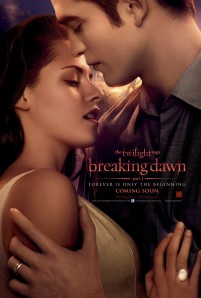
And all that brings us to Breaking Dawn, Part I.
Of the Twilight movies, I still feel Eclipse was the strongest one. Breaking Dawn covers everything the 1st half of the book does and manages to do it without stepping past the PG-13 bounds it created. The film starts off with Edward and Bella’s Wedding, with different reactions from everyone. Jacob hates it, wolfs out and runs to Canada. The Cullens are ecstatic. Charlie manages to deal with it. The wedding ceremony is done well, and gives some screen time to all of the high school friends (who we won’t be seeing after the wedding). Stephenie Meyer herself even has a cameo here (and eerily looks like my mother). Even the honeymoon is done better than I thought it would. Anyone expecting Bella and Edward’s honeymoon to look like something out of a late night Cinemax series may be disappointed, but the romance is nice to see and there were some laughs in the audience. Again, it’s Twilight. I’m not expecting Jane Eyre or Sense & Sensibility romance levels. At least, that’s what the snoring mother sitting next to me who brought her kids felt, I think.
After the married couple’s wild honeymoon, Bella discovers she’s miraculously pregnant and even worse, the unborn child is sucking the very life from her. The wolves find out about this and feel that she needs to be eliminated, along with the rest of the Cullens, as it breaks the Treaty. Bella is rushed home while the Cullens try to find a way to save both the baby and the mother. Will Bella make it? Will the Wolves pounce on the vampires? Those are some of the questions brought to the table.
Jacob finds himself taking sides with the Cullens, which causes him to recall his Alpha Status in his wolf pack and stand alone (or nearly alone) against his family. In the book, this was done pretty well, but translated to the screen the scene with wolves telepathically yelling at one another seemed a little cartoonish. Just change back to people and talk it over. I guess it was done that way to show how animals have the whole Alpha / Omega relationship, and remains one embarrassing moment in a sea of scenes that were okay.
Visually, Eclipse was a serious step up from both Twilight and New Moon. Breaking Dawn seemingly returns to the look and feel of the original Twilight, right down to Carter Burwell’s score. With the exception of the Bella’s Lullaby theme (which worked incredibly well, especially at the last two minutes of the film), the music felt a little weak to me. I actually preferred Howard Shore’s score to Eclipse. Don’t get me wrong, the movie goes where it’s supposed to, but you’d expect things to look a little better as it goes along. It would be nice if they improved on that.
One other thing I’ll give this (and that’s all of the Twilight mess) is the audience. I live for seeing audiences react to what they’re seeing on the screen, and I can’t remember a more reactive audience set since Captain America. Some of the girls who go to see this really go wild over it, and some of the guys grumble loudly. My theatre was packed, right down to the front seats where you have to crane your neck up to see everything. It’s the closest to a Midnight Movie experience you could have at a Matinee.
The big problem Breaking Dawn Part II will have will be trying to be exciting, because there isn’t a lot that occurs in the second half of the story that’s worthy of stretching it out to nearly two hours. It’ll be interesting to see what they do with that.
Overall, Breaking Dawn doesn’t really break any new ground in Vampire myths or anything like that. For anyone unfamiliar with the Twilight movies or books, it may feel slow and even a little boring at times. For it’s target audience (readers of the book), it gives them just about everything they wanted.
I noticed that Lisa had posted a quick review about this, but I saw it recently and have been wanting to review it because it was something I connected with and really wanted to share my opinion.
I honestly cannot think of another film I have seen this year that I found as charming and heartfelt as ‘Beginners’ which stars Ewan McGregor as Oliver, a middle aged man who has just lost his father Hal to lung cancer. Oliver reveals to us, through narration, that after the death of his mother a few years back his father came out, having been gay throughout the 40 plus years of his marriage. Oliver’s life following his father’s passing is a lonely one that often leads to him talking to Arthur, his father’s dog. One night at a party he meets a beautiful actress named Anna. The two hit it off quickly and the rest of the film follows the development of their relationship, set among flashbacks of Oliver’s parents and his father’s new life as a gay man in the years before his death. Through these memories we get a better understanding, as to why Oliver has been alone, and why his time with Anna may be short lived; he has had 4 relationships in the past, but left them all. The result is a film about being open and honest, and finding love and happiness through from it.
This idea of being honest was difficult for Oliver because of his parents. Their hollow marriage cast a shadow on his view of love. Wanting to avoid what they had created, this constant uncertainty and sadness caused him to think love was doomed and so he would break relationships off in fear of what he thought was their inevitable conclusion.
Luckily Oliver is able to find inspiration in his father who was able to be open and honest in the final months of his life. Through the memories of Hal, Oliver is able to take those steps towards true joy. One reason being that when he found out his father was gay it finally dawned on him why his parents’ marriage seemed so empty. It wasn’t genuine and so not a good example of how things really are. Which brings up another important theme, that being change and starting over.
The title ‘Beginners’ refers to both Oliver and Hal being at the beginning of their new respective lives. Anna points out towards the end of the film, after reading a funny but sweet personal ad Hal had made, that Oliver’s father “Didn’t give up”. Even facing death, in his 70’s, Hal wanted to be happy and be himself by embracing his sexuality. It is in remembering these moments, seeing how happy his father was, that Oliver is able to look forward in a positive light, with a new perspective on love and an understanding of why his mother was always so sad. Oliver too has a new beginning and like Hal can now be open and embrace his love for Anna.
What held this whole story together for me were the characters, and more importantly the chemistry between them. I felt the dynamic between Anna and Oliver, the feelings and time they shared was incredibly sweet. Upon first seeing him Anna instantly recognized Oliver’s sadness. She too felt alone, having spent most of the past few years going from one hotel room to another. It is the sort of relationship in which the one thing that makes the love between them so poignant is that they can save each other, filling the voids in each other’s hearts. This makes it harder to watch as Oliver’s misconceptions on love cause a divide between them. At the beginner Oliver worries, like he did in his previous relationships, where this one is heading. He fears Anna will become his mother, unhappy and bitter. But when Oliver does change, and get her back, the result is an incredibly sweet ending.
All of this is done with a collection of small, genuine and heartfelt moments that build upon one another to form something much greater. On top of that were three wonderful performances. Christopher Plummer was so lovable as Hal, and clearly had a lot of fun with the character. Melanie Laurent was mesmerizing and sweet, she is so beautiful and easy to fall for. Ewan McGregor was also fantastic, and the real stand out here, carrying a great deal of pain adding depth to his performance in a way I’ve rarely seen him do. The structure and visual devices also worked incredibly well, helping to give it a unique feel. I really loved the use of photographs, montages to the 50’s and how it handled the history of the gay rights movement. The music was also lovely and fit the tone perfectly. It is a score that I’ve listened to a few times since watching the film.
Honestly, it had me smiling from start to finish. It just had this emotional resonance that clicked for me in a way that can hardly be explained. I ended up watching it two nights in a row just because I loved it so much the first time and I just wanted to watch the characters again soon after. It saddens me that so few people seemed to have seen it. I can easily say that ‘Beginners’ is a charming, smart, funny, sentimental and quirky film, one of my new favorites and I loved every single moment of it.
‘Hugo’ is not only an old fashion and heartfelt adventure with enough whimsy and fun for all ages; but also a love letter to cinema, by one of this generation’s masters, and a plea to support film preservation.
Most of the credit for the its success has to be given to Martin Scorsese, who in an attempt to tell the story about the value of art and the dream like and important nature of films, managed to not only capture the magic of moving pictures but in doing so make one just as magical and beautiful as those he admires. The story follows a young boy named Hugo Cabret (Asa Butterfield). He lives among the gears and machinery within the walls of a grand train station in Paris where he keeps the clocks in working order. He is alone in this task and spends most of his free time trying to fix an automaton that his father found rusting away in a museum, and attempted to fix before he tragically died in a fire. With his father dead he was sent to work in the station with his uncle, a drunk who has gone missing leaving Hugo to live alone, stealing food from the shops to survive and avoid the orphanage. One morning Hugo gets in trouble with the owner, George Melies (Ben Kingsley), of a toy shop located within the station. Hugo had been stealing small trinkets for parts so he could use them in fixing the automaton, which he believes contains a message left to him by his father. The shop’s owner forces Hugo to hand over the stolen trinkets along with a notebook detailing the machine he was trying to fix. Oddly his drawings cause Melies to get emotional and he takes it. In an attempt to get it back, Hugo ends up getting help from the shop owner’s goddaughter, Isabelle (Chloe Moretzs), who is a lover of books and desperate for some kind of adventure. Together they try to unravel the mystery behind her godfather’s reaction to the notebook and the automaton’s message. It is a slow moving, but richly detailed journey that leads to them discovering George Melies’s sad past, which has important ties to the history of film.
Scorsese’s love for cinema is front and center here. Hugo’s loneliness mirrors his own. Scorsese suffered from asthma growing up and wasn’t allowed to play with other children. Like Hugo, Scorsese looked to machines and cameras to occupy his time, turning to art and film to express himself. Hugo’s automaton, a machine like a camera, which played a key part in Melies’s life, only works with a heart shaped key. It is no coincidence that the heart, love and a sense of wonder are the key to creating art and opening one’s imagination. Scorsese, perhaps more than most directors around today, understands the importance of film, especially for younger audiences and in a way this definitely seems like an attempt to get children to appreciate the medium as much as he did years ago.
My favorite aspect of the ‘Hugo’ would be the world created. It is fleshed out fairly well, with many supporting characters given a good deal of attention. The most important being the station inspector played by Sacha Baron Cohen who when he isn’t out trying to catch potential orphans, is trying to woo a beautiful florist, played by Emily Mortimer. It reminded me of ‘Amelie’ in a way, which I guess also had a lot to do with the tone and setting.
The stuff about Melies is incredible and as informative as it is disheartening. The man was one of the early pioneers of films. One of the first to truly understand its capabilities to enchant the audience with dream like settings. Learning the history of his career, how after making over 500 films he was forced to destroy most of them and his old sets when the popularity of his work dropped after the Great War, is tragic. Luckily for us some of his films survived, like “A Trip to the Moon” which is a highly recognizable and frequently referenced short.
The direction, the long shots in particular, are breathtaking. The opening is one of the year’s best and most spectacular scenes. It is arguably Scorsese’s most beautiful film. The fantastical portrayal of Paris is enhanced by 3D that is utilized better than anything I have seen. The use of depth, especially in scenes towards the end in which some of Melies films are recreated in flashbacks is stunning. For once it doesn’t feel like a gimmick. The score is also beautiful and luckily not overwhelming. It is one that is there but not noticeable because it fits the atmosphere of the story so well. Honestly, everything about ‘Hugo’ feels like one complete and perfect work of art, created with a great deal of passion. The only complaint I’ve really heard is that it is too slow at times. Personally I highly disagree with this. Even at its slowest points it is still totally mesmerizing because this isn’t just a love letter to film, or just a historical depiction of the life of one of its most important innovators, it is also a heartfelt story. It earns its emotions and nothing fells forced, and it does this by taking its time, to flesh out its characters and plot.
Lastly, the performances all around are wonderful. Butterfield gives Hugo a great deal of emotion and depth, as well as the level of maturity needed for the character. Ben Kingsley is absolutely magnificent as George Melies. He makes him a clearly sad man, with a long history that troubles him deeply. Chloe Moretz is also great, doing a surprisingly good English accent, and makes the character easily loveable and fun. Even Sacha Baron Cohen, who toned it down, brings his character to life in an almost classically funny way.
Overall to say I loved the film would not do my feelings for it justice. It is so exceptionally crafted, so fun and smart, and most of all it captivated me like few other films have in recent years. It truly is a magical experience, a must see and one of Scorsese’s best.
Hi out there! Did everyone have a good Thanksgiving? I know I did. Now, I know that some people will say that this has been a disappointing year in entertainment. Steve Carrell left the Office, Whitney Cummings got a sitcom, and — while I’ve truly loved a handful of films this year, it’s hard to ignore the fact that 2011 has yet to produce anything close to a Black Swan, A King’s Speech, or even a Social Network. Instead, the best films of the year have been ignored by both audiences and critics while good but definitely flawed films like J. Edgar are being touted as being the best was can hope for. Even Pixar failed to tug at our heart-strings this year.
However, I think we’re running the danger of giving too quickly into negativity when it comes to considering 2011. No, 2011 is no 2010. But there’s still a lot to be thankful for and below are just 10 examples of some things that, as 2011 reaches its conclusion, I’m thankful for.
10) This.
9) The time I have left with Community.
With The Office current flailing about in its attempts to establish a consistent post-Carrell identity, I have a new favorite sitcom and its name is Community. Now in its third season, Community has truly hit its stride and Joel McHale is, of course, to die for. So, naturally, Community has been yanked from the mid-season schedule while NBC continues to heavily promote shows like Whitney. This is indeed the darkest timeline but I know that I will continue to tweet things like #savecommunity, #6seasonsandamovie, and #NBCSucks for as long as it takes.
8 ) A second season of Game of Thrones
With the current season of Dexter getting bogged down in its attempt to make a villain out of Colin Hanks and the Walking Dead remaining a flawed masterpiece, the 1st season of Game of Thrones is now the unquestionable highlight of an otherwise uninspired season in television drama. I can’t wait to see what happens in season 2.
7) Higher Ground
Vera Farmiga’s directorial debut is probably one of the best films that you’ve never seen.
6) Black Swan is available on DVD and Blu-ray.
5) For that matter, so is the original, non-American, non-Hollywood, non-David Fincher, non-Daniel Craig, non-Rooney Mara Girl With The Dragon Tattoo trilogy.
4) Shame is rated NC-17.
What does this mean? It mean the Full Fassbender.
3) Hanna
This intriguing and criminally underappreciated postmodern fairy tale remains my favorite film of 2011.
2) Oscar Isaac
Seriously. Love him. I still love to imagine him shouting, “And I declare him to be an OUTLAAAAAAAAWWWWWWW!” whenever I’m annoyed at being stuck in traffic. You know what else I love? Listening to him as he sang over the end credits of Sucker Punch.
1) And finally…
I am thankful that I have the greatest sister ever! You may know her as Dazzling Erin and, if you’re on twitter, you can find her under the name TakeSumE. However, for me, she will always simply be my best friend and my older (but only by 11 months) sister. Yesterday was not only Thanksgiving but it was also her birthday! Now, for those of you who don’t know, Erin is not only my sister but she’s also a talented photographer, a great cook, a wonderful roommate, and the greatest guardian angel that anyone could possibly ever hope to ask for! And on top of all that, she’s hot too. Happy birthday, Erin Nicole!
It’s been too long since I did a What Lisa Marie Watched Last Night post so allow me to correct that by telling you about what I watched last night. Last night, I turned on the Lifetime Movie Network and I watched a future classic — Doug Campbell’s Betrayed at 17.
Why was I watching It?
I was watching it for two reasons. First off, I’m an unapologetic admirer of director Doug Campbell’s previous film, Accused at 17. I’m hoping that Campbell will go the trilogy route and give us a Convicted at 17 at some point in the near future. Secondly, this film was on the Lifetime Movie Network and I love LMN.
What Was It About?
Okay, there was a lot of plot to deal with here. The film starts out with scummy high school football player Greg (Andy Fischer-Price) seducing insecure virgin Lexi (Amanda Bauer) and secret recording the encounter on his laptop because, apparently, that’s the type of terrible things that 17 year-old boys do. Anyway, Greg’s got an ex-girlfriend named Carleigh (Katie Gill) and we know that Carleigh has some issues because she’s blonde, rich, drives a convertible, and says stuff to Lexi like: “I nearly ran your fat ass over.” Well, Carleigh finds out about the sex tape and gets so upset that she uploads the video to YouTube and soon, the whole school is watching it and Lexi gets so upset that she runs out into the middle of the street and gets run over by a truck.
So far, we’ve got the makings of a typical anti-bullying polemic and the film seems to be going down that route as Lexi’s mom (Alexandra Paul) demands justice for her daughter. However, then the film takes a sudden turn and just goes freaking crazy! See, Greg is feeling guilty about his part in Lexi’s death so Carleigh shows up with a gun and kills him! Then she steals Greg’s wallet and uses it to frame Lexi’s drug addict older brother (Shane Ross). So, Lexi’s mom and Greg’s mom (Paula Trickey) team up to try to take Carleigh down.
By the way, did I mention that Carleigh’s Dad is apparently in the Mafia? Well, I’m not sure if he actually is but he certainly acts like he is…
Seriously, this is a deceptively simple movie that’s really quite odd and compulsively watchable in the best Lifetime tradition.
What Worked?
In many ways, this film epitomized everything that I love about a good Lifetime film. It took a serious issue (bullying, in this case) and then explored it in the most melodramatic, over-the-top, tawdry, and silly way possible.
Just the title itself — Betrayed at 17 — is genius. Seriously, when you’re 17, everything is such a drama! Or at least it was for me. And I can remember that everything — and I do mean everything — was framed through the lenses of nonstop, over-the-top melodrama. Whether it was some other girl talking to “my man” or my best friend failing to answer her phone or any of the countless arguments that I had with my mom over things that seem so amazingly unimportant now, it was always all about being and feeling betrayed.
Finally, while this film is full of histrionic dialogue, there’s one scene that manages to perfectly capture the excruciating awkwardness of being in love when you’re in your teens. Greg, while admiring Lexi’s legs, asks her about a scar. “I cut myself shaving,” Lexi replies. Now, believe it or not, I had almost the exact same conversation when I was 17 and this film got it right.
What Didn’t Work?
Well, originally this looked like it was going to be yet another mawkish, if well-intentioned anti-bullying polemic but once people started drawing guns on each other and desperately trying to take out security cameras, it all worked. This was two hours of pure, silly Lifetime goodness.
“OMG! Just like me!” Moment:
Oh my God, a few! Listen, what 17 year-old girl didn’t get filmed having sex with a jock or accidentally end up shooting her ex-boyfriend? Seriously, that’s just a part of growing up.
Lessons Learned:
1) Guns are dangerous. So are videos of your ex having sex with some other girl. Put them together and inevitably, someone’s going to end up dead.
2) Fortunately, it’s apparently very easy and simple to frame someone for murder. So, if you haven’t done it yet, hurry up before things get complicated.
My review of Tarsem Singh’s Immortals will be spoiler free. My love of Greek mythology may have biased me positively (I loved Ninja Assassin because I still want to be a ninja despite being 30 years old).
The Olympians were depicted as young (and attractive) people instead middle aged folks, especially since the ancient Greek culture was so fixated physical perfection forms. These gods showed their prowess in combat and got their hands dirty instead fighting by proxy (Poseidon’s tidal waves and sea monsters, Zeus’ lightning bolt, Apollo’s arrows, and Dionysus’ murderous band of drunk women) as in most media productions.
Luke Evans provided a fresh interpretation of Zeus. He wasn’t the typical rash and violence prone elderly king with the libido of a frat boy, he displayed the same level of fatherly compassion as Anthony Quinn’s Zeus (y’all remember Kevin Sorbo’s Hercules series). He generally cared about humanity and looked at them as something more than notches on his belt like the previous Zeus. He even showed compassion for his children (male and female) unlike the mythical Zeus who only seemed to care about his sons in varying levels.
Found several things interesting:
Theseus’ demigod status and divine paternity was seemingly replaced by a more tragic upbringing.
The bovine suit that Daedalus made for Pasiphaë was transformed into a cruel torture device.
The suit was still linked to the result of Pasiphaë and Mino’s prized bull.
The war between the Olympians and the Titans was similar to the war between the Aesir and Vanir of Norse mythology.
The lack of Hades and the other major 12 Olympians.
Apollo’s weapon of choice was changed from a bow to a hammer.
The racial diversity of the background cast (there were only Caucasian actors and actresses in these types of film).
The religious ideologies of a believer, an atheist and an agnostic played out in the film.
The removal of mere mortals dying when they behold a god’s divinity.
Zeus and Athena using disguises to interact with mortals.
Hi out there. As I sit here typing this, I am so freaking sick, it is not even funny! Seriously. I’m congested, I’m running a fever, and I’m taking way too many naps while everyone else in the world is having a lot of fun playing outside and going to the new Twilight film. However, despite feeling all bleh, nothing will stop me from sharing another edition of Lisa Marie’s Favorite Grindhouse and Exploitation Film Trailers. NOTHING!
1) A Nightmare On Elm Street (1984)
One of the classic “old school” horror trailers. The bit with the stairs always freaks me out.
2) Alone in the Dark (1982)
Not to be confused with the later film from Uwe Boll.
3) Without Warning (1980)
Martin Landau was apparently busy in the early 80s.
4) Deadtime Stories (1986)
This film appears to be an alternative take on beloved bedtime stories and…wait. Bedtime. Deadtime. Hey, I just got that! Neat.
5) Hello Mary Lou: Prom Night 2 (1987)
Apparently, this film has next to nothing to do with the original Prom Night and you have to ask yourself: if there’s no elaborate disco dance-off, then what’s the point? Still, I own this one on DVD and I’ll be watching it soon if I don’t start to feel better.
6) Pet Sematary 2 (1992)
I remember that I saw this movie on TV one late night when I was like ten or eleven and oh my God, it scared the Hell out of me! I mean, literally everyone dies in it! Even kids! Trust me, that’s a really scary thing to see when you’re still just a kid yourself. But anyway, I rewatched it last year and was mostly bored.