A Quickie With Lisa Marie: Melancholia (dir. by Lars Von Trier)


Let us take a moment to consider the career of film director Lars Von Trier.  Is Von Trier a visionary?  Is he a genius?  Is he an artist who forces us to look at the world in a different way?  Is he one of the major voices working in the world of cinema today?  Or is he just full of crap?  This is the debate that always seems to come up whenever one talks about Lars Von Trier and a pretty good case can be made that the man is both a genius and an idiot, an artist and a charlatan.  How, we ask ourselves, do we reconcile the fact that this man who has directed so many memorable films is also the same man who goes to Cannes and hints that he might be sympathetic to Hitler.  As a result, Von Trier’s films seem to act as both aesthetic statements and as evidence in the never-ending trial to determine whether or not Lars Von Trier is worth all the trouble.  Melancholia — which is currently both playing at theaters and available OnDemand — is the latest exhibit in a long trial.

Melancholia is both the story of the relationship of two sisters (played by Charlotte Gainsbourg and Kirsten Dunst, who deservedly won best actress at Cannes for her performance here) and the story of what happens when a new planet called Melancholia appears in the sky and then promptly starts to move closer to the Earth.

The film is divided into two parts.  The first part takes place over the course of one long night.  Justine (Dunst) and her new husband Michael (Alexander Skarsgard who looks so amazing in a tux) attend a wedding reception at a mansion owned by Justine sister Clare (Gainsbourg) and Clare’s well-meaning but condescending husband John (Kiefer Sutherland).  While Justine and Michael, at first, appear to be the perfect couple, it slowly becomes apparent that the truth is far more complex.  The first part of the film takes its time establishing the characters and how they relate to each other but it never drags, largely because of the chemistry between Dunst and Skarsgard but also because Von Trier proves himself to be far more subtle director here than he’s usually given credit for being.  The first half of the film is full of details — some small and some not — that make us believe that these very familiar actors actually are the characters that they are portraying.  While Von Trier never explicitly show us what’s at the heart of Skarsgard and Dunst’s trouble relationship, he includes enough details that we, as the viewer, can figure it out.  Under Von Trier’s skilled direction, even such little things as Dunst’s constant struggle to keep her dress up take on an added and poignant significance.

In the second half of the film, a depressed Dunst is now living in the mansion with Gainsbourgh and Sutherland.  Despite the fact that Dunst is nearly catatonic, Sutherland has little sympathy for her and makes no secret of the fact that he’s not happy to have her living in his home.  However, things change rather quickly once it is learned that the new planet Melancholia is on a collision course with Earth.  While Sutherland insists that the two planets will not actually collide and Gainsbourgh panics, Dunst starts to find herself oddly rejuvenated by the prospect that the world might end…

If you were dismissive of Von Trier before this movie came out, I doubt watching Melancholia will change your mind.  In many ways, this film epitomizes everything that people tend to hate about his movies.  However, I loved Melancholia.  Visually, it’s beautiful and the film student in me loved the film simply for the many homages to Last Year at Marienbad.  Von Trier gets excellent performance from the entire cast but really, this is Kristen Dunst’s film and she proves that she’s capable of a lot more than just being a Manic Pixie Dream Girl.  Speaking of someone who has battled depression all of her life, I have to say that Dunst gets it right, capturing not only the pain of permanent sadness but also the odd moments of clarity that seem to come with it.  Finally, this is a unique film and it’s unique because Von Trier is a director that’s not afraid to be an egocentric asshole when it comes to telling the story that he wants to tell. 

I could spend hours debating what exactly Melancholia means and I’d probably change my mind several times during the conversation.  However, one thing is for sure: Melancholia is one of the best of films of 2011.

The Girl With The Dragon Tattoo (dir. David Fincher)


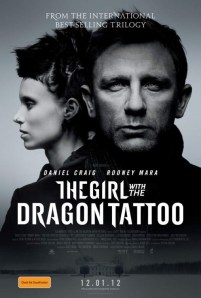
I’ve probably gone back and rewritten this review multiple times over the past few hours. I’ve been struggling to come to a final conclusion to how I felt about the film. On one hand it is a hollow crime thriller, all polish and no substance, and on the other it is an exceptionally crafted dark and mysterious tale of sex, corruption and murder that oozes with atmosphere. One could make the case for either, and many critics have argued in favor of one side or the other. After a lot of contemplation, I’ve come to decide that it actually seems to rely on both being hollow and atmospheric, but what continues to conflict me is whether the former can truly be overlooked even if crucial to the final product.

‘The Girl With The Dragon Tattoo’ stars Daniel Craig as Mikael Blomkvist, a journalist who has recently come under a lot of scrutiny after being accused of making up a story about a wealthy executive and losing the case of libel brought upon him. Facing financial and credibility problems he is hired by Henrik Vanger (Christopher Plummer) a wealthy entrepreneur  who wants Mikael to solve a ‘cold case’ that has haunted him for forty years, that being the disappearance of his grand-niece Harriet who he believes was murdered by a member of his corrupt family filled with Nazis and recluses. As Mikael delves deeper into the mystery of her disappearance he hires the assistance of Lisbeth Salander, a goth-hacker with a dark past who has her own personal issues to deal with, specifically a financial guardian who wants sexual favors in order for her to access her money. When they are finally brought together they discover the dark secrets of the Vanger family and its links to a serial murderer case that begins to threaten their own lives.

David Fincher, who directed ‘Zodiac’ and ‘Se7en’, is no stranger to graphic and dark thrillers so it is no surprise that he handles the creation of ‘The Girl With The Dragon Tattoo’ with a level of competence few other directors could have. Along with the help of cinematographer Jeff Cronenweth and being set in Sweden the film has a very dark and cold (often literally) tone, making an atmosphere just as chilling as the subject matter and beautiful to look at. Sadly under the gorgeous and dark visuals and the bleak and mysterious atmosphere there isn’t much to be had. There is a real lack of emotion and soul.

I can only assume that Fincher’s intentions from the beginning were to avoid any real substance, and to make a film just as hollow and sadistic as the story is was trying to tell. There is just about no emotion and so no reason to be attached to anyone except Lisbeth, but our empathy for her stems more from the vial acts we see acted upon her and less from truly knowing who she is, and why she is so emotionally restrained. It is not until the last twenty minutes that she gets any sort of development, but was it too little too late? Again I cannot decide. One could argue that this insight into the character earlier on would have made us care for her more, which I can understand. But I also question whether or not she could have even opened up the way she does at the end without having first gone through the events of the film, in particular the relationship she has with Mikael. Either way, I’m just glad Fincher went with Rooney Mara to play Lisbeth.

It is hard not to compare both film versions of the Lisbeth character, and even harder to choose which was better. This is mainly because both films, although similar in many ways, have very different tones. The Swedish version is a much more straight forward thriller and Rapace’s Lisbeth fits that film in being just a strong and tough individual, though there doesn’t seem to be too much below her surface and most of the development of her past is shown. Mara’s Lisbeth is a much more complex character, and although the film doesn’t give her much depth in terms of story until the very end, Mara gives off hints of a disturbing past just in the way she talks and moves, especially when men get too close to her. In reality she is a much weaker character than in the Swedish version. I personally liked that soft side because it makes her feel more like a vulnerable woman so when she fights back it feels more powerful.

It is this humanization that really helps propel Fincher’s adaptation over the Swedish version in my eyes. Even Daniel Craig, who put on a very good performance, is given a lot more to do and a much more interesting personality. He gives the character a bit of charisma, and wasn’t just a monotonous individual, like in the original, making it easier for us to care for both him and Lisbeth. It also makes their odd but provocative relationship seem more genuine and intimate.

All of this stuff I loved…but then I fall back to feeling like it was all for nothing. I mean it looks pretty, and the mystery is intriguing and the atmosphere is dark and cool, but once it is all over nothing really sticks other than the technical aspects. This isn’t helped by the fact that it over stays its welcome for the last few minutes, even if it adds to the characters. Luckily the pacing is done well enough to never make it feel boring but it does end up being rather anti-climactic. But I feel a second viewing is necessary.

With that said, as conflicted I am about everything else one thing that I can say for certain was fantastic is the score. It was crucial in the creation of the moody and dark atmosphere. Trent Reznor and Atticus Ross, who did the Oscar winning score for ‘The Social Network’, continue to impress and help give the film a pounding and chilling heartbeat. Also the ‘Bondesque’ opening credits, a brilliant animation of dark tar, leather and gothic imagery set to Karen O’s cover of Led Zeppelin’s ‘Immigrant Song’, was absolutely stunning.

So overall I will say that it is an incredibly well-crafted and dark thriller with fantastic visuals and a wonderful performance by Rooney Mara and because of that it certainly deserves a lot of credit but below the surface it is a rather hollow and anti-climactic story making it hard for me to love it as much as I might have wanted to. It also did not help that going into it my anticipation was at an all-time low due to the hype that was built up around it and by how much I liked the original. So for now I’ll just say I enjoyed it for what it was, it certainly is well crafted enough to deserves the praise it is getting, but a second viewing will determine whether or not I truly thought it was a great film. Still I recommend it for those interested.

A Quickie With Lisa Marie: The Adventures of TinTin (dir. by Steven Spielberg)


Originally, this was supposed to be the year of Steven Spielberg.  After all, Spielberg had two major films open within days of each other and, earlier this year, various know-it-all pundits declared that both of these films (along with David Fincher’s dumbed down version of Girl With The Dragon Tattoo) would be major awards contenders.  This was, of course, before films like Hanna, The Artist, Drive, and The Tree Of Life came out and made Spielberg’s trademark suburban cinematic vision seem almost quaint.  Spielberg’s two films — The Adventures of TinTin and War Horse — both very much remain in the hunt for nominations but few seem to be expecting them to actually win anything.  Oddly enough, it’s as if Spielberg’s films somehow went from being overrated to underrated before they were even released.

I haven’t seen War Horse yet (and the commercials don’t fill me with hope) but, in the case of TinTin, this is unfortunate because I saw the film on Friday and it’s a perfectly enjoyable animated film that, while never reaching the intertextual heights of Rango or matching the “awww” factor of Puss in Boots , is still a bit more memorable than Pixar’s Cars 2.  Based on a Belgian comic book, (which I had never heard of before so don’t expect me to get into the whole debate about whether Spielberg does the original justice) The Adventures of TinTin is about a “boy reporter” named TinTin (voiced by the always likable Jamie Bell) who, along with his adorable dog Snowy, ends up going on a quest for lost treasure.  The film plays out like an old-fashioned adventure film with TinTin and Snowy’s quest taking them from one exotic locale to another.  Continually, they find themselves getting captured by various bad guys and having to escape in some properly exciting manner.  Along with the way, they meet an alcoholic sea captain (voiced by Andy Serkis) and a whole variety of flamboyant characters.  My favorite characters were the two well-meaning but inept police detectives, Thompson and Thompson.  Thompson and Thompson are voiced by Simon Pegg and Nick Frost and the two of them have so much chemistry and play off each other so well that they’re even fun to just listen to.

When I saw The Adventures of TinTin, I was sincerely surprised by how quickly the film moved.  Usually, I find that the majority of Spielberg films tend to drag in the middle.  Whenever there’s nothing to blow up or an excuse to fill the scene with soaring music conducted by John Williams, Spielberg seems to lose his way as a filmmaker and can almost seem desperate in his attempts to convince us that he’s a serious artist.  However, it almost seemed as if The Adventures of TinTin was over before it even started.  This is not a film that drags but instead one that cheerfully leaps from one action sequence to another.  It’s as if working on an animated film freed Spielberg up from his inherent need to remind us that he’s a respectable filmmaker.  For once, he’s willing to just have fun without trying to justify it.  Since I was seeing the film with two hyperactive children (my nephew who is five and my niece who is three), I was happy and relieved that the film didn’t have any slow spots.  The movie, as a matter of fact, held their attention better than it held mine and all three of us loved Snowy.  An important lesson for all aspiring filmmakers: If you’re ever in doubt, always cut to a small animal doing something cute.

Ultimately, TinTin is an enjoyable little film that really doesn’t add up too much.  This isn’t another Toy Story 3 or a How To Train Your Dragon.  This is not a film to bring tears to your eyes but it’s enjoyable enough and it’s a rare Spielberg film that seems to be unashamed of simply being message-free entertainment.

Happy Holidays From The Shattered Lens (And Especially Lisa and Erin!)


Hi, everyone!  Now, I know that some of you may be saying, “It’s Saturday.  Where are the trailers, Ms. Bowman?”  Well, rest assured, a new entry in Lisa Marie’s Favorite Grindhouse and Exploitation Trailers will be posted next week.  However, today, me and the one and only Dazzling Erin are in Ft. Worth, hanging out with our family and trying to get those final few presents wrapped before Christmas morning. 

(Luckily, we live in America and not Europe or else it already would be Christmas and then we’d really be in a spot.)

So, again, the trailers will resume next week.  For today, however, I’d rather share with you one of my favorite movie endings of all time.  Yes, you’ve seen it a hundred times and you might be watching it on TV right now.  But I don’t care.  The ending of It’s a Wonderful Life always brings a tear to my eye.

Happy Holidays!

Quick Review: The Girl With The Dragon Tattoo (dir. by David Fincher)


Addendum: Leonth3duke has added his own thoughts on The Girl With The Dragon Tattoo, which are worth reading. Lisa Marie has also added her own viewpoint on the film.

I think had I not seen the Swedish version of The Girl With The Dragon Tattoo, this would be a far easier review to write, really. I tried reading the book a number of times, and found it really tough with Larsson’s exposition to stay with it. As such, this review is somewhat biased, perhaps heavily so, and it may be a little spoiler-ish. My assumption here is that with the novel having been available for some time now, and a separate movie to watch, there are very few people who don’t know what the story’s about.

A funny thing happened while watching David Fincher’s The Girl With The Dragon Tattoo the other night.  In the middle of the film, the projector turned off. After I calmed down, eyeing the exits and thinking the Blob might have made it’s way into my theatre, the audience had fifteen minutes of quiet to wait and give their thoughts on the movie.

One fellow stepped down from the seats, ready to ask for his money back when he stopped and turned around.

“Does anyone know what the F this movie is about? ‘Cause I’m frickin’ confused!” he raised his arms to the audience, pleading for reason.

“It’s about a girl with a Dragon Tattoo.”, Someone yelled back.

“What is supposed to mean!?” The angry man replied, sounding a lot like Rooney Mara in The Social Network. “All I’ve seen is Bond shiver his butt off and this chick type away on her laptop. This is garbage.” And with that, he left.”

“Yeah, this is some bulls—.”, Another fellow said as he left.

Needless to say, the movie resumed. There was a problem that caused their fire alarm to shut off and it stopped every film in the theatre. I’m not sure how much I may have missed, but I’ll probably see this again during the weekend.  I know, it’s not the best of review lead ins.

The simplest thing I can say about The Girl With the Dragon Tattoo is this:

– If you read the book and saw the Swedish film, this version only puts on a coat of Fincher Paint on the story. From the opening credits that rival the one in Se7en to the fade to black, it’s all distinctly Fincher’s touch on things.  You could almost argue that it feels like a Bond film, the way they did it. This basically means that the lighting might be dimmer in some places and the film may be more stylized. It comes across feeling more like a motion picture than the Swedish version, which to me felt a little more like a tv movie.

If you never read the book, I would highly recommend the Swedish version first. It’s on Netflix, and as some of the material is delicate, doing so would give you the freedom to hit the pause or fast forward button should you find yourself uncomfortable. That’s kind of hard to do in a movie theatre without walking out on the money you spent on a movie ticket.

And if you saw the Swedish Version, missed the book and are wondering if you should spend your money on this, Rooney Mara really is the only reason to give this a try. It’s essentially the same story, but with a different ending that’s tighter and closer to the book than the Swedish Film. While Rooney’s Salander may not be hard hitting as Noomi Rapace’s Salander , she deserves so much credit for throwing herself into this as deep as she did, and helping to create her own version of Lisbeth.  Daniel Craig, on the other hand, seems to be more restrained here.

The Girl With the Dragon Tattoo is the story of Mikael Blomkvist, an editor in chief of a magazine called Millenium in Sweden who is dealing with a mishap on a libel case against a magnate named Hans-Erik Wennerstrom. His recent notoriety catches the attention of Henrik Vanger (Christopher Plummer, who’s really having a great year), who asks him to investigate the 40 year old murder of his niece, Harriet. Of course, prior to asking Blomkvist to take on the case, Vanger’s lawyers perform a background check on him with the help of Lisbeth Salander (Rooney Mara). Salander happens to be both an ace Hacker and sports a photographic memory, which makes snooping into Blomkvist’s files a cinch.

Eventually, through his investigation of the Vanger Family on their private island, it becomes apparent that Blomkvist needs a little assistance, so he asks the lawyers if Salander can be brought on to work with him. It’s when the two characters meet that the story really picks up some steam.

While I loved it (I’m going back to see it again over the weekend, I think), there was the odd feeling that something was really off. At one point in the film, I find myself quirking my brow, because it occurred to me that there was just a little too much sex in the movie. I understand that’s not something one should complain about, but the Swedish version of the film led me to believe that Salander’s motives for any kind of passion were just a “want, need, have” and move on. In this version, she came across almost needy. It’s not even the right word. Where Rapace’s Salander felt cold and calculating even though the later parts of the story, Mara’s Salander feels like she’s warming up to Blomkvist emotionally. Of course, this could be attributed to screenwriter Steven Zaillian (Schindler’s List, Searching for Bobby Fischer) playing the story closer to the book than the other film, but it was strange for me in that sense. Fincher, who is notorious for control over his scenes may also be to blame here. If you have access to the behind the scenes for The Social Network, you can watch some of his interviews on the behind the scenes to get an idea of just how much he likes to control where a scene goes.

I don’t hate Fincher. I own Se7en, Fight Club and The Social Network and love all three of these, but even I have to admit that as cool and as stylish as the film is, something’s just off. I loved the film, but it’s just different.

The movie was advertised as the ‘feel bad film of the year’, and in that sense, they’re not lying. Keep the kids home, please. All three versions of the story contained a rape scene. Fincher and Co. Don’t pull any punches here, making it all a little disturbing for anyone not actually prepared for it. One standout to the film has to be the score, developed by Oscar Winners Trent Reznor and Atticus Ross (something I’ll never be fully able to handle saying, having been a Nine Inch Nails fan since the mid ‘90s). The movie has no clear-cut theme to it, but the music that fuels the scene add an extra layer to things. That I really enjoyed.

So, overall, the remake didn’t really need to be made, but it does make me interested to see what Fincher and Zaillian have in store if they decide to continue the Millenium Trilogy. My hopes are that they give Lisbeth Salander a bit of a sharper edge than she already has. Mara herself, they don’t have to worry about. She’s a definite lock as Salander, and I’m happy for her on that. It’s where they choose to take her that I’m concerned about.

Film Review: Sherlock Holmes: A Game of Shadows (dir. by Guy Ritchie)


One of my favorite films of 2009 was Guy Ritchie’s Sherlock Holmes.  I saw the first (of probably many) sequels to that film this weekend.  Now, I have to admit that I was kinda worried about Sherlock Holmes: A Game of Shadows.  As much as I loved the first film, it definitely had the feeling of being a happy accident.  There were so many obvious ways to screw the film up that I found myself suspecting that that’s exactly what would happen with the sequel and I worried that a bad sequel would make it impossible for me ever to really enjoy the first film.  Well, having seen Game of Shadows, I can see that no, it’s not as good as the first film.  However, it’s still  pretty good.

Game of Shadows picks up the story a bit after the end of the first film.  Sherlock Holmes (Robert Downey, Jr.) is still doing cocaine and solving mysteries in London.  Dr. Watson (Jude Law) is still his best friend and is still planning on getting married and, not surprisingly, Holmes is still not happy about the idea of losing him.  Holmes is also still investigating the mysterious criminal mastermind, Dr. James Moriarty (Jared Harris).  Holmes discovers that Moriarty is behind a series of world-wide anarchist bombings and, with the world on the verge of war, Holmes and Watson attempt to both figure out why and to thwart Moriarty’s scheme.  While I haven’t read enough Sherlock Holmes to say for sure (I read the Hound of the Baskervilles in high school and that’s about it), I get the feeling that, plotwise, this film was probably more James Bond than traditional Sherlock Holmes.  But no matter, it’s an intriguing enough plot and director Ritchie wisely doesn’t spend too much time trying to hammer home that similarities between Moriarty’s scheme and certain modern-day conspiracy theories.

If the first Sherlock Holmes was a comedy with some action scenes, this sequel is definitely an action film with a lot of comedic relief.  Whether or not this increases or diminishes your enjoyment of the sequel really depends on how you feel about the action genre in general.  To be honest, most big budget action films bore me several shades of silly and Game of Shadows pulls out all the usual tricks — slow motion explosions, fist fights full of jump cuts so quick that it becomes impossible to really keep track of who is actually fighting who, and the whole zooming into the barrel of a gun just as the trigger is pulled routine.  And yet these action sequences didn’t inspire my usual eye rolling, if just because it was obvious that the film itself understood just how over-the-top and silly all of it was.  The film has the decency not to demand that I take it seriously and for that, I’m more willing to accept the predictable parts than I would be with a film like Battle L.A.

Besides, even with the increased emphasis on action, the filmmakers still understand that what made the first Sherlock Holmes work was the chemistry between Robert Downey, Jr. and Jude Law.  Seriously, Downey and Law have some of the strongest chemistry in the movies today.  Certainly, there a more believable couple than Natalie Portman and Ashton Kutcher.  (It’s probably not a coincidence that the film, very early on, establishes that Watson is getting married and that Holmes is still mourning Rachel McAdams from the previous film.)  You buy their friendship and it’s just fun to watch these two actors bouncing lines off of each other.  Downey still comes across more like Robert Downey. Jr. than Sherlock Holmes (and that’s just fine with me) but Jude Law actually gets a chance to act in this film and he brings a lot of life to a character who, on paper, would just seem to be the prototypical sidekick. 

Joining the cast in this installment as Jarded Harris as the evil Dr. Moriarty and Noomi Rapace as the gypsy fortune teller who gets caught up in Moriarty’s latest scheme.  Now, you may be surprised to hear this with the current efforts to brainwash us all into being Rooney Mara-compliant but Rapace was the original Girl With the Dragon Tattoo and, regardless of the film establishment’s attempts to revise history, she is the one who made Lisbeth Salander into an icon.  Unfortunately, Rapace doesn’t get to do much here but I was happy to see her if just to know that the Hollywood establishment hadn’t succeeded in erasing her from history.  As Moriarty, Jared Harris doesn’t have a lot of scenes but he still totally dominates the entire film.  Harris’s Moriarty is truly serpent-like, outwardly smooth and calm but, on the inside, always ready to strike.  He makes Moriarty into such a memorable, genuinely threatening villain that he ends up giving the film an extra dimension that otherwise wouldn’t be there.  It’s a great performance and hopefully, when the inevitable third Sherlock Holmes film is made, Moriarty will be back and Harris will be playing him.

Lisa Marie Cries and Cries As She Watches A Dolphin Tale (dir. by Charles Martin Smith)


On Wednesday evening, Jeff and I went down to the dollar theater and we finally got around to seeing A Dolphin Tale.  A Dolphin Tale is one of those movies that I was really enthusiastic about seeing when it first opened in theaters but then, for whatever reason, I just never got around to seeing it.  So, I was happy to have a chance to catch it before it left theaters for a sure-to-be popular life as a video rental.  The film’s trailer led me to suspect that I would cry and cry while watching A Dolphin Tale and I was not disappointed.

This is going to be a pretty simple review because A Dolphin Tale is a pretty simple movie and that’s exactly why it’s a good movie.  The movie tells the true story of Winter, a dolphin who was horribly injured by a crab trap and who lost her tail as a result.  After almost dying, Winter manages to fight back and is soon able to swim again.  However, swimming with no tail is damaging her spine and, unless something can be done, Winter will eventually end up killing herself.  Luckily for Winter, there’s a dedicated and eccentric scientist (played by Morgan Freeman, who can make any line sound like an edict from God) who dedicates himself to building her a prosthetic tail.  Will Freeman be able to get the tail built before Winter has to be put down and, more importantly, will Winter be able to learn how to use the new tail before her new home, the Clearwater Marine Hospital, runs out of money and is sold off to a businessman who wants to turn the place into a hotel?

If you don’t already know the answer then you’ve never seen a movie before.  Yes, A Dolphin’s Tale is predictable and yes, it’s not very subtle about manipulating the audience’s emotions but I don’t care.  The movie is just so sincere and the film’s story is just so inspiring that I had no problem allowing myself to be manipulated.    This is a movie that has a good heart and it’s obvious that for director Smith and for most of the cast (which includes Ashley Judd, Harry Connick, Jr., and Nathan Gamble, along with Freeman) that this film really was a labor of love.  The true star of the film, however, is Winter, who plays herself in this film.

The film itself is in 3-D and yes, there’s about a hundred shots of Winter swimming straight at the camera that were obviously included just because the film was in 3-D but who cares?  Yes, it’s manipulative but it works.  At the film’s end, we see documentary footage of Winter actually being rescued and cared for by the real people who we’ve just seen recreated in the film.  Not a single one of them looks as good as Harry Connick, Jr. or quite as wise as Morgan Freeman but they all look like heroes to me.

Seriously, if this film doesn’t touch you then you have no heart and you are quite possibly a member of the walking dead.


A Dangerous Quickie With Lisa Marie: The Descendants (dir. by Alexander Payne)


One thing that always happens at Oscar season is that certain films will be so embraced by the critical establishment that even daring to challenge their opinion to even the slightest degree will be interpreted as some sort of cinematic heresy.  These are the films that make you feel as if Roger Ebert is standing directly behind you, holding a gun to your head and commanding you to enjoy and be moved by what you’re watching.  Last year, that film was The Social Network.  This year, at least for me, it’s The Descendants.

One reason why The Descendants has been so praised by the critics is because it’s seen as being a film about “real people” and “real life.”  It’s advertised as a film with no easy villains and no easy heroes.  This is the type of film that people tend to praise for not falling into specific genre.  However, those critics are wrong because The Descendants is a pure genre film, make no mistake about it.  It is the latest entry in the Mediocre White Man film genre.  The MWM genre tends to center on middle-aged white guys who are comfortably upper middle class, have quirky relatives, and have been afflicted by ennui.  The protagonist of the MWM film usually narrates the action for us and tends to spend a lot of time explaining how he’s managed to structure his life for maximum efficiency while, at the same time, shutting himself off emotionally from the rest of the world.  Over the course of the MWM film, the protagonist is usually forced to deal with some crisis that makes him realize that 1) he’s getting old, 2) his safe life has become a prison, and 3) there’s not much he can do about it.  The MWM film will feature at least one or more scenes featuring our protaganist either aimlessly running or standing still on an escalator with a blank expression on his face while some old song from the 60s or 70s plays on the soundtrack.  

MWM films tend to do well critically because most critics are mediocre white men themselves.  They also do well with the Academy, probably for the same reason.  And, don’t get me wrong.  There have been some excellent MWW films released over the past decade.  Sideways, Up in the Air, Thank You For Somoking, and even Michael Clayton are all excellent MWM films.  The problem isn’t that The Descendants is a MWM film, the problem is that it doesn’t really bring anything new to genre and even the film’s most effective moments feel awfully familiar.

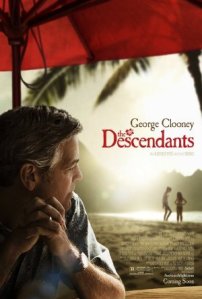
In The Descendants, George Clooney (a mainstay of MWM genre) plays Matt King, a wealthy attorney living in Hawaii.  Matt’s wife is in a boating accident that leaves her brain-dead.  Matt, who has always been “the backup parent,” finds himself forced to take care of his two daughters (Amara Miller and Shailene Woodley) while going from island to island to inform people of Elizabeth’s impending death.  Along the way, he discovers that Elizabeth has been having an affair with a sleazy real estate agent (Matthew Lillard) and he’s forced to confront the fact that he hasn’t always been the best husband or father.  There’s a lot of quirky and funny moments and there’s a lot of sad moments but they’re never feel quite as genuine as the film seems to believe.  Instead, they often feel more like they were just put there to satisfy the demands of the MWM genre.  The end result is a film that too often seems to mistake ambiguity for insight and which ultimately seems to be more safe than honest.

That doesn’t necessarily mean that The Descendants is a bad film.  Much like The Social Network, it’s a good film that also happens to be very overrated.  Director Alexander Payne keeps the story moving and, as predictable as the film may be, it’s still well-acted and occasionally well-written.  Though I thought a lot of the dialogue was a bit too spot-on perfect (this is a film where even the inarticulate characters sound calculated), the script features enough good one-liners to keep the film entertaining.  Amongst the cast, Robert Forster is poignant as Elizabeth’s grieving father (and his “I’m going to hit you line,” is perfectly delivered) and Judy Greer makes the most of the thankless role of Lillard’s wife.

In the end, I guess the Descendants is a lot like an old middle school crush.  He’s so cute and appealing that it takes a while of digging and soul searching before you can admit that there’s really not much going on there.

And now…6 More Trailers


Hi, everyone!  Sorry for the delay in getting out this latest edition of Lisa Marie’s Favorite Grindhouse and Exploitation Film Trailers.  What can I say?  The holidays are a crazy, crazy time.  If you promise to keep reading and watching then I promise to not be late again in the future.  Deal?  Deal.

And now, without further delay, here’s 6 more trailers!

1) Silent Night, Deadly Night 3: Better Watch Out (1989)

This film was directed by Monte Hellman, who directed some of the best films of the 60s and 70s.  So, in case you were wondering what you get for directing a work of art like Two-Lane Blacktop, well, here you go.

2) Black Christmas (1974)

Continuing the holiday theme, here is the trailer for the original Black Christmas.  This film was directed by the late Bob Clark, who later went on to direct a totally different Christmas movie called A Christmas Story.

3) Madhouse (1974)

I love this trailer for the melodramatic opening.  I love the way the old grindhouse and exploitation movies would literally dare filmgoers to stay away.  That takes confidence!

4) The Freakmaker (1974)

With a title like The Freakmaker, it has to be good.

5) The Creatures The World Forgot (1971)

The World, I am sure, had its reasons for forgetting.

6) Prehistoric Women (1967)

This film is also known as Slave Girls and I’m sure there’s probably prints out there entitled Slave Women and Prehistoric Girls as well. 

Film Review: Santa Claus Conquers The Martians (dir. by Nicholas Webster)


As our longtime readers may have noticed, I’m running behind on getting my weekly exploitation and grindhouse trailer post together.  I apologize for the delay and this week’s post should be up either tomorrow or on Monday.  However, until I finally manage to get my act together, why not enjoy a classic holiday film that just happens to be in the public domain?

You may think that you know everything about Santa but did you know that he’s also a super hero who is capable of interstellar conquest?  Did you know that he’s not only needed on Earth but on Mars as well? Did you know that apparently some people known him as “Santy Claus?”  And most importantly, did you know that Santa is actually kind of a creepy old man whose trademark laugh can actually sound quite disturbing in certain circumstances?

Okay, maybe that’s not true about the actual Santa Claus.  But it’s certainly true about the Santa Claus who turns up in the 1964 film Santa Claus Conquers The Martians.  This film, an obvious labor of love from director Nicholas Webster, presents us with a universe where the children of Mars are so stricken with ennui that the King of Mars has no choice but to go down to Earth and kidnap Santa.  Santa, however, manages to conquer those Martians while bringing holiday goodness and cheer to children all over the universe.  Santa, by the way, is played by John Call and … well, it’s a performance that has to be seen.

In fact, Santa Claus Conquers The Martians itself is a film that simply must be seen.  Everything from the cardboard robot to the cardboard South Pole to the cardboard cast to the painfully catchy theme song “Hooray for Santy Claus” simply demands that you watch this film at least once.  Santa Claus Conquers The Martians has earned its reputation for being one of the worst films ever made but you know what?  It’s also a lot of fun and it’s still better than Avatar.

Seriously, Avatar sucks.

So, please, sit back with your computer and enjoy Santa Claus Conquers The Martians.  Hopefully, next year at this time, it will be rereleased in 3-D.  And, if you’ve seen this film before, you know what the means.  That’s right — Dropo right in your face!