LeonTh3Dukes Best in Film of 2011


So it is the last day of 2011, for some it might even already by 2012 (and by the time most read this it will be) and I decided to compile my lists of favorite films, performances, directors, etc. of the year. Please feel free to comment, good or bad, on any or all my picks but just remember they are MY picks.

———-

Worst Films:

1) “Hall Pass” (dir. Bobby and Peter Farrelly)

<br/><a href="https://i0.wp.com/oi43.tinypic.com/2eg5jed.jpg" target="_blank">View Raw Image</a>

2) “Super” (dir. James Gunn)

3) “The Change Up” (dir. David Dobkin)

4) “Battle: Los Angeles” (dir. Jonathan Liebesman)

5) “Crazy, Stupid, Love” (dir. Glenn Ficarra and John Requa)

———-

Best Score or Song:

1) “Theme Suite” by Roger Neill, Dave Palmer, Brian Reitzell (“Beginners”)

2) “Brandon” by Harry Escott (“Shame”)

3) Rivers by Alexandre Desplat (“The Tree of Life”)

4) Nightcall by Kavinsky (“Drive”)

5) “It’s a Process” by Mychael Danna (“Moneyball”)

———-

Best Screenplay:

1) “Midnight in Paris” (Woody Allen)

2) “The Tree of Life” (Terrence Malick)

3) “The Artist” (Michel Hazanavicius)

4) “A Separation” (Asghar Farhadi)

5) “Moneyball” (Steven Zaillian and Aaron Sorkin)

6) “Beginners” (Mike Mills)

———-

Best Cinematography:

1) “The Tree of Life” (Emmanuel Lubezki)

2) “Meek’s Cutoff” (Chris Blauvelt)

3) “Melancholia” (Manuel Alberto Claro)

4) “Hugo” (Bob Richardson)

5) “The Artist” (Guillaume Schiffman)

———-

Best Directors:

1) Terrence Malick (The Tree of Life)

2) Martin Scorsese (Hugo)

3) Michel Hazanavicius (The Artist)

4) Nicolas Winding Refn (Drive)

5) Abbas Kiarostami (Certified Copy)

6) Steve McQueen (Shame)

———-

Best Supporting Actress:

1) Jessica Chastain (The Tree of Life)

2) Sareh Bayat (A Separation)

3) Carey Mulligan (Shame)

4) Melanie Laurent (Beginners)

5) Berenice Bejo (The Artist)

6) Leila Hatami (A Separation)

———-

Best Supporting Actor:

1) Christopher Plummer (Beginners)

2) Albert Brooks (Drive)

3) Brad Pitt (The Tree of Life)

4) Shahab Hosseini (A Separation)

5) Jeremy Irons (Margin Call)

6) Corey Stoll (Midnight in Paris)

———-

Best Actress:

1) Olivia Colman (Tyrannosaur)

2) Elizabeth Olsen (Martha Marcy May Marlene)

3) Rooney Mara (The Girl With The Dragon Tattoo)

4) Juliette Binoche (Certified Copy)

5) Kirsten Dunst (Melancholia)

6) Jeong-hie Yun (Poetry)

———-

Best Actor:

1) Michael Fassbender (Shame)

2) Peter Mullan (Tyrannosaur)

3) Jean Dujardin (The Artist)

4) Brad Pitt (Moneyball)

5) Ryan Gosling (Drive)

6) Peyman Maadi (A Separation)

———-

Best Films 25-11:

25) “The Trip” (dir. Michael Winterbottom)

24) “Submarine” (dir. Richard Ayoade)

23) “Like Crazy” (dir. Drake Doremus)

22) “Jane Eyre” (dir. Cary Fukunaga)

21) “The Girl With The Dragon Tattoo” (dir. David Fincher)

20) “Rise of the Planet of the Apes” (dir. Rupert Wyatt)

19) “Melancholia” (dir. Lars von Trier)

18) “Hanna” (dir. Joe Wright)

17) “Tinker Tailor Soldier Spy” (dir. Tomas Alfredson)

16) “Martha Marcy May Marlene” (dir. Sean Durkin)

15) “Meek’s Cutoff” (dir. Kelly Reichardt)

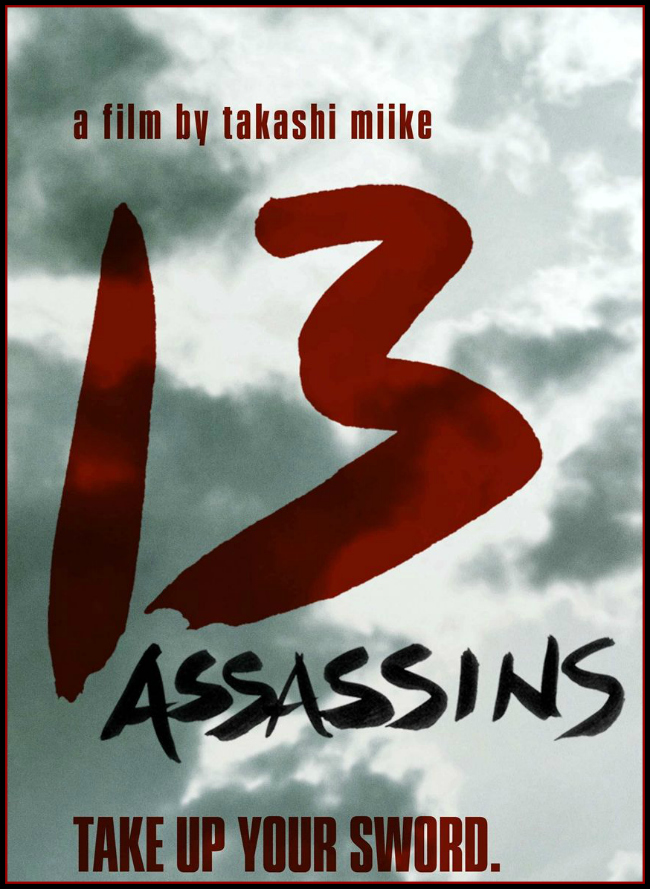
14) “13 Assassins” (dir. Takashi Miike)

13) “Moneyball” (dir. Bennett Miller)

12) “Poetry” (dir. Chang-dong Lee)

11) “Le Quattro Volte” (dir. Michaelangelo Frammartino)

———-

Best Films 10-1:

10) “Tyrannosaur” (dir. Paddy Considine)

9) “Midnight in Paris” (dir. Woody Allen)

8) “The Artist” (dir. Michel Hazanavicius)

7) “Certified Copy” (dir. Abbas Kiarostami)

6) “Hugo” (dir. Martin Scorsese)

5) “A Separation” (dir. Asghar Farhadi)

4) “Shame” (dir. Steve McQueen)

3) “Drive” (dir. Nicolas Winding Refn)

2) “Beginners” (dir. Mike Mills)

1) “The Tree of Life” (dir. Terrence Malick)

Review: 13 Assassins (dir. by Miike Takashi)


“…being a samurai is a burden.” – Shimada Shinzaemon

Miike Takashi (Takashi Miike to those in the West) has always been one of my favorite filmmakers and I consider him one of the most unique directors working. To say that he has an extensive body of work would be an understatement. This is a man who is quite at home at releasing 2-3 films a year. He has dabbled in all sorts of genres from drama, thrillers, horror, scifi, musicals and even children’s stories. Those who discovered him in the West mostly remember him for his more extreme films such as Audition, Ichi the Killer and his Dead or Alive epic. He’s taken extreme film-making to some unpredictable plac. While some of his films never work one could never say that they were ever boring or uninteresting.

In 2010, Miike released what I can only say is one of his best films to date with his remake of Tengan Daisuke’s 1963 film of the same name. 13 Assassins is Miike’s take on the classic jidaigeki (Japanese Edo period pieces…think of it as similar in idea to Merchant-Ivory period pieces) which incudes such great films as Kurosawa’s Seven Samurai, Rashomon and Yojimbo to name a few. This film also shares some similarities to the “men on a mission” war films which were quite popular during the early 60’s which included one of my other top action films in The Dirty Dozen.

The film is loosely based on some historical characters from the Tokugawa Shogunate era mainly that of Lord Naritsugu of the Akashi clan. In this film he’s portrayed as a sadistic young noble whose familial ties to the ruling Shogun allows him to kill and rape both commoners and nobles alike with impunity. When a high government official fears for the government and the country should Naritsugo ever ascends to a higher position in the Shogunate he takes it upon himself to hire a trusted friend and veteran samurai, Shinzaemon (Kōji Yakusho), to plan and pull off the assassination of Lord Naritsugo.

From this moment on the film takes it’s time in introducing the men who would form the film’s title. It doesn’t linger or take too long with each man, but we learn enough of these 13 assassins to form some sort of attachment to each and everyone that the loss of each man, once the battle begins between Shinzaemon’s assassins and Naritsugu’s 200 bodyguards, has emotional impact and meaning. Even knowing that this mission ultimately becomes a suicide task still doesn’t stop the surprise when one of these men falls to the blades of their enemies.

The assassins themselves were quite a diverse group of characters that could’ve been lifted off your typical “men on a mission” film. We have the goofballs with the talent for explosives, younger samurai eager to prove themselves in battle and to their masters, veteran samurai looking to do one more last job before they retire from the life right up to the last-minute addition of a fool whose unique skill sets becomes integral to the missions success.

13 Assassins begins the final 45 minutes of its running time with a non-stop battle which rivals anything we’ve seen put out by Hollywood in the past ten years. Unlike the sturm und drang actionfests from Michael Bay and those who seem to emulate his style of action film-making, Miike takes a much more restrained approach to the proceedings. This is not to say that the action in this film was boring. He allows the audience to know exactly what’s going on with long takes and minimal amount of edits. I don’t think he ever used too many quick cuts to help simulate chaos during the fight. Instead he lets the practical stunt choreography and the inventive set design of the village turned killing field to dictate the flow of the action. It’s quite interesting to note how a filmmaker such as Miike whose reputation in the West has been built on his style of extreme visuals and imagery on film would be quite adept at such a thing as traditional filmmaking that eschews heavy-usage of CGI, quick-cut editing and unnecessary montages to help propel not just the action but the film’s narrative.

Again, unlike the Bay-fest the West has been flooded with the last decade or so this film also has as one of it’s strength’s the story all the action revolves around. The story itself is quite simple when one really boils it down to it’s most basic premise. Evil lord sows chaos around the countryside and a group of honor-bound fighting men band together for one reason or another to stop this evil. It’s a story as old as Beowulf and as recent as 2010’s trio of such films with The Losers, The A-Team and the Expendables. What this film does with it’s characters which helps it stand out from that trio is how well Miike was able to balance not just the action with the story but how to make each character in the film seem unique despite being so stereotypical of such films at first glance.

The acting by the ensemble cast (a who’s-who of performers in Japanese, but mostly unknown to Western audiences) adds just the right mix of melancholy and dark humor not to mention some rock star-like work from it’s lead antagonist. Gorô Inagaki (himself not just a talented actor but one of Japan’s more popular pop star singers) as Lord Naritsugu brings energy as the evil lord to every scene he’s in not because of being so over-the-top but the opposite. He plays this villain as a noble bored with the peaceful days enjoyed by everyone and could only enjoy what life has to offer when he brings chaos to the proceedings. The fact that this involves him raping the women of a fellow noble and cutting off the limbs of a nameless young girl just shows how much out of touch he is with reality and at the same time romanticizes the age of war hundreds of years in the past. The rest of the cast does an admirable job in their own roles. To say that it was difficult to see one of them die on-screen would be an understatement.

13 Assassins was released in 2010, but really got it’s major showing in the United States in early 2011. Despite all of that and with the eclectic group of films I was fortunate enough to have seen in 2011 that made my “best of” list it would be this film that ranks as one of the best of 2011 and also one of my favorite films of recent times. Miike Takashi has shown himself to be now just a filmmaker provocateur whose reputation for shocking audiences have bee well-earned, but also cemented the true fact that he is a filmmaker (both in and out of Hollywood) who has the skills and know-how to escape being labeled as only a filmmaker of a particular genre. His restraint and decision to remake a classic film in the jidaigeki genre shows that while he hasn’t lost his panache for extreme brutality (and this film has them to satiate action and gore fans everywhere) he can also create a film using the subtle brushstrokes of traditional, old-school filmmaking. With this film he has made one of finest and cements his place in the roll call of best filmmakers of the last quarter-century.

My Favorite Film of 2011: Bill Cunningham New York (dir. by Richard Press)


 A few days ago, Lisa asked me what my favorite film of 2011 was.  I thought about it for a few minutes and then I said, “Bill Cunningham New York.”

Bill Cunningham New York is a documentary about Bill Cunningham, an 80 year-old fashion photographer who has been the fashion photographer for The New York Times since 1978.  The film follows Bill as he takes pictures of both celebrities and ordinary people in the streets and shows how, through his photography, the unassuming and humble Bill Cunningham has preserved a visual history of how New York City has changed through the years.  In interviews, Bill talks about everything from his sexuality to his feelings on religion but what mostly comes through is his love for taking pictures.  Whenever I need cheering up or I’m frustrated with my own attempts to take that perfect picture, this is the film I watch and it never fails to cheer me up and it just makes me want to grab my camera and go take a hundred pictures.

That’s why Bill Cunningham New York is not only my favorite movie of 2011 but one of my favorite movies of all time. 


A Quickie With Lisa Marie: Young Adult (dir. by Jason Reitman)


David Fincher’s rehash of The Girl With The Dragon Tattoo isn’t the only “feel bad movie of the holidays.”  There’s also Young Adult, a rather dark comedy that reunites the director and screenwriter behind Juno, Jason Reitman and Diablo Cody.

Young Adult is the story of Mavis (played winningly by Charlize Theron), a former high school mean girl who has grown up to be a lonely, alcoholic ghost writer of young adult literature.  Mavis is struggling to write her latest book when she gets an e-mail announcing that her former high school boyfriend Buddy (Patrick Wilson, who defines dreamy) is not only married but his wife has just given birth to their first child.  Mavis does what we would all do if we found ourselves in similar circumstances: she promptly returns to her old hometown and plots to break up Buddy’s happy marriage*.  (Or as Mavis puts it: “We can beat this thing.”) 

Once she returns to her hometown, Mavis not only struggles to reconnect with Buddy but also runs into another former high school classmate, Matt (Patton Oswalt, who deserves every sort of award nomination that there is for his performance here).  As opposed to Mavis, Matt was an outcast in high school who, during his senior year, was beaten and permanently crippled by a bunch of bullies who had decided that he was gay.  Much as Mavis has won fame as a writer, Matt has won his own sort of fame as “the hate crime guy.”  Despite themselves, Mavis and Matt start to bond over their own inability to move on with their lives past high school.

As you might guess from the plot synopsis above, Young Adult is a not a laugh-out-loud comedy.  Instead, it’s a comedy of awkward moments and “Oh no, she didn’t!” moments.  It’s not always an easy movie to recommend because Mavis is an apologetically unlikable character.  However, as the film goes on, you can’t help but respect the fearless way that the film tackles a character that doesn’t really offer up much chance for a crowd-pleasing redemption.  Obviously, for this to work, Charlize Theron has to give a brilliant performance in the lead role and she does.  However, the film truly belongs to Patton Oswalt, who plays his role with a perfect combination of anger, self-pity, and sarcasm.  He provides this film with its own fractured heart and we’re all better off for it.

—–

* Okay, technically, maybe not everybody would do that.  But I would.

A Quickie With Lisa Marie: Higher Ground (dir. by Vera Farmiga)


Last August, I saw a wonderful film called Higher Ground.  Despite the fact that it had gotten a rapturous review in our local news paper, I was one of the only people in the theater.  Higher Ground played for a week before leaving and it’s been rather ignored during Oscar season.  And that’s a shame because I think that Higher Ground is one of the best films of 2011.  It’s certainly one of my personal favorites.

Taking place over the course of several decade, Higher Ground follows Corinne (Vera Farmiga) as she goes from being married and pregnant at 18 to eventually following her husband into joining a commune of self-described “Jesus Freaks.”  The commune, while being undeniably well-meaning, is also male-dominated and follows an extremely fundamentalist interpretation of the bible.  The previously fiercely independent Corinne quickly settles in to being a compliant housewife with her social life being pretty much limited to hanging out with the other housewives in the commune.  As the years progress, Corinne struggles to balance her own independence with her own religious beliefs until finally, she starts to both question her faith and the life she’s lived for the past 20 years.

For the most part, American cinema doesn’t have a very good track record when it comes to religious themes.  Regardless of whether a film is pro-religion or anti-religion, the final result often times seems to be heavy-handed, simple-minded, and finally rather condescending.  (I always roll my eyes whenever a white, Southern-accented preacher shows up in a movie because I know that he’s going to turn out to be a villain within the next 30 minutes).  It’s very rare to find a film that treats religion and the issues of faith (and the lack of it) with anything resembling intelligence.  Higher Ground is one of those rare films and, for the reason alone, it deserves to be seen.  A typical and lesser film would have taken sides and would have given us a bunch of easy judgments and hissable villains.  Higher Ground, however, is far too subtle and intelligent to give us any easy answers.  In the end, its portrait of religion and faith is intriguingly ambiguous and one that forces the viewer to reconsider their own feelings as well.

Ultimately, Higher Ground is triumph for Vera Farmiga, who both stars and makes her directorial debut with this film.  As both a director and a star, she contributes some very subtle work here and, as a result, the film almost takes you be surprise as you suddenly realize just how wrapped of you gotten in its story.  Farmiga’s direction is so assured that she even gets away with a few showy fantasy sequences where Corinne reveals what’s going on behind her devout facade.  It’s a triumphant directorial debut and I’m looking forward to seeing what Farmiga does in the future.

What Lisa Marie Watched Last Night: A Friend of the Family (dir. by Stuart Gillard)


What did I watch last night?  I watched A Friend of the Family, a 2007 film that shows up on the Lifetime Movie Network every couple of weeks.

Why Was I Watching It?

Ennui.

What Was It About?

Well, it’s yet another Canadian true crime, exploitation film that has found a second life on Lifetime.  Newly weds Allison and Darrin (Laura Harris and Erik Johnson) move to a small town in Canada.  Darrin befriends and goes into business with David (Kim Coates) and David is like so obviously a serial killer but Allison is the only one who notices.  And then, when Allison attempts to let people know that David’s the one who has been killing all the blonde waitresses in town, everyone responds by saying that she’s the one who is being silly and emotional!

What Worked

It all worked!  Well, okay, not all of it but enough of it worked that I had fun curling up on the couch and watching it.  Laura Harris was a sympathetic heroine (and she played her character with just a hint of instability so you wondered sometimes if maybe she was just imagining it all), Kim Coates was creepy in that Kim Coates way, and Erik Johnson — Oh. My. God.  So. Cute.

Add to that, I could relate to this film.  Nobody believed me when I said the janitor in high school was a serial killer and I’m still pretty sure I was right about that.

What Didn’t Work?

You know what?  It all worked, as far as I’m concerned.

“Oh my God!  Just like me!” Moments

There were several, most of them having to do with Alison’s struggle to get people to listen to what she was saying.  Seriously, men need to lean how to shut up and listen when it comes to potential serial killers living next door.

Lessons Learned

The main lesson was the same one that’s taught by most Lifetime movies: If you ever think the guy next door might be obsessed with you and plotting to kill you, take the law in your own hands.  Seriously, all the men in your life are worthless when it comes to these situations. 


Film Review: Shame (dir. by Steve McQueen)


Earlier this month, Jeff and I saw the new film Shame.  Shame has gotten a lot of attention because 1) it’s rated NC-17 and 2) it stars a frequently naked Michael Fassbender (or, as me and my girlfriends call it, “the Full Fassbender.”)  I’m sure that some people out there will find Shame to be either too shocking or too disturbing or too explict for its own good but you know what?  Those people are idiots.  Shame is one of the best films of 2011.

(An extra benefit of Shame being rated NC-17 is that I was asked to show ID before I was allowed to enter the theater.  Usually, this is where I would do one of my patented “Don’t Tell Me What I Can’t See!” rants but, honestly, I had just recently “celebrated” my birthday and being mistaken for 16 made my day.)

In Shame, Michael Fassbender plays a succesful, outwardly confident New Yorker named Brandon.  Though the film never offers up a clinical diagnosis, Brandon is a sex addict who spends his time having anonymous sex with prostitutes, watching pornography on his computer, and apparently masturbating every chance he gets.  We discover this via an opening montage which quickly establishes both the pattern of Brandon’s life and that sex for Brandon is more about maintaining order than getting any sort of pleasure.  We watch as Brandon awkwardly flirts with an attractive co-worker and reluctantly goes out drinking with his boss and it quickly becomes obvious that Brandon is incapable of maintaining any sort of “real” relationship. 

Eventually, Brandon’s life is disrupted when his self-destructive sister Sissy (Carey Mulligan) shows up at his apartment and proceeds to move in with him.  Though Sissy and Brandon are obviously close, it also becomes apparent that Sissy is everything that Brandon isn’t.  Whereas Brandon is rigidly controlled and closed-off, Sissy is erratic and demanding.  With Sissy’s arrival, Brandon quickly starts to spiral as his own behavior lurches out of his control, leading to one harrowing night that forces both Mulligan and Fassbender to confront who they are, each in their own individual way.

Obviously, for Shame to work, it has to strike a perfect balance.  With this material, it’s very easy to go overboard and come up with something that feels histrionic and false.  Fortunately, director Steve McQueen finds that perfect balance.  McQueen mixes scenes of clinic observation with almost lyrical montages in a style that reminds one of some of David Cronenberg’s better film. 

McQueen’s direction is matched by the performances of Michael Fassbender and Carey Mulligan.  Playing the role of Brandon, Fassbender finds the perfect balance between self-loathing and narcissism and he makes blatant self-destruction both scary and compelling.  It’s impossible to imagine this movie working with anyone but Fassbender in the lead role.  He has more than enough talent and charisma to keep us watching even when we want to look away.  (And, let’s be honest, the fact that he’s naked for most of the film helps too.)  As Sissy, Mulligan runs the risk of being overshadowed by Fassbender’s performance but she more than holds her own while paying a character that will probably inspire mixed feelings in most viewers.  Debatably, Mulligan gives an even braver performance than Fassbender.  It takes guts to be this potentially unlikable on-screen and it takes talent to make us still care about the character and, fortunately, Mulligan has both.

I’ve heard a few people complain about the fact that McQueen declines to spell out any easy motivation for why Fassbender and Mulligan behave the way that they do.  I would argue that this is the film’s greatest strength.  Any possible explanation that McQueen could have offered would have just served to render what happens on screen simplistic.  Ultimately, the characters played by Fassbender and Mulligan are mysteries to themselves as well as to the audience.  That said, McQueen does offer up several clues.  To his credit as a director, McQueen has faith in the ability of his audience to notice those clues without having to have things spelled out.

After watching Shame, all I can say is that perhaps, in the future, all movies should be rated NC-17.

A Quickie with Lisa Marie: Like Crazy (dir. by Drake Doremus)


Like Crazy tells the story of Anna (Felicity Jones) and Jacob (Anton Yelchin), two college students who start dating as graduation nears and eventually come to discover that they love each other “like crazy.”  Unfortunately, U.S. immigration officials don’t care how much they love each other and when the British Anna overstays on her visa, she is promptly sent back home and told that she cannot reenter the U.S.  While Anna continues to pursue her literary career in England, Jacob runs a succesful design business in America.  Anna and Jacob struggle to maintain their long distance relationship, even while both of them are tempted by others (played quite well by Jennifer Lawrence and Charlie Brewley, both of whom give nuanced performances that make their characters into more than just romantic complications). 

While the plot might sound like the formula for your standard romcom, Like Crazy is actually a surprisingly mature and realistic film that also manages to be gloriously romantic and just a little sad (yes, Lisa cried a lot).  You really come to care about not only about Jacob and Anna but you also come to feel less like your watching a movie and instead like you’re literally eavesdropping on real life.  This is director Drake Doremus’s third film and his work here is almost like a blue print of how to make a film like this work.  When the film starts, his hand-held cameras is jittery and nervous, reflecting the rush of hope and fear that we all feel at the beginning of a new relationship.  As the film progresses, Doremus’s camera also calms down and it makes it impossible for us to look away, even when it almost feels as if we’ve intruded too far on the lives and feelings of our two lovers.

Doremus is helped by the fact that his two lovers are perfectly cast and totally believable and likable delivering dialogue that was reportedly improvised during filming.  I’ve seen Anton Yelchin in a few films but this is the first time that he ever truly impressed me as an actor.  One need only compare his vulnerable performance here to his more showy (and less effective) performance in The Beaver to see just how much Yelchin benefits from the improvised nature of Doremus’s film.  As Anna, Felicity Jones proves that a previously unknown actress doesn’t need a gimmick (like a dragon tattoo) to give a breakthrough performance.  Yelchin and Jones have a very real chemistry and you sincerely care about them. 

The end result is a wonderful film that deserves to be seen.  Like Crazy was one of the best films of 2011 and it’s a shame that it’s being overshadowed a bit by the bigger, more traditional films that have been released at the end of the year.

Film Review: Martha Marcy May Marlene (directed by Sean Durkin)


Martha Marcy May Marlene was, for me, one of the most surprising films of 2011.  I wasn’t expecting much when I went to see it because so much of the film’s publicity centered on the fact that it starred Elizabeth Olsen, the younger sister of the Olsen Twins.  Needless to say, we don’t usually associate the Olsen Twins with challenging and mature filmmaking and, even though they had nothing to do with Martha Marcy May Marlene, it was impossible to read or hear about the film without them being mentioned.  For a lot of people, this led to Martha Marcy May Marlene being dismissed by association.  That’s really not fair to the film or Elizabeth Olsen (or the Olsen Twins, for that matter).  Martha Marcy May Marlene is a haunting and disturbing little psychological thriller and one of the best films of 2011.

Olsen plays Martha, a young woman who, one day, shows up at the home of her older sister and her husband (played by Sarah Paulson and Hugh Dancy).  Though the film never gets into the specific details, it becomes apparent that Paulson and Olsen are the products of a dysfunctional background.  Olsen escaped by running away from home while Paulson found her exit by marrying the rather arrogant Dancy.  Hoping to repair their own strained relationship, Paulson agrees to let Olsen stay with them, despite both the objections of Dancy and Olsen’s refusal to say where she’s been.  No sooner has Olsen moved in then it starts to become apparent that she’s not the same person that Paulson remembers. When Paulson asks Olsen if she wants to take a swim in the nearby lake, Olsen responds by stripping off her clothes in front of Dancy and when Paulson and Dancy are trying to conceive their first child, Olsen sees nothing wrong with casually walking into the room and laying down on the bed beside them.  More ominously, Olsen soon reveals herself to be paranoid of strangers.  As Paulson struggles to understand her sister, we see flashbacks of a much more open (and trusting) Olsen joining a cult-like group, led by a magnetic John Hawkes.

Director Sean Durkin makes an assured debut with this film, subtly shifting between the present and the past and filling the screen with beautifully placid images that somehow manage to leave the audience with an unshakeable sense of menace and foreboding.  As a storyteller, Durkin keeps the audience guessing and wondering about both who Martha once was, who she eventually became, and who she’s going to be in the future.  Wisely Durkin doesn’t provide any easy solutions as much as he poses questions and then suggests a possible answer. 

If you’re like and you’re a true crime and/or exploitation junkie (I’m both), you’ll realize immediately that the character played by John Hawkes is pretty blatantly based on Charles Manson and his followers are the equivalent of Manson’s “family.”  What’s interesting is how Hawkes manages to keep his character both threatening and intriguing even after this become apparent.  Hawkes radiates such charisma in the beginning of the film that the scenes where he eventually reveals his true colors are shocking, despite the fact that you know they’re coming.  It’s a performance that proves that Hawkes is one of the best character actors working today and Durkin skillfully contrasts Hawkes’s more subtle form of domination with Hugh Dancy’s more obvious technique with the film ultimately suggesting that both of these patriarchal characters are just two sides of the same coin.

Ultimately, though, the film is dominated by Elizabeth Olsen who gives a performance that is simply brilliant.  Alternatively innocent and calculating, Martha is a fascinating character and Olsen brings her to haunting life.  As a result of Olsen’s brave performance, Martha Marcy May Marlene joins with Hanna and Shame as a great modern film about the search for identity.  This has been a year full of strong female performances and Olsen gives one of the strongest.  The next time some shyster tries to sell you on the idea that Rooney Mara is the actress of the future, tell them to go see Martha Marcy May Marlene.

Quick Review: A Separation (dir. Asghar Farhadi)


Elevated by a brilliant screenplay and some of the year’s best performances, the Iranian “A Separation” is a compelling and complex examination of cultural barriers, religious conflict, and responsibility all set within a simple domestic drama.


It focuses on a married couple, Nader (Payman Moadi) and Simin (Leila Hatami), who start the film off in front of a judge. Simin wants a divorce because Nader will not leave the country for Europe with her. She wants a better life for her daughter Termeh, but he cannot leave his father who is suffering from Alzheimer’s. When Simin goes to live with her parents out of anger over Nader’s refusal to leave, Nader hires a housemaid, Razieh, to help out around the house and take care of his sick father when he is at work. She is deeply religious and pregnant, though not many know, and when her duties begin to conflict with her religious beliefs she quits though offers her husband Hodjat to take over. He is deeply in debt and constantly abused by creditors. Razieh does not want him to know she has been working for Nader, but when Hodjat misses his first day she steps in. Unfortunately complications arise that result in a messy situation with Nader’s father, causing him to get angry and all the tension that had been boil between them all erupts with tragic results. They all find themselves in the middle of a legal dispute, with both sides making accusations even though they have secrets that could destroy their cases and families. During all this director Asghar Farhadi refuses to take sides, and instead focuses on the internal moral struggles of all parties affected by issues often not within their control; while also making these cultural, judicial and religious dilemmas, although set in Iran, feel universal.

What is truly remarkable is how he holds all these layers together with intricate but not blatantly obvious details put into the exposition. Asghar Farhadi’s handling of at times controversial subjects and the characters involved results in a fluid and consistently absorbing story from start to finish. Add onto that some of the more destructive yet quiet, emotional but subtle and complicated performances of the year and you get a film that cannot be ignored. A definite must see.