Quickie Review: Field of Dreams (dir. by Phil Alden Robinson)


“The one constant through all the years, Ray, has been baseball. America has rolled by like an army of steamrollers. It has been erased like a blackboard, rebuilt and erased again. But baseball has marked the time.” — Terence Mann

I have always been a fan of baseball. I would say that baseball has been the one thing which has always remained constant for me throughout the years. Other sports may be flashier, faster and more violent, but baseball I’ve always equated as part of America’s national identity. This is why 1989’s Field Of Dreams by Phil Alden Robinson continues to resonate for me and for legions of baseball fans everywhere.

The film is based off of the W.P. Kinsella’s novel, Shoeless Joe, and tells the story of one Ray Kinsella and his titular field of dreams. It’s a film which sees Ray not just building a baseball field in his field of corn despite financial problems bringing him and his family closer to losing everything, but it also sees him traveling across the country to find a reclusive writer in Terence Mann (J.D. Salinger in the novel). It’s afilm which offers an insight to what makes baseball and the American identity so intertwined as the film finally offers Ray a chance to finally realize that the very baseball field he has built in his cornfield has granted many a second chance to realize their dream. For this film that dream is to be able to play baseball once more and this second chance becomes important to the ghosts of baseball’s past who have fallen from baseball’s grace through a scandal which had them banned from the game they love.

I’ve never been a big Kevin Costner fan, but his work in this film as Ray Kinsella showed me why people saw in him talent as an actor and not just a pretty face up on the screen. His real-life love for baseball shows in his performance as Ray whose own love for baseball becomes a personal journey for redemption and reunion with a father who also shared his love for the sport. The performances by Amy Madigan as Ray’s supportive wife was quite good and allowed the character not to be eclipsed by Costner’s excellent work as Ray. Even James Earl Jones as the writer Terence Mann gives the film a level of gravitas which just added to the film’s intimate yet epic nature. But it’s the breakout performance by Ray Liotta as the ghost of baseball great Shoeless Joe Jackson. Liotta’s screentime was limited to mostly in the latter part of the film, but his presence dominated every moment he was on the screen.

Field of Dreams has been called just a good baseball film by some, but for many people who have seen and loved it see it as more than just a film about baseball. It’s a film that shows Americana at it’s best and most nostalgic. Shows how one sport has become such a positive influence on the relationship between children and their fathers. It’s a film that dares to show genuine affection and love to the idea of letting someone follow their dream despite many outside influences and obstacles trying to get in their way. There’s a reason the film was nominated for an Oscar Best Picture. Even voters who are so used to rewarding films that look at the darker and more depressing side of the human condition could see the inherent quality in a film which looks at the brighter and more hopeful side of the equation.

Lisa Considers The Great Dictator (dir. by Charles Chaplin)


I recently discovered that Uverse has select films from the Criterion Collection available OnDemand.  Last night, I took advantage of this service and watched 1940’s The Great Dictator.  Along with being Charlie Chaplin’s first all-sound film, the Great Dictator was also a best picture nominee.  (It lost to Alfred Hitchcock’s Rebecca.)

The Great Dictator is a broad comedy that, ultimately, has a very serious message.  Made at a time when the second world war was looking more and more inevitable, The Great Dictator features Charlie Chaplin in two roles.  As the film opens at end of World War I, Chaplin plays a meek but well-meaning Jewish barber who has found himself serving in the army of Tomania.  Though the barber manages to survive the war, he also loses his memory and ends up spending the next 20 years in a mental hospital.  When his memory finally does return, the barber returns to his barber shop and quickly discovers that things have changed.  His shop has been boarded up and the word “JEW” has been painted over the windows.  Thugs wearing military uniforms now patrol the streets and continually threaten to send people to concentration camps.  Tomania is now ruled by a dictator named Adenoid Hynkel.

Hynkel, who happens to look just like the barber (and who is, of course, also played by Chaplin) is quickly established as being a crazy and rather simple-minded buffoon.  As played by Chaplin, Hynkel gives long speeches in a harsh gibberish language that is designed to sound German without actually being German (fortunately, Hynkel has a translator on hand to tell us, after he has just spent two minutes harshly ranting, “Hynkel just explained his position on the Jews.”) and he continually runs throughout his palace in an attempt to prove that he’s capable of doing a hundred more things than the average person.  In his private time, he does a child-like dance with a big inflatable globe, speculates on how glorious it will be to be the “brunette dictator of the Aryan people,” and tries to maintain a shaky alliance with his fellow dictator Benzino Napaloni (Jack Oakie).  Playing a character that was the polar opposite of his usual persona, Chaplin’s performance manages to be both comedic and disturbing.  You laugh at Hynkel’s buffoonish behavior but you never forget that he’s a very dangerous man.  (Admittedly, I say that with a hindsight that was not possessed by either Chaplin or the audiences of 1940.)

The film proceeds to follow these two characters in two separate storylines that finally come together at the end of the movie with (SPOILER) Chaplin giving a nearly 5-minute plea for world peace.  While Hynkel schemes to conquer the world one country at a time, the barber attempts to adjust to his new life while sweetly romancing the outspoken Hanna (Paulette Goddard),  While the film is probably best known for Chaplin’s performance as Hynkel, I found the barber and Hannah’s relationship to be sweetly poignant.  Their relationship gives this film a heart to go along with its biting satire.

For me (and admittedly, I’m a secret history nerd), it’s interesting to watch The Great Dictator today and try to imagine how audiences first reacted to it in 1940.  According to Wikipedia, the Great Dictator was Chaplin’s most financially succesful film and Chaplin was even invited to the White House to recite the film’s climatic speech for President Roosevelt. And, of course, The Great Dictator also scored Oscar nominations for best picture, actor (Chaplin), supporting actor (Jack Oakie), screenplay, and original score.  Chaplin also said, in his later years, that if he had known what was truly being done by Hitler and the Nazis, he would never have made a comedy like The Great Dictator.

I think that would have been a mistake on his part because if The Great Dictator proves anything, it proves that satire and humor is often the most powerful weapon against the forces of evil.  Though Chaplin makes no secret of the fact that Hynkel is meant to be Hitler and Oakie is meant to be playing Mussolini, they could also serve as stand-ins for just about any dictator who has seized power through exploiting prejudice and hatred.  The sight of Hynkel dancing with that globe is actually a far more effective anti-totalitarian statement than the heartfelt and undeniably sincere speech that ends the film.

Lisa Marie Bowman Does Michael Clayton (dir. by Tony Gilroy)


As part of my continuing mission to see and review every single film ever nominated for best picture, I recently rewatched the 2007 Best Picture nominee Michael Clayton. 

The title character (as played by George Clooney) is a sleazy attorney who “fixes” problems for one of the biggest law firms in New York.  When Arthur Edens (Tom Wilkinson), one of the firm’s partners and Michael’s mentor, has a nervous breakdown while at a deposition in Minnesota and ends up in jail, Michael is sent to retrieve him.  Michael soon discovers that Arthur’s mental collapse was due to a class action law suit involving an evil, faceless corporation.  Before he reveals any more details, Arthur flees and is subsequently murdered by two assassins.  With the police calling Arthur’s death a suicide, Michael soon finds himself being pursued by the same assassins.

Though I’ve owned the DVD for a couple of years, this was only the second time that I had ever actually sat down and watched this film.  (The first time was during its initial theatrical run.)  There have been many insomnia-filled nights when I’ve gone to my DVD collection, fully intending on grabbing Michael Clayton and allowing the images of an unshaven George Clooney to flicker in my dark bedroom.  However, every time, I always ended up suddenly remembering a film that I wanted to see more. 

That’s the thing with Michael Clayton.  Having seen the film a second time, I can say that it remains a well-made film and an entertaining film and I can also say that I noticed a whole lot of small details that I had either missed the first time or had subsequently forgotten about.  Like a lot of best picture nominees, Michael Clayton is a good film.  It’s just not a very memorable one.  Seriously, is anyone surprised when business executives and attorneys turn out to be the villains in these type of films?  And if you couldn’t guess that Tom Wilkinson was going to end up dead from the minute he turned up on-screen then you may need to surrender your filmgoer card.

That said, Michael Clayton remains a fun little film and I enjoyed watching it even if it was predictable.  In fact, I may have enjoyed it even more the second time around because I currently work for an attorney so I was able to spend the whole movie playing the “What would my boss do in this situation?” game.  (Hopefully, the first thing he would do would be to send his loyal and capable red-headed assistant on a nice, long, all-expense paid vacation Italy.)  Beyond that, Tony Gilroy’s direction is efficient and fast-paced, George Clooney gives one of his less-smug performances (It can be argued that Michael Clayton — along with Up In The Air and The Descendants — forms Clooney’s Mediocre White Man Trilogy) and Tilda Swinton deserved the Oscar she won for playing a villain who isn’t so much evil as just really insecure.   However, for me, the best performances in this film come from two unheralded actors by the name of Robert Prescott and Terry Serpico.  Playing the two assassins who pursue both Wilkinson and Clooney, Serpico and Prescott play their roles with a nonchalant sort of respectability that is both compelling and genuinely frightening.  During those brief moments when Serpico and Prescott are on-screen, Michael Clayton actually becomes the film that it is obviously trying so hard to be.

Review: Chronicle (by Josh Trank)


“Found footage” films have become all the rage of late. Many attribute this to the extreme popularity of the Paranormal Activity films of the last couple years, but I like to think it goes even farther than that. Even before the aforementioned horror series we got the found footage horror of both the Spanish horror series [Rec] and it’s Americanized version with Quarantine. One thing which we haven’t gotten to see use this style of storytelling is the superhero genre which still continues to go strong. Filmmaker Josh Trank and screenwriter Max Landis (Masters of Horror: Deer Woman) solve this lack of superhero/found footage film with their surprisingly well-made Chronicle.

The film begins with one of three high school seniors, the shy and troubled Andrew (played by Dane DeHaan), testing out his new video camera. We learn through this first ten or so minutes of the film that his only friend in school is his own cousin Matt (Alex Russell) and that his plans for the new camera is to videotape everything that goes on through his day at school and at home. We learn much about Andrew during these first minutes of the film. We see that his home life consists of him worrying about his very sick mother and trying to avoid the wrath of his drunken, abusive father. School life is not any much better as he’s bullied by other classmates and seen as a non-entity by the rest outside of his cousin Matt. It is his cousin who invites him to a rave party in one scene which will lead up to the two meeting up with a third high school senior, the very popular Steven (payed by Michael B. Jordan), and their discovery of something strange in deep in the woods.

We never get any full explanation as to the origin of the mysterious object the three teens find underground, but all we know afterwards is how it’s given Andrew, Matt and Steven the ability to move things with their minds. This new found ability is just the tip of the proverbial iceberg as all three learn more about their new found powers. Matt figures out that their power is like a muscle and constant use just strengthens and enhances what they’re able to do. All three react to having superpowers as all high school teenagers would when confronted with such a situation: they become giddy boys behaving badly.

They test out their powers on the unsuspecting public at the local mall parking lot and stores. It’s all pretty much harmless, teenage fun until an accident caused by Andrew shows all three the inherent dangers in their new abilities. Matt wants ground rules in how they use their powers with Steven following suit, but Andrew doesn’t understand why the need for them even though he’s remorseful of what he had caused. It’s the beginning of small cracks in the relationship between the three teens that would widen as the film moves into it’s second half with less joy and lighthearted fun and more darkness as one of the three begins to act out on his troubles both at home and in school.

Chronicle could almost be a coming-of-age story in addition to being an origins story that superhero films seem required to do. We see Matt, the cousin, grow from being the wannabe intellectual into someone genuinely caring about what is happening to his introverted cousin Andrew. Steven, the popular football captain and student body president, learns more about Andrew and how he his new friend’s troubled upbringing concerns him enough to try and bring Andrew out from his protective shell and make him more confident about himself. With Andrew we see a teenager who many would feel much sympathy for. He’s the kid who symbolizes the turmoil a growing teen must go through both emotionally and psychologically. Whether it’s rebelling from familial authority or trying to survive the dangerous waters of high school life. We can see ourselves in Andrew’s shoes and his reaction to finally having the ability to fight back against those who have made his life a living hell feed our own fantasies as teenagers to be able to do the same.

All of this would be moot if the film ended up being uninteresting, bland and boring. Fortunately the film doesn’t end up being any of those three. What we get is a fun and thrilling film which takes both the superhero genre and the found footage gimmick and adds some new wrinkles that combines towards a fresh new take on both. Found footage films have the unenviable task of convincing the audience that we’d believe someone would be lugging around a camera all the time and find ways to videotape every moment to create a believable narrative. It’s a leap in logic that will sink or swim these types of films. With Chronicle we see how their new abilities solves this particular dilemma in found footage stories. Being able to move things with one’s mind should make it easy to film yourself without having to hold the camera and instead have it floating and following one around.

The film also does a great job in building up these characters into believable ones with their own back stories and motivations. We’re not left with basic cutouts of what we think teenagers are in films. Max Landis’ screenplay goes a long way in turning these three into real teenagers and their reactions in their new powers were quite believable. How else would teen boys react to finding out they’re now superheroes, but behave badly and use them not for the benefit of others but to have fun.

The film could easily have gone the route of making them want to start helping others (though in Steven’s case he does try to help Andrew become more outgoing through the use of his abilities), but that would’ve felt disingenuous and unrealistic. Even the film’s dialogue seemed to flow naturally without having to resort to witty teen-speak that some writers think teen conversations are full of. It helps that the performances of the three actors playing the three teens came off as well-done. Dane DeHaan as the troubled Andrew comes off looking best of all three with his reactions to his own personal troubles coming off as real and not as some young actor trying too hard to try and impress.

For a found footage film Chronicle does a great job in recreating the look and feel of the three teens superpowers. Whether it’s moving things around with their mind or flying through the sky, the film makes each and every act look like something that could happen for real. The scenes of destruction which encompasses the climactic sequence of the film look very realistic and on the small-budget (when compared to most superhero films) come off as very impressive. The technique of each scene being part of video camera footage (whether they’re handheld HD cameras or smartphone footages) allowed for whatever CGI-effect used to look seemless and not artificial looking.

January and February have always been the dumping ground for films the studios either have little faith in or think don’t deserve the much more lucrative summer blockbuster and holiday season months. Chronicle manages to make its case that this would’ve been one film that could’ve done well playing around with the mega-budgeted blockbusters this summer and hold it’s own. It’s a film that takes a simple premise and creates something not just fun and exciting, but also takes a delve into the psyche of the teenage mind and all the pitfalls and dangers one can find themselves in navigating through it. Chronicle is one of the better films in these early months of the 2012 film season and overall probably one of the better one’s by year’s end.

Film Review: The Woman In Black (dir. by James Watkins)


Taking place in turn-of-the-century England, The Woman In Black tells the story of Arthur Kipps (played by Daniel Radcliffe), a young lawyer who is still struggling to recover from the death of his wife four years previously.  Arthur is sent to an isolated village to settle the estate of a woman named Alice Drablow.  Despite several warnings from the superstitious townspeople, Arthur goes to Alice’s decrepit old mansion and he soon finds himself haunted by fleeting glimpses of a woman in black who seems to be in the house with him.  With each sighting of the woman in black, another child in the village commits suicide.

Despite a few genuinely disturbing scenes (mostly involving children committing suicide), The Woman In Black is, ultimately, a pretty typical PG-13 horror film.  There’s a few good, if predictable, jump scenes (most of which involve the title character popping up in the background) and there’s all the usual Insidious-style tracking shots through the creepy old house.  However, any time that it seems like the film is about to become truly disturbing or scary, it runs smack into that PG-13 rating and it has to pull back.  The end result is that the film is creepy yet oddly bland, like something you might find playing on Chiller around one in the morning.

Of course, The Woman in Black is getting a lot of attention because this is Daniel Radcliffe’s first film since the end of the Harry Potter franchise.  How does Radcliffe do in his first adult role?  Well, he’s okay.  In fact, I would say that he’s better than okay.  He’s perfectly adequate.  I think the main issue I had with Radcliffe’s performance is that he sometimes seems to be trying too hard to make sure that we understand that he’s not playing Harry Potter.  For that reason, he doesn’t shave and he spends almost the entire film with a grim expression on his face.  Radcliffe’s a good actor and I think he’ll have a long career but he’s just miscast here.  Arthur Kipps is a man who has given up on life and Radcliffe is simply too exuberant of a performer to play defeated.  Oddly enough, Ciaran Hinds (who co-stars in this film) would have made the perfect Arthur.

I did enjoy spotting the various references to other horror films that were littered throughout The Woman in Black.  While the film obviously owes its existence to the success of the Paranormal Activity films, both the film’s overall plot and isolated village setting reminded me of Mario Bava’s masterpiece, Kill, Baby, Bill.  Furthermore, the film’s somewhat effective ending reminded me of the end of Lucio Fulci’s The House By The Cemetery.  I’m not sure if any of those homages were intentional but they were still fun to spot.

As a final note, The Woman in Black is the latest PG-13 rated horror film to be advertised with annoying infrared footage of people watching the movie and screaming.   Personally, I think it might be time for a new cliché.

What Lisa Watched Last Night: Rocky (dir. by John G. Avildsen)


A few days ago, I set the DVR to record the 1976 Best Picture winner Rocky off of TCM.  Last night, I finally got a chance to sit down and actually watch it.

Why Was I Watching It?

I’ll be honest here and admit that I wasn’t watching it because I’ve ever had any great desire to see this movie or, for that matter, any other Sylvester Stallone film.  (Though, for the record, I thought the Expendables was vaguely entertaining.)  However, this being Oscar season, my mind right now is pretty much dominated by 1) a mental list of all 493 best picture nominees and 2) an obsessive need to see every single one of those films. 

And since we’re focusing on reviewing best picture nominees this month, I figured why not take this opportunity to watch Rocky.  After all, I thought, this is the film that managed to win best picture over Network, Taxi Driver, and All The President’s Men.  How bad can it be?

What’s It About?

So, there’s this guy named Rocky Balboa (Sylvester Stallone) and he’s got to be the nicest Mafia goon alive.  He spends his time collecting debts for the local loan shark (played by the Maniac himself, Joe Spinell) but he refuses to break anyone’s thumbs while doing so and even offers up helpful advice like, “Yo, you got to start thinking.”  Spinell’s all like, “Rocky, why aren’t you breaking anyone’s thumbs?” and Rocky says he doesn’t want to and Spinell’s all like, “That’s okay,” because oddly enough, Joe Spinell is the only guy in the Mafia who is nicer than Rocky.

Anyway. Rocky is also a boxer who fights “bums” (as his trainer Burgess Meredith is fond of bellowing) and who is sweetly courting Adrian (Talia Shire), a shy girl who works in the local pet store.  Adrian’s brother (played by Burt Young) is named Paul but since everyone in the film is Italian, he’s called “Paulie” instead.  (I can say this because I’m a fourth Italian and if your name is Paul, I’m going to call you “Paulie” whether you like it or not.) 

Anyway, there’s another boxer (played by Carl Weathers) and he’s named Apollo Creed.  Apollo is the champ because when you’ve got a name like Apollo Creed, you better be the best or else you’re just going to look silly.  For publicity reasons, Apollo gives the unknown Rocky the chance to fight him for the championship.  Apollo is expecting an easy fight but he hasn’t taken into consideration that Rocky is not only willing to run every morning but he’s willing to run up steps as well!

What Worked?

(WARNING: SPOILERS BELOW.)

The love story between Rocky and Adrian was kinda sweet, largely because Talia Shire and Sylvester Stallone both had a very genuine chemistry and Shire gave such a good performance that Stallone (who spends most of the film coming across like a parody of a method actor) gives a better performance when he’s sharing the screen with her.  I spent a lot of this movie rolling my eyes at just how shamelessly manipulative it was but I have to admit that the final scene — with Adrian going “I love you, Rocky,” and a bloody and kinda gross-looking Rocky replying with a heartfelt, “I love you!” — brought tears to my multi-colored eyes.

What Didn’t Work?

Rocky has got to be one of the most shamelessly manipulative films ever made.  Director John G. Avildsen (who won best director while Martin Scorsese wasn’t even nominated for Taxi Driver) pushed every obvious button and used every technique at his disposal to force the audience to root for Rocky.  Hence, we get the famous training montage set to soaring music and the subtle appeals to racism that are inherent in the portrayals of Apollo Creed and his entourage.  Admittedly, one reason that a lot of these scenes fell flat is because I’ve seen them duplicated in thousands of other sports films.  I know its possible that the reason I’ve seen them duplicated is because of Rocky’s success but still, it doesn’t make those scenes feel any less obvious and vaguely silly.

Do you know how sometimes you just watch a movie and you go, “There is absolutely nothing in this movie for me to relate to and I really should be watching the Real Housewives of Beverly Hills right now?”  Well, my reaction to Rocky wasn’t that extreme but it was pretty close.  I watched this film — which I’ve seen described as one of the most emotional films ever made — feeling oddly detached from everything I was seeing on-screen, my attention only being held by a clinical fascination concerning just how shamelessly manipulative this film was.  Try as I might, I simply could not get emotionally invested in what I was watching.  Some of that, undoubtedly, has to do with the fact that I’m not into sports films in general.  However, I think most of it comes down to the fact that I have a vagina and, quite frankly, the appeal of Sylvester Stallone is lost on me.

Speaking of the appeal of Sylvester Stallone…

“Oh my God!  Just like me!” Moments:

None.  It’s rare that I say that because I can usually find a way to relate any movie I see to my life but Rocky was just too alien to me.

Lessons Learned:

Best is a subjective term.

Scenes That I Love: “Jai Ho” from Slumdog Millionaire


Since February is Oscar month, I figured why not start things off with one of my favorite dance scenes of all time?  When Danny Boyle won his Oscar for directing Slumdog Millionaire (which, of course, was also named the best picture of 2008), he specifically thanked choreographer Longinus Fernandes for creating the “Jai Ho” dance sequence that is used to punctuate the film’s finale.  Indeed, the credit was deserved because that dance sequence not only served as a perfect coda for Boyle’s kinetic vision but it also elevated the entire film and transformed an otherwise grim little story about poverty and crime into the “feel good movie of 2008.”

To me, this scene epitomizes everything that caused me to fall in love with film in the first place.

What Lisa Marie Watched Last Night: Sexting in Suburbia (dir. by John Stimpson)


Last night, as I was laying in bed and waiting for sleep to come, I turned on Lifetime and watched a movie called Sexting in Suburbia.

Why Was I Watching It?

Because it was on Lifetime and seriously — how can you not watch something called Sexting in Suburbia?  That’s like the greatest freaking title ever.

What Was It About?

So there’s this popular, out-going, bright futured high school student named Dina (Jenn Proske) and, on the same night that she’s crowned homecoming queen, she’s also sends her boyfriend a naked picture but she accidentally sends it to the wrong phone as well.  So, of course, the picture goes viral and soon, everyone at school sees it and they get all judgmental and soon, everywhere Dina goes, she’s seeing graffiti that reads, “Dina is a slut!”  Plus, Dina gets kicked off of the Girl’s Field Hockey Team because apparently, there’s some sort of morality clause that goes along with being on a high school athletic team or something like that.  Seriously, is that like a real thing?  Anyway, Dina loses her college scholarship as a result of being kicked off the team so she goes home and kills herself.  Now, it’s up to her mom (Liz Vassey) to find out who is responsible for that picture going viral and get some justice for Dina. 

Oh, and by the way, this all takes place in…suburbia!

What Worked?

The film had a good anti-bullying message to it and it definitely captured how everything in high school is such a drama.  It also made a good point about just how messed up society is when it comes to dealing with sex in general and how quick everyone is to judge girls as opposed to boys.  Whereas guys are applauded for “acting like men,” girls are expected to meet someone else’s standard of perfection and the minute we deviate from that standard in any way whatsoever, we’re condemned and called nasty names and expected to live the rest of our lives being punished for not living up to someone else’s ideal.

However, ultimately, what really worked as far as this film is concerned is the title.  Seriously, I love that title!  Sexting in Suburbia.  Say it a few times and you’ll see what I mean.  It’s just so melodramatic and Lifetime-worthy.

What Did Not Work?

This movie, like a lot of Lifetime Movies, had a strong bias in favor of brunettes and against redheads.  Seriously, if you spend a week watching nothing by the Lifetime Movie Network, you will discover that 9 times out of ten, the movie will feature a smart brunette, a naive/or spoiled blonde, and a sociopathic redhead.  Seriously.

Speaking as a redhead, I have to say that this has always bothered me.

“OH MY GOD!  JUST LIKE ME!” Moments 

Seriously, who among us can say that they haven’t accidentally sexted the wrong person?  It’s just a part of growing up.

Lessons Learned:

It’s not easy being red.

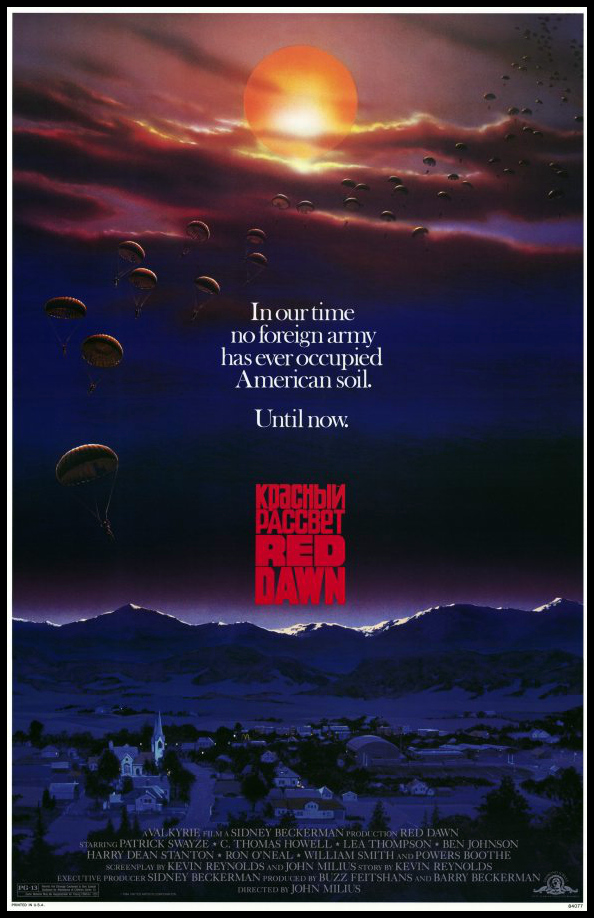
Review: Red Dawn (dir. by John Milius)


“I don’t know. Two toughest kids on the block I guess. Sooner or later they’re going to fight.”

[guilty pleasure]

Anyone who grew up during the 1980’s would say that some of the best action films were made and release during this decade. I won’t disagree with them and probably would agree to a certain point. This was the decade when action films evolved from the realism of the 70’s to the excess and ultra-violence of the 80’s. This was the decade which ushered in such action heroes as Schwarzenegger, Stallone and Willis. It was also the decade which released one of the most violent films ever released by a major motion picture studio. It’s a film that has been remembered through the prism of nostalgia. I speak of the 1984 war film by John Milius simply titled Red Dawn.

John Milius is one of those filmmakers who never conformed to the stereotype of liberal Hollywood. He was an unabashed Republican (though he considers himself more of a Zen anarchist) in a liberal studio system who happened to have written some of the most revered films of the 1970’s (Jeremiah Johnson, Apocalypse Now, Dirty Harry). He came up with a follow-up to his hugely successful Conan the Barbarian in the form of a war film set in current times (mid-80’s) America that he called Red Dawn. It was a story which takes an alternate history of the Cold War where Soviet forces and it’s allies launch a successful preemptive invasion of the United States. Before people think that this was the idea born of a conservative, warmongering mind it’s been documented that Milius’ inspiration for this film was a real Pentagon hypothetical exercise of what would happen if the Soviet Union conducted a conventional invasion of the United States and how the government and it’s population would react and resist such an occupying force. The  story would finally get it’s final treatment with major input from screenwrtier Kevin Reynolds’ own story which added a certain Lord of the Flies vibe to the group of teenagers who form the bulk of the film’s cast.

The film actually starts off with an impressive sequence of your typical Midwestern high school day with students seated in their classrooms. One moment this Rockwellian image gets a surprise from soldiers parachuting in the field outside the school. Thus we have the beginning of the Soviet invasion with one of the teachers being gunned down for trying to peacefully interact with the airborne troopers. The rest of the film is about a group of highschoolers led by senior Jed Eckert (Patrick Swayze) and his younger brother Matt (Charlie Sheen) as they flee with a handful of their classmates the massacre at their school and soon their whole town as well.

Red Dawn uses the first half of the film to show the confusion and chaos created by the sudden appearance of foreign soldiers on America soil attacking civilians and, soon enough, whatever American military response that manages to react in the area. We’re put in the shoes of Jed and his band of teenagers as they try to survive the roving bands of Soviet and Cuban soldiers patrolling the plains and countryside surrounding their hometown of Calumet, Colorado. We see American civilians packed into re-education camps and rumors of KGB secret police making certain troublemakers disappear and worst. It’s the America Cold War nightmare scenario where the Soviet Evil Empire has taken a foothold on US soil and the government and military nowhere in sight to help it’s population.

The second half of the film solves this scenario by arming the teenagers led by Jed into a sort of teen guerrila force using their school’s mascot as their rallying cry. It’s the shouts of “Wolverines!” which has become part of American pop-culture as we get to see these teenagers conduct hit-and-run strikes on enemy patrols and forward bases while at the same time arming those they free from camps. It’s during this part of the film where the violence gets ramped up to an almost ridiculous level. It’s no wonder that for almost two decades this film would be considered by Guinness World Records as the most violent film ever put on the big-screen. Milius and his filmmaking crew do not skimp on the use of blood squibs as Jed and his ragtag band of teen fighters gun down Soviets, Nicaraguans and Cuban soldiers by the score every minute during a long montage in the middle of the film.

Red Dawn in terms of storytelling is actually quite good in the grand scheme of the narrative being told, but even through the prism of nostalgia and rose-tinted glasses the characters in the film get the short-end of the stick. With the exception of Swayze’s eldest teen Jed as leader of the Wolverines the rest of the band’s teenage characters look like your typical casting call stereotypes who fill in the required roles in any ensemble cast. There’s Darren Dalton as the high school class president jealous of the group’s leader Jed, but unable to act on it. We have C. Thomas Howell as Robert the mousy one when the film begins who becomes a hardened and cold-hearted killer as the film goes on. Everyone fits in neatly to their assigned role and noen of the young actors (at the time) bring much to their characters.

This film continues to be remembered fondly by it’s fans both new and old because of the “what-if” scenario being played out on the screen. I would say that if there ever was a pure American film I would think Red Dawn manages to fit the bill. It’s a film which highlights the so-called individualism and can-do attitude Americans see for themselves. How it’s up to each individual to fight to protect their loved ones and for what is theirs. Some have called this film as a conservative’s wet-dream, but I rather think it’s a film that should appeal more to Libertarians as it focuses on individual liberties and self-preservation when the government and military tasked to protect them have failed.

John Milius has always been a maverick in Hollywood and his unpopular political beliefs have kept him from doing more work in the film industry, but one cannot deny the fact that he made one of the most iconic films of the 1980’s. Whether one agreed with the film’s politics and thought it to be a good film or not was irrelevent. Red Dawn has become part of American pop-culture and will continue to be a major example of the excess of 80’s action filmmaking for good or ill. Plus, even the most liberal people I know find the basic story of fighting to protect the nation from invaders something that feeds their innermost fantasy of playing the good guys fighting the good fight. Red Dawn is a great example of the underdog film that just happens to have teenagers kicking Soviet military ass.

Film Review: Man on a Ledge (dir. Asger Leth)


The newly released film Man on a Ledge is about a man (played by Sam Worthington) who checks into a hotel room in New York City and then climbs out on a ledge and threatens to jump off unless a specific hostage negotiator is brought in to talk him off the ledge.  We quickly discover that Worthington isn’t just a depressed jumper.  Instead, he’s got a really lengthy and overly complicated back story.  It turns out that he’s a former detective who used to moonlight for a venture capitalist and then one day, he was accused of stealing a priceless diamond and destroying it.  This resulted in him getting sentenced to 25 years in prison but when his father is reported to have died, Worthington is released from jail for a day so he can attend the funeral.  So, Worthington escapes and then ends up out on a ledge as part of a massively complicated plan to prove his innocence.  His name, by the way, is Nick because people named Alvin are never the stars of action movies.

Meanwhile, the cop that Nick demands to speak with is a hardened, veteran hostage negotiator and she’s played by Elizabeth Banks.  Yes, you read that correctly.  Anyway, Nick asks for her because he knows that the last guy she tried to talk out of jumping apparently jumped off a bridge.  Since Banks failed her last time out, her efforts to talk Nick off the ledge are cautiously observed by another detective, this one played by Edward Burns.  Banks is totally and completely miscast here and she has next to no chemistry with Sam Worthington.  However, she does have really good chemistry with Edward Burns.  Seriously, they would make a really cute couple and I would buy any issue of Us Weekly that had them on the cover.

Meanwhile, the guy that Nick is accused of stealing from just happens to be in a building across the street where he’s conducting some sort of generically evil business deal.  He’s a painfully thin, almost sickly man and, whenever he was on screen, I found myself wondering how his head managed to stay balanced on his body.  At first, I thought maybe it was the Red Skull waiting for the sequel to Capt. America to start filming.  However, on closer inspection, he turned out to be respected character actor Ed Harris.  In this film, Harris plays a ruthless capitalist who would have gone bankrupt if not for the insurance money he got as a result of Nick supposedly destroying that diamond.  Anyway, Harris appears to be enjoying playing a bad guy and he’s so over-the-top in his evil that you don’t really mind that he’s another one of those “I-should-kill-you-now-but-first-we-talk” type of villains.

Meanwhile, there’s two other people who are taking advantage of all the chaos caused by the man on the ledge to break into Harris’s building.  They’re played by Jamie Bell (who looks a lot like Casey Affleck in this film) and telenova veteran Genesis Rodriguez.  As you watch Bell and Rodriguez sliding down heating ducts and scaling elevator shafts, you can’t help but marvel at just how overly complicated everyone is making things.  Still, Bell and Rodriguez have a lot of chemistry and they’re fun to watch.

Meanwhile, NYC television reporter (played by Kyra Sedgwick) is running around the streets of New York, asking random bystanders how they feel about the prospect of Nick jumping.  Apparently, she is an old enemy of Elizabeth Banks’ though that whole plot line is dropped as soon as its brought up.  Still, the audience in my theater chuckled when Sedgwick dramatically rolled her r’s while introducing herself as “Suzie Morales.”

Meanwhile, there’s a bearded guy watching Nick up on the roof and he suddenly decides to go all Occupy Wall Street on the movie’s ass and starts shouting, “Attica!  Attica!” before then blaming it all on the 1%.  Unfortunately, he doesn’t put on Guy Fawkes mask at any point during all of this.

Meanwhile, the entire city of New York is obsessed with the man on the ledge and, if nothing else, they all end up acting exactly the way that people who have never been to New York City (like me) assume that people in New York act.  By that, I mean all the extras are all like, “Yo, Paulie!  There’s some man on a ledge!  Stop breaking my balls!” 

Meanwhile, there’s one final twist to the film’s plot that I can’t share without spoiling the film.  So, I’ll just say that it involved someone working at the hotel and I figured out the twist about 3 minutes after this character first appeared.  This is one of those twists that if you can’t figure out on your own then you need to hang your head in shame.  Seriously.

This film packs a lot of plot into 90 minutes of screen time and, not surprisingly, the end result is a bit of a mess.  This is one of those films where every single character attempts to solve his or her problems in the most needlessly complicated and implausible way possible.  Still, almost despite myself, I enjoyed Man on a Ledge.  It’s just all so silly and stupid that it becomes oddly likable.  The film also has two nicely done chase scenes and some of the scenes where Nick attempts to manuever about on the ledge made me go, “Agck!”

Seriously, I don’t do heights.