Film Review: Hell or High Water (dir by David Mackenzie)


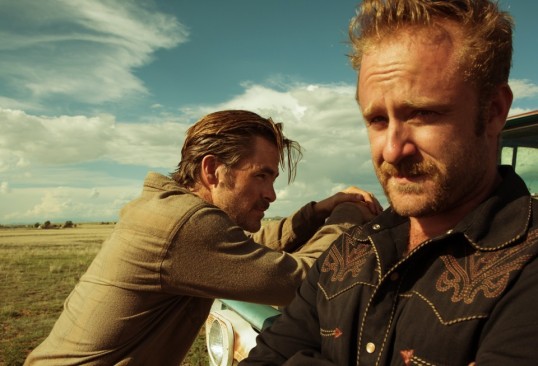
The Texas-set film Hell or High Water features four excellent lead performances.  There’s Chris Pine and Ben Foster, playing brothers and robbing banks.  And then there’s Jeff Bridges and Gil Birmingham, as the two Texas Rangers who are attempting to hunt the brothers down.

But for me, my favorite character was the waitress who, during the latter half of the film, serves lunch to the two Texas Rangers.  When Bridges asks her how she’s doing, she replies, “Hot and not in the good way.”  When the two Rangers start to order their food, she stops them and tells them that everyone who comes in the diner orders the same thing except for one “asshole from New York” who tried to order a trout.  “We ain’t got no goddamn trout!”  It’s a short scene but it’s one of my favorites because, if you’ve ever spent any time in West Texas, you know that this scene is probably the most realistic in the entire film.

My second favorite character was a banker teller played by the great Dale Dickey.  When the Rangers ask her if the men who robbed her bank were black, she replies, “Their skin or their souls?”  You just have to hear the way that she delivers it.  In theory, that should be an awkward line but Dale Dickey makes it sound totally natural.

In fact, everything about Hell or High Water seems totally natural.  For a film about bank robbers, it’s actually a deceptively low-key film, one that is as memorable for its quiet moments as its shoot outs.  When the violence does come, it’s all the more jarring because the movie has spent so much time focusing on the tranquil stillness of the West Texas landscape.

(That said, I should point out that the film was actually shot in New Mexico.  But, quite frankly, New Mexico is pretty much just West Texas with more Democrats.)

Hell or High Water is a film that’s all about the little details.  The film opens with a bank robbery and, as the camera gracefully circles the bank, we catch a glimpse of graffiti announcing that the artist did 4 tours in Iraq and that “bailouts (are) for banks, not for me.”  At its heart, Hell or High Water is about the many people who have been left out of this so-called “economic recovery,” in which we’re all supposed to have such faith despite having seen little evidence of its existence.  While the rich get richer, the struggle of the people in Hell or High Water is ignored by everyone but them. And so, the people do what they can to survive.  For some, that means robbing banks.  For others — like a wonderfully snarky group of witnesses in a diner — that means refusing to admit that they saw anything happen.  If you want to see a realistic portrait of economic uncertainty and populist revoltuon, don’t waste your time with the cutesy bullshit and bourgeois Marxism of The Big Short.  Watch Hell or High Water.

Of course, not everyone is willing to turn a blind eye to the bank robbing brothers.  Hell or High Water is not just about economic anxiety.  It’s also about the unique struggle of being a bank robber in a part of the country where literally everyone has a gun.  (During one robbery, Pine asks an old customer if he has a gun on him.  “Damn right I got a gun on me!” the old man snaps back.)  As opposed to so many other films, Hell or High Water gets West Texas right.

(It’s probably not a coincidence that we’re told the brothers robbed a bank in Archer City, the home of legendary Texas writer, Larry McMurtry.)

As for the film’s cast, Jeff Bridges and Ben Foster get the two “showiest” roles.  Jeff Bridges plays a Texas Ranger who is only a few days away from retirement and who enjoys needling his partner.  (One of the main delights of the film is the comedic interaction between Bridges and Gil Birmingham.)  Ben Foster is the more reckless of the two brothers, an ex-con who declares that everyone is his enemy but, at the same time, shows himself to be willing to do anything to protect his brother.  Both Bridges and Foster give excellent performances and Foster, in particular, reminds us that he’s one of the most exciting actors working today.

And yet, for me, the true anchor of the film is Chris Pine.  Chris Pine, of course, is best known for starring in the last three Star Trek films.  And while he was always an adequate lead in those films and he gave a wonderfully self-aware performance in Into The Woods, none of his past films prepared me for just how good a job he does in Hell or High Water.  Pine gives a quiet and rather subtle performance and, when we first see him, we automatically assume that he’s been dragged into the criminal life by his more flamboyant brother.  But as the film progresses, we start to realize that there’s more to both the character and to Chris Pine as an actor.  By the end of the film, we’re forced to reconsider everything that we previously assumed about everyone.

Speaking of end of the film — let’s just say that Hell or High Water has one of the best final scenes of 2016.  Like the film itself, it’s deceptively low-key but it leaves you reeling.

It took me a while to see Hell or High Water but I’m glad I did.  Come Hell or high water, you should see it too.

Film Review: Moonlight (dir by Barry Jenkins)


moonlight

I’m going to start this review of Moonlight by affirming something that you’ve either heard or, if you’ve seen the film, that you already know.

Moonlight is one of the best films of 2016.  Many critics have declared it to be the best.  When the Academy Award nominations are announced next month, Moonlight will receive several of them.  Barry Jenkins will not only be the fourth black filmmaker to be nominated for best director but he may very well be the first to win.  Personally, I would rate Arrival and Kubo and the Two Strings higher than Moonlight but I certainly won’t complain if Moonlight wins every Oscar that it’s nominated for.  It’s a powerful and personal film, one that might make you cry and will definitely make you think.  It sticks with you, from the brilliant opening to the powerful closing shot.  In a weak year for films, Moonlight stands one of the few legitimately great releases of 2016.

Moonlight is a film in three parts, all dealing with the life of Chiron.  Though he rarely speaks and often keeps his feelings hidden behind a wall of pain and deception, Chiron is one of the most fascinating characters that you’ll ever get to know.  Growing up in Miami, he seems to be destined to be forever on the outside.  In a country that protects whiteness and celebrates wealth, he’s black and he’s poor.  In a social environment that values being hard and demands an almost cartoonish masculinity, Chiron is sensitive and gay.

When we first meet Chiron, he’s a child nicknamed Little and he’s played by Alex Hibbert.  When we first see him, he’s fleeing both school bullies and a homelife that’s dominated by his abusive, crack-addicted mother, Paula (Naomie Harris, giving a brave and raw performance that reminds you of just how wasted she was in the role of Moneypenny in SPECTRE).  The only positive influence in Chiron’s life is a Cuban drug dealer named Juan (Mahershala Ali, who gives a performance of amazingly subtle power) and Juan’s girlfriend, Teresa (Janelle Monae).  Juan is the one who teaches Chiron how to swim.  He’s the one who tells Chiron that he can be more than he realizes.  Juan is the one who encourages Chiron to be himself, regardless of what the rest of the world demands that he be.  And yet, Juan is also the one who sells the drugs that are destroying Chiron’s mom.

We also see Chiron as an awkward and withdrawn teenager and this time, he’s played by Ashton Sanders.  Chiron struggles with his attraction to his best friend, Kevin (Jharrel Jerome) and does his best to avoid a terrifying bully named Terrel (Patrick Decile).

And finally, we meet Chiron as a muscular and sometimes menacing adult and he’s now played by Trevante Rhodes.  It’s when we meet the adult Chiron that we suddenly understand why the film was structured the way that it was.  As intimidating and noncommunicative as adult Chiron may be, we know who he really is.  We know that he’s still the same kid who we first saw hiding inside an abandoned apartment.  When Chiron received an unexpected phone call from Kevin (now played, quite poignantly, by Andre Holland), he’s forced to confront who he truly is.  It leads to … well, I don’t know how to tell you what it leads to without spoiling the film for you.  I will say that the film ends with a haunting image, one that will stick with you long after the film ends.

Moonlight is a heartfelt and incredibly moving film, one that will challenge all of your preconceived notions and one that will stick with you long after you see it.  Brilliantly directed and acted, Moonlight is a film full of beautiful, haunting, and often dream-like images.  (Cinematographer James Laxton is almost as important to the film’s success as director/screenwriter Barry Jenkins.)  And you definitely should see it if you haven’t.

It’s one of the best of 2016.

moonlight-620x360

Playing Catch Up With The Films of 2016: Race (dir by Stephen Hopkins)


race

Do you remember Race?

It came out in February of this year and it was kind of a big deal for a week.  I think everyone was expecting it to be a big hit, just because there’s never much competition in February.  Race is a biopic of Jesse Owens, the African-American runner who sets world records and won gold medals at the 1936 Berlin Olympics, defeating a legion of Aryan athletes while Adolf Hitler watched from the stands.  Not only is that a compelling story but 2016 was also an Olympic year.  Eddie The Eagle had already been a success due to the Olympic connection.  Add to that, Focus Features promoted the Hell out of this film.  In they weeks leading up to its release, I saw commercials for it on a nearly hourly basis.  The reviews, when the came, were mixed but generally positive.

I’m not really sure how Race did at the box office.  According to Wikipedia, on its opening weekend, it was sixth at the box office.  Apparently, the film only had a budget of five million and ultimately made a profit of $20,000,0000.  I guess that would make it a success.  All I know is that it seems like, for all the hype, Race just kind of came and went.

In fact, I didn’t see Race until about two months ago.  It’s one of those films that’s not really great but it’s certainly not bad.  It’s pretty much the epitome of being adequate.  It was well-made and generally well-acted.  Director Stephen Hopkins occasionally struggled to maintain a consistent pace (Race is over 2 hours long and feels longer) but he still did a good job filming the scenes of Owens of running and competing.  In the role of Jesse Owens, Stephan James was well-cast.  You not only believed him in the dramatic scenes but he was also believable as a record-setting athlete.  He had some great scenes with Jason Sudekis, who was surprisingly believable in the role of Jesse’s coach.

With all that in mind, why didn’t Race make more of an impression?  I think that, too often, Hopkins allowed the film’s focus to wander away from Jesse and the inner conflict he felt as he won medals for a country where he was treated like a second-class citizen.  There were too many random scenes of Jeremy Irons and William Hurt, playing Olympic officials and debating whether or not to boycott Hitler’s Olympics.  During the second half of the film, Leni Riefenstahl (Carice van Houten) showed up and we got a few scenes of her trying to film Jesse’s triumph at the Olympics despite the interference of Nazi propaganda minister, Joseph Goebbles (Barnaby Metschurat).  All of these extra scenes are supposed to set Jesse’s struggle in a historic context but they’re unnecessary and distracting.  All the context that the film needs can be found in the fact that Jesse was a black man living in America in the 1930s.

For the most part, Race is uneven but occasionally the film delivers a powerful scene or two.  One of the most powerful parts of the film comes when Jesse, after setting world records and being proclaimed as a hero across the world, is informed that he still can’t enter a New York club through the front door.  As well, the scenes depicting Jesse’s friendship with German jump Luz Long (David Kross) are poignant.  In fact, they’re so poignant that I initially assumed that they were fictionalized for the film but actually, Jesse and Luz Long did become good friends during the 1936 Olympics.

Race is uneven but it’s not bad.  Stephan James gives a good performance as Jesse and, if nothing else, the film provides a worthy history lesson.

Playing Catch-Up With The Films of 2016: The 5th Wave (dir by J Blakeson)


The 5th Wave, which came out in January of this year (and that really should be all you need to hear), is the epitome of a “Who cares?” type of film.

It’s another YA adaptation, taking place in a dystopian future and featuring way too many characters for its own good.  Aliens have invaded the Earth and they’ve attacked in 4 waves.  There was the 1st wave, which destroyed all of the electricity.  There was the 2nd wave which involved a lot of earthquakes and natural disasters.  I imagine California fell off the mainland during the 2nd wave.  The 3rd wave involved bird flu.  The 3rd wave is important because it killed the mother of our protagonist, teenager Cassie Sullivan (Chloe Grace Moretz).  You can’t be a YA protagonist unless you have at least one dead parents.  That’s the rules of the genre.

The 5th Wave deals with the … well, the fifth wave.  As far as I can tell, the 5th Wave involves turning every human left into a stock character from a YA dystopian novel.  Basically, if you’ve sat through Divergent or The Maze Runner or The Giver or countless other YA adaptations, you already know who everyone is in The 5th Wave.  Cassie is our heroine, which means that she spends a lot of time wandering around in the forest, killing potential threats, and thinking about how different things were back in high school.

And that’s really all she does.

See, The 5th Wave last nearly two hours and not a damn thing happens in the entire film.  That’s because the 5th Wave is all about setting up a sequel.  We meet a lot of characters.  We get a lot of backstory.  Imagine if The Walking Dead did a half-season with 6 shows straight of people talking about doing things but never actually doing any of it. (Oh, wait, they did just do that…)  That’s pretty much what sitting through The 5th Wave was like.  We learn that there are aliens disguised as humans.  We learns that what’s left of the government cannot be trusted and I was totally happy with that plot development because seriously, the government sucks.  As we watch Moretz, Ron Livington, Liev Schriber, and Maria Bello struggle to make some of the most cliched dialogue ever sound compelling, we learn that being a talented actor doesn’t mean that you always get to appear in interesting films.

Things drag on and then they end.  Why do they end?  Because that’s the way YA adaptations works.  Nothing can be resolved in just one movie.  Instead, everything’s about setting things up for the next installment.  At the very least, all YA films have to be a part of a trilogy.  And the third part of the trilogy always requires at least two parts to tell the entire story.  That’s just the way things works.

And really, I thought that Divergent was the most soulless YA adaptation that I had ever seen.  But the 5th Wave makes a strong case that perhaps it deserves the title.

I guess we could wait to see what happens when part two comes out but seriously, who cares?

Playing Catch Up With The Films of 2016: Whiskey Tango Foxtrot (dir by Glenn Ficara and John Requa)


whiskey_tango_foxtrot_poster

Some day, someone will get around to making the ultimate Tina Fey movie, which will basically just be 4 and a half hours of people talking about how much they love Tina Fey while Tina makes silly faces in the background.  Until that day comes, viewers will just have to settle for Whiskey Tango Foxtrot.

In Whiskey Tango Foxtrot, Tina Fey plays Tina Fey playing real-life journalist, Kim Baker.  When the film starts, Kim accepts an assignment as a war correspondent in Afghanistan.  Though she starts out as neurotic and intimidated, Kim soon steps up and emerges as a passionate and committed journalist, one who is dedicated to revealing the truth — both good and bad — about what’s happening in Afghanistan.  Helping her along the way is a BBC reporter, Tanya Vanderpool (Margot Robbie) and a Scottish photographer named Iain (Martin Freeman).  Iain and Kim may be attracted to one another but Kim has a boyfriend (Josh Charles) back in New York.  How long do you think it takes for Kim to catch her boyfriend cheating via Skype?

Whiskey Tango Foxtrot is one of those movies that you just know was made to be an Oscar contender.  Not only does it deal with a big important subject but it stars a popular performer in a change-of-pace role.  Except, of course, it’s not really that much of a change-of-pace.  Tina Fey’s a good actress but you never forget that you’re watching Tina Fey.  You never think to yourself, “Kim is caught in the middle of a firefight” or “Kim is getting addicted to the rush of being a war zone.”  Instead, you think, “Any minute now, Tina Fey’s going to start shooting a gun and it’s going to be funny because she’s Tina Fey.”  Towards the end of the film, when a U.S. soldier who has lost his legs tells Kim to never stop trying to tell the people the truth about what’s happening in Afghanistan, you don’t think, “Don’t give up, Kim!”  Instead you think, “Wow — so that soldier lost his legs so that Tina Fey could have an Oscar moment.”

If I haven’t already made it clear, Whiskey Tango Foxtrot is an extremely uneven film, one that never seems to be sure if it wants to be a relationship comedy, a media satire, or a serious look at the realities of war.  The film works best when it concentrates on the friendship between Tanya and Kim and it’s nice to see a film about two women who are colleagues and friends.  When Tanya first showed up, I was worried that the film would devolve into one of those “Women can’t work together” diatribes or that Tanya would immediately be set up as some sort of mean girl rival for Iain.  Instead, the film explores how women support each other through even the most difficult of circumstances.  But then there’s other scenes that just don’t work as well, like the scenes with Alfred Molina as an Afghan politician who has a crush on Kim.

Whiskey Tango Foxtrot has its moment but ultimately its too uneven to be of much consequence.

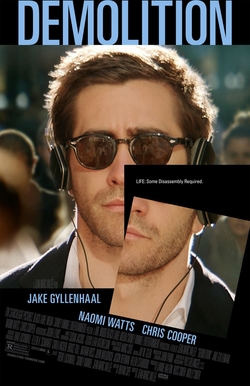
Playing Catch Up With The Films of 2016: Demolition (dir by Jean-Marc Vallee)


demolition_poster

Jake Gyllenhaal is owed an Oscar.  We all know that.  He should have been nominated for Nightcrawler and, even more importantly, he should have won.  However, for whatever reason, the Academy snubbed him.  Ever since then, we — and by “we,” I mean “me” but “we” sounds better — have been waiting for him to get another nomination.

Last year, for instance, we thought he would be nominated for Southpaw.  Then the movie came out and it turned out to be not that good.

This year, we thought it would be for Demolition.  Then Demolition came out and it turned out to be worse than Southpaw

And really, it shouldn’t have been.  Demolition was directed by Jean-Marc Vallee, who was rightly acclaimed for his work on Wild and Dallas Buyers Club.  Not only did it star Jake Gyllenhaal but it also featured Naomi Watts and Chris Cooper!  I mean, how could you go wrong with all that talent?

But the thing is, Jean-Marc Vallee may have directed Wild and Dallas Buyers Club but also directed the wildly uneven The Young Victoria.  Naomi Watts is a great actress but it’s rare that she gets truly great parts.  Chris Cooper can be great but he’s usually at his least subtle whenever he’s playing a suit-wearing authority figure.  As far Jake Gyllenhaal, he is an actor who was born to play eccentric outsiders.  Whenever he has to play someone who is “conventional,” he can seem miscast.

Now admittedly, Davis Mitchell is only “normal” for a few minutes in Demolition but, for the film to work, you have to believe that he was once a successful investment banker who made a lot of money, lived in the suburbs, and never questioned anything.  Since you never believe that Jake Gyllenhaal could ever not be eccentric, it’s hard to be shocked when Davis starts destroying houses and dancing in public.  Everyone else in the movie is so shocked to discover that Davis had an eccentric side but we’re not because he’s played by Jake Gyllenhaal.

The reason why Davis is acting so strange is because his wife has just died in a horrific auto accident.  Now that she’s gone, Davis finds himself wondering if he ever loved her and questioning his entire life.  What little joy he gets comes from helping to tear down houses and corresponding with Karen (Naomi Watts).  Karen works for a vending machine company.  When the hospital vending machine didn’t give Davis the candy that he paid for, he wrote a long letter to the company and explained that his wife has just died and…

*sigh*

See, this is one of those films that is so relentlessly quirky and full of scenes that are supposed to be profound and thought-provoking that it’s kind of a drag to actually try to describe the film’s plot.  I mean, it actually kind of ticks me off to think about all of the contortions that Demolition goes through in its attempt to convince us that it actually has something important to say.  (I was shocked to discover that it wasn’t based on a Nicholas Sparks novel.)  It’s one of those films that obviously has the best of intentions but it’s so overwritten and overdirected and overly portentous that anyone who has ever had to deal with depression will get annoyed with the simplified and shallow way that Demolition deals with it.

Demolition was supposed to be an Oscar contender last year but it’s release date got moved back and I can understand why.  The movie’s a mess.

Here’s hoping that Jake Gyllenhaal gets a great role next year!

Playing Catch-Up With The Films of 2016: Elvis & Nixon (dir by Liza Johnson)


elvis__nixon_poster

When you think of actors who you could cast in a biopic of Elvis Presley, Michael Shannon is probably not the first actor who comes to mind.  And yet that’s just what the people behind Elvis & Nixon did.  They also cast Kevin Spacey as Richard Nixon, a decision that, on the surface, makes more sense than Shannon playing Elvis.

And yet, in the finished film, it’s Shannon who gives the memorable performance while Spacey often seems lost in the role of Nixon.  Fortunately, with Kevin Spacey’s role largely being an extended cameo, Michael Shannon is the one who is in nearly every scene of the movie.

Elvis and Nixon is based on a true story.  In 1970, Elvis Presley asked for a meeting with Richard Nixon who, if the film is to be believed, wasn’t quite sure who Elvis actually was.  It turns out that Elvis was very concerned about the growing popularity of illegal drugs.  In between consuming prodigious amounts of legal drugs, Elvis formulated a plan.  Perhaps he could go to the White House and convince Nixon to deputize him.  Elvis could be a special agent of the FBI.  Even more importantly, maybe Elvis could get a FBI badge.

So, was Elvis sincere or was he just crazy?  Elvis & Nixon walks a thin line between those two possibilities, suggesting that Elvis may have been a bit unblanced but he was also achingly sincere.  Michael Shannon plays Elvis as a man who is blissfully out-of-touch but who truly wants to make the world a better place.  As played by Shannon, Elvis is defined by ennui.   He may be the biggest star in the world but he still struggles with the feeling that he hasn’t accomplished anything.  This is a film that asks, “When you’ve reached top, where else can you do?”  Elvis wants to make the world a better place by combating the spread of drugs.

And he also really, really wants that badge.  There’s an almost child-like petulance to Shannon’s Elvis.  He may be sincere but he’s also very much used to getting whatever he wants.

For that matter, so is Nixon.  And Nixon really doesn’t want to visit with Elvis.  Of course, that’s before his White House aides mention that being seen with Elvis could help him with the youth vote when he runs for reelection.  And then his daughter says that she wants Elvis’s autograph….

Anyway, it all leads to a meeting in the Oval Office and a scene that would have worked better if Spacey’s performance as Nixon was a bit less of caricature.  That said, the scene still works because Michael Shannon totally invests himself in the role of Elvis.  When he’s talking to Nixon and showing off his karate moves, Elvis is happier than we’ve ever seen him.  He’s performing on the biggest stage of his career.

Elvis & Nixon came out earlier this year.  It’s an enjoyable film, even if it’s never quite as good as you might want it to be.  If nothing else, this film proves that Michael Shannon can pretty much do anything.


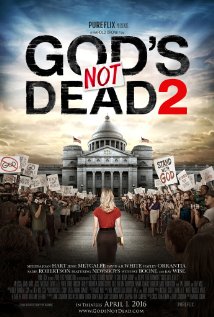
Catching Up With The Films of 2016: God’s Not Dead 2 (dir by Harold Cronk)


gods_not_dead_2_poster

Much like Warcraft and Nine Lives, God’s Not Dead 2 is one of those films that you just know is going to be mentioned on all of the “worst films of 2017” lists.  I imagine that it will get a lot of Razzie nominations and it might even win a few.

But you know what?  I watched God’s Not Dead 2 on YouTube and I enjoyed it, though probably not for the reasons that the filmmakers intended.  God’s Not Dead 2 is one of the most thoroughly over-the-top and shamelessly melodramatic films that I have ever seen.  This is one of those faith-based films where all of the Christians are practically saintly while the atheists are portrayed as being so evil that they might as well be tying people to train tracks and twirling their mustaches.  This is one of those films where the good guys discuss their plans while sitting in quaint kitchens while the bad guys gather in conference rooms and growl about how much they hate religion.  And the propaganda is just so blatant and lacking in subtlety that it becomes undeniably watchable.

God’s Not Dead 2 is, for lack of a better comparison, the Reefer Madness of Christian filmmaking.  It’s a film that makes Rock: It’s Your Decision look like a work of subtle nuance.  You may want to look away but you won’t be able to.

Essentially, God’s Not Dead 2 takes the heavy-handed sanctimonious sermonizing of the first film and then adds a healthy dash of anti-government paranoia.  (And you know how much I love anti-government paranoia.)  In this one, Melissa Joan Hart is a teacher who makes the mistake of 1) mentioning to her class that the Sermon on the Mount inspired Gandhi and Martin Luther King and 2) counseling a student who is struggling to deal with the death of her brother.  (When the student asks Melissa what gives her strength, Melissa replies, “Jesus.”)  Melissa is brought before the school board, which says that Melissa has broken the law and that they want to take away her teaching license.  Offering absolutely no support is her principal (Robin Givens).  Fortunately, a handsome lawyer (Jesse Metcalfe) is willing to help her out.  He doesn’t believe in God but how long do you think that will last?

Prosecuting Melissa is … a lawyer from the ACLU!  We know that this lawyer is evil because his name is Peter Kane and he’s played by Ray Wise.  And here’s the thing — Ray Wise gives perhaps the least subtle performance of the year.  When he talks about the importance of convincing America that there is no God, he does so with the type of evil gleam in his eye that we typically tend to associate with lower tier MCU villains.  When he cross-examines Melissa’s students, he smirks like a serial killer.  Whenever he has to say words like “God” or “Jesus,” he literally spits them out.  The only thing that trips him up is when a Christian admits to having once been an atheist and Wise looks so stunned that you half expect him to say, “But that is illogical and does not compute” before revealing that he’s actually a robot sent from the future. He’s one of the most evil characters of all time and Wise so throws himself into the role that you can’t help but enjoy watching him.

So, on the one side, you have Ray Wise spitting hellfire and, on the other side, you have a literally beatific Melissa Joan Hart.  And let’s give credit where credit is due — Melissa Joan Hart does as well as anyone could with her seriously underwritten and kinda drab character.  (Add to that, Melissa Joan Hart was Sabrina, The Teenage Witch and, therefore, I will always give her the benefit of the doubt.)

Meanwhile, there’s another subplot going on.  The local preacher — who somehow manages to get on the jury, despite the fact that there’s no way a preacher would actually be put on the jury of trial that centered around separation of church and state — is being pressured by the local authorities.  They want to see copies of his sermons.  Damn government!

Of course, what’s interesting is that this actually did happen in Houston.  In 2014, several preachers were presented with subpoenas demanding copies of their sermons, in order to determine if they had been preaching against the Houston Equal Rights Ordinance.  For that matter, there was also recently a story down here about a high school football coach who lost his job because he led his team in a prayer.  There is a basis in reality for both of the film’s main storylines but you’d never guess that from watching God’s Not Dead 2.  God’s Not Dead 2 is so melodramatic and so firmly devoted to its good-vs-evil worldview that it sacrifices whatever real world credibility it could have and probably does more harm than good to the cause that it supports.

That being said, it’s a fun movie in much the same way that the Atlas Shrugged trilogy was fun.  It’s just so silly and over-the-top that you can’t help but watch.  I imagine that believers will enjoy seeing the nonbelievers ridiculed while nonbelievers will enjoy shaking their head and saying, “How can anyone buy into this?”  By taking the side of half the audience but doing so in a way that seems to confirm every pre-conceived notion held by the other half, God’s Not Dead 2 appeals to all.

If nothing else, Ray Wise deserves some sort of award for perfecting the art of villainous overacting.  Though this year, he may have to share it with Kyle Secor.  Secor’s work in The Purge Election Year is impossible to top but Ray Wise sure does come close.

Overacting is not dead.

Playing Catch-Up With The Films of 2016: Nine Lives (dir by Barry Sonnenfeld)


Much like Warcraft, Nine Lives is another film that came out last year and got reviews that were far more negative than they should have been.  I mean, don’t get me wrong.  Nine Lives is technically a pretty stupid movie and it stars a lot of actors who probably should be doing something a little bit more substantial with their time.  That being said, it’s not as if Nine Lives ever promised to be anything more than what it is.

Two facts about Nine Lives:

Number one — it did not make me physically ill, which already makes it a better movie than Hardcore Henry.

Number two — it’s all about cats!  After being more or less pushed to the side by The Secret Life of Pets (which featured only one tokenish kitty), cats finally get a movie of their very own!

It may not be a very good movie but that’s beside the point.  KITTY POWER!

As for what the film is about — well, it’s a concept that is so silly and stupid and predictable that I’m not surprised that it was produced by a major American studio.  (Except apparently, it wasn’t!  Despite taking place in America, featuring a totally American cast, and English dialogue, this is actually a French film, produced by Luc Besson’s EuropaCorp.)  Kevin Spacey is an emotionally cold and ruthless businessman who discovers that he does have a heart when he switches bodies with a cat.  Don’t ask how he switches bodies, it’s just too silly for me to talk about.  The important thing is that he switches and it leads to a lot of litter box jokes that made me, as a proud cat owner, cringe.

BUT — and here’s why this film is not as bad you may think, the cat is really cute.  And if a cat did speak with a human voice, chances are that voice would sound a lot like Kevin Spacey’s.  It may sound like a pretty weird role for a two-time Oscar winner and multiple Emmy nominee (and don’t even get me started on the Golden Globes) but dammit, Kevin throws himself into voicing that feline’s thoughts and good for him!

Plus, this is yet another film that features a totally out there Christopher Walken cameo.  The presence of Christopher Walker automatically elevates any film.

Nine Lives may not be good but it’s not terrible.

(Of course, dog lovers will hate it….)


Playing Catch-Up With The Films of 2016: Warcraft (dir by Duncan Jones)


Last night, my cousin and I watched Warcraft, which is a film that has been called “the worst of 2016” by several critics.

Personally, I don’t think it’s the worst film of 2016.  It didn’t make me physically ill, like Hardcore Henry did.  My cousin — who, unlike me, has actually played all of the Warcraft games and therefore came into the film already knowing who and what everything was — says that he enjoyed it.  On the basis of both Moon and The Source Code, I think Duncan Jones is a genius who will eventually emerge as one of the most important directors working right now.  Dominic Cooper is in Warcraft and so is Ben Foster.  They’re both fairly unrecognizable (thought not as unrecognizable as Clancy Brown!) but they’re also two excellent actors and I’m always happy to see them listed in the credits.  Visually, the film was well-designed though it was impossible for me not to think about the Make Love, Not Warcraft episode of South Park.

But I have to say that no film has ever left as totally confused as Warcraft.  I got that the film was about a war between Orcs and humans.  And I appreciated the fact that the film attempted to give all of the Orcs their own individual personalities and culture.   If I wanted to, I could probably spend a few 100 words talking about how the war in Warcraft can serve as a metaphor for every war currently being fought in the real world.

But seriously, I spent nearly the entire film trying to keep straight who was who.  The cast was huge and the dialogue was full of people and creatures talking about magic and honor and history and tradition and sacrifice and why so-and-so had to do this to such-and-such because of something that happened to someone else centuries ago and it made my head hurt trying to keep up with it all.  I eventually gave up.  My cousin was enjoying the film and, in the end, that’s all that mattered.

Plus, there was a cute little orc baby!  I liked him and his story reminded me of the story of Moses floating away in that basket.

Anyway, Warcraft was slaughtered by critics and, because it cost a ton of money to make, it didn’t make any money back.  So, the film probably won’t get the sequel that the ending was obviously designed to set up.  However, I get the feeling that, next year, Warcraft will be a popular film to live tweet whenever it shows up on SyFy.

It may have been the most incoherent film of 2016 but it wasn’t necessarily the worst.