Horror Film Review: The Sentinel (dir by Michael Winner)


Here’s the main lesson that I’ve learned from watching the 1977 horror film, The Sentinel:

Even in the 1970s, the life of a model was not an easy one.

Take Alison Parker (Cristina Raines) for instance.  She should have everything but instead, she’s a neurotic mess.  Haunted by a traumatic childhood, she has attempted to commit suicide twice and everyone is always worried that she’s on the verge of having a breakdown.  As a model, she’s forced to deal with a bunch of phonies.  One of the phonies is played by Jeff Goldblum.  Because he’s Goldblum, you suspect that he has to have something up his sleeve but then it turns out that he doesn’t.  I get that Jeff Goldblum probably wasn’t a well-known actor when he appeared in The Sentinel but still, it’s incredibly distracting when he suddenly shows up and then doesn’t really do anything.

Alison has a fiancée.  His name is Michael Lerman (Chris Sarandon) and I figured out that he had to be up to no good as soon as he appeared.  For one thing, he has a pornstache.  For another thing, he’s played by Chris Sarandon, an actor who is best known for playing the vampire in the original Fright Night and Prince Humperdink in The Princess Bride.  Not surprisingly, it turns out that Michael’s previous wife died under mysterious circumstances.  NYPD Detective Rizzo (Christopher Walken) suspects that Michael may have killed her.

(That’s right.  Christopher Walken is in this movie but, much like Jeff Goldblum, he doesn’t get to do anything interesting.  How can a movie feature two of the quirkiest actors ever and then refuse to give them a chance to act quirky?)

Maybe Alison’s life will improve now that she has a new apartment.  It’s a really nice place and her real estate agent is played by Ava Gardner.  Alison wants to live on her own for a while.  She loves Michael but she needs to find herself.  Plus, it doesn’t help that Michael has a pornstache and may have killed his wife…

Unfortunately, as soon as Alison moves in, she starts having weird dreams and visions and all the usual stuff that always happens in movies like this.  She also discovers that she has a lot of eccentric neighbors, all of whom are played by semi-familiar character actors.  For instance, eccentric old Charles (Burgess Meredith) is always inviting her to wild parties.  Her other two neighbors (played by Sylvia Miles and Beverly D’Angelo) are lesbians, which the film presents as being the height of shocking decadence.  At first, Alison likes her neighbors but they make so much noise!  Eventually, she complains to Ava Gardner.  Ava replies that Alison only has one neighbor and that neighbor is neither Burgess Meredith nor a lesbian.

Instead, he’s a blind priest who spends all day sitting at a window.  He’s played by John Carradine, who apparently had a few hours to kill in 1977.

But it doesn’t stop there!  This movie is full of actors who will be familiar to anyone who enjoys watching TCM.  Along with those already mentioned, we also get cameos from Martin Balsam, Jose Ferrer, Arthur Kennedy, Eli Wallach, Richard Dreyfuss, and Tom Berenger.  There are 11 Oscar nominees wasted in this stupid film.  (Though, in all fairness, Christopher Walken’s nomination came after The Sentinel.)

Personally, The Sentinel bugged me because it’s yet another horror movie that exploits Catholic iconography while totally misstating church dogma.  However, the main problem with The Sentinel is that it’s just so incredibly boring.  I own it on DVD because I went through a period where I basically bought every horror film that could I find.  I’ve watched The Sentinel a handful of times and somehow, I always manage to forget just how mind-numbingly dull this movie really is.  There’s a few scary images but mostly, it’s just Burgess Meredith acting eccentric and Chris Sarandon looking mildly annoyed.  If you’ve ever seen Rosemary’s Baby, The Exorcist, or The Omen, you’ll figure out immediately what’s going on but The Sentinel still insists on dragging it all out.  Watching this movie is about as exciting as watching an Amish blacksmith shoe a horse.

There’s a lot of good actors in the film but it’s obvious that most of them just needed to pick up a paycheck.  I’ve read a lot of criticism of Cristina Raines’s lead performance but I actually think she does a pretty good job.  It’s not her acting that’s at fault.  It’s the film’s stupid script and lackluster direction.

Horror on the Lens: The Spiral Staircase (dir by Robert Siodmak)


For today’s horror on the lens, we have the 1946 suspense film, The Spiral Staircase!

In this film, Dorothy McGuire plays Helen, a young mute woman who has been hired to serve as a caretaker for wealthy old Mrs. Warren (Ethel Barrymore, who was nominated for an Oscar for this film).  At the same time, someone is murdering women in the same town.  Are they all connected?  Of course, they are!  The fun of the movie is discovering how they’re connected.

I was introduced to The Spiral Staircase by my friend and fellow member of the Late Night Movie Gang, Chris Filby.  It’s a gothic murder mystery, full of atmosphere and menace.  I think you’ll like it so, if you have 80 minutes to spend on it, please watch and enjoy!

Cleaning Out The DVR: Open Marriage (dir by Sam Irvin)


(Lisa is not just watching horror movies!  She is also trying to clean out her DVR!  She has got over 200 movies that she needs to watch before January 1st!  Will she make it?  Keep checking here to find out!  She recorded Open Marriage off of Lifetime on February 4th!)

Sometimes, cleaning out the DVR really does make you feel as if you’ve stepped into a time machine.

Take Open Marriage, for instance.  I recorded this film on February 4th and, as soon as I watched it, I was transported back to those romantic days leading up to Valentine’s Day.  Suddenly, I once again found myself in a time when every other commercial was either for Fifty Shades Darker or Adore Me lingerie.  I was reminded of how, from the beginning of January to the end of March, not a single day went by that I didn’t say to my boyfriend, “You like it too.  Right, babe?”

(If you’ve seen the commercial, you know what I’m talking about.  If not, don’t worry about it.)

Anyway, it’s appropriate that Open Marriage aired in between all of those commercials for Fifty Shades Darker.  Much like the Fifty Shades movies, Open Marriage is one of those films that pretends to be all decadent but which is actually kind of silly.  Ron (Tilky Jones) and Becca (Nikki Leigh) are young, pretty, and married but they’ve got some problems.  Ron recently hurt his back and he’s been out of work for a year.  They’ve got a huge house but they’re struggling financially.  Despite Ron’s big sexy tattoo, there’s no more spark to their marriage.

However, things change when they visit their friends, Mindy (Kelly Dowdle) and Max (Jason Tobias).  Mindy and Max are young, pretty, and married but they don’t spend all of their time fighting.  How is this possible!?  Could it be because they’re rich and have an even bigger house than Ron and Becca?  Or could it be the fact that they have an open marriage?  Ron and Becca may say that they’re skeptical about the whole open marriage thing but they get so turned on by the idea that they have very passionate Lifetime-approved sex right before the first commercial break.

Naturally, all of this leads to the two couples experimenting with each other.  This means going to a secret club and getting a private room in back.  One of the rules is that the two couples always have to be together but, instead, Becca and Max go off on their own.  Ron gets upset and demands an end to all the swinging.  Becca agrees but soon finds herself tempted to return to the club.  The club, by the way, is named Caligula.  I assume that Nero was already taken.

Anyway, I liked Open Marriage because it offered up three of my favorite things: trashy sex, trashy lingerie, and trashy melodrama.  On the one hand, the movie is totally ludicrous and kind of silly.  On the other hand, it’s so totally over the top that it’s impossible not to be amused and entertained by it all.  If nothing else, Open Marriage was better than Fifty Shades Darker so let’s give credit where credit is due.

A Movie A Day #287: Leviathan (1989, directed by George Pan Cosmatos)


A group of miners are sent into a dangerous environment by an evil corporation.  When they explore an abandoned ship, they unknowingly bring a hostile creature onto their own vessel.  One of the crewman is killed when the creature mutates inside of his body.  The rest of the crew includes a scientist, one strong woman, one woman who cries, and a strong, silent captain.
Sound familiar?

No, it’s not Alien.  

Instead, it’s Leviathan, which could best be described as being Alien underwater with a dash of The Thing tossed in.  The main difference between Leviathan and the films that inspired it is that people are still watching Alien and The Thing while Leviathan is one of the most forgettable films that I have ever seen.  Peter Weller is the captain.  Richard Crenna is the scientist.  Amanda Pays has the Ripley role and Ernie Hudson fills in for Yaphet Kotto.  Daniel Stern plays Sixpack, who turns into a monster after he drinks contaminated Russian vodka.  (It happens to the best of us.)  Meg Foster, with her translucent eyes, represents the corporation.

That’s a good cast and the script was written by David Peoples (who also wrote Blade Runner, Unforgiven, and 12 Monkeys) and Jeb Stuart (who wrote Die Hard and The Fugitive).  The above average special effects were designed by Stan Winston.  Why, with all of these talented people involved in the production, is Leviathan so by the numbers and forgettable?  It probably had something to do with the presence of George Pan Cosmatos in the directing chair.  Cosmatos is also credited with directing Rambo: First Blood II, Cobra, and Tombstone.  The first two films starred Sylvester Stallone, who was known for directing all of his 80s films in every way but name only and everyone knows that Kurt Russell was in charge on Tombstone.

If you want to see Alien underwater done right, watch Deepstar Six.

Horror on the Lens: The Creeping Terror (dir by Vic Savage)


Watching The Creeping Terror is an October tradition here at the Shattered Lens.  How could anyone resist a film about a killer carpet, especially one that features a random dance party?

Read my review here.

Read Patrick’s review here.

And enjoy the film!

Short Horror Film Review: Spirits of the Dead — Toby Dammit (dir by Federico Fellini)


Directed by Federico Fellini, Toby Dammit was the third and final part of the 1968 anthology movie, Spirits of the Dead.

All three parts of Spirits of the Dead were based on a short story by Edgar Allan Poe.  Toby Dammit was based on Never Bet The Devil Your Head.  It seems appropriate that Fellini was the only director to rename his adaptation.  While Toby Dammit may be based on Poe’s story, it’s definitely Fellini’s film.

Terrence Stamp plays Toby Dammit, a former Shakespearean actor turned dissolute film star.  As is quickly established, Toby is an alcoholic.  As we watch him stumble through this film, alternatively bitter and flamboyant, we’re reminded of the stories of other British thespians who were legendary drinkers: Oliver Reed, Trevor Howard, David Hemmings, Peter O’Toole, and others.  With his Shakespearean background, it’s tempting to assume that Toby is meant to be a stand-in for Richard Burton but he actually bears a greater resemblance to Richard Harris.

(If you’re wondering how I came to be an expert on British alcoholics, might I recommend a short but informative book called Hellraisers: The Life and Inebriated Times of Richard Burton, Richard Harris, Peter O’Toole & Oliver Reed.  It was written by Robert Sellers and it makes for very interesting reading.  Especially the parts about Oliver Reed.)

Toby has come to Rome, to work on a film.  He doesn’t seem to be quite sure what the film is about or what role he’ll be playing.  (Judging from what the people around him say, it appears to be a biblical epic and Toby will be playing Jesus.)  While Toby floats through the city in an alcoholic haze, sycophants and fans surround him.  While he sits in the back set of a limo, a fortune teller looks at his palm and gets a worried look on her face.  Toby doesn’t care.  He just wants to get the Ferrari that the film’s producers promised him.

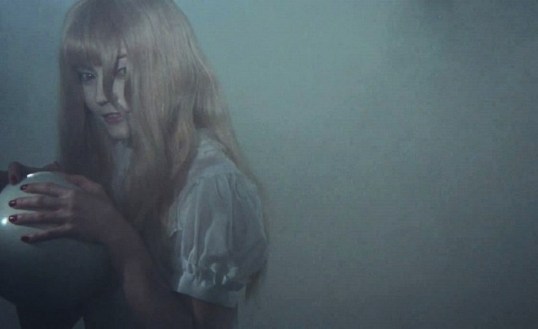
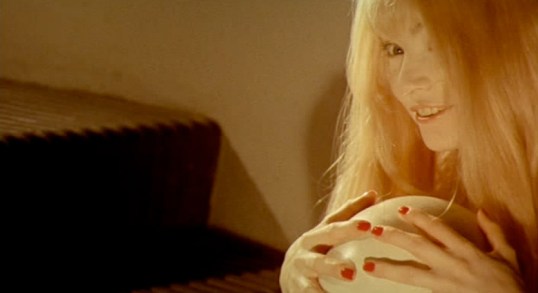
The only thing that worries Toby is the little girl that he keeps seeing out of the corner of his eye.  She bounces a white ball and whenever Toby sees her, a truly evil smile cross her face.  Interestingly, Fellini always frames the girl so that, like Toby, we only seem to be seeing her out of the corner of our eye.  Is she real or is she a figment of Toby’s alcohol-addled brain?  And what are we to make of the fact that Toby’s normally noise-filled world goes silent whenever he sees the girl?

On a talk show, Toby is asked how he visualizes the devil.  He says that he doesn’t see the devil as being a demon with horns or an old man.  (Interestingly enough, that’s how Poe portrayed the Devil in the original short story.)  Instead, he sees the devil as being a little girl with a ball.

However, Toby can’t spend too much time worrying about the little girl.  He just got his Ferrari…

Toby Dammit is the only unqualified success among the three short films that make up Spirits of the Dead.  I think it helps that, unlike Roger Vadim and Louis Malle, Fellini updated Poe’s story to the 20th Century and set it in the international film world.  If Malle and Vadim both seemed detached from their segments, Fellini knew the world that he was depicting.  I imagine he certainly was acquainted with plenty of actors who were just like the brilliant but self-destructive Toby Dammit.

The images of frequently dream-like.  Everything is filmed slightly off-center, mirroring Toby’s hazy view of existence.  When he sits in his limo, the world outside looks like the ruins of some sort of apocalyptic hellscape.  When he is on a talk show or at an awards show, Toby still seems to be isolated from all of the adoring people around him.  The few times that he does talk to other people, he does so without looking at them.  In fact, the only person who seems to truly capture Toby’s attention is that little girl with the ball.

Speaking of which, it seems obvious that Toby Dammit was meant to be a bit of an homage to Fellini’s friend and fellow director, Mario Bava.  Not only is the film’s color scheme very Bavaesque but that little girl will look familiar to anyone who has ever seen Kill, Baby, Kill.

Valerio Valeri in Mario Bava’s Kill, Baby, Kill

Marina Yaru in Federico Fellini’s Toby Dammit

Toby Dammit is definitely the best part of Spirits of the Dead.  It’s a true Italian horror classic.

Short Horror Film Review: Spirits of the Dead — William Wilson (dir by Louis Malle)


Directed by Louis Malle, William Wilson is the second part of the 1968 anthology film, Spirits of the Dead.  All three of the stories were adapted from the work of Edgar Allan Poe.

William Wilson is one of Poe’s best known and most highly regarded stories.  It’s also one that has been adapted into several films, perhaps most famously as the silent German film Student of Prague.  So, how did Louis Malle do when it came time to direct his own version?

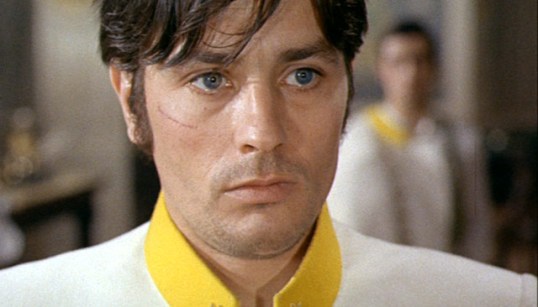
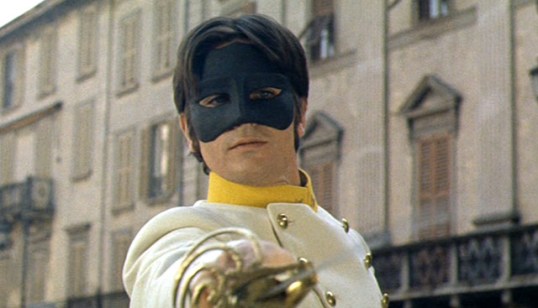
Malle’s William Wilson opens with the title character (played by Alain Delon) running through the cobblestone streets of a gray city.  As we shall soon learn, the time is the early 19th century.  William Wilson is an officer in the Austrian army, assigned to an occupied Italian village.  Wilson, with blood on his head, rushes into a church, ducks into a confessional, and tells the priest that he has just murdered someone.

Wilson goes on to tell the story of not just his life but also the life of his Doppelganger, who is also named William Wilson and who is just as virtuous as the first Wilson is corrupt.  All of his life, the first William Wilson has just wanted to be evil in peace and every time, the Doppelganger has shown up and ruined things.  The Doppelganger first showed up when Wilson was a young boy and he’s proceeded to always pop up wherever Wilson may happen to go.  When the first Wilson was enrolled in medical school and wanted to dissect a village girl, his Doppelganger had to show up and stop things.  When the first Wilson beat the famous courtesan, Giuseppina (Brigitte Bardot), at cards and won the right to whip her, the Doppelganger had to show up and let everyone know that Wilson had cheated.  Is the Doppelganger real or is he just a figment of Wilson’s imagination?  Is Wilson just evil or is he crazy as well?  Wilson isn’t sure but he does know that a well-placed dagger is one way to determine the truth…

Reportedly, Malle agreed to direct William Wilson because he was trying to raise the money to direct a far more personal film, Murmer of the Heart.  As such, Malle didn’t have a personal stake in William Wilson and made several compromises to keep the film’s producer happy.  As a result, William Wilson often doesn’t make much sense.  For instance, how does Wilson go from being merely decadent to suddenly trying to dissect a living human being?  Though the idea of Wilson cheating at cards is taken straight from Poe’s original story, Brigitte Bardot’s lengthy cameo still feels out of place.

That said, Malle was a good enough director that, even if he was detached from the end result, his segment of Spirits of the Dead is always watchable.  The film’s best moments are the ones that simply study Alain Delon’s fascinating face.  Delon feels miscast as the virtuous Doppelganger (who, let’s just be honest, is kind of a prig) but he is dangerously compelling at William Wilson.  The coldness of his eyes tells us everything that we need to know about who William Wilson is.

William Wilson is technically better than the 1st part of Spirits of the Dead, Roger Vadim’s Metzengerstein, but it’s never as much fun.

Short Horror Film Review: Spirits of the Dead — Metzengerstein (dir by Roger Vadim)


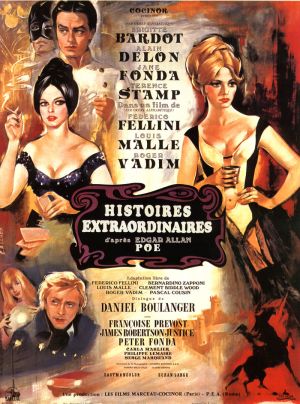
First released in 1968, Spirits of the Dead is an anthology film, one in which three famous international directors (Roger Vadim, Louis Malle, and Federico Fellini) each took a shot at adapting a short story by Edgar Allan Poe.  By their very nature, anthology films tend to be uneven and that’s certainly the case with Spirits of the Dead.

Consider the first story in the film, Roger Vadim’s adaptation of Metzengerstein.  Vadim was best known for his visually lavish films, the majority of which starred whoever he happened to be romantically involved with at the time.  Vadim’s films were sexually charged and decadent but it was a very specific, late 60s type of decadence.  They may have seemed wild when they were first released but, seen today, his films seem rather quaint (not to mention dated).

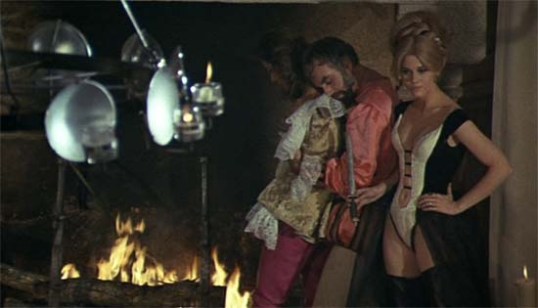
Anyway, when Vadim was hired to shoot his part of Spirits of the Dead, he was married to Jane Fonda so, of course, she stars as Countess Frederique Metzengerstein (Jane Fonda).  That Countess Frederique is evil is obvious from the start.  In between having tastefully shot orgies, she torments her servants.  She even has one servant boy hung so that she can see if she can shoot an arrow through the rope.  (Fortunately, for the servant boy, she can.)  It’s an evil, spiritually empty life but, as can be seen in the picture above, her clothes are to die for.

(Though Metzengerstein appears to be taking place in the 19th century, everyone looks like they’ve just flown over from swinging London.  There’s a lot of miniskirts, sideburns, and tinted glasses.)

Anyway, things change for Frederique when she meets her virtuous cousin, Wilhelm.  She immediately falls into lust with him but he wants nothing to do with her and her evil ways.  (Her cousin, I might add, is played by Peter Fonda, brother of Jane.)  Upset over being rejected, Frederique sets his stables on fire.  Wilhelm dies in the inferno.

After Wilhelm’s death, a new horse suddenly appears outside of Frederique’s castle.  Convinced that Wilhelm’s spirit has inhabited it, Frederique grows obsessed with the horse.  Soon, Frederique is spending all of her time riding the horse.  With no more time to be evil, Frederique becomes less feared.

But, in the distance, there are always flames calling out to her…

So, let’s just start with the obvious.  There is a huge ick factor to be found in Metzengerstein.  Just as Frederique spends the first half of the movie in love with her cousin, Jane Fonda spends the first half of the movie pretending to be in love with Peter Fonda.  Wilhelm, of course, rejects Frederique but still, it just feels undeniably … creepy.  What’s odd is that it’s difficult to tell if Vadim was trying to make the audience uncomfortable or if this casting was just a case of Peter having some time to kill while visiting his sister and brother-in-law.  For all the attention that he pays to the film’s lush visuals, Vadim is such a detached storyteller that it’s hard to guess what his intention was.

Jane Fonda gives a good performance as the cruel Frederique but otherwise, everyone else in the film is just a part of the scenery.  That’s the thing with Metzengerstein.  It’s a gorgeous film but, ultimately, it’s all scenery that adds up to nothing.


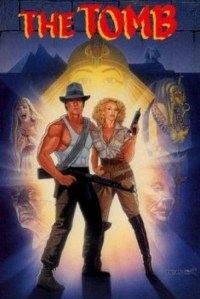
A Movie A Day #286: The Tomb (1986, directed by Fred Olen Ray)


 Sybil Danning is top-billed in The Tomb but she only appears at the very start of the film.  She lands an airplane on a landing strip in the middle of the Egyptian desert and then gets into a gunfight with two archeologists who have robbed a tomb and are now trying to sell off the artifacts.  When one of the archeologists aims his handgun at the plane and pulls the trigger, the plane explodes.  Though Sybil survives the gun fight, that’s it for her in this movie.  Since whatever modern-day audience The Tomb may have is largely going to be made up of nostalgic Sybil Danning fanboys, most people will probably stop watching once it becomes obvious that she is never coming back.

The rest of the movie is about the archeologists selling off the artifacts to greedy collectors like Cameron Mitchell (who spend the entire movie sitting in his office).  This ticks off the ancient Egyptian princess, Nefratis (Michelle Bauer), and she sets off to kill all of the collectors, one-by-one.

Like The Awakening and Blood From The Mummy’s Tomb, The Tomb claims to be based on Bram Stoker’s The Jewel of Seven Stars.   Actually, The Tomb is just an early Fred Olen Ray film, complete with Ray regulars like John Carradine, who gets even less screen time that Danning and Mitchell.  Like most early Ray films, it suffers due to a low budget but Ray’s enthusiastic, never-say-die spirit keeps things moving right along.  With most of the top-billed actors only appearing in a scene or two, the movie belongs to Bauer and she does the most that she can with her role, tearing apart hearts and swearing vengeance with real gusto.

One final note: during the opening credits, The Pharohs, a band that performed while wearing headresses and wrapped in banadages, performs Tutti Frutti.  That almost makes up for Sybil Danning only appearing in 3 minutes of the movie.

Horror Scenes That I Love: Danny Meets The Girls In The Shining


Today’s horror scene that I love is from 1980’s The Shining.

(As much as I loved It and regardless of King’s own opinion, Stanley Kubrick’s The Shining remains the best Stephen King adaptation to date.)

I’ve seen this scene a hundred times.

It still freaks me out.