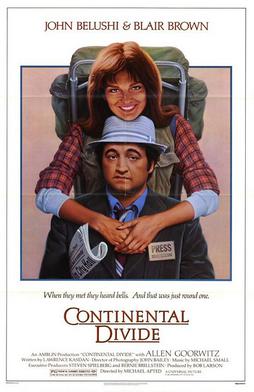
 Ernie Souchak (John Belushi) is a reporter in Chicago. He specializes in stories about municipal corruption and Mafia power plays. Needless to say, living in Chicago, that keeps him busy. Literally everyone in the city knows him. Even the two muggers who try to steal his wallet recognize him and share inside information about which street gang is about to make a big move. From a modern day vantage point, it seems strange to see everyone so excited about meeting a newspaper columnist but this movie was made in 1981, long before an army of bloggers put journalists like Ernie Souchak out of business.
Souchak’s gotten in trouble with the mob so his editor (Allen Garfield) sends him out of Chicago for his own protection. Chain-smoking city boy Ernie Souchak finds himself in the Rocky Mountains, assigned to track down and get a story on Dr. Nell Porter (Blair Brown). Dr. Porter has spent the last few years researching and protecting bald eagles. She doesn’t like reporters but Souchak wins her over. Despite being two very different people, Nell and Souchak fall in love. But can a city boy and a country girl stay together, especially when there are people in Chicago who want Souchak dead?
A strange movie, Continental Divide was meant to be an updated version of the romantic comedies that Spencer Tracy and Katharine Hepburn used to make and Blair Brown was even made up to look like a young Hepburn. It was one of the first films to be produced by Steven Spielberg, who has always been better at picking material as a director than a producer. It was directed by Michael Apted, a great documentarian who has never shown himself to have much affinity for comedy. It was written by Lawrence Kasdan, who specialized in homages to classic film genres and who, after this movie, made it a point to direct the majority of his scripts. And it starred John Belushi, in his only romantic film lead.
Belushi, of course, is the main reason why anyone would want to see this movie. It was his second-to-last movie, coming out between the popular success of The Blues Brothers and the infamous failure of Neighbors. Continental Divide gives Belushi a chance to play a character, instead of just a version of his own wild persona. The legend has always been that Continental Divide showed the actor that Belushi could have become if not for his tragic death. The truth is that Belushi frequently looks uncomfortable and it is often evident that he is having to reign back his natural instincts. Belushi’s best scenes are the ones where Souchak is walking around Chicago and hustling everyone that he meets. In those scenes, he’s confident and in control and it’s easy to get swept up in his life. His scenes with Blair Brown, where he has to be sincere and serious, are far more awkward. Belushi has enough good scenes in Continental Divide to make you regret the performances that we never got but, at the same time, it’s evident that he still had room to grow as an actor.
If Belushi hadn’t died and had instead gone on to make several more movies (and hopefully beat his drug addiction at the same time), Continental Divide would probably be forgotten. Instead, it now exists as a hint of what could have been.
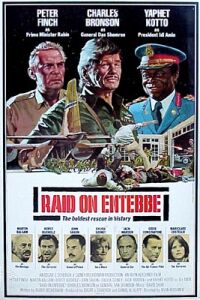 On June 27th, 1976, four terrorists hijacked an Air France flight and diverted it to Entebbe Airport in Uganda. With the blessing of dictator Idi Amin and with the help of a deployment of Ugandan soldiers, the terrorists held all of the Israeli passengers hostage while allowing the non-Jewish passengers to leave. The terrorists issued the usual set of demands. The Israelis responded with Operation Thunderbolt, a daring July 4th raid on the airport that led to death of all the terrorists and the rescue of the hostages. Three hostages were killed in the firefight and a fourth — Dora Bloch — was subsequently murdered in a Ugandan hospital by Idi Amin’s secret police. Only one commando — Yonatan Netanyahu — was lost during the raid. His younger brother, Benjamin, would later become Prime Minister of Israel.
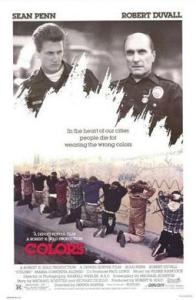 Los Angeles in the 80s. Beneath the California glamour that the rest of America thinks about when they think about L.A., a war is brewing. Bloods vs Crips vs the 21st Street Gang. For those living in the poorest sections of the city, gangs provide everything that mainstream society refuses to provide: money, a chance to belong, a chance to advance. The only drawback is that you’ll probably die before you turn thirty. Two cops — veteran Hodges (Robert Duvall) and rookie McGavin (Sean Penn) — spend their days patrolling a potential war zone. Hodges tries to maintain the peace, encouraging the gangs to stay in their own territory and treat each other with respect. McGavin is aggressive and cocky, the type of cop who seems to be destined to end up on the evening news. With only a year to go before his retirement, Hodges tries to teach McGavin how to be a better cop while the gangs continue to target and kill each other. The cycle continues.
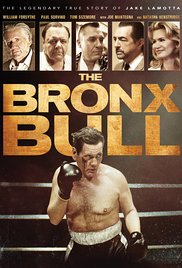 New York in the 1930s. Jake LaMotta (Morean Aria) is a tough street kid who is pushed into fighting by his abusive father (Paul Sorvino) and who is taught how to box by a sympathetic priest (Ray Wise). When Jake finally escapes from his Hellish home life, it is so he can pursue a career as a professional boxer. Ironically, the same violent nature that nearly destroyed him as a youth will now be the key to his future success.


 The year is 1963. The month is November. The city is Dallas. The President of the United States, John F. Kennedy, is coming to visit and two very different men have very different reactions. An eccentric and lonely strip club owner, Jack Ruby (Michael Lerner), worries about an anti-Kennedy ad that has just appeared in the Dallas Morning News. Another loner, a strange man named Lee Harvey Oswald (Frederic Forrest), is busy making plans of his own. When Kennedy is assassinated, history brings Ruby and Oswald together in a way that a shattered nation will never forget.
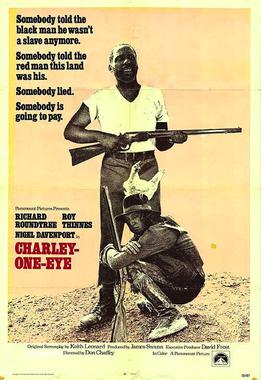 Welcome to the old west, where life is brutal and unpredictable. Ben (Richard Roundtree) joined the Union Army so he could kill white men. When his commanding officer caught Ben in bed with his wife, Ben was forced to commit murder and go on the run. When Ben stumbles across an unnamed Indian (Roy Thinnes) with a bad leg, Ben forces the Indian to accompany him. Despite Ben being loud, cruel, and mentally unstable, an unlikely friendship develops between Ben and the Indian, cemented by their mutual hatred of the white man. When they find a deserted church, Ben and the Indian settle in and start to raise chickens. The Indian’s favorite chicken is a one-eyed bird that he has named Charley. Meanwhile, the Bounty Hunter (Nigel Davenport), a British racist, retraces their every step.

 The year is 1944 and a group of Germany officials and military officers, all of whom are secretly opposed to the Nazi regime, are plotting to assassinate Adolf Hitler. A group of American and British operatives, led by Captain Evan Blackburn (Sean Patrick Flannery), have been dropped behind enemy lines. Their mission is to protect the man who has been chosen to lead Germany after Hitler’s death but, after the assassination fails, Blackburn and his men find themselves with a new mission. Working with a group of Russian soldiers, Blackburn tries to prevent a group of Nazis from fleeing to Argentina with a cache of stolen good.
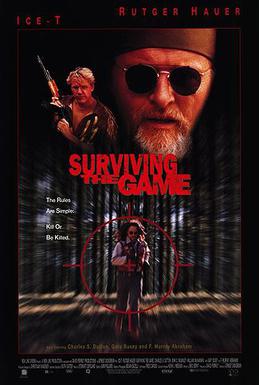 Jack Mason (Ice-T) has been living on the streets of Seattle ever since the death of his wife and daughter. When Cole (Charles S. Dutton), the friendly man at the soup kitchen, tells Mason that he can get him a job, the suicidal Mason accepts. It turns out that a group of wealthy men are going on a hunting trip and they need a guide to lead them through the wilderness. Mason accepts but, upon arriving, he discovers that the men (who are played by Rutger Hauer, F. Murray Abraham, William McNamara, John C. McGinley, and, of course, Gary Busey) are actually planning on playing the most dangerous game and hunting him for the weekend.
 Through the Shattered Lens