1. The Souvenir
2. Once Upon A Time In Hollywood
3. Uncut Gems
4. Luce
5. The Irishman
6. Parasite
7. The Lighthouse
8. Crawl
9. Dragged Across Concrete
10. Doletmite Is My Name
11. Avengers: Endgame
12. 1917
13. Joker
14. The Two Popes
15. The Aeronauts
16. Hustlers
17. The Report
18. Brittany Runs A Marathon
19. Rocketman
20. The Last Black Man in San Francisco
21. Apollo 11
22. I Lost My Body
23. The Farewell
24. Us
25. Midsommar
26. Spider-Man: Far From Home
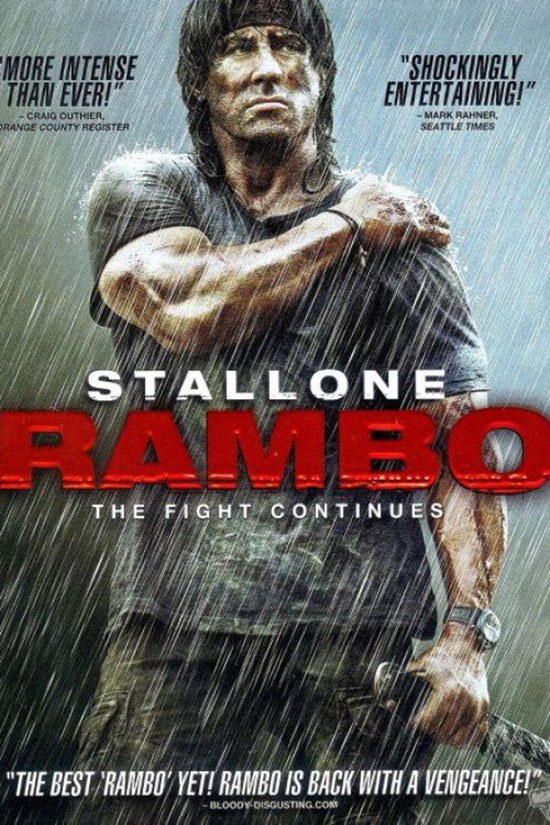
When a group of Christian missionaries needs someone to guide them into Burma so that they can provide medical supply to the oppressed Karen people, they approach John Rambo (Sylvester Stallone). The missionaries think that Rambo is just an American living in Thailand who makes a meager living as a snake catcher and a boat guide. Because we’ve seen the previous Rambo films, we know that John Rambo is actually a Vietnam vet who, after destroying the town of Hope, Washington, was recruited by the government to rescue POWs in Vietnam and fight the Russians in Afghanistan.
At first, Rambo tells the missionaries that it’s foolish for them to go anywhere near Burma and that he wants nothing to do with them. It’s only when Sarah Miller (Julie Benz) asks him personally that Rambo agrees to ferry the missionaries up the Salween River. Rambo isn’t doing it for the missionaries. He’s doing it to protect Sarah.
Unfortunately, on the way to the village, Rambo is forced to kill a group of pirates and he is rejected by the pacifist missionaries and, after he drops them off at the village, they order him to leave. However, after the village is attacked and Sarah is taken prisoner by the Burmese military, Rambo returns. This time, he’s with a group of younger mercenaries who, like the missionaries before them, don’t know what Rambo is capable of doing. Rambo soon proves that he might not be as young as used to be but he’s still just as deadly.
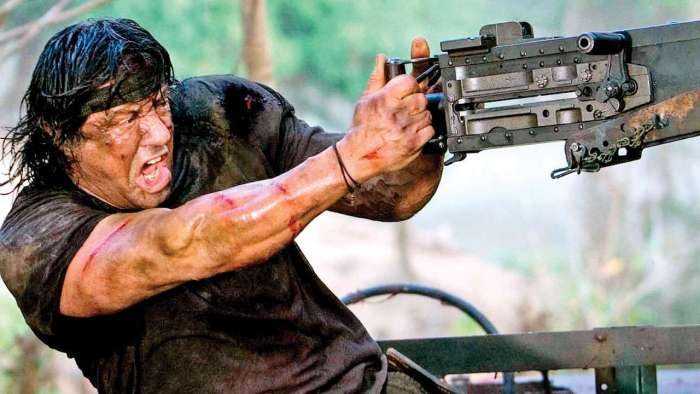
During the final 11 minutes of this movie, Rambo kills over a hundred people but fortunately, they’re all bad. It’s excessively violent and gory and it’s also totally awesome. When you go to see a Rambo movie, you’re not expecting to see Shakespeare. You’re expecting to see Rambo blow away the bad guys and, on that front, this film definitely delivers. Even more than the previous films in the series, Rambo is up front about what happens when someone gets shot by a machine gun or blown up by a bomb. It’s not pretty picture. The violence is so gruesome that Rambo could almost pass for an antiwar film if the people that Rambo blows up weren’t all portrayed as being almost cartoonishly evil.
Rambo is also upfront about what that type of violence would do to a man’s psyche. This film features one of Stallone’s best performances. Eschewing the comic book heroism of the 2nd and 3rd films in the franchise, Rambo reminds us that, when first introduced in First Blood, John Rambo was portrayed as being a seriously damaged and bitter man, someone who hated what the war had done to him and who felt that he no longer had a home in the normal world. Stallone was 62 when he starred in Rambo and he surrendered enough of his vanity to actually allow himself to look and sometimes act his age. In this film, Rambo may start out as bitter but he finally accepts that his pain doesn’t have to define his life. “Live for nothing or die for something,” Rambo says, a line that has subsequently been picked up by the real life Karen National Liberation Army in Burma.
Of the four sequels to the original First Blood, Rambo is the best. It has the biggest action sequences, the best Stallone performance, and it alerted people to very real atrocities being carried out against the Karen people. Coming out shortly after Rocky Balboa, Rambo was one of the films that reminded audiences that Sylvester Stallone still had it. Rambo was a box office success and, 11 years after its release, it was followed by Last Blood. I’ll be reviewing that one tomorrow.
“These straight-to-video, schlocky films I was getting were giving me an ulcer, basically because I was the only one on the set that cared about anything… Between that and my biological clock, I decided to give it all away.”
— Linda Kozlowksi, on why she retired from acting
When Linda Kozlowski talked about the “shlocky films” that soured her on acting, Backstreet Justice was probably high on the list. Kozlowski may have found fame co-starring with her then-husband Paul Hogan in the Crocodile Dundee films but, in Backstreet Justice, there’s neither an Australian nor a sense of humor to be found.
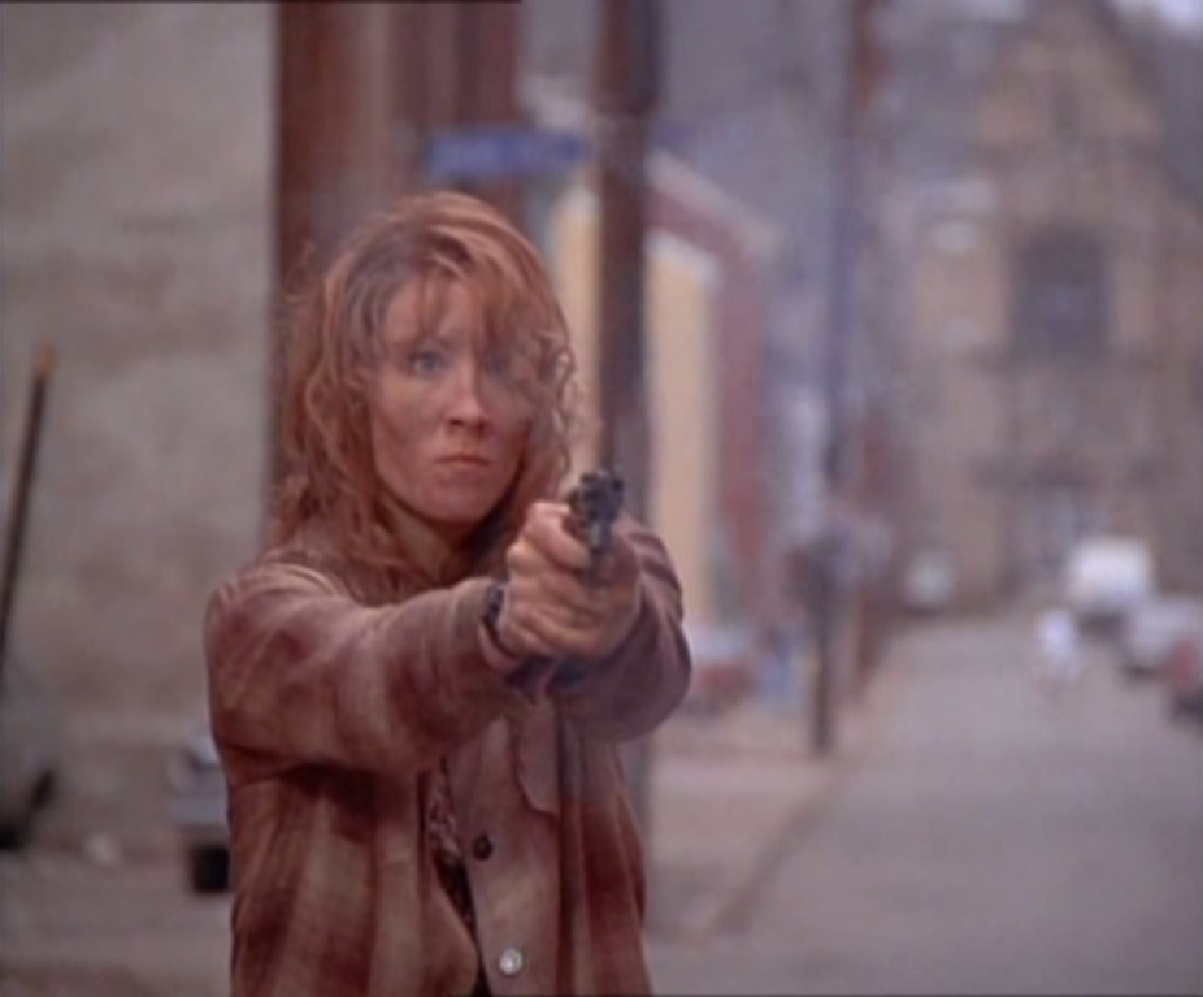
Kozlowski plays Keri Finnegan, a tough and streetwise private investigator in Philadelphia. Her late father was a policeman who was accused of corruption while her mentor (Hector Elizondo) is the district attorney. Most of the cops hate Keri, especially Captain Giarusso (Paul Sorvino). The one exception is her lover, Nick Donovan (John Shea).
The residents of Philadelphia’s worst neighborhood have hired Keri to protect them. For the past two years, a murderer has lurked among them. With the police showing no interest in solving the crimes, the neighborhood turns to Keri. Keri’s investigation leads her to believe that the murders are being carried out be corrupt cops but Keri isn’t prepared for just how far up the corruption goes.
For a straight-to-video film, Backstreet Justice has a surprisingly good cast, with Paul Sorvino, Hector Elizondo, John Shea, Tammy Grimes, and Viveca Lindfors all appearing in supporting roles. Linda Kozlowski holds her own opposite her better-known co-stars and is believable in the film’s many action scenes. The movie has a good sense of urban squalor and captures the desperation of people living in a dying neighborhood. The main problem with the film is that the central mystery is never that interesting and the solution is one that most people will see coming from miles away. For all the violence and scenes of people chasing each other, Backstreet Justice is still a boring movie.
With the exception of one surprisingly explicit sex scene, Backstreet Justice could easily pass for a made-for-TV film or a pilot for a Keri Finnegan television series. Instead, it was just another straight-to-video thriller and another reason for the talented Linda Kozlowski to leave acting behind. Her final film appearance was in 2001’s Crocodile Dundee in Los Angeles.
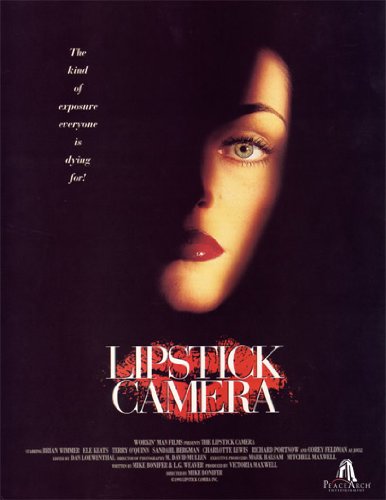
Omy Clark (Ele Keats) is an aspiring journalist who wants to work with the world famous videographer, Flynn Dailey (Brian Wimmer). When she shows up at Flynn’s studio and marvels at how much power the filmed image can wield, Flynn blows her off. While Flynn is busy ignoring Omy, Lily Miller (Sandahl Bergman) drops by and tries to hire Flynn to film her and her husband, Raymond (Terry O’Quinn), making love. When Flynn heads out to the Miller residence, Omy tags along as an uninvited guest. She happens to have a tiny camera that she stole from her best friend, Joule (Corey Feldman, sporting a beard and a beret). Omy plants the camera in Lily’s bedroom. Later, when Flynn, Omy, and Joule all return to the Miller house to retrieve the tiny camera, they discover that Lily has been murdered and that Raymond is a communist war criminal who fled East Germany following the collapse of the Berlin Wall.
Lipstick Camera has an intriguing premise and, even in 1994, it was trying to say something about media manipulation and what is today referred to as being “fake news.” You could say that it was a film that was ahead of its time. You could also say that it’s a complete mess or that it’s an erotic thriller that is neither erotic nor thrilling and you would be just as correct. The main problem with the film is that almost every plot development is set in motion by Omy being either extremely self-absorbed or extremely stupid. When she’s not manipulating Joule (who is not too secretly in love with her), she’s stalking Flynn and carelessly losing an expensive camera that didn’t even belong to her in the first place. And she, of course, is meant to be our hero!
In the 90s, former teen idol Corey Feldman was one of the mainstays of late night Cinemax. Even during his Cinemax years, Feldman would occasionally give a good performance. Lipstick Camera was not one of those occasions. In Lipstick Camera, Feldman wears a beard and a beret and spends a lot of time in a room that’s full of computer monitors and TV screens and that’s the extent of his characterization. He does get a dramatic death scene, in which Joule appears to be determined to stave off the grim reaper by giving a monologue of Shakespearean proportions but otherwise, this is Corey Feldman at his worst. Faring slightly better is Terry O’Quinn, who, at least, gets to deliver his lines in a light German accent.
With its focus on the media and communist war criminals, Lipstick Camera is an example of a direct-to-video film that tried to be about something more than just sex and murder. (Though, this being a DTV film, there is one brief sex scene that takes place in front of a TV that’s showing a video of a fireplace.) Unfortunately, nobody involved seems to know what that something was supposed to be.
You know the story that’s told in this 1936 film already, don’t you?
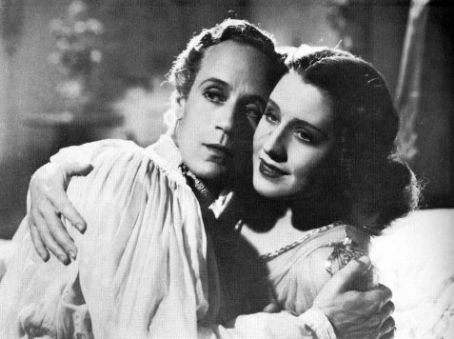
In the city of Verona, Romeo Montague (Leslie Howard) has fallen in love with Juliet Capulet (Norma Shearer). Normally, this would be cause for celebration because, as we all know, love is a wonderful thing. However, the House of Capulet and the House of Montague have long been rivals. When we first meet them all, they’re in the process of having a brawl in the middle of the street. There’s no way that Lord Capulet (C. Aubrey Smith) will ever accept the idea of Juliet marrying a Montague, especially when he’s already decided that she is to marry Paris (Ralph Forbes). Things get even more complicated with Juliet’s cousin, Tybalt (Basil Rathbone), kills Romeo’s best friend, Mercutio (John Barrymore). Romeo then kills Tybalt and things only grow more tragic from there.
It’s hard to keep track of the number of films that have been made out of William Shakespeare’s tale of star-crossed lovers and tragedy. The plot is so universally known that “Romeo and Juliet” has become shorthand for any story of lovers who come from different social sects. Personally, I’ve always felt that Romeo and Juliet was less about love and more about how the rivalry between the Montagues and the Capulets forces the young lovers into making hasty decisions. If not for Lord Capulet throwing a fit over his daughter’s new boyfriend, she and Romeo probably would have split up after a month or two. Seriously, I’ve lost track of how many losers I went out with in high school just because my family told me that I shouldn’t.
Producer Irving Thalberg spent five years trying to get MGM’s Louis B. Mayer to agree to greenlight a film version of Romeo and Juliet. Mayer thought that most audiences felt that Shakespeare was above them and that they wouldn’t spend money to see an adaptation of one of his plays. Thalberg, on the other hand, thought that the story would be a perfect opportunity to highlight the talents of his wife, Norma Shearer. It was only after Warner Bros. produced a financially successful version of A Midsummer Night’s Dream that Mayer gave Romeo and Juliet the go ahead.
Of course, by the time the film went into production, Norma Shearer was 34 years old and a little bit too mature to be playing one of the most famous teenagers in literary history. Perhaps seeking to make Shearer seem younger, Thalberg cast 43 year-old Leslie Howard as Romeo, 44 year-old Basil Rathbone as Tybalt, and 54 year-old John Barrymore as Mercutio, (In Barrymore’s defense, to me, Mercutio always has come across as being Verona’s equivalent of the guy who goes to college for ten years and then keeps hanging out on the campus even after dropping out.)
In short, this is the middle-aged Romeo and Juliet and, despite all of the good actors in the cast, it’s impossible not to notice. There were few Golden Age actors who fell in love with the authenticity of Leslie Howard and Basil Rathbone is a wonderfully arrogant and sinister Tybalt. Norma Shearer occasionally struggles with some of the Shakespearean dialogue but, for the most part, she does a good job of making Juliet’s emotions feel credible. As for Barrymore — well, he’s John Barrymore. He’s flamboyant, theatrical, and a lot of fun to watch if not always totally convincing as anything other than a veteran stage actor hamming it up. The film is gorgeous to look at and George Cukor embraces the melodrama without going overboard. But, everyone in the movie is just too old and it does prove to be a bit distracting. A heart-broken teenager screaming out, “I am fortune’s fool!” is emotionally powerful. A 43 year-old man doing the same thing is just not as effective.
Despite being a box office failure (it turned out that Mayer was right about Depression-era audiences considering Shakespeare to be too “arty”), Romeo and Juliet was nominated for Best Picture of the year, the second Shakespearean adaptation to be so honored. However, the award that year went to another big production, The Great Ziegfeld.
Burned-out writer Jake Bridges (William L. Petersen, a year or two before CSI) comes home one day to discover his wife in bed with another man. Jake, who is already suffering from an epic case of writer’s block, goes to Atlantic City and tries to drink his troubles away. When the bitter Jake gets into a bar fight, he’s saved by Frankie (Michael Wincott). Frankie takes Jake back to his house, where Jake meets Frankie’s girlfriend, Melissa (Diane Lane). Jake also discovers that Frankie works as a debt collector for a local mob boss, Lange (Michael Byrne).
Frankie and Jake strike up an unexpected friendship. Jake wants to experience what it’s like to be a real tough guy. Frankie wants to improve his vocabulary. Frankie agrees to take Jake with him when he makes his collections on the condition that Jake recommend a book to him. Soon, Jake is pretending to be a gangster and Frankie is reading Moby Dick. Frankie shows Jake how to be intimidating. Jake explains the symbolism of Ahab’s quest to Frankie. They become good friends, with the only possible complication being that Jake is falling in love with Melissa.
For a low-budget neonoir that, as far as I know, never even got a theatrical release before being released to video, Gunshy is surprisingly good. The plot may sometimes be predictable but Petersen and especially Wincott give good performances and they both play off of each other well. Diane Lane is undeniably sexy but also bring a fierce intelligence and a sense of wounded dignity to the role of Melissa. This is a love triangle where you want things to work out for all three of the people involved. The rest of the cast is full of familiar faces. Keep an eye out for everyone from R. Lee Ermey to Meat Loaf. Director Jeff Celantano keeps the story moving and proves himself to be adept at balancing scenes of violence with scenes where Frankie and Jake simply discuss their differing views of the world.
An unjustly obscure film, Gunshy is a 90s film that deserves to be rediscovered.
Delfina, a precocious ten year-old, desperately needs a bone marrow transplant. Unfortunately, the only available donor is Rudy Salazar (Danny Trejo), a sociopath who is currently sitting on Death Row. (We’re told that Rudy is the only possible donor because both he and Delfina are “half-Mexican, half-Greek.” I’m not a medical expert but I imagine there’s probably more to finding a donor than just that. And, even if it was that simple, surely Rudy and Delfina are not the only two people of Mexican-Greek ancestry living in Los Angeles.) Lydia Cantrell (Sofia Shinas), who works for the governor, arranges for Rudy’s death sentence to be commuted to life in prison in return for him donating his marrow. At the hospital, Rudy stages a violent escape and soon, he and his old gang are on a rampage.
It falls to renegade Detective Quin Quinlan (C. Thomas Howell) to track down Rudy and bring his rampage to an end. The only catch is that Rudy has to be captured alive because Delfina still needs that transplant. Complicating matters is that Quinlan really enjoys shooting the bad guys.
If the plot of Dilemma sounds familiar, you may be one of the handful of people who remember an old Michael Keaton/Andy Garcia film called Desperate Measures. Desperate Measures may have had the same plot as Dilemma (along with a bigger budget and bigger stars in the cast) but it didn’t have Danny Trejo. Trejo appears without his trademark mustache and he really plays up the idea that Rudy Salazar is one evil dude. Rudy’s so evil that he even laughs at shooting people in the back. When a member of his gang is wounded in a shootout and begs, “Don’t leave me, dawg!,” Rudy takes one look at him and says, “You’re of no use to me.” Only Danny Trejo can make a line that work. With the rest of the cast not making much of an effort one way or the other, Danny Trejo is the best thing about Dilemma and one of two reasons to watch the movie. The other reason is to watch in amazement as both the police and the criminals fire thousand of bullets at each other without ever having to stop and reload their guns. Luckily, they’re all terrible shots who only have good aim when its convenient for the plot.
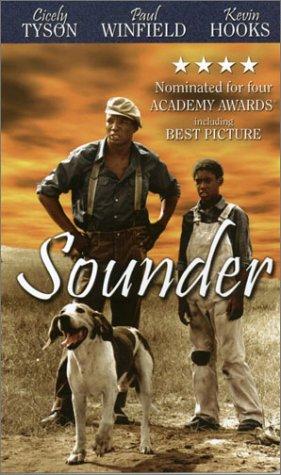
The 1972 film Sounder follows the Morgans, a family of black sharecroppers living in 1930s Louisiana.
When we first see Nathan Lee Morgan (Paul Winfield) and his young son, David Lee (Kevin Hooks), they’re hunting. Accompanying them is their loyal dog, Sounder. As they hunt, two things become very obvious. Number one, David Lee is a good father who is doing his best to provide for his family under the most difficult circumstances possible. Number two, the family is desperately poor. When Nathan finally gives in to temptation and steals a ham to feed his family, the local Sheriff (James Best) shows up at the farmhouse the next day and arrests him. Nathan is taken away to prison and one of the deputies even shoots Sounder.
Fortunately, Sounder survives and so do the Morgans. Under the stern but loving leadership of their mother, Rebecca (Cicely Tyson), the Morgan children manage to bring in the season’s crops. Unfortunately, having to work out in the fields doesn’t leave much time for David Lee to get an education. When he does go to school, he and the other students listen as a middle-aged, white teacher reads to them from Huckleberry FInn.
After the wounded Sounder finally returns to the Morgan family and recovers from his wounds, David Lee decides that he wants to go to the prison and see his father. Unfortunately, the sheriff refuses to even tell the family where Nathan has been incarcerated. None of the white authority figures in town care that the Morgans are struggling or that they’ve managed to bring in the crops themselves. None of them cares or seems to even understand that David Lee is missing his father. The sheriff presents himself as being a reasonable man and is never heard to the use the n-word. Instead, he and every other white person in town refers to David Lee as being “boy,” diminishing everything that he’s done since his father was arrested.
David Lee finally figures out the location of a prison that might (or might not) currently be housing his father. It’s several miles away. Accompanied by Sounder, David Lee sets out to make the long journey to the prison. Along the way, he discovers another school and a far more empathetic teacher named Camille (Janet MacLachlan). David Lee is forced to make a decision that will effect not only his future but also the future of his family.
Sounder is a heartfelt film. It’s a film that’s less interested in telling a story with a traditional beginning and end as opposed to just sharing scenes of everyday life. In this case, it’s the life of family that manages to survive despite it often seeming as if the entire world is arrayed against them. The film was based on a book that pretty much centered around the dog. The movie, on the other hand, is more about the family and, despite the fact that the film is still named after him, the dog is pretty much superfluous to the plot. That said, Sounder still plays an important role because, just as Sounder survives being shot at and remains loyal to the people that he loves, the Morgans survive whatever adversity is tossed at them. Watching the film, the viewer is very much aware that life is never going to be easy for the Morgans but, at the same time, it’s impossible not take some comfort in the fact that they have each other. Paul Winfield and Cicely Tyson both give strong performances as the resilient Nathan Lee and Rebecca and the entire film is the type of movie that’ll inspire tears even as it inspires happiness.
At the Oscars, Sounder was nominated for Best Picture, where it provided a gentle contrast to the other nominees, Cabaret, Deliverance, The Emigrants, and The Godfather. Paul Winfield and Cicely Tyson were nominated for Best Actor and Best Actress, making 1972 the first year in which black performers were nominated in both of the lead categories. (It was also the first year in which more than one black actress was nominated for Best Actress as Tyson ended up competing with Lady Sings The Blues‘s Diana Ross.) In the end, Tyson lost to Cabaret‘s Liza Minnelli while Winfield lost to The Godfather‘s Marlon Brando. And, of course, The Godfather also went on to deservedly win the award for Best Picture.





 Through the Shattered Lens