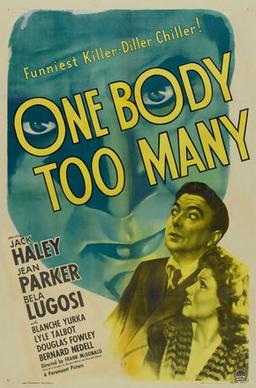
Horror Film Review: One Body Too Many (dir by Frank MacDonald)


In 1944’s One Body Too Many, Jack Haley stars as Albert L. Tuttle. Tuttle is an insurance agent. He’s a rather mild-mannered one. In fact, people often have a hard time remembering his name. He’s called “Mr. Turtle.” He’s called “Mr. Title.” Patiently, he explains over and over again that his name is Tuttle. Looking to secure his job, Tuttle hopes to sell $200,000 in life insurance to an eccentric millionaire named Cyrus J. Rutherford.

What Tuttle doesn’t know is that Cyrus J. Rutherford has recently died. His entire greedy family and all of his servants have gathered at the Rutherford Mansion so that they can hear the reading of the will. In his will, Rutherford lays out all the reasons why he didn’t like his family or anyone who worked for him. He accuses the butler, Merkil (Bela Lugosi), of padding his expense account. He accuses his lawyer (Bernard Nedell) of always trying to take advantage of him. Rutherford writes that his last request is that his body be placed in a glass-domed vault so that the stars can forever shine down upon his face. He says that anyone who leaves the house before the glass vault is built will lose their inheritance. If the body is buried instead of in the vault, then Rutherford’s largest beneficiaries will instead become his smallest beneficiaries and vice versa. It’s a bit of an odd will, to be honest. I’m not particularly sure that it would stand up in court today, but in 1944, eccentric millionaires could pretty much do whatever they wanted. Myself, I have to applaud Rutherford for messing with everyone even after death. That takes determination.

When Tuttle shows up, the family mistakes him for a detective that has been sent to make sure that Rutherford’s body isn’t stolen before the glass dome is constructed. Tuttle, not picking up on how weird this all is, assumes that the family is just really excited about insurance. When Tuttle finds himself locked in with the dead body, he immediately demands to leave. However, since the real detective has failed to show up, Rutherford’s niece, Carol (Jean Parker), asks him to stay and guard the body. A good Tuttle appears on one of Tuttle’s shoulders while a bad Tuttle appears on the other. After listening to the debate, Tuttle decides to stay if only because Carol is attractive.

It’s going to be a long night, though. Not only does the body disappear, but it appears that there is a murderer in the house!

One Body Too Many is an amiable comedy, one that features a very 1940s mix of absurd dialogue and slapstick humor. Though Jack Haley, who is best-remembered for playing the Cowardly Lion in The Wizard of Oz, is the lead and a very likable one at that, the movie is pretty much stolen by Bela Lugosi. Lugosi’s later films tend to be a mixed bag, but One Body Too Many allows Lugosi to give a good and genuinely funny performance as a butler who is far more clever than anyone realizes. Lugosi’s snarky reactions make the film, and they’re a nice reminder that Lugosi was a far more talented actor than he’s often given credit for.
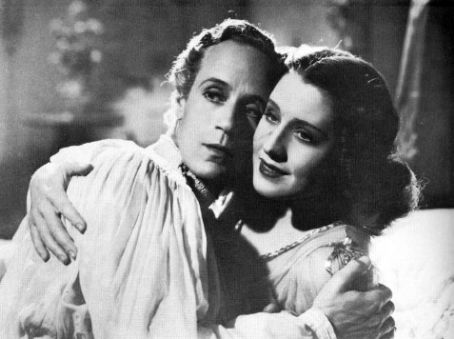
Lisa Reviews An Oscar Nominee: Romeo and Juliet (dir by George Cukor)


You know the story that’s told in this 1936 film already, don’t you?

In the city of Verona, Romeo Montague (Leslie Howard) has fallen in love with Juliet Capulet (Norma Shearer).  Normally, this would be cause for celebration because, as we all know, love is a wonderful thing.  However, the House of Capulet and the House of Montague have long been rivals.  When we first meet them all, they’re in the process of having a brawl in the middle of the street.  There’s no way that Lord Capulet (C. Aubrey Smith) will ever accept the idea of Juliet marrying a Montague, especially when he’s already decided that she is to marry Paris (Ralph Forbes).  Things get even more complicated with Juliet’s cousin, Tybalt (Basil Rathbone), kills Romeo’s best friend, Mercutio (John Barrymore).  Romeo then kills Tybalt and things only grow more tragic from there.

It’s hard to keep track of the number of films that have been made out of William Shakespeare’s tale of star-crossed lovers and tragedy.  The plot is so universally known that “Romeo and Juliet” has become shorthand for any story of lovers who come from different social sects.  Personally, I’ve always felt that Romeo and Juliet was less about love and more about how the rivalry between the Montagues and the Capulets forces the young lovers into making hasty decisions.  If not for Lord Capulet throwing a fit over his daughter’s new boyfriend, she and Romeo probably would have split up after a month or two.  Seriously, I’ve lost track of how many losers I went out with in high school just because my family told me that I shouldn’t.

Producer Irving Thalberg spent five years trying to get MGM’s Louis B. Mayer to agree to greenlight a film version of Romeo and Juliet.  Mayer thought that most audiences felt that Shakespeare was above them and that they wouldn’t spend money to see an adaptation of one of his plays.  Thalberg, on the other hand, thought that the story would be a perfect opportunity to highlight the talents of his wife, Norma Shearer.  It was only after Warner Bros. produced a financially successful version of A Midsummer Night’s Dream that Mayer gave Romeo and Juliet the go ahead.

Of course, by the time the film went into production, Norma Shearer was 34 years old and a little bit too mature to be playing one of the most famous teenagers in literary history.  Perhaps seeking to make Shearer seem younger, Thalberg cast 43 year-old Leslie Howard as Romeo, 44 year-old Basil Rathbone as Tybalt, and 54 year-old John Barrymore as Mercutio,  (In Barrymore’s defense, to me, Mercutio always has come across as being Verona’s equivalent of the guy who goes to college for ten years and then keeps hanging out on the campus even after dropping out.)

In short, this is the middle-aged Romeo and Juliet and, despite all of the good actors in the cast, it’s impossible not to notice.  There were few Golden Age actors who fell in love with the authenticity of Leslie Howard and Basil Rathbone is a wonderfully arrogant and sinister Tybalt.  Norma Shearer occasionally struggles with some of the Shakespearean dialogue but, for the most part, she does a good job of making Juliet’s emotions feel credible.  As for Barrymore — well, he’s John Barrymore.  He’s flamboyant, theatrical, and a lot of fun to watch if not always totally convincing as anything other than a veteran stage actor hamming it up.  The film is gorgeous to look at and George Cukor embraces the melodrama without going overboard.  But, everyone in the movie is just too old and it does prove to be a bit distracting.  A heart-broken teenager screaming out, “I am fortune’s fool!” is emotionally powerful.  A 43 year-old man doing the same thing is just not as effective.

Despite being a box office failure (it turned out that Mayer was right about Depression-era audiences considering Shakespeare to be too “arty”), Romeo and Juliet was nominated for Best Picture of the year, the second Shakespearean adaptation to be so honored.  However, the award that year went to another big production, The Great Ziegfeld.