The Perfection, Review By Case Wright


perfection

Let me begin by writing that I love watching Netflix and I REALLY love livetweeting with Lisa and the rest of the Shattered Lens staff. We can coordinate times well and it’s easy to sync up.  This time, I was given the movie choosing authority and perhaps it will be my last.  I heard that The Perfection was a bit gory, but I figured come on, this is Shattered Lens- we Rocktober the October over here with our Horrorthon!  When I saw that Steven Weber was in it, I felt like ok, this is going to be like a Tales From the Crypt experience.  Well……….not so much.

The Perfection has trashy components to it and some cheaply built sets and the director REALLY wants you to know that they splurged and actually filmed in China! The best way to describe The Perfection is as an unaware, pretentious, and boring episode of Tales From the Crypt.  It had the victim goes to victimizer TFTC theme and the over the top gore, but it was always trying to be serious and important when it was just an overly long TFTC episode without any humor.

The plot is pretty straight-forward: Charlotte is a prodigy Cellist who left her art to care for her dying mother for ten-years.  When she tries to return to her life, she finds that a younger classmate Lizzy has attained the Cello fame that she sought.  She sees her old Mentor Anton (Steven Weber) and Charlotte is now the clear has-been.  Charlotte executes a plan to destroy Lizzy forever.  Charlotte meets Lizzy, seduces Lizzy, drugs Lizzy, and convinces Lizzy to chop her hand off.  Yep, another Hollywood girl meets girl, girl drugs girl, girl gets girl to chop her hand off story.  The Perfection was actually the original script for Love Actually.  The “To Me You Are Perfect” scene was just going to be Andrew Lincoln throwing severed hands at people – “To Me you are a perfect…Target” *throws hand at Juliet*.

Just when you think this movie will be a fun version of Black Swan it takes a turn for the dumb, gross.  Yes, I get that this was made by a post-Weinstein Miramax and it was showing how fame could encourage and condone horrible behavior, but it was done with so much exposition that it really caused the film to jerk from long explanations to gore and long explanations to gore and long explanations to trying a Subway Cold Cut Combo – even terrible movies get hungry.

I’m not sure if I should spoil this piece of trash or not.  It’s really not worth your time. Instead of watching this film you could eat a sandwich, do your taxes, plot revenge. However, it is nice to see that Steven Weber is still working – there’s that.


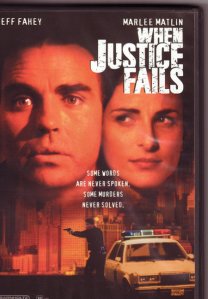
When Justice Fails (1999, directed by Allan A. Goldstein)


In New York City, two men have been murdered in the same ritualistic way.  Both of the men were accused rapists who beat the system, getting their charges dismissed due to legal technicalities.  When detectives Tom Chaney (Jeff Fahey) and Rod Lambeau (Carl Marotte) discover that assistant D.A. Katy Wesson (Marlee Matlin) was the prosecutor on both of the dead men’s cases, she becomes their number one suspect.  However, Chaney has his doubt about her guilt, especially after he goes on a few dates and starts sleeping with her.  Katy is an enigma with a traumatic childhood and penchant for picking up men in nightclubs but is she a murderer?  Other suspects include a creepy artist named Josh (Charles Powell), who also works as the deaf Katy’s interpreter, and Katy’s overdramatic mother (Monique Mercure).

That a direct-to-video thriller from 1999 would be a rip-off of Basic Instinct is not a shock.  Almost every thriller released between 1992 and 2000 was at least partially cloned from Basic Instinct.  What sets When Justice Fails apart is that it’s probably the only Basic Instinct clone to actually feature it’s two main characters discussing the ending of Basic Instinct post-coitus.  (For the record, Chaney thinks that the final shot means that Sharon Stone was the murderer while Katy says that the ice pick showed that the director was playing a joke on the audience.)  I guess When Justice Fails deserves some credit for being willing to so directly acknowledge the film that inspired it but, when you’re a mediocre film, you probably don’t want to intentionally remind audiences that they could be watching something better.

When Justice Fails actually gets off to a good start, with Jeff Fahey playing another one of his driven loners and Marlee Matlin really committing to the role of the film’s femme fatale.  The movie even manages to avoid the usual awkwardness that comes from having a hearing character repeating everything that a deaf character either signs or writes down.  The early scenes have a Law & Order feel to them, with Chaney and Lambeau interviewing witnesses on the busy streets of New York and also talking to a world-weary coroner.  It would have been a surprise if Stephen Hill had suddenly shown up and said, “Your case is weak and this trial could drag on through election day.  Make him an offer.  Man 1.  Depraved indifference.”

Unfortunately, once Chaney sleeps with Katy, the movie becomes increasingly implausible and goes downhill.  There just aren’t enough suspects to generate any suspense over who the murderer is ultimately going to turn out to be.  The surprise at the end is only a surprise because it didn’t occur to Chaney to run a routine background check on one of his suspects, something that I would think most cops would do at the start of a murder investigation.  Marlee Matlin is a terrific actress who is always interesting to watch but When Justice Fails ultimately fails to be very memorable.

Lisa Reviews An Oscar Nominee: Tender Mercies (dir by Bruce Beresford)


The other day, on this very site, I mentioned that the 1983 film Tender Mercies was one of the films that David Lynch turned down.  

In his memoir, Room to Dream, Lynch wrote that he was sent the film’s script while he was looking for a project to serve as his follow-up to The Elephant Man.  Lynch wrote that he liked the script, which was written by Horton Foote (who had previously won an Oscar for adapted To Kill A Mockingbird), but that Lynch also felt that it just wasn’t the right project for him at the time.  Tender Mercies was eventually directed by Bruce Beresford and Lynch mentioned that he felt that Beresford did a “brilliant” job.

After I posted the article, it occurred to me that Tender Mercies is not a film that’s as well-known as it deserves to be.  It received five Oscar nominations, including one for Best Picture.  Robert Duvall won his first (and, to date, only) Oscar for playing the lead role.  It’s an acclaimed film but it also plays it in a rather low-key style, particularly when compared to some of the other films that were released in the early 80s.  (1983 may have been the year of Tender Mercies but it was also the year of Scarface, Flashdance, Return of the Jedi, and Risky Business.)  As such, it’s a film that’s been a bit overshadowed over the years.

Tender Mercies takes place in rural Texas.  Mac Sledge (Robert Duvall) is a former country-western star whose career has collapsed due to his alcoholism and his own self-destructive behavior.  One morning, a hungover Mac wakes up in a roadside motel.  Not having any money on him, Mac asks the motel’s owner — Rosa Lee (Tess Harper), who lost her husband in Vietnam — if he can work at the motel in return for a room.  Rosa Lee agrees, on the condition that Mac not drink while he’s working.

As the days pass, Mac and Rosa Lee grow closer and Mac becomes a surrogate father to Rosa Lee’s young son, Sonny (Allan Hubbard).  Eventually, Mac and Rosa Lee marry and Mac becomes an accepted member of the community.  However, Mac remains troubled.  His ex-wife, Dixie (Betty Buckley), has built a career on singing the songs that he wrote for her but she refuses to consider anything new that he’s written.  His teenage daughter (Ellen Barkin) stops by the motel and announces that she’s running away to get married.  There’s tragedy but there’s also hope and forgiveness.

Tender Mercies is a simple but affecting film about a good man who is struggling to deal with the fact that he was once a very bad man.  What makes Tender Mercies interesting is what doesn’t happen.  The first time I saw it, I spent the entire movie expecting Mac to fall off the wagon and break everyone’s heart.  Instead, Mac manages to keep his promise to his new family but what he discovers is that being sober doesn’t automatically exempt one from pain or guilt.  He still has to deal with sadness and disappointment but now, he has to do it without using alcohol as a crutch.  Instead of getting his strength from booze, he now gets it from love.

It’s a wonderfully sweet movie, featuring naturalistic performances from Harper, Hubbard, and especially Robert Duvall.  It seem appropriate that, after making his film debut as Boo Radley in a film written by Horton Foote, Duvall would win his first Oscar for another film written by Foote.  Duvall plays Mac as a plain-spoken and weary soul who is still just enough of a romantic to find some sort of redemption in the world.  It’s a great performance and it’s a good film and I’d suggest checking it out if you ever need a good cry.

Lisa Marie’s 10 Worst Films of 2019


Well, I guess it’s finally that time!

It’s time for me to finally post my picks for the best (and worst) of 2019.  This is something that I do every year.  Usually, I manage to do it before the third week of January but I’ve been running behind.  I’ll be posting my film, television, book, and music picks throughout today and maybe into tomorrow, depending on how long it takes me to narrow down my choices.

Let’s start with my picks for the 10 worst films of 2019!  Below are my picks for the worst.  Some of you will agree and some will disagree.  In the end, what truly matters is that I’m right.

(Also be sure to check out my picks for 2018, 2017201620152014201320122011, and 2010!)

10. The Upside (dir by Neil Burger)
9. Glass (dir by M. Night Shyamalan)
8. X-Men: Dark Phoenix (dir by Simon Kingberg)
7. The Kitchen (dir by Andrea Berloff)
6. The King (dir by David Michod)
5. Miss Bala (dir by Catherine Hardwicke)
4. The Dirt (dir by Jeff Tremaine)
3. Backdraft 2 (dir by Gonzalo López-Gallego)
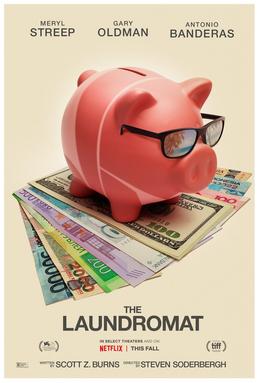
2. The Laundromat (dir by Stephen Soderbergh)
1. After (dir by Jenny Gage)


Goin’ South (1978, directed by Jack Nicholson)


Jack Nicholson was not an overnight success.

Nicholson was 17 years old when he first came to Hollywood in 1954.  Looking to become an actor, Nicholson toiled as an office worker at the MGM cartoon studio, took acting classes, and went to auditions.  It would be four years before he even landed his first role, the lead in the Roger Corman-produced The Cry Baby Killer.  When that film failed to become a hit, Nicholson spent the next ten years doing minor roles and occasionally starring in a B-picture.  He auditioned for some big parts, like Benjamin Braddock in The Graduate, Buck Barrow in Bonnie and Clyde, and Guy Woodhouse in Rosemary’s Baby, but his big break continued to allude him.  By 1969, Nicholson was so disillusioned with acting that he was planning to instead pursue a career as a director.  However, before Nicholson officially retired from the acting game, he received a call from the set of Easy Rider.  Depending on who you ask, Rip Torn, who had previously been cast in the role of alcoholic George Hanson, had either quit or been fired.  Bruce Dern, the first choice to replace Torn, was busy filming They Shoot Horses, Don’t They?  Nicholson agreed to step into the role and the rest is history.

Easy Rider may have made Jack Nicholson one of the world’s biggest film stars but he never lost his ambition to direct.  In 1971, he made his directorial debut with Drive, He Said, a film about campus unrest.  At the time, the film flopped at both the box office and with critics and quickly sunk into obscurity.  (It has subsequently been rediscovered and, in some cases, positively reevaluated.)  After the failure of Drive, He Said, it would be another seven years before Nicholson again got a chance to direct.

Nicholson’s second film as a director, Goin’ South, is a comedic western.  Nicholson plays Henry Lloyd Moon, an unsuccessful outlaw who used to ride with Quantrill’s Raiders.  When Moon is captured in Longhorn, Texas, he is sentenced to be hanged.  Fortunately, for Moon, Longhorn has a special ordinance.  Any man condemned for any crime other than murder can be saved from the gallows if a local woman agrees to marry him and take responsibility for his good behavior.  As a result of this ordinance, Longhorn is populated almost exclusively by single women and reformed outlaws.

While standing on the gallows, the cocky Moon is stunned to discover that none of the women want to marry him.  Finally, an old woman emerges from the crowd and announces that she’ll become Moon’s wife.  When Moon hops off the gallows and thanks her, the woman drops dead.  Fortunately, another, younger woman, Julia Tate (Mary Steenburgen, making her film debut), steps forward.

Once they’re married, the lecherous Moon discovers that Julia is a virgin and that the only reason she married him was so she could force him to work in the secret gold mine that’s hidden underneath her property.  The railroad will soon be taking over the land and Julia wants to get all of the gold before she leaves town for Philadelphia.  Though Julia, at first, wants nothing to do with Moon, he eventually wears her down through sheer persistence and the two fall in love.

Complicating matters is Deputy Towfield (Christopher Lloyd), who is upset because he feels that Julia was meant to be his wife.  Also, the members of Moon’s former gang (including Danny DeVito and Veronica Cartwright) show up at Julia’s house and discover the truth about the mine.

Goin’ South gets off to a good start.  The scene on the gallows, where Moon waits for someone to marry him and save his life, is genuinely funny and Nicholson and Steenburgen have a playful chemistry for the first hour of the movie.  Nicholson leers even more than usual in this film but the script is written so that the joke is always on Moon.  Much of the film’s humor comes from Moon always overestimating both his charm and his cleverness.  However, once Moon and Julia finally consummate their marriage, the movie loses whatever narrative momentum it may have had and gets bogged down with the subplots about Towfield and Moon’s gang.  There are funny moments throughout but the story gets away from Nicholson and the film is reduced to a series of set pieces, none of which build up to much.

Not surprisingly, Nicholson gets good performances from his cast, which is largely made up by the members of his 1970s entourage.  Along with Danny DeVito and Christopher Lloyd, longtime Nicholson associates like Tracey Walter, Ed Begley Jr., Richard Bradford, Jeff Morris, and Luana Anders all appear in small roles.  John Belushi plays the tiny role of Deputy Hector.  (Goin’ South was actually the first film in which Belushi was cast, though production didn’t actually begin until after Belushi had finished working on National Lampoon’s Animal House.)  Unfortunately, despite all of the good performances, the script doesn’t do much to develop any of the characters.  Belushi especially feels underused.  (Because Belushi had moved on to Animal House by the time the film went into post-production, Nicholson ended up dubbing several of Belushi’s lines himself.)

Drive, He Said was largely considered to have failed at the box office because Nicholson remained behind the camera so he took the opposite approach with Goin’ South.  Nicholson is in nearly every scene and he gives one of his broadest performances.  It works for the first half of the film, when Moon is constantly trying to get laid and failing every time.  But, during the second half of the movie, Nicholson’s failure to reign in his performance works to the film’s detriment.  When the movie needs Nicholson to be romantic, he’s still behaving like a horny cartoon. Whenever he looks at Mary Steenburgen, it seems as if his eyes should be popping out of his head, Tex Avery-style.  He’s an entertaining cartoon, but a cartoon nonetheless.  As a result, Goin’ South is often funny but it still feels very inconsequential.

Like Drive, He Said, Goin’ South was both a critical and a box office flop and it temporarily turned Nicholson off of directing.  It would be another 12 years before he would once again step behind the camera.  In 1990, Nicholson directed The Two Jakes, the sequel to one of his best films, Chinatown That would be Nicholson’s last film as a director.  Nicholson acted for another 20 years, following the release of The Two Jakes.  To date, he made his final screen appearance in 2010, with a supporting role in James L. Brooks’s How Do You Know.  Nicholson has disputed claims that he’s officially retired, saying that he’s instead just being more selective about his roles.  Even though it’s been ten years since we last saw him on screen, Jack Nicholson remains an American icon and a living legend.

Lisa Reviews An Oscar Nominee: Alibi (dir by Roland West)


1929 was a transitional year for Hollywood.

On the one hand, more people were going to the movies than ever.  The studio moguls were getting rich and directors, many of whom were influenced by German expressionism, were experimenting with new ways to visually tell their stories.  The days when an motionless camera would just be planted on the floor so that it could record actors moving in and out of the frame were over.

At the same time, Hollywood was also struggling to adjust to the arrival of sound.  Though many assumed that sound would just be a fad, it quickly turned out that audiences preferred sound pictures to the old silent melodramas.  Films that had been originally conceived as being silent were reshot with sound and the results were often mixed as Hollywood technicians struggled to figure out how to get the best and clearest recording possible.  Even harder hit were the actors, who had spent decades giving silent performances but who were now expected to adapt, overnight, to an entirely new style of acting.  Some actors saw their career abruptly end because their voice didn’t match their appearance or because they simply couldn’t memorize the dialogue that they were now required to actually speak.  Even the actors who could handle delivering their dialogue often struggled to find the right balance between acting too much and acting too little.

Take Alibi, for instance.  This crime film was released in 1929 and visually, it’s often a marvel.  But whenever the actors open their mouths and start to recite their dialogue …. yeesh!

Based on a Broadway play, Alibi tells the story of Chick Williams (Chester Morris, whose brooding good looks go a long way towards making up for his awkward screen presence).  Chick is a career criminal who has just been released from prison.  Because he’s a “jailbird,” (as they used to put it in 1929), Sgt. Pete Manning (Purnell Pratt) is convinced that Chick has hooked back up with his old gang and that he’s responsible for a recent robbery that left one policeman dead.  However, Chick has an alibi.  It turns out that, after getting out of prison, one of the first that Chick did was get married.  Chick’s new wife is Pete’s daughter, Joan (Eleanor Griffith)!  And Joan swears that, on the night of the crime, Chick was with her at the theater.

Despite his alibi, Pete is convinced that Chick had something to do with both the robbery and the murder.  Pete decides to send in an undercover cop, Danny McGann (Regis Toomey).  Pretending to be a permanently drunk businessman, Danny works his way into Chick’s mob.  But can Danny find the proof needed to take Chick down?

So, here’s what’s good about Alibi.  First off, it’s a pre-code film, which means that the characters are allowed to occasionally curse and that the gangsters all spend their time at a nightclub, watching the floor show.  It also means that Joan is allowed to openly discuss why she distrusts the police and the film shows the police being brutal in a way that would never be allowed during the production code years.  Secondly, from the very first scene, director Roland West creates an almost dream-like atmosphere, full of looming shadows and art deco sets and close-ups of menacing faces.  West’s camera prowls through the streets and clubs with a restless energy.

But then, as I mentioned earlier, someone will open their mouth and start to speak and the entire film comes to a halt.  The cast — some of whom went on to have long and successful careers — was obviously still struggling to figure out how to act in a sound film and the results are definitely mixed.  Eleanor Griffith delivers all of her lines in the same angry tone while Purnell Pratt stiffly defends the police force.  Regis Toomey, meanwhile, goes so overboard as Danny that you find yourself hoping that he’ll blow his cover and be forced out of the film.  Though he’s occasionally awkward, Chester Morris probably does the best out of the entire cast.  At the very least, he manages to communicate some genuine menace.

Seen today, Alibi is mostly interesting as a historical document.  It represents both the best and the worst of the early sound era.  When it was first released, Alibi was a hit at the box office.  Though no official nominees were announced for the 2nd Academy Awards, notes from the era indicate the Alibi was among the films considered for Best Picture and it’s usually listed as being a nominee.  The award itself was given to Broadway Melody.

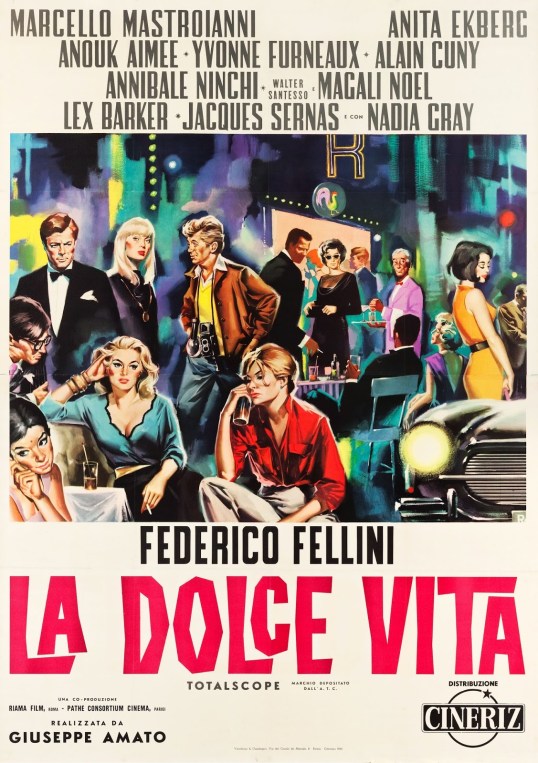
Scenes That I Love: The Final Scene of Federico Fellini’s La Dolce Vita


100 years ago today, the great Federico Fellini was born in Rimini, Italy.  It seems appropriate that today’s scene of the day should come from my favorite Fellini film, 1960’s La Dolce Vita.

In this scene, which occurs at the end of the film, jaded journalist Marcello Rubini (Marcello Mastroianni) finds himself hung over on the beach, watching as a group of people pulls a dead sea serpent out of the ocean.  The serpent appears to be a giant squid of some sort.  Myself, I’ve always felt that it was the equivalent of the Biblical Leviathan and maybe the fish that swallowed Jonah.  Regardless of the fish’s history, it’s now dead but, as Marcello points out, its eyes continue to stare.  The people on the beach are less interested in what the fish is and instead more concerned with what they can do with the carcass.

Marcello looks away from them and sees a young woman named Paola (Valeria Ciangottini) standing at the other end of the beach, calling out and motioning to him.  Marcello attempts to hear what Paola is saying but he cannot hear her words over the sounds of the ocean.  For once, Marcello, the journalist and the high society insider, does not know what is being said.  Finally, Marcello walks away with another woman, leaving Paola’s message a mystery.

What was Paola saying?  Perhaps, in the end, that’s not as important as what we think she may have been saying.  (Sofia Coppola later played a sort of homage to this ending with the final scene of Lost In Translation.)  Marcello missed the message but the good life — La Dolce Vita — continues.

Hijack! (1973, directed by Leonard Horn)


Jake (David Janssen) is a down-on-his-luck trucker who is offered job by a mysterious man named Kleiner (WIlliam Schallert).  If Jake agrees to transport a cargo across the country, he will get not only $6,000 but Kleiner will also pull some strings get Jake back in the good graces of the trucking company.  If Jake takes the job, he will be given a slip of paper with a phone number on it and, according to Kleiner, that piece of paper will get him out of any trouble that he runs into along the way.  The only condition is that Jake is not allowed to know what he’ll be transporting.  Jake agrees and soon, he and his partner Donny (Keenan Wynn) are driving the truck through the desert.  They are also being followed by a group of men who will stop at nothing to steal the cargo.

This made-for-TV movie is called Hijack! but no one ever gets hijacked.  Instead, with the exception of a brief romantic interlude between Jake and a truck stop waitress (Lee Purcell), this is a nonstop chase movie but the chase itself is never exciting enough to justify that exclamation mark in the title.  It was probably made to capitalize on the success of Steven Spielberg’s made-for-TV classic, Duel, but it never come close to capturing the nerve or intensity of that film.  There’s one good scene where the bad guys come after the truck in a helicopter but otherwise, this is a pretty anemic stuff.  Even the eventual reveal of what Jake and Donny are hauling across the desert is a let down.

David Janssen specialized in playing grizzled loners and Keenan Wynn specialized in playing eccentric old coots so both of them are adequate in the main roles.  The bad guys are largely forgettable and, as she did in so many other TV movies in the 70s, Lee Purcell brings what life that she can to an underwritten role.

Lisa Reviews An Oscar Nominee: The Wolf of Wall Street (dir by Martin Scorsese)


Suck it, The Big Short The Wolf of Wall Street is the best film to be made about Wall Street this century.

Martin Scorsese’s 2013 financial epic tells the true story of a group of rather sleazy people who got rich and who basically, to quote Robert De Niro from an earlier Scorsese film, “fucked it all up.”  Jordan Belfort (Leonardo DiCaprio, giving what I still consider to be the best performance of his career) is the son of an accountant named Max (Rob Reiner).  Fresh out of college, Jordan gets a job on Wall Street.  Under the mentorship of the eccentric (but rich) Mark Hanna (Matthew McConaughey), Jordan discovers that the job of a stock broker is to dupe people into buying stock that they might not need while, at the same time, making a ton of money for himself.  With the money comes the cocaine and the prostitutes and everything else that fuels the absurdly aggressive and hyper-masculine world of Wall Street.  Jordan is intrigued but, after the stock market crashes in 1987, he’s also out of a job.

Fortunately, Jordan is never one to give up.  He may no longer be employed on Wall Street but that doesn’t mean that he can’t sell stocks.  He gets a job pushing “penny stocks,” which are low-priced stocks for very small companies.  Because the price of the stock is so low, the brokers get a 50% commission on everything they sell.  Because Jordan is such an aggressive salesman, he manages to make a fortune by convincing people to buy stock in otherwise worthless companies.  As Jordan’s boss (played, in an amusing cameo, by Spike Jonze) explains it, what they’re doing isn’t exactly regulated by the government, which just means more money for everyone!  Yay!

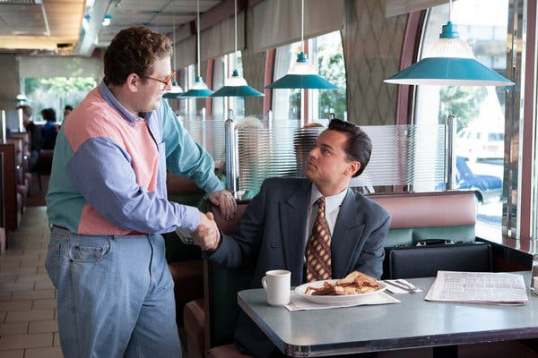
Working with his neighbor, Donny Azoff (Jonah Hill, at his most eccentric), Jordan starts his own brokerage company.  Recruiting all of his friends (the majority of whom are weed dealers who never graduated from high school), Jordan starts Stratton Oakmont.  Using high-pressure sales tactics and a whole lot of other unethical and occasionally illegal techniques, Jordan soon makes a fortune.  When Forbes Magazine publishes an expose that portrays Jordan as being little more than a greedy con man, Stratton Oakmont is flooded by aspiring stock brokers who all want to work for “the wolf of Wall Street.”

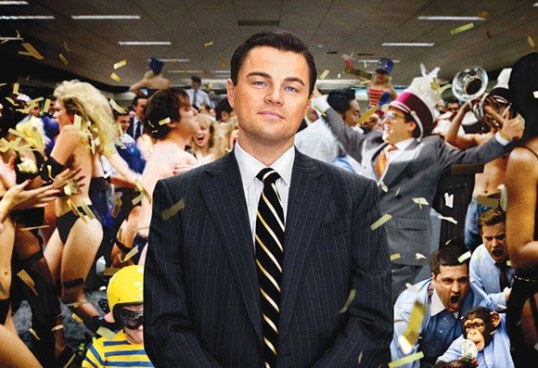
And, for a while, Jordan has everything that he wants.  While the Stratton Oakmont offices become a den of nonstop drugs and sex, Jordan buys a huge mansion, a nice car, and marries a model named Naomi (Margot Robbie).  His employees literally worship Jordan as he begins and ends every working day with inspirational (and often hilariously profane) sermons, encouraging his people to get out there and sell no matter what.  Of course, making that much money, Jordan has to find a way to hide it from the IRS.  Soon, with the help of Naomi’s aunt (Joanna Lumley), he is smuggling millions of dollars into Switzerland where a banker (Jean Dujardin, who is both hilariously suave and hilariously sleazy a the time) helps him hide it all.

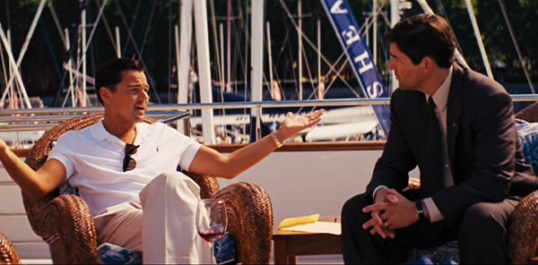
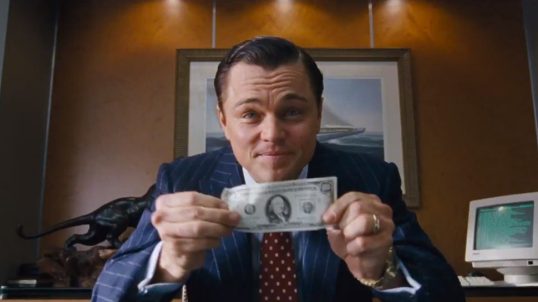
When Jordan learns that the FBI and SEC are looking into his dealings, Jordan invites Agent Patrick Denham (Kyle Chandler) to come visit him on his yacht and, in a scene that launched a thousand memes, the two of them have a friendly conversation that’s largely made up of passive aggressive insults.  Jordan taunts Denham over the fact that Denham washed out when he tried to get a job on Wall Street.  Denham laughingly asks Jordan to repeat something that sounded like it may have been a bribe.  When Denham leaves the boat, Jordan taunts him by tossing a wad of hundred dollars bills into the wind….

And here’s the thing.  Yes, the media and our political class tells us that we’re supposed to hate that Jordan Belforts of the world.  One can imagine Bernie Sanders having a fit while watching Jordan brag about how he cheated the IRS.  If Adam McKay or Jay Roach had directed this film, one can imagine that they would have used the yacht scene to portray Jordan Belfort as pure evil.  (McKay probably would have tossed in Alfred Molina as a waiter, asking Belfort if he wants to feast on the lost future of the children of America.)  But the truth of the matter is that most viewers, even if they aren’t willing to admit it, will secretly be cheering for Jordan when he throws away that money.  DiCaprio is so flamboyantly charismatic and Scorsese, as director, so perfectly captures the adrenaline high of Jordan’s lifestyle that you can’t help but be sucked in.  He may be greedy and unethical but he just seems to be having so much fun!  Just as how Goodfellas and Casino portrayed life in the mafia as being an intoxicating high (as well as being more than a little bit dangerous), The Wolf of Wall Street refrains from passing easy judgment and it steadfastly refuses to climb onto a moral high horse.  Jordan narrates his own story, often talking directly to the camera and almost always defending his actions.  As a director, Scorsese is smart enough to let us make up own minds about how we feel about Jordan and his story.

Of course, when Jordan falls, it’s a dramatic fall.  That said, it’s not quite as dramatic of a fall as what happened to Ray Liotta in Goodfellas or Robert De Niro in Casino.  No one gets blown up, for instance.  But Jordan does lose everything that gave his life meaning.  By the end of the film, he’s been reduced to giving seminars and challenging attendees to sell him a pen.  (“Well,” one hapless gentleman begins, “it’s a very nice pen…..”)  During the film’s final scenes, it’s not so much a question of whether Jordan has learned anything from his fall.  Instead, the movie leaves you wondering if he’s even capable of learning.  At heart, he’s the wolf of Wall Street.  That’s his nature and it’s really the only thing that he knows how to do.  He’s a bit like Ray Liotta living in the suburbs at the end of Goodfellas.  He’s alive.  He has his freedom and a future.  But he’s still doesn’t quite fit in.  Much like Moses being denied the opportunity to physically enter the Promised Land, Jordan’s punishment for his hubris is to spend his life in exile from where he truly belongs.  And yet, you know that Jordan — much like Henry Hill — probably wouldn’t change a thing if he had the chance to live it all over again.  He’d just hope that he could somehow get a better ending while making the same decisions.

Unlike something like The Big Short, which got bogged down in Adam McKay’s vapid Marxism, The Wolf of Wall Street works precisely because it refuses to pass judgment.  It refuses to tell us what to think.  I imagine that a lot of people watched The Wolf of Wall Street and were outraged by the way Jordan Belfort made his money.  I imagine that an equal number of people watched the film and started thinking about how much they would love to be Jordan Belfort.  The Wolf of Wall Street is a big, long, and sometimes excessive film that dares the audience to think of themselves.  That’s one reason why it’ll be remembered after so many other Wall Street films are forgotten.

The Wolf of Wall Street was nominated for best picture of the year.  It lost to 12 Years A Slave.

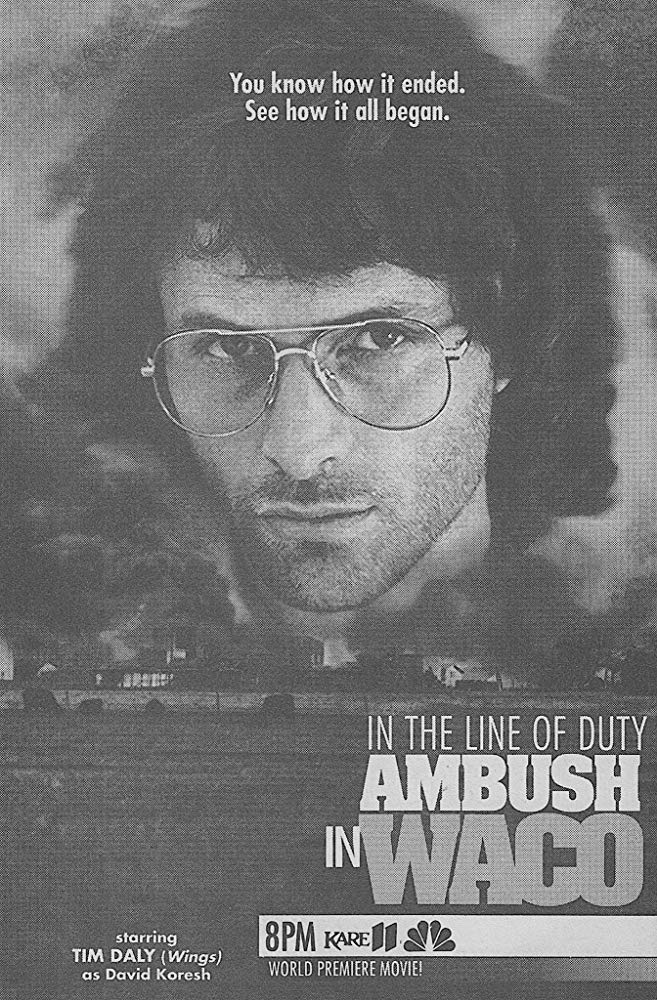
In The Line Of Duty: Ambush In Waco (1993, directed by Dick Lowry)


In Waco, Texas, a scruffy and frustrated musician named David Koresh (Tim Daly) has announced that he is the messiah and is gathering followers to live with him in a compound.  The Branch Davidians, as they are known, spend hours listening as the increasingly unhinged Koresh gives lengthy sermons.  There are rumors that Koresh is abusing the many children who live in the compound and that he is stockpiling weapons for a confrontation with the government.

The ATF makes plans to raid the compound and take Koresh into custody.  Under the supervision of Bob Blanchard (Dan Lauria), the agents run several practice raids.  However, when the day of the actual raid comes, they discover that the David Koresh and the Branch Davidians aren’t going to give up so easily…

Ambush in Waco is a dramatization of the infamous raid that led to a 51-day stand-off between the government and the Branch Davidians, a stand-off that ended with the compound in flames and the deaths of several innocent children.  Over the years, the siege in Waco has often been cited as an example of both government incompetence and law enforcement overreaction.  Instead of arresting Koresh during one of his many trips into town, the ATF decided to do a dramatic raid for the benefit of the news cameras and they were unprepared for what was waiting for them inside of the compound.  After 51 days of negotiations, the FBI tried to force Koresh out and, in the eyes of many, were responsible for the death of every man, woman, and child inside of the compound.  For many, the events in Waco represent the government at its worse.

You wouldn’t know that just from watching Ambush In Waco.  This made-for-TV movie was put into production while the siege was still ongoing.  As a result, the film shows the events leading up to the initial raid but nothing that followed.  Since it would be years before the full extent of the government’s incompetence at Waco would be uncovered, Ambush in Waco today feels like propaganda, a whitewash of a shameful moment of American law enforcement history.  The ATF is portrayed as being thoroughly professional while Koresh is a dangerous madman who is on the verge of trying to lead a violent revolution.  Today, we know that wasn’t the case.  Koresh may have been a loser with delusions of grandeur but he probably would have been content to spend the rest of his life hidden away in his compound.  Meanwhile, newly appointed Attorney General Janet Reno was so eager to prove her toughness that the situation was allowed to get out of control.  That’s not something you’ll learn from watching Ambush in Waco.

Of course, that doesn’t mean that David Koresh wasn’t a bad dude.  Tim Daly is this film’s saving grace, giving an outstanding performance as an unstable, wannabe dictator.  Ambush in Waco shows how someone like Koresh could end up attracting so many followers and it also shows how even the most well-intentioned of people can be brainwashed.  Though the film may not convince us that the ATF was justified in their actions, it does show us why we should be weary of anyone who claims to have all the answers.