Ghosts of Sundance Past #3: Crown Heights (dir by Matt Ruskin)


The 2017 film, Crown Heights, tells the story of two friends and a miscarriage of justice.

In 1980, a 19 year-old Trinidadian named Colin Warner (Lakeith Stanfield) is arrested in the Crown Heights neighborhood of Brooklyn.  Taken down to the police station, Colin is told that he has been arrested for the murder of Marvin Grant, a man who he has never heard of.  When Colin says that he is innocencent, he’s informed that eyewitnesses saw him at the scene of the crime.  Though he continues to protest his innocence, Colin is transferred to a jail where he is to await his trial.

From the start, it’s obvious that Colin didn’t have anything to do with the shooting of Marvin Grant.  What’s messed up is that the people prosecuting him know it as well.  When another prisoner tell the detectives the name of the man who actually committed the murder, his statement is ignored because he refuses to name his source.  When one of the prosecution’s witnesses testifies that he saw someone other than Colin fire the gun, the prosecutor “corrects” his witnesses’s testimony in open court. After the jury returns a guilty of verdict for Colin and another man, the judge says that he can’t be sure whether or not Colin is guilty but that he can only follow the law.  And the law says that, as an adult convicted of a crime, Colin is going to spend the rest of his life in prison.  No one in the legal establishment cares that Colin is obviously not guilty.  He’s a young black man with a minor criminal history and, by convicting him, the police can close one homicide investigation and move on to the next one.

In prison, Colin finds himself isolated, both literally and figuratively.  When he refuses to get involved with any of the prison gangs, the other prisoners shun him and he finds himself being targeted.  When a prison guard pushes Colin until Colin finally snaps and throws a punch, Colin ends up spending two years in solitary confinement.

Meanwhile, on the outside, Colin’s best friend, Carl King (Nnamdi Asomugha), attempts to prove that his friend is innocent.  That proves to be even more difficult than Carl initially expects.  No one is interested in reopening a closed case and Carl can’t even afford a good attorney to help him pursue Colin’s appeal.  Still, Carl never gives up.  He even trains to become a process server so that he can have an excuse to hang out at the court house and hopefully meet a lawyer who will be willing to take on Colin’s case.  Amazingly, that’s exactly what happens.

Of course, by this point, Colin Warner has been in prison for 20 years….

Based on a true story, Crown Heights was a hit at the 2017 Sundance Film Festival, winning the Audience Award for the U.S. Dramatic Film competition.  Watching the film, you can easily see why it was such a crowd pleaser.  Not only does the film deal with serious issues of race and economic disparity but, when watching the film, it’s impossible not to be moved by the strength of Carl and Colin’s friendship.  Despite all of the difficulties that are placed in front of him, Carl never gives up in his quest to prove Colin’s innocence and get him out of prison.  The film works as both a cry for freedom and a celebration of friendship.

The film’s execution is not quite as strong as its message.  Matt Ruskin’s direction occasionally veer towards made-for-TV (or, at the very least, made-for-HBO) territory and the film’s constant switching back and forth between Colin in prison and Carl searching for witnesses sometimes seems to prevent either storyline for really maintaining a consistent momentum.  20 years is a long time to cover in just 90 minutes and sometimes, it’s hard not to feel as if important parts of the story have been left out or, at the very least, glossed over.  That said, it’s a heartfelt film and it’s blessed with two wonderful lead performances from Lakeith Stanfield and Nnamdi Asomugha.

Crown Heights is not a perfect film but the story and the performances are powerful enough to make you think and to leave you moved.

Club Paradise (1986, directed by Harold Ramis)


I think I was nine or ten years old when I first saw Club Paradise on HBO.  I remember thinking it was pretty funny.

I recently rewatched Club Paradise and I discovered that ten year old me had terrible taste in movies.

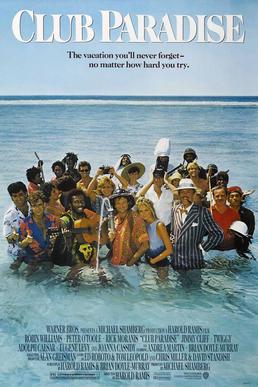
Robin Williams plays Jack Moniker, a Chicago fireman who gets blown out of a building while rescuing a dog.  Living off of his disability payments, he retires to the island of St. Nicholas, which is basically Jamaica but with less weed.  Jack and reggae musician Ernest Reed (Jimmy Cliff) open up their own Club Med-style resort, Club Paradise.  Jack doesn’t know much about the resort business but he does know how to put together a good brochure.  Almost the entire cast of SCTV shows up at Club Paradise, looking for a tropical vacation.  Things quickly go wrong because Jack doesn’t know how to run a resort and there’s also an evil developer (played by Brian Doyle-Murray) who wants Club Paradise to fail so that he can get the land.

Club Paradise has got a huge and impressive cast, the majority of whom probably signed on because they were looking forward to a paid Caribbean vacation.  Peter O’Toole plays the British-appointed governor of St. Nicholas.  Twiggy plays Jack’s girlfriend.  Joanna Cassidy plays a reporter and Adolph Caesar is cast in the role of St. Nicolas’s corrupt prime minister.  Because the film was directed by Harold Ramis, it is full of Ramis’s co-stars from SCTV.  Andrea Martin tries to get her husband to enjoy the islands as much as she’s enjoying them.  Joe Flaherty is the crazed pilot who flies people to the resort.  Rick Moranis and Eugene Levy play two nerdy friends who are both named Barry and who are only interested in scoring weed, getting laid, and working on their tan.  Rick Moranis and Eugene Levy playing nerds?  It’s a shock, I know.

There’s enough funny people in Club Paradise to ensure that there are a few isolated laughs.  Not surprisingly, the movie comes to life whenever Moranis and Levy are onscreen.  (If I had to guess, I imagine they were the reason why ten year-old me liked this movie so much.)  Needless to say, Jimmy Cliff also provides a killer soundtrack.  But Club Paradise ultimately doesn’t work because the script is too disjointed and it feels more like an uneven collection of skits than an actual film.  It’s impossible to tell whether we’re supposed to think of Club Paradise as being the worst resort ever or if we’re supposed to be worried that the bad guys will shut it down.  For a movie like this, you need a strong central presence to hold things together.  Unfortunately, Robin Williams’s style of comedy is too aggressive for the role of Jack.  The role was originally written for Bill Murray and it shows.  Most of Jack’s lines sound like things you would expect Bill Murray to say in his trademark laid back fashion and it is easy to imagine Murray redeeming some of Club Paradise‘s weaker scenes simply by attitude alone.  Instead, Robin Williams is so frantic that you never buy he could be happy living a laid back life on a Caribbean island.  As played by Williams, Jack often comes across as being unreasonably angry at everyone staying at Club Paradise and it’s hard to care whether or not he manages to save his resort or not.

Club Paradise was a bomb at the box office.  Harry Shearer, who was originally credited with working on the screenplay, hated the movie so much that he requested his name be removed from the credits.  (Instead, credit is given to Edward Roboto.)  As a result of the film’s failure, it would be 7 years before Harold Ramis would get to direct another movie.  Fortunately, that movie was Groundhog Day and this time, Ramis was able to get Bill Murray.

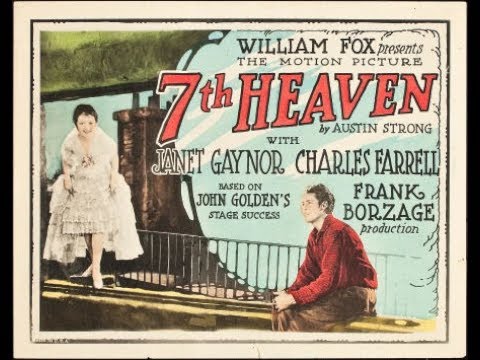
Lisa Reviews An Oscar Nominee: 7th Heaven (dir by Frank Borzage)


The 1927 melodrama 7th Heaven tells the story of two people in Paris.

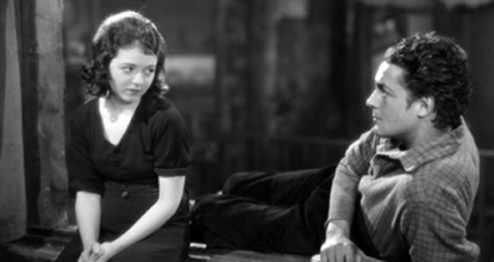
Chico (Charles Farrell) works in the sewers but lives by the stairs.  Though he spends all of his days under the street and dealing with literally the worst that the world has to offer, Chico remains an optimist.  After all, he has his small apartment, which sits atop seven flights of stairs.  He has his dreams, which involve eventually getting promoted to being a street cleaner.  He doesn’t have much religious faith, which concerns Father Chevillon (Emile Chautard) but who knows?  Maybe something can happen to change that….

Diane (Janet Gaynor) is a desperately sad young woman who lives in squalor with her older sister, the cruel Nana (Gladys Brockwell).  When we first see Diane, she’s lying on the floor while being whipped by Nana and that’s pretty much the way her life goes for the first fourth of the movie.  Nana treats Diane less like a sister and more like a slave, sending her out to steal food and buy absinthe.  Diane and Nana’s father has made a good deal of money overseas but when he sees how they’re living in Paris, he rejects both of them.

How bad of a sister is Nana?  She’s so bad that, when she’s eventually arrested by the Paris police, she points out her sister on the street and demands that they arrest her as well.  Fortunately, Chico just happens to present at the scene.  Having already protected Diane from Nana’s abuse once before, Chico steps forward and announces that Diane is his wife!  The police ask Chico if he’s sure and then remind him that, if it’s found that he’s lying, both he and Diane could go to prison.  Chico, however, insists that it is true.

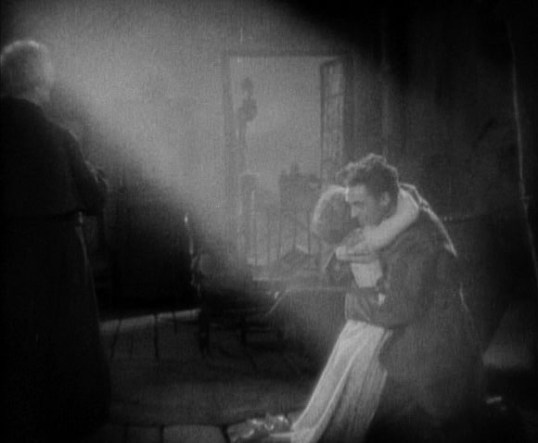
To keep the deception going, Chico allows Diane to move in with him.  When Father Chevillon arranges for Chico to get promoted to street cleaner, he also requests that Chico keep an eye on Diane.  Chico agrees and slowly but surely, the two of them fall in love.  Chico’s apartment, sitting atop 7 flights of stairs, becomes their 7th heaven.

However, World War I looms in the distance.  With all of Chico’s friends and coworkers receiving their draft notices and being sent to fight, Chico and Diane knew that it’s only a matter of time before the same thing happens to Chico….

As in so many other silent films, the shadow of World War I looms over every minute of 7th Heaven.  In the 20s, the Great War was still the main trauma that has shaped most viewer’s lives and one can imagine those viewers watching 7th Heaven and falling in love with the characters of Chico and Diane, all the while knowing that their happiness is only temporary.  If the 1st hour of 7th Heaven is a romantic mix of melodrama and comedy, the 2nd hour becomes a rather grim war film.  Even separated by war, Chico and Diane remain soulmates.  When Diane is told that Chico has been listed as having been killed in action, she knows that it’s not true because she can still feel their connection.  And yet, the final fourth of the film is so stylized and the final shot is both so beautiful and yet so artificial that the audience is left to wonder whether Diane is correct or if she’s simply dreaming what she (and, undoubtedly, the many other members of the audience who had also lost loved ones in the war) wishes to be true.

7th Heaven is a deliriously romantic film and watching it actually requires a bit less of an adjustment on the part of modern audiences than other silent films.  Director Frank Borzage keeps the action moving quickly and, even more importantly, Janet Gaynor and Charles Farrell both give sincere and naturalistic performances.  Never do they resort to the type of theatrical overacting that was featured in so many other silent films.  Instead, you watch the film and you truly believe that you are watching two people fall in love.  You’re happy when they’re happy and when tragedy strikes, you cry for them.  Their love is your love and their sadness is your sadness.

7th Heaven was one of the first films to even be nominated for Best Picture.  While Gaynor won Best Actress and Frank Borzage won Best Director, the award for Best Picture went to another World War I romance, Wings.

Ghosts of Sundance Past #2: The Report (dir by Scott Z. Burns)


Remember The Report?

The Report premiered at last year’s Sundance Film Festival, where it was a hit with the critics who saw it.  Amazon acquired the distribution rights and, for the first part of 2019, The Report was one of those films that was regularly discussed as being a potential Oscar nominee.  Not only was it based on a true story but it starred Adam Driver and Annette Bening.  There are several online film critics and award bloggers who are convinced that any film featuring Annette Bening will automatically be an Oscar contender, despite the fact that it rarely seems to work out that way.

Certainly, that ended up being the case with The Report.  Despite all of the hype from Sundance, The Report kind of fizzled when it was finally released.  That it didn’t do much business at the box office makes sense because it was only given a limited release and everyone knew that it would soon be available to stream on Prime.  But even after it was made available on Prime, The Report never really seemed to make much of a dent in the public consciousness.  When the Oscar nominations were announced, The Report was not mentioned once.  Adam Driver did receive a nomination for Best Actor but it was for Marriage Story.

What happened to The Report?  It may have been too low-key for audiences (and, let’s be honest, critics) who have come to expect even a movie about a Senate committee to be experimental and overly stylized.  It could be that, even though the film was critical of the CIA and the War on Terror, it wasn’t angry enough for the same people who thought Adam McKay’s Vice was a brilliantly conceived work of political cinema.  A more realistic explanation is probably that, in this hyper political age, people didn’t want to watch a 2-hour movie about a senate staffer.  Instead, people wanted an escape from all that.

It’s understandable but it’s also a shame because The Report is a very good film.  I mean, I usually hate films like this but I was surprised by how much I liked it.

The Report deals with the efforts of Senate staffer Daniel Jones (Adam Driver) and the members of the Senate Intelligence Committee to investigate the CIA’s use of torture in the aftermath of 9-11.  Skipping back and forth through time, the film shows us how Jones was first assigned to lead an investigation into the CIA’s activities in 2005 and how, over the course of seven years, Jones puts together not one but two reports that absolutely nobody wants released.  Along the way, Jones goes from being a generally idealistic and optimistic staffer to eventually becoming the type of paranoid and obsessive man who meets with reporters in underground garages and who considers leaking classified information.  Daniel has what he believes to be proof that using torture is not only unethical but also counter-productive but, as he discovers, even the members of his own political party aren’t particularly interested in releasing his report.  Adam Driver gives a memorably intense performance of Daniel, playing him as someone whose obsession with his report sometimes threatens to push him over the edge and transform him from being a crusader to being a zealot.

Annette Bening plays Daniel’s boss, Sen. Dianne Feinstein.  It’s interesting casting and, to be honest, it doesn’t quite work.  I almost feel like it would have been better for the film to have either kept Feinstein off-screen or to have at least minimized her role.  The problem is that Dianne Feinstein is a widely-known figure and it’s jarring to see Annette Bening, another well-known figure (at least among film fans), in the role.  Bening plays Feinstein as being a ethical and serious-minded stateswoman and she does what she can with what the film gives her but, at the same time, it’s still kind of a boring performance.  The film presents Feinstein, a not uncontroversial figure, in a positive light and I’m sure some, on both the Right and the Left would say that it’s perhaps a bit too positive.  One gets the feeling that Feinstein’s main role in the film is to assure us that the system works but we just have to take one look at Adam Driver losing his mind to realize that it doesn’t.

That misstep aside, The Report still works far better than I was expecting it too.  Taking obvious inspiration from All The President’s Men, Scott Z. Burns directs the film as if it were a thriller and the deeper that Adam Driver gets into his research, the darker and more shadowy Washington D.C. seems to become.  Even though the film clearly has an agenda, Burns gives the other side a chance to make their case without presenting them as being cartoonish villains.  In other words, this is the opposite of an Aaron Sorkin or Adam McKay-style diatribe.  Instead, this is an intelligent movie about intelligent people.  It’s a film that makes some of the same points as many other similarly liberal films but it makes them without taking cheap shots or resorting to a heavy hand. Long after Vice has been forgotten, The Report will be remembered.

And, if you haven’t seen it yet, it’s on Prime!

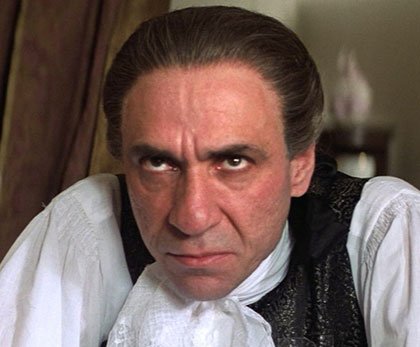
Lisa Reviews An Oscar Winner: Amadeus (dir by Milos Forman)


The 1984 film Amadeus is about a man who learns, after it’s a bit too late to really do anything about it, that he is thoroughly mediocre.

When we first meet Antonio Salieri (played by F. Murray Abraham), he’s an old man who has been confined to a mental asylum because he attempted to slit his own throat.  What should drive Salieri — a respected, if not particularly beloved, composer in 18th Century Vienna — to attempt to take his own life?  As he explains it to Father Vogler (Richard Frank), it’s the guilt of knowing that he’s responsible for death of the greatest composer of all time, Wolfgang Amadeus Mozart.

When Mozart (Tom Hulce) first showed up in Vienna, Salieri was already the court composer to the thoroughly vacuous Emperor Joseph II (Jeffrey Jones).  At the time, Salieri believed himself to be a genius touched by God.  As he recounts to Father Vogler, he prayed to God when he was a boy and he struck what he believed was an ironclad deal.  God would make Salieri a great composer and Salieri would remain a faithful believer.

But then Mozart shows up and, from the minute that he first hears one of Mozart’s compositions, Salieri realizes that Mozart is the one who has been blessed with genius.  Mozart is the one who is writing the music that will be remembered for the rest of time, long after Salieri and all of his other rival composers have been forgotten.  Upon first hearing Mozart, Salieri suddenly realizes that he has been betrayed by God.  He is a mediocre talent and he’s always been a mediocre talent.

The worst part of it is not just that Mozart’s a genius.  It’s also that Mozart knows he’s a genius.  He’s a bit of a brat as well, with a remarkably annoying laugh and vulgar manners that scandalize proper society.  Despite the efforts of his rivals to dismiss his talent, Mozart is beloved by the common people.  He’s an 18th century rock star and it seems as if no amount of scandal and petty jealousy can slow him down.  Even worse, the emperor takes a interest in Mozart and commissions him — and not Salieri — to write an opera.

Rejecting a God that he feels has betrayed him, Salieri plots Mozart’s downfall….

Goddamn, this is a great movie.  Seriously, everything about Amadeus works.

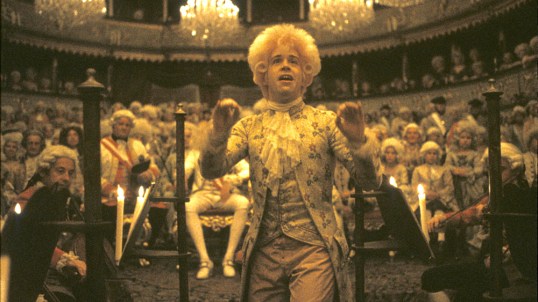
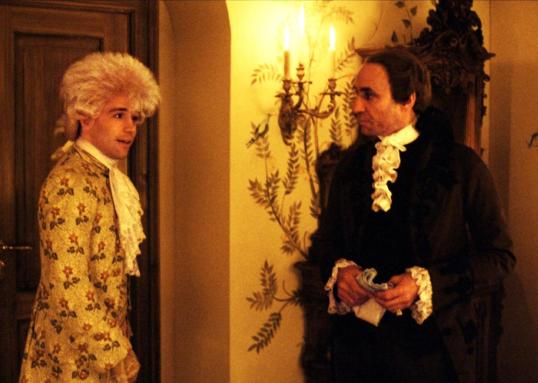
The ornate sets and the costumes not only wonderful to look at but they also actually tell us something about the characters who inhabit them.  One look at the beautiful but cluttered home that Mozart shares with his wife, Constanze (Elisabeth Berridge), tells you almost everything you need to know about not only Mozart’s tastes (which are expensive) but also his talent (which is undisciplined but also limitless).  The empty-headedness of Emperor Joseph is perfectly mirrored by the pretty but uninspired decor of his court while the grubby chaos of the mental asylum seems to have sprung straight from Salieri’s tortured soul.  As visualized in Amadeus, there’s a cold beauty to Vienna, one that is fascinating but, at the same time, menacing.  As for the costumes, Mozart’s powdered wig somehow seems to be brighter than everyone else’s and his colorful wardrobe demands your attention.  Meanwhile, when a costumed and masked Salieri shows up at Mozart’s door, he’s like the Grim Reaper coming to collect a soul.

The witty script is full of sharp lines and director Milos Forman does a wonderful job of balancing comedy and drama.  The scenes involving Joseph II are frequently hilarious and Jeffrey Jones does a great job of portraying Joseph as essentially being a very influential dunce.  The scene where Joseph tells Mozart that he liked his latest composition but that “there are simply too many notes” is a classic and one to which any artist, whether they’re Mozart or not, will be able to relate.  (“Just cut a few and it will be perfect.”)

The film is dominated by the performances of F. Murray Abraham and Tom Hulce.  Hulce is wonderfully flamboyant in the early part of the film and, bravely, he doesn’t shy away from portraying Mozart as occasionally being a bit of a spoiled brat.  It’s not just that Mozart can be annoying.  It’s also that he’s often deliberately annoying.  When we first see Mozart, it’s easy to understand why his very existence so grated on Salieri’s nerves and why Salieri considers him to be an “obscene child.”  But as the film progresses, Hulce lets us in and we come to see that Mozart is actually a very vulnerable young man.  When his disapproving father (Roy Dotrice) comes to visit, we suddenly understand both why Mozart is so driven to succeed but also why he is so instinctively self-destructive.

Meanwhile, F. Murray Abraham — well, what can I say about this performance?  In the role of Salieri, Abraham gives one of the greatest film performances of all time.  In many ways, Abraham has a tougher job than Hulce.  If Hulce has to convince us that Mozart has been touched by genius despite the dumb things that he often does, Abraham has to make petty jealousy compelling.  And somehow, Abraham manages to do just that.  Whereas the role of Mozart allows Hucle to wear his emotions on the surface, Abraham has to play a character who keeps most of his thoughts and impulses hidden and the fact that we end up understanding Salieri (if never actually sympathizing with him) is a testament to F. Murray Abraham’s skill as an actor.  Abraham won the Oscar for Best Actor for his work in Amadeus and it was more than deserved.

At the end of the film, Salieri declares himself to be the patron saint of mediocrities and, to a large extent, that’s what sets Amadeus apart from other biopics.  Most people are mediocre.  Most people are not going to end their life as a Mozart.  They’re going to end their life as a Salieri or worse.  This is one of the few films to be made about a runner-up.  It’s interesting to note that, even though the film is more about Salieri than Mozart, it’s still called Amadeus.  It’s not named Antonio or Salieri.  Even in a film made about Salieri, Mozart is advertised as the main attraction.

(It should also be noted that many historians believe that Salieri and Mozart were actually fairly friendly acquaintances and that, beyond the normal rivalry that any two artists would feel, neither held any significant ill will towards the other.  In other words, enjoy Amadeus as an outstanding piece of cinema but don’t necessarily mistake it for historical fact.)

Along with Abraham’s victory, Amadeus also won Best Picture of the year.  Of the nominees, it certainly deserved it.  (My pick for the best film of 1984 is Once Upon A Time In America with Amadeus as a close second.)  It’s a great film and one that definitely deserves to be watched and rewatched.

Outlaw Justice (1999, directed by Bill Corcoran)


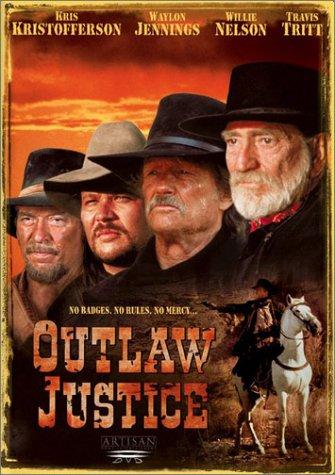
During the closing days of the old west, the evil Holden (Sancho Garcia) guns down retired outlaw, Tobey Naylor (Waylon Jennings).  Tobey’s son, Bryce (Chad Willett), is determined to get revenge so he teams up with three members of Tobey’s old gang, Lee Walker (Willie Nelson), Jesse Ray Torrance (Kris Kristofferson), and Sheriff Dalton (Travis Tritt).  They ride into Mexico, searching for one final shootout.  Along the way, they befriend the locals, find time to rebuild a burned-out church, and bicker like aging gunslingers in a Larry McMurtry novel.  Chad Willett and Willie Nelson also find time to fall in love with local women because, obviously, the entire film can’t just be gunfights and church-building.

Outlaw Justice is a standard western, which is distinguished only by the casting of the pioneers of outlaw country music as actual outlaws.  Since this was made during the Lonesome Dove-Unforgiven era of westerns, there’s some talk about how Lee and Jesse Ray are past their prime but otherwise, it’s an angle that largely left unexplored.  Of the singers, Kris Kristoffeson and Travis Tritt are probably the best actors but Willie Nelson seems to be having the most fun.  (Nelson has enough natural charisma that he can get away with a lot.)  If you’re a fan of westerns who doesn’t demand too much from the movie you’re watching, Outlaw Justice will probably be entertaining enough.  Otherwise, it’s pretty forgettable.

Ghosts of Sundance Past #1: Brittany Runs A Marathon (dir by Paul Downs Colaizzo)


As we all know, this year’s Sundance Film Festival started last week on Thursday.

To me, Sundance has always signified the official start of a new cinematic year.  Not only is it the first of the major festivals but it’s also when we first learn about the films that we’ll be looking forward to seeing all year.  It seems like every year, there’s at least one successful (or nearly successful) Oscar campaign that gets it start at Sundance.  This year, for instance, people are already intrigued by Zola, Minari, Shirley, and Ironbark and it’s almost entirely due to how those films have been received at Sundance.

My initial plan for this year was to spend the last few days of January looking at some of the films that have won awards or otherwise created a splash at previous Sundance Film Festivals.  I was planning on starting last Thursday but then I came down with a terrible cold, from which I’m still recovering.

So, instead, I’m starting today.  It happens.  In the past, I would have beaten myself up over not starting on time but, if I’ve learned anything from my 10 years of writing for TSL, it’s that sometimes you just have to accept that life can be unpredictable.  Sometimes, you just have to embrace the mystery.

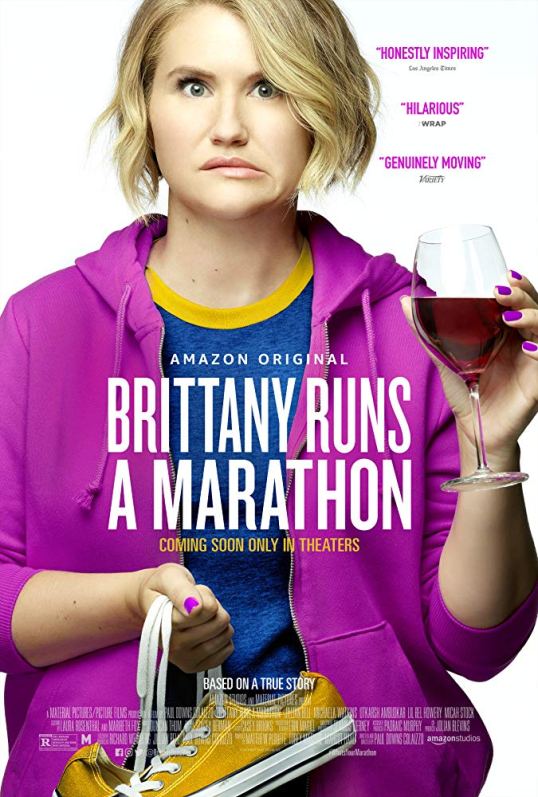
Anyway, to start things off, I want to take a look at one of my favorite films from last year, Brittany Runs A Marathon.

When we first meet Brittany Forgler (Jillian Bell), she is a 28 year-old New Yorker who works at a theater.  She’s single.  She’s funny.  She’s irresponsible.  She usually either drunk or hungover.  In many ways, she’s the ideal friend.  You wouldn’t necessarily want her to be your best friend, of course.  But she’s still someone who seems like she’d be the perfect member of a group, in that she can make a joke but, at the same time, she doesn’t have much of a life so you don’t have to worry about her attracting attention away from you.  Add to that, Brittany has an Adderall prescription, which she tends to abuse.  (It happens.)  Everyone loves someone who can provide them easy access to prescription medication.

In fact, it’s while she’s trying to get her prescription updated that Brittany is given some very serious news.  Her doctors informs her that she’s not very healthy.  She’s overweight and rarely gets any exercise.  Her doctor tells her that she needs to change that.  And since Brittany can’t afford to be a member of even the cheapest of gyms, it seems like the only option left is to start running.

In public.

In New York City.

Now, you can probably guess from the title that Brittany eventually comes to love running and decides that she wants to run in the New York marathon.  And you can probably guess that, about halfway through the movie, Brittany faces a crisis that causes her to consider just giving up.  As far as the running is concerned, this is a likable but occasionally predictable film.

Fortunately, Brittany Runs A Marathon is about more than just running.  It’s about growing up and taking responsibility for your life but it’s also about loving who you are, regardless of who that might be.  What makes this film so special is that Brittany doesn’t automatically become an Olympic class runner.  Nor does her life magically come together just because she manages to complete a 5k.  Instead, what makes this film so special is that it’s about Brittany finding her own happiness and accepting who she is.  When Brittany struggles, it’s impossible not to feel for her.  When Brittany succeeds, it’s impossible not to cheer.

It helps that this is also a terrifically funny film.  The dialogue is sharp and witty and Jillian Bell is one of those actresses who can make even the simplest of lines hilarious.  (She can also make them heart-breaking when she needs to.)  While Brittany is running, she’s also working as a pet sitter.  When she discovers that another pet sitter, Jern (Utkarsh Ambudkar), is essentially squatting in their employer’s house while she’s out of town, Brittany ends up moving in with him.  Everyone tells Brittany that she’s eventually going to end up sleeping with Jern.  Brittany says it will never happen.  Jern says it will never happen.  We know it will happen because Bell and Ambudkhar have such a wonderful chemistry.  They’re like a 21st century version of Tracy and Hepburn.

I wasn’t expecting much from Brittany Runs A Marathon but it’s a good film, a funny comedy with a good heart and serious points to make.  Not surprisingly, it was also loved at Sundance, where it won the Audience Award.

Rambo: Last Blood (2019, directed by Adrian Grunberg)


John Rambo (Sylvester Stallone, of course) is back!

He’s in his 70s now.  He talks a little slower.  He moves a little stiffly.  He wakes up every morning and takes a hundred different pills.  He says that he has finally given up his anger but, deep down, he’s still the same Rambo who blew up the town of Hope, Washington before becoming an international problem solver.  He still likes to dig underground tunnels and make weapons.  When he’s not doing that, he and Maria Beltran (Adriana Barraza) run his father’s old horse ranch in Arizona.

When Maria’s granddaughter, Gabriela (Yvette Monreal), sneaks down into Mexico to search for her biological father, Rambo goes after her.  When he discovers that Gabriela has been kidnapped and drugged by a Mexican cartel, Rambo announces that he’s going to rescue her and get revenge, even if it means blowing up the entire southwest to do it.

There’s a scene in Last Blood where Rambo literally rips a man’s heart out of his chest and holds it in front of his face while he dies.  That’s pretty cool and doubly impressive when you consider that Rambo’s not that young anymore.  I’m 40 years younger than Rambo and I can’t do that.  Other than that, though, Last Blood is a disappointment.  The cartel makes for a forgettable group of villains and too much of the plot depends on otherwise intelligent people suddenly doing something stupid.  The Rambo films have never been known for their carefully constructed storylines but, even by the standards of the previous films in the series, Last Blood feels as if it was hastily slapped together.

The main problem, though, is that John Rambo doesn’t feel like Rambo.  There are references to the time that Rambo spent in Vietnam and Rambo does use several VC-style booby traps to take out most of his enemies but otherwise, Sylvester Stallone might as well have just been playing John Smith.  I spent the whole movie waiting for Rambo to at least say something along the lines of, “A friend of mine from Nam — his name was Sam Trautman — taught me this,” but instead, the previous Rambo films go largely unacknowledged until the end credits, during which we see some scenes from our hero’s past adventures.  If you’re going to make a Rambo film, it should feature a story that could only happen to Rambo and a problem that only he can solve.  Last Blood felt like it had more in common with Taken than Rambo.

Rambo’s had a good run but, on the basis of Last Blood, I think it may be time to let the character enjoy his retirement in peace.  He’s earned it.


Lisa Reviews An Oscar Nominee: The Diary of Anne Frank (dir by George Stevens)


From 1942 to 1944, a teenage girl named Anne Frank lived in hiding.

She and her family lived in what was sometimes called The Secret Annex, three stories of concealed rooms that were hidden behind a bookcase in an Amsterdam factory.  At first, it was just Anne, her older sister Margot, and their parents.  Eventually, they were joined by another family and eventually a dentist, with whom Anne did not get along.  Life was not easy in the concealed space and tempers often flared.  As the months passed, Anne had a romance-of-sorts with Peter, the teenage son of the other family, but she wondered if she truly felt anything for him or if it was just because they were stuck together.  Anne looked forward to someday returning to school and seeing all of her old friends, again.  However, she knew that she could not leave the Annex until the Nazis had finally been forced out of the Netherlands.  She and the other occupants had to remain in hiding and they had to remain perfectly quiet eight hours a day because they were Jewish.  If they were discovered, they would be sent to the camps.  So, they waited and Anne kept a diary.

Tragically, the Nazis did eventually discover the Secret Annex.  Of the 8 occupants, only Anne Frank’s father, Otto, would survive the war.  The rest died in various concentration camps.  Anne Frank’s mother starved to death in Auschwitz.  Her older sister, Margot, was 19 when she fell from her bunk and, because she was in such a weakened state, was killed by the shock.  Anne Frank, it is believed, died a few days after Margot.  She died at the Bergen-Belsen Concentration Camp, one of the 17,000 prisoners to succumb to Typhus.  Before she died, Anne Frank spoke with two former schoolmates who were also being held at Bergen-Belsen.  She told them that she had believed her entire family was dead and that she no longer had any desire to go on living.

However, Otto Frank did survive and, at the end of the war, he returned to the Secret Annex.  That’s where he discovered Anne’s diary.  After editing it (a process that Anne, who aspired to be a journalist, had already started doing shortly before she was arrested), Otto arranged for the publication of the diary.  The Diary of A Young Girl (or, as it was titled in some countries, The Diary of Anne Frank) was a bestseller and has remained one ever since it was first published.  Along with being recognized as being one of the most important books ever written, it’s also been adapted for both stage and screen.

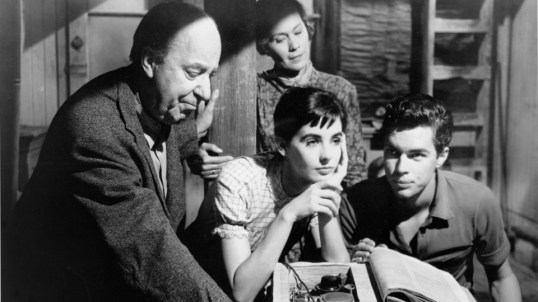
The first such screen adaptation was in 1959.  It was directed by George Stevens and it starred 20 year-old Millie Perkins as Anne.  (Perkins bore a great resemblance to Audrey Hepburn, who was reportedly Otto Frank’s preferred choice for the role.  Hepburn turned him down, saying she would have been honored to have played the role but believed that she was too old to believable as a 14 year-old.)  Joseph Schildkraut played Otto while Diane Baker played Margot and Gusti Huber played Edith Frank.  The Van Daans were played by Shelley Winters and Lou Jacobi while Richard Beymer played their son (and Anne’s tentative boyfriend), Peter.  Ed Wynn, who was best known as a comedian, played the role of Albert Dussell, the dentist to whom Anne took a dislike.  (The surviving family of Fritz Pfeffer — who was renamed Dussell in Anne’s diary — objected to the way he was portrayed in both the book and the film.)

As a film, it has its flaws.  George Stevens specialized in big productions but that was perhaps not the proper approach to take to an intimate film about a teenage girl coming-of-age under the most difficult circumstances imaginable.  Because this was a 20th Century Fox production from the 50s, The Diary of Anne Frank was filmed in Cinemascope, which made the annex itself look bigger than it should.  Scenes that should feel claustrophobic often merely come across as being cluttered.

But, in the end, the story is so powerful and so important that it doesn’t matter.  Though the Annex was recreated on a Hollywood sound stage, the exteriors were actually filmed in Amsterdam.  When we see the outside of the factory where the Frank family lived, we are seeing the actual factory.  When we see repeated shots of the uniformed Nazi police patrolling the streets at night, we know that we’re seeing the actual view that Anne Frank undoubtedly saw many a night from the Annex.  And because we know the story, we begin the film knowing how it’s going to end and that adds an even greater weight to each and every scene.  It’s impossible not to relate to Anne’s hopes for the future and it’s just as impossible to not mourn that Anne never lived to see that future.

Stevens originally planned for the film to end with a scene of Anne at Bergen-Belsen.  To their discredit, 20th Century Fox removed the scene after preview audiences complained that it was too upsetting.  People should be upset while watching (or, for that matter, reading) The Diary of Anne Frank.  Even today, there are people who still seem to struggle with acknowledging the enormous evil that was perpetrated by the Nazis and their allies.  As a result, it’s not uncommon to find people who, when they don’t outright deny that it happened, try to minimize the Holocaust.  It’s a disgusting thing.  There was recently a viral video, which was released by NowThis that featured a student at George Washington University saying, “What’s going to happen if there’s another Holocaust? Well, we’re seeing what’s happening. We’re seeing people die at the border for lack of medical care. That’s how Anne Frank died. She didn’t die in a concentration camp, she died from typhus.”  NowThis later said that the student meant to say that Anne Frank “didn’t die from a concentration camp, she died from typhus,” and you really have to wonder just how fucking stupid someone has to be to think that 1) that’s somehow an improvement on what was originally said and 2) that typhus and the concentration camp were not essentially the same thing.  Even if one accepts that the student misspoke, it would seem that her main complaint was the the concentration camp didn’t have proper medical care, as opposed to the fact that it was specifically created to imprison and kill Jewish people.  It’s an astounding combination of ignorance and antisemitism.  NowThis later edited her comments out of the video, which again seems to miss the point of why people were upset in the first place.  Instead of just saying, “Hey, this idiot is a Holocaust denier and, regardless of whether she hates Trump as much as we do, we want nothing to do with her,” NowThis instead said, “Well, if that comment offends you, we’ll take it out and you won’t have to hear it.”  To me, that’s why The Diary of Anne Frank is still important and why it should still be read and watched and studied.  There are too many ignorant people and craven, weak-willed organizations out there for us to turn our backs on teaching history.

The Diary Anne Frank was nominated for best picture of the year.  While Shelley Winters won the Oscar for Best Supporting Actress, the Best Picture Oscar went to Ben-Hur.  Interestingly enough, Ben-Hur’s director, William Wyler, was originally interested in directing The Diary Anne Frank before George Stevens was brought on board.

Lisa’s Marie’s Top 26 Films of 2019


And now, without further ado, I conclude my look back at 2019 with my 26 favorite films of the years.  Why 26?  Because Lisa doesn’t do odd numbers!

(Want to see my previous picks?  Click here for 2018, 2017, 20162015, 2014201320122011, and 2010!)

1. The Souvenir
2. Once Upon A Time In Hollywood
3. Uncut Gems
4. Luce
5. The Irishman
6. Parasite
7. The Lighthouse
8. Crawl
9. Dragged Across Concrete
10. Doletmite Is My Name
11. Avengers: Endgame
12. 1917
13. Joker
14. The Two Popes
15. The Aeronauts
16. Hustlers
17. The Report
18. Brittany Runs A Marathon
19. Rocketman
20. The Last Black Man in San Francisco
21. Apollo 11
22. I Lost My Body
23. The Farewell
24. Us
25. Midsommar
26. Spider-Man: Far From Home