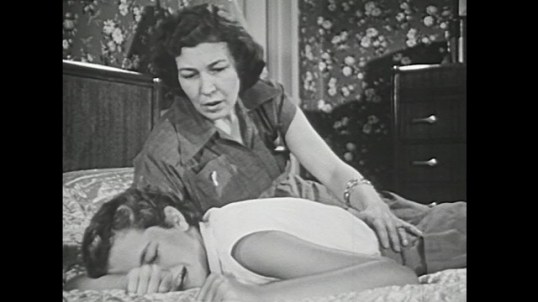
The year was 1951 and Susie Jane was struggling to fit in at school. While everyone else was planning dances and hanging out at the malt shop, Susie was standing off to the side, quietly. Why was Susie Jane such an outsider? Was it the fault of her peers or was it her fault for being such a nonconformist?
This educational short, from Young American Films, puts most of the blame on Susie. Yes, the film suggests, her classmates could have made more of an effort to include her. But Susie also should have made more of an effort to fit in and she shouldn’t have been so quick to assume that everyone was against her. Susie might think that Marcy is only calling the house to taunt her but Marcy is actually calling because she feels guilty and obligated.
The short film may feel like one of the films that Herk Harvey made before directing Carnival of Souls but this film was actually directed by Arthur Wolf. The narrator, I have to say, is a bit of a jerk and spends the entire film talking down to Susie. Susie’s having a hard enough time without having to put up with all of that! That said, the film also takes a very 1950s approach to the issue of fitting in. Susie’s an outside because she’s shy. No consider is paid to the idea that maybe Susie just isn’t interested in doing the same thins as everyone else.
Sixteen year-old Jimmy Mulligan (Tucker Albrizzi) is a nice kid with a big problem. His high school is ruled by a gang led by a bully named Miles (Jack DiFalco) and the overweight and quiet Jimmy has become the gang’s number one target.
Miles has decided that Jimmy owes him a hundred dollars. Even though Jimmy has never borrowed any money from Miles and is obviously not from a family that would have a hundred dollars to just toss around, Miles insists that Jimmy is in his debt. When Jimmy refuses to pay, Miles beats the poor kid while he’s walking home from school. However, the beating is observed by a retired boxer named Clarence “Action” Jackson (Ron Canada). Action runs off Miles and then he makes Jimmy an offer. He’ll help Jimmy learn how to box as long as Jimmy agrees to only use his skills for self-defense. At first Jimmy and his parents are reluctant but, after he gets beaten up for a second time, it’s time to go to Manny’s Gym!
Manny (Danny Trejo!), who is a legendary trainer, takes Jimmy under his wing and teaches him how to throw a punch and avoid a jab. Soon, Jimmy is losing weight, gaining confidence, and even going out on a date with a supercool goth girl named Adrian (Elanna White). But Miles still wants his money and eventually, Jimmy is going to have to put his training to use.
In many ways, Bully is every bullied kid’s dream. Not only does Jimmy learn how to throw a punch and get a girlfriend but he also gets to hang out with Danny Trejo! Manny is a tough but funny guy with a rough past but a good heart and he is using his skills to try to make the world a better place. The same can be said for Danny Trejo himself, so he’s the perfect choice to play Manny. Ron Canada is also good as Action Jackson, bringing a lot of quiet dignity to the part. Tucker Albrizzi does a good job of going from being insecure to being confident.
It’s just too bad that the film itself isn’t better. Bully has good intentions but the execution is lacking. The movie kept suggesting that there would be a scene where Jimmy had to chose between using his new skills for revenge or just for self-defense but it never happened. There were too many scenes that did not seem to go anywhere and, for all of the build-up, the final fight between Jimmy and Miles was anti-climatic and confusingly filmed. During the final 15 minutes, several new characters show up and suddenly become central to the story. Somehow, the Mafia finds out about the fight and takes an interest in whether or not Jimmy is going to be able to beat up Miles. On the one hand, it’s cool because Vincent Pastore is one of the gangsters but on the other hand, what’s going on? Why are they there?
Danny Trejo’s cool, though. That counts for a lot.
Loosely based on a novel by Norman Mailer, the 1966 film, An American Dream, tells the story of Stephen Rojack (Stuart Whitman). Rojack’s a war hero, a man who has several medals of valor to his credit. He’s married to Deborah (Eleanor Parker), the daughter of one of the richest men in the country. He’s an acclaimed writer. He’s got his own television talk show in New York. He’s been crusading against not only the Mafia but also against corruption in the police department. He has powerful friends and powerful enemies. You get the idea.
He’s also got a marriage that’s on the verge of collapse. Deborah calls Rojack’s show and taunts him while he’s on the air. When Rojack goes to her apartment to demand a divorce, the two of them get into an argument. Deborah tells him that he’s not a hero. She says he only married her for the money and that she only married him for the prestige. She tells him that he’s a lousy lover. Being a character in an adaptation of a Norman Mailer novel, the “lousy lay” crack causes Rojack to snap. He attacks Deborah. The two of them fight. Deborah stumbles out to the balcony of her apartment and it appears that she’s on the verge of jumping. Rojack follows her. At first, he tries to save her but then he lets her fall. She crashes down to the street, where she’s promptly run over by several cars. The cars then all run into each other while Rojack stands on the balcony and wails. There’s nothing subtle about the first 15 minutes of An American Dream.
Actually, there’s nothing subtle about any minute of An American Dream. It’s a film where everything, from the acting to the melodrama, is so over-the-top and portentous that it actually gets a bit boring. There’s no relief from the screeching and the inauthentic hard-boiled dialogue. When a crazed Rojack starts to laugh uncontrollably, he doesn’t just laugh. Instead, he laughs and laughs and laughs and laughs and laughs and …. well, let’s just say it goes on for a bit. It’s like a 60s version of one of those terrible Family Guy jokes.
Anyway, the police don’t believe that Deborah committed suicide but they also can’t prove that Rojack killed her. Meanwhile, within hours of his wife’s death, Rojack meets his ex-girlfriend, a singer named Cherry (Janet Leigh). Rojack is still in love with Cherry but Cherry is also connected to the same mobsters who want to kill Rojack. Meanwhile, Deborah’s superrich father (Lloyd Nolan) is also on his way to New York City, looking for answer of his own.
An American Dream is a very familiar type of mid-60s film. It’s a trashy story and it’s obvious that the director was trying to be as risqué as the competition in Europe while also trying to not offend mainstream American audiences. As such, the film has hints of nudity but not too much nudity. There’s some profanity but not too much profanity. Rojack, Deborah, and Cherry may curse more than Mary Poppins but they’re rank amateurs compared to the cast of Who’s Afraid of Virginia Woolf? It’s an unabashedly melodramatic film but it doesn’t seem to be sure just how far it can go in embracing the melodrama with alienating its target audience so, as a result, the entire film feels somewhat off. Some scenes go on forever. Some scenes feel too short. The whole thing has the washed-out look of an old cop show.
All of that perhaps wouldn’t matter if Stephen Rojack was a compelling character. In theory, Rojack should have been compelling but, because he’s played by the reliably boring Stuart Whitman, Rojack instead just comes across as being a bit of a dullard. He’s supposed to be a charismatic, two-fisted Norman Mailer-type but instead, as played by Whitman, Rojack comes across like an accountant who is looking forward to retirement but only if he can balance the books one last time. There’s no spark of madness or imagination to be found in Whitman’s performance and, as a result, the viewer never really cares about Rojack or his problems.
Noman Mailer reportedly never saw An American Dream, saying that it would be too painful to a bad version of his favorite novel. In this case, Mailer made the right decision.
That’s the question that is at the heart of the 1960 Italian-French film, Kapo.
The film opens in Nazi-occupied France, with 14 year-old Edith (played by 22 year-old Susan Strasberg) practicing the piano at her teacher’s house. Edith wears the yellow star on her dress and, as she finishes her lesson, her teacher instructs her to be careful returning home. Edith cheerfully states that she and her family have nothing to worry about. Edith walks home and, as the opening credits roll, we follow her as she walks through what appears to be a very robust and busy city. Other than the yellow star on Edith’s dress, there are no outward signs of the occupation in the city. However, when Edith finally reaches her neighborhood, she sees that her family and her neighbors are being rounded up the Germans.
Edith and her parents are sent to a concentration camp but get separated as soon as they arrive. Wandering around the camp, Edith meets another prisoner named Sofia (Didi Perago). Sofia takes Edith to the camp doctor. He arranges for Edith to switch identities with a non-Jewish prisoner who has just died. Edith’s new name is Nicole and her yellow star is removed and replaced by a black triangle, which designates Edith/Nicole as being “asocial.”
Edith is transferred to another concentration camp, this one in Poland. She comes to think of herself as being Nicole. When another prisoner, Terese (Emmanuelle Riva), asks her is she’s Jewish, Nicole replies that she’s not. Nicole quickly grows hardened to life in the camp and exchanges sex for food. She becomes the lover of a guard named Karl (played by future spaghetti western mainstay Gianni Garko) and is made a Kapo, a prisoner who also works as a guard. However, when Nicole then falls in love with a Russian prisoner-of-war and he asks her to help him and his comrades escape, she is forced to finally decide whether she is Nicole or whether she’s Edith.
To return to the question that started this review: What makes someone a collaborator? That’s the question that Kapo attempts to answer and it’s a question that was undoubtedly close to Director Gillo Pontecorvo’s heart. Pontecorvo was one of the most political of the post-World War II Italian filmmakers. He was born in 1919 and, as a child, saw firsthand the rise of Mussolini. As a Jew, he also experienced anti-Semitism firsthand and, in 1938, he left Italy for France. In France, he befriended Sartre and many other key members of the International Left. He was reportedly emotionally and politically moved by his friends who left France to fight on the Republican side during the Spanish Civil War. During World War II, he joined the Italian communist party and fought in the resistance. It’s perhaps not a surprise that, in Kapo, Nicole’s chance at redemption comes about as a result of falling in love with a communist soldier.
Unfortunately, Kapo struggles to answer the question of why one would collaborate with the enemy. The main problem is that Susan Strasberg is miscast of Edith/Nicole, never convincing us that she’s a naïve teenager or a hardened collaborator. She’s also not helped by a script that continually reduces everything down to who Edith/Nicole happens to be in love with at any given point of time. It also doesn’t help that Strasberg find herself acting opposite Emmuelle Riva, Gianni Garko, and other actors who all authentic in a way that she’s not.
Kapo is more valuable as an examination of the horrors of the camps than as a character study. The film’s most powerful moment comes early on, when Edith/Nicole learns that, in the eyes of the Nazis, it’s preferable that someone be a criminal to being a Jew. In that moment, the film captures both the brutal horror and the arbitrary absurdity of prejudice. The scene is followed by another harrowing moment, in which Edith can only helplessly watch as her parents are marched to gas chambers. In those brief moments, Kapo becomes an important film. You may not remember much about Edith/Nicole but you will remember those scenes.
I should also note that, regardless of its flaws, the film does end on a powerful note, one that will leave many viewers asking how much they would be willing to sacrifice to do the right thing. Would you sacrifice your life to save hundreds of others? It’s a question that Edith/Nicole has to answer, though the film leaves it ambiguous as to whether her final decision was made by her or if it was made for her. Still, the film’s final images do stay with you.
In America, Kapo received a nomination for what was then known as the Best Foreign Film Oscar. In Europe, though, many critics criticized Pontecorvo for making a film that they felt sentimentalized the Holocaust. Stung by their criticism, Pontecorvo’s next film, which would be considered by many critics to be his masterpiece, would be the documentary-style The Battle of Algiers, one of the most resolutely anti-sentimental political films ever made.
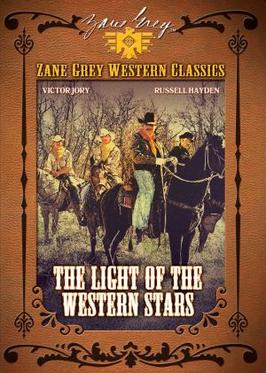
In the dead of night, a train stops in an isolated western town. Only one passenger disembarks. Majesty Hammond (Jo Ann Sayers) is a wealthy Bostonian, who has traveled all the way to the town to try to prevent her bother from marrying a local woman. Majesty takes a seat in the station and waits for someone to come get her.
After a few minutes, a drunken ranch foreman named Gene Stewart (Victor Jory) enters the station. He has made a bet with the local sheriff (Tom Tyler) that he can convince the first new woman to arrive in town to marry him. Stewart’s friends find a priest but before Gene can force the priest to marry them, a local girl named Bonita (Esther Estrella) rides up and tells Gene that one of the ranch hands, Danny (Alan Ladd, the future Shane in one of his earliest roles), has been forced to flee town after getting into a fight with the sheriff.
As if that’s not bad enough, Gene then discovers that Majesty’s brother is going to marry Flo Kingsley (Ruth Rogers), who happens to be Gene’s employer! Ashamed of his behavior, Gene leads Majesty to Flo’s ranch.
After some initial weariness, Majesty is convinced that Flo and her brother really are in love. Flo explains to Majesty how life works out in the frontier and Majesty is even able to forgive Gene for his drunken antics. Majesty decides to buy a ranch in town but what she doesn’t know is that corrupt businessman Hayworth (Morris Ankrum) is using the ranch to smuggle weapons to the Mexican army and that he’s working with the sheriff! Majesty is going to need Gene’s help to run the ranch but, after getting into another fighting with the sheriff, Gene goes into hiding. Can Majesty find Gene and convince him to return to town?
Based on a novel by Western specialist Zane Grey, The Light of Western Stars is only 65 minutes long but it packs a lot of plot and a lot of action into those sixty minutes. Of course, the plot is pretty standard stuff but, for B-movie fans, it’s a chance to see Victor Jory in a rare leading role and also a chance to see what Alan Ladd was doing before he became a noir mainstay. Hard-drinking and occasionally irresponsible, Gene is an interesting hero and Jory does a good job playing him. Alan Ladd doesn’t make a huge impression as Danny but he looks convincing fleeing town on horseback and that’s all the role really requires.
For many viewers, though, the main appeal of Light of Western Stars will be the beautiful Jo Ann Sayers as Majesty. Primarily a stage actress, Sayers only appeared in 16 films before she got married and semi-retired but she made an impression in every one of them. That’s certainly the case here, where her beauty makes it very plausible that even a wanted man would return to town just to be with her.
“American,” a young Vietnamese refugee says to Sgt. Mike Ransom, “tell me about Disneyland.”
Ransom tells him all about Disneyland, a magical place where, according to Rasom, the trees are made of ice cream and genies pop out of lamps. Ransom breaks down in tears, sobbing as he realizes that his friend will never get to experience Disneyland firsthand.
Years later, Ransom is in Manila, blowing up a former American military officer who gave aid to the communists. “DIE! DIE!” Ransom shrilly yells as the man literally explodes in front of him. And while the man may not have been one of the good guys and he did a lot of bad things during the Vietnam War, it’s hard not to feel that Ransom’s attitude would get him banned from Disneyland. Not even the ghost hitchhikers at the Haunted Mansion would want to accept a ride from the “Die! Die!” guy.
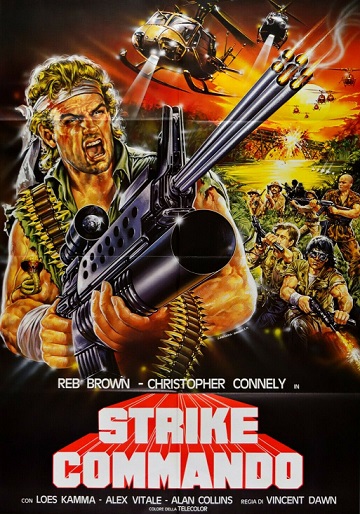
That Mike Ransom, he’s a complicated man. As played by Reb Brown, he’s also at the center of the 1987 Italian film, Strike Commando. As you can probably guess from the film’s title, he’s the leader of an elite squad of soldiers, a team of strike commandoes who are determined to lead America to victory during the Vietnam War. We’re continually told that Ransom is the best, though we don’t see much of evidence of it. He’s the type of commando who specializes in sneaking behind enemy lines and hitting the communists before they even realize he’s there but he’s so bulky and loud that it’s hard to imagine that he’s ever been able to successful sneak around anywhere. He has a particularly bad habit of shrilly screaming every word that he says. Even when he’s not telling people to die, he’s yelling. He’s like the athletic coach from Hell.
In fact, as I watched Strike Commando, I started to wonder what it would be like to live next door to someone like Mike Ransom.
“Hi, Mike, are you doing okay?”
“I’M DOING GREAT! GREAT! GREAT!”
“Any plans for the day?”
“I’M MOWING THE LAWN! MOWING! MOWING! MOWING!”
“I think I’ve got some mail for you that accidentally left in my mailbox….”
“THE POSTAL SERVICE LIED! LIED! LIED! LIED!”
At first, living next door to Mike Ransom would probably be entertaining but I imagine it would get kind of boring after a while. Yelling can be an effective way to express yourself but it loses its power if that’s the only thing you ever do. The same can be said for Strike Commando as a film. It gets off to a good start, with several extremely over-the-top action sequences and, of course, Mike telling a little refugee child about Disneyland. But the second half of the film, which involves Mike being held in a POW camp and meeting a fearsome Russian torturer named Jakoda, drags a bit because there’s only so much time you can listen to Ransom yell before you start to tune him out. It doesn’t help that the second half of the film features some particularly nasty torture scenes. Still, it is somewhat redeemed by a scene where the Viet Cong attempt to force Ransom to broadcast a propaganda message over their radio station. “KEEP FIGHTING!” Ransom yells into the microphone. Hell yeah! You tell ’em, Ransom!
Strike Commando was directed by Bruno Mattei, an Italian exploitation filmmaker who was never one to just turn things up to ten when he could turn them up to 11 instead. Strike Commando was obviously meant to capitalize on the success of the Rambo films. In typical Mattei fashion, the action is over-the-top, nonstop, and more than a little silly. Mattei was never shied away from embracing excess and Strike Commando has everything that you would expect from one of his war films: lots of stuff blowing up, heavy-handed use of slow motion, and plenty of grainy stock footage. You have to admire Mattei’s dedication to always finding something for Reb Brown to yell about.
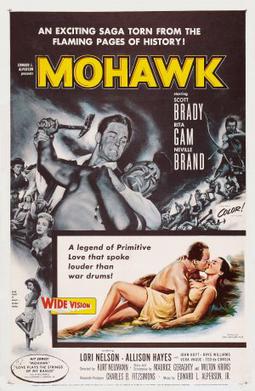
In the late 18th century, Boston socialite Cynthia Stanhope (Lori Nelson) travels to Fort Alden in upstate New York to visit her fiancé, a painter named Jonathan Adams (Scott Brady), who has been commissioned to paint the local scenery. As soon as Cynthia and her mother arrive, they are shocked to discover that not only Jonathan has been painting pictures of the members of the Native local tribes but that he is also now flirting with a barmaid named Greta. Greta is played by Allison Hayes so who can blame him? Cynthia wants to return to their normal upper class life in Boston but Adams has fallen for the untamed wilderness of the frontier.
When Onida (Rita Gam), the daughter of Iroquois chief Kowanen (Ted de Corsia) is captured during a raid on the fort, Adams is assigned to escort her back to her tribe. Leaving behind Cynthia and Greta, Adams falls in love with Onida over the course of the journey. When he meets the Iroquois, he earns the respect of her father and the entire tribe when he agrees to paint the chief’s portrait.
Meanwhile, a haughty settler named Butler (John Hoyt) is trying to play the army and the Iroquois against each other, feeding both of them false information in an attempt to spark a war. Butler is hoping that a war will lead to both sides wiping each other out so that he can once again have the valley to himself. When it turns out that his words might not be enough to spark a war, Butler resorts to murder. When Kowanen’s son is killed, the Iroquois prepare for war while Adams is framed for the crime and finds himself tied to a stake.
Mohawk is a standard B-western, with a plot that is largely lifted from John Ford’s Drums Along The Mohawk. Unfortunately, Adams is about as sympathetic hero as you would expect someone manipulating three different women to be and, when it comes to depicting the Iroquois, Mohawk resorts to too many clichés. This is one of those westerns where the Native characters speak broken English, even when they are just talking to each other.
Mohawk does have three things to recommend it. Number one, John Hoyt was a master at playing haughty villains and Butler is easy to root against. You will look forward to seeing him get his comeuppance. Number two, Allison Hayes was a force of nature and that’s true even in this film, where she’s not given nearly enough to do. Number three, one of Iroquois braves is played by Neville Brand. A highly decorated World War II veteran, Brand built a long career playing tough guys. In Mohawk, it only takes one look at Neville Brand to know that this isn’t someone you want to mess with. Anyone watching would want to stay on Neville Brand’s good side.
Otherwise, Mohawk is forgettable. Two years after it was released, Mohawk’s director Kurt Neumann, would be responsible for the much more memorable The Fly.
In the post-civil war west, two Calvary troopers steal a Gatling Gun, the weapon that was invented to be such a powerful instrument of death that people would stop fighting wars just to avoid finding themselves in front of its barrel. (It didn’t work out that way, of course.) With the help of a pacifist reverend named Harper (John Carradine), they smuggle the gun into Apache territory. Rev. Harper thinks that the gun is going to be destroyed and, thus, another instrument death will be eliminated. from the world Instead, the greedy troopers are planning on selling the gun to Apache Chief Two Knife (Carlos Rivas). Two Knife has promised a fortune’s worth of gold to anyone who can deliver to him the deadliest weapon in the west.
Before the gun can be exchanged, the reverend, his daughter, and the two deserters are intercepted by a group of Calvary troops led by Lt. Wayne Malcolm (Guy Stockwell). One of the deserters is killed while the other, Pvt. Sneed (Robert Fuller) is captured.
However, Chief Two Knife still wants what he calls “the king gun.” Malcolm and his troops find themselves pinned down by the Apaches. Can Malcolm, with the help of a rancher (Phil Harris), a scout (Woody Strode), and a cook (Pat Buttram), keep both the gun and the all important firing pin from falling into the hands of Two Knife?
The Gatling Gun is a low-budget western that would probably be today forgotten except that it has fallen into the public domain and has been included in several DVD box sets. It has the flat, generic look of a Western television show and Guy Stockwell’s stiff performance may be believable for a 19th century Calvary captain but it’s still doesn’t exactly make for compelling viewing. The main problem is that the most exciting and interesting part of the story, the two deserters stealing the gun and tricking the Reverend into helping them, occurs off-screen and the movie instead begins with Malcolm capturing Sneed.
Western fans will mostly want to watch this one to see John Carradine and Woody Strode, two very different actors who were both favorites of John Ford’s and who appeared in several other, better westerns. (Strode and Carradine had both previously appeared in The Man Who Shot Liberty Valance, to name just one example.) Carradine is typically theatrical, delivering his lines like the old Shakespearean that he was. Strode, as usual, is stoic but his imposing screen presence makes him the most memorable of the film’s heroes. Also keep an eye out for Patrick “son of John” Wayne, playing the rancher’s son.
Though The Gatling Gun has the look of a film that was shot on a studio backlot in Hollywood, it was actually filmed, on location, in New Mexico. The state’s then-governor, David Cargo, has a small role as Corporal Benton and is listed in the credits as “Honorable Governor David Cargo.” A look at his imdb page reveals that David Cargo appeared in four films while he was governor. All of them were filmed in New Mexico so I guess casting the governor was a requirement for filming in that state. When Cargo left office in 1971, his movie career ended.
That was certainly the case with me and East of the Mountains, an independent film which came out last September. I have to admit that the film completely slipped past me when it was initially released. In fact, I didn’t even know that the film existed until it was nominated for Best Motion Picture Drama by the Satellite Awards in December. I wasn’t alone in that. I remember when the Satellite nominations were announced, there were a lot of people who looked at the list of nominees and, upon seeing an unfamiliar title mixed in with West Side Story, The Power of the Dog, and Don’t Look Up, said, “East of what?”
Because I’m always on the lookout for an overlooked gem, I rented East of the Mountains on Prime. I watched it yesterday. My initial reaction was that it was a well-made film, featuring both pretty scenery and an excellent lead performance from veteran actor Tom Skerritt. (Skerritt is also credited as being an executive producer on the film.) I appreciated that, in a time when so many film feels as if they’re at least ten minutes too long, East of the Mountains was a remarkably short film. It only needed 79 minutes to tell its simple but effective story and it didn’t waste a single one of them. At the time, I also thought that the film’s direction was perhaps a bit too low-key for the film to really work. I thought it was a good film but I also thought it was one that I would probably forget about in a day or two.
Instead, the opposite has happened. East of the Mountains has stuck with me. Even as I sit here typing, I can still picture the film’s final few scenes in my head. That’s the type of film that East of the Mountains is. It’s a film that sneaks up on its audience, capturing their attention so subtly that it’s not until several hours later that they realize that they’re still thinking about the film.
Based on a novel by David Guterson, East of the Mountains is a character study. Tom Skerritt plays Ben Givens. Ben is a retired doctor and a veteran of the Korean War. He lives in Seattle. His wife has passed away. He’s estranged from his brother. His daughter is busy with a family of her own. Ben’s only companion is his dog, Rex. When he tells his daughter (played by Mira Sorvino) that he’s planning on going bird hunting for the weekend, she’s concerned. She knows that her father has been depressed. She also knows that Ben has recently been diagnosed with cancer. Ben assures her that he just wants to see his “old stomping grounds” one last time but his daughter worries that Ben may be planning on never coming back.
She’s not wrong. Since we’ve already seen Ben pressing the barrel of a rifle against his forehead, we know that she has every reason to be concerned about his plans. Ben is considering ending it all, east of the mountains where he grew up, fell in love, and experienced his happiest moment. However, from the minute that Ben sets off on what he plans to be his final hunting trip, fate seems to be determined to keep him alive. After his SUV breaks down, he’s given a ride by a mountain climbing couple and their love reminds Ben of when he first met the woman who he would eventually marry. After a run-in with a half-crazed mountain man, Ben loses his prized rifle, the one that was given to him by his father and which Ben planned to use to end his own life. After an unexpected dog fights leads to Ben taking Rex to the local animal hospital, he meets a young veterinarian who can tell that Ben needs someone to talk to.
The plot is rather simple but Tom Skerritt’s performance brings the story a certain depth that it might not otherwise possess. It would be easy to sentimentalize a character like Ben or to portray him as being flawless. Instead, Skerritt plays Ben as someone who is genuinely well-meaning and naturally kid but who also can occasionally be a bit self-absorbed. Watching Ben, one can understand why his brother is estranged from him, which makes their eventual, if rather prickly reunion all the more poignant. (Ben’s brother is well-played by an actor named Wally Dalton. He and Skerritt play off of each other with such skill that it’s hard to believe that they actually aren’t brothers.) The viewer hopes that Ben will find what he needs to find in order to achieve some sort of peace for himself, even if Ben himself doesn’t always seem to be quite sure what that possibly mythical thing would be.
Skerritt’s performance here is comparable to Robert Redford’s turn in All Is Lost, with the main difference being that Ben is far more lost than even Reford’s unnamed sailor. However, much like the sailor in All is Lost, it’s impossible to look away from Ben’s journey. It’s also tempting to compare Skerritt’s performance to Rchard Farnsworth’s Oscar-nominated turn in David Lynch’s The Straight Story. (Indeed, the scene between Skerritt and Dalton is comparable to the final scene between Farnsworth and Harry Dean Stanton.) Much like Farnsworth in Lynch’s film, Tom Skerritt may move slowly but the viewer is always aware of his mind working.
East of the Mountains may sound like a depressing or heavy-handed film but actually it’s not. If anything, it’s life-affirming. The audience is right alongside Ben, learning with him that the world is not as terrible a place as he had convinced himself it was. In the end, the viewer cares about Ben and worries about what his ultimate fate will be. The film’s ending sneaks up on you and it stays with you afterwards.
There is one scene involving a dog fight that is difficult to watch but otherwise, East of the Mountains is a simple but poignant film that deserves more attention than it’s received.
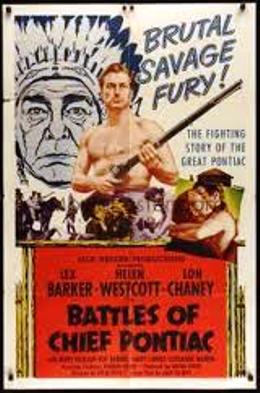
A decade before the start of the American Revolution, the British have managed to force the French out of the Great Lakes region. Fort Detroit has been established to oversee the area and provide protection from the Odawa tribe. Chief Pontiac (Lon Chaney, Jr.) believes that the Odawa and the White Man can live in peace but his beliefs are challenged when the British bring in a brutal German mercenary, Col. von Weber (Berry Kroeger), to patrol the land. After Col. von Weber and his soldiers massacre a village, Pontiac and the Odawa prepare for war.
Lt. Kent McIntire (Lex Barker, who was best known for playing the role of Tarzan in several movies) is a Colonial officer and a scout who is convinced that he can broker a peace between the Odawa and the British. Odawa respects and trusts McIntire but when von Weber tries to wipe the Odawa out by sending them small pox-infected blankets, Pontiac realizes that there can be no peace and he launches an attack on Fort Detroit.
Though hardly a great film, Battles of Chief Pontiac deserves some credit for its sympathetic portrayal of the Odawa People. From the start, the film makes clear that everything that the Pontiac does, he does out of self-defense. Even the most enthusiastic of his warriors, Hawkbill (Larry Chance), is not fighting because he wants to fight but he’s fighting because it is evident that von Weber is not going to leave the Odawa any other choice. Though the small pox-ridden blankets were actually given to a different tribe, just the fact that Battles of Chief Pontiac acknowledges that it happened sets it apart from many other B-movies of the period. Though not a Native American himself, Lon Chaney, Jr. gives a surprisingly dignified performance as Pontiac and he doesn’t allow the character to become a caricature. Again, that alone is enough to set Battles of Chief Pontiac apart from a lot of the other films of the period.
Battles of Chief Pontiac still cheats by laying the blame on the Hessians, the German mercenaries who, historically, were not even present in North America until they were hired by the British during the American Revolution, which happened ten years after Pontiac’s siege of Fort Detroit. Berry Kroeger plays Von Weber as if he was a high-ranking Gestapo officer who somehow found himself in the 18th Century. By making Von Weber the villain, the film lets the British off the hook. The only mistakes that the British officers make in Battles of Chief Pontiac is that they trust a German and fail to listen to the advice of the all-American Lex Barker.
Battles of Chief Pontiac has a narrator who sounds like he would have been better suited for an educational filmstrip about hygiene and its epic ambitions are thwarted by its low-budget. There’s a not very interesting love story between McIntire and a white woman (Helen Westcott) who is being held prisoner by the Odawa. The movie’s intentions go a long way towards making up for the flaws but they can’t do all the work. At least, Barker, Chaney, and Kroeger manage to keep thing interesting.